


Since 1989, nearly 2,600 people in the United States have been exonerated after being wrongly convicted of crimes they did not commit (National Registry of Exonerations Reference Millern.d.).Footnote 1 Scholars have documented the rise in media attention dedicated to this problem and the emergence of an “innocence frame” in the rhetoric surrounding the justice system (Baumgartner, DeBoef, and Boydstun Reference Baumgartner, DeBoef and Boydstun2008; Fan, Keltner, and Wyatt Reference Fan, Keltner and Wyatt2002; Sarat et al. Reference Rudolph and Evans2017). Some have even suggested that we are observing an “innocence movement” in the United States (Baumgartner, DeBoef, and Boydstun Reference Baumgartner, DeBoef and Boydstun2008; Norris Reference Norris, Zalman and Carrano2017). Importantly, policy reforms have been enacted to address wrongful convictions both before and after they occur (e.g., Kent and Carmichael Reference Kahn and Kirk2015; Norris et al. Reference Norris2017). Yet, we have a very limited understanding of the dynamics that lead some states to adopt these policy reforms.
In this paper, we focus on the influence of three covariates in the adoption of wrongful conviction reforms in the American states: public opinion, electoral competition, and innocence group advocacy. Insights gleaned from the dynamic responsiveness literature might prompt the expectation that lawmakers simply adopt wrongful conviction reforms in light of increasingly liberal public opinion (e.g., Caughey and Warshaw Reference Caughey and Warshaw2018; Stimson, MacKuen, and Erikson Reference Squire1995). However, such an expectation fails to appropriately integrate and account for the state political context. We argue that the relationship between public opinion and state policy adoption is nuanced in that it depends on electoral context. As such, we hypothesize that lawmakers are most likely to adjust policy in light of public opinion when they are electorally vulnerable. Furthermore, interest group presence and advocacy are critical to the adoption of wrongful conviction reforms. Innocence organizations may pressure lawmakers directly through lobbying activity, but also exert pressure on lawmakers indirectly by exonerating wrongfully convicted people, thereby generating media coverage and increasing public awareness.
We recognize that wrongful conviction reforms have not been entirely ignored by scholars (e.g., Kent and Carmichael Reference Kahn and Kirk2015; Norris et al. Reference Norris2017; Owens and Griffiths Reference Norris and Mullinix2012). These studies suggest that the presence and activities of innocence groups explain some of the reform efforts, though their evidence is limited. Further, none of them provide compelling evidence that public opinion drives wrongful conviction reforms,Footnote 2 conditional on electoral context or not. We present evidence that innocence group advocacy, electoral context, and public opinion mattered for the adoption of wrongful conviction legislation from 1989 to 2018. In doing so, we bolster the literature on dynamic representation. Perhaps more importantly, though, we establish that electoral context conditions the impact of public opinion, at least in the case of wrongful conviction legislation. Finally, we contribute to the emerging literature on wrongful convictions by establishing the underlying political conditions that make reform more or less likely.
The Political Dynamics of Innocence Legislation
There are strong theoretical reasons to believe that public opinion is an integral part of the adoption of wrongful conviction legislation. Decades of social science research have provided evidence of policy responsiveness to public opinion (see Beyer and Hanni Reference Beyer and Hanni2018 for a recent review). Much of it incorporates the framework of dynamic representation (Erikson, Wright, and McIver Reference Erickson, Wright and McIver1993; Stimson, MacKuen, and Erikson Reference Squire1995; Erikson, MacKuen, and Stimson Reference Erikson, MacKuen and Stimson2002; Caughey and Warshaw Reference Caughey and Warshaw2018). This literature suggests that public opinion shapes policy in one of two ways. First, changes in public opinion can change policy indirectly through the partisan election of new representatives (i.e., replacement). Second, changes in public opinion can change policy directly through adaptation or anticipation among already elected lawmakers. That is, lawmakers adapt policy in light of changing opinions in anticipation of future majorities. Like prior scholars, we think the former is important, but find the latter route more compelling. Applying this to our topic raises questions about public opinion toward wrongful convictions and policies designed to mitigate them.
While media attention to wrongful convictions is a relatively recent phenomenon, previous literature has already demonstrated that the rise of an “innocence frame” was consequential for public opinion toward the death penalty (Baumgartner, DeBoef, and Boydstun Reference Baumgartner, DeBoef and Boydstun2008), and although wrongful convictions are by no means a new problem, many of the policy reforms designed to address them are more contemporary issues. As such, there is little empirical research specifically focused on public attitudes toward policies addressing wrongful convictions. Importantly, while we do not have reason to believe that the issue is extremely polarized, we suspect that public opinion on wrongful conviction policies is, indeed, divided along ideological lines. More specifically, we argue that liberals in the mass public will be more supportive of policy reforms designed to mitigate wrongful convictions (e.g., changes to eye witness and interrogation practices), discover errors (e.g., DNA access laws), and aid the exonerated (e.g., compensation reform) than conservatives. This assumption is justified by several basic ideas.
First, we emphasize that wrongful conviction reforms often require nontrivial changes to the regulations and policies guiding police practices. It is well established that conservatives tend to have a more sanguine perception of police and prosecutors, while liberals tend to be more pessimistic (e.g., Brown and Benedict Reference Brown and Benedict2002). People who have positive feelings toward law enforcement and the justice system may not look favorably on legislation that calls attention to their potential mistakes.
Second, many wrongful conviction policies require additional state funds for implementation. Certainly, financial compensation reform necessitates funds, but policies such as mandatory recording of interrogations may also impose financial costs associated with equipment and data storage, and ideology exerts considerable influence on public attitudes toward government spending across a wide range of issues (e.g., Rudolph and Evans Reference Rogers2005).
Third, while perspectives on criminal justice are not divided strictly along ideological lines, conservatives have been found to be more punitive, concerned with public order and crime control, while liberals often exhibit a stronger due process orientation (Beckett Reference Beckett1997; Gromet and Darley Reference Gromet and Darley2011; Miller Reference McKinley1973; Payne et al. Reference Owens and Griffiths2004).
A fourth, and perhaps less obvious, reason is that media coverage and elite discourse regarding wrongful convictions often highlights the disproportionate risk that disadvantaged groups, like racial and ethnic minorities, face in the criminal justice system (Baumgartner, DeBoef, and Boydstun Reference Baumgartner, DeBoef and Boydstun2008; Byfield Reference Byfield2014; Gross, Possley, and Stephens Reference Gross, Possley and Stephens2017). That is, discussions of wrongful convictions do not occur in a vacuum, but are often entwined with broader issues of racial and economic disparities in the criminal legal system. Racial disparities exist across the criminal legal system, for example, in the rates at which people are stopped by police, sentencing outcomes, and imprisonment (Cole Reference Cole1999; Epp, Maynard-Moody, and Haider-Markel Reference Epp, Maynard-Moody and Haider-Markel2014; Tonry Reference Stimson, MacKuen and Erikson2011). This information is increasingly discussed in the media (e.g., Kahn and Kirk 2015; McKinley Reference Kollman2014) and rhetoric which invokes social group cues can help people structure the issues along ideological lines (Chong and Mullinix Reference Chong and Mullinix2019). If stories of wrongful convictions are discussed alongside issues of race and income, it seems plausible (if not likely) that liberals and conservatives may view policies designed to address the problem through an ideological lens tied to social groups they find more or less sympathetic.
Because wrongful conviction reforms are relatively new, we have little public opinion data on these specific attitudes. In one of the few studies directly focused on wrongful convictions and public attitudes, Norris and Mullinix (Reference Norris, Bonventre, Redlich, Acker and Lowe2019) assessed the extent to which respondents supported police investigatory reforms that might reduce wrongful convictions, but also increase the difficulty of obtaining convictions in general, and found that liberals were significantly more supportive of the reforms than conservatives, while controlling for other explanations.
To further substantiate our argument that beliefs about wrongful convictions are likely divided along ideological lines, we fielded an original survey with a national sample of 691 respondents to test the effect of ideology on support for wrongful convictions reforms. Similar to Norris and Mullinix (Reference Norris, Bonventre, Redlich, Acker and Lowe2019), we assessed support for investigatory reforms as well as support for exoneree compensation. A multivariate regression with a variety of control measures showed that ideology is a significant predictor of support for both police reforms and compensation, such that respondents who were more conservative were less supportive of both reforms than those who were more liberal. The full details of the survey are described in the Appendix and the full results are presented in Appendix Table A1, but suffice it to say that these data show clearly that ideology matters for beliefs about wrongful convictions and related policies.
Collectively, the available evidence leads us to believe that liberals are more supportive of wrongful conviction reforms than conservatives. As such, we might initially expect—other things being equal, including the partisan composition of legislatures—increasingly liberal attitudes among the mass public to increase the number of wrongful conviction reforms a state adopts. This would be consistent with the substantial evidence that policy is often responsive to public opinion, particularly on criminal justice issues (Baumgartner, DeBoef, and Boydstun Reference Baumgartner, DeBoef and Boydstun2008; Enns Reference Enns2016; Nicholson-Crotty, Peterson, and Ramirez 2009).
Unlike much of the prior research, however, we argue that the effect of public opinion on wrongful conviction polices depends on states’ electoral competitiveness. Vulnerable lawmakers or those in relatively more vulnerable chambers likely have a stronger motivation to update policy in light of public opinion. After all, scholars have demonstrated that states’ electoral competitiveness shapes chambers’ behavior and outcomes (e.g., Barrilleaux, Holbrook, and Langer Reference Barrilleaux, Holbrook and Langer2002; Carroll and Eichorst Reference Carroll and Eichorst2013; Hicks Reference Hicks2015). To the extent that this is true, it also may be that lawmakers’ behavior is driven just as much by their perception of being vulnerable as it is by real vulnerability, because there is little evidence that citizens actually reward or punish lawmakers for their voting behavior (Rogers Reference Rogers2017). We hypothesize that public opinion liberalism exerts a positive and strong effect on future wrongful conviction reforms in states with more competitive state legislative elections. In the absence of competitive state legislative elections, we expect a weaker relationship between public opinion and policy.
Additionally, we argue that the presence of innocence organizations shapes the adoption of wrongful conviction-related policies. The Innocence Network is an association of almost 70 organizations around the world, more than 50 of which are in the United States, that work to exonerate innocent prisoners and advocate for criminal justice reforms (Innocence Network Reference Holbrook and Van Dunkn.d.). There are two complementary ways in which we believe group presence matters. First, citizens in states with innocence organizations are more likely to hear about wrongful convictions, as these organizations regularly contribute to the exoneration of wrongfully convicted persons in ways that garner media attention (Norris Reference Norris, Zalman and Carrano2017). Innocence organizations also make an effort to advocate directly with citizens, raising awareness about the prevalence and causes of wrongful convictions. These efforts likely raise public concern with wrongful convictions, which can put pressure on lawmakers to adopt new laws (e.g., Kollman Reference Klarner1998). Second, some innocence organizations also directly advocate in state legislatures (Norris Reference Nicholson-Crotty, Peterson and Ramirez2014, Reference Norris, Zalman and Carrano2017). By both shaping public concern for wrongful convictions and directly lobbying with lawmakers, we believe states with more innocence organizations are more likely to adopt wrongful conviction reforms.
Empirical Strategy
Wrongful Conviction Reforms
To measure wrongful conviction reforms, we identify a set of policies designed to mitigate the chances of wrongful convictions, discover errors, or provide redress in their wake. Of course, we are not the only scholars interested such reforms. Like Kent and Carmichael (Reference Kahn and Kirk2015), our measure of wrongful conviction reforms includes five distinct policies that are prioritized and tracked by The Innocence Project, the largest and most well-known innocence organization in the United States. These include: (1) changes to eyewitness identification practices that are in line with research-based best practices, (2) mandatory recording of criminal interrogations, (3) laws governing the preservation of biological evidence such as DNA, (4) laws that grant convicted persons access to postconviction DNA testing, and (5) laws providing compensation and other reentry services to exonerees. We measure when and where these reforms were adopted between 1989—the year of the first DNA exoneration in the United States and the starting year for the largest database of known exonerations (National Registry of Exonerations Reference Millern.d.)—and 2018.
These reforms are empirically useful for a few reasons. First, the Innocence Project advocates for these reforms, which includes direct lobbying efforts (Innocence Project n.d.; Norris Reference Norris, Zalman and Carrano2017). If the presence of Innocence Network organizations, of which the Innocence Project is the largest and most influential, generally matter, we would likely find evidence by way of these laws. Second, these reforms are wide-ranging because they address issues in distinct areas that could lead to wrongful convictions (eyewitness identification, interrogations, and forensics), aid in the discovery of errors (evidence preservation and DNA access), and provide reentry assistance (compensation statutes). Third, these reforms have been supported by both advocates and scholars as ways to alleviate the harms associated with wrongful convictions, though they certainly would not fully eliminate them. Finally, since 1989, there has been a lot of variation with respect to these reforms. In 1989, forty states had adopted none of these reforms, while the other ten states had adopted only one. By 2018, every state had adopted a policy in at least one of these areas, and eleven states had adopted reforms across all five areas.
Estimation
Our goal is to figure out the conditions that encourage governments to adopt these reforms. Toward this end, we developed several complementary statistical models that serve this purpose. Our central dependent variable represents a count, in each year and state, the number of reforms the government has adopted (0–5). Of course, clustered, time-varying data such as these are complicated to model. Our approach is to analyze these data using growth curve models, which provide tremendous flexibility in how we account for serial correlation. For example, we fit a random intercept to each state (i.e., years are nested within states) and model temporal dependence directly with polynomials for time (measured as a yearly counter). We also used lagged versions of independent variables, where appropriate, to ensure their values precede in time those of the dependent variable.
Although we only present our findings from multilevel models, we experimented with several alternatives. For example, we explored a few different duration/survival models. Our exploration of survival models took us down two separate roads. On the on the one hand, we disaggregated, so to speak, our dependent variable and looked at discrete survival models fit to each of our five laws. Such models allow us to investigate the probability as state adopts a specific policy, provided it has not already done so. While we found mixed results with these models,Footnote 3 our biggest concern with their use is conceptual. We think of state adoptions of a single reform fails to capture governments’ commitment to wrongful conviction reform. In other words, we think that a count of all the laws captures something more than a series of binary logits would otherwise indicate.
For this reason, we also explored survival models that allow for repeated, multiple, or competing events. One example is Andersen and Gill’s (Reference Andersen and Gill1982) counting process estimator (see also Andersen et al. Reference Andersen, Borgan, Gill and Keiding2012). This model allows us to evaluate the number of events that occur, in no particular order, over a specified period of time. We preferred such a model conceptually to alternatives like so-called marginal or conditional models, which concern the likelihood an event or events occur in certain sequences or in light of other events. All of the models we used for repeated, multiple, or competing events allow minimal capabilities for including time-varying covariates. Although we find some support for our expectations with these models, their failure to flexibly allow for time-varying covariates makes them problematic for our purposes.
A final issue we face in our estimation strategy is deciding the most appropriate method to estimate the residual error-covariance matrix. Of course, we assume our data are correlated over time—that is, Alabama’s residuals in time t are related to Alabama’s residuals in time t − 1. However, the nature of this correlation forces us to choose between alternatives with an eye toward efficiency. One alternative to a simple varying intercepts model with fixed effects for time is to also fit an AR1 (autoregressive error structure to the order of 1-year) error-covariance matrix.Footnote 4 This approach allows us to capture the correlation between the outcome in year t and its value in t − 1. A second alternative is a random coefficients model that allows the effect of time to vary between the states randomly. Perhaps the rate of change is quicker or slower randomly from state to state. Most importantly for our purposes, are our findings subject to one set of assumptions or another?
We present these two alternative approaches to modeling these data in Appendix Table A2. The findings reveal that the value of the outcome for state i in year t is correlated with its value in t − 1 given the estimate of the rho parameter (0.866). The random coefficients model similarly reveals evidence that the effect of time is likely not uniform across the states. Furthermore, standard likelihood ratio tests reveal the same conclusions comparing the AR1 model (p < 0.01) and random coefficients model (p < 0.01) to the basic varying intercepts model. That said, these more complicated alternatives do not change our conclusions regarding public opinion, electoral competition, and innocence group advocacy. Our findings are remarkably stable across these different specifications. For these reasons, we present the most efficient models below—simple varying intercepts growth curve models with fixed effects fit for time—and report alternatives in the Appendix.
Covariates
Our investigation of state wrongful conviction reforms centers on three crucial variables: public opinion, electoral competition, and the presence of innocence organizations. To the extent that these things matter, we should find evidence in the experience of policy adoptions across the states and over time, at least since 1989; again, the year of the first DNA-based exonerations and thus the earliest year of data collection on known exonerations.
To measure the presence of innocence groups, we started by looking at the current listing of all Innocence Network member organizations, available on the Innocence Network website, which not only identifies each member organization, but also their geographic location. Working backward from this list, we sought out the founding date for each organization. In most cases, this information was accessed by looking at websites for specific member organizations. In a small number of cases, though, this information was much more difficult to uncover. If the information was not available on an organization’s webpage, we would seek out the founding date by calling the organization and, in some cases, looking through media accounts of the organization. We were ultimately successful in finding the founding date of every current member organization.
There are a couple things we should note about these data. First, the Innocence Network was created in 2005. This means that, for many organizations, their founding occurred prior to the formalization of the international network. This is irrelevant, however, because our concern—our hypothesis—is that the presence of local innocence organizations shapes reform, not the activity of the network. Why this is relevant is because it is possible that we missed some organizations. If an organization lost its funding or, for whatever reason, disbanded before the formalization of the network, our data collection effort likely missed it.
Second, we use the founding date of innocence organizations to create a state level variable. Our state level variable is simply the number of innocence organizations in each state/year from 1989 to 2018. If in 1999 a state had no organization that we know of, it is coded as a 0; if there were three organizations, it is coded as a 3. We want to give more weight to states and years that have more organizations, and this strategy satisfies this objective. However, it may miss other critical information about these organizations, like their size, staff, and funding. Our assumption is that these errors are only likely to lead to an underestimate of the variable’s effect, however.
To capture public opinion, we use Caughey and Warshaw’s (Reference Caughey and Warshaw2018) public opinion liberalism measures. Caughey and Warshaw estimate public opinion liberalism on social and economic policy for each state from 1936 to 2014 using annual group-level (e.g., state, race, and urban residence) item response models. They fit their models to more than a thousand polls, and it incorporates hundreds of domestic policy questions. We specifically use their social policy public opinion measure because, theoretically, we think this makes the most sense as a catalyst for change with respect to criminal justice reform. Caughey and Warshaw’s research reveals that mass social policy liberalism exerts a stronger influence on policy making than economic liberalism because (1) state governments typically have more control over social policies, (2) citizens typically have stronger and more stable opinions on social policy, and (3) citizens’ attitudes on social policies, given their relatively simpler technical complexity, are easier for politicians to infer (see, e.g, Caughey and Warshaw Reference Caughey and Warshaw2018, 252).
Because the measure spans all 50 states, in each year until 2014, we had to manage missing values for 2015, 2016, and 2017. Rather than throwing those years out, or simply using 2014 values for each of the remaining years, we forecasted public opinion values with a longitudinal model.Footnote 5 Of course, we also checked our findings against models that stop in 2015, and ones in which we carry forward constant 2014 values through 2017. Neither changed our substantive conclusions.
We chose Caughey and Warshaw’s measure for two reasons. First, we prefer a measure of public opinion that captures citizens’ general attitudes across topics rather than on specific policies or issues. We conceive of the effect of public opinion on policy in the vein of “rational anticipation” (e.g., Stimson, Mackuen, and Erikson Reference Squire1995). Our theoretical assumptions, then, make it hard to believe lawmakers have a strong sense, if any at all, of public opinion on wrongful convictions or these specific reforms. However, we assume lawmakers do have a fairly strong sense of citizens’ attitudes overall. Second, we sought a measure that captures as accurately as possible annual movements in public opinion. Caughey and Warshaw’s annual estimates are useful for such dynamic processes.
On the 2007 polls alone that Caughey and Warshaw use to measure social policy liberalism they include survey questions measuring citizen opinions on the death penalty, immigration, gun control (i.e., assault weapons ban), same-sex marriage, stem cell research and abortion (see Caughey and Warshaw Reference Caughey and Warshaw2018). They bridge these policy questions with ones asked with similar wording in different years and with different samples. It is our contention that politicians make decisions on wrongful conviction reforms in light of trending opinion on issues like these because they provide insight into how the public might respond to changes in the criminal justice system generally.
Finally, we measure states’ electoral competitiveness using the results of state legislative elections from 1986 to 2016 (Klarner Reference Kingdon2018). We specifically use a Holbrook and Dunk (Reference Hicks1993)-like index of electoral competitiveness. Our index includes and equally weights, for a given election year, the average margin of victory for contested seats,Footnote 6 the percentage of safe elections (“safe” meaning a margin of victory equal to or greater than 10 percentage points), and the percentage of uncontested elections across all state legislative seats. We take the average of these three values and subtract them from 100 so that higher values imply more electoral competition for legislative seats. Given the number, nature, and nonuniform distribution of uncontested elections in state legislatures, such an index is much preferable to simple margin-of-victory-style measures.
Control Variables
Our models include two additional political characteristics about the states: citizens’ party identification and the partisan control of governments. For the former, we use Caughey and Warshaw’s (Reference Caughey and Warshaw2018) estimates for the share of each state’s population that identifies with the Democratic Party, in each year from 1988 to 2017.Footnote 7 For the latter, we include three variables: Democratic margin of control in state houses (i.e., the percentage of Democrats minus the percentage of Republicans), Democratic margin of control in state senates, and a dummy variable indicating state/years with Democratic governors.Footnote 8 Our theoretical assumption here is that among both citizens and elites, wrongful conviction reforms operate like a wedge issue. Most Democrats support their passage, but Republicans are cross-pressured given the fact that such reforms by their nature are critical of the criminal justice system, including law enforcement.
Our models also account for institutional difference between state legislatures. We use, in particular, control variables for legislative professionalism and whether or not legislators are subject to term limits. We use the Squire index to measure professionalism (Squire Reference Sarat, Kermes, Cambra, Curran, Kiley and Pant2007; Squire Reference Squire2017).Footnote 9 Professional legislatures may have larger capacities to discover, manage, and reform policy problems (e.g., Epp Reference Epp2018) like wrongful convictions. We measure term limits with a simple binary variable, coded 1 for a state legislature that has adopted and implemented term limits, 0 otherwise. By increasing turnover, term limits may enhance the power of governors, bureaucratic agencies, and interest groups over the legislature (e.g., Carey et al. Reference Carey, Niemi, Powell and Moncrief2006). Such changes may make it easier for external actors like these to push reforms through the policymaking branch, thereby enhancing legislative efficiency (Hicks Reference Hicks2015).
Our models also include two additional characteristics about states’ criminal justice systems. First, we include a measure of the number of exonerations a state has experienced. We derived these data from the National Registry of Exonerations (Reference Millern.d.). Founded in 2012, the NRE maintains a list of all known exonerations in the United States since 1989, the largest collection of its kind. This variable is both critical and tricky for the same reason: exonerations are highly correlated with the presence of innocence organizations. We want to control for this variable because it is possible that lawmakers pursue reform in light of exonerations rather than the presence of an innocence organization. An additional tricky aspect of exonerations is that, for states with innocence organizations, they are highly variable over time. We measure death penalty exonerations specifically using a one-sided moving average that only includes data up to and prior to a particular date.Footnote 10 It specifically gives more weight to more recent exonerations, but still allows past exonerations to exert some effect.
Our models also include a measure for states’ violent crime rate, using estimates from the FBI’s Uniform Crime Report.Footnote 11 We expect the violent crime rate to have a negative effect on wrongful conviction reforms. That is, higher violent crime rates may motivate lawmakers to prefer a more punitive set of criminal justice policies, other things being equal, while lower violent crime rates make wrongful conviction reforms more attractive.
Finally, we include a set of variables that capture states’ racial composition and citizens’ economic situation. We derived our data from Census estimates via IPUMS USA.Footnote 12 Our Census data include decennial estimates from 1980, 1990, 2000, and 2010. We add additional yearly variation between 2000 and 2010, and after 2010 using the Census Bureau’s American Community Survey. State values are constant between 1990 and 2000, though, and 1988 and 1989. Our findings did not change when using interpolated values during the 1990s. The variables we include are the percentage of states’ population that are black and Hispanic, and states’ median household income (adjusted to 2016 dollars).
Findings
We present our findings in Table 1. This table presents two mixed-effects, growth curve models. These models fit variance components to each state, and model time directly with polynomials for yearly counters (0–29). Our dependent variable represents from 0 to 5 the number of wrongful conviction reforms a state has adopted in a particular year. With respect to the pooled dataset, this variable has a surprisingly normal distribution. Even so, we were encouraged to check our results with a slightly less efficient model, a mixed-effect ordered logit, because our outcome has a ceiling and a floor, and is measured in discrete levels. Our substantive conclusions are very similar across the two models. For this reason, we mostly interpret the simpler of the two models.
Wrongful conviction reform in the states

Note. Dependent variable represents count (0,5) of wrongful conviction reforms adopted in each state 1989–2018. First column represents a mixed effects model with variance component fit to states, second represents a mixed effects ologit (cutpoints suppressed for space). “L1” represents variables whose values are lagged 1-year. Electoral competitiveness is most recent, prior election.
* 0.1;
** 0.05;
*** 0.01.
In Table 1, we use “L1” to represent covariates whose values have been lagged by a year. Electoral competitiveness uses information from the most recent, prior election. So, for example, a state’s value in 2015 and 2016 is actually based on election results from 2014 (aside from the handful of states who hold elections in odd-years). We do not lag values for the measurements of state governments’ partisan composition. A state’s value in 2016 represents the partisan composition of the state legislature and governor’s office for people who are in government that year. That being said, for most states that value is the same as it was for 2015.
With respect to our central covariates, we find some support for our expectations. Both models reveal a positive and significant effect for the presence of innocence organizations on wrongful conviction reforms. At its most extreme, a shift of this variable from its minimum to its maximum in year t, 0–4, increases a state’s number of reforms by 0.84 in year t + 1—nearly one new reform. Controlling for other things, states with more innocence organizations adopt more wrongful conviction reforms.
We also find support for our expectations with respect to the interaction between electoral competition and public opinion liberalism (mixed effects, p < 0.01; ordered choice, p < 0.08). This suggests that the effect of public opinion on wrongful conviction reforms depends on states’ electoral competitiveness (and vice versa). We note that the main effect for public opinion liberalism reveals a negative effect on wrongful conviction reforms in states with nonexistent electoral competition for legislative seats. The main effect for electoral competition reveals it has a negative and statistically insignificant effect on wrongful convictions in states with somewhat moderate policy attitudes. Yet, these main effects are misleading and mask the underlying dynamics of policy responsiveness in this context, as the effects of public opinion liberalism are contingent the vulnerability of state lawmakers. This is the crux of our theoretical argument.
To gain better purchase on the nature of these interaction effects, we generate two plots. Figure 1 presents the simple slope (or marginal effect) of public opinion liberalism on wrongful conviction reforms conditional on states’ electoral competitiveness. The vertical bars represent the 95% confidence interval. This plot reveals that, in state/years with unusually high electoral competition, a shift in public opinion liberalism from its minimum to maximum could increase the number of reforms by more than 1.6 the following year.Footnote 13 A shift in public opinion liberalism of 1 standard deviation in this situation produces a shift of 0.277 reforms. Figure 1 also reveals that a shift in public opinion liberalism could reduce wrongful conviction reforms in states with very little electoral competition. Electoral competition in our dataset has a mean value of 52.21, and a standard deviation of 9.44. This plot shows that public opinion exerts a negative and significant effect in situations where electoral competition is lower than average. It also illustrates that public opinion exerts a positive and significant effect in situations where competition for legislative seats is higher than average.
Public opinion liberalism and wrongful conviction reforms.

This finding supports our theoretical expectations: public opinion drives reform insofar as lawmakers are electorally vulnerable. What do we make of this negative effect with lower than average electoral competition, though? This finding is also consistent with our theoretical expectations. Our data contain a variety of cases in which public opinion trended liberal over the time period. We can further divide these liberal trending cases into three groups—state/years with lower than usual electoral competition, state/years with average electoral competition, and state/years with higher than average electoral competition. Our findings indicate that in state/years with higher than average competition for legislative seats, the overwhelming trend over time is more wrongful conviction reforms, other things being equal. In state/years with average electoral competition we find a mixture of wrongful conviction reforms; some states adopt them and others do not. In state/years with lower than average electoral competition, on the other hand, the overwhelming trend is no wrongful conviction reforms. In effect this finding reveals that the gap between public opinion and policy outcomes grows in situations with very little electoral competition, at least in terms of wrongful conviction legislation.
Figure 2 presents the simple slope of electoral competition conditional on public opinion liberalism. This plot shows that in states with very liberal public opinion, electoral competition exerts a strong and positive effect on wrongful convictions. In the most liberal state, a shift of this variable from its theoretical minimum to maximum would produce an increase of 4 out of 5 total reforms. Of course, shifting electoral competition from its observed minimum and maximum produces a more modest, though still notable, increase of 2.6 reforms.Footnote 14 On the other hand, the plot reveals that electoral competition has an insignificant effect on wrongful convictions in states with conservative to moderate public opinion.
Electoral competition and wrongful conviction reforms.

Finally, Figure 3 explores the effect of time on wrongful conviction reforms. Again, the vertical bars represent 95% confidence intervals and, in this case, other variables are set at their mean values. This plot demonstrates a few notable facts. First, since 1989, controlling for other variables, most states have doubled the number of wrongful conviction reforms. Second, most of the variation in wrongful conviction reforms occurred between 2001 and 2012. Indeed, the plot shows that there was very little variation in these policies prior to 2000. Finally, the plot demonstrates that the effect of time on wrongful conviction adoptions resembles an S-shaped curve. This may reveal a policy diffusion process that operates similarly to punctuated equilibrium (Baumgartner and Jones Reference Baumgartner and Jones2009; Rogers Reference Payne, Gainey, Triplett and Danner2003). Public policy scholars have often discussed the importance of “policy windows” for agenda-setting (e.g. Kingdon Reference Kent and Carmichael2011; also see Herweg, Zahariadis, and Zohlnhofer Reference Herweg, Zahariadis, Zohlnhofer, Weible and Sabatier2018 for a review), and punctuated equilibrium can be used to understand how various dynamics lead to policy windows and policy change (Epp Reference Epp2018). We strongly encourage future research to investigate whether the rate of change reveals any additional dynamics at play (e.g., Boushey Reference Boushey2012).
The effect of time on wrongful conviction reforms.

Our models also reveal some interesting findings with respect to our control variables. For example, we find some support that other political variables matter. Across both models, the gubernatorial party matters, with new reforms more likely in states with Democratic governors. We also find that the larger the Democratic coalition in state senates, the more reforms states are likely to adopt. However, our findings are mixed with respect to citizens’ partisanship and the partisan composition of state houses. We find mixed evidence that term limits matter. While the ordered choice model reveals a significant and positive effect—wrongful conviction reforms are marginally more likely to be adopted in states whose legislatures have adopted and implemented term limits—we fail to find persuasive evidence in the first model of the same. Finally, we find no evidence that legislative professionalism shapes the adoption of wrongful conviction reforms.
We fail to find evidence that death penalty exonerations shape the adoption of these reforms. This variable is in the “right” direction—more exonerations in year t produce more reforms in year t + 1—but it is neither strong nor statistically significant. On the other hand, we find evidence that the violent crime rate matters. The higher the violent crime rate in year t, other things being equal, the lower the number of reforms in year t + 1.
Finally, there are mixed results with respect to our demographic controls. We are unable to find evidence that states’ racial composition matters. We do find evidence that states’ economic situations play a role in wrongful conviction reforms. Median household income in year t shapes the number of reforms in year t + 1. In fact, shifting this variable from its observed minimum to maximum increases the number of wrongful conviction reforms by over 2.
Taken together, political variables appear to be the main drivers of wrongful conviction policy adoption in the American states. Advocacy groups, Democratic governors, and the size of Democratic coalitions are consequential for the adoption of reforms. Beyond these factors, policy is responsive to public opinion, but the effects are contingent on the electoral vulnerability of state lawmakers. In short, political context matters a great deal.
Conclusion
Grounding our argument in the framework of dynamic responsiveness, we find evidence that public opinion liberalism shapes the adoption of wrongful conviction reforms. We refine this point by providing evidence that, on this issue at least, the effect of public opinion is conditional on states’ electoral context. Public opinion increases the likelihood of the adoption of wrongful convictions only in state-years with relatively competitive elections. Otherwise, we find that public opinion liberalism exerts a negative effect on wrongful conviction reform. Yet, this main effect obfuscates the underlying dynamics. To truly grasp policy responsiveness to public opinion, it is imperative to account for the political and electoral environment.
We also find evidence that, net of death penalty exonerations, the presence of innocence organizations influences wrongful conviction reforms. We reason that innocence organization presence matters in two ways. First, innocence groups contribute to greater levels of citizen awareness of and knowledge about wrongful convictions in the states in which those organizations reside. This happens indirectly through the media coverage of exonerations these groups secure, and through advocacy campaigns these groups engage in with respect to citizens. Second, innocence groups also may directly lobby legislatures, and we assume these lobbying efforts shape the adoption of policy on the margins. As such, our study substantially enhances our understanding of the effects of innocence advocacy, and thus of the “innocence movement.”
We encourage future researchers to engage with our findings in a few ways. First, future scholars should evaluate the extent to which the effect of public opinion on public policy is, in fact, conditional on electoral context. This would likely require testing this idea against a broader set of issues and outcomes, and perhaps more comprehensive policy indices. Second, future scholars should investigate alternative measurement strategies with respect to the presence and activity of innocence groups. Our measure, which is quite blunt, likely underestimates the effect these groups have on wrongful conviction reform. Notably, it does not allow us to disentangle direct and indirect efforts and how they may shape reform. Our study establishes that innocence group presence matters, but future scholars should unpack the lobbying mechanisms through which this influence most effectively occurs. Finally, a potentially fruitful extension of the current endeavor would be to explore the ways in which innocence policy reforms are discussed and framed by media, advocacy groups, and lawmakers, and then isolate and test for the most persuasive ways of communicating information about the policy reforms.
Data Availability Statement
Replication materials are available on UNC Dataverse at https://doi.org/10.15139/S3/RO9FZS.
Funding Statement
The authors received no financial support with respect to the research, authorship, and/or publication of this article.
Conflict of Interest
The authors declared no potential conflicts of interest with respect to the research, authorship, and/or publication of this article.
Author Biographies
William D. Hicks is an Associate Professor of Political Science at Appalachian State University. His research focuses on American political institutions, elections and election laws, criminal justice policy, and quantitative methodology. Kevin J. Mullinix is an Assistant Professor in the Department of Political Science at the University of Kansas. His research concentrates on public opinion, political communication, and public policy. Robert J. Norris is an Assistant Professor in the Department of Criminology, Law, and Society at George Mason University. His research focuses on wrongful convictions, criminal legal reform, and public opinion on the justice system.
Appendix A
Original Survey Data
We contracted with Dynata to implement an online survey from January 24 to January 27, 2020. Dynata maintains an opt-in panel of survey respondents and draws national samples using algorithms and quotas so that the sample matches several characteristics of the U.S. adult population. Our national sample included 691 respondents with the following demographic characteristics: 53.46% female; 63.54% non-Hispanic white and 15.27% non-Hispanic black; 34.01% liberal and 30.4% conservative; mean age of 45.86. The median education level was an associate’s degree and the median income category was $50–59k.
We had two main dependent variables gauging wrongful conviction policy reform support. First, we used a measure similar to Norris and Mullinix (Reference Norris, Bonventre, Redlich, Acker and Lowe2019) with a minor edit to add in the word “accurate.” We asked:
Research suggests that reforms to police investigation practices, such as eyewitness procedures and interrogations, may reduce the likelihood of wrongful convictions. However, they may also increase the difficulty of obtaining accurate convictions. To what extent do you support or oppose these types of police reforms?
We added a second question focused directly on compensation for exonerees, which stated:
People who are wrongfully convicted for crimes they did not commit face many challenges when released from prison. Research shows that compensation laws that provide money and services for people when they are released can help them reintegrate into society. However, they may cost the states a significant amount of money. To what extent do you support or oppose these types of policies?”
For each question, there were seven response options that ranged from strongly oppose to strongly support.
Our main independent variable was a standard 7-point measure of self-reported political ideology that ranged from extremely liberal to extremely conservative. To ensure that any observed relationship between ideology and support for reforms was robust, we performed multivariate regression with controls for gender, education, age, income, race, political interest, concern about victimization, the degree to which they felt safe in their neighborhood, negative experiences with police, trust in the justice system, and trust in police. The full results of our regression model are presented in Appendix Table A1.
Support for wrongful conviction policy reform

Note. Coefficients are based on OLS regression models. Positive coefficients reflect “more support.” Ideology ranges from 1 (extremely liberal) to 7 (extremely conservative). The baseline category for race is non-Hispanic white.
Robust standard errors in parentheses.
Two-tailed tests of significance: ***p < 0.01, **p < 0.05, *p < 0.1.
Main Analyses: Alternative Estimation Strategies
Comparing alternate residual error-covariance matrices
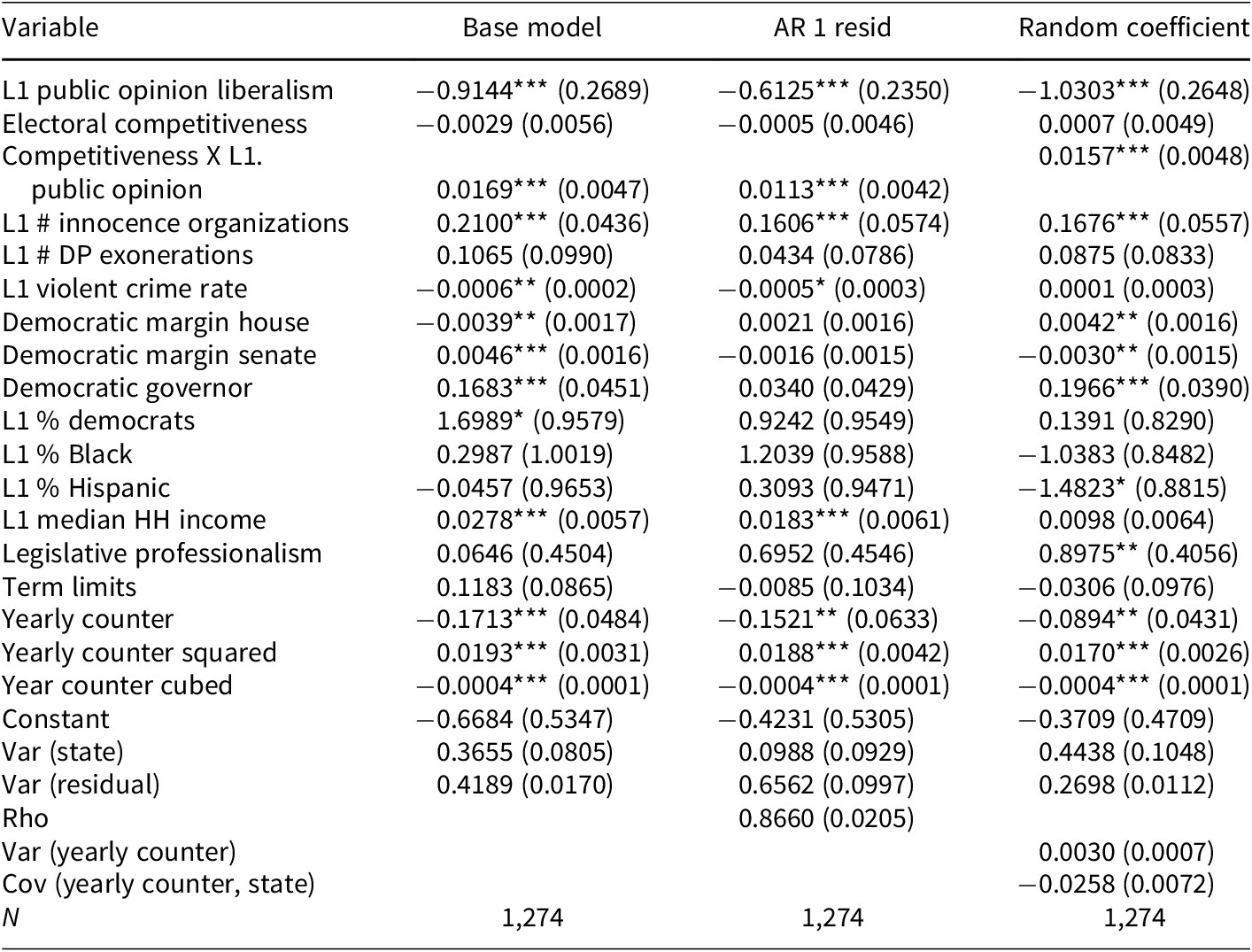
Note. Dependent variable represents count (0,5) of wrongful conviction reforms adopted in each state 1989−2018. First column represents a mixed effects model with variance component fit to states, second represents a mixed effects model with an autoregressive structure to the order of 1-year (AR1) fit to the residual error matrix, and the third column represents a mixed effects model with a random coefficient fit to the effect of time. “L1” represents variables whose values are lagged 1-year. Electoral competitiveness is most recent, prior election. *0.1; **0.05; ***0.01.



