Introduction
The search for higher temperature superconductors is a tough business. It has been largely carried out by a small segment of the superconducting materials community whose struggles are legendary. The last time there was a broad, concerted effort to search for higher temperature superconductors was in the decade following the development of the BCS (Bardeen-Cooper-Schrieffer) theory in the late 1950s. Many interesting theoretical suggestions (including new mechanisms) were put forth at that time, which in turn motivated various experimental searches. These ideas had a large and lasting impact on condensed matter physics. Alas, no really higher T c materials were discovered.Reference Rogalla and Kes1
Recently, however, there has been renewed interest in the search for higher temperature superconductors, as evidenced by the results of two workshops: “The Road to Room Temperature Superconductivity” organized by the U.S. Air Force Office of Scientific Research, and a workshop sponsored by the U.S. Department of Energy that led to the report, “Basic Research Needs in Superconductivity.”2 Based on these meetings, both agencies introduced new programs explicitly aimed (wholly or in part) at the search for higher temperature superconductors.
There are several driving motivations for these developments:
• The strong sense in the superconducting materials community that the proliferation of higher temperature superconductors in recent decades demonstrates great opportunity and researchers should search broadly.
• The developing understanding of the high-critical-temperature cuprate and Fe-based superconductors, although still incomplete, can usefully guide searches for higher temperature superconductors in related materials. Even for conventional superconductors that depend on the electron-phonon interaction, some would argue that the theory and associated computational tools are well-enough developed that materials by design (or at least specific computationally derived guidance) in the search for higher transition temperatures may be possible.
• The simplification of cryogenic refrigeration afforded by high-temperature superconductors significantly increases the likelihood of their adoption in practice.
• A documented need (e.g., in the DOE report mentioned previously) for a new high-temperature superconductor if there are to be electric power applications of superconductivity operating above liquid nitrogen temperatures.
Much has been said about the first three points. The fourth has received less attention and is the focus of this article. We discuss the ways in which the present high transition temperature cuprate superconductors are inadequate for electric power applications above liquid nitrogen temperatures and why. Going down this path uncovers a seemingly fundamental competition between the material characteristics needed for a high-temperature superconductor to be useful and those believed to be favorable for high transition temperatures in and of themselves.
Limitations of the cuprate superconductors
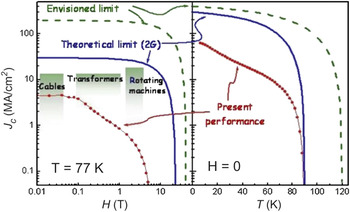
The limitations of YBCO (yttrium barium copper oxide) for power applications were examined in the DOE report mentioned earlier, see Figure 1. The figure compares the present performance of practical YBCO conductors at 77 K (dotted red curves) with the fundamental theoretical limit to the critical current density (blue curves) at the same temperature. The green boxes indicate the operating parameter range needed for various classes of electric power applications.
Comparison of the present performance of the so-called second generation (2G) conductor made from yttrium barium copper oxide (YBCO) operating at 77 K (left panel) along with the requirements of various electric power applications and with fundamental physical limits. The figure demonstrates that if power applications are to be possible above liquid nitrogen temperatures, a new third generation (3G) high-temperature superconductor will be required. Figure courtesy of U.S. DOE.

There is an important message in Figure 1. First, except for power transmission line applications (cables), present YBCO conductors lack sufficient maximal theoretical critical current density at the required magnetic fields to be useful at 77 K or higher. Of course, they are useful for electric power applications at lower temperatures. Moreover, there are other high-current applications of superconductors of interest (e.g., magnets for magnetic resonance imaging) where YBCO (and perhaps even MgB2) are suitable. Hence there is plenty of reason to maximize the performance of YBCO at these lower temperatures. This point is cogently argued in the companion article in this issue by Malozemoff. Also, Gurevich has discussed, equally cogently, some of the physical issues associated with improving the known superconductors.Reference Gurevich3 Still, at 77 K, the needed current densities J c for the three application classes shown are just below the theoretical limit. Even the most highly developed commercial low T c superconducting conductors (NbTi alloys and Nb3Sn) do not achieve critical current densities more than roughly a factor of 10 below their fundamental limits. The message is that if operating temperatures above liquid nitrogen temperature are to be possible for electric power applications, a new high-temperature superconductor will be required. Parameterization of this need is notionally indicated by the dashed green curve in Figure 1.
Origins of these limitations
What determines the theoretical limit to J c? The physics is straightforward.Reference Tinkham4 Any supercurrent J s has an associated kinetic energy density due to the motion of the paired electrons

where m * is the pair mass, e * = 2e is the pair charge, v s is the pair velocity, and  is the density of Cooper pairs. This relation defines the kinetic inductivity
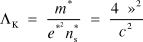
of the superconductor. The last equality follows because λ2 depends only on  (more precisely
 ).
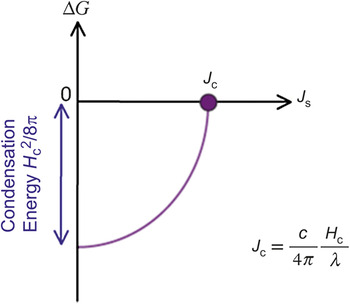
Returning to the energy associated with J s, when this kinetic energy density equals the superconducting condensation energy  , the normal state is favored thermodynamically over the superconducting state. Here, H c is the bulk thermodynamic critical field of the superconductor. This situation is illustrated in Figure 2.
The fundamental thermodynamic current density limit J c of a superconductor occurs when the Gibbs free energy G no longer favors the superconductor. As the supercurrent density J s increases, its associated kinetic energy density increases, ultimately exceeding the condensation energy density of the superconductor at J c. H c is the critical field, λ is the penetration depth, and c is the speed of light.

A more precise calculation of the theoretical limit, including the reduction in pair density in the presence of a current (so-called pair breaking), can be obtained from the Ginzburg-Landau (GL) theory.Reference Tinkham4 The result is

where ξ is the GL coherence length, v F is the Fermi velocity, and in the second near-equality, the relation  has been used. (This relation for ξ derives from BCS theory but is known now to be of general applicability.) Hence we see that
 should increase as T c increases. Indeed, for the elemental superconductors,
 is found to be proportional to T c. YBCO, on the other hand, has a zero-temperature in-plane
 that is considerably less than that of Nb, in spite of its higher T c. The reason for this is the much lower pair density in YBCO. Thus, it does not follow that just finding a higher T c superconductor will revolutionize power applications. It must also have sufficient pair density.
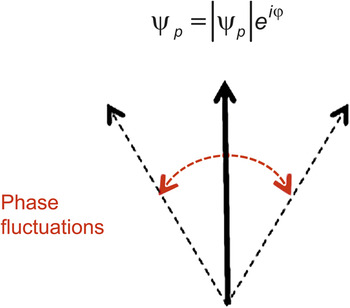
But the problem with low pair density superconductors is not limited to  . The transition temperature may be affected as well. The physics here is also simple.Reference Carlson, Emery, Kivelson and Orgad5 As the temperature of a superconductor increases, so do thermal fluctuations of the superconducting macroscopic quantum pair wave function Ψp. Of particular importance are phase fluctuations, as illustrated in Figure 3. Even if the amplitude of the wave function |Ψp| is rigid (i.e., there is a fixed, finite pair density
 ), thermal phase fluctuations can destroy the phase coherence of the superconductor and hence the property of zero resistance even though bound pairs continue to exist. The magnitude of these phase fluctuations is governed by the absolute temperature T and the magnitude of the phase stiffness (i.e., how hard it is to twist the phase in space), which is the reciprocal, 1/ΛK, of the kinetic inductivity defined previously.
Phase fluctuations of the superconducting pair wave function at a given point in space are illustrated. Phase coherence is lost when the phase fluctuations between two nearby points, roughly the size of a Cooper pair apart, get too large.

This idea can be quantified roughly as discussed by Carlson et al.Reference Carlson, Emery, Kivelson and Orgad5 They estimated the temperature T φ at which phase fluctuations are sufficient to cause a phase difference of π across a Cooper pair, enough to destroy overall phase coherence. These authors considered a two-dimensional superconductor, but a straightforward generalization of their results to a quasi-two-dimensional (i.e., anisotropic) superconductor yields the following expression for T φ:
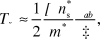
where ξab is the in-plane GL coherence length (essentially, the size of a Cooper pair). The anisotropy  is the effective mass parameter in the anisotropic GL theory and is a measure of the relative strength of the superconductivity along the planes compared to perpendicular to the planes in a quasi-two-dimensional superconductor. If we allow for preformed pairs to form at a higher temperature T p, one is led to the important result that T p and T φ need not be the same (as they are in the conventional BCS theory of low-temperature superconductors). Under this circumstance, the actual transition temperature T c where zero resistance arises, is given by the lower of the two:

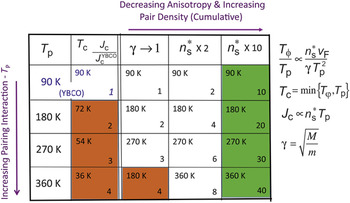
Do these considerations rule out a room-temperature superconductor? Fortunately not, but some combination of lower anisotropy and higher pair density will be necessary. This is shown in Figure 4, where the performance of various notional higher temperature superconductors is compared with YBCO (in blue). The scaling relations used to derive the matrix are shown on the right and follow from Equation 4. Moving down the matrix corresponds to increasing the pairing energy scale (T p), and to the right, progressively decreasing the anisotropy (γ) and increasing the pair density, again relative to YBCO. The resultant transition temperature T c is shown in the upper left corner of each block in the matrix, and the ratio of the theoretical critical current density to that of YBCO  in the lower right. For example, if T p were increased relative to YBCO with no change in the anisotropy or pair density (moving down the first two columns), the coherence length ξ decreases and consequently T c decreases due to increasing phase fluctuations. (Note that T φ/T p = 1.6 for YBCO and therefore T c = T p, the lower temperature of the pair). The negative effect of phase fluctuations is mitigated as the anisotropy is reduced and the pair density is increased, as seen in the entries in the matrix to the right of the double line. The actual numbers here are at best approximate, but the trends should be valid. Also note that the notional superconductor in the lower right corner of the matrix has a transition temperature of 360 K and a theoretical limit of its critical current density 40 times that of YBCO—an impressive superconductor indeed.
The need for decreased anisotropy and increased pair density n s* to achieve critical temperatures T c much higher than the 90 K of yttrium barium copper oxide (YBCO) (blue) is demonstrated. Moving down the rows corresponds to increasing the pairing interaction T p. Moving across the columns corresponds to decreasing γ and then increasing n s*. The resulting T c is shown in the upper left corner of each block of the matrix. The region where phase fluctuations reduce T c is shown in red. The theoretical critical current density J c relative to that of YBCO is shown in the lower right corner. The region where J c is increased by a factor of 10 or more is shown in green. The other quantities entered into the illustrated formulas are described in the text.

Routes to useful higher T c superconductors
The challenge facing those seeking useful higher temperature superconductors is clear. In addition to increasing T p, one must be mindful of high anisotropy and low pair density. Problems arise, however, if these requirements compete. The need for a fundamental understanding of the interplay among anisotropy, pair density, and high pairing temperatures is a key fundamental issue derived from the considerations of utility discussed here.
For example, there is a school of thought that argues that highly correlated materials with reduced dimensionality and low carrier density are favorable for high T c. The cuprates would appear to confirm this point of view. The larger fluctuations associated with reduced dimensionality makes it easier to disrupt the long-range antiferromagnetic order of a Mott insulator by doping, adding carriers and leaving the short-range antiferromagnetism to provide the magnetic pairing interaction needed to produce long-range superconducting order. Low carrier density is favorable for reducing screening and creating the conditions for a highly correlated material. The degree to which phase fluctuations play a role in the transition temperatures of the cuprate family of superconductors is still a matter of active study. Nonetheless, there is no question that as the transition temperature increases, the role of phase fluctuations in determining the transition temperature will increase, as Figure 4 illustrates.
There may also be another fundamental correlation between strong interactions and low pair density, which can be formulated as follows in terms of the frequency-dependent complex conductivity σ(ω). In the superconducting state, the spectral weight of the real part of the conductivity σ1s(ω)Reference Tinkham4 consists of a sharp δ-function at zero frequency, plus a contribution at higher energies, above the energy gap Δ/ħ (expressed in terms of the corresponding angular frequency ω). The weight of the superconducting δ-function at ω = 0, which determines the pair density n s* or more precisely  , is determined by the integrated spectral weight of the normal-state σ1n(ω) from zero frequency to the superconducting energy gap. One speaks of the amount of the low-frequency spectral weight being transferred to the δ-function when the material goes superconducting. Technicalities aside, the important point is that the magnitude of the superconducting pair density depends critically on the low-frequency spectral weight of the real part of the normal state conductivity.
In strongly correlated materials, the large on-site interaction U (positive or negative) causes transfer of a large portion of the spectral weight of σ1n(ω) to much higher energies (e.g., the upper Hubbard band for positive U) relative to the spectral weight without interactions (e.g., from that calculated from density functional theory). This transferred spectral weight is effectively lost for superconductivity. Thus we see that the presence of strong correlations brings with it an undesirable reduction in the superconducting pair density.
The full story of the effects of correlation on  is admittedly more complicated and not fully understood. An excellent discussion of these issues for the cuprates (positive U) can be found in a review article by Basov and TimuskReference Basov and Timusk6 and for the bismuthate superconductors (negative U) in an article by Puchkov et al.Reference Puchkov, Timusk and Karlow7 In any event, understanding the relation between the nature and strength of the interaction and the spectral weight of σ1n(ω) in highly correlated superconductors is clearly a key issue in evaluating the prospects of these materials for useful higher transition temperature superconductors.
These potential problems have also stimulated some creative ideas on how they may be circumvented. Berg et al.Reference Berg, Orgad and Kivelson8 have shown that through a proximity effect between a negative U material and a normal metal, one can achieve both the benefits of large U and high pair density. The basic idea is that the large density of conduction electrons in the normal layer can hop on and off the negative U sites, thereby taking advantage of their large attractive interaction. The material conditions to achieve this situation are challenging, but this is a very intriguing possibility. Let us hope that more such clever proposals will be forthcoming.
Conclusions
If higher temperature superconductors are to be useful (at least for electric power applications), they will need to have increasingly higher pair densities and lower anisotropy. As we have also shown, these realities have important consequences in the search for higher temperatures superconductors. At a fundamental physics level, there is a critical interplay between the degree of strong correlation and pair density that needs careful examination in order to strike a favorable balance. Finally, as the work of Berg et al.Reference Berg, Orgad and Kivelson8 shows, there may be creative solutions to avoid this competition between strong correlation and large pair density and achieve a robust very high temperature superconductor. Of course, in the end, one has to look where the light available is dim. For an authoritative review of some history and the current prospects for finding new and better superconductors, see the article by Canfield.Reference Canfield9
Acknowledgment
This review was written with the support of the U.S. Air Force Office of Scientific Research.