1. Introduction
In recent years, there has been a growing trend towards using modern information technology (IT) in relation to justice systems across the world. This technology includes artificial intelligence (AI), machine learning (ML), deep learning (DL) and natural language processing (NLP). Legal systems, which are complex in nature, have been largely insulated for a long time from IT advances and has made relatively little progress as compared to other fields such as health, medicine. The situation is more worrying in developing countries, such as India, where IT-enabled legal advancements are almost negligible and the system of law has largely remained old, stale, inefficient and unproductive. The legal system still functions in a traditional style, which requires enormous resources and manual effort. The focus of this work is the Indian legal justice system, which has enormous scope for improvement and requires urgent attention from the scientific - both legal and computational - communities in order to improve Indian jurisprudence which is still very complex, slow and inefficient. For the majority of cases, court proceedings run for a very long time and final judgments can take a few decades! The relatively small number of judges presiding and adjudicating over the large total number of cases is often considered as the primary reason behind the length of court proceedings. However, this does not justify the injustice felt by the community. The consequences for the individual include the loss of time, resource and energy. There can be personal agony, stress and acute financial distress attached to this failure in the justice system. In these circumstances there can be a real risk that hope and faith in the justice system fades.
Despite the low ratio of judges to the high volume of cases little has improved over a long period of time due to political, financial and other reasons and constraints. Therefore, the legal community needs to explore other innovations and mechanisms to enhance the existing civil justice system. State-of-the-art IT infrastructure comprising AI, ML, DL and NLP (the AI-ecosystem), has the potential to reshape and transform the current legal system to be more efficient and effective in the future.
Law and legal science are considered to be the soft sciences, which do not require enormous technical understanding. However, the AI-ecosystem comes from the hard sciences, where the technical background forms the backboneFootnote 1. This helps to explain the slow progress of AI in relation to jurisprudence, law and legal studies. AI underlines the automation and free decision-making in performing the tasks which involve human intelligence.Footnote 2 An example of this could be detecting fraud. In other words, the advanced cognitive processes are invoked when performing such tasks and these processes include the combination of several abilities of reasoning, organizing, scheduling, strategizing, optimizing and decision-makingFootnote 3. Research in ‘narrow A1’ is often focused on tackling narrowly defined tasks,Footnote 4 which typically have rich assessment metrics and involve simple goals to achieve end solutions - like DL techniques.Footnote 5 On the contrary, ‘composite AI’ covers tasks related to more complex human cognitive actions that need concurrent multi-skills and are less often undertaken by the AI community.Footnote 6 The reason may be that the most well known problems solved by AI today are mainly associated with its ‘comfort zone’, while several real-life problems are fundamentally ambiguous and deeply complex in numerous waysFootnote 7. Most legal problems are unfortunately characterized by this ambiguity, which requires advanced human cognition, which takes AI techniques out of their ‘comfort zone’ – such as court debatingFootnote 8 and complex case resolution.Footnote 9 Legal and judicial analytics are increasingly being associated with technological support in jurisprudence, primarily including the AI-ecosystem approaches.Footnote 10 The data analytics approaches have begun to penetrate through the legal system, even in the areas which have been protected by the decision-making practice.Footnote 11 Moreover, the phrase ‘Artificial Legal Intelligence (AI-LI)’ has started to be used in a few scholarly articles, latterly called ‘jurimetrics’.Footnote 12 AI-LI denotes the law data-driven solutions based on the algorithms of the AI-ecosystem for legal data argumentation. Legal scholars and law practitioners can take advantage of these AL-LI based solutions in resolving the legal disputes for their clients.Footnote 13
ML is the largest branch in AI, where the algorithms excel in the data-rich environment. However, law is one of those domains where the datasets are scarce except in certain contexts.Footnote 14 Despite this scarcity, research efforts into ML-based law or legal systems are increasing and more applications are emerging.Footnote 15 The ML capabilities of tailoring tasks through the automation and its ability to excel in the decision-making processes are persuading the scientific and legal communities to seriously consider its ability in judgment-making and judgment-delivery – such as with predicting court conclusions.Footnote 16 One of the well-known applications of ML in legal analytics is the prediction of the case outcomes in courts;Footnote 17 the algorithms strive to learn, detect and judge the terms and factors in trials by arbitrating the different parties in judicial events.Footnote 18 ML has also been used for predicting crime by using the clustering in character profiling of the people.Footnote 19 Based on the characteristics and behaviour of people, the algorithms can predict various scenarios such as who will be a good neighbour, who will commit a crime, and so forth.Footnote 20 However, this raises the issue of human rights and discrimination as the algorithms reproduce the biases in the historic data of judgments. The use of AI for legal reasoning purposes is not new.Footnote 21 One of the pioneers was Professor McCarty whose famous research was published in the Harvard Law Review in 1977Footnote 22. The author developed an AI-based program, called ‘Taxman’ for the taxation of corporate reorganizations. Given a description of the facts in a corporate reorganization, the program is able to perform an analysis of these facts based on the set of legal concepts. In the legal reasoning, the program has to perform an exhaustive search, automatically or semi-automatically, in full text of a legal issue and tries to retrieve the referencing documents.Footnote 23 The search must be conducted by using the simple or combined keywords or by using a sequence of questions and answers. The program must conclude in a legal deduction. There are many cases that are associated with the use of legal concepts in the regulation of human affairs. That is why, in jurisprudence, it is important for a judge to differentiate between ‘rules’ and the ‘practice’. However, the jurisprudential literature (ie. the case law) is particularly imprecise and vague in most cases.Footnote 24 An automated reasoning program must be able to recognise and interpret verbal, semantic, and abstract issues in legal texts. Its distinctive tasks include elucidating the vague concept, and distinguishing between the ‘legal rules’ and the ‘legal practices’.Footnote 25 In judicial reasoning the analysis requires a step of explicitness in order to clarify the building of the concepts, which has never been undertaken before.Footnote 26 For legal practitioners, the step to be established is embedded in reasoning, and while describing these concepts, they implicitly reference the theories associated without explicitly mentioning them. For automated practitioners, based on an AI-program, these concepts must be expressed and the implications of the referenced theories can be provided. The practice of legal reasoning changes with AI-programs that are more suitable for articulating the formal referencing theories for all the consequential legal conclusions. The argument and debate are essential parts of human and social intelligence. They characterize the main behaviour in social thinking and decision-making processes of people. The computational argumentation is an emerging branch in AI research.Footnote 27 For some specific tasks, based on simple linguistic analytics such as text and speech mining, tokenization, and sentiment text-based prediction, the existing systems often provide good outcomes. However, for the tasks which are based on more complex linguistic analytics, such as real-time speech translation, automatic understanding, text-to-summarization and automatic dialogue, AI-based systems are still limited and far behind human achievements. The advent of the project ‘Debater’ of IBM has changed the shape of debating and social decision processes in the concepts and thinking by using AI.Footnote 28 IBM Debater is an autonomous system, where the AI program drives disputes with humans in competitive arguments about a wide range of complex topics.Footnote 29
The IT, including the AI-ecosystem, and legal communities are collaborating and are gradually coming together to share their knowledge and expertise to strengthen the efforts to devise and deduce the IT-enabled solutions for today's jurisprudence. The field of study at the intersection of IT and legal domains is being referred to as legal informatics (LI).
The recent Covid-19Footnote 30 pandemic has greatly challenged and deeply disrupted the traditional legal justice system which requires in-person proceedings. During the pandemic, court systems world-wide have either been forced to temporarily shut down completely or have been compelled to use alternative and innovative ways to conduct court proceedings within the prescribed Covid-19 guidelines such as social distancing. As a result, in some countries the court system has adopted internet-enabled online court settings using the technologies available to continue to provide access to justice. The online approach to court proceedings has helped litigants, lawyers, and jurors in some jurisdictions. Nevertheless, it has also raised some concerns about the capacity and capability of the courts, jurors, lawyers, to adopt and accept the use of the technology. It also raises questions about how the marginalized population, who have no access to online resources, can have access to justice. Additional and legitimate concerns include whether or not the LI-enabled technologies consider all aspects of traditional settings such as empathy factor in arguments when delivering the outcome; and whether the LI-produced outcome serves the same justice objectives as expected in traditional settings. Also, while the court system is increasingly becoming online, with LI-supported technology for court proceedings, dispute resolution, other litigation and arbitration, so the possible technology-related challenges cannot be ignored; which may have an impact and an influence on the justice objectives.
The rest of the paper is structured as follows and divided into various sections. Section 2 provides the formal definition for the legal actors discussed in this paper. Section 3 describes and discusses the current trend of LI and the future challenges and opportunities of legal innovation. Section 4 explores the LI-enabled legal tech landscape. Section 5 is a discussion section. Finally, the paper concludes with section 6.
2. Formal Definition of Legal Participants
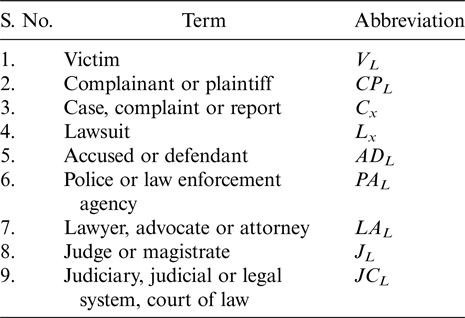
This section provides the formal definition of the legal participants, used in this research work.Footnote 31 The abbreviations of the terms, used in this paper, can be summarized in computational, and AI terms, as formulae with reference to Table 1.
Term abbreviationFootnote 32

1. A victim (VL) is an individual who suffers as a consequence of an action by the ADL (s).
 $$\eqalign{& \Rightarrow V_L\ne AD_L\;\&\; V_L\oplus AD_L \cr & but\;( ( V_L\in AD_L) \vee ( V_L\notin AD_L) ) } $$
2. A complainant or plaintiff (CPL) is someone, who files a Cx against ADL (s) in a PAL or JCL.
$$\eqalign{& i.e.\; ( {CP_L = V_L} ) \vee ( CP_L\ne V_L) \cr & \Rightarrow ( CP_L\ne AD_L)\; \& \;CP_L\oplus AD_L \cr & but\;( ( AD_L\in CP_L) \vee ( AD_L\notin CP_L) ) } $$3. A case, complaint, or report (Cx) is the first written document of the related information by the VL or CPL submitted to the PAL(s) about an unpleasant event, which as a consequence hurts a VL or CPL.
$$\eqalign{& \exists\; C_x\vert C_x\in V_L\vee C_x\in CP_L\;but\; C_x\notin PA_L( s ) \cr & \therefore\; PA_L( s ) \leftarrow C_x\Rightarrow C_x\in PA_L( s )\; now} $$4. A lawsuit (Lx) is a Cx filed by a CPL to a JCL for adjudication.
$$\eqalign{& \exists\; L_x\vert L_x\in CP_L\;but\; L_x\notin JC_L \cr & \therefore \;JC_L\leftarrow\; L_x\Rightarrow L_x\in JC_L \,now} $$5. An accused or defendant (ADL) is a person or an entity who defends themselves against a criminal or civil offence in a JCL.
$$\eqalign{& \matrix{ {\;\exists \;AD_L\vert \forall\; AD_L\ne CP_L\;\&\; AD_L\oplus CP_L} \hfill \cr {\Rightarrow ( {AD_L\cap CP_L} ) = \emptyset } \hfill \cr } \cr & \Rightarrow P\;( AD_L\cap CP_{L) } = 0} $$6. The police or law enforcement agency (PAL) is regulated by government and is assigned the responsibilities to ensure that laws and order is maintained in the assigned jurisdictions.
$$\;\exists\; PA_L\vert \forall\; LA_L\in JC_L\vert \vert LA_L\notin JC_L$$7. A lawyer or attorney (LAL) is the professional with deep knowledge and understanding of the law who practises law. A LAL argues in favour of their their clients Cx(s) in a JCL.
$$\exists\; LA_L\vert \forall\; CP_{L, }LA_L\exists \Ghe ( {LA_L} ) \colon CP_L\to JC_L$$8. A judge or magistrate (JL) is an individual who has been given official authority and responsibility to make unbiased decisions on the Cx(s) or Lx(s) in the JCL.
$$\exists\; J_L\vert \forall\; J_L\in\; JC_L \,\& \, \Ghe( J_L) \colon J_L\to \{ C_x( s ) \vert \vert L_x( s ) \} $$9. The judiciary, judicial system or court of law (JCL) is a system that consists of the judicial authority to adjudicate the legal Cx(s) according to the laws prescribed in its country.
$$\exists \;JC_L\vert \forall\; JC_L\supset \{ {V_L, \;AD_L, \;L_x, \;AD_L, \;PA_L, \;LA_L, \;J_L} \} $$


3. Legal Informatics and Legal Innovation
Legal systems, which are complex in nature, can be improved by science, which helps to build realistic and effective legal solutions (Ruhl et al., 2017).Footnote 33 Conventional legal systems are mostly empirical study-based systems and generally ignore the scientific facts; therefore, they are under-exposed to the complexity of science and therefore its benefits. As legal systems have developed, so legal industry, experts, scholars and practitioners have started to understand and study the benefits of information technology in legal systems in the form of legal informatics. Legal documents, such as courts decisions, executive orders, regulations, contracts, written laws, case laws, citation records, individually and collectively contribute and constitute strong and complex datasets, which are central to LI operations.
Expert systems had been introduced in legal reasoning since the early applications were developed in the 1980s. The jurisprudential rigour in reasoning has justifed the idea of applying the expert systems.Footnote 34 An example is TurboTax, a well-known legal application that was built by, and for, tax attorneys to manage the income tax laws to automatically decode and infer the logic of tax rules. The system needs the basic logic from the law to run the computer conversion process. It is one of the most intuitive models. Though in many cases the transcoding can create complex and unclear results. These rules-based approaches are time-consuming particularly in the preparatory phase for the programmers to formulate the rules and inference. That is the difference with the ML operative techniques that extract the rules by induction.
Modern data science and IT has great potential to improve legacy legal systems and are introducing more LI-enabled mechanisms to transform traditional legal tasks and applications into more efficient and robust computer-assisted and online processes, which are of great assistance to court users. Waltl and VoglFootnote 35 study and explain the broader AI and the allied technologies ML, DL, NLP, etc as the possible frontier in the LI discourse and outline their potential to help transform existing legal systems (JCL). The authors focus on the notion of the AI to append the explanations along with the decisions in legal case law – Cx(s).
The LI-supported JCL(s) are expected, and envisioned, to be smart and intelligent systems to deliver fair justice in a much shorter time and to better serve society.
This section covers the current status of legal informatics and explores the future challenges and possible opportunities for legal innovation to improve the existing JCL.
3.1 Legal Document Digitization
IT concepts are gradually being applied in the legal domain and legal communities globally are striving to digitize the centuries-old physical copies of the archived legal documents held in law libraries, or courts, to create a digital legal corpus. This is the first, and most important task and can be considered as the gateway for larger LI efforts. The digitization of lengthy legal documents such as court judgments, legal proceedings, etc, will be ongoing work at different levels even in the developed countries such as the United States.
3.2 Legal Data Visualization and Analyses
In the last few years, the scientific and legal communities have begun to leverage the visualization and the associated analytics in legal science and law to perform exploratory visual analyses to better understand the intricacies of legal data; and have incorporated, integrated and implemented at least some basic visualization support, conducive to the legal domain. Lettieri and Malandrino (2018)Footnote 36 study computer visualization support and applied aspects in law and call it Visual-LI. Some interesting tools and techniques are emerging to support the Visual-LI. KnowLex, developed by Lettieri et al (2017a),Footnote 37 also provides web-enabled visual analytics support for various legal documents such as case law, legal doctrines, legislation. KnowLex particularly helps legal scholars and practitioners to experiment, explore and learn about the legal patterns and the legal relationships in relation to diverse legal documentation. Similarly, there is another online system, called EUCaseNetFootnote 38 which helps legal scientists and practitioners with the experimentation and exploration of new ways of analyzing the European legal corpora. EUCaseNet helps visualize and analyze the judgments of the European Court of Justice to deduce the relevant information. CrimeMinerFootnote 39 is another efficient tool, which equips scientists with data mining, visualization, and data and social network analytic capabilities to graphically study the crime and its societal impacts. It aids understanding of crime patterns of criminals and criminal organisations.
3.3 Legal Document Design
Rossi et alFootnote 40 understand the complexity of legal documents. They explore how standard complex and lengthy legal documentation and associated communications can be easily designed and tailored to improve readability and understanding; documents which otherwise exist and are shared in the standardized document format regardless of the targeted audience. The language itself of legal documents is often technically very complicated and requires a good degree of understanding of law in order to comprehend it; additionally, the ‘fuzzy’ terminology of legal documents often leads to various interpretations, that can deviate from the intended meaning. As a result, the general public is often unable to understand a legal document and needs some legal assistance. Therefore, the design patternFootnote 41 concept from computer and information science is applied in legal document design to help develop the legal document, especially the contract in the desired formats. The design pattern-based legal documents are easily readable and can be understood by the lay reader. However, there are numerous design patterns which have been created in recent years, most of which are underused and unusable. The lack of a central repository for the legal design patterns is the most likely reason for this. So, finding a suitable design pattern for the legal use is not easy. Therefore, RossiFootnote 42 and her team have proposed a legal language to reconfigure and restructure the legal design patterns with effective documentation and sharing practices. The goal is to cumulate and centralize fragmented legal resources and remedies and to append suitable examples with encompassing illustrations of their usage to standardise legal communications.
3.4 Future of the Legal Justice System
Case flow management is an important area for IT and LI applications in the judicial system. While the significance of IT has been identified at a quite early phase in IT development, the scope of application is yet to be completely explored. Case management means ensuring the progress of the Cx(s) through the judicial process is expedited and streamlined.Footnote 43 The JL(s) should have the help of IT and LI to ensure that effective management and tracking of Cx(s) are possible. The fast-tracking of Cx(s), disposal of small-claim matters, referring matters to alternative dispute resolution processes, and reducing the delays in the administrative process are all possible with the application of IT and LI to the Cx management process. Even in professional legal practice, the relevance of Cx management software is evident. Ensuring the efficiency of the JCL and professional accountability using Cx management mechanisms will be an important area in the future of the JCL.
The significance of legal informatics in the execution of judgments is rarely highlighted. The execution of judgments and judicial orders is usually not effectively monitored and leads to major inefficiency in the JCL. A proper mechanism for tracking and monitoring the execution through the application of LI and AI would help to transform the JCL. The European Commission for the Efficiency of Justice (CEPEJ), in its toolkit for cyber justice, highlights the fact that the court has an important responsibility beyond merely providing the verdict.Footnote 44 The CEPEJ recommends that LI tools are used to ensure proper monitoring of the execution of judicial decisions. This would be a significant step for countries with complex civil procedures for the execution of judgments. The CEPEJ also points out the need for evolving ethical principles while applying the use of LI and AI to judicial functioning. The ethical principles that are mentioned relate to ensuring that fundamental rights are protected, including non-discrimination, security transparency and fairness in the manner the data and technology are used.Footnote 45 The application of LI to the judicial process and legal professional practice has to be guided by the ethical conduct and performance. The need for the fair trial during a criminal trial process needs to be kept in mind while adopting IT technology in the courts. The examination evidence and the deposition would require more attention as the focus on the criminal justice process has a higher evidence threshold.Footnote 46 Confidentiality of the process could be much better protected in the case of virtual proceedings.
3.5 Access to Legal Justice
In way countries there have been significant attempts to deploy technology-enabled solutions for courts through virtual hearings.Footnote 47 In some countries the technology-based solutions have enabled women to participate in judicial trials where previously due to the time-consuming and lengthy process they opted to not seek remedy.Footnote 48 The expert evidence delivered by virtual means would go a long way to ensuring fair trials take place. Moreover, the cost of conducting the civil Cx(s) would be with the help of the technology. The use of ‘e-courts’ may become more popular in the post-Covid world.
It is significant and beneficial to have an Online Dispute Resolution, (ODR) in situations such as civil Cx(s), consumer Cx(s), and tenancy Cx(s). The European UnionFootnote 49 and India are progressing towards ODR processes. The Ministry of Consumer Affairs in India had set up a model Online Consumer Mediation Centre to understand the impact of the same on access to justice.Footnote 50 The application of ODR for family law,Footnote 51 and other civil law processes would be beneficial in tackling the delay in the process of justice delivery.
If the 2008–2009 recession is any guide, the economic fallout from the Covid-19 pandemic will trigger a spike in consumer credit and eviction Cx(s), placing substantial pressure on state courts to innovate, including expanded use of virtual hearings, pre-hearings and court-ordered ODR processes. While, there is a focus on the use of e-courts and the ODR process for access to justice, the disparity and lack of accessibility needs to be noted. The quality of the service and procedural requirements need to be the focus for access to justice. The disparity in access to the internet and basic IT infrastructure needs to be addressed for ODR to be adopted widely. The digital divide and the varying capabilities of people to access the IT-enabled judicial facilities are the major issues that need to be addressed. Moreover, the language barrier regarding access to justice is often evident in the countries such as India. The migration of courts to a digital format requires an understanding the cultural and socio-economic realities of the community.
3.6 Access to Legal Data
Democratizing access to legal data is significant for the JCL(s). Across the world, the e-governance push has led to the basic legal data and related material being tracked. But, it needs to be noted that in many countries, even the developed countries, the judicial data, judgments and judicial orders are not always available in the public domain.Footnote 52 This means that the legal material is not accessible to the LAL(s), researchers and general public. Access to the legal data and information including legislations, pending Cx(s) and other related statistics would significantly improve the effective access to justice. IT, IT-enabled AI and AI-supported LI can facilitate wider public access to the data.
At the same time, it is important to note that there are rising concerns regarding the disparity in the access to legal data due to the role of players in the private sector - such as commercial enterprises. Examples of this are the legal research data bases of leading publishers such as Westlaw and LexisNexis. These databases allow subscription access only. The paywall creates a disparity amongst the law students and lawyers (LAL(s)) in economically weaker areas. Large law firms and corporates may have better access to legal data reducing fairness and equality in the legal process. In India civil society initiatives such as PRS Legislative ResearchFootnote 53 have played an important role in the accessibility of legislative instruments such as draft bills and rules as well as data on regulatory bodies.
The relatively few participants within the legal system (JCL) have privileged access to the data necessary to develop and refine the effective legal tech tools. High data costs and the failure of federal and state judicial administrators to make the court data available in bulk means that large tech companies and defence-side BigLaw firms - typically not plaintiff-side firms, access-to-justice groups or civil justice institutions - have the data and technical know-how necessary to make effective use of potent new analytics.
3.7 Algorithms and Applications in LI
Algorithms and the applications in the LI have a major role to play in predictive analysis, which maybe significant in the future of justice in the future. The crucial factor in ensuring a just and fair decision process should be embedded in the algorithm. The algorithm could enable predictive reasoning and analysis especially in the context of the criminal justice system. Granting of bail and other discretionary elements such as parole could be relying on evidence-based and data-driven decision-making with the help of algorithm-based AI applications. According to existing academic literature, the predictive algorithm is already in use in the US for various purposes such as pretrial, bail, criminal sentencing, juvenile justice and probation.Footnote 54
The use of ROSS, the world's first artificially intelligent attorney and based on the IBM Watson platform, is a significant part of the AI application, in providing the faster legal research and predictive analysis of the Cx results and legal solutions.Footnote 55 In developing countries such as India, the plan for applying AI to judicial functioning has been initiated. The process of developing AI applications as commercial proprietary software could limit the legal research capability to a few law firms and legal practitioners. The open-source AI applications also need to be developed to improve access to legal research tools. This would help civil society organizations, pro-bono LAL(s), legal researchers and academics.
Whether AI should always be allowed to replace the human element needs consideration in terms of policy formulation? The prerequisite for algorithmic accountability is significant for its legitimacy and ensuring fairness in the system. It can only be possible by having policies in place that evaluate and revisit the results provided by the algorithm.Footnote 56 Transparency in the way the algorithm operates is another major concern regarding the increasing influence that algorithms have on society.Footnote 57 Having transparency in the guiding principles for the algorithms being used for judicial decision-making purposes is necessary. The architecture of the accountability has to be embedded in the institutional mechanism of judicial functioning.
3.8 AI, ML and DL in Jurisprudence
The application of AI in JCL would be a major groundbreaking process for judicial decision-making with the JL(s) being able to review a simulated scenario before arriving at the decision-making process.Footnote 58 The predictive analysis would be helpful for JL(s) to understand the unknown flaws or biases in their thinking process. Thus, AI would be an important tool for a better decision-making process. In the context of the Big Data sets that the government has control over, applying ML and DL techniques (the key components of the AI-ecosystem) would help understand and predict criminal activities and prevent them. Detecting tax evasion and other white-collar crimes could be tracked using the AI-ecosystem. Evidence of criminal proceedings could also be gathered through the AI-ecosystem processes. Cyber-crimes would also necessitate the application of the AI-ecosystem for detecting and tackling crime.Footnote 59 In the context of developing countries, the AI-ecosystem has enormous scope for providing a smart JCL.Footnote 60
3.9 Legal Information Retrieval
Interdisciplinary communities, primarily computer scientists and engineers and legal professionals and scholars, are devising and developing new methods and mechanisms to access legal information from the digitized legal corpus. Goswami (2018)Footnote 61 has developed a mechanism, legal catchphrase, for legal information retrieval, which is effective in retrieving legal documents; for example judgments, case law, acts, testimonies, etc. The auto legal catchphrase helps to retrieve the catchphrases from lengthy legal documents to provide quick and better understanding of the legal documents in a much shorter time. This would otherwise be challenging and a time-consuming process to read through and comprehend entire documents even for expert legal scholars and practitioners, who need to cite them in their adversarial court arguments. The legal catchphrase research is tested and validated on the legal documents from the Indian JCL(s). Additionally, there are other tools such as IndianKanoonFootnote 62 and Manupatra,Footnote 63 which also assist legal experts and scholars with needs for document searching and retrieval.
3.10 NLP and Text Processing in Jurisprudence
The NLP service is deployed by legal database service providers such as LexisNexis and Thomson Reuters (Westlaw). The value-added services provided by these databases include case law retrieval based on keyword search and case law suggestions based on legal precedence. Along with these multinational corporations various national data service providers, such as Manupatra,Footnote 64 have been in existence in countries like India. Public domain free access service providers such as IndiakanoonFootnote 65 also use NLP and text processing. The application of NLP and text processing facilities are bound to increase with specialized software tools being developed for various branches of law such as intellectual property rights by Lex Machina.Footnote 66 E-court dockets and e-filing facilities for cases could lead to more NLP and text processing avenues for the legal community. The emergence of ROSS, based on IBM's Watson, opens more pragmatic and cognitive level understanding of the context in which the NLP is used.Footnote 67 This would help the results to be more oriented to the need of the LAL community.
3.11 Ontology and Knowledge Representation of Legal Data
The major challenge to scaling upon LI is the scattered and complex manner in which legal knowledge evolves. The universe of legal knowledge is quite wide as in the case of other social science arenas.Footnote 68 The LI field would face similar challenges on a significant scale as legal systems and procedures are diverse. The existing literature shows the possible ways in which the challenges are attempted to be addressed. The possibility of using the Resource Description FrameworkFootnote 69 in German law forms an interesting study in this area. The manner in which the legal principles have diverse applications and interpretations would require more nuanced methods to create knowledge representation frameworks. The choice of the country-based or subject-based knowledge representation of the legal data requires a significant number of databases to be evolved. The widespread universe of the legal information required has led to alternative suggestions such as ‘multi-user filling of knowledge base’ through crowdsourcing.Footnote 70 But, the possible errors in such a database need to be tackled. The ‘semantic based dematerialized process’ is another alternative suggested in the context of legal knowledge base.Footnote 71
3.12 Blockchain Technology in Jurisprudence
Blockchain technology could be an important part of the smart legal contract framework. Moreover, legal services such as land records managementFootnote 72 could be linked to blockchain technology. It would also be helpful in the verification and enforcement of judgments and judicial orders. Blockchain is also relevant in the context of the service delivery process of government. The possibility of blockchain being used for the purpose of verification of legal documents would help in tamper-proof evidence examination. This could increase the effectiveness of the judicial process. It is also important to ensure that blockchain technology is regulated to minimise unethical use and financial crime. The possibility of digital currency and the decentralized process of the operation prompts the need for rethinking the centralized judicial model. The various autonomous blockchain hubs need to be regulated instead through specialized dispute resolution platforms. The rise of ODR platformsFootnote 73 would also be fueled by the use of the blockchain technology.
3.13 Smart Legal Contracts
Smart legal contracts have the characteristic of self-execution. The possibility of self-execution is significant as the intermediary requirements of executing and monitoring a contract document can be avoided. Hence, from an efficiency and a cost perspective smart contracts are useful.Footnote 74 Notarization and registration requirements of the contract documents will not arise. The requirement for verification of the contract documents for administrative and judicial purposes could be avoided with the introduction of smart contracts. Contract law frameworks have to be changed to ensure that the present JCL accommodates the self-executing contracts.Footnote 75 The specific legal framework for smart contracts and blockchain technology could also be used for effective implementation.Footnote 76 Smart contracts also face challenges in the context of the ambiguous and complex terms being mentioned in the contract. The technology and the legal solutions to overcome this hurdle are important for the smooth development of smart contract legal frameworks.
3.14 Robot Lawyer
While the AI-ecosystem based predictive systems are bound to evolve, the question of AI replacing the needs for the LAL(s) could become a reality. Already, the legal research role of a junior associate could be taken over by AI-based applications. Policy formulations, allowing the robot lawyer, also called robo lawyer (R-LAL), to provide legal advice would be necessary. Questions pertaining to the extent of the work and the areas that the R-LAL should be allowed to deal with and the accountability factor need to be evaluated and addressed. The possibility of the R-LAL(s) in the field of ODR through mediation and negotiation assistance will be relevant in the near future. The practice of lawyering would see a change if the R-LAL is able to participate. The present practice of early neutral evaluation as an amicable dispute resolution method is an appropriate area in which the R-LAL could be useful. But, the empathy-based lawyering required in the case of crime victims and human rights issues would require a human touch. It would be quite far stretched and may lead to access to justice issues to allow R-LAL(s) any role in these areas. However, with the developments in the legal predictive and the legal expert systems, providing legal advice and solutions could be more affordable and accessible.Footnote 77
3.15 Robot Judges
The use of robot judges (R-JL(s)) in place of the human JL(s) is already being tested in the EU for smaller Cx(s) adjudication, and in the UK for the parking ticket fines.Footnote 78 The replacement of the R-JL(s) would be effective in matters where only the logical rational approach is necessary and procedural fairness requirements do not arise. Studies have pointed out that leaving the final decision in an adjudication with an R-JL could lead to the concerns of a ‘fairness gap’.Footnote 79 Dealing with the procedural complexity, the necessity of being unbiased is not necessarily easily adopted by the R-JL(s)). Issues such as domestic violence, victim support mechanisms and juvenile justice require a human touch and an empathetic approach. Moreover, since the JCL is being considered as a ‘social process’, the R-JL(s) may not be well regarded as a replacement for human JL(s).Footnote 80 In this regard, from a legitimacy perspective, the assistance from a R-JL would be perceived more favourably than the complete replacement.Footnote 81
3.16 Automated Dispute Resolution (ADR) System
The ADR system refers to the use of an expert system and other advanced algorithmic tools to rule on a conflict. The nudge to reach a decision or final decision could be suitably at by the use of AI-powered predictive tools and expert systems. The existing academic literature points towards greater chance of acceptability of ADR in the Cx(s) related to commercial matters, where there is greater emphasis on win-win solutions and the cost involved is high.Footnote 82 ADR systems would not be a success in situations where empathy, human rights and sensitive issues such as child custody and juvenile justice are involved. Moreover, in traditional courtroom litigation involving procedural complexity, the ADR system may not fit. The ADR process could be optimized through better human and computer interaction tools.Footnote 83
3.17 Online Dispute Resolution (ODR) System
The ODR mechanism is an innovative solution to conflict resolution using digital tools. Usually providing an online platform and digital tools for a traditional or alternative model of dispute resolution could be referred to as an ODR system. The predominant emphasis of the existing models, such as mediation room and a private JL, is on the alternative dispute resolution process such as mediation, arbitration and other hybrid processes to be provided on the digital platformFootnote 84. The primary benefit of the ODR mechanism is the greater accessibility to the platform, which would enable the geographical and infrastructural constraints of the traditional physical model dispute resolution processes to be overcome. The access to justice part would also be significantly improved with the possibility of AI-based expert systems being applied.Footnote 85 The AI-enabled expert systems and the decision support systems could be helpful in the process of arriving at just and fair solutions. The hybrid process of med-arb, where in the event the mediation fails, the parties move to arbitration could be best implemented in the ODR model with the digital tools. To increase access to justice, open source models of ODR would be a suitable solution.
4. Legal Tech Landscape
The primary aim and focus of LI innovation and research are to advance the existing JCL and civil practices and procedures to make them more efficient, effective, automated and eventually more democratic. The AI-supported LI systems are seen to be faster and the Cx outcomes are expected to be delivered much sooner than the traditional JCL. Also, the Cx(s) stakeholders such as CPL, ADL, and LAL can take advantage of the AI-enabled LI systems in predicting the numerous outcomes of their Cx(s) based on tweaking and tailoring the input arguments and other weighted factors and parameters such machine-driven predictions will help the stakeholders to better prepare for their arguments to strongly and favourably support and defend their claims and Cx(s). This legal tech landscape discussion is inspired by the comprehensive work of Engstrom and GelbachFootnote 86. Despite some progress of the AI-ecosystem in LI research and innovation, the emergence of legal tech systems is still slow and shallow and most of the systems are still in the prototype testing stage. Complex legal tech systems such as robot-lawyersFootnote 87 and robot-judgesFootnote 88 with the ultimate potential of truly transforming the JCL(s) are still futuristic. Although, as the LI research widens, the LI-led tech innovation also expands its landscape, however, this produces several severe challenges to the traditional JCL as the LI-enabled legal system horizon expands; the bigger concern is whether the main legal actors and players – chiefly LAL(s) and JL(s) - are ready to adopt and endorse the emerging tech-enabled legal system. If yes, then how and how fast, are they willing to learn and accept its technical complexities and subsequently promote the LI-enabled modern JCL, for civil procedure towards the mainstream. The fast-growing LI and consequently, the increasing number of legal techs are believed to affect the central stakeholders of the civil justice system - LAL, CPL, and JCL - and these emergent legal tech solutions are expected to reduce the exceedingly lengthy time taken in the traditional legal proceedings and reduce excessively unaffordable LAL(s) fees and the associated expenditure incurred in the conventional civil procedure. This section also provides an informative classification of the existing and emerging legal techs to better understand the current trend and the future orientation of the LI-enabled legal landscape.
4.1 Classification
A. Legal Analytics (L-Analysis) – The L-Analysis class of the legal techs enables the LAL(s) to perform thorough analytics of the disparate legal items, elements and documents. For example, mapping of the Cx citation, analytics of the legal document and legal proceedings, legal judgments, etc.
B. Legal Auto Assistant (L-Auto) – The L-Auto legal techs aid, especially, the marginalized CPL(s) and ADL(s), who cannot afford the high LAL(s) fees, in their legal Cx(s). The L-auto techs provide legal advice online and resolve legal disputes and Lx(s) online.
C. Legal Doc Developer (L-Develop) – The L-Develop techs are the customized template providers to the LAL(s), which can be used to draft, develop and deliver comprehensive legal documents.
D. Legal Doc Discovery (L-Discover) – The L-Discover legal techs are here to strengthen the procedures to identify and indicate suitable documents for a legal procedure.
E. Legal Management (L-Manage) – The L-Manage legal tech class offers graphical dashboards and assists the LAL(s) to efficiently manage and execute their business-related operations.
F. Legal Match (L-Match) - The L-Matchers assist in matching and connecting the CPL(s) to the potential LAL(s) based on the domain expertise of the LAL(s). The L-Match legal techs also support the LAL(s) with additional features to execute other related tasks such as managing the legal records of clients.
-
G. Legal Prediction (L-Predict) – The L-Predict class is increasingly getting more interest from practitioners and the scientific communities. The L-Predict legal techs intend to predict the probable legal outcomes of the Cx(s) and Lx(s). The L-Predict also enables the operators to adjust the input variables to construct more tailored outcomes to analyze to obtain the suitable and favored options to help decide the future course of their litigation.
H. Legal Search (L-Search) – The L-Search type legal techs provide the intuitive platforms to the LAL(s), where they can efficiently search for matching texts and patterns in legal documents, such as case decisions, statutes, regulations, etc, and retrieve the matched ones. The L-Search tools are also very helpful in assisting the LAL(s) in their document research to prepare, support and strengthen their arguments in their Cx(s).
4.2 Emerging Legal Techs
Based on the above classification, Table 2 lists some of the important and emerging legal techs, which are either prototypes, startups or enterprises, serving in the commercial domain.
Emerging legal techs and their classification

In the Table 2, only a small set of legal tech examples are listed and each entity is assigned to one classification only. However, several of them may fall into multiple classes. The global legal tech space is still new and small, but the emerging LI, powered by the AI-ecosystem, is expected to fuel its growth and upward trajectory leading to a faster legal tech evolution in future years. The LI-enabled legal tech solutions will potentially restructure, reorganize and reshape the existing JCL and transform it to be more transparent, time-sensitive and cost-effective and accessible to the marginalized and underprivileged worldwide. The tech-powered new age JCL will hopefully empower the disempowered and = restore their confidence in the legal system (JCL).
4.3 Legal Service Regulation
Having explored some examples of ongoing and future developments, we will now turn to legal service regulation – broadly defined to encompass court rules, case law and legislation – and how it affects legal services. In so doing, we will make reference to legal services in the United States in this section. Professional bodies and state legislatures JCL(s) govern who can offer these legal services, including the abilities required, the amount of training required, and the geographic regions in which they are permitted to practise law. Professional bodies have economic incentives to limit innovations in the supply of legal services that threaten its membership's economic interests, such as the provision of legal services by non-lawyers. This opposition is both economic and cultural in nature. The JCL(s) actively control certain types of services that must be provided, as well as the manner in which this should occur, by establishing criteria for legal misconduct. States eventually control aspects of both of the above by, for example, recognizing professional groups and enacting legislation that supports some services while reducing (or eliminating) demand for othersFootnote 124.
A statute that liberalizes divorce, for example, is likely to increase certain legal activity. Likewise, states compete in creating legislation that may encourage positive economic development. For example, most corporations are incorporated under Delaware law since it is seen as beneficial. The action of these regulators can be creative in and of itself (as in the Delaware example), or might stimulate or inhibit innovation. The involvement of JCL(s) in promoting alternative litigation financing (ALF) through changing views regarding the law of champertyFootnote 125. It is equally important to recognize that legislation that limits innovation can be advantageous to society. Because of the external influences on legal services, changes (to practice, services or suppliers) might have unexpected consequences, which regulators can help to internalize.
Similarly, lack of information might make it difficult to select an appropriately qualified LAL for the work (as we will see below). At the same time, regulation may stifle innovation, and we conclude this section by looking at one area where the debate over the consequences of regulation is particularly heated: licensing and entry barriers. While it is apparent that such regulation is in the public interest at some level, we highlight numerous cases where creative activity may be hindered as a result, and when some degree of liberalization may promote such activity.
Professional licensing and entry barriers have the potential to benefit customers by making goods and services less expensive to make and, in a competitive market, less expensive to acquire. However, while cost reductions may be beneficial, manufacturers will absorb the benefits unless they are obliged to pass on a portion of the cost savings by reducing their pricing. Competition between suppliers may be the most efficient method for doing this. It may also have the added benefit of encouraging suppliers to seek out new goods (as well as methods) and attract new consumers. While analysing the potential for innovation in legal services, it is critical to consider the regulatory environment that governs providers, as this may either promote or stifle competition.Footnote 126
There is one significant caveat to the above. As noted earlier, many legal services are complicated, making it difficult for the customer to judge the quality of the service being acquired. This can operate as a barrier for using such services, affecting access to justice and efficiency. As a result, as in other professional contexts, it may be important to guarantee that providers have a minimal degree of expertise in order to convince an otherwise skeptical audience. Occupational licensing has been justified in this manner on occasion.Footnote 127
In a nutshell, asymmetric information indicates that we should not expect legal services to be provided under the same competitive conditions as, say, clothing or groceriesFootnote 128. Our paper does not attempt to address the ultimate issue of whether lowering entrance barriers is a ‘good thing.’ We also cannot possibly cover all entrance regulations due to space constraints. We do, however, provide some examples of broad barriers that have received significant criticism, and where careful scrutiny may be warranted as outlined above, and perhaps especially in light of some of the innovations that might occur if these barriers were removed.
In the United States, a variety of restrictions limit the availability of legal services and these include: (1) the requirement that one have a law licence from a specific state jurisdiction in order to practise law in that jurisdiction; and (2) the necessity that lawyers be graduates of accredited law schools; and (3) the limitations imposed by ethical norms on the conduct of attorneys, notably the prohibition on lawyers collaborating with non-lawyers. While each of these restrictions has its own explanations they are all part of the endeavor to establish the practice of law as a unique profession with its own professional standards. Every state requires that a person pass the state bar exam before practicing law. The term ‘practice of law’ is broadly defined, and it is a criminal violation in most jurisdictions to practise law without a licence, although prosecutions are rare.Footnote 129 Non-lawyers are permitted to offer broad, general legal advice but are not permitted to provide customized assistance, according most legislation.Footnote 130
An ABA task committee offered a model definition in 2002: ‘the practice of law is the application of legal principles and judgement with reference to a person's circumstances or aims that need the knowledge and competence of a person trained in the law’.Footnote 131 According to the proposed definition, the practice of law is presumed when a person acts on behalf of another in - (1) giving advice or counsel to persons as to their legal rights or responsibilities or those of others; (2) selecting, drafting, or completing legal documents or agreements that affect a person's legal rights; or (3) representing a person before of an adjudicative body, including but not limited to drafting or submitting papers or conducting discovery; or (4) negotiating legal rights or duties on a person's behalf.
This concept of legal practice is extremely wide.Footnote 132 Furthermore, jurisdictions have embraced a larger variety of definitions of what constitutes legal practice.Footnote 133 The production of legal self-help books and computer software has also been deemed to contravene the restrictions against practising law.Footnote 134 Similarly, the legal document preparation service LegalZoom was sued for engaging in the unlicensed practice of law.Footnote 135 These limitations clearly stifle competition in the market for legal services from non-lawyers and attorneys licensed in other countries.
State bar organizations explain these bans as essential to ensure that persons offering legal services are conversant with applicable state and local laws, as well as to safeguard inexperienced legal service consumers from exploitation.Footnote 136 States ensure that customers of legal services enjoy the benefits of the attorney-client relationship, which includes the obligation of loyalty (which includes the responsibility to detect and prevent conflicts of interest), confidentiality, and competence which non-attorneys lack. G.K. Hadfield compares them to obligatory conditions in a legal services contract.Footnote 137 Academic commentators,Footnote 138 as well as the general public, are dubious.Footnote 139 According to one famous law professor, ‘Legal self-regulation exhibits the normal self-interested conduct of a cartel without any of the attendant benefits.’Footnote 140
In an ABA poll, more than four-fifths of the public believed that many problems might be ‘done as well and less expensively by non-lawyers.’Footnote 141 Hadfield stated that these obligatory contract provisions are especially improper and unneeded for smart businesses that do not require paternalistic safeguards to receive adequate legal services. Hadfield levelled a more fundamental critique of the effects of these restrictions, claiming that the prohibition on unauthorized practice of law has stymied the development of legal innovations and resulted in a situation in which the legal system requires ‘enormous complexity and quantity of legal effort to achieve the transactional and dispute resolution goals of business entities.’Footnote 142 She claims that the constraints have hampered the creation of new techniques for effective conflict resolution, as well as the intellectual development of new conflict resolution paradigms.
It may be uncommon for a person to employ someone to help with legal claims unless legal aid is available, but this is especially true for middle and low-income individuals. It is costly and often causes anxiety, and little is known about the quality of the services provided. This is due in part to legal practice limitations, which usually require a very expensive qualified attorney to be actively involved in the supply of legal services. Furthermore, the contractual conditions under which the attorney is involved include a number of extra limitations (duties of loyalty, secrecy, and avoiding conflict of interest) that can raise the cost of legal services even higher.
Legal services for those on lower incomes are frequently limited to law school clinics where legal services are largely given by law students or as a form of charity. The legal profession frequently stresses the value of pro bono legal services as a charitiable gift.
According to most estimates, the demand for legal services by those on low- and middle-income considerably outstrips supply from pro bono volunteer efforts and law clinics. In order to satisfy this demand, nearly every lawyer and law student in the United States has been encouraged to give additional pro bono hours.Footnote 143 This might be the incorrect technique. Rather than maintaining restrictions that limit the supply of legal services, raise their costs, and attempt to give legal services to those on lower incomes through charity efforts, it may make more sense to make legal services cheaper. Certainly, there are dangers associated with relaxing limits on legal services in order to encourage additional low-cost choices. Defenders of the status quo have claimed that the US judicial system is the envy of the world and that any changes should be made with extreme caution. Lower-cost legal services may encourage more litigation, which may have significant negative externalities—litigiousness is not typically regarded as a virtue. It is possible that the present limits on the practice of law are placed at the bare minimum for societal reasons. But, at the absolute least, we should carefully consider if innovations in delivering legal services, such as the relaxation of legal service limitations, could improve societal welfare. From the standpoint of innovation, the fundamental question is how much innovation might be promoted by liberalizing entrance into the United States legal profession, and if the advantages from such innovations would exceed the losses.
While this is a difficult issue to answer, we believe that case studies of liberalization in other jurisdictions and in other professional services (such as health and accounting) might help uncover some key lessons.
5. Discussion
As the AI-ecosystem-enabled LI emerges, the legal community is still skeptical with the obvious questions about whether the LI-powered tech tools will be truly capable enough to transform the existing JCL into an intelligent and efficient JCL. However, such skepticism is likely to gradually recede especially given the pace that the AI-ecosystem is permeating through the legal world. The different legal actors and stakeholders have various views on AI-ecosystem usage in the legal domain – whether AI-enabled legal tech tools will augment or replace the primary legal players - LAL(s), JCL(s) and JL(s). Despite these differences the general consensus favours the expansion and growth of LI and its supported technologies and tools. The deep, quick, vast and self-learning capability of the AI algorithms to enhance their intelligence, evidently outsmart the human cognitive capacity has strengthened the confidence of the IT and legal communities to exploit AI and its allied technologies - ML, DL, NLP, etc. - to transform the existing inefficient and under-performing human-driven JCL into the AI-powered intelligent, highly efficient, robust and more capable technology-driven JCL.
This discussion mostly focuses on the current standing of AI and AI-enabled LI in Indian JCL,Footnote 144 which when compared with western and European JCL(s) lags severly behind in using even basic technology or largely no technology. Although, some discussions have been taking place in the last couple of years concerning the advantages of the Al-ecosystem in Indian JCL Footnote 145, but having efficient, fully-developed tech tools available for public use soon is unlikely in the near to medium term. It is quite exciting and encouraging to note that the apex Indian JCL itself is taking enormous interest in exploiting the AI to elevate the court efficiencyFootnote 146 and has administered the engineering and development of the prototypes of two indigenous legal tech tools - SUVAS (Supreme Court Vidhik Anuvaad Software)Footnote 147, and SUPACE (Supreme Court Portal for Assistance in Court Efficiency).Footnote 148 SUVAS is AI-powered and is useful in translating legal documents such as judgments, orders, etc, written in English, into simpler, easily readable and comprehensible layman language. In the current state, SUVAS supports up to nine languages and dialects. The SUPACE portal is also an AI-enabled tool and is an intelligent research platform for the primary legal players such as JL(s) and gathers the legislation and other required facts and findings relevant to a case (Cx) and delivers the tailored output to the JL(s) to help save them time and efforts; consequently the waiting lists of cases (Cx(s)) pending. In our opinion, the abbreviations used above for the AI-supported tools have scope for improvement and can be substituted by more appealing and descriptive acronyms, which are easier to remember. The research and development efforts to develop the LI-enabled legal tech tools are continued globally to elevate the judicial efficacy to substantially reduce litigation time, improve judicial transparency, and improve the delivery of justice. For example, the ODR systemsFootnote 149 are already integrated into the mainstream civil JCL and are functional in several countries now as an alternative dispute resolution mechanism.Footnote 150 The development of smart contractsFootnote 151 and the context-based search in the lengthy contracts to extract and highlight the relevant text is one of the most commendable and appreciable innovations that LI has made in the legal domain.Footnote 152 The design, development and the deployment of the predictive legal tech tools may be the most advanced and effective innovation that AI and AI-enabled LI offers to the legal world, which will disrupt the existing JCL and revolutionize it to be a more intelligent and effective JCL, enriched with all the features and functions to satisfy societal needs and obligations.Footnote 153 If the current trajectory is to continue, in the future, then AI and AI-enabled LI technologies will be firmly embedded within the JCL and will address a range of legal challenges and potentially aid each of the main legal participants such as LAL(s) and JCL(s) at some stage of the legal proceedings. The growing pervasiveness of AI in the legal domain has triggered the legal community in Europe and the US to initiate a discussion about regulating the use of AI in JCL.Footnote 154 However, we do not necessarily envisage such regulations for AI to take place in the Indian JCL at least for next several years given the present situation whereby even the basic IT and AI usage in Indian legal premises are negligible at the present time. Also, the fact that Indian legal data is not yet available in the required open standards is not encouraging either, which is the key ingredient for the advancement of AI-enabled LI systems. Therefore, before the LI evolution in India, we must develop a publicly available centralized database repository of machine readable, openly accessible legal datasets. The literature notes how the availability of open access legal data has stimulated AI-driven legal tech innovations.Footnote 155 If the Indian JCL wants to harness the unlimited potential of the AI and AI-enabled LI to improve things, it is critically important and imperative for it to identify the obstacles with the availability of, and access to, the present data; and then take the required steps and draft proper policies and governing rules to support open data access. This is critical for the digital transformation of the Indian JCL. Although, the Indian JCL is yet to take the advantages of the AI and emerging LI, these technologies have already made some notable progress in several other countries. For example, in Brazil, the AI-enabled legal tech tool, VICTOR, is assisting Brazil's supreme federal court and helps with preliminary document analysis.Footnote 156 In Latin America, Argentina and Columbia are using a highly efficient legal predictive tool, Prometea, in their JCL(s) to accurately predict the Cx outcomes.Footnote 157 Elsewhere United Arab Emirates is also exploring the inclusion of a predictive intelligent tech tool in its justice system.Footnote 158 Russia, China, and Mexico are harnessing the power of AI-enabled legal robots to offer legal aid to their public and to assist their JL(s) in certain Cx types.Footnote 159 In addition, there are several other developing and developed countries, which are either exploring, piloting or operating AI-enabled legal solutions to improve their JCL(s). The AI-driven LI revolution in jurisdictions world-wide is imminent and is expected to completely transform existing justice systems.
The countries which do not yet realise the power of the AI-ecosystem in the legal domain and do not perceive the transformative changes that they bring, will be left behind in the legal digitisation age, and consequently, will continue to underserve their citizens with outdated legal practices and procedures, and neglect their human rights.
6. Conclusion
Notwithstanding the growth in IT and its presence in today's world, the IT-enabled JCL(s) are yet to develop on a par with those in other sectors such as healthcare, medicine and education. However, the modern IT, embedded in the AI-ecosystem is enabling computer science, IT and legal communities to converge on their research efforts to explore the possibilities to advance existing global JCL, and their consolidated endeavours are being termed as legal informatics (LI).
In this research paper, we explored the concept of IT, and AI-enabled IT improving the existing JCL significantly via LI. Particularly, emphasis was put on the modern IT technologies such as AI, ML, DL, NLP, etc, collectively known by the term of the AI-ecosystem, and how they will transform the existing JCL to be more intelligent, efficient, effective and at least in part automated. Furthermore, several important aspects of LI, enabling legal innovation, were also described. The state-of-the-art legal tech landscape was also explored, which was supported by a possible classification of emerging legal techs, with examples. The LI aspect in this paper was further enriched by the detailed discussion section, aligned with the theme of the work with particular focus on the current standing of the AI-ecosystem and LI in the Indian JCL. Future work will explore other factors, which show enormous potential to further elevate the existing global JCL and help establish such a JCL, which is robust, impartial, pragmatically democratic, expeditious, economically affordable and easily accessible even to the oppressed, disenfranchised, impoverished, and alienated sections of global society.
Acknowledgments
Dr. Sugam Sharma acknowledges the CodeX at Stanford Law School, Stanford University, USA, where he is the regular participant in the CodeX meets. This has helped him to better understand the contemporary research and future trends in the legal informatics arena. He would also like to thank Divya Dwivedi, Advocate at Supreme Court of India, for the related discussion.