

The governance of international security has considerably multilateralised over the past two hundred years. Beginning at the Vienna conference, this historical trend picked up speed after each of the two World Wars, to later peak during the post-Cold War era.Footnote 1 Today, a very significant portion of international security politics is conducted through multilateral channels, often from the halls of international organisations (IOs) such as the United Nations (UN) or regional structures such as the North Atlantic Treaty Organisation (NATO). Global city hubs like New York, Brussels, and Vienna host vast networks of national delegations managing international affairs on behalf of their country. In fact, according to one observer, ‘[i]f any form of diplomacy deserves to be called “modern”, it is the multilateral diplomacy within an international organization’.Footnote 2
What kind of impact does multilateralisation have on the politics of international security? Existing literatures suggest that the increasing prevalence of multilateral diplomacy has transformed the global governance of organised violence in important ways, including constraints on power and institutional lock-in,Footnote 3 better information provision,Footnote 4 the strengthening of legal discourse,Footnote 5 bureaucratic adaptations,Footnote 6 socialisation dynamics,Footnote 7 and the formation of authority sites above states.Footnote 8 This article adds to this literature by theorising – and empirically documenting – a key consequence of the multilateralisation of international security: the production, reproduction, and contestation of local diplomatic hierarchies that practitioners often call ‘international pecking orders’. In a nutshell, I posit that the multilateral diplomatic process does something to the politics of international security: it generates a distinctive set of endogenous opportunities and constraints in the making and remaking of international hierarchies.
For those state delegates operating along the corridors of international IOs headquarters, it is a basic fact of life that diplomacy takes place on a deeply unlevelled playground. Carne Ross, who was a British delegate to the UN before turning into a diplomatic consultant for stateless peoples, tells of his everyday encounters with international hierarchy: ‘When I was with the British mission, officials of the UN or other countries paid attention when we spoke. Doubtless this was often faked, but it was perhaps felt to be required, given Britain’s place in the UN pecking order. With the Kosovars, no such deference is necessary. Junior officials become impatient with our demands and even on occasion allow themselves a perceptible sneer when they talk to us.’Footnote 9 International pecking orders are very real in at the level of practice: ‘Meeting a national diplomat at the UN or a UN official is, like an audience with the King, a more difficult matter, its ease or difficulty a signifier of one’s status in the obscure hierarchies of international diplomacy.’Footnote 10 The principle of sovereign equality notwithstanding, then, in any multilateral setting some state representatives weigh much more heavily than others.
As a category of practice, pecking order stands for an analytical concept that has now gained much currency in International Relations (IR): that of hierarchy. Increasingly, scholars from a variety of theoretical perspectives defy the age-old assumption of anarchy in IR to instead depict a highly stratified global realm, pervaded with domination and authority struggles.Footnote 11 In this article I conceive of hierarchy as the combination of vertical differentiation and a set of organising principles of differentiation. I argue that the growing prevalence of multilateral diplomacy in the governance of international security generates distinctive forms of social stratification organised around a struggle for diplomatic competence. As they pursue their instructions and manage everyday multilateral affairs, state representatives posted at major IOs make use of the opportunities and constraints of the situation at hand and compete for rank through the display of practical know-how. In a multilateralised world, a significant yet poorly understood dimension of international hierarchy is endogenous to diplomatic practice itself.
This argument runs counter to conventional wisdom in IR according to which the sources of international hierarchies are primarily structural, stemming from the interstate distribution of (material) capabilities. Indubitably, variations in country assets play a key role in diplomatic pecking orders: after all, ambassadors are not individuals like any other, but the representatives of states. Yet multilateral diplomacy adds much more social complexity to stratification dynamics than what the generic structural model is able to capture. This article seeks to show that the ways in which permanent representatives and their team perform their trade on an everyday basis form a critical factor in shaping how they (as well as the country that they represent) ultimately fare at the table. Even though state-to-state inequalities have pervaded security politics for times immemorial, multilateralised governance generates distinctive sources of social stratification that would not obtain otherwise.
Three prefatory notes seem in order. First, in this article I want to show how international hierarchy emerges in and through diplomatic practice. In other words, pecking orders are my explananda – that which I seek to explain – while the multilateral process is my explanan – that which explains. As a result, documenting the effects of diplomatic hierarchies on variation in multilateral outcomes is not my primary concern here. Second, because I study diplomacy from the inside out, I end up neglecting a number of sources of social stratification whose origins lie beyond – and run much deeper than – the multilateral sites that I focus on: most prominently, race, gender, language, culture, and religion. These pervasive domination structures certainly play a major role in multilateral diplomacy. Because I focus on those pecking order dynamics that are endogenous to multilateral diplomacy, though, I find myself bracketing out forms of social stratification that are primarily produced outside of diplomacy. Third, in order to show how international hierarchy emerges in and through practice, I focus on the ordinary and uneventful practice of diplomacy. Exceptional diplomats punching way above their country’s weight certainly exist (and matter), but in the grand scheme of things, pecking orders primarily rest on much less heroic practices. In this article I want to make international hierarchies visible not spectacularly but through the regular enactment of everyday diplomacy.
The article proceeds in four steps. First, I establish the centrality of multilateral diplomacy in contemporary global governance and examine its founding paradox: despite de jure sovereign equality and the pervasive belief in multilateralism as an equalising force, in practice diplomacy rests on (and produces) strong patterns of social stratification. The second section seeks to explain the sources of multilateral pecking orders. I review existing explanations centered on state capacities, and then show how the organising principles of multilateral hierarchies of standing are endogenous to diplomatic practice. Building on the social theories of Erving Goffman and Pierre Bourdieu, in the third section I explain how the struggle for practical mastery works to produce multilateral pecking orders. Social stratification is a by-product of an endless struggle for diplomatic competence. Fourth and finally, I illustrate my argument with a handful of typical multilateral diplomatic practices ranging from showing esprit de corps to reporting back to the capital. These locally defined practical logics, I argue, enable and constrain the agonistic social patterns out of which international pecking orders emerge.
Multilateral diplomacy and sovereign inequality
The last century has witnessed a remarkable trend of multilateralisation in world politics. According to Jonas Tallberg: ‘Multilateral negotiations today constitute the most prominent method by which states address joint problems, resolve disagreements, and formulate common norms in world politics’.Footnote 12 The governance of international security, by which states seek to collectively manage the usage of organised violence, has not escaped this historical transformation. As G. John Ikenberry puts it: ‘An historical pattern can be identified. Beginning with the 1815 settlement and increasingly after 1919 and 1945, the leading state has resorted to institutional strategies as mechanisms to establish restraints on indiscriminate and arbitrary state power and “lock in” a favorable and durable postwar order’.Footnote 13 Multilateralism – ‘an institutional form which coordinates relations among three or more states on the basis of “generalized” principles of conduct’Footnote 14 – has come to form the baseline of international security politics.
As part of this historical trend, the practice of permanent representation, by which governments open missions abroad with delegates accredited to a given IO, has gradually become a major form of multilateral diplomacy and global governance. While the first such missions appeared in Geneva in the 1920s and 1930s, it is only in the 1970s that the practice generalised and institutionalised, at the UN and a number of other organisations. When he was Secretary-General, Dag Hammarskjöld went as far as to suggest that permanent missions ‘may be considered the most important development in customary law … within the constitutional framework of the Charter’.Footnote 15 Given the significance of this development, it is altogether surprising that there exist so few studies on its political implications for the governance of international security. This article focuses on the socially stratifying effects of multilateral diplomacy, which often flow under the radar of practitioners and scholars alike.
Like other forms of diplomacy, the practice of permanent representation rests on a de jure notion of sovereign equality, which various rituals help deploy on a daily basis. Over the last two centuries, multilateral diplomacy has gradually evolved into a rationalised mode of operation whose formal procedures generally serve to maintain state parity, including alphabetical seating, rotating presidencies, and regulated speaking order. While institutional privileges do exist, in the form of permanent seats with veto power for instance, overall the basic rules of permanent representation fall in line with the long-held principle of sovereign equality that gave rise to both modern public international law and multilateral diplomacy.
Echoing this practical understanding, several IR scholars posit that multilateralism has ‘a strong leveling impulse’.Footnote 16 From a liberal perspective, multilateralism provides significant advantages to smaller states, such as voice opportunities and constraints on the use of arbitrary power by dominant states.Footnote 17 Similarly, constructivists argue ‘multilateralism implies a relationship among partners that is based on rules rather than simple power’.Footnote 18 By contrast, echoing realist and critical theories, in what follows I posit that the practice of multilateral diplomacy is inherently shot through with power politics: inequality is the rule not the exception. Contrary to Robert O. Keohane, such a view does not ‘tarnish’ multilateralism or even reveal its ‘imperfection’.Footnote 19 It rather captures its existential condition in power struggles: sovereign equality and generalised principles notwithstanding, the practice of multilateral diplomacy does not suppress social stratification, but rather thrives on it.
In recent years, a few scholars have drawn attention to ‘ubiquitous informal governance’ in the working of IOs.Footnote 20 In his study of the World Trade Organisation (WTO), Randall W. Stone observes that ‘[i]nformal influence is invariably unequal, and cannot be wholly prevented by any constitutional scheme … Countries with substantial structural power are accorded opportunities for informal influence in order to make participation attractive to them.’Footnote 21 The same logic applies at the European Union (EU), argues Mareike Kleine: ‘Informality might be the rule rather than the exception in politics. Behind the scenes and alongside official procedures seems to be where many important decisions are being made.’Footnote 22 Beyond the formal pretense of sovereign equality, then, informal dynamics of hierarchy prevail at the multilateral table. The sources of informal governance, however, remain a matter of debate. While Kleine conceives of it as a functional response that ‘allows the member states to manipulate one another’s politics of collective action in such a way that domestic interests remain persistently aligned in favor of integration’,Footnote 23 Stone rather emphasises what he calls ‘structural power’, that is to say, the distribution of state capabilities. Neither of these views, I now want to argue, fully captures how international pecking orders actually come about under conditions of multilateralised security governance.
The organising principles of international hierarchies
Building on Donnelly, I conceive of hierarchy as a particular combination of form – vertical differentiation – and content – a set of organising principles of differentiation.Footnote 24 While vertical differentiation is a relatively constant feature of world politics across time and space, its organising principles tend to be contingent and evolving. Indeed, the manifold ways in which international actors rank-order each other are not fixed, but derive from prevalent social, cultural, and political contexts.Footnote 25 Problematically, structural accounts of international hierarchy generally limit themselves to identifying the kind of country assets that are deemed functional in security politics. This, I want to argue, glosses over the specific dynamics of social stratification that operate under contemporary conditions of multilateralised security governance.
Conventional wisdom in IR theory holds that the uneven distribution of state capabilities best explains unequal leverage and influence on the world stage, including at the multilateral table. Elaborating what he calls the ‘power-based model’, Richard H. Steinberg argues that at the WTO, ‘relative market size offers the best first approximation of bargaining power’.Footnote 26 From this perspective, a trade diplomat enters an international negotiation equipped with his or her country’s economic assets in a briefcase, so to speak. These assets then translate into leverage over counterparts (or lack thereof). In the security realm, the same positional logic would emphasise military capabilities and other material resources as key sources of leverage. Building on a similarly structural reasoning, Joseph S. Nye’s soft power argument suggests that a state’s cultural assets, ranging from movies to technological patents and so on, are key sources of influence in world politics.Footnote 27
While scholars disagree as to which state capacities ultimately matter – ranging from guns through money to ideas – the basic argument remains essentially the same: inequality in state assets translates into uneven leverage at the multilateral table. The analytical implication should be clear: when negotiations actually begin, the playing ground is already unlevelled. State representatives essentially respond to, and play out, the preexisting distribution of whichever corporate assets are thought to matter in the situation at hand. As a result, the diplomatic process plays little to no role in and of itself: it is basically epiphenomenal. To caricature a bit, diplomats could all vanish overnight and the world would continue to go round, with multilateral outputs essentially mirroring the unequal distribution of state capacities. At points, scholars seem to intuit that there is more going on: Steinberg observes for instance that at the WTO ‘initiatives from weak countries have a habit of dying’.Footnote 28 He hints at a few possibilities to explain this pattern: who gets to draft and table initiatives, who staffs the secretariat, and so on.Footnote 29 Yet these practices are reduced to epiphenomena of structural forces, without any explicit theorisation.
A similar flaw plagues bargaining theory more generally. In the standard model, country assets determine the availability of outside options – that is, the costs incurred from not striking a deal. In a given negotiation, explains Stone, ‘powerful states are powerful by virtue of the fact that they have attractive outside options’.Footnote 30 In a multilateral setting, then, the key bargaining tactic is the threat to exit the negotiations – however implicit that menace may remain. In the rationalist logic, the outside option is credible only to the extent that the country in whose name the diplomat speaks has the capacity to implement it (by foregoing a deal). For example, a country with vast trade flows gains influence at the multilateral table from its capacity to live without an agreement. While diplomats do (technically at least) exert some agency in making use of the threat to exit, students of bargaining generally take that part of the story more or less for granted, preferring to infer bargaining leverage directly from the exogenous distribution of (relevant) state capabilities.Footnote 31
Does the power-based model work? In a seminal book, Robert W. Cox and Harold K. Jacobson endeavour to explain ‘[h]ow are decisions taken in international organizations and who most influences these decisions.’Footnote 32 The authors conclude the book by drawing a critical distinction between what they call ‘actual influence’ and the ‘stratification of power’ – essentially a composite index of state capacities. As they observe: ‘The influence of some states in some international organizations is greater than their power in their environment; with others it is less.’Footnote 33 But what explains the gap between actual hierarchies of influence in multilateral organisation and the distribution of state capabilities? In his case study chapter, Nye identifies a long list of ‘sources of influence’, many of which have less to do with state capabilities than with the social attributes of the delegates on the ground and the local dynamics within the IO: personal expertise, experience, regional support, personality, interest, importance of the country, administrative competence, seniority, relationship with others, formal leadership position, material resources, country reputation, parliamentary skills, etc.Footnote 34 As unsystematic as it may be, this list suggests that the gap between the local hierarchy of influence and the distribution of country capabilities largely results from the specific context within which the diplomatic process unfolds. The organising principles of hierarchy, in other words, are contingent on the nature and form of prevalent practices in the governance of international security.
The socially stratifying effects of practice
A key analytical objective of this article is to endogenise the production, reproduction, and contestation of international hierarchies as part of the multilateral diplomatic process itself. Social stratification does not simply precede negotiations, in the form of a distribution of corporate assets. It rather springs out of interaction and everyday performances, against the backdrop of the opportunities and constraints of the situation at hand. To ignore practice, then, is to cut oneself off from those dynamics of social stratification that pertain to a central characteristic of today’s security governance: the considerable prevalence of multilateral diplomacy in the international management of organised violence.
My theoretical premise is a simple one: practices structure social interaction. For example, in the field of international security, the practice of deterrence operates based on a limited number of repeated and scripted gestures, signals, and linguistic devices that organise state-to-state relations along more or less established patterns.Footnote 35 Because it aspires to mutual intelligibility, the regular enactment of these deeds within a particular political context structures social interactions along more or less shared lines. To borrow Ann Swidler’s language: ‘The crucial thing about social practices – and the feature that differentiates them from most habits – is that they are the infrastructure of repeated interactional patterns. They remain stable not only because habit ingrains standard ways of doing things, but because the need to engage one another forces people to return to common structures.’Footnote 36 Practices are socially productive because they create baselines for interaction, around which expectations converge.
Such patterns of practice produce, reproduce, and sometimes overturn what Erving Goffman calls ‘interaction orders’.Footnote 37 In several of his writings, the sociologist is amazed by the orderly nature of everyday rituals: ‘In any society, whenever the physical possibility of spoken interaction arises, it seems that a system of practices, conventions, and procedural rules comes into play which functions as a means of guiding and organizing the flow of messages.’Footnote 38 How can such social structures obtain? Crucially, for Goffman the interaction order forms ‘a substantive domain in its own right’ in the study of society.Footnote 39 One cannot capture the orderly space of practice and social intercourse by looking into intentions, beliefs, and preferences, as per rational choice theory or political psychology; nor can we simply reconstruct macrostructures and directly infer actions, as per functionalism or systems theorising. Instead, ‘Goffman’s work points to an interaction order sui generis: an order that can be derived neither from macro social structures or the “institutional order”, nor by focusing on individual agency. His interaction order is based on constraints and moral ground rules that emanate from the interaction situation itself.’Footnote 40
Interaction orders are socially emergent, meaning that they are the by-products of a set of dynamic social relationships arranged in a particular way. As micro-structures,Footnote 41 they are partly autonomous from both the interacting parts themselves and the environmental determinants:
Minor social ritual [that is, practice] is not an expression of structural arrangements in any simple sense; at best it is an expression advanced in regard to these arrangements. Social structures don’t ‘determine’ culturally standard displays, merely help select from the available repertoire of them. The expressions themselves, such as priority in being served, precedence through a door, centrality of seating, access to various public spaces, preferential interruption rights in talk, selection as addressed recipient, are interactional in substance and character; at best they are likely to have only loosely coupled relations to anything by way of social structures that might be associated with them.Footnote 42
There certainly are interesting parallels to draw between Goffman’s ‘loose coupling’ and the gap observed by Cox and Jacobson between the distribution of capabilities and actual influence on the ground.
Beyond the immediate task at hand drawing at set of practitioners together, then, practices also bring the world into being. For example, in Western societies shaking hands stands for greetings, whose exact meaning varies depending on context. The performance of handshaking creates new social facts that generally outlast the greeting itself – for instance, a friendly reconciliation, a business contract, or a first encounter. These are real-enough social structures constituted in and through practice. Likewise, as multilateral diplomats negotiate real-world problems – international crises, global public policies, institutional reforms, etc. – their practices not only serve to resolve the issue at hand, but also to produce broader structural effects, which outlast punctual performance. To put it in simple terms, one can never do only one thing in social settings. Interestingly, the structuring effects of practices are often not intended as such: they are side effects, so to speak, of coping with the world. This pervasive phenomenon in the constitution of society I call the social productivity of practices.
Social stratification patterns emerge through such indirect processes. The performance of practice generates vertical differentiation through a never-ending struggle for competence or practical mastery. As practitioners perform their trade, they also stake a claim as to how things are done.Footnote 43 Indeed, ways of doing things are eminently – and irreducibly – political insofar as they inevitably contain the germ of symbolic struggle. Thanks to its social productivity, practice tends to generate collective notions of what it means to be an able player at the game, which grant certain players more standing, locally, than others.Footnote 44 This politics of competence and practical mastery, which is inherent to human interaction, is at the root of any form of hierarchy, including what multilateral diplomats call the international pecking order. To foretell the next section, for a permanent representative sitting at the multilateral table, being a ‘good NATO ally’ is not the same thing as being a ‘responsible Security Council member’. The ways of climbing each of these pecking orders differ in subtle but significant ways. And precisely because the struggle for competence is endogenous to the local interaction orders within which it takes place, this fundamental process is generally lost on purely structural depictions.
At heart, then, practice entails a politics of competence. This politics plays out in the clash of practices and the competing authority claims that come with them. Willingly or not, players struggle to establish the competence of their ways of doing things over that of others. By the simple fact of playing the game, they jockey for position in and through practice. To be clear, I do not presume that such jockeying is the deliberate intention or strategic purpose that practitioners pursue. The point is emphatically not that everything diplomats do, they explicitly do for the pecking order. In fact, what permanent representatives deal with on a daily basis is primarily targeted at very concrete tasks and negotiations. Yet in seeking to fulfill instructions diplomatic practices also produce socially stratifying effects. When a diplomat holds a bracket in order to defer agreement on a particular clause in a text, for instance, the immediate objective may be substantive (for example, to influence a policy document in line with instructions). Yet, the ways in which this practice is performed and socially negotiated with local peers has indirect effects that outlast the very problem at hand. To put it simply, there are more masterful ways to hold a bracket than others. Pecking orders, in that sense, are side effects of the continuous stream of ongoing negotiations.
The politics of practical mastery form a particularly complex social process for two important reasons. First, social recognition must be obtained from those very competitors vying for social standing.Footnote 45 As Pierre Bourdieu explains, the pursuit of competence is ‘a struggle in which each agent is both a ruthless competitor and supreme judge’.Footnote 46 In order to gain standing, one must not only beat opponents at the line, but also secure recognition from the same interlocutors who are competing for recognition. One cannot climb the pecking order echelons unless fellow practitioners acknowledge practical mastery. This makes for a foundational paradox in social stratification that Bourdieu called the ‘complicity of the dominated’: in and through practice, stratification emerges out of a struggle for practical mastery only made possible by a form of collaboration between dominant and subordinate players.
Second, competence is different from conformity and replication. Practical mastery does not reduce to strictly following social standards: sometimes it is improvisation or even deviance that actually wins the day. Virtuosos are the best example of this complex politics, in which new ways of doing things, although departing from the existing interaction order, succeed in making the authority claims that ‘this is how things are now’. The most competent practitioners are masters at socially rewarded deviations: ‘Only a virtuoso with a perfect mastery of his “art of living” can play on all the resources inherent in the ambiguities and indeterminacies of behaviours and situations so as to produce the actions appropriate in each case, to do at the right moment that of which people will say “There was nothing else to be done”, and do it.’Footnote 47 Critically, not ‘anything goes’ in the social negotiation of practical mastery, especially in conservative social realms such as diplomacy. There are more competent ways to subvert established practices than others.
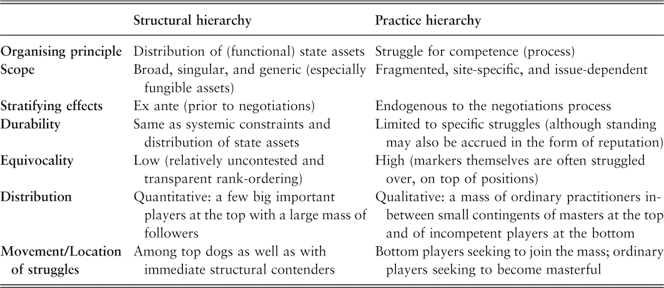
Taking stock of this and the previous section, Table 1 shows that the socially stratifying effects of multilateral diplomatic practice produce a distinctive brand of hierarchy compared to its structural alternative centered on the distribution of state capabilities. Both forms of hierarchy coexist in contemporary security governance and fall more or less in line with one another (I will return to this relationship in the conclusion). But they also exhibit contrasting features. Structural hierarchy forms a more durable, generic distribution of assets that preexist negotiations; by contrast, practice hierarchy is much more contingent because it emerges out of a local process of struggle for practical mastery. As such, practice-induced pecking orders are by nature more polysemous and fragmented than structural distributions. In terms of distribution and movement within the hierarchy, structural hierarchy tends to have more gradients, with struggles concentrated at the top echelons; whereas practice hierarchy is organised around a masterful vs incompetent binary where the positional movement takes place, with a mass of ‘ordinary’ practitioners mostly staying put in the middle. The next section seeks to illustrate how these analytical differences play out in practice.
Comparing structural and practice accounts of hierarchy.

International pecking orders in practice
How does hierarchy emerge out of multilateral diplomatic practice? In this section, I show how a number of practical logics that inhere in permanent representation to IOs both enable and constrain the struggle for competence. My analytical starting point is that IO-based diplomacy presents a number of intriguing features that are specific to the multilateral form yet general across sites. This peculiar morphology generates a number of practical logics that both enable and constrain the struggle for practical mastery. In what follows, then, I focus on relatively general sets of practices that obtain in different multilateral sites (as opposed to more deeply local ways of doing things). I do this in order to increase the analytical generality and portability of my analysis, although this in no way reduces the contextual thickness of each multilateral configuration. Importantly, my objective here is not to take a snapshot of a given pecking order at a particular point in time in a specific IO. This would certainly be an interesting endeavour, although measuring something as contingent, perspectival and contested as a struggle for competence does present daunting methodological challenges. In this section my aim rather is to inventory the key practical logics out of which multilateral pecking orders take root. What are the key multilateral diplomatic practices that create opportunities and constraints in the making and remaking of pecking orders?
My data builds in large part on a series of 68 semi-directed interviews conducted in Brussels and New York City over a span of 25 months (April 2009 to June 2011). Thirty-one (31) background interviews were also performed earlier, between 2006 and 2008. Looking into the internal politics of NATO and the UN, I met with ambassadors and lower officials from a sample of national delegations in order to discuss ongoing negotiations as well as the everyday practices of permanent representation.Footnote 48 Interviews were not for attribution and the identity, position, and nationality of interviewees are not referenced below. Meetings lasted between 45 and 75 minutes and the vast majority of them took place in the interviewee’s professional habitat. Throughout, I supplement this interview data with a number of other sources, including primary data gathered by other researchers, memoirs written by former practitioners, secondary analyses of actual negotiations and multilateral sites, as well as official accounts of meetings.
Showing esprit de corps
In their struggle for multilateral competence, diplomats are led to perform their trade in a way that appears supportive of the community. As an unwritten rule, the pure and naked maximisation of the national interest poses problem in multilateral diplomacy. There are tacit but very clear limits to what is acceptable and what is not in the pursuit of one’s objectives. As such, the skillful multilateral diplomat must walk a very fine line between getting her way and playing roughshod. Showing ‘esprit de corps’, to use the diplomatic shorthand, requires the constant demonstration of self-restraint and group solidarity.
Within multilateral sites, high social density requires everyone to preserve the appearances of social cohesion and mutual respect. To maintain relationships despite conflicts is of course a basic disposition for any diplomat; but the practical logic of esprit de corps is particularly pregnant in multilateral settings. Given the repeated and multidimensional negotiations involved, everybody begins with a vested interest in achieving some kind of agreement. The art of successful negotiation is less about benefitting individual participants than it consists of avoiding collective pitfalls. By implication, and contrary to standard constructivist accounts, the multilateral onus is less on substantive arguments and persuasion than on a collective endeavour to meet all potential objections. In the words of a seasoned UN practitioner: ‘Diplomatic issues are not resolved through the quality of arguments, but thanks to a capacity to imagine steps that people can engage in [and to find] the next step to rally people to move forward.’ The skillful practice of multilateral negotiation is – literally – a collective accomplishment.
By contrast, those delegates whose practices are not deemed supportive enough of the group generally pay hefty social costs. Blockers or vetoers often have a hard time maintaining their stance in the face of a group that wants to move in a given direction. Asking for derogations, for example, is often problematic in a multilateral configuration. Not only does it suggest ‘a lack of solidarity with partners’, argues one former ambassador; it also puts the delegate ‘in a position of claimant and thus weakness’.Footnote 49 Similarly, forceful tactics and arm-twisting strategies are risky: repeated attempts to publicly weaken an opponent’s hand at the multilateral table may lead other partners to react negatively and marginalise the offender. The same logic applies to the tactic of bid escalation: ‘One’s exaggeration leads to other’s escalation, neutralizing on the way the preferential room for maneuver that was sought.’Footnote 50 Brinkmanship must be performed very carefully within a multilateral configuration.
Because it feeds on regular and face-to-face interaction, the small world of permanent representation heightens the probability that breaching the rules will spark an immediate social reaction. The presence of an audience multiplies the possibility of chain reactions – a particularly complex part of multilateral diplomatic practice to master: ‘to the maneuvers of some add up those deployed by others, and each of them generally provokes reactions’.Footnote 51 So much so that, according to David Ambrosetti, ‘diplomatic practices primarily derive from the practical evaluation of the risk of a negative sanction, which worries agents about the durability of their social position. Indeed, in order to endure these social positions require reproducing routine practices.’Footnote 52 Showing esprit de corps is not only the skillful thing to do – it also comes with clear social benefits: ‘the maintenance of good personal relationships by the individual permanent representative with his colleagues often constrains the latter to make the best effort possible to accommodate his wishes within the framework of their own instructions. It is in the “squaring” of other people’s wishes with one’s own instructions that personal relationships play a role.’Footnote 53 Diplomats certainly have strategies and purposes, but they operate within a thick social context that prescribes and proscribes certain ways of doing things.
Deploying local codes
High social density fosters the development of local codes and rules, which competent diplomats know how to use. In order to be socially acceptable, the pursuit of the national interest must be cast in terms that make sense to the multilateral audience. This is a key component of what Jennifer Mitzen calls the ‘forum effects of talk’:Footnote 54 there are ways of presenting a case that are more skillful than others in the eyes of peers, usually because they resonate with local referents, be they international legal norms or recognised precedents. As a general rule, those representatives who are best able to make use of locally shaped codes gain social recognition as competent diplomats.
In order to learn the local codes, a diplomat newly posted to a multilateral site must go through a usually complex socialisation process. Learning occurs in and through practice, through immersion in the diplomatic setting. One diplomat put it thusly: ‘It’s about experience. When I came to New York for the first time, I spent one year without intervening. I would never speak up: I was observing, taking notes, etc. You can’t take the risk, at your first meeting, to do anything. People know each other, they know their limits, etc. You can’t intervene without knowing who’s with you in the room. You have to be credible for people to take you seriously. You can’t do what you want.’ Diplomatic standing comes out of the mastery of local practices, which is essentially learned by doing: ‘Knowing how to play the game is important’, concludes Niels Nagelhus Schia from his ethnographic stint in New York. ‘Local knowledge in the [Security Council] means knowing how to master the relationship between “instructions”, “influence”, “work culture”, and the dynamics in that small meeting room.’Footnote 55
In order to become a smooth operator, one must learn how to navigate within the group in a socially skillful way. For instance, informal gatherings allow for the diffusion of various pieces of information, indirectly gleaned through casual conversations with colleagues. In that sense, national delegates to IOs are akin to professional gossipers: they trade hearsay bites with one another so as to amass as much information as possible. As one interviewee explained: ‘Nothing in the UN is on the surface – nothing. Most people see what happens in the conference rooms, but that’s not the UN at all. It’s the corridors that determine what happens at the UN. In fact, sometimes it’s even outside the corridors. So the secret is to know how, as you walk into a room and you see delegates talking – you immediately build a picture while the two are talking. And that is how you get to know what the UN is really up to.’
Learning the ropes of multilateral diplomacy is not simply a question of knowing the rules, but also of knowing how to use those rules and when. As Buchet de Neuilly explains with regards to EU diplomacy: ‘Socialization entails not only the accurate interpretation of other negotiations’ positions and efficient anticipation, but also the internalization of a know-how, of a sociability in establishing contacts with other protagonists: how to select interlocutors, how to approach them – by email, by phone, by a lunch invitation –, how to orient discussions …’.Footnote 56 Practical skills (for instance: how to posture, how to call out to others, how to formulate an idea) are learned in and through practice, thanks to exposure, imitation, and trial and error. The author concludes that each forum ‘has its practical rules, its own norms of appropriateness. Minimal conformity to these norms is necessary in order to stay in the game.’Footnote 57 By implication, multilateral diplomacy may be done well or badly – the very essence of the struggle for practical mastery.
As I explained above, though, deviations from established practices are not always deemed incompetent in multilateral diplomacy. Virtuosic players sometimes manage to break with established ways of doing things and gain standing all the while. In the negotiations of the 2011 intervention in Libya, for instance, British diplomats were able to skillfully play with accreditation practices at the UN in order to have the defecting Libyan deputy PR address the Security Council in support of a military intervention.Footnote 58 Rather puzzlingly, as departing from established procedure as the British move was, other players around the table eventually let it go, as if it fell within the boundaries of UN rules. Multilateral diplomats who manage to carve a small room for manoeuvre between established ways of doing things and socially valued slippages may be recognised by peers as virtuosic – that is, as an astute innovator, a great leader, a charismatic speaker, a skillful negotiator, or an efficient bargainer. Alluding to Liechtenstein, one UN deputy permanent representative explained: ‘That Ambassador, he’s been here for what, ten years. So he knows everybody, he knows the procedures, he knows how to manage a meeting. It’s a technique for diplomats: how to convince or sway the audience in the room. … You speak in such a natural and convincing manner that those who don’t know their interest will follow you. … With time and experience you learn how to take the room’s temperature.’ Multilateral diplomacy is, through and through, a practice learned by doing.
Playing with Instructions
Although not entirely cut from the world, the multilateral site forms a partly secluded social environment. The strong and relatively exclusive ties that permanent missions enjoy with their capital are the source of complex practical logics having to do with information asymmetry. Governments regularly issue instructions for their permanent representatives in terms of objectives, requirements, and so-called red lines. Yet contrary to the cliché of the shrewd negotiator who keeps his cards close to his chest, multilateral diplomats sometimes openly discuss their instructions with others, either to take some distance from what the government is asking or to frame them to their advantage.
The most intuitive tactic here is to exaggerate the demands made by the capital in order to obtain more concessions. Such theatrics are the bread and butter of multilateral negotiations: ‘We say: “This is my red line, which I cannot cross.” These are classic formulas. There is also: “Those are the firm instructions from my capital, my minister or my president.” Great powers do a lot of drama. Their delegates come and tell you: “These are my instructions, I just received them, I was outside on the phone …” Or when it suits them, they leave the room and say: “Now I have to call my minister.” This is all theatre.’ Socially apt practitioners hide their opposition behind high demands that cannot be met by others. That said, while red lines are known to be part of the diplomatic way of life, abusing such tactics always risks marginalising those who pursue it. As they play with their instructions, competent diplomats strive to maintain an appearance of reasonableness: ‘Partners are generally not willing to make efforts to meet unreasonable demands. Overly tough tactics may lead to a loss a influence, and even to the discarding [mise au rancart] of the delegation.’Footnote 59
Perhaps the most socially valued way to play with instructions is for the multilateral diplomat to take some distance from them. In several interviews, the ability to carve room for manoeuvre for oneself was often treated as an indicator of competence by peers: ‘Many of us from time to time feel uncomfortable about instructions from home’, said one experienced diplomat. ‘Let me give you an example of one of my favorite ambassadors … who came with instructions that he didn’t agree with that he was uncomfortable with. He knew that we would all sort of contradict, disagree and so forth. And he said: “Come on, give me more arguments so I can feed them back home.”’ To show a measure of detachment from the capital is a skill that other diplomats recognise and value. It may signal a solid reputation at home as a seasoned negotiator or, in the case of political appointees, a close relationship with top-level decision-makers in the government. As David L. Bosco illustrates, one of the most highly regarded UN diplomats during the Bosnia crisis was Diego Arria, who ‘had a close relationship with Venezuelan president Carlos Andres Perez and did not require or accept regular instructions from the Foreign Ministry. His personality and room to maneuver made him an unusually influential nonpermanent ambassador.’Footnote 60
As a general rule, multilateral diplomacy requires diplomats to be able to take more distance from their capital than regular ambassadors would typically do. This is primarily due to the ever-going process of negotiation, which makes for a ‘continuous, unpredictable, and evolving structure that requires permanent adaptation and rectification’.Footnote 61 Diplomats often need to act quickly on pieces of information that are available only to people on the ground. In practice, there are clear limits to phoning the capital back and forth, because multilateral momentum emerges locally and requires fast reactions and adaptation. As one interviewee put it: ‘ambassadors need to have the flexibility necessary to be able to reach a position of consensus without all the time call back the capital to see how far we can go.’ Practices vary across countries when it comes to the nature of the instructions that are sent to permanent missions. Regardless, socially skilled diplomats make daily usage of all the flexibility they can get in order to take time-sensitive initiatives, craft local compromises, or coordinate positions on the ground.
Reporting back
The information asymmetry created by the relative seclusion of the multilateral clique works in the opposite direction too – from the permanent mission to the capital. It creates a high demand, on the part of capitals, for insider information. This induces a peculiar practical logic in the everyday interactions that national delegates have, in which gathering information about others’ positions, dilemmas, and manoeuvring becomes an overarching objective. Regarding the UN, for instance, ‘almost invariably, there is less information on [issues] at many capitals than in New York. Governments are thus largely dependent upon their missions for much of the information necessary for the making of policy, particularly where it concerns the attitudes of other governments and the possible patterns of voting on given issues.’Footnote 62 In this endeavour, tracking the positions of other delegations, and packaging and communicating this information back to the capital, become critical sources of standing.
On an everyday basis, delegates are aware of a number of internal dynamics that escape the capitals’ knowledge. As a partly secluded social configuration, multilateral diplomacy develops its own temporality. For example, Magnus Ekengren shows how European governance works along its own, peculiar rhythm, with significant consequences for national policymakers and institutions.Footnote 63 Local institutional procedures and bureaucratic practices create a practical space for representatives to ‘re-dramatize’ or ‘re-transcribe’ the nature of multilateral discussions so as to frame them in a way that is adapted to the group’s own practical logics: a ‘performing diplomat’ excels in ‘translating’ often-contradictory requirements between the capital and the multilateral diplomatic setting.Footnote 64 Similarly, referring to the Libyan intervention, one interviewee explained: ‘The French ambassador was a big pedagogue. He really did a great job explaining to Paris that they needed NATO. He was excellent. Because you know, Paris had problems understanding and accepting this.’ Competent diplomats sometimes come close to suggesting their own instructions to the capital.
Thanks to their insider feeling for the unfolding of negotiations, skillful delegates manage to claim room for manoeuvre from the capital. There is a form of selective retention at work here: ‘They report back to their capitals what will or will not work, reports in which they have quite a bit of discretion. Also, officials in the capitals do not know what happens in informal discussions among diplomats unless ambassadors share that information.’Footnote 65 In some cases, the redramatisation even goes one step further, in the form of ‘the collective “plotting” of agreements’, whereby multilateral diplomats reformulate the stakes in order to move the negotiations forward: ‘Plotting’ is a negotiation pattern in COREPER that demonstrates how a collective rationality can reformulate individual, instrumental rationality. The basic function of plotting is using the group to redefine a national position or to reshape domestic constraints. ‘To get new instructions we have to show [the capital] we have a black eye’, an ambassador explained, ‘We can ask COREPER for help with this; it is one of our standard practices.’Footnote 66
These social dynamics grant multilateral diplomats much more agency than what IR theory usually concedes. As Cross writes about the EU: ‘COREPER ambassadors are not simply transmission belts for states. They are constantly coming to agreement among themselves, then seeking to persuade their politician counterparts of their decisions. Although they work with instructions, in the EU context they often play a role in writing those instructions and frequently persuade their capitals to be flexible.’Footnote 67 There is a kind of dialogical process going on, from the capital to the mission and back: ‘It is through a dialogue with permanent missions that governments can develop a national policy.’Footnote 68 As one ambassador put it: ‘I talk to my director often. “I feel that so and so. …” And I tell him: “This is closer to our position, this is less close to our position.” And I suggest we could go as far as something. And then I try to rally the rest to come as close as possible to what we think is a reasonable position.’ In other words, because of local dynamics multilateral diplomats often end up partaking in ‘policy formulation’.Footnote 69 And the better attuned to locally defined multilateral dynamics the instructions they help formulate are, the stronger their hand and profile become within the clique.
Riding the beltway
While the main connection that permanent missions entertain with the external environment is with their own capital, governments on their part maintain parallel relations with other head offices, forming a kind of beltway around the multilateral clique. Government apparatuses tend to have their own set of ties potentially circumventing permanent missions. This beltway introduces further opportunities and constraints in the struggle for practical competence: for one thing, competent diplomats know how to use their capital’s network to reinforce their hand; and for another thing, practical mastery requires permanent representatives to avoid being sidelined by direct capital-to-capital relations.
Diplomats call the practice of moving a given negotiation from the multilateral site up to a bilateral, government-to-government contact a démarche. Skillful diplomats make use of the beltway if and when needed: ‘Sometimes New York is not enough. You need to involve the capital.’ In the 2011 Libyan crisis, for instance, several delegates reported that the negotiations became a ‘multi-level thing’, with ‘contacts at a higher level in the capitals.’ As a result, the ‘diplomatic power’ of a country also hinges on the extensiveness of its worldwide network of embassies abroad, said one interviewee. ‘In order to achieve something’, confirmed another delegate, ‘you often need to work on capitals.’ Beyond démarches per se, the diplomatic outreach of a country can play a key role in supporting permanent missions on the field: ‘Some countries benefit from the multipositionality of their government, directly represented in related negotiations (e.g, Security Council resolution, Contact Group agreement, NATO declaration …) which supplies precious insider information.’Footnote 70
The flip side is that the risk for a delegate to be sidelined by the beltway is very real. After all, it is not only diplomats who detain valuable information that the capital does not have; central governments, thanks to their bilateral ties with other countries, are also aware of the big picture that often escape practitioners on the ground. What is more, in multilateral diplomacy the beltway may also serve disciplining purposes, when it is thought for instance that a given ambassador is acting outside of (or beyond) its instructions. As one practitioner explained: ‘We know that for certain countries in order to get support we need to approach them here in New York but also in the capitals. Then, here in New York we make the capital’s position known and say: “Listen, you say this, but your capital says that. How do you explain the difference?” Sometimes it becomes a triangle, because the communication between mission and capital isn’t working.’ At the Security Council, the permanent members are masters at this practice: ‘The P5 calls your capital, and your president then puts you back in place. If you hold your ground with P5, they will block you somewhere else.’ The pecking order can be a brutal reality.
Under such circumstances, it sometimes occurs that the capital will prefer to back down and instruct its ambassador to stay out of the way. One delegate recalled a telling episode: ‘In a GA committee, the Chair had slipped some language in his report that hadn’t been agreed upon previously. But the capital calls and says: “I don’t want any upheavals, don’t speak, just get out of the room.” There was pressure from the P3 [France, the UK and the US] thus it is better to abstain.’ Clearly, the beltway can seriously curb multilateral diplomats in their struggle for standing. As this delegate added: ‘There is a disconnect between capitals and New York. They don’t know the reality on the ground. There is a lot of humiliating blackmail with the capital. They hold us with money.’ Country profiles, professional trajectories and the stakes at hand all intersect in creating a field of potentialities for competent diplomats to realise.
Brokering and group politics
As one former permanent representative with decades of experience in New York put it: ‘The only sin at the UN is being isolated.’ Group politics and the necessity of belonging to shifting coalitions are key structuring logics of multilateral sites. The urge to team up with others and enter into privileged relationships is the essence of skillful diplomacy. As a result of clustering dynamics, multilateral diplomacy generally takes place on two fronts simultaneously: within the subgroup and between the subgroups.Footnote 71 As Margaret P. Karns and Karen A. Mingst observe: ‘The diplomacy of coalition-building is likely to be both bilateral and multilateral. It involves negotiating a common position, then maintaining cohesion and preventing defections to rival coalitions, as well as choosing representatives to bargain with others. In other words, there is a both intra-bloc diplomacy and interaction with other blocs, the secretariat of the organization and committee chairs.’Footnote 72 In functional terms, this feature is both an advantage and a disadvantage: ‘Groups may facilitate international dialogue and help overcome lowest common-denominator and consensus decision-making by building consensus among the like-minded first, locking in positions and reducing the number of possible objections; at the same time, they may also introduce rigidity into decision-making and prevent coalitions among potential partners.’Footnote 73 The latter dynamic often creates particularly vexing deadlocks, because once a subgroup finds a common position, it is often less flexible given the compromises that have been already made internally.
Clustering dynamics make it possible for some countries to play distinctive roles as brokers – a significant source of diplomatic standing. Brokers occupy central positions in networks thanks to stronger than average connections with more than one cluster. This strategic location, linking otherwise less connected subgroups of nodes, generates interesting pecking order dynamics. Brokering renders others dependent on the broker for their interactions, both inside the cluster and between the clusters. Within the subgroup, multilateral diplomacy rests on the local ties that ambassadors develop and cultivate. As Guillaume Devin explains: ‘In a somewhat paradoxical way, bilateralism sits at the core of multilateral negotiation. It tests potential allies, assesses possible compensations, defines expectations, prepares groupings. Multilateralism is unthinkable without bilateralism because the latter is the only way to build coalitions.’Footnote 74
Brokering often remains a rather informal position in multilateral diplomacy, but in some cases it is semi-codified. The practice of ‘taking the lead’ at the UN Security Council, for instance, is relatively institutionalised by now: ‘Through this position, one or several delegations are informally granted a driving position in the negotiation and decision-making process concerning a particular issue and at a particular moment.’Footnote 75 As the ‘pen holder’, a given mission and its representatives are offered the possibility to broker deals among various actors and draft the documents to be negotiated. In more general terms, the number of committees and commissions that IOs often comprise means that there are always many such brokering positions up for grabs. Some permanent representatives build a reputation for these kinds of leadership positions: one experienced permanent representative for a microstate admitted that ‘Now, people come to me to offer a position. Before I had to seek them.’
Brokerage positions form a significant source of standing and influence in the diplomatic process. For instance, it is not rare for diplomats representing smaller countries to rely entirely on the subgroup to which they belong in order to get information and formulate a position on a given issue. In a large platform such as the UN, several capitals ‘often instruct their representatives to support the group consensus’.Footnote 76 Brokers are in a position to define group positions and coordinate the circulation of information. As one ambassador explained: ‘Countries ask for my point of view. What are your ideas on Syria, on Somalia? They know our contribution. Some countries even ask me to campaign for them. Others follow our lead, and ask what our position is on X and Y.’ On top of leading their own coalition, brokers also spearhead communication and interaction with other subgroups in the multilateral configuration. Leading representatives are charged with communicating the group’s positions to outside partners, as well as with negotiating on behalf of group members. Brokers also are the preferred interlocutors of chairpersons and senior international civil servants, a process that further reinforces standing. Some ambassadors play the brokerage card so well that they end up spearheading more than one group. For instance, one interviewee explained that Egypt is a ‘very influential player’ in the African Union, the Organisation of the Islam Conference, and the Non-Aligned Movement, which allows it ‘to be one day an African country, the other Arab, and then developing’. As a result, he said, ‘You have to get Egypt inside; otherwise they become spoilers.’
Given intergroup dynamics, the geometry of the multilateral setting shifts rapidly.Footnote 77 Clustering introduces third-party dynamics in multilateral diplomacy, adding another layer of complexity to the practice. Third parties are essentially those representatives who do not have a direct stake in a given negotiation, but nonetheless hold the balance of power to decide where the collective wind shall blow. When two delegates disagree in a multilateral negotiation, they do often not settle the dispute as in a duel, but by the other members around the table, who observe, ponder, and adjudicate the reasons given by each to take a given stance. Third parties may remain neutral in appearance, but in actuality they are likely to tip the balance in one’s favour. This means that multilateral diplomats not only fulfill their instructions, but also arbitrate the conflicting interests of their peers.
To conclude, in multilateralised security governance ‘being part of the parade’ (to borrow Schia’s terms) often becomes an end in itself.Footnote 78 One deputy permanent representative expressed the stakes quite well: ‘As far as we are concerned, we try to be on all groups because being present is also a way to exist.’ All in all, the practical logics of multilateral diplomacy and the struggle for competence that they spark would seem to take on a life of their own in the twenty-first-century politics of international security.
Conclusion
The politics of international security do not function in the same way under conditions of multilateralised governance as they would otherwise. As this article sought to demonstrate, the prevalence of multilateral diplomacy creates distinctive opportunities and constraints that help generate endogenous pecking orders in the collective management of organised violence. Contrary to the power-based model, the organising principles of international hierarchies are not fixed and generic but defined in context. The multilateral process generates a peculiar kind of struggle over diplomatic competence, out of which local pecking orders emerge. To put it in counterfactual terms, but for multilateralised governance the politics of international security would be structured along different kinds of hierarchy than the ones currently on display. The point is not that structural accounts focused on state assets are wrong but simply incomplete. They fail to capture key sources of international hierarchy that owe specifically to the multilateralisation of security governance.
How do the structural and practice hierarchies interact? This question opens a fascinating avenue for future research. There is not enough space here to get into details, but generally speaking, three kinds of interaction may occur: practice-based stratification either multiply, reflect, or dampen structural effects due to state resource distributions. Which of these effects obtains depends in part which multilateral practical logic one looks into. Some diplomatic practices would seem to favour the dominant: riding the beltway, for instance, is easier to do for ambassadors of larger countries with vast diplomatic network abroad. For their part, brokering practices could go either way: richer and larger countries have better trained and more numerous personnel on site to navigate coalition politics and group meetings; but ambassadors from smaller countries are often better situated to play a go-between role given their limited substantive interests. When it comes to playing with instructions and reporting back, the afferent opportunities and constraints flow not from resource distributions but from national organisational and bureaucratic traditions. Finally, the practical logics of showing esprit de corps and deploying local codes would seem to open the door to delegates who need to make up for their country’s structural weaknesses. And yet, chances are that a diplomat from a structurally powerful country will not suffer the same social opprobrium from insufficient mastery of the codes as its colleagues.
All in all, then, the connections between structural forces and multilateral pecking orders are variegated, complex, and multidirectional. So much so, in fact, that it is not impossible for the same practice to produce conflicting effects. For instance, countries such as the US, which tend to politically appoint permanent representatives, benefit from closer ties with top decision-makers, but may also suffer from a lack of diplomatic experience and networking. Such contingency is built in the very process of the struggle for competence. The play of practice, while structured, is never determined. That is why the account I proposed in this article is such a necessary complement to the power-based model in IR. Compare with David A. Lake, for instance: ‘If we but peel back the surface of formal equality, we can see many symbols of obeisance in the everyday practice of world politics.’Footnote 79 Such a view arguably runs the risk of reducing practices (‘symbols of obeisance’) to mere effects of hierarchy-qua-structure.
Yet practices do not form a superficial varnish atop more fundamental processes, or a curtain in front of the stage: they are the social reality in and of itself. Put differently, ways of doing things are not mere effects of structures but the constitutive building blocks of social life. As Alexander Wendt correctly notes, overlooking processes ‘is problematic because macro-level structures are only produced and reproduced by practices and interaction structures at the micro level’.Footnote 80 Without a doubt, the structure of international hierarchy would immediately falter if it were not for the manifold productive practices that generate, reproduce and transform it. Even the most minor patterns of action, argues Goffman, generate social stratification: ‘The expression of subordination and domination through this swarm of situational means is more than a mere tracing or symbol or ritualistic affirmation of the social hierarchy. These expressions considerably constitute the hierarchy; they are the shadow and the substance.’Footnote 81 Far from being ‘inherently unobservable’,Footnote 82 then, international hierarchy is part and parcel of each and every practice that makes the world go round.
Biographical information
Vincent Pouliot (PhD University of Toronto, 2008) is an Associate Professor and William Dawson Scholar in the Department of Political Science at McGill University. He is also the Director of the Centre for International Peace and Security Studies (CIPSS) and a Research Fellow at CERI-Sciences Po Paris. Pouliot’s research interests include the political sociology of international organisations, the politics of multilateral diplomacy, and the global governance of international security. With Cambridge University Press, he is the author of two books (International Pecking Orders: The Politics and Practice of Multilateral Diplomacy, 2016; and International Security in Practice: The Politics of NATO-Russia Diplomacy, 2010) and the co-editor of two volumes (Diplomacy and the Making of World Politics, 2015; and International Practices, 2011). His works have appeared in various outlets, including International Organization, International Studies Quarterly, European Journal of International Relations, Security Studies, Review of International Studies, International Theory, Journal of Peace Research, International Political Sociology, Global Governance, Cooperation and Conflict, and International Journal.
Acknowledgments
For helpful comments on this article, I am grateful to Sébastien Mainville and EJIS reviewers and editors. A full list of the many people and organisations that have made the broader project possible may be found in the Preface of my 2016 book, from which this article is drawn (International Pecking Orders: The Politics and Practice of Multilateral Diplomacy; Cambridge University Press).