Introduction
Since the early 1990s, the Dutch health system has been undergoing a transition from supply-side government regulation towards ‘managed competition’Footnote 1 with a view to making health insurers prudent purchasers of care for their enrolees (Schut and Van de Ven, Reference Schut and van de Ven2005; Van de Ven and Schut, Reference Van de Ven and Schut2008, Reference Van de Ven and Schut2009). In 2006, the government took a major step, implementing the Health Insurance Act (Zorgverzekeringswet): a mandate for every citizen to buy a basic package of health-care benefits from a private insurer. The Act is financed through a combination of income-related contributions (50%), community-rated premiums (45%) and general tax revenues (5%). Individuals can choose between insurers on an annual basis (open enrolment) and insurers can selectively contract or integrate with health care providers. Income-related subsidies aim to make health insurance affordable for everyone, while a risk equalisation scheme compensates insurers for enrolees with predictably high medical expenses in order to guarantee a level playing field and prevent risk selection.
In this article, we consider whether and how health insurers are taking up their role as purchasers of health services. Do they effectively compete for customers and negotiate with health-care providers about the price, quality and coordination of health services? Do they engage in selective contracting, managed care or vertical integration, and do they channel enrolees to preferred providers or provider networks? Has purchaser competition improved efficiency in health-care provision?
To answer these questions, we review evidence from the period 2006–2009. This evidence – largely collected as part of a formal evaluation of the initial effects of the Health Insurance Act carried out for the Ministry of Health in 2009 (Van de Ven et al., Reference Van de Ven, Schut, Hermans, de Jong, van der Maat, Coppen, Groenewegen and Friele2009) – is based on a variety of documents (scientific papers, policy documents, annual reviews by the Dutch Healthcare Authority (Nederlandse Zorgautoriteit, NZa) and relevant publications from stakeholders and supervisory and advisory bodies) as well as 27 interviews with key stakeholders (government, health-care providers, health insurers, patient organisations and supervisory bodies).
We start with a short description of the Dutch health system post-reform and the main policy measures implemented between 2006 and 2009. We then analyse evidence concerning the effects of purchaser competition. Finally, we briefly discuss future prospects for managed competition in the Dutch health system.
Changes in the Dutch health system since 2006
The introduction of the Health Insurance Act profoundly changed the health insurance system in the Netherlands. One major change was the abolition of the distinction between mandatory social health insurance for lower- and middle-income groups (previously administered by sickness funds) and voluntary private health insurance for higher-income groups (sold by private insurers). This was accomplished by transforming the legal status of the sickness funds from non-public administrative entities into private health insurers and by applying much of the regulation of the former sickness fund scheme (e.g. open enrolment, community rating and risk equalisation) to private health insurers.
As a result, all Dutch citizens are now mandated to buy a legally defined basic benefits package from a private health insurer at a community-rated premium. Children below the age of 18 are exempted from paying premiums; their expenses are financed through general taxation. Half of all benefits are financed through income-related contributions (largely paid by employers). Both income-related contributions and government subsidies for children are pooled in a central Risk Equalisation Fund, from which health insurers receive risk-adjusted capitation payments. Health insurers compete for customers and are free to set their own community-rated premiums and to contract with any health-care provider. They must also accept any applicant for basic health insurance, irrespective of an applicant's risk status or other personal characteristics.
A sophisticated risk equalisation scheme is intended to neutralise the strong incentive for risk selection created by the requirement to charge community-rated premiums. The scheme was first introduced in 1993 for the old sickness funds (which also had to compete for members) and has gradually been improved by adding new risk adjusters. The most significant improvements were the introduction of pharmacy-based cost groups in 2002 and diagnostic cost groups in 2004 as indicators for chronic and severe health problems. As risk equalisation is not perfect, health insurers receive ex-post compensation for the health-care costs of high-risk individuals, but as the risk equalisation scheme has improved, the extent of ex-post compensation has declined from 97% of total expenditure in 1993 to 25% in 2010.
In contrast to the radical reform of the health insurance system, the supply side of the health-care market remained largely unchanged in 2006 and for the most part is still heavily regulated by the government. Although health insurers have been given incentives to act as prudent purchasers and are allowed to selectively contract health-care providers, room for negotiating on price and quality is severely constrained by government regulation. In fact, reform of the health insurance market represents only the first stage in the introduction of managed competition. The next stage, a complementary reform of the provider market, only began around 2006. Managed competition in Dutch health care therefore remains a work in progress (Van de Ven and Schut, Reference Van de Ven and Schut2009).
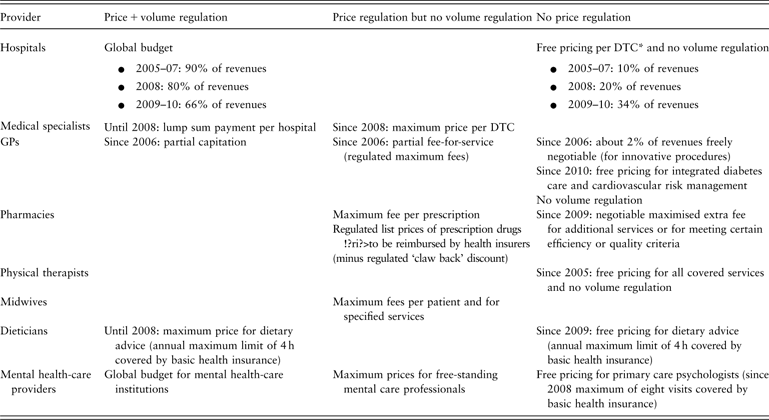
Nevertheless, since 2005 the scope for health insurers to actively purchase health services has gradually increased. As Table 1 shows, while the prices of most services covered by basic health insurance are regulated by government, health insurers have greater opportunity to negotiate on price. In the hospital sector, freely negotiable prices were introduced in 2005 for a number of routine hospital procedures (services in what is known as ‘segment B’ e.g. hip, knee, cataract and inguinal hernia operations), accounting for about 10% of total hospital expenditure. Free pricing was extended to about 20% of hospital expenditure in 2008 and about 34% in 2009. In addition, price regulation was abolished for physical therapists in 2005 and for dieticians in 2009, and the Dutch Healthcare Authority has advised the government to allow pharmacies and midwives to set their own prices from 2011. However, fees for specialists and general practitioners (GPs) continue to be tightly regulated. Still, these regulated prices are maximum rather than fixed prices, leaving room – at least in theory – to negotiate lower prices.Footnote 2
Price regulation of care covered by basic health insurance, 2005–2010
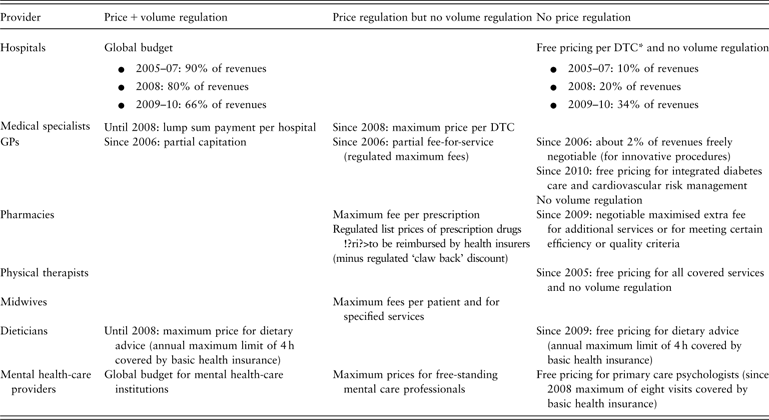
DTC = diagnosis treatment combination; GPs = general practioners.
*A DTC (diagnose behandelcombinatie) is a combination of a patient's diagnosis and typical treatment pattern in a hospital or by a mental health-care provider. Unlike most DRG systems, the Dutch DTC system describes the total episode of care delivered in hospitals (not only inpatient care but also outpatient and day care and including activities by medical specialists).
There are also substantial (regulatory) barriers to entering the health-care market. The government restricts entry to medical school (numerus fixus), while entry to residential training programmes for specialists and GPs is largely controlled by the medical profession and academic hospitals. Partnerships of specialists also control entry to hospital facilities and generally uniform admission contracts between specialists and hospitals provide the former with almost guaranteed permanent appointment.
Prior to 2008, entry to the hospital market was almost impossible. Setting up a hospital required a building permit from the government and access to legally guaranteed full reimbursement of capital investment. Only a small number of independent treatment centres (zelfstandige behandelcentra) were able to enter the market (provided that the period of treatment did not exceed 24 h). Moreover, hospitals are not allowed to distribute profits, so entering the hospital market is unattractive to private entrepreneurs. As with price regulation, however, entry regulation has slowly fallen since the 2006 reform: the building permit was abolished in 2008; hospitals are increasingly put at risk for capital investment; the government is considering creating a new legal entity which would make it possible to attract private capital in the hospital sector and distribute profits under legally specified conditions; and both the Dutch Healthcare Authority and a major advisory body on health care have advised the government to lower entry barriers to medical education and residential training and change the contractual arrangements between (partnerships of) medical specialists and hospitals (NZa, 2009e; RVZ, 2009, 2010).
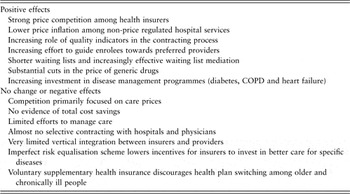
In view of the limited scope for health insurers to negotiate with providers on health-care price and quality of care, what effect has extending purchaser competition had so far? Depending on one's perspective, the glass can be seen as either half full or half empty. Table 2 summarises the effects of purchaser competition following the 2006 Health Insurance Act, which we discuss below in more detail.
Overview of the effects of purchaser competition, 2006–2009

Effects of purchaser competition: a glass half full
Price competition among health insurers
The Health Insurance Act has led to strong price competition among health insurers. Many insurers attract customers by offering low-priced policies, particularly through discounts on group contracts.Footnote 3 The Act has also encouraged many people to reconsider their choice of insurer. The switching rate initially rose to 18% of the population, an all-time high. In subsequent years, however, the rate has fallen to about 4% (slightly higher than under the previous sickness fund scheme; NZa, 2009a). As a result of vigorous price competition, community-rated premiums converged and most health insurers incurred annual losses on the basic benefits package (Vektis, 2009a).Footnote 4 To prevent further losses, health insurers began to cut operating costs, which decreased on average by about 10% to 3.6% of gross premiums in 2008 (Vektis, 2009a). Health insurers also began to employ strategies to lower health-care costs. Here, we focus on the most interesting purchasing strategies concerning hospital care, prescription drugs and primary care.
Hospital prices
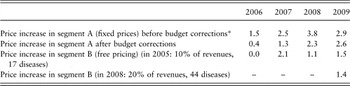
As Table 3 shows, health insurers increasingly put pressure on hospitals to charge lower prices. As a result, hospital prices in the free-pricing segment (B) have increased at a lower rate than in the regulated-price segment (known as segment A). In 2006 and 2008, prices in segment B even declined in real terms. The aggregate volume of hospital services in segment B grew by an average of 4.2% per year between 2005 and 2007, which was somewhat below the average annual increase of 5.2% in segment A (NZa, 2009b). Thus, there is no indication of hospitals offsetting lower price increases in segment B by increasing service volume (supplier-induced demand).
Changes in average hospital prices, 2006–2009 (% growth relative to previous year)

*If total annual health-care expenses covered by the HIA exceed a soft budget constraint set by the government, the government may retrospectively reduce hospital revenues by price cuts in subsequent years.
Source: NZa (2010).
However, preliminary figures indicate that the change in the payment of specialists (from a fixed lump sum to a fixed payment per diagnosis treatment combination) in 2008 generated strong growth in the volume of hospital care (NZa, 2010). Only a few health insurers include volume caps in their negotiations – for example, by using a sliding scale in which prices go down if volume exceeds certain thresholds (NZa, 2008).
For segment B, hospitals typically charge different prices to different insurers. An empirical study of the impact of the relative bargaining power of hospitals and health insurers in the first two years after the reforms shows that hospital concentration had a significantly positive effect on hospitals’ price-cost margin and insurer concentration had a significantly negative effect (Halbersma et al., Reference Halbersma, Mikkers, Motchenkova and Seinen2007).
Hospital quality
Quality of care plays an increasing role in contracts between health insurers and hospitals. A 2009 survey of hospitals found that about two-thirds make agreements with health insurers about quality and almost 90% about reporting quality indicators (NZa, 2009b). Further analysis shows that while most contractual arrangements involve initiatives to improve quality, most of the quality indicators used are related to the structure and process of care, although some health insurers also use outcome indicators when contracting selectively (NZa, 2010).
The use of quality indicators for hospital care – especially those related to outcomes – is still in its infancy, but health-care reform was an important catalyst for their development. Since 2005, the Dutch Health Care Inspectorate (Inspectie voor de Gezondheidszorg) – a governmental body responsible for monitoring health-care quality – has published annual reports on the performance of Dutch hospitals based on 20 quality indicators (Berg et al., Reference Berg, Meijerink, Gras, Goossensen, Schellekens, Haeck, Kallewaart and Kingma2005). Since 2006, the Netherlands Health Insurers Association (Zorgverzekeraars Nederland) has published an annual guide to hospital services in segment B that includes hospital performance indicators.
More broadly, a national system of measuring consumer experience with health insurers and providers has also been developed since 2006. These consumer quality indices are published on a government-sponsored website (www.kiesbeter.nl). The website shows that consumers score health insurers fairly highly, from 7.4 to 8.8 on average per insurer on a 1–10 scale.Footnote 5 It also rates hospitals using a three-star system to indicate below average, average and above average performance for selected diseases (e.g. readmission or mortality rates following myocardial infarct for patients in specific age groups).
The media have used the public release of quality indicators to construct hospital league tables. However, due to variation in the indicators used, the quality of the indicators and the way in which the league tables were constructed, the rankings produced are highly inconsistent (Pons et al., Reference Pons, Lingsma and Bal2009; Varkevisser, Reference Varkevisser2010). Moreover, the indicators used are not reliable because they are not adjusted for case-mix and ignore the impact of random variation (Van Dishoeck et al., Reference Van Dishoeck, Looman, Wilden-van Lier, Mackenbach and Steyerberg2009).
In 2007, the Health Care Inspectorate set up an ambitious programme (Transparent Care) to develop reliable, comparable and valid quality information for patients, health insurers, providers and policymakers. The process of implementing comprehensive sets of structure, process and outcome indicators began in 2008 for 10 diseases (e.g. diabetes, hip and knee replacement and breast cancer) in 33 hospitals. The aim is to expand the indicator sets to about 80 diseases for all hospitals in 2011. Performance indicators are also being developed for other health-care providers.
Preferred providers
Health insurers use various incentives to guide their enrolees to preferred hospitals. Several provide information on their websites about good-quality local hospitals and about half exempt people from paying the mandatory deductible (€165 per year) if they visit a preferred hospital. Whether these soft incentives to channel patients towards preferred hospitals are effective is not known. To date, only one health insurer has selectively contracted hospitals, reimbursing only 80% of the cost of non-acute care in non-contracted hospitals.
Hospital waiting lists
Hospital waiting lists have slowly decreased since 2000, a downward trend that continued after the introduction of the Health Insurance Act. For most hospital services, waiting times have fallen substantially since 2006 and, with a few exceptions, are currently below the generally agreed acceptable norms (Treeknormen; established in 2000 by the representative associations of providers and health insurers; NZa, 2010). Health insurers are increasingly active in assisting their enrolees to obtain faster treatment. Most have introduced waiting list mediation services that actively search for hospitals with the shortest waits. In 2009, these mediation services claimed to have reduced waiting times for about 47,000 people by an average of 1 to 2 months (Baltesen, Reference Baltesen2010). About 10% of these patients were treated in hospitals in other countries, mainly Belgium, Germany and Spain.
Pharmaceutical prices
Perhaps the strongest effect of purchaser competition so far has been downward pressure on generic drug prices (Boonen et al., Reference Boonen, van der Geest, Schut and Varkevisser2010). Before 2008, generic drug prices in the Netherlands were very high due to ineffective price regulation. Pharmacies were allowed to charge health insurers the official list price as set by the supplier. Suppliers of off-patent drugs competed for market share by offering discounts to pharmacists. However, pharmacies had no incentive to pass these discounts on to health insurers because (until 2006) health insurers had to reimburse the full cost of all drugs covered by social health insurance up to a legally determined reimbursement limit. As a result, the prices of generic drugs were all close to the reimbursement limit and pharmacies made huge profits. Although the government tried to claw back part of the discounts offered to pharmacists, these attempts were only marginally successful (Boonen et al., Reference Boonen, van der Geest, Schut and Varkevisser2010).
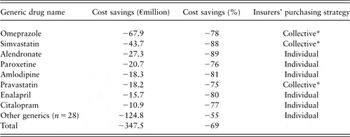
The Health Insurance Act allowed insurers to use preferred drug formularies. In 2008, four of the five biggest health insurers started to experiment with preferred drug formularies for the lowest priced generics within the same therapeutic class. This means that if a patient chooses a non-preferred drug, the cost of the drug is no longer reimbursed by the insurer. Preferred drugs were selected by issuing tenders among suppliers of several high-volume generic drugs. The individual bidding strategies had a dramatic effect on the prices of generics. List prices of the 10 biggest-selling generics fell by between 76% and 93% (Boonen et al., Reference Boonen, van der Geest, Schut and Varkevisser2010), leading to aggregate savings estimated at €348 million (69%) per year (see Table 4).
Cost savings on generic drugs, 2008

*For three blockbuster generic drugs, six health insurers jointly organised a competitive bidding process. This collective bidding process was approved by the Netherlands Competition Authority (Nederlandse Mededingingsautoriteit), which concluded that it would not result in a significant reduction of competition. In 2009, collective purchasing strategies for these drugs were replaced by tendering by individual health insurers.
Source: Boonen et al. (Reference Boonen, van der Geest, Schut and Varkevisser2010).
In 2009, the use of preferred drug formularies was extended to include more generic drugs (some of which went off-patent in 2009) and adopted by more health insurers, resulting in additional cost savings. Despite large price reductions, total pharmaceutical expenditure increased moderately (by 1–2%), mainly due to growth in the consumption of drugs going off-patent (Vektis, 2009b).
Primary care and disease management programmes
Health insurers are increasingly involved in supporting disease management programmes for chronic diseases such as diabetes, chronic obstructive pulmonary disease, strokes and chronic heart failure. A major obstacle to developing integrated care programmes, however, is the rigidly regulated payment system for GPs. Since 2007, therefore, the government has supported experiments with bundled payments for diabetes management programmes involving nine primary care groups varying in size from 7 to over 100 GPs (Struijs et al., Reference Struijs, van Til and Baan2009). Following intensive negotiations between primary care groups and health insurers about the organisation and type of services to be included, negotiated prices for delivering or purchasing all care defined in the programme varied from about €250 to €475 per patient per year.
A preliminary evaluation did not show improved patient outcomes after one year and did not investigate the impact on hospital admissions, intensity of treatment and total costs (Struijs et al., Reference Struijs, van Til and Baan2009). In spite of these inconclusive results, in 2010 the government decided to allow all insurers and primary care groups to negotiate bundled disease-based payments for diabetes, cardiovascular risk management and chronic obstructive pulmonary disease and such payments have now been taken up by about 100 primary care groups.
The introduction of bundled disease-based payments may generate serious risks for health insurers, such as the potential for duplicate payments (due to comorbidity), risk selection by providers and abuse of market power by large primary care groups (Struijs et al., Reference Struijs, van Til and Baan2009; NZa, 2009c). However, greater scope for negotiating other payment schedules with primary care providers may be seen as a first step towards more comprehensive bundled payments and integrated and coordinated delivery systems (ZN, 2009).
Effects of purchaser competition: a glass half empty
Competition primarily focused on price
Critics note that so far purchaser competition has focused primarily on price. Although much more attention is paid to variation in quality now than prior to the reform, this has had a limited influence on the purchasing process. Most health insurers are unwilling to selectively contract with health-care providers and rely on soft incentives to channel enrolees to preferred providers. The effectiveness of these incentives is doubtful and they may not provide health insurers with sufficient leverage to stimulate better performance among providers. Health-care providers may therefore be able to offset lower prices by inducing demand for their services. In recent years, demand for most health services has increased substantially, and there is some evidence to show that part of this increase may have been induced by providers (Pomp and Hasaart, Reference Pomp and Hasaart2009).
Health insurers are also very reluctant to integrate vertically with providers and to set up health maintenance organisation-type organisations as in the United States and Switzerland. To date, only one major health insurer has vertically integrated with a primary health-care centre and participates in a number of others, in spite of initially planning to establish about 50 health centres.
At the end of 2008, a relatively small regional health insurer announced plans to set up a cooperative (together with a regional GP cooperative, nursing homes, hospital personnel and specialists) to take over a local hospital that was in financial trouble. This provoked fierce opposition in parliament and several political parties even proposed changing the Health Insurance Act to prohibit the vertical integration of hospitals and health insurers. The main fear was that health insurers would interfere with professional autonomy and patients would no longer have free choice of provider. After an independent expert committee judged that vertical integration was not in itself harmful to the public interest, the government dismissed the proposal to prohibit vertical integration.
The reaction to the proposed integration demonstrated that the idea of health insurers interfering in medical practice remains a sensitive issue in the Netherlands. This seems to be an important explanation for the reluctance of health insurers to engage in selective contracting and managing care. Annual surveys show that an increasing proportion of the insured do not believe that health insurers are committed to contracting good quality care (Boonen, Reference Boonen2009). Health insurers are keen to avoid being seen as dictating to doctors which type of care they can prescribe to their patients. Without better performance indicators, it may be difficult for health insurers to overcome doubts concerning their commitment to quality.
Imperfect risk equalisation offers inappropriate incentives
Despite continuous improvement in the risk equalisation scheme, health insurers can still easily identify unprofitable subgroups (Van de Ven and Schut, Reference Van de Ven and Schut2008). This may become a problem because the Health Insurance Act provided health insurers with more incentives (e.g. stronger price competition) and more tools (e.g. selective contracting and other purchasing strategies) to select risks. Although clear evidence of risk selection is limited, this may be because it is difficult to detect. For example, it may not be possible to say whether health insurers do not invest in better care for unprofitable subgroups since all health insurers face the same incentives and the counterfactual, that is, what would have happened if insurers had had appropriate incentives – is unknown.
The negative incentives generated by imperfect risk equalisation are substantially mitigated by ex-post compensation. However, this also lowers incentives for effective purchasing. First, the incentive to improve efficiency is moderated because losses are partially reimbursed retrospectively. Second, since ex-post compensation is mainly used to reduce losses on hospital care, health insurers have limited incentives to substitute outpatient for more expensive inpatient care (NZa, 2009d).
Lock-in effect of voluntary supplementary health insurance
Mandatory basic health insurance and voluntary supplementary health insurance are sold as a joint product. Supplementary health insurance can therefore be used as tool for risk selection for the basic benefits package (Paolucci et al., Reference Paolucci, Schut, Beck, Greβ, van de Voorde and Zmora2007). In the first two years after the introduction of the Health Insurance Act, risk selection via supplementary health insurance was not an issue because under public pressure health insurers collectively agreed not to refuse applicants for supplementary cover. Roos and Schut (Reference Roos and Schut2009) found that in later years, too, only a minority of health insurers were using health questionnaires and selective underwriting practices for people applying for supplementary cover. However, they also found that an increasing share of respondents – rising from 4% in 2006 to 7% in 2009 – would not contemplate switching to another health insurer because they believed they would not be accepted (for age and health reasons) if they applied for a new supplementary health insurance policy. This implies that choice of basic health insurance for high-risk individuals is substantially constrained by the presence of supplementary health insurance, reducing incentives for health insurers to offer attractive basic health insurance policies for high-risk individuals (e.g. by contracting the best providers or organising integrated care for specific chronic diseases).
Conclusion
Since the radical reform of the Dutch health insurance system in 2006, a gradual transformation of the supply side of the health-care market has taken place. Supply and price regulation has decreased and concurrently the scope for purchaser competition has grown. Still, the role of supply and price regulation in allocating health services remains at least as important as the role of the market.
Spurred on by the global financial crisis and growing criticism of ‘neo-liberal’ support for an expanded role for the market, the future division of labour between state and market in the allocation of health services is again under debate in the Netherlands. The financial crisis and the growing government deficit have put control of public expenditure at the top of the political agenda. This makes a rapid expansion of purchaser competition unlikely because purchaser competition cannot guarantee that health-care expenditure growth will satisfy public budget constraints. Even if it were to result in lower unit prices, total expenditure would increase if quality and demand increased. So far, there is no hard evidence of total health-care expenditure growth falling following reform.
Other indicators suggest the reform has not had a significant effect on the Dutch health system's performance (Westert et al., Reference Westert, van den Berg, Zwakhals, de Jong and Verkleij2010). For instance, although hospital mortality and perinatal mortality rates have declined since 2006, these trends were underway well before the introduction of the Health Insurance Act. Nor has there been any negative effect on access to health care. The proportion of disposable income people spend out-of-pocket for curative health care has been the lowest among OECD countries for many years and has even decreased slightly since the reform – so at least increasing the role of purchaser competition has not jeopardised access to basic health services. And about 90% of the Dutch population are satisfied with the way they are treated in the health system, a percentage that has also remained stable over time (Westert et al., Reference Westert, van den Berg, Zwakhals, de Jong and Verkleij2010).
Given that reform of the provider market only really began four years ago, it would be surprising to see major changes in general performance indicators. However, purchaser competition has already had a substantial effect on the provision of hospital care, pharmaceuticals and primary care and on efforts to gather and disseminate information about care quality. From this perspective, the glass is half full. Nevertheless, the scope of purchaser competition has been limited so far and incentives need to be improved in order to change the sceptic's view that the glass is half empty (Rosenau and Lako, Reference Rosenau and Lako2008). In particular, the effectiveness of purchaser competition depends crucially on the success of ongoing efforts to improve performance indicators, product classification and the risk equalisation scheme.