Introduction
In his recent book on the history of Bermuda, Michael Jarvis issued a call to historians, arguing that when we study the Atlantic world we ‘need to pay as much attention to economic, cultural, migratory cross-cultural contact between places on the periphery as we do to contact between periphery and core’.Footnote 1 This call should be heeded, and the concerns outlined by Jarvis seem prudent when conducting work not just on the Atlantic but on any region with multiple imperial polities present. In order to add to the expansion of such research, the present article constructs a theoretical framework of analysis that emphasizes interconnectedness through exchanges, rivalries, and cooperation taking place across formal imperial and colonial boundaries. This framework is based on an analytical construct, that of the inter-imperial microregion, which draws upon insights from a range of disciplines and historical fields, and allows for an approach to the study of global history that connects the local with the global and opens the door for broad yet focused comparative analyses.
The empirical part of the article investigates the role of the Danish West Indies as an integral part of the inter-imperial microregion of the Leeward Islands in the eighteenth and early nineteenth centuries. It argues that the relationships between different European colonial peripheries in the Caribbean were in many cases more important for local conditions than were the direct relations to imperial metropoles. Since a detailed account of all the Leeward Islands is beyond the scope of this article, the more limited history of the Danish islands of St Thomas, St John, and Ste Croix serves as an example of the interconnectedness that characterized intercolonial relations and commercial networks in many parts of the maritime Atlantic world, and in other maritime regions with similar political and commercial conditions.Footnote 2 The relatively small geographic region of the Leeward Islands represented both a multitude of languages and nationalities and an exceptional degree of porousness in the social, economic, and legal boundaries between colonies.Footnote 3 As will become clear, the Danish colonies were particularly open to outside influences owing to the relatively weak administrative and military infrastructure of the empire, their reliance on foreign trade, their demographic composition, and the period of foreign imperial occupation during certain critical junctures in the history of the region. The islands should not, however, be seen as extreme outliers in this regard and, while their porousness might have had a certain accentuated quality, their place in a sophisticated and interdependent regional network was neither unique nor unprecedented in the world of overseas European colonies.Footnote 4
Toward a microregional framework of analysis
In order better to grasp the nature of imperial interconnectedness and the role played by individual colonies in such networks, I propose a new framework for historical analysis – that of the inter-imperial microregion. In its ideal-typical form, an inter-imperial microregion is defined as a geographical area inhabited by multiple polities, with a particularly high density of relations and interactions between and across the formal boundaries of these polities. Such connections can include the movement of goods, information, and people; the transference, dissemination, and adoption of legal, commercial, and political practices; the formation of informal networks of groups and individual actors, tied together by language, ethnicity, economic interests, or politics; and the shared internal and external threats to security and social order posed by slave uprisings, revolutions, and inter-imperial war, alongside local inter-polity rivalries. The polities in question need not all be imperial, but at least some of them must have connections of authority that stretch outside the microregion, placing their subjects in a situation of potential conflict between regional and metropolitan interests. The last point also implies the existence of some type of imperial intermediary – actors operating locally as representatives of a metropolitan authority that is geographically removed from the region. These agents operate alongside more inherently local actors, such as settlers, merchants, sailors, slaves, and indigenous groups, whose interests are primarily, although not always exclusively, tied to the regional context. For some of the latter actors their ties to the region are the result of a chosen relocation to the area, while others have had their ties to outside contexts forcefully severed through involuntary displacement.Footnote 5
While the framework itself is new, individual elements of it have been influenced by the work of several different scholars. In particular, the focus on circulation and movement owes much to Julius Scott's work on Afro-Caribbean lines of communication, and to Francesca Trivellato's writing on Sephardic trading diasporas; the emphasis on colonial networks is inspired by both Julia Adams’ and Kerry Ward's treatments of Dutch imperial structures; and the idea of the adaptability of legal practices and the fluidity of sovereignty comes out of Lauren Benton's work on colonial legal regimes.Footnote 6 Another obvious influence is social scientific network theory – an analytical framework that has proliferated widely in recent years, but which is proving increasingly hard to pin down in a coherent theoretical and conceptual, let alone methodological, sense.Footnote 7 The interpretations by various scholars have been so divergent as to make network theory well nigh indefinable today, much as is the case for such contested concepts as structure and agency.Footnote 8 Rather than attempt to provide yet another interpretation of network theory, the microregional model draws on some of the broader propositions stemming from the theory in order to suggest a framework for studying a particular historical and geographical phenomenon. Some archaeologists and anthropologists have used variants of network theory specifically to study the historical connections within certain island regions. These studies provide remarkably insightful perspectives on the nature and structure of island societies, but they have primarily been concerned with the early histories of insular regions prior to widespread transoceanic contact, and their implications for a global imperial study therefore remain somewhat limited.Footnote 9
The inter-imperial microregion consists of numerous networks, and these operate at what are at once different and overlapping levels of interaction and authority. We can observe at least three distinct levels of cross-polity interactions in most inter-imperial microregions. The first is that of inter-imperial politics, meaning those interactions between formal imperial actors that influence the region in some way, including declarations of war and peace, formations of alliances, and negotiations of trade agreements. The second is that of intercolonial relations, which encompasses interactions and exchanges taking place at the level of local political and legal authority, such as claims to and contestations of sovereignty, dissemination of perceived best practices in governance and policy implementation, and local colonial competition and cooperation. The third is that of trans-imperial networks, be they social, commercial, or political. Such networks can be composed of numerous different types of actors and spring from an even greater myriad of activities, but common to all of them is the idea that they cross the nominal boundaries of different polities without the same degree of institutionalized formality as the previous two types. This does not imply that they are necessarily without inherent structures of authority or power, but rather that they operate outside the norms of regular diplomatic or jurisdictional channels.
The categories outlined here represent useful analytical distinctions, but they are not isolated from one another, nor do they imply that actors are limited to participation at a single level. Rather, they exist in a complex system of mutual interaction and many of the specific networks or transactions within any given microregion will be at once trans-imperial and intercolonial, involving both actors who are moving within the political institutions of the colonies and others who are defying or subverting these.Footnote 10 While inter-imperial politics can usually be seen as more of an exogenous force for the region in question, actions at any one level will often have important ramifications for the other two, moving either from the global to the local or vice versa.
In analytical terms, the inter-imperial microregional framework stresses a relational approach, one that looks at the interactions between groups or individuals as they take place within a given historical context, thereby highlighting the importance of the autonomy of agents, the influence of institutions, and the role played by physical and material reality, without having to resort to either speculation or structural determinism. Indeed, this is one of the aspects that most clearly distinguishes the microregional study from a traditional microhistory, with the latter's emphasis on actor-centric analysis and narratives that are necessarily based on sources read heavily against the grain.Footnote 11 A similar point can be made in relation to the regional version of the world-systems approach employed by some global historians, most prominently the distinguished Africanist Donald R. Wright.Footnote 12 While the model presented in the present article has many features in common with the work of scholars such as Wright, it does not rely on the same structuralist underpinnings, nor does it necessitate a view of historical change based primarily on macroeconomic or sociological cycles.
Another perspective with which the microregional lens shares considerable common ground is the German idea of translocality. This notion is at once a research programme and a conceptual approach to global history, presenting, in the words of the historian Ulrike Freitag and the sociologist Achim von Oppen, a ‘more open and less linear view on the manifold ways in which the global world is constituted: through the trans-gression of boundaries between spaces of very different scale and type as well as through the (re)creation of “local” distinctions between those spaces’.Footnote 13 As indicated by this quote the approach is a very broad one, and whether or not it can or will present a theoretically coherent alternative to other paradigms in global history remains to be seen.Footnote 14
In geographical terms the inter-imperial microregion is defined as a functional instead of a formal region, as interdependence and cross-group connections rather than formal criteria, such as ecological generalizability or uniformity, define its composition and boundaries.Footnote 15 Such distinction is especially important for the spatial boundaries of the microregion, which are not strictly coterminous with a particular physical area but instead depend on the malleable lines of interaction of the social groups operating within it. This point leads to the question of environmental characteristics, namely the distinction between maritime and landlocked spaces. While insular or coastal regions have the benefit of less costly and more reliable seaborne lines of travel, communication, and transportation than those reliant on inland routes, examples such as the eighteenth-century Ohio valley and the upper Mississippi valley illustrate that the formation of inter-polity networks and considerable cross-colonial integration can also be found in landlocked regions.Footnote 16 Thus even though maritime areas, and especially those with a multitude of relatively small islands, seem more likely to produce the conditions of porousness and interconnectedness that enable the formation of inter-imperial microregions, proximity to the sea is not a necessity in a definitional sense.
While the historical analysis presented here is focused on the Caribbean, the usefulness of the microregional framework extends well beyond this geographical area. It is a methodological approach that fits particularly well with studies in global history, as the relatively narrow lens of regional history is combined with a perspective that emphasizes transnational and inter-imperial interactions and connections, enabling historians to conduct studies that are at once local and global. The framework is equally useful for works of comparative history, as distinct areas can be compared and contrasted across time and space through the use of the inter-imperial microregion as an ideal-typical model in the Weberian sense.Footnote 17 Using the model in this way – as a ‘conceptual instrument for comparison with and measurement of reality’, to use the words of Weber, one can identify the parallels between various inter-imperial configurations while also highlighting the way in which individual historical cases diverge from the ideal type, and thereby illuminate the distinctive character of specific regions while placing them in the context of a global history of connectivity and patterns.Footnote 18
In order to illustrate the breadth of the framework, it seems useful to consider briefly some other possible examples of inter-imperial microregions. The West African region known by contemporaries as the Gold Coast is another area in the Atlantic world that comes close to the ideal-typical model. From the late seventeenth century to the early nineteenth century this relatively narrow stretch of land, today a part of the country of Ghana, saw the interaction of multiple small European communities with a number of local polities and the resulting formation of commercial, political, and cultural networks – structures that lasted until the eventual regional hegemony of the British empire in the 1850s.Footnote 19 Moving beyond the Atlantic, Mauritius and the Seychelles are an Indian ocean example of a microregion that witnessed a complex web of interactions between both European and indigenous polities, particularly in connection with the widespread slave trade and later British attempts to suppress it.Footnote 20 The nineteenth-century Pacific offers numerous cases that are worth exploring, from the relatively loose networks of traders and missionaries in Melanesia and Micronesia to the more firmly established settlements and trading posts along the Strait of Malacca, connecting the Indian and Pacific oceans.Footnote 21 The Straits Settlements, and in particular Singapore, were arguably dominated by the presence of British colonial administrators, but their inhabitants operated within a much broader world of inter-imperial and Eurasian connections.Footnote 22 The same can be said of the city of Shanghai, which, following the creation of the United Municipal Council in 1854, became an inter-imperial microregion in its own right, albeit a uniquely institutionalized one with representatives from most of the Western empires, as well as the Qing Empire, dividing the city between them, creating a space of complex and overlapping sovereignty in the process.Footnote 23 Each of these cases would be an obvious subject for a microregional study, either on its own or as part of a broader comparative analysis.
A key aspect of the microregional framework here proposed is its focus on diplomacy and foreign relations at the margins of imperial systems. By placing the interaction of individual colonies, or in some cases clusters of colonies or quasi-colonies, at the centre of a study of inter-imperial relations, the crucial role of imperial magistrates, agents, intermediaries, or middlemen becomes clear. Whatever term we use to characterize these actors, their contribution to the shaping of inter- as well as intra-imperial policy and practice is fundamental to a fuller understanding of the dynamics of alliances, rivalries, and legal contestations. Placed as they were between metropolitan decision-makers, local elites, colonial citizens, and marginalized groups of slaves or natives, they clearly had a central role in determining the daily governance of imperial states.Footnote 24 But they were likewise positioned as the first arbitrators of intercolonial disputes and as the physical and political representatives of their respective empires. Often lacking any policy dictates beyond the most superficial, and faced with numerous and unforeseeable challenges, these men had to walk the tightrope between rapid and responsible decision-making, attentive to their local conditions, and policies that would not fly in the face of the kings and governments to whom they were ultimately responsible. When they succeeded in this balancing act, they could continue their work with the support of both local and imperial interests. However, if they veered too much to either side, they would end up falling out of favour with either local, regional, or national actors, when the challenge of independence did not paralyse them outright, reducing them instead to passive observers of the developments and opportunities of the colonial world.
If officials and magistrates are one of the fundamental elements of the inter-imperial microregional framework, local actors with few direct imperial affiliations are another. The mobility of individual merchants, sailors, adventurers, and speculators in the colonial maritime world was high indeed, and navigating the networks of smuggling, trade, and privateering was both as profitable, as dangerous, and as natural to these actors as was navigating the high seas of the oceans themselves. The movement of people across imperial borders, whether temporary or more permanent, was an integral aspect of the microregional system, and it serves to question the notion of imperial sovereignty over discrete political and geographic units as much as do the autonomous political actions taken by the nominal agents of imperial authority. In fact, this movement often acted to expose just how tenuous these agents’ hold on power was, demonstrating as it did the strength of the informal networks that crisscrossed and often subverted official authority.
None of this is to say that studies of inter-imperial interactions at the metropolitan level should be dismissed. A host of decisions were made at the highest level of political authority, and employing a framework that highlights relations and agency at the local level does not necessitate simultaneously ignoring these other processes. What it does do is show how imperial aims and decrees translated into action on the ground, and how actors outside the formal hierarchy of political decision-making could influence and steer the course of events towards their own interests, whatever they might be. In this way, the inter-imperial microregional framework fits well with the emerging paradigm of new transnational political history, employing a ground-level perspective on events that were previously seen through the eyes of diplomatic elites.Footnote 25
The approach outlined above is in many ways a challenge to the underlying assumption of much traditional scholarship on empire, which tends to focus on the relationship between core and periphery within individual empires, thereby neglecting the connections across peripheries.Footnote 26 Equally narrowing is the recent tendency within Atlantic history to focus on a specific ‘linguistic Atlantic’, as if the currents of the ocean were somehow shaped by the use of French, Spanish, or English.Footnote 27 Such an approach might seem to reject the national confines of traditional imperial history, but boundaries based on language are only marginally less arbitrary and ahistorical. Among other dangers, this approach runs the risk of overlooking the important insights concerning the malleability and historical evolution of languages themselves, gained from recent studies on migration and creolization.Footnote 28
My argument is, in part, that the historical importance of some colonies, such as those of the Danish West Indies, can only be fully appreciated when seen in relation to other regional colonies. In the following analysis I show this through a case study of the Danish West Indies and their role within the inter-imperial microregion of the Leeward Islands, focusing on three key aspects of colonial life – geography, security, and commerce. Following the main analysis, I return to the microregional framework and its value for studying the Danish West Indies.
The geography of the Danish West Indies
While the argument for viewing the Leeward Islands as a distinct inter-imperial microregion goes beyond a mere geographical notion of regionality and moves into the legal, political, economic, and social aspects of colonial life, geography is still an important foundational factor for these boundary-crossing connections. This section deals briefly with the geography of the Leeward Islands in general and the Danish West Indies in particular, both within the context of the Caribbean Sea (as shown in Figure 1) and as a part of the wider Danish empire.
The Leeward Islands in the greater Caribbean

The Leeward Islands were given their name by Europeans owing to their downwind location to ships arriving in the Caribbean from the eastern coasts of the Atlantic basin, making it easy for these ships to reach Leeward ports simply by sailing with the wind. They are made up of the northern half of the Lesser Antilles, ranging from the Virgin Islands in the northwest to Dominica in the southeast, and are plagued by seasonal hurricanes as well as sporadic earthquakes and volcanic activity. At the turn of the eighteenth century, the colonies of the Leeward Islands belonged to a multitude of European empires, including those of Britain, Denmark, France, the Netherlands, Spain, and Sweden. Besides European settlers, the populations included considerable numbers of African slaves, coloured freedmen, and, on certain islands, indigenous Caribs.
Although it is easy to imagine islands as neatly divided units of colonial territory, clearly demarcated and separated from one another by their physical boundaries and the water that surrounds them, it is more apt to see them as points of connectivity within inter-polity webs. Although divided by the ocean, their territorial integrity is in no way impenetrable, and the multidimensional connections binding them together expand further than the strictly physical aspect of geography, undermining the idea of a neat and divisible territorial sovereignty.Footnote 29
Besides the legal and social dimensions of such connections, the physical qualities of island chains themselves work to further increase the porousness of borders. While manmade ports and harbours serve as entry points that are fairly easy to control given the proper resources, the long coastlines and abundance of lagoons and other natural inlets characteristic of these islands make them very prone to uninvited and unsupervised visitors. Officially sanctioned or otherwise, the connections between the Leeward Islands were especially dense given the close proximity of the islands to one other. As Figure 2 illustrates, these islands were at most a few days of sailing away from each other, and such a short trip by boat or ship was in many cases a safer journey than a similar excursion by land or river in the mainland of the Americas.
The Leewards and neighbouring islands
The Danish West Indian islands of St Thomas, St John, and Ste Croix were far removed indeed from the rest of the Danish empire. This polity, also known as the Danish–Norwegian composite state, consisted of a European continental core and a number of overseas possessions spread across the globe, from the tropical colonies in the Caribbean, Africa, and India to the north Atlantic territories of Greenland, the Faroe Islands, and Iceland. Norway itself was bound to Denmark in a personal union that placed the majority of political and governing institutions in Copenhagen, until the dissolution of that union in 1814. While the tropical colonies were decidedly peripheral components of the empire, that was not the case with the Arctic and northern Atlantic holdings, which not only had belonged to the imperial state for far longer but also played a more integral part in its wider commercial and geopolitical strategy.Footnote 30 The observations in the following analysis thus pertain solely to the Caribbean colonies, rather than to the Danish colonial territories in general.
Sovereignty and demography
When the Danish empire began its tropical colonial venture in the late seventeenth century, England and the Dutch Republic had already paved the way for Protestant colonization of the Americas. By the time the first Caribbean islands, St Thomas and St John, were settled by Danes in 1672 and 1683, the treaties between England, Spain, and Portugal had loosened Catholic and Iberian claims of monopoly on Atlantic empire. When Ste Croix became Danish in 1733, most attempts at universal empire had been given up entirely with the 1713 Treaty of Utrecht, which not only ended the War of Spanish Succession but also forced the relinquishment of Spanish and French claims to exclusive rights to the New World.Footnote 31
In one of the better historical accounts of the Danish West Indies, Neville Hall has characterized the colonies as constituting an ‘empire without dominion’ and this seems in some ways an accurate description.Footnote 32 Because of the inter-imperial legal precedents just described, Denmark did not need to establish and maintain dominium, or possession, to quite the same degree that previous European settlers had had to. Instead, Denmark could claim imperium, or sovereign control, over their Atlantic colonies through formal legal channels, purchase, or conquest, and then in effect loosen their possession of these by inviting foreign settlers and merchants into the colonies. This strategy was not deliberate from the outset, but was born out of necessity, as the Danish crown realized that it would not be possible to keep the colonies strictly, or even predominantly, settled by Danes. There simply were not enough Danish subjects interested in becoming settlers to populate the islands, and at the end of the seventeenth century it became official policy to invite foreigners into the colonies.Footnote 33 This approach was accentuated by a policy of religious toleration in the islands, which led to a highly diverse religious landscape that included a Dutch Reformed church, a Catholic church initially run by Jesuits, one of the first synagogues in the western hemisphere, and a number of both Lutheran and Moravian missionary organizations.Footnote 34
The presence of foreign settlers influenced colonial society in different ways, and each island developed its own distinctive ethnic and linguistic character. Since St Thomas had originally been colonized by the Dutch West India Company, the majority of the island's settler population continued to be of Dutch descent, while immigrants from Britain and various British colonies quickly came to be the dominant group on the former French island of Ste Croix.Footnote 35 Intercolonial migration was at least as common as immigration from Europe, and it contributed significantly to the multinational and multicultural nature of the islands, while often infuriating local administrators, who saw some of their wealthiest or most skilled inhabitants move away from their territory in search of greater opportunities for profit and prosperity.Footnote 36
During the second half of the eighteenth century Anglicization spread across the islands, and at the end of the century English was the predominant daily language on all three islands. The importance of English was reflected at all levels of society, from the language spoken by the black slave population (by far the single largest group of inhabitants) to the language of most printed news publications, which, despite carrying Danish mastheads, were most often made up of primarily English content.Footnote 37 While Danish continued to be the official administrative language, even imperial decrees from the colonial administrators were increasingly issued in both Danish and English versions, sometimes accompanied by official or unofficial Dutch and French translations. The polyglot nature of the islands, especially St Thomas and Ste Croix, was further reflected in the type and quantity of foreign travellers passing through their ports. In the 1790s, St Thomas was widely known in the region as the best place to obtain news and intelligence from the various colonies and empires, as men of almost all European nationalities travelled through there, eager to share rumours and gossip.Footnote 38
The slave system was of course an integral part of the Caribbean plantation economy and one of the driving factors in creating interdependence between the European colonies in the region. The Danish islands were thoroughly engaged in this system, both through utilizing slaves as the primary labour force on plantations and through transporting captive Africans across the Atlantic, from Danish and other European forts on the West African coast to the port cities of the Americas. Ste Croix became one of the major Caribbean slave markets in the second half of the eighteenth century, and trans-shipment of slaves was an important economic activity for many local sailors and merchants. Danish and Norwegian slave ships would move from port to port in the region, chasing the largest demand and the highest prices for their human cargo, rather than necessarily selling it in their own imperial ports.Footnote 39 Even after the nominal abolition of the Danish slave trade in 1803, slave traders sailing under the Danish flag continued to be important suppliers of forced African labour, including to the growing plantation economy of Cuba.Footnote 40
Revolts, conspiracies, and invasion
Moving beyond the foundational aspects of regional connectedness in the Danish West Indies, this section looks at security, diplomacy, and colonial organization. It starts with the slave uprisings and conspiracies of the eighteenth century and ends with the fully fledged British invasions at the dawn of the nineteenth century.
The one sector of colonial society in which Danes and Norwegians made up the majority was that of the imperial administration, consisting of a modest number of soldiers and magistrates who were generally stationed on the islands for a limited period of time. These Scandinavian civil servants were far from prepared for the tropical diseases existing in the colonies, and a not insignificant number of them spent the majority of their time in the colonies bedridden, often dying before they could even finish their period of service. Throughout the eighteenth century, the state institutions suffered from a number of problems, mainly relating to insufficient resources and a general lack of efficient measures of control in the relationship between the metropolitan principal and the peripheral agents. A major consequence of this was an early reliance on local but external sources of security.
During the majority of the colonial period the military infrastructure of the islands, and in particular the garrisons and fortifications outside the main harbour cities of Charlotte Amalie and Christiansted, were understaffed and dilapidated, much like the situations experienced by most neighbouring colonies. During an investigation of an alleged slave conspiracy on Ste Croix in 1759, an official report mentioned the sorry condition of one of the island's main military fortifications. It was seen as ‘an easy matter to take the West-End fort, which indeed at that time was with ten men … since there was no gate to the fort. There was, to be sure, a cannon, but no rapperter. The soldiers were half demoralized and entirely starved, and the fort not half built.’Footnote 41
This situation was not much of an improvement from the earlier state of affairs on neighbouring St John, which a few decades earlier had faced its own slave rebellion. In late November 1733 a group of slaves rose up in an organized revolt on the island, captured the nearby military fortification, took control of the majority of the colony's plantations, and forced a large part of the white population off the island. The rebels, who identified themselves as Aminas and hailed from the African Gold Coast, proceeded to declare the island their own. Faced with this significant challenge to imperial authority and local security, the Danish governor, Philip Gardelin, did not appeal to Copenhagen for assistance, nor did he turn to the Danish West India and Guinea Company. Instead, he wrote a letter to his French counterpart in the nearby Windward Islands, pleading for military aid:
I feel that we are on the verge of some terrible happening unless you have the kindness to honour me with your assistance; I request it, Monsieur, in the name of the King my master. Not only are you bound to save us because we are allies, friends and neighbours, but also because, as Christians, you cannot allow slaves to triumph over our weakness and to render us victims to their rebellion.Footnote 42
The French governor, Monsieur de Champigny, obliged this request, acknowledging both the importance of regional stability and the more personal tie that connected the officials:
… since I know better than anyone all the regrettable consequences, which might arise if such crimes are committed with impunity by slaves against their masters, consequences which are of interest to all nations, I flatter myself greatly and give you many thanks for the preference that you have been kind enough to show me among all my neighbours by requesting that succour which I grant you with all the more pleasure since you have hereby provided me with the means to repay you, Monsieur, with the gratitude which I owed your predecessor.Footnote 43
A few weeks later an imperial expeditionary force from Martinique, consisting of 200 French and Swiss soldiers, arrived on the island and put a violent stop to the rebellion over the next two months.Footnote 44 French concerns for regional stability were not unfounded, as part of the rebels’ plan seems to have been to spread the uprising to neighbouring islands, including both St Thomas and the British island of Tortola, which themselves had large groups of Amina slaves.Footnote 45 It is interesting to note that the French governor made his decision before having received approval or official word from Paris, a fact that underlines the autonomy of imperial agents in the region: ‘I did not see the necessity to consult with the King, my master, who honoured me with the command of all the Windward Islands; as long as I continue to hold this office, I will always represent him through my word and my actions and with the proper disinterest as the great King he is.’Footnote 46
A further curiosity about the inter-imperial response to the uprising on St John is to be found in the report of the governor of the British Leeward Islands. It seems that the Danish governor had requested help not only from his French neighbour but also from the authorities of the British islands. In part owing to a longstanding dispute over the territorial rights to St John, which both the British and the Danish empire had claimed since the start of the century, the British governor, William Matthew, flatly refused to assist the Danes.Footnote 47 More than that, however, he explicitly asked his superiors in London for clarification on whether or not he should seize the opportunity to finally rid the island of its Danish occupants: ‘Must I drive them [the Danes] out of St Thomas and St John's? I pray your Lordships will please to direct me herein.’Footnote 48
It is unclear what the response from London was to this request but, in any case, by the time such orders could have arrived in the region the French forces had already reinstated Danish rule on St John. While it is not possible to determine Champigny's familiarity with the British claims from the source material, it seems at least plausible that part of the motivation for the French intervention was a desire to see a continued Danish presence in the West Indies. Had the Danish islands fallen into the hands of the British empire they might well have shifted the regional distribution of power, thereby endangering the French colonies. For his part, Matthew continued to loathe the Danish presence in the West Indies throughout his reign as governor, seeing their presence in the Virgin Islands as an affront to British imperial ambitions.
One consequence of the 1733 rebellion was the proposal by a prominent Danish magistrate that a set of laws concerning slaves be codified, following the examples of neighbouring colonies: ‘Could the Negro codes of the French, English, and Dutch islands, be collected by a competent man, and then worked over not only by the burgher councils on Ste Croix and St Thomas, but also by the wisest of the planters, it would be possible in my opinion to produce in that way a permanent law.’Footnote 49 Even by the mid eighteenth century, such laws had yet to be institutionalized in the Danish territories. It is telling that the solution perceived by colonial magistrates was to adopt the best practices of other empires. This suggestion shows the way in which foreign colonies were often seen as the most obvious place to look for inspiration in designing the local legal framework of governance, since magistrates and white settlers could not rely on Copenhagen to provide such institutions. Rather than operating within a system of specific Danish imperial law, the West Indies islands cobbled together a set of laws and practices that combined metropolitan decrees, ad hoc inventions, and the perceived best practices of other imperial actors within the region.
The series of slave uprisings and conspiracies that took place throughout the eighteenth century, combined with a continued Danish policy of wartime neutrality, caused internal colonial security to be the primary concern for local administrators. Thus the majority of soldiers were stationed on the plantation islands of Ste Croix and St John rather than on St Thomas, which was primarily a site of trade and commerce because of its rocky natural environment and the quality of its natural harbour. Furthermore, the establishment and training of local militias were given a relatively high priority by the local governors, who saw them as the primary line of defence against rebellious slaves.Footnote 50
When the European Caribbean colonies were seized by an even greater fear of slave uprisings and conspiracies as a consequence of the prolonged and ultimately triumphant revolution on French Saint-Domingue, Danish magistrates became increasingly fearful. The number of black freedmen living on the islands was quite high, and the open policy on intercolonial migration meant that there were many creoles of various linguistic and ethnic groups arriving in the bustling ports. The local freedmen made up several racially categorized militia units, including one composed entirely of French creoles, some of whom hailed from Saint-Domingue. Owing to the prevalent racial fear of white administrators, as well as a general and increasing distrust of French-speaking colonial subjects, the Danish commandant of St Thomas, Casimir von Scholten, approached this militia company with the utmost caution, deeming them to be nothing more than ‘untrustworthy French gens de couleur’, and ultimately banishing several of them from St Thomas out of fear of a conspiracy.Footnote 51
As the wars of continental Europe moved ever closer to the West Indian islands, it began to look as if von Scholten and his predecessors had been blinded by their racial prejudice, ignoring a more tangible threat to Danish colonial territory – the large presence of British settlers. When foreign imperial forces did invade the Danish islands in 1801 and again in 1807, as part of the Anglo-Danish engagement in the Napoleonic wars, they were met by ragtag bands of colonial soldiers and local militiamen. Not only was this defence force less than a fifth of the size of the British invasion force in 1801, it was also made up of a large percentage of English subjects.Footnote 52 These men could hardly be expected to take up arms against their countrymen in any serious manner, if not because of divided loyalties then because of the treason charges they would surely face if caught, as the British empire was fully expected to execute any of its own subjects fighting against it in such a manner.Footnote 53
The Anglicization of the islands also influenced the political reaction to the British invasion, especially within the St Thomas Burgher Council, which at that point was dominated by English-speaking merchants. The burghers’ advice to the colonial War Council in 1801 amounted to little more than a call for unconditional capitulation.Footnote 54 This response was perhaps not unreasonable given the military superiority of the invasion forces, but it also seems clear that the priority of most local settlers was less a patriotic defence of the Danish imperial territory than a strong concern for their private property rights and their continued ability to trade freely with neighbouring colonies and international sailors. Such demands were clearly put forth by the Burgher Council during subsequent negotiations, and the head of the British forces, Lieutenant-General Thomas Trigge, largely met them.Footnote 55
These concerns over free trade had characterized island politics since the early days of Danish colonization, and it should come as no surprise that they dominated much of the internal discussion over capitulation, despite the complaints of Governor-General Lindemann. While Commandant von Scholten, stationed as he was on St Thomas, was willing to go along with the recommendations of the Burgher Council – probably because he fully realized the military superiority of the British – Lindemann initially insisted on waiting on direct orders from Copenhagen before surrendering.Footnote 56 Such orders never actually seem to have arrived, despite ostensibly having been drafted and sent across the Atlantic by the Danish government, underlining yet again the fragility of the link between Copenhagen and the West Indies.
Free ports and black markets
In the area of commercial policy the two primary characteristics of Danish imperialism in the Caribbean – the lack of intra-imperial infrastructure and the strong ties between different colonies – stand out clearly, particularly so when considering the implementation of policy on the ground. This section considers various aspects of commercial policy and practice, from the implementation of the free port acts to the prosecution of illegal maritime trade.
Danish commercial strategies in the West Indies often followed the example of other European empires. A prominent example of this mimicry was the British legislation on West Indian free ports of 1766, which sparked great interest among imperial administrators in Copenhagen.Footnote 57 Very similar legislation was adopted by the Danish government the following year, with the goal of increasing the profit gained from inter-imperial trade in the already busy harbours of St Thomas and Ste Croix. The port of Charlotte Amalie had been open to foreign ships since 1724, but metropolitan policy-makers thought that an official shift to free port status would help the imperial state share in the profits earned by private enterprise on the island, especially following the end of company rule in 1755.Footnote 58 The new status did not significantly increase colonial revenues from trade, however. Despite the fact that an ever-increasing number of foreign ships passed through the harbour, the great majority of state profit continued to come from the large sugar plantations of Ste Croix and St John, which were taxed based on acres of sugar and number of slaves, rather than from the free port on St Thomas.Footnote 59
While some historians have pointed to the lack of a Danish mercantilist strategy in the Americas in order to explain this shortcoming, a more accurate explanation can be found in the disconnect between metropolitan ambitions and colonial implementation.Footnote 60 Although it was relatively easy to adopt the legislative language of foreign empires, it proved much harder to imitate the actual legal practice on the ground. Thus the free port system was implemented, lifting restrictions on trade with foreign subjects and lowering or removing tariffs on certain goods, but no efforts were made to strengthen the resources of the customs agents or the colonial administration. This meant that these agents had neither the manpower nor the legal institutional backing necessary to conduct thorough inspections of incoming ships, so that in effect tariffs were rarely paid, even on those goods not covered by the free port acts – a fact well known by merchants and magistrates in the area.Footnote 61
Furthermore, the general lenience of legal practice and the lack of administrative capacity led many Danish magistrates to profit privately from the situation, rather than attempt to implement imperial policies seen as naive. This practice further fuelled the islands’ regional reputation as a haven for illicit maritime commerce, a stigma that had plagued them since the first piratical decades of colonial rule and that was clearly expressed in a number of early reports written by British colonial administrators.Footnote 62 When inspections were conducted or when colonial administrators attempted to enforce official policy, they were seen as examples of arbitrary encroachment on the free trade of the colonies, resisted by both local and foreign merchants in a way that bore a striking resemblance to similar acts of resistance in other regional ports.Footnote 63 Such resistance could not last forever, however, and both internal and external imperial pressure was placed on the Danish colonies to put a stop to the rampant smuggling.
In the early years of the nineteenth century the gradual shift away from de facto free trade through smuggling and towards de jure free trade through legislative policy gained further momentum by the reforms implemented during the British occupation. The British administrators who controlled the colonial administration of the islands during the occupation from 1807 to 1815 came to St Thomas with prior experience of the practical implications of the British free port system. This experience proved applicable to the Danish colonies as well, and following the end of occupation the reforms implemented by the foreign empire were largely kept intact.Footnote 64 They included a more formalized tariff system in the port and a larger emphasis on the keeping of logbooks and statistics concerning the nationality and cargo of all incoming and outgoing ships.Footnote 65 Further reforms were implemented by the newly appointed Danish magistrates throughout the 1820s, as local administrators faced with a lack of metropolitan backing from Copenhagen found other ways to provide the needed increase in resources for the customs house and harbourmaster's office. New decrees in 1825 required all vessels originating from the Danish islands to carry certain papers, obtained and paid for at the customs house in Charlotte Amalie.Footnote 66
Two aspects of post-occupation commercial development on the islands are worth investigating in some detail – the changing role of illicit commerce and the growing dependence on intercolonial trade. While reforms and the more vigilant legal practices of imperial agents went a long way towards changing the reputation of the islands within the region, their role as a cog in the wheel of the informal and illegal economy of the Caribbean Sea did not cease entirely. With the growing unrest in the region stemming from the struggles for independence in the Spanish colonies came a host of opportunities for independent actors to make a profit. What was most clearly felt in the Danish West Indies was the return of widespread privateering in the late 1810s and the 1820s.Footnote 67 The entrepreneurial traders, sailors, and moneylenders of St Thomas participated in these activities as, at various times, perpetrators, backers, or victims.
Local officials, in contrast, found themselves in a political tight spot. Denmark's membership in the Holy Alliance, and its general support of absolutism against democratic revolutionaries, meant that the government preferred not to take sides in the Latin American struggles directly, but largely left the ad hoc decisions to local administrators. These men then had to try to maintain good relations with their Spanish counterparts in the neighbouring colony of Puerto Rico, which was an important regional actor in terms of political and military power, while also favouring the private commercial interests of St Thomas, which profited substantially from the continued conflict. The solution was to stay neutral for the most part, while purposefully ignoring most local involvement with the independence movements.Footnote 68 It seems that the one thing that imperial administrators would not tolerate, however, was direct attacks on the perceived interests of either Denmark or Britain in the region, including privateering that targeted ships sailing under those flags.Footnote 69
The case against the captain and crew of the schooner Las Damas Argentinas is an excellent example of nineteenth-century piracy in the Leeward Islands. In 1828 a sailor named Jean Jayet de Beaupré was arrested on St Thomas, after having flaunted a spectacular collection of gold and silver jewellery and other seemingly ill-gotten goods. He quickly confessed to having been a crewmember of Las Damas, and, over the next few days, local colonial soldiers rounded up and arrested a number of his former shipmates who were lying low in Charlotte Amalie. While Las Damas had ostensibly been sailing under the flag of the Republic of Buenos Aires and carrying a letter of marque from that young polity, the crew did not seem to have shown much discrimination in the choice of ships and boats to board. For the Danish officials, the line between politically questionable privateering and outright piracy was crossed when they discovered that the latest ship plundered was a British brig from Liverpool, and that, as a consequence, Las Damas and the remainder of her crew were currently being held by British authorities in St Eustatius.Footnote 70
What complicated the case further, and illustrates the complex web of formal and informal networks across the region, were the accusations made in the Leeward Islands newspaper, the St Kitts Advertiser. Articles in this publication argued strongly that Las Damas, while she might have sailed under the flag of Buenos Aires, was in fact backed by influential moneymen on St Thomas, namely the merchant house Cabot, Bailey, & Co. This group of traders had ties to local officials, including, according to some sources, the then governor-general, Peter von Scholten, son of the former commandant Casimir von Scholten, and their financial support of such shady and illicit activities was neither surprising nor uncommon in the Danish colony.Footnote 71 While the validity of these claims does not seem to have been tested in court, they show that the reputation of St Thomas as a hotspot for illicit activities was, despite the efforts of some Danish magistrates, still alive in the region. While many of the men arrested and accused of piracy in Charlotte Amalie were sentenced and hanged in 1829, the owners of Cabot, Bailey, & Co. had left the island some time before and were now nowhere to be found. Their history of participation in the illicit slave trade, and their prior run-ins with British imperial magistrates, indicate that they may have deemed it the proper time to seek greener, and safer, pastures.Footnote 72
The trend towards increased inter-imperial and intercolonial trade that can be seen throughout the eighteenth century continued in the first half of the nineteenth century, and with the increased attention paid to tracking this trade by contemporary administrators its exact characteristics are much more readily observable to modern historians. As the sugar production on Ste Croix and St John began to suffer under the competition of the emerging regional powerhouses of Cuba, Puerto Rico, and Brazil, St Thomas once again became a centre of trade in the Leeward Islands, creating considerable wealth for the local merchants and speculators, if not for the Danish imperial state.
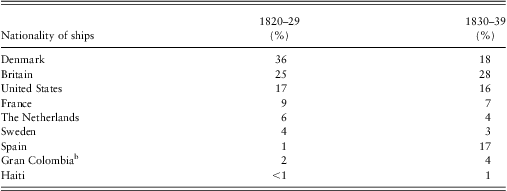
The total number of ships passing through the free port of Charlotte Amalie fell slightly from a yearly average of 2,831 in the 1820s to one of 2,571 in the 1830s. The nationality of the ships changed, as illustrated in Table 1, becoming ever more international as the percentage of vessels sailing under the Danish flag fell from an average of 36% in the 1820s to an average of 18% in the 1830s, partly as a consequence of the falling prices of sugar – by far the largest export to Denmark. What the numbers in the table do not show is the degree to which the maritime traffic was dominated by regional rather than European trade. While ships from European ports such as Liverpool, London, Copenhagen, and Amsterdam arrived in Charlotte Amalie on a monthly basis, such transatlantic ships were not the majority. Judging from the harbourmaster of St Thomas’ logbooks the most common places of origin of the incoming ships were either neighbouring Caribbean islands, such as Tortola, Puerto Rico, St Eustatius, St Barthélemy, Guadeloupe, and Trinidad, or North American port cities, particularly Baltimore, Philadelphia, New Orleans, and Charleston.Footnote 73
Ships passing through Charlotte Amalie, 1820–1839Footnote a
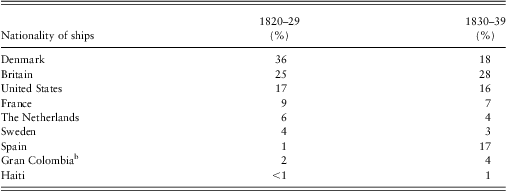
a The numbers of incoming ships used in the table are found in RA, West Indian Local Archives 25.6.1, St Thomas harbourmaster 1819–1867, ‘Statistics concerning incoming vessels’. Besides the nationalities shown here, a number of other flags are presented in the data, which collectively amount to less than 2% of the total.
b Gran Colombia was composed of a number of former Spanish American colonies that would go on to become its successor states after the dissolution of 1831, namely Colombia, Venezuela, and Ecuador.
This is not to say that the ultimate departure points or destinations of those vessels were necessarily regional, but rather that Charlotte Amalie became a hotspot for transhipping, a favoured stopover point for merchants and sailors passing through the region in search of trade, supplies, and gossip. While the flow of those most prized exports of the previous century – sugar and coffee – fell considerably in the nineteenth century, a myriad of new goods were transhipped through St Thomas. These included provisions, dried foodstuffs, manufactured goods, mules and cattle, and loot obtained through privateering and piracy.Footnote 74 The main reasons for such transhipping were to be found in the advantageous customs policy of the free port, the high concentration of potential sellers and buyers located there, and the possibilities of passing on goods of questionable legality with less risk of confiscation than in neighbouring ports. Even as the widespread smuggling and contraband trade of the eighteenth century had become less common, or, at least, less visible, in the 1820s and ‘30s, the island's free port status and the active neutrality of its Danish colonial administration continued to make it one of the most popular ports in the Leeward Islands for international and intercolonial travellers.
The Danish West Indies and the microregional perspective revisited
Perhaps the strongest argument for casting the Danish West Indies as parts of a distinct inter-imperial microregion is the way in which this move completely alters our perception of the islands. When viewed through the lens of narrow national history, the colonies inevitably end up as peripheral elements of a larger imperial polity that was much more focused on continental affairs than on the events of far-flung tropical lands. Knowing that it would never rival the European giants of France, Spain, and England, Denmark seemed content to invest the minimum resources required in order to retain its territorial claim to the West Indian holdings, while often ignoring them almost entirely in times of crisis and warfare. The insignificance of the tropical colonies when viewed through the lens of national history is reflected in the sparse number of scholarly works on the Danish West Indies, and is also apparent in those works on Danish history more broadly that do mention these territories.Footnote 75 When examined instead through the lens of a microregional study, the islands appear much more significant. Rather than seeing them as distant territories of a minor European empire, we can reinterpret them as holding companies for the activities of a multitude of regional actors, from privateers and smugglers to foreign diplomats; from republican revolutionaries to black freedmen, finding their own way in the sea of empires.
The microregional focus has several advantages over a more broadly defined, possibly oceanic, perspective. When we look at the many relations and interactions that linked actors across imperial and later national borders, a certain growth in the density of these networks seems apparent the further in we zoom our lens of analysis. For every ship that left Charlotte Amalie bound for Cuba, Liverpool, or Buenos Aires in the 1820s, many more left for Puerto Rico, Tortola, or St Barthélemy. While newspapers in Charleston and Baltimore would sometimes carry articles and letters dealing with events and conditions in the Virgin Islands, this type of information was the bread and butter of regional news publications such as the St Kitts Advertiser, complete with political and national biases.
While the revolutions in Saint-Domingue and across Latin America had significant consequences for all the Leeward Islands, including the intensification of racial paranoia and the new wave of privateering, the comparatively more modest uprising of enslaved Aminas on St John posed an immediate threat of potentially existential proportions to white slave-owners and to the underpinnings of the plantation system on Tortola and other neighbouring islands. It seems to have been an express, if somewhat farfetched, intention of the African rebels to spread their revolt and ultimately conquer the entire region, and the fact that it took more than six months and the intervention of troops from Martinique to quell the uprising was not a testament to indifference on the part of other colonies. Rather, it was a consequence of, first, the military weakness of the Danish empire, and second, the highly localized inter-imperial rivalry between Danish and British magistrates over the territorial rights to the Virgin Islands, including St John – a dispute that was seemingly of more pressing concern to agents on the ground, such as Governor Matthew, than to decision-makers in London.
By casting an initial net that encompasses a specific and historically well-defined inter-imperial microregion such as that of the Leeward Islands, we do ourselves a great favour in terms of both methodological feasibility and the possibility for new analytical insights. Employing such a framework does not preclude us from expanding our horizons or adjusting our initial expectations, but it does provide for a more rigorous process through which to make these decisions, and it does not run the risk of limiting ourselves by purely arbitrary boundaries or of attempting to describe something too vast and sprawling to be contained within a historical narrative. While the exact scope and dimensions of any analytically constructed microregion will vary, depending on the area and topic under examination, the framework contains the possibility of opening our eyes to interactions that are too often overlooked by existing and, in their own way, much narrower imperial or national histories. The true test of the model is whether it can be fruitfully applied to other historical contexts in which local actors and imperial polities met, crossed, and interacted in ways that were surely both similar to and vastly different from that of the case here presented.
Jeppe Mulich is a doctoral candidate at New York University, working on comparative empires and transnational history.