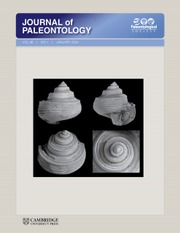



Non-technical Summary
A new genus and new species of fossil freshwater sponge was discovered in southern New Zealand. It is similar to the living genus Oncosclera of the family Potamolepidae but differs in features of the silica skeleton (spicules) and reproductive structures (asexual gemmules). The new fossil sponge lived in a small volcanic lake at Foulden Maar in the late Oligocene to early Miocene, some 23 million years ago. The vertical distribution of sponge remains in the lake sediments suggests that sponges colonized the hydrologically closed lake soon after its formation, most likely by passive dispersal attached to water birds. Our discovery of a fossil sponge in the Miocene of New Zealand indicates a formerly wider geographic distribution of the family Potamolepidae.
Introduction
New Zealand, from a general biogeographic point of view, could belong to the Australasian, Oceanian or Antarctic realms. Placement is controversial based on the introduction of new biogeographic classification systems of ecozones (ecoregions) (Udvardy, Reference Udvardy1975; Holt et al., Reference Holt, Lessard, Borregaard, Fritz and Araújo2013; Cox et al., Reference Cox, Moore and Ladle2016). The geological history of New Zealand has its roots in Gondwana, and it is part of the almost entirely (93%) submerged Zealandia microcontinent. Gondwana gradually broke up during the Mesozoic and in the Late Cretaceous (at ca. 83 ma) Zealandia (and Australia) drifted away from the eastern margin of Gondwanaland (Veevers, Reference Veevers2012). Sea floor spreading in the Tasman Sea ceased at about 55 Ma, by which time the part of Zealandia that is now New Zealand had reached its maximum distance from Australia (e.g., Lee et al., Reference Lee, Lee and Mortimer2001). Since then, New Zealand has more or less maintained its relative position in the South Pacific, but tectonic, volcanic and climatic events during the Cenozoic have profoundly affected land area, landscape evolution and biota of the islands (e.g., King, Reference King2000; Lee et al., Reference Lee, Lee and Mortimer2001; Gibbs, Reference Gibbs2016). Notwithstanding the common geological origin, the climate of New Zealand is quite different from that of Australia, because of the more oceanic and southern latitudinal position of the former—warm summer (Cfb) and cold summer (Cfc), with spots of tundra (ET)—based on the Köppen–Geiger climate classification system (Köppen and Geiger, Reference Köppen and Geiger1954; Peel et al., Reference Peel, Finlayson and McMahon2007).
Despite the ancient origin and complex evolution of the Australasian realm, the evolutionary history of its freshwater fauna is poorly understood due to a paucity of studies on fossil remains, as in the case of freshwater sponges (Demospongiae: Spongillida). Fossil Spongillida are known from scattered records from the Palearctic, Nearctic, Afrotropical and Oriental-Himalayan regions (Rauff, Reference Rauff and Kaiser1926; Rezvoi et al., Reference Rezvoi, Zhuravleva, Koltun and Orlov1971; Harrison and Warner, Reference Harrison and Warner1986; Pisera and Saez, Reference Pisera and Saez2003; Pisera, Reference Pisera2006; Pronzato et al., Reference Pronzato, Pisera and Manconi2017; Pronzato and Manconi, Reference Pronzato and Manconi2019; Samant et al., Reference Samant, Pronzato, Mohabey, Kumar, Dhobale, Pizal and Manconi2021, Reference Samant, Pronzato, Mohabey, Cubeddu, Stocchino, Krutika, Dhobale, Pranay and Manconi2023). Until Kaulfuss (Reference Kaulfuss2013, Reference Kaulfuss2017) and Kaulfuss et al. (Reference Kaulfuss, Lee, Wartho, Bowie, Lindqvist, Conran, Bannister, Mildenhall, Kennedy and Gorman2018) discovered spicular remains from Early and Middle Miocene lake sediments of southern New Zealand, no fossil (pre-Quaternary) sponges were recorded from inland waters of Australasia (Pronzato et al., Reference Pronzato, Pisera and Manconi2017; Pronzato and Manconi, Reference Pronzato and Manconi2019).
Fossil freshwater sponges are known since the Mesozoic Era, with records from the Permo-Carboniferous to Miocene for the families Palaeospongillidae Volkmer-Ribeiro and Reitner, Reference Volkmer-Ribeiro, Reitner, Reitner and Keupp1991, Spongillidae Gray, Reference Gray1867, and Potamolepidae Brien, Reference Brien and Symoens1967, of the order Spongillida Manconi and Pronzato, Reference Manconi, Pronzato, Hooper and van Soest2002 (Hinde, Reference Hinde1883; Ott and Volkheimer, Reference Ott and Volkheimer1972; Williams, Reference Williams, Smiley, Leviton and Berson1985; Volkmer-Ribeiro and Reitner, Reference Volkmer-Ribeiro, Reitner, Reitner and Keupp1991; Dunagan, Reference Dunagan1999; Richter and Wuttke, Reference Richter and Wuttke1999; Pisera, Reference Pisera2006; Schindler et al., Reference Schindler, Wuttke and Poschmann2008; Pisera et al., Reference Pisera, Siver and Wolfe2013, Reference Pisera, Manconi, Siver and Wolfe2016; Pronzato et al., Reference Pronzato, Pisera and Manconi2017; Samant et al., Reference Samant, Pronzato, Mohabey, Kumar, Dhobale, Pizal and Manconi2021, Reference Samant, Pronzato, Mohabey, Cubeddu, Stocchino, Krutika, Dhobale, Pranay and Manconi2023). Several freshwater sponge subfossils belonging to extant taxa have been reported from the Quaternary (Racek, Reference Racek, Cowgill, Hutchinson, Racek, Goulden, Patrick and Tsukada1966; Harrison et al., Reference Harrison, Gleason and Stone1979; Matsuoka, Reference Matsuoka1983; Harrison and Warner, Reference Harrison and Warner1986; Harrison, Reference Harrison1988, Reference Harrison and Warner1990; Frost, Reference Frost, Smol, Birks, Last, Bradley and Alverson2001; Volkmer-Ribeiro et al., Reference Volkmer-Ribeiro, Marques, De Rosa-Barbosa and Machado2004; Volkmer-Ribeiro and Machado, Reference Volkmer-Ribeiro and Machado2007; Parolin et al., Reference Parolin, Volkmer-Ribeiro and Stevaux2008; Machado et al., Reference Machado, Volkmer-Ribeiro and Iannuzzi2014, Reference Machado, Volkmer-Ribeiro and Iannuzzi2016). The living genera that encompass fossil species are Ephydatia Lamouroux, Reference Lamouroux1816 and Spongilla Linnaeus, Reference Linnaeus1759, of the family Spongillidae, and Potamophloios Brien, Reference Brien and Symoens1969, and Oncosclera Volkmer-Ribeiro, Reference Volkmer-Ribeiro1970, of the family Potamolepidae (Pronzato et al., Reference Pronzato, Pisera and Manconi2017).
Here, a detailed paleontological, morphological, and taxonomical study is provided for a new genus and new species of freshwater sponges from southern New Zealand, with discussion of its occurrence in a late Oligocene–Early Miocene maar lake in terms of paleohabitat, paleoecology, and biogeographic history of the family Potamolepidae.
Geological setting
The fossil sponges described herein come from freshwater diatomite/spiculite of the Foulden Maar Konservat-Lagerstätte in Otago, southern New Zealand (45.5269°S, 170.2191°E) (Figure 1). Highly fossiliferous diatomite/spiculite at this locality was deposited in a small (1500–2300 m diameter) but deep (200–350 m) lake infilling a maar crater excavated into regional schist basement rocks (Lindqvist and Lee, Reference Lindqvist and Lee2009; Kaulfuss, Reference Kaulfuss2017). According to two 40Ar/39Ar dates of 24.51 Ma and 23.38 Ma from basanite, the maar-forming, phreatomagmatic eruptions took place at the end of the Oligocene epoch (Fox et al., Reference Fox, Wartho, Wilson, Lee, Nelson and Kaulfuss2015). The freshly formed crater quickly filled with groundwater and initial deposition of coarse-grained material from crater-wall collapse and mass flows was soon replaced by seasonally controlled biogenic sedimentation under meromictic conditions (i.e., chemically stratified throughout the year; Figure 1). The biogenic sediments have a preserved thickness of 120 m, representing a depositional period of at least 130,000 years and spanning the Oligocene/Miocene boundary at 23.03 Ma (Fox et al., Reference Fox, Wartho, Wilson, Lee, Nelson and Kaulfuss2015; Kaulfuss, Reference Kaulfuss2017). The stratigraphically youngest sediments (exposed in a surface mining pit) have been dated palynologically as earliest Miocene (Aquitanian; New Zealand local stages: late Waitakian–early Otaian) (Mildenhall et al., Reference Mildenhall, Kennedy, Lee, Kaulfuss, Bannister, Fox and Conran2014).
Locality information and sample sites. (1) Map of the Otago region, South Island, New Zealand, showing the location of Foulden Maar (45.5269°S, 170.2191°E) near Middlemarch (modified from Kaulfuss et al., Reference Kaulfuss, Harris and Lee2010). (2) Simplified map of Foulden Maar showing the approximate extent of the maar crater within regional schist basement. Sponge samples were collected in a diatomite mining pit (pit A) and from drill core FM 2 (modified from Kaulfuss, Reference Kaulfuss2017). (3) Crater stratigraphy at Foulden Maar and samples examined for the presence of fossil sponges (modified from Kaulfuss, Reference Kaulfuss2017). Sample types refer to thin sections (white squares), SEM samples (gray squares), and smear slides (black squares). Protooncosclera zealandiae n. gen. n. sp. is ubiquitous throughout the maar lake sediments above 167 m (double tip arrow) from an early stage of the incipient maar lake. The stratigraphic occurrence of sponges (shown on the right) refers to the presence of spicules and gemmules in diatomaceous mud/sand, diatomite, and spiculite.

The varved diatomite consists of light-colored (beige to white) sub-laminae essentially composed of the pennate diatom Encyonema jordaniforme Krammer, Reference Krammer1997 (Cymbellaceae, Bacillariophyta) alternating with dark (brown to dark gray) sub-laminae of minor silt and organic detritus washed into the lake during wet seasons (Lindqvist and Lee, Reference Lindqvist and Lee2009; Kaulfuss, Reference Kaulfuss2017; Harper et al., Reference Harper, van de Vijver, Kaulfuss and Lee2019). Near the top of the preserved crater sequence, the diatomite is replaced by a 60-cm-thick interval of laminated spiculite essentially composed of siliceous sponge spicules and gemmules, and clay with minor amounts of centric diatom frustules (Figure 1). The macrofossil record from Foulden Maar includes leaves, fruits, seeds and flowers, spiders, insects, and fish (summarized in Lee et al., Reference Lee, Kaulfuss, Conran, Bannister and Lindqvist2016, Reference Lee, Kaulfuss and Conran2022). The fossil site is registered as I43/f8503 in the New Zealand Fossil Record File administered by the Geoscience Society of New Zealand and GNS Science (https://fred.org.nz/).
Material and methods
Material and sample preparation
Thin sections and smear slides of samples taken throughout drill core FM2 (183 m long) and from mining pit A were initially examined in the course of a facies analysis of the Foulden Maar stratigraphic sequence (Kaulfuss, Reference Kaulfuss2017). Both the core site and mining pit are located near the center of the maar (Figure 1); thus, the sampled sediments represent the anoxic profundal zone of the former maar lake. Thin sections and smear slides of sediments, together with coprolites collected in pit A, were examined with a petrographic microscope to verify the presence of microfossils. For Scanning Electron Microscopy (SEM) imaging, small portions of sediment (see Figure 2) or coprolite were air-dried, mounted on stubs with conductive carbon paint, and sputter coated with gold/palladium. Samples were examined and imaged with a Cambridge S360 Stereoscan Electron Microscope at the Otago Centre for Electron Microscopy, Otago University. Measurements of gemmules and spicules were obtained by Light Microscopy (LM) and/or SEM imaging.
Type material of Protooncosclera zealandiae n. gen. n. sp. from Foulden Maar, South Island, New Zealand. (1) Type material on SEM stubs, holotype OU47584 (left) and paratype MSNG 62671 (right). (2, 3) Spicules at the surface of type material at low magnification by SEM, (2) close up of (1) on stub at left; (3) close up of (1) on stub at right. Scale bars = 12.7 mm stub diameter in (1) and 0.5 mm in (2, 3).

Morphological analysis
Representative samples of the Foulden Maar sponge fossil material were compared to type material and specimens from historical collections and to the original descriptions. Comparative analyses were carried out on Spongillida taxa from around the world, particularly in the family Potamolepidae. A set of micro-morphotraits was considered diagnostic at the family, genus, and species levels (i.e., skeletal spicules, gemmular and gemmulosclere morphs) (Manconi and Pronzato, Reference Manconi, Pronzato, Hooper and van Soest2002, Reference Manconi, Pronzato, Thorp and Rogers2019). Terminology refers to the Thesaurus of Sponge Morphology (Boury-Esnault and Rützler, Reference Boury-Esnault and Rützler1997) and Systema Porifera (Manconi and Pronzato, Reference Manconi, Pronzato, Hooper and van Soest2002, p. 923–924). The taxonomy used herein refers to Systema Porifera (Manconi and Pronzato, Reference Manconi, Pronzato, Hooper and van Soest2002) and the World Porifera Database (de Voogd et al., Reference de Voogd, Alvarez, Boury-Esnault, Cárdenas and Díaz2025).
Repositories and institutional abbreviations
BMNH = The Natural History Museum, London, United Kingdom. FZRG MNC = Museu de Ciências Naturais, Fundação Zoobotânica do Rio Grande do Sul, Porto Alegre, Brazil. IRScNB/KBIN = Royal Belgian Institute of Natural Sciences, Bruxelles, Belgium. MNHN = Muséum National d’Histoire Naturelle, Paris, France. MNRJ = Museu Nacional, Universidade Federal do Rio de Janeiro, Brazil. MRAC (KMMA) = Musée Royal de l’Afrique Centrale de Tervuren, Belgium. MSNG = Museo Civico di Storia Naturale ‘Giacomo Doria’ Genova, Italy. OU = Geology Department, University of Otago, Dunedin, New Zealand. RM&RP FW-POR = R. Manconi & R. Pronzato personal collection, Italy (ex-FWPOR; ex-DISTAV; ex-IZUG; ex-DTRG). MFN = Museum für Naturkunde, Leibniz Institut für Evolutions und Biodiversitätsforschung, Berlin, Germany.
Systematic paleontology
Class Demospongiae Sollas, Reference Sollas1885
Order Spongillida Manconi and Pronzato, Reference Manconi, Pronzato, Hooper and van Soest2002
Family Potamolepidae Brien, Reference Brien and Symoens1967
Remarks
The family name Potamolepidae is inaccurate as it must be derived from the name of the type genus (Potamolepis) using the Latin genitive declination. Because the genitive of lepis is lepidis, the correct family name should be “Potamolepididae”, but this change does not match the rules of ICZN-International Code of Zoological Nomenclature (Ride et al., Reference Ride, Cogger, Dupuis, Kraus, Minelli, Thompson and Tubbs1999).
Genus Protooncosclera Manconi and Pronzato new genus
Type species
Protooncosclera zealandiae new genus new species.
Diagnosis
As for the type species, by monotypy.
Occurrence
Foulden Maar Konservat-Lagerstätte east of Middlemarch, Otago, southern New Zealand (45.5269°S, 170.2191°E), locality I43/f8503 in the New Zealand Fossil Record File (Figure 1); latest Oligocene (Chattian)–earliest Miocene (Aquitanian).
Etymology
The new genus name Protooncosclera refers to the Latin term proto (meaning earliest form of) and to its partial resemblance with the extant genus Oncosclera; onco refers to the ancient Greek term ὄγκος (meaning lump, mass, bulk) and the Latin term sclera is from the Greek term skleros, meaning hard.
Remarks
Other Potamolepidae genera diverge from Protooncosclera n. gen. by the following morphotraits (1) strongyles/slender oxeas as skeletal megascleres and gemmules absent (Echinospongilla Manconi and Pronzato, Reference Manconi, Pronzato, Hooper and van Soest2002); (2) strongyles/oxeas stout as skeletal megascleres and gemmuloscleres strongyles, when present (Potamolepis Marshall, Reference Marshall1883); (3) strongyles smooth, stout up to slender strongyles/oxeas as skeletal megascleres and gemmuloscleres as suboval/elongate strongyles smooth to spiny (Potamophloios Brien, Reference Brien and Symoens1969); (4) strongyles stout, smooth/granulated to rare oxeas with blunt tips as skeletal megascleres, and gemmuloscleres ellipsoid/subspherical strongyles (Sterrastrolepis Volkmer-Ribeiro and de Rosa-Barbosa, Reference Volkmer-Ribeiro and de Rosa-Barbosa1978); (5) strongyles granulated as skeletal megascleres, stout, smooth oxeas of the gemmular cage, and gemmuloscleres bean-like strongyles, smooth, curved (Uruguaya Carter, Reference Carter1881); and (6) spiny oxeas as skeletal megascleres and gemmuloscleres bean-like to ovoid strongyles (Cherokeesia Copeland, Pronzato, and Manconi, Reference Copeland, Pronzato and Manconi2015).
Protooncosclera zealandiae Manconi and Kaulfuss new species
Type material
Holotype OU47584, Department of Geology, University of Otago; paratype MSNG 62671, Museum of Natural History Giacomo Doria, Genoa; samples on SEM stubs (Figure 2).
Diagnosis
Diagnostic gemmuloscleres morphotraits: (1) strongyles to strongyloxeas stout, straight, spiny (acanthostrongyles/acanthostrongyloxeas) entirely ornate by scattered spines, and by very dense spines/tubercles at tips with spines and tubercles in a wide range of morphs (i.e., microspines, simple spines with acute tips, large and ornate spines with apical microspines [rosettes]); (2) gemmules with subspherical–oval outline armed by spicular cage; (3) spicular cage of slender, straight, megascleres oxeas densely spiny (acanthoxeas) except at tips, tangentially arranged at the gemmular surface together with rare thinner short oxeas; (4) skeletal megascleres stout, spiny/tubercled oxeas (acanthoxeas) to smooth oxeas, fusiform with acute tips, straight to slightly bent; and (5) skeletal microscleres apparently absent.
Description
Growth form, color, consistency, basal plate, body surface, ectosomal and choanosomal skeletal network, and gemmules position not observed. Skeletal megascleres 381–636 (avg. 501, SD 57) × 27–50 (avg. 37, SD 6) μm from diatomite core, and 190–298 (avg. 256, SD 29) × 11–18 (avg. 15, SD 3) μm from spiculite pit; spiny oxeas (acanthoxeas) to smooth oxeas fusiform, stout, spiny/tubercled, straight to slightly bent, with acute tips. Less frequent thinner, shorter smooth oxeas also present 97–115 μm (avg. 104, STD 7) × 3–5 μm (avg. 4, SD 1) (arrows in Figures 3, 4). Skeletal microscleres absent. Gemmules remains (660–1330 μm in diameter, Figure 5) single or in clusters, with subspherical/suboval outline surrounded by spicular cage (Figures 3–5). Gemmular theca architecture and foramen details not observed. Gemmular cage of slender, straight, fusiform megascleres oxeas densely spiny (acanthoxeas) except at tips, arranged at the gemmular surface together with also rare thinner short oxeas (Figures 3–6). Gemmuloscleres strongyles to less frequent strongyloxeas 38–70 (avg. 52, SD 8) × 9–14 (avg. 11, SD 1) μm from spiculite pit, 50–63 (avg. 59, SD 5) × 10–11 (avg. 10, SD 1) μm from diatomite core, stout, straight, spiny (acanthostrongyles to acanthostrongyloxeas) entirely ornate by spines and tubercles of various sizes and density, and by very dense spines/tubercles at tips; spines and tubercles in a wide range of morphs (i.e., microspines, simple spines with acute tips, very large and ornate spines with apical microspines [rosettes]) (Figures 3, 4, 6).
Protooncosclera zealandiae n. gen. n. sp. from Foulden Maar, South Island, New Zealand. Spiculite with monaxial spicules associated with less-abundant diatom frustules from near the top of the Foulden Maar stratigraphic sequence (see Figure 1). (1) Oxeas (megascleres) in a wide size range; thinner, short oxeas are also present (arrow). (2) Accumulation of free oxeas (megascleres) between laminae with embedded oxeas (megascleres) and centric diatom frustules (top, bottom); thinner, short oxeas are also present (arrows). (3) Stout, spiny oxeas (megascleres, partly broken) with dense, simple, or grouped spines except at acute tips. (4) Grouped, slender oxeas (megascleres) resembling the outline of a rounded gemmular cage, surrounded by scattered stout skeletal oxeas. (5) Spiny slender oxeas (megascleres) resembling the outline of a rounded gemmular cage (close-up of 4); thinner, short oxeas are also present (arrows). (6) Gemmuloscleres strongyles to strongyloxeas ornate by spines to tubercles in a wide range of size and morphs. Scale bars = 100 μm in (1, 2, 4) and 50 μm in (3, 5, 6).

Protooncosclera zealandiae n. gen. n. sp. from Foulden Maar, South Island, New Zealand. Foulden Maar diatomite consisting of diatom frustules associated with less-frequent monaxial spicules. (1, 2) Oxeas, smooth (megascleres), scattered to grouped within a dense matrix of diatom frustules (diatomite in core at 41.88 m; (2) diatomite in core at 67.6 m); thinner, short oxeas are also present (arrow). (3) Stout, smooth oxeas (megascleres) with acute, tapered tips (diatomite in core at 65.0 m). (4) Slender oxeas (megasclere) densely spiny, except for tips (diatomite from pit A - no level measured). (5, 6) Grouped strongyles to strongyloxeas (gemmuloscleres) ornate by large spines with microspiny rosettes at shaft, and very dense spines bearing microspines at tips, (6) close-up of (5) (diatomite in core at 38.97 m). Scale bars = 100 μm in (1–3) and 20 μm in (4–6).

Protooncosclera zealandiae n. gen. n. sp. from Foulden Maar, South Island, New Zealand. Photomicrographs (1–4) and SEM images (5, 6) photomicrographs. Gemmules and spicules associated with coprolites from mining pit A. (1) Dense group of whitish gemmules, entirely or partly sectioned, along the axis of a coprolite. (2) Dense layer of oxeas and rare centric diatoms along the axis of a coprolite. (3) Dense group of entire, whitish gemmules covered by dense oxeas (cage of megascleres) along the axis of a coprolite. (4) Scattered spicules, mostly large oxeas, in a brown matrix of a coprolite. (5, 6) Circular groups of gemmuloscleres strongyles to strongyloxeas (gemmular remains) surrounded by scattered, large oxeas and diatoms within a coprolite. Scale bars = 2 mm in (1–4) and 200 μm in (5, 6).

Protooncosclera zealandiae n. gen. n. sp. from Foulden Maar, South Island, New Zealand. SEM images of gemmules and spicules associated with coprolites from mining pit A. (1–3) Gemmuloscleres strongyles to strongyloxeas with dense spines at tips; shaft ornate by minute spines to large spines bearing microspines up to rosettes. (4) Pointed, spiny tip of a megasclere oxea and gemmuloscleres strongyles ornate by spines and tubercles. (5) Gemmuloscleres spiny strongyles to strongyloxeas, and megascleres spiny oxeas. (6) Gemmuloscleres spiny strongyles and megascleres spiny oxeas with variable tip morphs. Scale bars = 20 μm in (1–4) and 100 μm in (5, 6).

Etymology
The species epithet refers to the largely submerged ancient continent Zealandia, which includes present-day New Zealand.
Comparative material
Cherokeesia armata Copeland, Pronzato, and Manconi, Reference Copeland, Pronzato and Manconi2015, topotype RM&RP FW-POR 763 specimen fragment from Nolichucky River, Tennessee River basin, Tennessee, USA, J. Copeland coll., 29.vii.2013. Echinospongilla brichardi (Brien, Reference Brien1974) holotype MRAC (KMMA) 1430, RM&RP FW-POR 489, leg. M. Brichard, v.1973, Urundi, Lake Tanganyika, Usumbura. Oncosclera jewelli (Volkmer, Reference Volkmer1963) holotype MNRJ 001, schizoholotype RM&RP FW-POR 547, Rio Thainas, São Francisco da Paula, Rio Grande do Sul, Brazil, 10.ix.1960, det. C. Volkmer-Ribeiro; BMNH 1978.12.12.12 (ex-FZBRS 124), RM&RP FW-POR 410, Rio Thainas, ibid., 17.i.1971; FZRG MNC 1080, fragment RM&RP FW-POR 487, 11.i.1983. Oncosclera asiatica Manconi and Ruengsawang in Manconi et al., Reference Manconi, Ruengsawang, Ledda, Hanjavanit and Sangpradub2012, schizoholotype MSNG 56534a, RM&RP FW-POR 719, Pong River, Mekong Basin, Thailand, N. Ruengsawang coll. 14.vi.2008. Oncosclera macrospiculata (Stephens, Reference Stephens1919), MNHN DT 2846, fragment RM&RP FW-POR 508ab, Niger, Timbuktu, on shells of Aetheria sp., 1931, A. Chevalier leg., Topsent det. Oncosclera rousseletii (Kirkpatrick, Reference Kirkpatrick1906), holotype BMNH 06.2.28.IC, 13. IIIC, alcohol, schizotype RM&RP FW-POR 390, Zambezi River above Victoria Falls. Oncosclera schubotzi (Weltner, Reference Weltner and Schubotz1913), holotype MFN 3716a, schizotype RM&RP FW-POR 539, Aruwimi River near Banalia, on Aetheria elliptica Lamarck, Reference Lamarck1807, v.1908, Schubotz leg., Weltner, Reference Weltner and Schubotz1913, det. Oncosclera gilsoni (Topsent, Reference Topsent1912), type IRScNB POR.048, schizotype RM&RP FW-POR 361, River Waidina, Viti Levu, Fiji Archipelago, E. Topsent det., 22.x.1897. Potamophloios stendelli (Jaffé, Reference Jaffé1916), holotype MRAC 410-411, RM&RP FW-POR 372, Kasenga, Lake Luapula, on shell fragments, mission Stappers, 25.vii.1911, 0–10 m depth, by dredge. Potamolepis leubnitziae Marshall, Reference Marshall1883, BMNH 1938.2.3.9, RM&RP FW-POR 391 Barrage de Mateba, River Congo, coll. Schouteden. Sterrastrolepis brasiliensis Volkmer-Ribeiro and de Rosa Barbosa, Reference Volkmer-Ribeiro and de Rosa-Barbosa1978, holotype MNRJ 092, RM&RP FW-POR 580, Rio Turvo, Brazil. Uruguaya corallioides Carter, Reference Carter1881, BMNH 1952.6.30.2, Rio Uruguay, RM&RP FW-POR 540-541.
Remarks
Protooncosclera zealandiae n. gen. n. sp., which is characterized by spiny strongyles/strongyloxeas with variable morphs and topographic distribution of spines in gemmuloscleres, also belonging to the same gemmule, differs from all other potamolepids in its unique gemmuloscleres diagnostic traits.
The new fossil species diverges from species of Oncosclera Volkmer-Ribeiro, Reference Volkmer-Ribeiro1970, in the following ways: (1) Oncosclera kaniensis† Matsuoka and Masuda, Reference Matsuoka and Masuda2000 (Miocene, Japan) with megascleres being stout strongyles, spiny and with dense spines at tips, with less frequent spiny oxeas, and gemmuloscleres being strongyles; (2) three Afrotropical living species—Oncosclera macrospiculata (Stephens, Reference Stephens1919), Oncosclera rousseletii (Kirkpatrick, Reference Kirkpatrick1906), and Oncosclera schubotzi (Weltner, Reference Weltner and Schubotz1913)—with megascleres being smooth strongyles and with gemmuloscleres being short, spiny/smooth strongyles; and (3) five Neotropical living species with megascleres being spiny strongyles—Oncosclera tonolliae (Bonetto and Ezcurra de Drago, Reference Bonetto and Ezcurra de Drago1968); Oncosclera atrata (Bonetto and Ezcurra de Drago, Reference Bonetto and Ezcurra de Drago1970); Oncosclera spinifera (Bonetto and Ezcurra de Drago, Reference Bonetto and Ezcurra de Drago1973); Oncosclera ponsi (Bonetto and Ezcurra de Drago, Reference Bonetto and Ezcurra de Drago1968); and Oncosclera navicella (Carter, Reference Carter1881).
Although the skeletal megascleres being stout oxeas and gemmuloscleres being strongyle-like in Protooncosclera zealandiae n. gen. n. sp. are shared with some extant species of Oncosclera, these differ in the following traits: (1) Oncosclera gilsoni (Topsent, Reference Topsent1912) from Fiji with small, suboval and strongyle-like gemmuloscleres with a few spines and megascleres being spiny oxeas; (2) Oncosclera diahoti (Rützler, Reference Rützler1968) (New Caledonia) with megascleres being smooth oxeas and aberrant gemmuloscleres being smooth oxeas (problematic taxonomic status); (3) Oncosclera asiatica Manconi and Ruengsawang in Manconi et al., Reference Manconi, Ruengsawang, Ledda, Hanjavanit and Sangpradub2012 (Thailand) with skeletal megascleres being slightly spiny oxeas and gemmuloscleres being short strongyles (bean-like) with few apical spines; and (4) a Neotropical group bearing skeletal smooth/spiny oxeas (megascleres) and strongyles/oxeas (gemmuloscleres) with a range of variably developed micro-ornamentations: Oncosclera petricola (Bonetto and Ezcurra de Drago, Reference Bonetto and Ezcurra de Drago1967), Oncosclera jewelli (Volkmer, Reference Volkmer1963), Oncosclera rosariae Tavares-Frigo, Volkmer-Ribeiro, Oliveira & Machado, Reference Tavares-Frigo, Volkmer-Ribeiro, Oliveira and Machado2015 in Tavares-Frigo et al., Reference Tavares-Frigo, Volkmer-Ribeiro, Oliveira and Machado2015, Oncosclera schubarti (Bonetto and Ezcurra de Drago, Reference Bonetto and Ezcurra de Drago1967), Oncosclera stolonifera (Bonetto and Ezcurra de Drago, Reference Bonetto and Ezcurra de Drago1967), and Oncosclera intermedia (Bonetto and Ezcurra de Drago, Reference Bonetto and Ezcurra de Drago1973).
Discussion and conclusions
Stratigraphic occurrence and paleoecology of Protooncosclera zealandiae n. gen. n. sp
Foulden Maar was an isolated, groundwater-fed lake, surrounded by a steep rim of pyroclastic ejecta and disconnected from the local drainage system. The stratigraphically oldest occurrence of sponge spicules at Foulden Maar is at 167 m in drill core FM2 (Figure 1). Relatively coarse-grained, fining-upward cycles at this interval were deposited by subaqueous mass flows and represent an early depositional stage within the freshly excavated, steep and unstable maar crater (Kaulfuss, Reference Kaulfuss2013, Reference Kaulfuss2017). Formation of an incipient maar lake at this stage is evinced by sedimentary structures typical of subaqueous transport and deposition and by limnic microfossils in the sediment. The lentic habitat at this stage was frequently disturbed by re-mobilization of pyroclastic material, perhaps in combination with ongoing volcanic/hydrothermal activity nearby. Our data show that freshwater sponges had colonized the incipient maar lake at an early stage and managed to survive the unstable environment, as siliceous spicules are ubiquitous throughout the maar lake sediments above 167 m (Figure 1).
Given the isolated nature of the paleolake, we surmise that sponges (and other aquatic fauna) were passively distributed into the maar, most likely by water birds, which may be important dispersal vectors for aquatic invertebrates (van Leeuwen et al., Reference van Leeuwen, Lovas-Kiss, Ovegård and Green2017; Green et al., Reference Green, Lovas-Kiss, Reynolds, Sebastián-González, Silva, van Leeuwen and Wilkinson2022). Passive dispersal and persistence within the same habitat (clonal populations) or into other, distant water bodies (clonal metapopulations) is supported by the modular organization of sponges and their clonal strategy by gemmules production (Pronzato and Manconi, Reference Pronzato and Manconi1995; Manconi and Pronzato, Reference Manconi and Pronzato2016). To date no bird fossils have been found at Foulden Maar, but frequent coprolites of swimming waterfowl, possibly of ducks (Lindqvist and Lee, Reference Lindqvist and Lee2009), support our hypothesis of bird-mediated arrival of sponge propagule gemmules in the maar lake.
The 120-m-thick biogenic laminites in the upper two-thirds of the crater stratigraphy (Figure 1) document long-lasting, stable conditions in a meromictic maar lake. Laterally continuous lamination, absence of benthic organisms and bioturbation, and organic preservation of fossils in these sediments strongly suggest anoxic conditions on the profundal lake floor. Dissociated sponge spicules are a common component of the diatomite laminites but are basically confined to darker (brown to black) sub-laminae where they occur horizontally oriented together with frustules of centric diatoms and chrysophycean stomatocysts in an organic mud matrix (Figure 4). These darker sub-laminae are the result of run-off from the basin margins in seasons of reduced near-surface bioproductivity and high precipitation (autumn/winter) (Lindqvist and Lee, Reference Lindqvist and Lee2009; Kaulfuss Reference Kaulfuss2013, Reference Kaulfuss2017). By contrast, the pale sub-laminae, formed after blooms of the pennate diatom Encyonema jordaniforme in spring/summer, contain only very rare sponge spicules.
The life cycle of gemmule-producing sponges is pluriannual with an annual rhythm according to the seasonal length and chronology typically with four phases: vegetative growth, gemmulation/sexual reproduction, cryptobiosis, hatching of gemmules and regeneration (Weissenfels, Reference Weissenfels1989; Pronzato and Manconi, Reference Pronzato and Manconi1994, Reference Pronzato and Manconi1995). These sponges display a life cycle rhythm synchronized with the timing of seasonal conditions such as floods and temperature variation. The actively filtering mother sponge (vegetative phase) produces gemmules (gemmulation phase) devoted to protecting totipotent cells in stress conditions, for example in cold seasons. From these considerations it is clear that Protooncosclera zealandiae n. gen. n. sp. thrived in the upper, mixed water column near the edges of lake Foulden, from where sponge remains were transported into the profundal zone by run-off in autumn/winter. Within its shallow lake-margin habitat, P. zealandiae n. gen. n. sp. may have been anchored to the soft substrate or may have formed crusts on stems of water plants, submerged logs, or dead leaves (Lindqvist and Lee, Reference Lindqvist and Lee2009).
In a 60-cm-thick laminated spiculite near the top of the crater sequence (Figure 1) dissociated sponge spicules become so frequent that they are the main sediment-building component. Intact gemmules are frequently encountered on laminae planes (Figure 3). Apart from the abundance of sponge remains, this interval differs from the diatomite by increased amounts of clay and silt, fewer chrysophycean stomatocysts, nearly complete absence of pennate diatoms, and a comparatively high proportion of centric diatoms. A shift in limnic conditions, as evinced by this facies change, likely included increased turbidity and decreased light intensity, possibly coupled with turbulence and shifts in nutrient supply, which resulted in strongly reduced productivity of pennate diatoms and Chrysophyceae. The apparent proliferation of P. zealandiae n. gen. n. sp. during this interval likely indicates adaptability to changing limnic conditions, concurring with the tolerance of fresh-water sponges to variable environmental parameters (Harrison, Reference Harrison1988; Pronzato and Manconi, Reference Pronzato and Manconi1994; Manconi and Pronzato, Reference Manconi and Pronzato2008; Kenny et al., Reference Kenny, Plese, Riesgo and Itskovich2019). Overall, the reconstructed depositional period of sponge-bearing sediments at Foulden Maar is ca. 130,000 years.
As evinced by SEM and light microscopy observations of spicules and gemmules collected along the stratigraphic column, there are divergent spicular morphs: (1) spiny versus smooth oxeas megascleres, with dominance in some layers of exclusively and evidently spiny morphs; (2) gemmuloscleres (in the sediment) with notably larger and denser spines along the shaft; and (3) gemmuloscleres (of gemmules found in the coprolites) with very abundant microspines on the shaft (Figures 3, 4, 6). Such variability in morphology could indicate morphological differentiation in the isolated maar lake and one could hypothesize the existence of two separate ecotypes or taxa (varieties or sub-species). For the moment we prefer to not split the new fossil taxon and maintain the single taxonomic entity Protooncosclera zealandiae n. gen. n. sp. Further investigations at Foulden Maar and other Miocene maar lakes of the Dunedin Volcanic Group (Kaulfuss et al., Reference Kaulfuss, Lee, Wartho, Bowie, Lindqvist, Conran, Bannister, Mildenhall, Kennedy and Gorman2018) could clarify the status of these potential taxonomic groups, their spatial and temporal distribution, together with the hypothetical occurrence of successive waves of colonization versus intra-population splitting. In general, the present record confirms the frequent colonization of New Zealand crater lakes by recent Spongillida (de Ronde et al., Reference de Ronde, Stoffers, Garbe-Schönberg, Christenson and Jones2002; Pronzato and Manconi, Reference Pronzato and Manconi2019).
Sponge remains associated with coprolites
Dissociated spicules and intact gemmules are frequently found in coprolites from Foulden Maar, indicating the presence of facultative sponge-consuming aquatic taxa in lake Foulden. Within coprolites, spicules and gemmules were found with visually estimated concentrations of 3–50 vol% (up to 90 vol% in some cases), together with mineral grains, organic detritus, centric diatoms, and scarce arthropod cuticle (Figures 5, 6). Spongivorous taxa in freshwater systems include some specialized invertebrates such as caddisflies, neuropterans, and chironomid midges (Brown, Reference Brown1952; Skelton and Strand, Reference Skelton and Strand2013; Palatov and Sokolova, Reference Palatov and Sokolova2017) and certain vertebrate taxa, such as fish (McAtee, Reference McAtee1932; Galvez et al., Reference Galvez, St. John, McLean, Touokong, Gonwouo and Martin2022), turtles (Manconi et al., Reference Manconi, Erpenbeck, Fromont, Wörheide and Pronzato2021; Lindeman et al., Reference Lindeman, Selman and Jones2024), and waterbirds (e.g., cormorants; van Leeuwen et al., Reference van Leeuwen, Lovas-Kiss, Ovegård and Green2017).
Spicule-/gemmule-bearing coprolites at Foulden Maar were described as various morphotypes by Kaulfuss (Reference Kaulfuss2013). Collectively, they are relatively small, 1–30 mm long and 1–14 mm wide, elongate to sub-circular in shape, and are abundant throughout the laminated lacustrine sequence. Kaulfuss (Reference Kaulfuss2013) proposed different ontogenetic stages of Galaxias (small fish of the Southern Hemisphere family Galaxiidae) as the most likely producers of these coprolites, based in part on direct comparison between the composition of coprolites and in-situ stomach content of galaxiid fossils from Foulden Maar. Other coprolites identified as those of swimming waterfowl, possibly of ducks, are quite different in size, shape, and composition, notably in the predominance of well-rounded, allochthonous quartz grains, which are not found in the lake sediment at Foulden Maar (Lindqvist and Lee, Reference Lindqvist and Lee2009). A detailed study of the sponge-bearing coprolites is beyond the scope of this study. We concur with the proposed Galaxias origin because this fish is currently the only aquatic taxon found in sufficient numbers to explain the abundance of sponge-bearing coprolites at Foulden Maar.
As in extant species, Galaxias at Foulden Maar probably consumed a range of terrestrial and aquatic arthropods and would have ingested mineral grains, plant detritus, and sponges when foraging in benthic zone of the shallow lake margin. Benthic foraging is uncommon but does occur in some extant species of Galaxias in New Zealand (Glova and Sagar, Reference Glova and Sagar1989; McDowall, Reference McDowall2010). Galaxiid larvae, juveniles, and adult specimens are frequently found in the diatomite and indicate lake-locked (non-diadromous) galaxiid populations (Lee et al., Reference Lee, McDowall and Lindqvist2007; Kaulfuss et al., Reference Kaulfuss, Lee, Robinson, Wallis and Schwarzhans2020). One species, Galaxias effusus Lee, McDowall, and Lindqvist, Reference Lee, McDowall and Lindqvist2007, has been described from the fossil site (Lee et al., Reference Lee, McDowall and Lindqvist2007).
Potamolepidae biogeography and diversity
Diversity of the New Zealand freshwater sponge fauna is likely to be underestimated, particularly in the South Island where only the New Zealand endemic Spongillidae taxon Heterorotula kakahuensis (Traxler, Reference Traxler1896) has been reported from Kakahu River (Canterbury) and a creek near Invercargill (Southland) (Chilton, Reference Chilton1883; Traxler, Reference Traxler1896; Gee, Reference Gee1931; Pronzato and Manconi, Reference Pronzato and Manconi2019). Freshwater sponges are present in some modern lakes in Otago, including Lake Waihola south of Dunedin (M. Schallenberg, personal communication, 2024), but research on their distribution and ecology is currently lacking.
Although there is a plentiful sedimentary record of diversified Cenozoic freshwater habitats and associated biota in Otago and Southland (e.g. Douglas, Reference Douglas1986; Pole et al., Reference Pole, Douglas and Mason2003; Lee et al., Reference Lee, McDowall and Lindqvist2007; Kaulfuss et al., Reference Kaulfuss, Lee, Wartho, Bowie, Lindqvist, Conran, Bannister, Mildenhall, Kennedy and Gorman2018), Protooncosclera zealandiae n. gen. n. sp. is the first fossil freshwater sponge reported from these regions and, in fact, the whole of New Zealand. Its geographic range is currently restricted to the type locality at Foulden Maar. Siliceous sponge remains are also very common at the nearby Hindon Maar Complex, a similar lacustrine environment of Middle Miocene age (14.6 my), but it is currently not known whether these are attributable to P. zealandiae n. gen. n. sp. or represent a different taxon (Kaulfuss et al., Reference Kaulfuss, Lee, Wartho, Bowie, Lindqvist, Conran, Bannister, Mildenhall, Kennedy and Gorman2018).
The find of P. zealandiae n. gen. n. sp. in a warm-temperate to subtropical Miocene lake in southern New Zealand is the southernmost record of potamolepid freshwater sponges and extends our knowledge of Potamolepidae evolution and biogeography. Almost all extant species of Potamolepidae occur in the Afrotropical and Neotropical regions (Figure 7) and this distribution has been related to the split-up of the former supercontinent Gondwana (Bonetto and Ezcurra de Drago, Reference Bonetto and Ezcurra de Drago1967; Brien, Reference Brien and Symoens1969; Volkmer-Ribeiro, Reference Volkmer-Ribeiro1970; Manconi and Pronzato, Reference Manconi, Pronzato, Hooper and van Soest2002). No extant potamolepids are known from New Zealand and Australia but the aberrant Oncosclera diahoti (Rützler, Reference Rützler1968), from New Caledonia supports the proposed Gondwana history of Potamolepidae, as New Caledonia (and New Zealand) is part of the largely submerged subcontinent Zealandia, which separated from Gondwana in the Late Cretaceous (Mortimer et al., Reference Mortimer, Campbell, Tulloch, King and Stagpoole2017). The spicular complement of P. zealandiae n. gen. n. sp. exhibits a close morphological similarity to living and fossil Potamolepidae. The discovery of this fossil species at Foulden Maar provides evidence for the presence of progenitors of extant Potamolepidae in southern Zealandia in the Early Miocene and corroborates a biogeographic history of the Potamolepidae strongly influenced by the break-up of Gondwana.
Global geographic range of the family Potamolepidae. The red cross refers to the type locality of Protooncosclera zealandiae n. gen. n. sp. from Foulden Maar (45.5269°S, 170.2191°E), South Island, New Zealand. Black crosses refer to other fossil records of potamolepids. Extant taxa include seven genera and 34 species: Australasian (1 sp.), Oceanian (1 sp.), Oriental-Himalayan (1 sp.), Afrotropical (17 spp.), Neotropical (13 spp.), and Nearctic (1 sp.). Map modified after Manconi and Pronzato (Reference Manconi and Pronzato2009) and Manconi et al. (Reference Manconi, Ruengsawang, Ledda, Hanjavanit and Sangpradub2012). Species shown on Figure 7 not otherwise mentioned in the text: Potamophloios guairensis Volkmer-Ribeiro, Parolin, Fürstenau-Oliveira & Menezes, Reference Volkmer-Ribeiro, Parolin, Fürstenau-Oliveira and Menezes2010 in Volkmer-Ribeiro et al., Reference Volkmer-Ribeiro, Parolin, Fürstenau-Oliveira and Menezes2010; Potamophloios gilberti Brien, Reference Brien and Symoens1969; Potamophloios songoloensis Brien, Reference Brien and Symoens1969; Potamophloios symoensi (Brien, Reference Brien and Symoens1967); Potamolepis belingana Lévi, Reference Lévi1965; Potamolepis bhangazi Pinheiro, Calheira, and Samaai in Pinheiro et al. Reference Pinheiro, Calheira, Martins, Janson, Taylor and Samaai2020; Potamolepis chartaria Marshall, Reference Marshall1883; Potamolepis micropora Burton, Reference Burton1938; Potamolepis pechueli Marshall, Reference Marshall1883; Potamolepis weltneri Moore, Reference Moore and Moore1903.

However, disjunct geographic distributions of two extant species and the known other three potamolepid fossils in the Northern Hemisphere indicate a more complex biogeographic scenario. Potamolepidae fossils include the Middle Eocene Potamophloios canadensis Pisera, Siver, and Wolfe, Reference Pisera, Siver and Wolfe2013, from the Nearctic region (Pisera et al., Reference Pisera, Siver and Wolfe2013), Potamolepidae gen. sp. from the Middle Miocene of the western Palearctic Region (Pisera et al., Reference Pisera, Siver and Mandic2019), and the Early Miocene Oncosclera kaniensis Matsuoka and Masuda, Reference Matsuoka and Masuda2000, from the eastern Palearctic Region (Matsuoka and Masuda, Reference Matsuoka and Masuda2000) (Figure 7). Additionally, two living species, one occurring in the Oriental Region at the Lower Mekong, Oncosclera asiatica, and the other in the Nearctic Appalachian Mountains, Cherokeesia armata, extend the present-day potamolepid range to the north (Manconi et al., Reference Manconi, Ruengsawang, Ledda, Hanjavanit and Sangpradub2012; Copeland et al., Reference Copeland, Pronzato and Manconi2015).
The distribution of extant and fossil potamolepid freshwater sponges thus indicates that (1) the family has a Gondwana-like distribution with small enclaves in the Nearctic, Oriental, and Oceanian regions; (2) it had a much wider geographical distribution extending to high- and low-latitude subtropical paleolakes in the Eocene–Miocene; and (3) a successive geographic range retraction of Potamolepidae was probably related to late/post-Cenozoic climate change, with extant species restricted to present-day subtropical and tropical climates. Further paleontological data and new findings of living species are required to better resolve the historical biogeography and evolutionary history of the potamolepid freshwater sponges.
Acknowledgments
We are grateful to the Gibson family at Foulden Hills for allowing access to the fossil site. We thank M. Schallenberg (University of Otago) for information on living sponges in the Otago region, L. Girvan (formerly Otago Centre for Electron Microscopy, University of Otago) for help with SEM imaging, and the Geology Department, University of Otago, for assistance with fieldwork. Two anonymous reviewers and associate editor J. Botting provided constructive comments, which greatly improved the manuscript. Scientific core drilling at Foulden Maar was financially supported by a Marsden Grant (11-UOO-043) from the Royal Society of New Zealand. This work was funded by the German Research Foundation (DFG project 429296833). R. Manconi and T. Cubeddu were co-funded by the Fondazione di Sardegna (grant FdS/RAS-2016/CUP J86C1800082005), Regione Autonoma Sardegna (grant RAS2012-LR7/2007-CRP-60215), and Sassari University (grant 2019-2021).
Competing interests
The authors declare that they have no competing interests.



