There is a curious gap in the study of political parties and interest groups. While there is a long and vibrant tradition of political science research on both parties and interest groups, we know very little about the connections between these two entities. One reason for this gulf is that we can think of parties and interest groups as competing forms of political organization. While parties attempt to build broad, multi-dimensional coalitions, interest groups mobilize narrow slices of the electorate around a focused set of issues. Indeed, political parties may serve as the antidote for the narrow, self-serving agendas advocated by interest groups.Footnote 1 However, many interest groups choose to co-operate with one party or the other on a persistent basis, and there has been very little research on these organizational ties.
We also know little about the bonds between the political media and political parties. While Groseclose and Milyo measure ideological bias in the media,Footnote 2 there has been little research on organizational ties between the press and political parties. We know, for example, that the National Review is a conservative magazine that tends to favour Republicans over Democrats, but it will also occasionally assert its independence, criticizing prominent ‘Grand Old Party’ (GOP, Republican) officeholders. However, we are uncertain whether the National Review actually co-operates with the Republican party and its candidates to promote conservative causes.
We can improve our understanding of the scope and influence of political parties in America by studying their alliances with interest groups and media outlets. Towards this end, this exploratory study uses an innovative approach to identify links between formal party organizations and informal networks of interest groups, media and 527s.Footnote 3 We trace exchanges of donor and subscriber names between organizations and we use social network analysis (SNA) to reveal the communities that drive modern politics. While SNA is a prominent technique in economics and sociology, SNA research is still rare in political science. SNA techniques are especially useful for studying political parties and interest groups since these actors are best understood as networks of co-operating allies.Footnote 4
We find that a significant number of nominally independent media outlets and interest groups exchange information with formal party organizations and ideologically similar organizations. These ‘extended party networks’, as we call them, are starkly divided into polarized camps that funnel information to formal party organizations. Our data tentatively suggest, also, that the Democratic network is larger and more integrated than the Republican network. These results suggest the value of viewing parties as social networks.
Formal parties and political networks
An interesting puzzle in contemporary American politics is the escalating polarization of the nation’s political parties. Recent scholarship agrees that something in politics has become polarized in the last few decades, but it is not clear just what that something is. It might be tempting to say that the party-in-government is polarized, while the party-in-the-electorate is not. But the emerging consensus is slightly more complicated. Most scholars argue that while the ‘elite’ parties (in Congress, campaigns and commentary) are polarized,Footnote 5 many ordinary voters may not be.Footnote 6 But a large slice of the most active voters are polarized.Footnote 7 This confusion highlights the importance of understanding the size and organization of political parties.
V. O. Key famously partitioned the study of political parties into the ‘party in government’, ‘party in the electorate’ and ‘party as organization’.Footnote 8 Some research fits nicely into one of these categories, such as work on congressional parties,Footnote 9 mass partisanshipFootnote 10 and party organizations.Footnote 11 Some research also traces the relationships between party segments.Footnote 12
A notable omission from the Key trichotomy is the set of citizens who finance and staff political campaigns.Footnote 13 These activists are essential to the functioning of modern parties, yet they are not part of the formal party organization. Beginning with James Q. Wilson’s work on ‘amateur’ Democratic clubs,Footnote 14 political scientists have sought to measure and explain the influence of party activists.Footnote 15
The Key trichotomy also omits interest groups. While we observe close interaction and co-operation between formal parties and some organized groups in everyday life,Footnote 16 political scientists typically study parties and interest groups separately or even portray them as competitors. Schattschneider, for example, promotes parties as the antidote for excessive interest group influence in American politics.Footnote 17 In practice, many interest groups emphatically claim they are non-partisan, while parties deny linkages with outside groups.Footnote 18
Relatedly, the Key model omits the partisan media. Early in American history, media outlets were central to party activity.Footnote 19 In this era of objective journalism, the major city newspapers are independent, but opinion journalism is not. Magazines such as the New Republic and the National Review would maintain that they are at least nominally independent of party organizations. But they also consistently take sides on partisan matters. It is an open question just how similar they are to the partisan press of an earlier era.
Party activists, interest groups and the partisan media pose a conceptual challenge for the study of parties. Unlike the party-in-government or party-as-organization, these actors lack centralized leadership and transparent decision-making processes. Like birds in a flock, activists, interest groups and the media are autonomous but co-operating. They can pursue their common goals more effectively through co-operation, but no single actor appears to be in charge.
Parties as Networks
Our criticisms of Key’s tripartite model are, then, consistent with the view of parties offered by Downs (‘a team of men seeking to control the governing apparatus’)Footnote 20 and endorsed by Schlesinger,Footnote 21 or by Schattschneider (‘an organized attempt to gain power’).Footnote 22 However, while these authors do emphasize that parties are a co-ordinated team, they do not offer a rich conception of how different party actors interact in those teams. Since political parties in the United States are not hierarchically organized, we need to think about how they manage to co-ordinate in the absence of such organization. If all of these elements, formal and informal, are part of the team, what makes them team members?
A solution is to conceive of parties as networks of co-operating actors. In this view, a party is broadly defined to include its candidates and officeholders; its formal apparatus; loyal donors, campaign workers and activists; allied interest groups; and friendly media outlets. We refer to these party teams as extended party networks (EPNs), which include – but are not limited to – formal party organizations such as the Democratic National Committee and the Republican National Committee. In the network approach, the defining characteristic of a party is co-operative behaviour, not formal positions. Actors ‘join’ the party when they begin communicating with other members of the network, developing common strategies and co-ordinating action to achieve shared goals.
Power in a network is potentially decentralized; unlike the hierarchical structure of formal party organizations, networks may feature several actors or factions that simultaneously co-operate to beat the opposing party and compete to shape the future of the party.Footnote 23 Network members often influence each other by sending informative signals (for example, endorsements), linking network members together and co-ordinating action. Politicians and organizations attach great value to their lists of other actors – especially donors and activists – in the network, and they share these lists cautiously.
Typically, some actors exert more influence than others in a partisan network because they possess the connections and vision to co-ordinate collaborative effort. Just as one department in a firm may not know about the firm’s overall strategy, some organizations in a party network may only know about their own connections. The key difference is that formal organizations include recognized authorities who possess the authority to enforce co-ordination and compliance. Without a hierarchy, more important players can only exert influence informally and indirectly.
Researchers have begun to study parties as networks. Schwartz found that the Republican elites in the state of Illinois are best understood as an organization composed of formal and informal party leaders.Footnote 24 Similarly, Bernstein and Doherty found that political consultants form part of an expanded party that is more loyal to the traditional party than to individual candidates.Footnote 25 Cohen et al. demonstrated that an alliance of donors and elite endorsers in each party have influenced presidential nominations since 1980.Footnote 26 Dominguez, meanwhile, has found evidence of a network of donors and endorsers who co-ordinate to promote some candidates in congressional primaries and prevent others from winning.Footnote 27 Together, this research demonstrates the importance of studying the informal networks at the heart of modern American parties.Footnote 28 Each aspect of the informal networks so far studied, however, is only one part, and little research has identified connections between parties, interest groups and the media.Footnote 29
In prior work on party networks, it has often been necessary to infer relationships from observable behaviour. Thus candidates who share consultants, elites who endorse the same candidates or interest groups who share donors are assumed to be linked. This approach is necessitated by the behaviour of party officials and interest groups, who downplay the co-operation that is evident to political observers. In some cases, formal co-operation is explicitly forbidden by campaign finance regulations. If party actors do not want outsiders to know that they are co-operating, direct observation may not reveal them doing so.
We extend the network approach using an innovative data collection effort to identify links between formal party organizations, interest groups and the media. We track transfers of vital information – the names of donors and subscribers – as a concrete measure of co-operation between political organizations. We analyse these transfers using the concepts and methods of social network analysis (SNA). SNA focuses on the properties of societies and the role of individuals within their social context. Thus we are particularly interested in the relationships between political actors and the overall structure of the name-trading society. In the next section we measure the bonds between each formal party and its allies, the extent to which the allies of one party exchange information with the allies of the opposing party, which actors are more likely to provide information and which are more likely to receive it.
The Name Game
Since communication is a defining feature of party networks, the obvious measurement strategy is to search for evidence that EPN members exchange information with politicians and formal parties. However, most interaction between parties and interest groups is unobserved by outsiders. There are no public transcripts of meetings between interest group leaders and congressional leaders, no roll call votes for social scientists to pore over. To a significant degree, formal parties and their allies collude privately while publicly stressing their autonomy.
We identify these opaque relationships by tracking mailing list exchanges. The names of donors and subscribers are of considerable value to political actors.Footnote 30 Cultivating a list of people who are willing to donate to a cause can demand a great deal of time and energy. Rather than develop a list on its own, an organization will frequently purchase such a list from a like-minded group; lists are frequently traded or sold among interest groups, magazines, formal party groups, candidate campaign committees, and other organizations. For example, donors to Howard Dean’s presidential campaign would be likely to donate to other progressive candidates and causes across state lines, and those to whom Dean decides to give his list would obtain a great advantage in fundraising. By tracking addresses as they are sold or traded, we can map the links between political organizations.Footnote 31
Our data identify which organizations are willing to engage in a limited form of co-operation with each other. They do not, regrettably, provide a full ‘map’ of the two party networks. There are undoubtedly organizations that are strongly allied with one major party but are missing from our data, because exchanging mailing lists is just one of many possible forms of co-operation between members of a party network. Organizations and other actors who do not exchange mailing lists but otherwise interact in the party might theoretically be studied by looking at these other forms. We focus on lists exchanges because they are a traceable form of co-operation.
In typical mailing list exchanges, an organization leases some subset of its list to another organization or publication for a single usage in exchange for a rental fee, which varies with the size and quality of the list.Footnote 32 Occasionally, such exchanges will be facilitated by a list broker, who receives a fee for pairing an organization’s list with a prospective buyer. Since most exchanges are for a one-time use, the buyer cannot sell the names to yet another organization, and no master list is ever generated.
We assume that expected profit is a necessary condition for one organization to solicit names from another; organizations try to rent lists that will yield more donations than the cost of the mailing.Footnote 33 This is not a trivial goal – a successful ‘cold’ direct mail solicitation will rarely secure donations from more than 1 or 2 per cent of its recipients. Short-term profit, however, is not the only consideration for list owners. There are several reasons why list owners might turn away a bid for their lists. First, a list owner’s reputation might suffer if the list buyer is disreputable, and vice versa. For example, many organizations would refuse to share their lists with the Ku Klux Klan. Secondly, a list owner may refuse an offer to avoid annoying the donors or subscribers on the list with an excessive number of unsolicited requests for donations. Thirdly, a list owner must trust that the list recipient will not use the information to harm the owner. One possibility is that an interest group in the same niche may attempt to steal members from the list owner. A second scenario is that a list recipient may try to convince group members that their group leaders are doing a bad job or taking an incorrect issue position. The Democratic National Committee, for example, might try to convince members of the National Rifle Association that their leaders are extremists. The Republican National Committee might try to sell members of the American Association of Retired People on the idea of investing Social Security funds in the stock market. To avoid such challenges, organization leaders have an incentive to scrutinize list-renting proposals and refuse to share information with organizations that are notorious or opposed to the owner’s interests.Footnote 34
A weak interpretation of each name trade, then, is that it represents an economic exchange based on the list buyer’s expectation that the list will generate positive net revenue. A slightly stronger interpretation is that there are two necessary conditions for each exchange: the expectation of net revenue, and mutual respect and trust. For this exploratory analysis we are largely agnostic whether ‘pure profit’ or ‘profit plus politics’ is the primary mechanism. However, some of our results do indicate that political kinship factors into list exchanges. Almost none of the actors we examined sold a list to a commercial, non-political enterprise. One way to distinguish these motives is to think of profit as the baseline incentive. It is then useful to imagine what the data would look like if profit were the only motive. We could then ask how partisan exchange might change the data.
A Simple Model of Name Trading
We propose a simple economic model of name trades. Assume that both groups soliciting donations and the potential donors have ideal points in a unidimensional policy space.Footnote 35 Assume also that the probability of a donation, given a solicitation, is a decreasing function of the distance between the donor and the group.
We begin by claiming that each group develops its own list of names from non-trading behaviour. Most list trades are temporary – a group leases the list but does not get permanent access to it. But some donors seek out the group, and others come across solicitations that are not from traded lists. We further claim that the donors in each group’s list are distributed about the group’s ideal point.
Since solicitations are costly (in postage and printing), groups will not solicit donors who are far from them. Specifically, group j will solicit potential donor i if and only if

where CS is the cost of a solicitation, pi is the probability that donor i will donate to group j, which in turn is a decreasing function of the distance between the group j and donor i. D is the expected donation from the potential donor.
We do not need to define the functional form of the probability to see the most important implications of the model. It defines an interval around each group that includes donors that group would like to solicit. A group will purchase a list if it overlaps this interval sufficiently for the total expected gain from soliciting that list to be greater than the cost of that list (CLIST):

This will be more likely when the group selling the list has an ideal point closer to the group buying it. So groups buy lists from their ideological neighbours.
What this says about the nature of the social networks we will uncover when we look at name trading. First, it says that the apparent social network depends on the distribution of donors and groups. If either donors or groups are in clusters far away from one another, then groups in those clusters will trade among themselves and we will not see much across them. Alternatively, if there are donors and groups across the entire political spectrum, we should expect to see one network connected from one end to the other. Groups at the two extremes might never trade with one another, but a daisy-chain of trades would connect everyone into one network. What the distribution of donors and groups looks like is an empirical question.
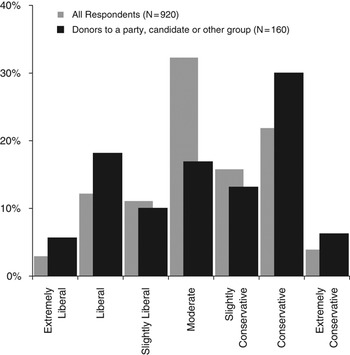
The empirical answer is that donors and groups are not so polarized that they would not support any overlap. Figure 1 shows the ideological distribution of respondents in the 2004 National Election Study who say they have made a political donation. This subset of respondents is less moderate than the general population, but the distribution is not bimodal. There are potential donors, many of them, in the middle of the distribution.
Ideological distribution of donors Source: American National Election Study, 2004.

What about groups? It is harder to measure the ideological spread of groups, but McCarty, Poole and Rosenthal have some evidence, using the ideological locations of the member of Congress to whom political action committees donate.Footnote 36 The distribution of the mean ideal point of the recipients of each group’s donations is not bimodal, but rather is concentrated in the middle.Footnote 37 Their finding echoes the legal conclusion in McConnell v. FEC: that interest groups were donating to candidates of both parties, and thus are not likely to be ideologically motivated.Footnote 38 In other words, there are at least some groups that do bridge between the two ideological clusters, at least when it comes to campaign donations. This is no doubt for strategic reasons, but it means that the groups are moderate enough that their interests might be met by the opposing party.
However, political action committees (PACs) and interest groups that donate to campaigns are not exactly the same as the interest groups that we discuss here. It may be that the moderate groups are disproportionately not the kinds of groups that solicit donors from the population. However, we do think it suggests that there are groups across the political spectrum. We also note that there are a number of groups that claim to be moderate ideologically.
Thus we feel comfortable claiming that the distribution of ideal points for donors is not extremely polarized, and we tentatively claim that it is not obviously polarized for groups. It is not necessary for the distribution to be unimodal or uniform, only that there is considerable representation across the spectrum. If so, absent any additional sorting behaviour, we might expect purely profit-motivated groups to generate a network that is connected from one end to the other by a daisy chain of donations. If not, then name-trading between groups may reflect collaboration that is difficult to explain simply in terms of preferences and financial incentives. We turn now to the practice of exchanging mailing lists.
Data and methods
Our first challenge was to collect data on information exchange between political organizations. We gave donations and subscribed to an initial sample of fifty candidates, political organizations and publications in February 2004, using a unique name for each contribution. We then tracked subsequent solicitations to each name. The initial sample was selected to include an ideologically diverse set of party organizations, magazines and interest groups, and (at the time) every major candidate for president. We held the address (a new post office box in Los Angeles, California) and donation size ($25) constant; for periodicals we chose the subscription offer closest to $25. When we received subsequent solicitations from organizations outside the initial sample, we were able to trace the unique name from its source to its recipient. For example, in February 2004 we donated $25 to Americans for Democratic Action using a unique name; we subsequently received solicitations from America Coming Together and Project Vote Smart to the same name.
Our initial sample was like a drop in a wide pool, and our goal was to see where the ripples led. We therefore donated $25 under unique names to each organization that subsequently solicited us in November 2004 (110 new donations) and April 2005 (170 new donations). This ‘following-up’ technique is known as ‘snowball sampling’. In the vocabulary of social network analysis, each exchange is a ‘directed’ relationship, with one actor sending and another receiving information with no reciprocal exchange implied.Footnote 39
Our use of snowball sampling imposes limits on our inferences, which we note below when appropriate. Essentially, comparisons between organizations in the initial sample and those in subsequent samples are complicated by the different lengths of time we observe their behaviour, and by the selection bias used for the second and third waves. With our short time frame, we also cannot say much about the dynamics of the name-trading process.
However, our approach is appropriate for this exploratory study; since we know little about the extended party, it was appropriate to let the name-trading network reveal itself. Furthermore, the financial cost of sampling organizations puts a premium on identifying organizations that actively trade names. We simply must be cautious not to extrapolate much beyond the 2004–05 period we have chosen. Those years included a contest for the Democratic party nomination but no contest in the Republican party. They included a presidential election, and the same party controlled the White House and both houses of Congress for the entire period. All of those factors might affect differences between the parties in our data. A longer time period might reveal patterns we do not observe here.
This process yielded a sample of 286 organizations in three waves. For this analysis we excluded all California-specific organizations (such as the Los Angeles Times Family Fund). Sixteen organizations – obviously all in the initial wave – exchanged no information at all. Two general patterns are worth noting. First, the network is not very dense. There were 433 connections between all the actors (or ‘nodes’ in social network vocabulary) out of a possible 81,510. This is unsurprising since we expected that many transfers would not happen (for example, National Review to the Democratic National Committee). Secondly, most actors tend to be primarily sources or consumers of information. Thirty organizations both gave and received information; the rest were either name sources or name takers. Only five pairs of organizations (1.17 per cent of all ties) swapped address lists in a reciprocal relationship.
The next section analyses our data in greater depth under the headings of polarization and centralization. For simplicity, we explain the details of our methods as we go rather than present the techniques and results separately. All analysis was conducted within ucinet 6 and all figures were created using the embedded netdraw software.Footnote 40
Polarization and extended parties
A threshold question is whether some interest groups and media groups co-operate primarily with the Democratic party while others tend to work with the Republican party. If all groups – or at least moderate groups – trade freely across the network, then we may conclude that most interest groups and media outlets are free agents who deal with both sides. If, by contrast, we find that our political organizations are grouped into two distinct clusters with little overlap, we may infer the existence of distinct party networks. We begin our analysis with a basic measure of polarization – the distance (number of steps) between the Democratic and Republican formal organizations – and then apply a more formal measure of the connections between party members and across the party divide.Footnote 41
Let us begin with a simple question: how long are the ‘walks’ from formal Democratic to Republican committees, and vice versa? A walk is a sequence of edges (or connections) from one node to another. For example, if the Democratic National Committee (DNC) directly shared names with the Republican National Committee (RNC), that would be a walk of length ‘one’. If the DNC shared with Greenpeace, Greenpeace shared with the National Rifle Association (NRA), and the NRA shared with the RNC, that would be a walk of length ‘three’.
As it turns out, there are no directed walks from any Democratic party committee – the DNC, Democratic Senatorial Campaign Committee (DSCC) or Democratic Congressional Campaign Committee – to any Republican committee (RNC, National Republican Senatorial Committee (NRSC) or National Republican Congressional Committee (NRCC)). That is, there is no sequence of name exchanges from one formal party to the other. By itself, this is partial evidence of polarization, but it also suggests the general thinness of the network.
More interestingly, the two parties seem to behave differently within their own networks: Democratic organizations are more actively involved in information exchange. Table 1 displays the number of direct connections and other walks for each party committee.
List Exchanges Involving Formal Party Organizations

As Table 1 shows, the DNC is involved in fourteen total exchanges while the RNC is involved in five. The DCCC received ten names to the NRCC’s three. This suggests that Democratic committees are more active players in the name game.
The difference between the Democratic and Republican networks is further evident in Figure 2, which displays the ‘egonets’ for each party’s committees. An ‘egonet’ is the set of contacts for a specific actor or, in this case, two sets of actors; it also shows links between these affiliated nodes. All figures are made using NETDRAW’s ‘spring-embedding’ algorithm with minor modifications for visibility.
Egonet of Democratic formal party organizations

Egonet of Republican formal party organizations

The Democratic egonet contains four media outlets and nine interest groups. The Republican egonet, in contrast, consists of four magazines. Again, the formal Democratic party is involved in more transfers than its Republican counterpart.
Having found no ‘walks’ between Democratic and Republican parties due, in part, to the Republicans’ comparative lack of ties, what other measures can we use to test for partisan polarization? A more sophisticated approach is to identify factions in the dataset. A ‘faction’, in social networks parlance, is a collection of nodes that are more tightly connected to one another than to other nodes.Footnote 42 To identify factions, netdraw software iteratively searches for a distribution of nodes among a selected number of factions to minimize the number of connections between factions and to maximize the number of connections within factions.
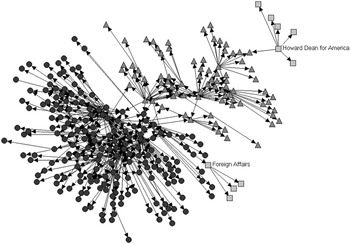
Figure 3 illustrates the separation of political organizations into three factions, revealing the polarization in the information-trading network. The largest faction, shown on the left as circles, is the liberal/Democratic network with 181 nodes. The next largest faction with seventy-nine nodes is a conservative/Republican network, shown on the right as triangles. Both networks suggest a core–periphery structure, with a dense inner network of closely connected groups and a fringe of ‘pendants’, i.e. groups with only one connection. This is partially due to the data collection process; many of the pendants are from later waves and were not observed for the entire sampling period. The number of nodes involved renders it inconvenient to label each group, but the distribution corresponds to the expectations of most observers. The Democratic network includes the formal Democratic party; interest groups such as the Sierra Club, the National Organization for Women, and People For the American Way; publications like The Nation; and the 527 group America Coming Together. The Republican network includes publications like the Weekly Standard and Human Events and interest groups like Club for Growth and Focus on the Family. For clarity, some groups are put into a ‘fringe’ faction with distinct clusters tied to Foreign Affairs and Howard Dean’s presidential campaign.Footnote 43
The polarized network: A three-faction depiction Note: The Democratic EPN is depicted as circles, the Republican EPN as triangles, and the ‘Other’ faction is squares. Unconnected groups not shown.

As we expected, there are relatively few links between the Democratic and Republican networks. Just eight of 433 transfers were between groups in the two major factions. These links, moreover, are almost exclusively by media outlets that solicit readers across the divide – such as The Economist, the Wall Street Journal, and Mother Jones.Footnote 44 It is not surprising that publications were more likely to solicit customers in both networks. Subscribing to a magazine does not carry the same political weight as donating to a cause, and people interested in politics may want to read a variety of publications. Since many media actors are deeply committed to some notion of objectivity, they can offer something to consumers who generally disagree with a publication’s perspective.
While some media sought customers across the spectrum, there were zero connections between the formal party organizations and members of the opposing party’s network, i.e., the DNC did not solicit Human Events readers, and the RNC did not solicit donors to the National Organization of Women, etc. This is consistent with the claim that information-sharing is much more likely to occur within two distinct camps than across the spectrum. In particular, interest groups involved in name transfers seemed to trade only with formal party committees and interest groups within one party network or the other.
This impression that there are two polarized party networks can be measured more formally using the External–Internal (E–I) Index.Footnote 45 The E–I Index is simply the number of inter-faction ties minus the number of intra-faction ties, divided by the total number of ties. It varies from 1 (all ties are between factions) to −1 (all ties are within factions). The E–I Index for our three-faction network is −0.953.Footnote 46 It is not surprising that the E–I index is negative since the factions were calculated to maximize intra-EPN ties, but this index score suggests almost perfect polarization between the two EPNs. By comparison, random links between the actors in these groups would have an average E–I index of 0.048 (p < 0.001).
These results are consistent with the claim that a significant portion of the politically active citizens are divided into competing camps. If this separation is what we mean by polarization, then it is consistent with polarization. They may not be far from each other in ideological space – as Figure 1 shows – but they are separated into two groups, despite their closeness ideologically. This perhaps suggests we need to think about polarization in a different way, or that we should think about ‘separation’, of the sort we have identified here, instead of ‘polarization’. More work would be needed on mass attitudes to address this question.
Mail solicitations are targeted to those who seem likely to give some money based on their prior donations and subscriptions. Political organizations, in turn, behave as if there is not some large mass of moderate participants, but rather that there are two distinct groups. However, the sharp distinction between the two party networks and the absence of non-political groups taking names from across the ideological spectrum suggest that, in addition to the polarization of political activists, there is an element of organizational cleavage as well. Indeed, the fact that there are only ten organizations that fall into the non-aligned ‘fringe’ faction suggests that there are few groups that are truly profit-seeking or politically independent in our sample.
Centrality within extended parties
We are also interested in the relationship between the formal party and the extended networks of allied media and interest groups. Are formal parties just ‘part of the gang’, or are they at the apex of the party pyramid? There are multiple measures of the relative importance, or centrality, of actors within a society.Footnote 47 We begin with a simple measure of centrality by illustrating the connections within each EPN, then we describe the number of transfers by each organization. Finally, as explained below, we estimate the centrality of major organizations, taking into account the ‘quality’ of their trading partners.
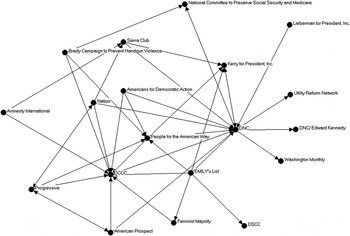
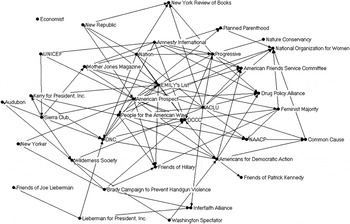
As noted, there is a great deal of information sharing within the Democratic network. There were 318 transfers within the Democratic network, only twenty-five of which involved the DNC, DSCC or DCCC. The remaining transfers connected one non-committee member to another, with an average of 3.3 non-committee transfers per organization within the Democratic network. While a full map of the Democratic network is difficult to display, Figure 4 depicts all organizations in the Democratic network that participated in five or more exchanges. If the formal party was the central actor in the network, we would only see ties between the party committees and other groups, like a hub and spokes. Figure 4, however, includes numerous links between non-committee organizations. This is consistent with the claim that the ‘party’ extends beyond its formal apparatus to include a network of interest group and media allies.
The extended Democratic network

Also telling is Howard Dean’s complete absence from the Democratic network. At first blush, it might seem curious that the chairman of the DNC from 2005 to 2009 was not connected to the party network in early 2004. However, given what we are attempting to measure, this is appropriate. In early 2004, Dean was a party insurgent and outsider. While he shared many ideological positions with the liberal network, he did not co-ordinate with it. Dean’s list would have been valuable to liberal groups and other presidential candidates. But while Dean was willing to share the list with some outside businesses, he did not share names with actors in the Democratic network. This accurately places Dean outside the party network in early 2004, and captures political behaviour at odds with a purely economic rationale for list sharing. The party network in early 2004 included non-formal actors such as Americans for Democratic Action and People for the American Way, but the network did not include Dean.
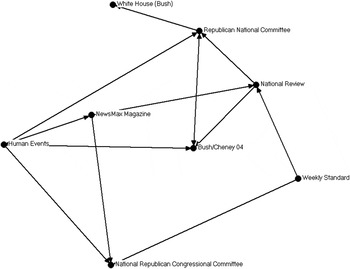
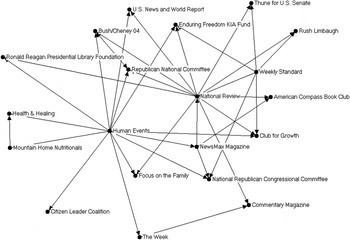
While the Democratic network is dense, the Republican network is not. Figure 5 presents the entire network minus single-connection ‘pendants’. The most prominent pattern in Figure 4 is the role of news magazines. Without their active name-sharing, the Republican network would be even smaller and less active. There were eighty-eight transfers between non-formal party nodes within the Republican network, a mean of 2.3 per organization.
The extended Republican network

We cannot be sure whether the Republican party’s relative lack of connections is a feature of the party or the period studied. Since the Democratic party had a contested presidential nomination right at the beginning of our sample, the Democratic network might have been simply more active for longer, and this is why we see the relationship. Alternatively, the Republican party might be less informal, and thus rely less on the connections we are measuring.
But the connections are still present. Figure 5 is what we would expect to see in a party network, with a twist. There is the expected combination of party committees, candidates, interest groups and conservative media. The inclusion of two alternative medical publications, Health & Healing and Mountain Home Nutritionals, is presumably spurious and due to Human Event’s ‘liberal’ attitude toward name sharing. These links suggest a profit motive for exchanging names, but the fact that there are so few such transfers also suggests an element of political co-operation in the broader network – most of the time, organizations seem to be trading names with their friends instead of selling to any available buyer. In addition, John Thune is the only Congressional candidate in Figure 5. In 2004, Thune unseated Senate minority leader Thomas Daschle (D – South Dakota) in a close, very expensive and nationally watched contest, so his appearance in the dataset suggests that he solicited from a national base of donors with the aid of conservative magazines.
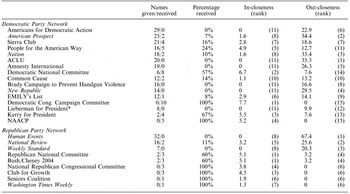
A simple measure of each organization’s centrality is its degree, or number of information transfers. In order to ensure that we are not making invalid comparisons across different waves of our sample, we focus on organizations in the initial sample and classified as part of the Democratic or Republican networks. Table 2 presents the number of names given and received for each group; the Democratic side excludes groups involved in fewer than five transfers. Both sides are organized with the most active groups towards the top of the table.
Information Sharing by Democratic and Republican Network Members in the Initial Sample

Notes: ‘In-closeness’ and ‘Out-closeness’ are calculated using reciprocal geodesic paths and normalized as a percentage of the maximum possible closeness. Six Democratic-connected actors involved in fewer than five transfers are omitted.
* The Lieberman campaign’s low in-degree may be due to Senator Lieberman’s decision to drop out of the presidential primary race soon after our donation arrived.
Eleven of the twelve most active groups in the Democratic network were primarily donors of information; they gave or sold names away, but rarely obtained names from other sources. This included both interest groups and publications. Indeed, the only interest group in this sample which was primarily a recipient of information was the National Association for the Advancement of Colored People. However, formal party organizations were more likely to act as recipients of information. The DNC received eight names and shared six, while the DCCC kept its information in-house while collecting from ten other sources. The DSCC, not shown, received one name and shared with no one. To the extent that organizations favour their friends when making transfers, this pattern suggests that Democratic party committees have a position of prestige in the network; other groups aid the committees by sharing information.
A similar pattern occurs on the Republican side, although there are fewer cases to consider. Three magazines in the original sample were active sources of names but not major recipients of information. Like the DNC, the RNC gave and received with roughly equal frequency. The RNC, however, only shared with organizations tied to President Bush – the 2004 campaign and the White House. Like the DCCC, the NRCC did not share names.
While each actor’s degree and propensity to share conveys a great deal of information, it is also possible to measure centrality by weighing each organization’s position within its party network. We do so using a formal measure of the proximity of each organization to every other actor in a network known as ‘closeness’. Specifically, we calculate the shortest path from one node to every other node, then take the reciprocal of that number as a measure of closeness.Footnote 48 Finally, we normalize this statistic by expressing the observed closeness as a percentage of the maximum possible closeness, i.e. as if every node in a party network was directly connected to each other. We calculate each actor’s ‘in-closeness’, or centrality as a receiver of names, separately from ‘out-closeness’, or centrality as a name donor.
These results are in the right-hand columns of Table 2. They support the claim that formal party organizations are primary recipients of information within each party network. The DCCC, DNC and Kerry campaigns ranked first, second and third in in-closeness in the Democratic network, while the RNC, Bush–Cheney campaign and NRCC ranked first, second and fourth in in-closeness in the Republican network. Publications ranked highest in Republican network out-closeness, while a mix of interest groups (such as the ACLU) and publications (American Prospect, Nation, New Republic) ranked highest in out-closeness among Democratic groups. These organizations were not just name sources; they shared names to organizations that were also active name-traders.
Discussion
Our results suggest the existence of two major networks of ideological teammates, polarized from each other. It is no surprise that the national Democratic and Republican committees do not exchange information. However, the gap between the formal party organizations extends to the constellations of interest groups and magazines that trade information with each formal party. A simple measure of this broader polarization is that there is no path from one formal party entity to an organization of the opposing party. When we partitioned the name-trading actors into factions, we identified two distinct major coalitions: one liberal and Democratic and the other conservative and Republican.
It is unlikely that this polarization is due to the divergent political views of the donor and subscriber base for the organizations in our dataset, since we saw in Figure 1 that while the most politically active Americans tend to be more polarized than their less involved counterparts, many moderates do contribute. A more likely possibility is that the groups themselves are polarized, although we have argued that there is some evidence to believe that there should be enough moderate groups to span the gap. The separation of organizations into two distinct party networks may also reflect deliberate collaboration as well as market mechanisms. We observe relatively little name-trading between moderate organizations in different networks despite the potential for profitable outreach. Further, while a few organizations – such as the Howard Dean campaign – did sell names to non-political businesses, the scarcity of name transfers to businesses also suggests that political organizations are not simply selling names to any available bidder and, instead, favour their friends.
Our data also suggest that formal party organizations tend to be information receivers within their respective networks; other media and interest groups provide the formal parties with names, while party committees are more likely to share information with candidates or to keep names for themselves.
This pattern implies that while the formal party organizations are not the entire party, they are important players in it. Membership information flows to the formal organizations, allowing them the broadest access to the donor base of the party. It would be reasonable to conclude also that the formal organization relies on the rest of the network to mobilize and collect that information. At the very least, the access points for donors and perhaps activists to the party network appear to be decentralized.
The conception of parties as networks has implications for the direct study of the constituent elements. Some strains of interest group research place a central emphasis on the connections of interest groups to party networks, especially where a group is attached to one party and clearly not another. This work should continue. Research on the media also ought to explore the connections between journalists and party actors. Newspapers of an earlier era in the United States were explicitly partisan. We think a set of modern magazines ought to be seen that way as well.
These results should be interpreted with care. First, we should note that the extended parties we identify in this study are not complete. There are many other organizations that informed observers might categorize as affiliated with a political party (for example, the National Federation of Independent Businesses – Republicans; AFL–CIO – Democrats) that do not appear in our dataset.Footnote 49 Our measurement of name exchanges necessarily excludes those groups that do not solicit small donors or new members from the general population. Secondly, there are important groups to which we donated, such as the National Rifle Association and MoveOn.org, that nonetheless do not appear in the dataset. This should not be interpreted as a sign that these organizations do not matter or that they do not trade names; we simply did not observe them doing it. Thirdly, the links we find between specific organizations and the Democratic or Republican parties are often indirect. We should not be hasty to label as ‘partisan’ specific organizations with a low number of indirect ties to parties. However, we do have more confidence the general pattern of polarization that emerges from these indirect relationships is valid and noteworthy.
Finally, as with any exploratory work, additional research is required to validate and extend this project. It would be helpful, for example, to vary the size of initial donations or location of mailing addresses, to change the initial sample for a snowball study, or to utilize a large-scale single-step survey. It would be extremely valuable to collect information on party networks over time to evaluate the stability of extended party membership and centrality over time. We hope that our effort sparks additional investigation of extended party networks.
More broadly, this article and its companion works on the network structure of political parties should prompt a reconsideration of conventional views about American political parties. What does it mean for a network party to be ‘strong’ or ‘weak’? How and why do party networks change and realign? How do changes in electoral rules and governing institutions affect party networks? When we think of parties as networks of formal and informal actors, we gain a fresh perspective on the classic questions of party research.