The prevalence of congenital heart defects is more than 6 per 1000 live births and is one of the most frequent congenital defects.Reference Øyen, Poulsen, Boyd, Wohlfahrt, Jensen and Melbye1 Most congenital heart defects are diagnosed during the first year of life, but age at diagnosis varies according to defect type and severity.Reference Hoffman and Kaplan2 Survival of congenital heart defect patients has improved markedly during recent decades,Reference Nieminen, Jokinen and Sairanen3 and the prevalence of adults living with severe congenital heart defects is increasing.Reference Marelli, Mackie, Ionescu-Ittu, Rahme and Pilote4 The current goal is to ensure these patients’ broad well-being, including prevention of comorbidity and promotion of educational attainment.
Several factors affect the educational level of the congenital heart defect patients. Hospital stays may interfere with school attendance, or motivation may be lacking as a result of emotional difficulties, social isolation, and restricted physical activity.Reference Bruto, Harrison, Fedak, Rockert and Siu5–Reference Kovacs, Sears and Saidi7 Perhaps most importantly, neurodevelopmental impairment may affect these patients’ ability to pursue education, owing to, for example chromosomal abnormalities, preterm birth, or treatment-related factors.Reference Miatton, De Wolf, Frantois, Thiery and Vingerhoets8, Reference Shillingford, Glanzman, Ittenbach, Clancy, Gaynor and Wernovsky9
More information on long-term educational outcomes among the growing population of adults with congenital heart defects is needed to counsel patients and their parents, to provide appropriate care and follow-up, and to better understand the effect of congenital heart defects on the brain.Reference Altman10 Interpretation of existing studies is hampered by the use of self-reported educational data, low participation rates,Reference Nieminen, Sairanen and Tikanoja11, Reference van Rijen, Utens and Roos-Hesselink12 failure to include all types of congenital heart defect,Reference Ternestedt, Wall, Oddsson, Riesenfeld, Groth and Schollin13–Reference Wright and Nolan15 follow-up ending after basic schooling,Reference Nuutinen, Koivu and Rantakallio16 and failure to control for socio-economic factors related to educational attainment.
We, therefore, undertook a nationwide study to compare the educational attainments of congenital heart defect patients, from basic schooling to higher education, with that of a population-based comparison cohort.
Patients and methods
Data on congenital heart defects
We conducted this population-based follow-up study using electronic data from the Danish National Registry of Patients to identify all Danish patients born between 1 January, 1977 and 1 January, 1991 who received a primary discharge diagnosis of congenital heart defect before the age of 13 years. These patients were followed until 1 January, 2006. The Danish National Registry of Patients contains information on all hospital admissions in Denmark, including patients’ civil registration number, dates of admission and discharge, surgical procedures, and up to 20 discharge diagnoses coded exclusively by physicians according to the International Classification of Diseases. The 8th edition of the International Classification of Diseases was used until the end of 1993 and the 10th edition thereafter. International Classification of Diseases’ eighth revision codes used to identify congenital heart defect patients were 746–747 – except for 746.7 and 747.5–747.9, which were not specific to congenital heart defects – and International Classification of Diseases’ tenth revision codes Q20–Q26 – except for Q26.5–Q26.6, which were not specific to congenital heart defects. Diagnoses of patent ductus arteriosus were only considered for infants with gestational age of 37 weeks or more.
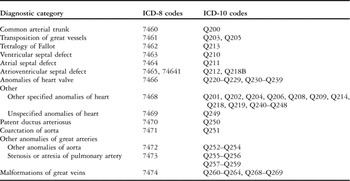
For study purposes, each patient was assigned one congenital heart defect diagnostic code, based on the first primary discharge diagnosis of congenital heart defect. We subsequently grouped International Classification of Diseases’ tenth revision codes according to the corresponding International Classification of Diseases’ eighth revision codes, to uniformly categorise the study cohort during the study period (Table 1).
Diagnostic categories with corresponding ICD-8 and ICD-10 codes.

ICD = International Classification of Diseases
We used Denmark's Civil Registration System to sample a comparison cohort of 10 persons per congenital heart defect patient, frequency matched on sex and year of birth.Reference Pedersen, Gøtzsche, Møller and Mortensen17 The Civil Registration System also allowed us to identify the parents of all the patients in the study. The 10-digit unique civil registration number assigned to every Danish resident since 1968 allows for valid linkage among Danish national registries. In Denmark, all persons with congenital heart defects receive public health care free of charge.18
Data on educational attainment
We used Denmark's Integrated Database for Labour Market Research to obtain annually updated information on the educational level of each patient in the study and his/her parents, family structure, and parental income. Completion of the following educational levels was ascertained, with the corresponding International Standard Classification of Education level19: Basic schooling (9 or 10 years of compulsory education; International Standard Classification of Education level 2); Youth education (International Standard Classification of Education level 3), including upper secondary school and vocational education – the latter leading to jobs such as skilled craftsman or assistant nurse; Higher education, designated as short cycle (International Standard Classification of Education level 4), leading to jobs such as programmer or laboratory technician, medium cycle (International Standard Classification of Education level 5), leading to jobs such as primary school teacher or nurse, and long cycle (International Standard Classification of Education level 5), leading to jobs such as attorney or physician.
Data on extracardiac defects, chromosomal abnormalities, and preterm birth
We used the following codes to identify diagnoses of extracardiac defects and chromosomal abnormalities in the Danish National Registry of Patients: International Classification of Diseases’ eighth revision: 310.40–310.41, 310.5, 311.40–311.41, 311.5, 312.40–312.41, 312.5, 313.40–313.41, 313.5, 314.40–314.41, 314.5, 315.40–315.41, 315.5, and 740.99–759.99 and International Classification of Diseases’ tenth revision: DQ00.0–DQ99.9. We considered diagnoses given at all ages. According to a guideline from the European Surveillance of Congenital Anomalies (EUROCAT), we disregarded isolated minor defects such as torticollis (Q68.0) or protuberant ears (Q17.3).20 We obtained data on gestational age from the National Medical Birth Registry and defined preterm birth as gestational age <37 weeks.
Data on mortality
We obtained data on vital status for the entire cohort through linkage with the Civil Registration System, which has kept electronic records on date of birth, date of emigration, and exact date of death for all Danish residents since 1968.Reference Pedersen, Gøtzsche, Møller and Mortensen17
Data analyses
Person-years at risk was calculated based on a pre-specified age preceding the earliest age at which each educational level could be completed: 13 years of age for basic schooling; 16 years of age for youth education; 18 years of age for short-, medium-, and long-cycle higher education. Persons were followed until the level of education under investigation was attained or until death, emigration, or the end of the study period, whichever came first. We estimated the hazard ratio of attaining each educational level using discrete-time Cox regression analysis, with calendar time as the underlying time scale, conditional on attainment of the foregoing level. This method was adapted from Koch et al.Reference Koch, Kejs, Engholm, Johansen and Schmiegelow21 We report estimates adjusted for current age, sex, parental income, number of siblings, presence of only a single parent, and parents’ highest educational level. The adjusted and unadjusted estimates were not substantially different. We repeated the analysis after excluding individuals in both cohorts who were born preterm or with extracardiac defects or chromosomal abnormalities.
Results
Descriptive data
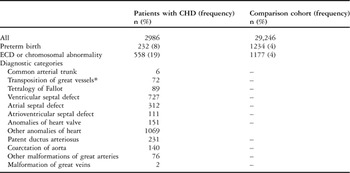
Of the congenital heart defect patients born between 1977 and 1991, 2986 were alive at the age of 13 years. The proportion of patients born with extracardiac defects or chromosomal abnormalities (19%) or born preterm (8%) was higher in the congenital heart defect cohort than in the comparison cohort (4% and 4%, respectively; Table 2).
Characteristics of CHD patients more than 13 years of age and the comparison cohort.

ECD = extra cardiac defect; CHD = congenital heart defect
*Complete and congenitally corrected transposition
Educational attainment
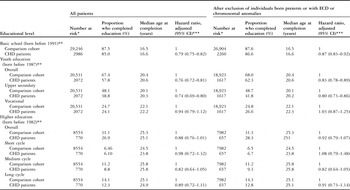
The proportion of all congenital heart defect patients who completed basic schooling (85.0%) was lower than the corresponding proportion in the comparison cohort (87.5%; adjusted hazard ratio = 0.79; 95% confidence interval: 0.75–0.82). In addition, in the sub-cohort, after excluding persons born with extracardiac defects or chromosomal abnormalities or born preterm, the probability of attaining basic school education among congenital heart defect patients was lower than that for the comparison cohort (hazard ratio = 0.87; 95% confidence interval: 0.83–0.92). We repeated this analysis after grouping some of the patients as those with severe congenital heart defects, including common arterial trunk, transposition of great vessels, tetralogy of Fallot, atrioventricular septal defect, anomalies of heart valve, other malformations of great arteries, and malformations of great veins, and as minor-to-moderate severity congenital heart defects, such as ventricular septal defect, atrial septal defect, patent ductus arteriosus, and coarctation of aorta. Congenital heart defect patients in both sub-groups had a lower probability of attaining basic schooling than controls and the estimates did not differ according to severity (severe congenital heart defects: hazard ratio = 0.87; 95% confidence interval: 0.76–1.00), moderate severity congenital heart defects: hazard ratio = 0.92; 95% confidence interval: 0.85–1.00.
Among patients who completed basic schooling, the proportion then completing youth education was lower among congenital heart defect patients (57.8%) than in the comparison cohort (67.4%; hazard ratio = 0.76; 95% confidence interval: 0.72–0.81). The lower probability of attaining youth education held in the sub-cohort analysis is due to differences in the attainment of upper secondary school education (hazard ratio: 0.80; 95% CI: 0.73–0.86), but not vocational education (hazard ratio: 1.03; 95% confidence interval: 0.87–1.25). Among sub-cohort patients completing youth education, the probability of then attaining a higher education was lower overall than that for the comparison sub-cohort (hazard ratio = 0.92; 95% confidence interval: 0.79–1.07) (Table 3).
Educational attainment of all CHD patients and the sub-cohort excluding patients born preterm or with extracardiac defects.

CHD = congenital heart defect; CI = confidence interval; ECD = extra cardiac defect
*Conditional on being alive at 13 years of age. Results are also conditional on completion of basic school before youth education and completion of youth education before higher education
**Restrictions based on birth year were made to enable attainment of educational level within the study period
***Adjusted for current age, sex, parental income, number of siblings, having a single parent, and parents’ highest educational level
Discussion
In this population-based follow-up study, we found a lower probability of completing basic and upper secondary school among congenital heart defect patients compared with a population-based control cohort. For all congenital heart defect patients who had completed youth education, the likelihood of completing a medium- or long-cycle higher education was also lower than that for population controls.
Our study findings extend previous research on this topic.Reference Nieminen, Sairanen and Tikanoja11–Reference Nuutinen, Koivu and Rantakallio16 In line with our results, van Rijen et alReference van Rijen, Utens and Roos-Hesselink12 found lower-than-expected educational achievement in a study among adult Dutch patients with a wide range of congenital heart defect diagnostic categories, after exclusion of mentally retarded patients. In contrast to our findings, Nieminen et alReference Nieminen, Sairanen and Tikanoja11 found that the educational level among congenital heart defect patients was comparable to that of the general population in a Finnish nationwide study encompassing all congenital heart defect diagnostic categories. However, this study was based on self-reports from congenital heart defect patients, with a response rate of 76%, using data from Statistics Finland on the educational level of the general population as a comparison. It was thus susceptible to both information and selection biases and did not control for socio-economic variables.
Several factors affect the interpretation of our findings. The congenital heart defect cohort was defined as individuals with a discharge diagnosis of congenital heart defect according to the Danish National Registry of Patients, and misclassification of exposure status may have occurred. However, the positive predictive value of congenital heart defect diagnoses in the Danish National Registry of Patients is reported to be high,Reference Jepsen, Jepsen, Johnsen, Espersen and Sørensen22 and any misclassification is most likely independent of future educational level. A strength of this study is its population-based design. The Civil Registration System allowed complete long-term follow-up of vital status and linkage to complete and accurate data on educational level, reducing selection and information bias. The public and freely accessible nature of the Danish education system reduced the potential for confounding from differences in socio-economic status among the congenital heart defect patients and the comparison cohort. Furthermore, we were able to adjust for socio-economic and familial factors that influence educational attainment.
As expected, our analysis indicates that the presence of extracardiac defects, chromosomal abnormalities, or preterm birth influences the educational attainments of congenital heart defect patients relative to the comparison cohort, as these conditions are more prevalent among congenital heart defect patients and are associated with decreased educational levels.Reference Moster, Lie and Markestad23–Reference Tanner, Sabrine and Wren25
However, in this study, we can only speculate on the mechanisms explaining the decreased educational attainments of congenital heart defect patients without these conditions. Multiple factors are most likely to interact depending on diagnostic sub-categories of congenital heart defects, including abnormal brain developmentReference Miller, McQuillen and Hamrick26 and brain injury potentially occurring in foetal life,Reference Kaltman, Di, Tian and Rychik27 during cardiopulmonary bypass,Reference Hsia and Gruber28 or post-operatively in the intensive care unit,Reference Newburger, Wypij and Bellinger29 as well as psychosocial factors.Reference Kovacs, Sears and Saidi7 Studies on long-term prognosis are inherently based on patients born and treated in an earlier era where patient management was less advanced. Thus, the educational attainment of patients treated today may turn out differently than the educational attainment of the patients in our cohort.
Conclusion
We found an association between congenital heart defects and a reduced probability of completing basic and upper secondary school, as well as medium- and long-cycle higher education. Attainment of vocational and short-cycle higher education did not differ among congenital heart defect patients and their controls.
Acknowledgements
This study was financially supported by grants from The Danish Heart Foundation (Grant no. 07-4-B350-A1439-22375), Snedkermester Sophus Jacobsen og hustru Astrid Jacobsens Fond, and Aarhus University. The work was independent of the funders. The authors have no conflict of interest to declare.