Implications
The overall costs associated with reproductive inefficiency are larger in pasture-based systems driven by the potential reduction in the synchrony between feed supply and feed demand at farm level due to potentially increased calving intervals. Key traits affecting the economics of overall fertility are calving interval, survivability, level of artificial insemination use and intervention and overall labour efficiency. Identifying and communicating key simple economic messages (6-week calving rate) around key performance indicators facilitate a targeted response to increasing fertility on the farm.
Introduction
The removal of the milk quota regime will create a significant opportunity for expansion within Irish grass-based dairy systems. An Irish national government strategic document (Department of Agriculture, Fisheries and Food, 2010) has set out a pathway for the dairy industry between now and 2020. This document sets out a strategy of expansion in the dairy industry culminating in a 50% increase in milk output by 2020. When milk quotas were introduced in Ireland in 1984 there were over 1.5 million dairy cows, while today there are ~1.1 million cows (Central Statistics Office (CSO), 2013) with a similar level of national milk production today when compared with 1984. In order to facilitate this expansion in a profitable manner there will be a requirement to significantly increase cow numbers as well as increasing milk yield per cow. Using New Zealand (similar to Ireland in relation to it being a largely pasture-based system) as a case study since milk quotas were introduced in Ireland, national milk output has increased over three-fold in New Zealand (LIC, 2012). The costs associated with reproductive inefficiency are magnified within an industry that has the potential to expand.
The relative importance of fertility is greater in seasonal systems of dairy production compared with non-seasonal systems (Veerkamp et al., Reference Veerkamp, Dillon, Kelly, Cromie and Groen2002). A compact calving period in early spring is essential to match the intake demands of the cow to spring pasture growth. The costs associated with reproductive inefficiency in dairy herds can be broadly divided into four main categories. These costs include the effects associated with: increased calving intervals, increased culling (Esslemont et al., Reference Esslemont, Kossaibati and Allcock.2001), increased labour costs and increased costs associated with additional artificial insemination (AI) usage, and interventions of one form or another. These costs were highlighted by Boichard (Reference Boichard1990) when he highlighted additional inseminations, veterinary and hormonal costs, and a modification of current and subsequent lactations associated with infertility costs. In addition to these costs which can be directly linked to reproductive inefficiency, there are indirect costs which can have significant implications for a dairy farm. These include the reduction in the potential for expansion as well as an increased likelihood of animals being purchased onto the farm thus increasing the disease risks associated with not maintaining a closed dairy herd.
Within pasture-based systems, synchronising the supply of feed through pasture growth patterns with the demand for feed is mainly driven by planning the calving pattern such that the peak herd feed demand is matched with peak grass growth (Shalloo et al., Reference Shalloo, O’Donnell and Horan2007). Across both pasture and high input total mixed ration (TMR)-based systems the optimum calving interval is 365 days (Esslemont et al., Reference Esslemont, Kossaibati and Allcock.2001). However, the effect of an increase in calving interval is magnified within grass-based systems as the synchrony of feed supply and demand is distorted. Therefore, the overall economic effects of reproductive inefficiency could be anticipated to be larger in a grass-based system. This effect is further magnified when the overall costs are scaled up to an industry level (including processing components, processing costs and product portfolio effects (Geary et al., Reference Geary, Lopez-Villalobos, Garrick and Shalloo2012)).
To our knowledge, no study has quantified all of the effects associated with reproductive inefficiency in one single analysis. The quantification of the economic effects of each of the individual components would allow the total costs associated with reproductive inefficiency to be quantified. The objective of this study was to quantify the effects of a number of key traits associated with reproductive inefficiency on total farm profitability and then to relate these economic effects to one single variable that helps describe the overall economics of reproductive inefficiency (6-week calving rate).
Material and methods
In this analysis the direct costs associated with reproductive inefficiency are included using the Moorepark Dairy Systems Model (MDSM) (Shalloo et al., Reference Shalloo, Dillon, Rath and Wallace2004). The effects included in the analysis were the effect on: (1) survivability, (2) calving date change, (3) overall labour requirement and (4) increased AI usage and intervention costs. The effects not included in this analysis include reduced potential for expansion, increased herd health risk affects due to an inability to maintain a closed herd.
Survivability
Reduced survivability in a dairy herd is generally the most focused component of infertility. It has been previously stated that the optimum annual culling rates should be kept at close to 18% to maximise the benefits of age structure and genetic improvement within the dairy herd (Esslemont et al., Reference Esslemont, Kossaibati and Allcock.2001). The optimum replacement rate within a dairy herd is driven by the interaction of replacement heifer rearing costs, cull cow values and the genetic potential of the heifers entering the herd in comparison with the cows that are leaving the herd. Therefore the optimum replacement rate will differ by individual country and herd. In this analysis the effect of reduced fertility performance is simulated based on a 5% and 10% increase in herd replacement rate on overall replacement costs including the effect on herd milk yields with the baseline herd replacement rate assumed at 18%. A change in replacement rate was expressed as a percentage change in replacement rate for every cow in the herd.
Heifer rearing costs
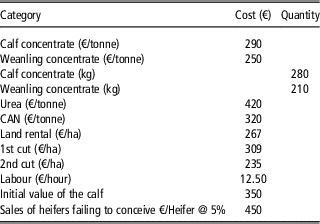
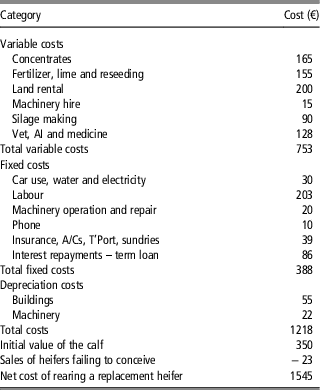
There are significant costs associated with rearing heifers for the dairy herd. The heifer rearing cost assumptions are included in Table 1 and the costs associated with rearing a replacement heifer from birth to entering the dairy herd are shown in Table 2. All costs are included in this analysis. Calf and weanling concentrate is included at €290 and €250/tonne, with 400 kg and 60 kg fed to calves and weanlings respectively, nitrogen fertilisers was included (urea included at €420/tonne and calcium ammonium nitrate at €320/tonne) and land rental at €450/ha. Full labour costs were included based on one full time labour unit (1868 h/year) managing 150 replacement livestock units at a cost of €12.50/h. The initial value of the calf was included at €350 and all costs were inflated to take into account the costs associated with heifers that failed to conceive with a residual value included for these animals of €450. It was assumed that 5% of the animals failed to conceive and were sold from the herd. When all costs were included in the analysis for the full 2-year period, the total cost associated with rearing a replacement heifer was €1545. Variable costs were €753, fixed costs were €388 and when costs are increased by 5%, the total cost for a replacement heifer was €1218. Including an initial value of €350 for the calf and €450 for the heifers that are sold from the farm not in-calf, results in the total cost of €1545. These are the full costs associated with rearing a replacement heifer, while if the non-cash costs such as land, labour, interest on capital tied up and the value of the calf are removed from the analysis the cost drops by €706 per heifer. However, all costs should be included in any analysis to ensure that the opportunity costs associated with any enterprise are captured.
Assumptions used for rearing dairy replacement animals with current cost and prices

CAN=calcium ammonium nitrate.
Costs associated with rearing replacement dairy animals with current cost and prices

AI=artificial insemination.
Milk yield effect
A heifer produces substantially less milk than a mature dairy cow and, therefore, when a heifer replaces a mature dairy cow in the dairy herd the overall herd milk yield declines (Hutchinson et al., Reference Hutchinson, Shalloo and Butler2013b). Milk production per cow is dependent on parity, and full yield potential is reached at 4th lactation. Milk production included in the analysis was 0.75, 0.92 and 0.98 of 4th lactation yield for 1st, 2nd and 3rd parity cows, respectively, calculated using historical Irish milk production data.
Calving interval
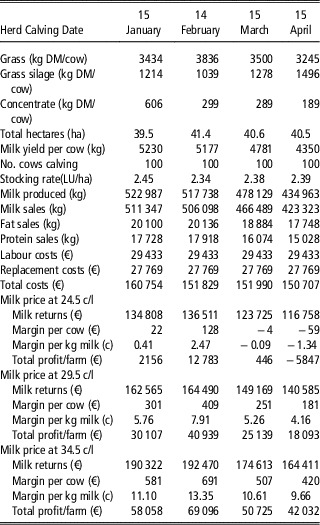
Systems of production based on a high proportion of in situ pasture utilisation are constrained by the seasonality of pasture production, thereby requiring that animal production fit within the cycle of annual grass supply (Dillon et al., Reference Dillon, Crosse, Stakelum and Flynn1995). Therefore synchronising feed supply and demand will have a large impact on the overall efficiency of pasture-based systems of milk production (Shalloo et al., Reference Shalloo, O’Donnell and Horan2007). To quantify this effect, herds with different mean calving dates were compared with each other to determine the effect of a slippage from a predefined optimum (herd demand and supply of feed synchronised) herd mean calving date to a suboptimum mean calving date on overall farm profitability. In the analysis four differing mean herd calving dates were compared (15 January, 14 February, 15 March and 15 April). It was assumed that lactation length changed as the drying off date remained static at the 15 December. The economic effect of a 1 day slip in calving date was averaged across months February to April and expressed per day slippage for every cow in the herd.
Labour requirement
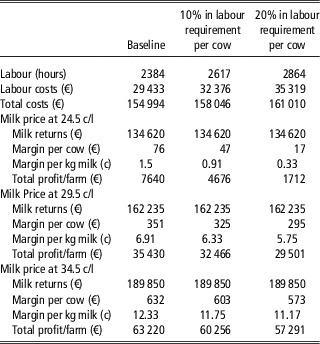
Within pasture-based systems much of the workload can be described as seasonal in nature with herd calving, calf rearing and herd breeding occurring in a batch format within the farm. In a situation where these batches are extended due to longer calving seasons, longer breeding seasons and more batches of calves to rear, the resultant effect is a reduction in the number of cows that can be handled by one individual. In a study of the factors affecting labour efficiency on farms O’Brien et al. (Reference O’Brien, O’Donovan, Gleeson, Ruane and Kinsella2006) highlighted the potential associated compact calving in relation to labour efficiency. That study showed dramatic increases in labour efficiency as herd size increased but within herd size category the study showed substantial differences in overall labour efficiency. In the analysis presented here, three different levels of labour efficiency were evaluated based on the study of the assumption that the overall labour requirement was 25 h/cow per year based on O’ Brien et al. (Reference O’Brien, O’Donovan, Gleeson, Ruane and Kinsella2006) with a 10% and 20% increase in labour requirement associated with a reduction in overall herd fertility.
AI and intervention costs
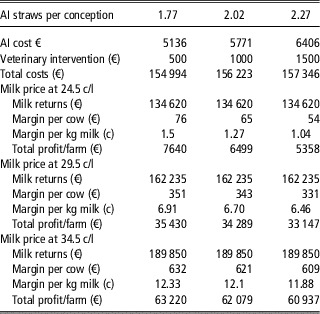
A reduction in herd fertility can be more generally associated with a decline in conception rates and submission rates, higher replacement rates and general herd fertility intervention. Included in this analysis two different levels of fertility were assumed. The assumptions included were 0.25 and 0.5 additional services per cow in the herd and an additional 10% and 20% of the herd requiring treatments of one form or another when compared with a herd with better fertility over the full breeding season. This increased cost was expressed per additional 0.1 inseminations for every cow in the herd.
MDSM
These four effects were modelled independently using the MDSM (Shalloo et al., Reference Shalloo, Dillon, Rath and Wallace2004). The MDSM is a stochastic budgetary simulation model which is used to simulate a model farm integrating biological information around the effects of increased infertility on overall farm profitability. All male calves were sold at 1 month of age and female replacement females were contract reared leaving the farm at 1 month of age and returning 1 month before calving. There was a difference in the overall replacement rate, calving date, cows per labour unit and level of AI usage included for the four different variables in the analysis. The default owned farm size was 40 ha. Land area was treated as an opportunity cost; land was leased out when not required for on-farm feeding of animals in the early years of the simulation, or rented in when required due to increased herd size in subsequent years.
The MDSM integrates animal inventory and valuation, milk production, feed requirement, land and labour utilization and economic analysis. Grass utilization was calculated by the MDSM meeting the net energy requirements for maintenance, milk production and BW change across lactation (Jarrige, Reference Jarrige1989) minus energy requirements supplied through concentrate supplementation. Variable costs (fertilizer, contractor charges, medical and veterinarian, silage and reseeding), fixed costs (machinery maintenance and running costs, farm maintenance, car, telephone, electricity and insurance) and sales values (milk, cull cow and calf) were based on current prices (Teagasc, 2013). The herds were compared at a milk price of 29.5 cpl, assuming 33.0 g/kg protein and 36.0 g/kg fat with a relative price ratio of 1 : 2.56 for fat : protein (Shalloo et al., Reference Shalloo, Geary and Villalobos2013).
Scenario analysis
Within the MDSM each of the four effects was included independently with the model quantifying the importance of each individual trait. Within the analysis it was assumed that land was limiting at 40 ha. Therefore an increased requirement for heifers due to reduction in cow survivability was facilitated by increased contract rearing and therefore it manifested itself in increased costs. Similarly, changes in calving date were facilitated by increased feed requirements. In all of the analysis presented full costs were included. Cull cows were included in the analysis based on a value of €2.20/kg carcass weight, it was assumed that they would have a kill out percentage of 40% and that the live weight pre slaughter was 550 kg resulting in a cull cow value of €484 (at end of lactation without any finishing period). AI costs were included based on the semen and the service costs of €29/service and the synchronisation and intervention costs were included at a cost of €50/animal for those animals that require intervention in the form of veterinary intervention, scanning, synchronisation, uterine wash out, etc. Sensitivity analysis was carried out through simulation with milk prices of 24.5 and 34.5 cpl. Fertility indicator trait data was then incorporated with the economic data to quantify the economic effect associated with changes within the indicator trait (6-week calving rate).
Development of a fertility indicator trait
Analysis was completed of the Irish national database (Irish Cattle Breeding Federation) to determine the relationship between 6-week calving rate with each of the four independent traits, however, there was no data available on the relationship between 6-week calving rate and labour use, therefore labour data were not included in the development of the predictor trait. The overall objective was to create one single variable that explained the costs associated with infertility within a dairy herd.
Data editing and trait definition. Calving dates from 4 716 477 cows totalling 4 421 512 calving events between the years 2008 and 2013 were available from 36 804 dairy herds. Only spring calving herds where >80% of cows calved between 1st January and 1st June were retained. Six-week calving rate was defined based on the number of cows that calved in the first 42 days of the herd calving season. The calving season was defined separately for heifers and cows. The start of the calving season was defined as the first calving date, within the herd, when five cows (or heifers) calved within a subsequent 14 days period. The end of the calving season was defined as the last calving, within herd, which was not followed by a subsequent calving within 21 days. Only calving seasons between 35 and 200 days in length were retained and each calving season had to have at least 5 and 10 calving events for heifers and cows, respectively, thus ensuring data integrity.
Survival was defined as whether a cow survived from one lactation to the next. A cow was assumed not to have survived to a subsequent lactation if: (1) no calving record was available for the following lactation, (2) the difference between the cow’s calving date was >800 days from the last recorded calving date of the herd, or, (3) if the cow was slaughtered or died on farm within 400 days of calving.
Calving interval was defined as the difference, in days, between two consecutive calving events for each cow; only calving intervals between 300 and 800 days were retained.
The number of inseminations per animal was calculated for each breeding season. The start of the breeding season was defined as the 1st insemination date, within herd, when five cows were inseminated within the subsequent 14 days. The end of the breeding season was defined as the last insemination date, within herd, which was not followed by a subsequent insemination within 10 days, or the gap between three consecutive inseminations was >21 days. Only breeding seasons between 35 and 140 days in length were retained and each herd had to have at least 20 insemination events. Cows that were served before the commencement of the herd breeding season were set to missing and submission rate information was only retained for the 1st service record of the cow.
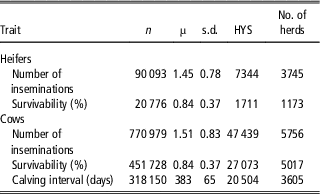
Herd-year-season contemporary groups were generated for each cow and heifer trait separately using the Crump algorithm (Crump et al., Reference Crump, Wray, Thompson and Simm1997). This algorithm creates contemporary groups based on animals from the same herd calving in close proximity of time. In this study, animals from the same herd that calved within 10 days of each other were grouped together. If the number of records in this immediately defined contemporary group was less than eight then this contemporary group was merged with an adjacent group if the start date of one group and the end date of the other group were within 182 days of each other. For cow and heifer survival, to avoid quasi-complete separation of the data in the subsequent analysis, only contemporary groups with variation were retained (Table 3).
Number of animals (n), mean (µ), standard deviation (s.d.), trait range, no. of contemporary groups (HYS) and number of dairy herds selected from the Irish national database (Irish Cattle Breeding Federation (ICBF)) and included in the analysis

Data analysis
The association between 6-week calving rate and calving interval, and number of inseminations was quantified using linear mixed models in ASReml (Gilmour et al., Reference Gilmour, Gogel, Cullis and Thompson2012) separately for heifers and cows. Risk factors associated with the logit of the probability of cow or heifer survival was modelled using generalised estimating equations in ASReml (Gilmour et al., Reference Gilmour, Gogel, Cullis and Thompson2012) assuming a binomial distribution of the data. Fixed effects included in all models were: month of calving, year of calving (2008 to 2013), 6-week calving rate, heterosis and recombination loss coefficient for each animal, breed proportion of Holstein and Friesian for each animal and contemporary group. For cows, parity of the cow (2, 3, 4 and 5+) was included as a fixed effect and cow was included as a random effect.
Results
Survivability
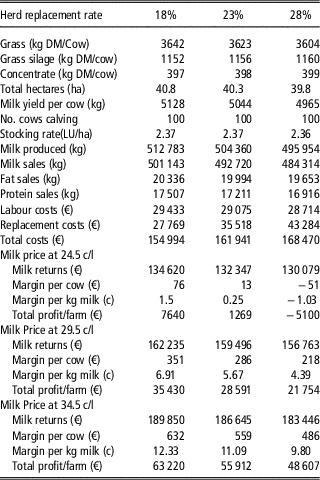
When the replacement of the herd increased from 18% to 23% and 28%, respectively; there was a corresponding reduction in milk sales of 638 kg MS and 1274 kg MS from the farm corresponding to 1.7% and 3.4% reduction in milk solid sales (Table 4). Replacement costs increased by 28% and 56% with total costs increasing by 4.5% and 8.7% when replacement rate increased from 18% to 23% and 28%, respectively. At a milk price of 29.5 c/l farm profitability reduced by €6839 and €13 676 while the corresponding figures at 24.5 were €6371 and €12 471 while at 34.5 profitability reduced by €7308 and €14 613 when replacement rate increased from 18% to 23% and 28%, respectively. Each 1% change in herd survivability was associated with a profitability change of €13.68/cow, €12.74/cow and €14.61/cow at 29.5 c/l, 24.5 c/l and 34.5 c/l, respectively.
The effect of replacement rate on the key herd parameters and farm profitability of dairy herds using current costs and projected prices

Calving date change
The optimum herd mean calving date in a post quota environment was mid-February (Geary et al., Reference Geary, Lopez-Villalobos, Garrick and Shalloo2012). A slippage in calving date from mid-February to a later calving date was associated with a reduction in profitability (Table 5). The level of the reduction in profitability was affected by the milk price that prevailed at the time. At a higher milk price there was an increased effect of a 1 month slippage in herd mean calving date. At a milk price of 29.5 c/l each 1 day slippage in herd mean calving date reduced profitability by €3.86/cow in the herd between February and April, respectively. The corresponding figures at a milk price of 24.5 and 34.5 c/l were €3.14, and €4.57/cow, respectively.
The effect of herd mean calving date on the key herd parameters and dairy farm profitability using current costs and projected prices

Labour
An increase in the labour requirement of 10% or 20% resulted in a reduction in farm profitability by €2964 and €5929 per farm, respectively (Table 6). If the increased labour requirement resulted in a reduction in the number of cows that could be handled on the farm the overall effect would be significantly higher at farm level.
The effect of increases in labour requirement per cow on dairy farm profitability using current costs and projected prices

AI and intervention costs
An increase in AI usage and increased general fertility intervention has a relatively small but negative effect on overall herd profitability. A 0.1 increase in AI usage per cow reduced farm profitability by €4.56/cow (Table 7), however, the magnitude of the effect is significantly less than the effects associated with survivability or with calving date change.
The effect of increased AI usage and intervention on dairy herd profitability using current costs and projected prices

AI=artificial insemination.
Statistical results
Across all years the average 6-week calving rate was 0.65 (s.d.=0.47) for cows and 0.80 (s.d.=0.39) for heifers. The average number of inseminations for seasonal calving herds was 1.51 (s.d.=0.83) and 1.45 (s.d.=0.78) for cows and heifers, respectively (Table 3). Across all years on average 84% of cows and heifers survived within the herds to a subsequent lactation, this should, however, not be assumed to represent national statistics because an edit was applied so that each contemporary group contained some incidence of culling. The average 6-week calving rate for seasonal calving herds varied from 80% (s.d.=0.39) for heifers to 65% (s.d.=0.47) for cows. The average calving interval across all years was 383 (s.d.=65) days but varied from 395 (s.d.=79) days in 2009 to 370 (s.d.=35) days in 2012.
Heifers
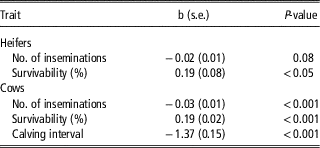
The association between 6-week calving rate and average number of inseminations for heifers decreased linearly by −0.02±0.01 (P=0.08; Table 8). Each percentage increase in 6-week calving rate resulted in 0.19±0.08 (P<0.001) percentage increase in survival, indicating that herds with superior 6-week calving rates also had improved survival rates.
Regression coefficients (b; standard error in parenthesis) of phenotypic performance of no. of inseminations, survivability and calving interval on 6-week calving rate from the Irish national database

Cows
The average number of inseminations decreased by −0.03±0.01 (P<0.001) straws per percentage increase in the 6-week calving rate. The log of the odds of a cow surviving to next parity increased by 0.19±0.02 (P<0.001) percentage points, per unit increase in the 6-week calving rate. Calving interval decreased by −1.37±0.15 days (P<0.001) per percentage increase in 6-week calving rate (Table 8) when cows with a calving interval of 340 to 400 days were included in the analysis.
Combining the statistical analysis with the economic effects associated with the key traits suggests that for every 1% increase in 6-week calving rate there is an associated increase in farm profitability of €9.26/cow per year and €3.51/heifer per year. When this analysis is scaled up to a 100 cow 40 ha farm, each 1% increase in 6-week calving rate is associated with €822 increase in profitability per farm.
Discussion
Optimum dairy herd performance is generally associated with calving intervals of about 365 to 370 days and a failure to conceive culling rate (FTC-CR) of <10%. This results in the optimum balance between replacement costs and genetic improvement as well as optimising the synchrony between feed supply and feed demand (Esslemont et al., Reference Esslemont, Kossaibati and Allcock.2001).
Financial effects of reproductive inefficiency
Calving Interval
Within the confines of milk quotas where the total volume of milk supplied was limited, the optimum mean calving date tended to be later thereby sacrificing overall farm milk production in order to use more cheap grazed grass to produce the fixed milk quota based on achieving a high profit per litre (Shalloo et al., Reference Shalloo, O’Donnell and Horan2007). While this principle is still important, the ability to increase overall production in a non-quota scenario coupled with recent advances in grazing technology showing that lower grazed grass allocation levels in early spring are sufficient to fully feed the dairy herd and achieve high animal performance (Kennedy et al., Reference Kennedy, O’Donovan, O’Mara and Delaby2007). This has implications for the optimum calving date in the future. This is even further magnified by the implications of new grass selection indices which are identifying grasses that provide greater early season growth (McEvoy et al., Reference McEvoy, O’Donovan and Shalloo2011). There is also potential to increase milk values and the price received by farmers by optimising the herd mean calving date through increasing the capacity utilisation of milk processing as well as increasing the value of the products produced by diversifying the product portfolios (Geary et al., Reference Geary, Lopez-Villalobos, Garrick and Shalloo2012).
Culling
The optimum culling rates in a herd will be driven by a number of factors which include the rates of genetic progress possible within the national dairy herd and therefore the genetics available, cull cow values, replacement heifer rearing costs and the levels of involuntary culling within the herd. There are significant costs associated with rearing replacement heifers which can put substantial pressure on the dairy farm business in particular when the dairy farm is expanding and when there is cash flow pressures on the farm (Hutchinson et al., Reference Hutchinson, Shalloo and Butler2013a and Reference Hutchinson, Shalloo and Butler2013b; McDonald et al., Reference McDonald, Shalloo, Pierce and Horan2013). Losing a high genetic merit cow early in her productive life through enforced culling means that the cow does not realise her full genetic potential within the dairy herd. Poor herd fertility results in a situation where cows are culled that are generally healthy and sick cows (prone to mastitis and lameness) are retained in the herd resulting in an increased risk of disease spread around the herd (Esslemont et al., Reference Esslemont, Kossaibati and Allcock.2001). Increased culling is associated with reduced milk yields as the age profile of the herd is sub optimum. A dairy heifer will produce ~75% of a mature cow’s milk yield (Hutchinson et al., Reference Hutchinson, Shalloo and Butler2013b). Therefore increased genetic potential for milk production when associated with reductions in survivability often result in the increased potential for milk production never being fully realised at farm level (Esslemont et al., Reference Esslemont, Kossaibati and Allcock.2001).
Labour
In this study the effect of reduced labour efficiency within the dairy herd was simulated through increasing the labour requirements by 10% and 20% within the dairy herd, which resulted in a negative effect on farm profitability. In reality the effect of a reduction in labour efficiency would be more severe if it manifested itself in the herd size being restricted. Increased labour requirements were associated with reduced fertility performance in a study by De Vries et al. (Reference De Vries, Crane, Bartolome, Melendez, Risco and Archbald2006). In an Irish study, it was demonstrated that there was substantial variation in labour efficiency across farms (O’ Brien et al., Reference O’Brien, O’Donovan, Gleeson, Ruane and Kinsella2006), some of which could be explained by differences in herd fertility.
National data analysis
Population statistics reported in this study for number of inseminations, calving intervals and cow survival corroborated previously reported statistics across similar systems of production (Darwash et al., Reference Darwash, Lamming and Wooliams1997; Wall et al., Reference Wall, Brotherstone, Woolliams, Banos and Coffey2003; Berry and Cromie, Reference Berry and Cromie2009). Across both heifers and cows the direction of the association between 6-week calving rate and survival and number of inseminations concurred with expectations, with higher survival and a lower number of inseminations recorded for herds with higher 6-week calving rates. Previous studies have reported favourable genetic correlations between traditional fertility traits (Wall et al., Reference Wall, Brotherstone, Woolliams, Banos and Coffey2003; de Jong, Reference de Jong1997) such as calving interval and number of inseminations, with the results from this study showing that positive associations between the traits also exist at the phenotypic level, suggesting that improving one fertility trait will result in an improvement in overall fertility and cow survival. This indicates that selection on the current traits included in the Irish Economic Breeding Index (EBI, i.e. cow survival and calving interval) will allow for the indirect selection on improved 6-week calving rates. This study has shown that each 1% change in 6-week calving rate is associated with €9.26 and €3.51 in net farm profit per cow and heifer, respectively, per year.
Reproductive inefficiency
There has been an international decline in dairy cow fertility associated with genetic selection for milk production which has had a negative impact on the profitability of all dairy producers, especially those that practice seasonal calving with pasture-based dairying. As has been shown in the present study there are substantial costs associated with reduced fertility at farm level which have both direct effects but also can be associated with indirect costs. For example, there are implications associated with the unrealised potential from herds with poor fertility, reduced potential for expansion as well as increased likelihood of disease issues in the herd related to reduced voluntary culling and increased likelihood that the herd is not operated as a closed herd.
Genetics
Genetic improvement in cow fertility is possible through the selection and use of bulls which have higher breeding values for fertility traits (Veerkamp et al., Reference Veerkamp, Dillon, Kelly, Cromie and Groen2002). Selection based on productive traits without focus on fertility has a negative influence on reproductive ability, because reproduction is negatively correlated with milk yield (Veerkamp et al., Reference Veerkamp, Dillon, Kelly, Cromie and Groen2002). Jones et al. (Reference Jones, Hansen and Chester-Jones1994) reported that selection based on milk yield produces more income in dairy populations but also greater costs. Dekkers (Reference Dekkers1991) reported that an improvement in fertility increases profit, not only by reducing culling cost but also by increasing incomes from milk sale and shorter calving intervals. Recently, in many countries, fertility has been included in breeding goals to place emphasis on genetic aspects of reducing fertility costs in dairy cattle (Kadarmideen and Simm, Reference Kadarmideen and Simm2002). Ireland introduced fertility in its selection index (EBI) in 2000 with the weighting on fertility increasing to over 35% of the overall index weighting currently. A number of studies have shown that animals selected using the EBI result in increased dairy farm profitability (McCarthy et al., Reference McCarthy, Horan, Dillon, O'Connor, Rath and Shalloo2007; Ramsbottom et al., Reference Ramsbottom, Cromie, Horan and Berry2012).
Synchronisation
Synchronisation is not commonly used in pasture-based systems in comparison with systems where cow’s calve all-year round in TMR-based systems. Studies suggest that it is possible to shorten the calving interval of a dairy herd through the introduction of a synchronisation protocol (Herlihy et al., Reference Herlihy, Berry, Crowe, Diskin and Butler2013), however, the economic effect of synchronisation has not been evaluated in the context of pasture-based systems. For herds that currently could be described as having a sub optimum mean calving date, synchronisation may have something to offer but the overall economic benefits associated with synchronisation will be determined by the effect of synchronisation on herd mean calving date as well as how long this effect lasts within the herd and the associated synchronisation costs.
Sexed semen
High pregnancy rates early in the breeding season are essential if the desired calving pattern is to be achieved. This represents a major barrier to widespread adoption of sexed semen use in seasonal production systems if associated with reductions in conception rates (Hutchinson et al., Reference Hutchinson, Shalloo and Butler2013b). In this sexed semen analysis, there was a reduction in farm profit when there was a significant reduction in conception rates associated with sexed semen. Reduced fertility was reflected in poorer economic performance through: increased rates of culling for infertility, fewer available replacements heifers, increased replacement heifer costs, and increased semen costs (Plaizier et al.,Reference Plaizier, King, Dekkers and Lissemore1998; Hutchinson et al., Reference Hutchinson, Shalloo and Butler2013b). Therefore the economic benefits associated with sexed semen, are dependent on the balance between the increased infertility and sexed semen costs and the increased heifers born under the sexing scenarios.
Extended calving intervals
In non-pasture-based systems the overall costs associated with reproductive inefficiency are masked as the calving intervals of the herds are extended. Within pasture-based systems extending the calving intervals results in a breakdown between the synchrony of feed supply and feed demand as well as being associated with milk production in a period where the overall herd would not be milked. In a study completed using Irish data, Butler et al. (Reference Butler, Shalloo and Murphy2010) showed that the optimum herd calving interval for a dairy herd was 365 days. However, the study showed that for animals not in-calf with high milk production potential extending the calving interval was more profitable than culling. The opposite was the case for low milk yield potential animals.
Nutrition
A key driver of profitability on pasture-based dairy farms is grass utilised per hectare (Shalloo, Reference Shalloo2009) with each additional tonne of dry matter utilised worth €161/ha (Dillon, Reference Dillon2011). A number of studies have shown that when animals are well fed at pasture there is no benefit from increased supplementary feeding (Buckley et al., Reference Buckley, Dillon, Rath and Veerkamp2000; Kennedy et al., Reference Kennedy, Dillon, O’Sullivan, Buckley and Rath2003; Horan et al., Reference Horan, Mee, Rath, O’Connor and Dillon2004; McCarthy et al., Reference McCarthy, Mee, O’Connor, Rath and Dillon2005; Coleman et al., Reference Coleman, Pierce, Berry and Horan2009) from a fertility perspective, with a study of Diskin et al. (Reference Disken, Murphy and Sreenan2006) showing a similar result for first service conception rates with a contradictory result for the 2nd service. The economic implications associated with nutrition are dependent on milk price, feed price and pasture availability (Shalloo et al., Reference Shalloo, Dillon, Rath and Wallace2004; McCarthy et al., Reference McCarthy, Horan, Dillon, O'Connor, Rath and Shalloo2007). A number of studies have shown a relationship between body condition score loss and fertility performance (Berry et al., Reference Berry, Buckley, Dillon, Evans, Rath and Veerkamp2003; Roche et al., Reference Roche, Friggens, Kay, Fisher, Stafford and Berry2009). Minimising the levels of body condition score loss is one of the key drivers of fertility management of pasture-based management systems.
Conclusion
There are significant costs associated with reproductive inefficiency in the dairy herd. This study has quantified the costs associated with increased culling, calving date slippage, increased AI and intervention costs as well as increased labour costs. This study does not include the indirect costs such as reduced potential for expansion, increased costs associated with not having a closed herd as well as the unrealised potential within the herd. Analysis of the Irish national database has shown that there is a statistically significant association between the 6-week calving rate and survivability, calving interval and AI usage at farm level. Each 1% change in 6-week calving rate was associated with €8.22/cow per annum for a herd average cow in the dairy herd.
Acknowledgement
The authors would like to thank the Irish Cattle Breeding Federation for providing access to the national dairy database.