Introduction
Major depression (MD) is one of the most common psychiatric conditions, affecting approximately 6.6% of adults each year in the USA (Kessler et al. Reference Kessler, Berglund, Demler, Jin, Koretz, Merikangas, Rush, Walters and Wang2003, Reference Kessler, Chiu, Demler, Merikangas and Walters2005). The risk of MD varies over the life course, with peak incidence in young adulthood (Eaton et al. Reference Eaton, Anthony, Gallo, Cai, Tien, Romanoski, Lyketsos and Chen1997; Kessler et al. Reference Kessler, Amminger, Aguilar-Gaxiola, Alonso, Lee and Ustun2007). Population-based studies that use fully structured diagnostic instruments have consistently found that older adults (e.g. aged ⩾60 years) have the lowest lifetime prevalence of MD, despite the expectation that lifetime prevalence of non-fatal conditions should increase monotonically with age (Eaton et al. Reference Eaton, Kalaydjian, Sharfstein, Mezuk and Ding2007; Kessler et al. Reference Kessler, Birnbaum, Bromet, Hwang, Sampson and Shahly2010).
There are several plausible explanations for this counterintuitive finding (Patten et al. Reference Patten, Gordon-Brown and Meadows2010). The first is recall bias, such that older adults fail to report earlier depressive episodes, which biases lifetime prevalence downwards (Giuffra & Risch, Reference Giuffra and Risch1994; Wells & Horwood, Reference Wells and Horwood2004; Patten, Reference Patten2009). Second, these results could arise because of selective attrition, in which persons with a history of MD either die or enter institutions (e.g. nursing homes) at a higher rate than those without, which results in a more ‘healthy’ remaining population. Indeed, MD is modestly associated with increased mortality (Kouzis et al. Reference Kouzis, Eaton and Leaf1995). Finally, some have argued that the lower prevalence of MD among older adults relative to younger age groups is due to a cohort effect (Cross-National Collaborative Group, 1992). However, there are several observations that call into question whether the low prevalence of MD in later life is attributable to these three explanations: (i) the relationship between depressive symptoms and age seems to be U-shaped, with both the youngest and oldest age groups reporting high levels of symptomatology as measured by scales such as the Center for Epidemiologic Studies – Depression (CESD; Kessler et al. Reference Kessler, Foster, Webster and House1992; Nguyen & Zonderman, Reference Nguyen and Zonderman2006; Blanchflower et al. Reference Blanchflower and Oswald2008); (ii) depression is strongly associated with suicidality, and suicide risk is highest among older adults, particularly those over age 75 (Blazer et al. Reference Blazer, Bachar and Manton1986); and (iii) antidepressant use is just as, if not more, common among older relative to middle-aged adults (Middleton et al. Reference Middleton, Gunnell, Whitley, Dorling and Frankel2001). Together these observations suggest that the lower prevalence of MD among older adults is not due to a cohort effect, nor to selective attrition or recall bias (Eaton et al. Reference Eaton, Kalaydjian, Sharfstein, Mezuk and Ding2007, Reference Eaton, Shao, Nestadt, Lee, Bienvenu and Zandi2008).
An alternative hypothesis to explain the low prevalence of MD in later life is that the expression of depressive symptomatology changes over the lifespan. Gallo et al. (Reference Gallo, Anthony and Muthen1994) reported that older adults were less likely to endorse symptoms of dysphoria, appetite disturbances and motor agitation than younger adults, a phenomenon they termed ‘depression without sadness’. As dysphoria is a cardinal symptom of MD, this finding implies that requiring this symptom as part of this diagnosis would artificially lower the prevalence of MD among older adults.
Latent variable modeling is a useful approach for examining heterogeneity in depressive symptomatology within the population. Latent class analysis (LCA) has been used previously to examine heterogeneity of depressive symptomatology in both general population (Eaton et al. Reference Eaton, Dryman, Sorenson and McCutcheon1989; Kendler et al. Reference Kendler, Eaves, Walters, Neale, Heath and Kessler1996; Sullivan et al. Reference Sullivan, Kessler and Kendler1998; Chen et al. Reference Chen, Eaton, Gallo and Nestadt2000) and clinic-based (Hybels et al. Reference Hybels, Blazer, Pieper, Landerman and Steffens2009, Reference Hybels, Blazer, Landerman and Steffens2011) samples. A key assumption of LCA is that an unobserved, categorical variable (e.g. depression status) explains the association between a set of observed variables (e.g. signs and symptoms) that indicate this latent status (McCutcheon, Reference McCutcheon1987; Eaton et al. Reference Eaton, Dryman, Sorenson and McCutcheon1989; Kendler et al. Reference Kendler, Eaves, Walters, Neale, Heath and Kessler1996). LCA is used to identify distinct groups of people, called classes, that share similar symptom endorsement profiles. The predicted probability of each class represents the prevalence of each class in the population (Chen et al. Reference Chen, Eaton, Gallo and Nestadt2000). Conditional on class membership, the predicted probability that any particular depressive symptom is endorsed describes the features of that class (e.g. a non-depressed class is likely to be characterized by very low conditional probabilities of endorsement of all depressive symptoms) (Chen et al. Reference Chen, Eaton, Gallo and Nestadt2000). Symptoms of MD are relatively common (Eaton et al. Reference Eaton, Anthony, Gallo, Cai, Tien, Romanoski, Lyketsos and Chen1997), and therefore using LCA to examine the patterning of symptoms in the general population, rather than only among those who meet diagnostic criteria, may provide a more complete picture of the heterogeneity of depressive symptomatology over the life course.
The aim of this study was to examine variation in depressive symptomatology in the general population across the lifespan. This investigation focused on two questions: (1) Does the prevalence of specific depressive symptoms classes vary by age? and (2) Are the symptom profiles that characterize these depressive classes similar across age?
Method
Sample
Data came from the National Institute of Mental Health Epidemiologic Catchment Area (ECA) Project, a five-site study of the prevalence and incidence of mental health in the community. The study design, sampling strategy and survey procedures have been described previously (Reiger et al. Reference Regier, Myers, Kramer, Robins, Blazer, Hough, Eaton and Locke1984). In brief, adults aged ⩾18 years residing in each of the catchment areas (East Baltimore, MD; New Haven, CT; St Louis, MO; Durham, NC; and Los Angeles, CA) were initially interviewed in 1981 and then followed up in 1982. Each site recruited approximately 3500 community-residing adults, and an additional sample of 500 adults from institutions. The New Haven site used a different version of the survey instrument than the remaining four sites, and we therefore excluded it from this analysis. The St Louis site did not include items on the recency of individual depressive symptoms and it was also excluded. The analysis of depressive symptomatology is therefore limited to the community-residing sample of the remaining three sites that included measures of recency of depressive symptomatology (East Baltimore, MD; Durham, NC; Los Angeles, CA), with an analytic sample size of 10 529.
Depression
Depressive symptomatology was assessed using the Diagnostic Interview Schedule (DIS; Robins et al. Reference Robins, Helzer, Croughan and Ratcliff1981). The DIS reflected the diagnostic criteria for MD outlined in DSM-III published in 1980. The specific symptom criteria were updated in 1988 and 1994; however, the core symptom groups have remained consistent across these revisions: sadness (dysphoria), loss of interest or enjoyment in activities (anhedonia), sleep disturbances, appetite disturbances, guilt, concentration problems, psychomotor disturbances, fatigue, and thoughts of death or suicidal ideation (Robins et al. Reference Robins, Helzer, Croughan and Ratcliff1981). The DIS is a fully structured instrument administered by lay interviewers and consists of stem and probe questions modeled after a clinical psychiatric interview. Validation studies of the MD module of the DIS within the ECA study have demonstrated that this instrument has moderate concordance with clinical assessments (Robins et al. Reference Robins, Helzer, Ratcliff and Seyfried1982); the majority of the disagreements between the DIS and clinical diagnosis occur because this instrument under-reports cases that are identified by clinicians (Eaton et al. Reference Eaton, Neufeld, Chen and Cai2000).
Unlike other fully structured psychiatric assessments used in the general population (e.g. the CIDI), the MD module of the DIS has no screening or skip-out questions. The initial stem items on all depressive symptoms items (17 in total) were asked of all participants, regardless of whether or not they endorsed specific core symptoms (e.g. dysphoria). For symptoms in which there are non-psychiatric causes (e.g. sleep disturbances, appetite changes, fatigue, psychomotor changes and concentration problems), probes were used to determine whether the specific symptom was attributable to a physical illness or injury, or use of medication, drugs or alcohol. Only those symptoms that were not attributed to any of these alternative causes (e.g. plausible psychiatric symptoms) are used in this analysis. After completing these initial items, those who potentially met diagnostic criteria for MD (e.g. participants who had endorsed experiencing at least five of nine symptom groups in their lifetime, including dysphoria, as specified in DSM-III) were asked which symptoms occurred during the most severe episode to determine whether the symptoms clustered together during a single episode to determine the DIS diagnosis of MD.
Each symptom was coded dichotomously; suicidal ideation and attempt were combined into one item because of the low prevalence of the latter. Items were coded 1 if the symptom occurred in the past 6 months and 0 if they never occurred or last occurred more than 6 months prior to the interview.
Analysis
Initially, the prevalence of each symptom was compared across age groups using χ2 tests; weights were used to account for the sampling design for this descriptive analysis. Next, exploratory factor analysis using tetrachoric correlations was used to confirm that the DIS items described a unidimensional construct for all four age groups; in each age group the eigenvalue distribution clearly indicated that a one-factor solution fit the data.
The number of latent classes indicated by the observed variables for each of the four age groups was determined by comparing model fit statistics between nested (in terms of the number of classes extracted) models. Entropy, bootstrap likelihood ratio test (BLRT), Bayesian information criterion (BIC) and sample size-adjusted BIC (BICN) were used to compare fit between nested models that extracted larger numbers of classes. Improvement in model fit, and thus support for additional classes, is indicated by smaller values in the BIC and BLRT, and values close to 1.0 in entropy. The number of distinct classes extracted is influenced by the number of observed variables (e.g. depressive symptoms) included in the analysis and the prevalence of endorsement of these variables; the greater the numbers of observed variables and the higher the overall prevalence of item endorsement tend to result in more classes (McCutcheon, Reference McCutcheon1987). As a result, both empirical (e.g. improved model fit) and theoretical (e.g. model interpretability and class prevalence) considerations were used to determine the most appropriate number of classes to extract. Previous reports using the DIS in the general population have extracted both three- (Eaton et al. Reference Eaton, Dryman, Sorenson and McCutcheon1989) and five-class models (Chen et al. Reference Chen, Eaton, Gallo and Nestadt2000). The prevalence and composition of each class was compared across the four age groups, and individuals were assigned to each class based on the highest probability of class membership based on their symptom endorsement.
Latent class regression was then used to determine the influence of age as a continuous variable (range 18–98 years) on class membership. In this model, a common latent class structure was fit to the entire sample (i.e. the conditional predicted probabilities of the latent classes did not vary by age). The categorical latent variable of depression, with the non-depressed class as the reference group, was regressed on the determinant age, similar to multinomial regression (Bandeen-Roche et al. Reference Bandeen-Roche, Miglioretti, Zeger and Rathouz1997). Age was then categorized into four approximately equal-sized groups of 18–29, 30–44, 45–64 and ⩾65 years. These age groups were selected to indicate developmental periods across which the expression of depressive symptomatology may be expected to vary (e.g. ages 18–29 representing early-onset depression; ages 30–44 representing peak age of depression onset; ages 45–64 representing the menopausal transition and onset of many common medical conditions; and ages ⩾65 representing a period of multiple medical co-morbidities). Depression class was then regressed on this categorical indicator of age to be able to further examine how the composition of the classes varied by age group. Finally, to examine whether age was associated with individual symptom endorsement above and beyond latent class membership, a direct effect between age and individual depressive symptoms was added to the latent class regression models.
Descriptive analyses were conducted using Stata version 10 (Stata Corporation, USA). The LCA was conducted with MPlus (version 5) using maximum likelihood with robust standard errors; the number of random starts was varied (from 1000 to 100 000, depending on the model) to ensure that the maximum likelihood solution was reliably achieved. The ECA Study was approved by the Institutional Review Boards at each of the five catchment sites and all participants provided written informed consent.
Results
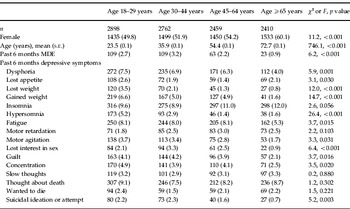
As expected, the 6-month prevalence of an MD episode (MDE) was inversely associated with age (Table 1) and, in general, depressive symptoms were most common among the youngest age groups. Insomnia was a notable exception to this pattern, and was marginally more common among the oldest age group (χ2=2.6, p=0.056). Endorsement of the symptoms of psychomotor retardation, slow thoughts, thinking about death and wanting to die did not vary significantly by age.
Depressive symptoms during the past 6 months: the Epidemiologic Catchment Area (ECA) Project, n=10 529

MDE, Major depressive episode; s.e., standard error.
Values given as n (weighted %) unless stated otherwise.
p value comparing characteristics across the four age groups using Pearson's χ2 tests (3 degrees of freedom) for categorical variables and ANOVA/F statistics for continuous variables.
Model fit statistics indicated that, overall, both four- and six-class models were consistent with the data, although the difference in their BICN values was fairly small (absolute difference 53.14; 34 degrees of freedom) (see online Supplementary Table S1). Upon inspection of the conditional probabilities within each class, the additional classes extracted from the six-class model seemed to be delineations of severity from the mild and severe depression classes and were relatively uncommon (i.e. two classes had <2% prevalence and another two classes had <4% prevalence, Supplementary Table S2). The four-class model provided the best balance of interpretability and goodness of fit to the data.
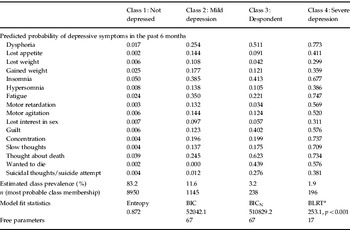
Table 2 shows the results of the final four-class model for the entire sample. The four classes described individuals who were not currently depressed (class prevalence 83.2%), mildly depressed (class prevalence 11.6%), despondent (class prevalence 3.2%) and severely depressed (class prevalence 1.9%). Those in the latter three classes had a higher prevalence of all symptom endorsement than those in the non-depressed class. Relative to the despondent class, those in the severe depression class were significantly more likely to endorse all symptoms except weight loss (χ2=1.501, p=0.133), psychomotor agitation (χ2=1.724, p=0.085), wanting to die (χ2=1.285, p=0.199) and suicidal ideation or attempt (χ2=1.738, p=0.082). The despondent class could be best understood as arising from a dissociation of two sets of depressive symptoms that cohered more closely in the mild and severe groups. That is, the despondent class had elevated levels for core mood and cognitive depressive symptoms (dysphoria, guilt, thoughts about death, wanting to die and suicidal thoughts), with endorsement frequencies broadly intermediate between the mild and severe groups. By contrast, the conditional probability of endorsement of the vegetative symptoms (e.g. concentration problems, fatigue, psychomotor disturbances) in the despondent class closely resembled that seen in the mild class. Overall, the LCA results are consistent with quantitative differences between the non-depressed, mild and severe depression classes, and also qualitative differences between the despondent and severe depression classes.
Overall four-class model from latent class analysis (LCA): the Epidemiologic Catchment Area (ECA) Project, n=10 529

BIC, Bayesian information criterion; BICN, sample-size adjusted BIC; BLRT, bootstrap likelihood ratio test.
a BLRT for four-class versus three-class model.
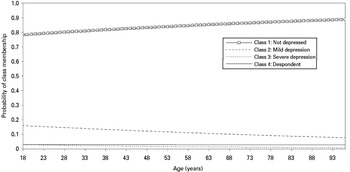
The first research question concerned whether the prevalence of specific classes varied by age. Age was significantly associated with class membership as indicated by the latent class regression analyses. Relative to the non-depressed class, older age was inversely associated with membership in the severe depression class [odds ratio (OR) 0.982, 95% confidence interval (CI) 0.973–0.992, z score=−3.693, p<0.001] and the mild depression class (OR 0.988, 95% CI 0.982–0.994, z score=−4.074, p<0.001). There was no age difference in likelihood of membership in the despondent class relative to the non-depressed class (OR 997, 95% CI 0.981–1.01, z score=−0.340, p=0.734). Overall, age was most strongly inversely associated with prevalence of the severe depression class relative to the other three classes (Fig. 1).
Class prevalence by age: results from the regression of the four-class depression model using data from the Epidemiologic Catchment Area (ECA) Project (n=10 529).

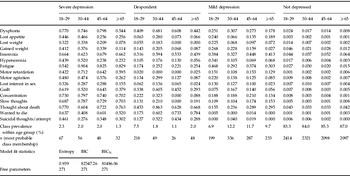
The second research question concerned whether the composition of the latent classes varied by age. Table 3 shows the prevalence of each of the four classes and the predicted probability of symptom endorsement by class across the four age groups. The probability of symptom endorsement (i.e. what depression ‘looks like’) in the non-depressed and mild depression classes is similar across all four age groups. For example, the predicted probability of endorsing dysphoria within the mild depression class ranges from 0.178 for those aged ⩾65 years to 0.307 for those aged 30–44 years. The prevalence of the despondent class is J-shaped, with the highest prevalence among the 18–29-year age group (7.5%), substantially lower prevalence among the middle-age groups (approximately 1%), and then a modest increase among the oldest age group (2.0%). However, there are some qualitative differences in the composition of the despondent class across age group that is not seen in the other depression classes. For example, the predicted probability of endorsement of the preoccupation with death items (e.g. thought about death, want to die) is substantially lower among the 18–29-year age group than for the other three age groups for this class. This is in contrast to the severe depression class, in which the predicted probabilities of symptom endorsement are generally high across the board and similar across age groups.
Regression of four-class latent depression on age group (18–29, 30–44, 45–64 and ⩾65 years)

BIC, Bayesian information criterion; BICN, sample-size adjusted BIC.
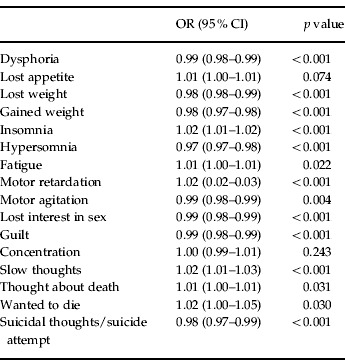
Table 4 shows that age was directly associated with all depressive symptoms except concentration problems and lost appetite, above and beyond depression class membership. These results indicate that, even within latent classes of depression, older age was associated with higher endorsement of some neurovegetative symptoms (e.g. insomnia, psychomotor changes) but lower endorsement of others (e.g. weight change, fatigue, hypersomnia). Consistent with previous research, age was inversely associated with dysphoria even after accounting for depression class (Gallo et al. Reference Gallo, Anthony and Muthen1994).
Direct effect of age on depressive symptom endorsement after accounting for latent class membership

OR, Odds ratio; CI, confidence interval.
ORs indicate effect of a 1-year increase in age on endorsement of depressive symptom after accounting for depression class membership.
Discussion
The primary finding from this study is that, although the overall burden of depressive symptomatology is similar across mid- and later-life, the characteristics of this symptomatology vary. Two qualitatively different types of severe depressive symptomatology were indicated by the LCA: a typical form characterized by high levels of all depressive symptoms, and a second form characterized by a relative lack of neurovegetative symptoms despite high endorsement of dysphoria, guilt and suicidal thoughts. These two subtypes of depression have differing patterns by age. Specifically, the prevalence of the severe depression class decreased monotonically with age, whereas the prevalence of despondent depression did not vary significantly with age, and was more common than severe depression in the oldest age group. Age was also significantly associated with most symptoms even after accounting for depressive latent class, consistent with previous research (Gallo et al. Reference Gallo, Anthony and Muthen1994). Overall, these findings are consistent with the hypothesis that the expression of depression, as indicated by symptom profile, varies over the life course.
These results indicate that the prevalence of the despondent class does not decrease with age, in contrast to the mild and severe depression classes. The symptom composition of this class differed substantially from the youngest to the oldest age groups, also in contrast to the mild and severe depression classes. It is unclear why the patterning of this class by age differs. This finding suggests that the natural history of despondent depression, characterized by a relative lack of neurovegetative symptoms despite feelings of dysphoria, guilt and preoccupation with death, differs from the typical depression syndrome over the lifespan. This suggests that, among older adults in particular, there may be two distinct types of severe depressive symptomatology, one that fits relatively well with established diagnostic criteria (e.g. the severe class) and one that is characterized by a lack of neurovegetative symptoms despite pronounced mood and cognitive disturbances. There was no evidence that older adults were more likely to be in the mild depression class, a somewhat unexpected finding given the support for subsyndromal or minor depression as being more common in later life (Lavretsky & Kumar, Reference Lavretsky and Kumar2002). There is no agreed upon diagnostic criteria for subsyndromal depression, and it may be that the despondent class, which was distinguished from the severe depression class by a relative lack of neurovegetative symptoms, may have captured this group (Geiselmann & Bauer, Reference Geiselmann and Bauer2000; Flint, Reference Flint2002). Future research should investigate the clinical characteristics of these subtypes (Chen et al. Reference Chen, Eaton, Gallo and Nestadt2000; Lux & Kendler, Reference Lux and Kendler2010), and also their relationship to medical co-morbidity and risk of suicide.
These LCA results differ from previous reports in several ways. For example, Kendler et al. (Reference Kendler, Eaves, Walters, Neale, Heath and Kessler1996) reported an atypical depression class (characterized by hypersomnia, hyperphagia and fatigue) in their analysis of female twins based on 14 depression symptom items. The version of the DIS used in the present study does not assess hyperphagia, a key atypical symptom that may have influenced the ability to differentiate an atypical class in these data. However, there was no evidence of an atypical group even in the models that extracted additional classes. Using nine symptom groups from the DIS, Chen et al. (Reference Chen, Eaton, Gallo and Nestadt2000) reported a five-class model consisting of non-depressed, anhedonia, suicidal, psychomotor and severely depressed classes in a community sample aged 27–96 (median 48) years. Because this study used symptom groups rather than individual symptom items, it is not directly comparable to the results presented here, but these two studies are broadly consistent. Finally, Hybels et al. (Reference Hybels, Blazer, Pieper, Landerman and Steffens2009) reported a four-class model using items from the Montgomery–Asberg Depression Rating Scale in a sample of adults aged ⩾60 years seeking treatment for depression; these four classes seemed to indicate differences in severity rather than qualitative variations, and there was no evidence of a distinct despondent class in that analysis.
The results of this study should be interpreted in light of study limitations. The version of the DIS used here was based on the DSM-III version published in 1980. However, the symptom criteria for MD on which the DIS is based have not changed substantially since DSM-III and thus these results still have relevance to understanding the natural history and expression of depression in the community. This is a cross-sectional study and, as such, longitudinal analyses are needed to examine directly how individuals transition across depression classes over the lifespan. This study also has several strengths. Because there are no skip patterns in the DIS, this analysis was able to examine the prevalence and clustering of depressive symptoms group together, independent from the cardinal symptoms of dysphoria and anhedonia. This analysis of specific symptoms, rather than symptom groups, provided a more detailed examination of the relationship between age and depressive symptomatology than prior studies. The study used a large, population-based sample that limits the influence of selection bias on the findings. Overall, these findings demonstrate the benefit of examining individual symptoms rather than broad symptom groups for understanding the natural history of depression over the lifespan.
These findings have potential implications for the revision of DSM diagnostic criteria, and particularly for instruments aimed at comparing incidence and prevalence of depression syndromes in mixed-aged populations. The finding that age is inversely associated with dysphoria, a cardinal symptom of depression, after accounting for depression class indicates that instruments that use endorsement of this symptom as the gateway to assessing the other symptom groups will tend to underestimate the prevalence of depression among older adults. These findings also point to two distinct patterns of high depressive symptomatology: a severe depression class that maps well onto current diagnostic criteria, and a despondent class that is indicated by a notable lack of neurovegetative symptoms, with the exception of insomnia, despite pronounced low mood, worthlessness and preoccupation with death. This despondent class may be particularly difficult for health-care providers to identify unless they explicitly ask about guilt, worthlessness and suicidal ideation (Vannoy et al. Reference Vannoy, Tai-Seale, Duberstein, Eaton and Cook2011). Assessment instruments and diagnostic criteria that reflect the heterogeneity in depression syndromes, particularly variation in expression of symptoms by age, will provide the most complete understanding of the epidemiology of depression over the lifespan.
Note
Supplementary material accompanies this paper on the Journal's website (http://journals.cambridge.org/psm).
Acknowledgments
B. Mezuk is supported by the VCU Building Interdisciplinary Research Careers in Women's Health (BIRCWH) Program (K12-HD055881).
Declaration of Interest
None.