Effective parenting is an integral part of the successful transition to adolescence when children are at increased vulnerability for substance abuse, social alienation, and behavior problems (Steinberg & Silk, Reference Steinberg, Silk and Bornstein2002). Parenting that is consistent, supportive, and monitors adolescents’ activities can facilitate secure exploration of new roles and increasing independence (Baumrind, Reference Baumrind, Cowan and Hetherington1991). However, there is wide variation in parenting during early adolescence. Belsky, in his process model (1984; Belsky & Jaffee, Reference Belsky, Jaffee, Ciccetti and Cohen2006), proposed that parenting is influenced by multiple interpersonal and contextual determinants, including children's behavior and the marital relationship. Researchers have found that problems within the marital relationship and children's difficult behavior are both associated with poor parenting, which is subsequently associated with children's problem behavior later in life (Davies & Cummings, Reference Davies and Cummings1994; Scaramella & Leve, Reference Scaramella and Leve2004). Additional evidence suggests that problems within the marital relationship are related to the quality of fathers’ parenting more than mothers’ parenting (Coiro & Emery, Reference Coiro and Emery1998) and, conversely, that children's externalizing behavior is associated with the quality of mothers’ parenting more than fathers’ parenting (Besnard et al., Reference Besnard, Verlaan, Davidson, Vitaro, Poulin and Capuano2013). However, there have been no studies examining marital stress and children's externalizing behavior as competing stressors on mothers’ versus fathers’ parenting. Moreover, it is important to consider these influences on parenting behavior within broader longitudinal models that consider child outcomes at later points in development. For instance, bidirectional models have been used to test whether children's difficult behavior is associated with subsequent difficult behavior via potential effects on parenting behavior (Scaramella & Leve, Reference Scaramella and Leve2004).
Researchers previously examined either marital stress or children's behavior as a predictor of children's behavior problems via parenting (Harold, Elam, Lewis, Rice, & Thapar, Reference Harold, Elam, Lewis, Rice and Thapar2012). However, few researchers have investigated the relative impact of children's externalizing behavior and the quality of the marital relationship in middle childhood on parenting in early adolescence, and subsequent associations of parenting with later externalizing behavior. It is important to note that, to our knowledge, investigators have not examined whether this mediated relationship is moderated by parent gender. Examining children's externalizing behavior and marital stress as predictors of mothers’ versus fathers’ parenting can help to determine the unique predictors of these competing stressors on specific indices of parenting.Footnote 1 The identification of bidirectional associations among children's externalizing behavior, marital stress, and poor parenting in mothers versus fathers can help to inform parenting programs and future research designed to promote children's well-being.
The present study uses a moderated mediation framework (Edwards & Lambert, Reference Edwards and Lambert2007) to address the aforementioned gaps by examining the associations between marital stress and children's externalizing behavior in middle childhood and externalizing behavior 6.5 years later, mediated by specific indices of parenting in early adolescence (5 years after the initial assessment). To test whether mothers’ versus fathers’ parenting might be differentially influenced by difficult child behavior and marital stress, moderation by parent gender within the mediated model was examined using multigroup modeling. Associations were examined in a sample with a high proportion of parental substance disorder, a sample in which one might expect relatively low levels of optimal parenting; thus, parental substance disorder was controlled for in analyses.
Parenting During Early Adolescence: Support and Care, Monitoring, and Consistency of Discipline
Effective parenting during early adolescence has been consistently associated with children's well-being and low levels of psychopathology in adolescence and into adulthood (Baumrind, Reference Baumrind, Cowan and Hetherington1991). Three aspects of parenting that provide important contributions to children's psychosocial outcomes are parental support and care, monitoring, and consistent discipline. Parental support and care during early adolescence is characterized by parents’ provision of interpersonal warmth, social support, and care. Parental support and care during early adolescence has been associated with a range of positive child outcomes such as lower levels of emotional problems, substance use, and externalizing behavior (Barrera, Chassin, & Rogosch, Reference Barrera, Chassin and Rogosch1993; Helsen, Vollebergh, & Meeus, Reference Helsen, Vollebergh and Meeus2000). Parental support and care can help establish a positive social exchange between parent and child on which children can draw to navigate new social encounters (Bandura, Reference Bandura1977; Furman & Burmester, Reference Furman and Buhrmester1992).
Another aspect of parenting that is important in early adolescence is parental monitoring. Parental monitoring is often conceptualized as parents’ knowledge of their child's daily activities (Stattin & Kerr, Reference Stattin and Kerr2000). Prior to adolescence, children spend their time largely in the presence of an adult. As children enter adolescence, they are unsupervised more frequently than at younger ages and also encounter new social experiences. These changes provide increased opportunities for delinquent behavior, conduct problems, and exposure to drugs and alcohol. A host of studies have shown that greater parental monitoring is associated with fewer conduct problems, substance use, and risky behavior, and can therefore be beneficial by reducing exposure to risky situations (e.g., Laird, Marrero, & Sentse, Reference Laird, Marrero and Sentse2010). However, there is debate as to whether monitoring is effective in reducing problem behavior or whether well-behaved children simply disclose more information to their parents about their activities (Racz & McMahon, Reference Racz and McMahon2011).
Consistent discipline is a third aspect of parenting that is important because early adolescence is often accompanied by noncompliance and parent–child conflict regarding parental discipline. Increases in noncompliance and parent–child conflict in early adolescence are likely the result of increasing autonomy and jurisdiction, time spent with peers, and greater stakes for high-risk behavior as compared to middle childhood (Allison & Schultz, Reference Allison and Schultz2004; Laursen & Collins, Reference Laursen, Collins, Lerner and Steinberg2009; Steinberg & Silk, Reference Steinberg, Silk and Bornstein2002). As a result, the parent–child dynamic changes and parents’ provision of consistent disciplinary practices probably is paramount for providing appropriate guidelines during early adolescence. Parental inconsistent discipline has been associated with children's noncompliance (Chamberlain & Patterson, Reference Chamberlain and Patterson1995), whereas consistent discipline has been related to better psychosocial and behavioral adjustment (Wolchik, Wilcox, Tein, & Sandler, 1999) and appears to buffer the negative effects of peers’ drug use on substance use (Marshal & Chassin, 2010). It has been proposed that consistent discipline promotes children's well-being in early adolescence by communicating clear expectations and consequences (Holden, Vittrup, & Rosen, Reference Holden, Vittrup and Rosen2011).
In short, parental support and care, monitoring, and consistent discipline are aspects of parenting that confer benefits for child outcomes. The best youth outcomes are found when parents exhibit multiple aspects of positive parenting (Chamberlain & Patterson, Reference Chamberlain and Patterson1995; Wolchik et al., Reference Wolchik, Wilcox, Tein and Sandler2000), a finding that supports the utility of examining multiple indices of parenting. It should be noted that these parenting dimensions are interconnected, and some perspectives suggest that typologies of parenting may better capture parenting as a whole (Baumrind, Reference Baumrind1971). However, other literature shows that support, monitoring, and discipline practices are distinct despite their intercorrelations (Fletcher, Steinberg, & Williams-Wheeler, Reference Fletcher, Steinberg and Williams-Wheeler2004; Pettit, Laird, Dodge, Bates, & Criss, Reference Pettit, Laird, Dodge, Bates and Criss2001). Moreover, researchers have found that support, monitoring, and discipline varies for mothers versus fathers, including greater average levels of maternal versus paternal warmth and monitoring, and greater paternal versus maternal consistent discipline (using Z tests and linear mixed models; Gordon, Reference Gordon1999; Putnick et al., Reference Putnick, Bornstein, Lansford, Chang, Deater-Deckard, Di Giunta and Pastorelli2012). We therefore examined mothers’ and fathers’ support, monitoring, and consistent discipline as distinct but correlated aspects of parenting.
The Prediction of Parenting Behavior by Children's Externalizing Behavior
Previous theory and research suggests that facets of children's externalizing behavior during middle childhood, such as conduct problems, impulsivity, and aggression, are predictors of poor-quality parenting during middle to late childhood (Besnard et al., Reference Besnard, Verlaan, Davidson, Vitaro, Poulin and Capuano2013; Wang, Christ, Mills-Koonce, Garrett-Peters, & Cox, Reference Wang, Christ, Mills-Koonce, Garrett-Peters and Cox2013). According to Patterson's coercion theory (1982), children's externalizing behavior is particularly salient (as compared to internalizing behavior), and in parent–child exchanges initiates a bidirectional cycle beginning in early childhood in which parents find it challenging to cope with their child's difficult behavior, which evokes poorer parenting. This poor parenting contributes to further childhood externalizing behavior. However, both Wang et al. (Reference Wang, Christ, Mills-Koonce, Garrett-Peters and Cox2013) and Shaffer, Lindheim, Kolko, and Trentacosta (Reference Shaffer, Lindhiem, Kolkdo and Trentacosta2013) found effects of child externalizing behavior on maternal parenting but no subsequent effects of parenting on later externalizing behavior. Using cross-lagged models in middle childhood, Wang et al. (Reference Wang, Christ, Mills-Koonce, Garrett-Peters and Cox2013) found that children's externalizing behavior at 4, 7, and 9 years of age predicted lower levels of maternal sensitivity at each subsequent time point (7, 9, and 11 years old), whereas maternal sensitivity did not predict children's externalizing behavior. Shaffer et al. (Reference Shaffer, Lindhiem, Kolkdo and Trentacosta2013) found that externalizing behavior in 8-year-olds predicted parents’ inconsistent discipline, poorer monitoring, and greater negativity 6 months later with a similar lack of parent-to-child effects. In support of the coercion model, Eisenberg et al. (Reference Eisenberg, Fabes, Shepard, Guthrie, Murphy and Reiser1999) found bidirectional relations such that children's externalizing behavior at age 6–8 predicted parental punitive reactions at age 8–10, which in turn predicted later externalizing behavior at age 10–12. Partial support exists for other aspects of externalizing behavior as well. Across middle to late childhood, callous–unemotional traits in boys have predicted change in mothers’ consistent discipline (Hawes, Dadds, Frost, & Hasking, Reference Hawes, Dadds, Frost and Hasking2011). In addition, Keijsers, Loeber, Branje, and Meeus (Reference Keijsers, Loeber, Branje and Meeus2011) found that boys’ delinquency in both late childhood (7–10 years old) and early adolescence (10–13 years old) predicted poorer parent–child relationship quality 3 years later.
Although there is consistent evidence of child externalizing behavior predicting parenting, there is also some (albeit limited) evidence that its effects may vary by parent gender. The data are limited because the majority of studies in middle childhood have focused only on mothers’ parenting or have collapsed across mothers’ and fathers’ parenting. However, Kiff, Lengua, and Zalewski (Reference Kiff, Lengua and Zalewski2011), in a review, found that difficult behavior in early childhood is more often associated with the quality of mothers’ parenting versus fathers’ parenting. Meunier et al. (Reference Meunier, Roskam, Stievenart, Van de Moortele, Browne and Kumar2011) found that in early to middle childhood, children's externalizing behavior was associated with mothers’ (but not fathers’) parenting efficacy and negative parenting. In a study of children in middle childhood, Besnard et al. (Reference Besnard, Verlaan, Davidson, Vitaro, Poulin and Capuano2013) found that children's externalizing behavior negatively predicted maternal, but not paternal, involvement and support. Moreover, in a meta-analysis, mothers, compared to fathers, appeared to be more affected by children's externalizing behavior in middle childhood (Connell & Goodman, Reference Connell and Goodman2002).
Although some evidence suggests that children's externalizing behavior in middle childhood is preferentially associated with the quality of mothers’ rather than fathers’ parenting, there is limited theory regarding this gender difference. In middle childhood, as well as other ages, mothers are known to interact more frequently and be more responsive to their children as compared to fathers (Lewis & Lamb, Reference Lewis and Lamb2003). Connell and Goodman (Reference Connell and Goodman2002) suggested that in middle childhood, mothers’ greater involvement in childrearing may lead to greater exposure to the behavioral outbursts that characterize externalizing behavior. This more frequent exposure to children's outbursts may have cumulative effects and result in mothers’ parenting being more affected than fathers’ parenting. Alternatively, fathers’ greater involvement in activities centered around play and recreation in middle childhood may make them more tolerant of aggressive behavior (Lewis & Lamb, Reference Lewis and Lamb2003). In any case, there are both empirical and some theoretical reasons to test whether associations between children's externalizing behavior and parenting differ for mothers compared to fathers. The current study tests this question with respect to parent support, monitoring, and consistency of discipline.
The Prediction of Parenting Behavior by Marital Stress
In addition to being affected by children's externalizing behavior, parenting may also be affected by the quality of the marital relationship. Marital stress may affect parenting by leaving parents emotionally exhausted so that they are unable to invest themselves in emotionally supportive and guiding parenting (Belsky, Reference Belsky1984; Bhavnagri & Parke, Reference Bhavnagri and Parke1991). Parenting may be especially vulnerable to marital stress during early adolescence because the parent–child relationship is subject to increased strain and intense parent–child conflict during this period (Grych, Raynor, & Fosco, Reference Grych, Raynor and Fosco2004; Laursen, Coy, & Collins, Reference Laursen, Coy and Collins1998). When examined concurrently, greater marital satisfaction has been related to higher levels of parental consistency, support, and monitoring of adolescents (Ha, Overbeek, Vermulst, & Engels, Reference Ha, Overbeek, Vermulst and Engels2009; Simons, Whitbeck, Conger, & Melby, Reference Simons, Whitbeck, Conger and Melby1990; Slesnick et al., Reference Slesnick, Reed, Letcher, Katafiasz, Jones and Buettner2012), whereas marital discord has been associated with poorer monitoring and consistency (Lee, Beckert, Wu, & Kuan, Reference Lee, Beckert, Wu and Kuan2011). Similar findings appear in longitudinal research, with higher levels of marital conflict predicting poorer child ratings of parental availability and dependability (Harold, Shelton, Goeke-Morey, & Cummings, Reference Harold, Shelton, Goek-Morey and Cummings2004).
In addition, there is accumulating evidence that marital stress may affect fathers’ parenting more than mothers’ parenting (Coiro & Emery, Reference Coiro and Emery1998; Cummings, Goeke-Morey, & Raymond, Reference Cummings, Goeke-Morey, Raymond. and Lamb2004). In a review, Coiro and Emery (Reference Coiro and Emery1998) suggest that marital discord contributes to lower father involvement, which in turn weakens the father–child relationship. In a more recent study, McCoy, George, Cummings, and Davies (Reference McCoy, George, Cummings and Davies2013) found that marital conflict was associated with fathers’, but not mothers’, inconsistent discipline. When marital problems are present, fathers are less supportive and involved with their child, whereas mothers have been found to be more involved with their child (Brody, Pellegrini, & Sigel, Reference Brody, Pellegrini and Sigel1986). One explanation for this gender difference is that fathers are less invested than are mothers in the parenting role and are therefore more vulnerable to the effects of marital stress on their parenting (Cummings & Watson, Reference Cummings, Watson and Lamb1997). Conversely, mothers might purposefully become more invested in parenting in the context of interparental conflict in an effort to buffer their children from the deleterious effects of such conflict (Bailey, Reference Bailey1994; Crnic & Low, Reference Crnic, Low and Bornstein2002). In short, available evidence indicates that marital stress may have a stronger effect on fathers’ parenting compared to mothers’ parenting, and the current study tested this question.
The Present Study
To our knowledge, this study is the first to examine a mediated model in which marital stress and children's externalizing behavior in middle childhood predict indices of parenting in early adolescence, which in turn predict externalizing behavior 1.5 years later. It is important to note that we tested whether the associations of marital stress and children's externalizing behavior with parenting were moderated by parent gender. In addition, the present study extends past research by testing this moderated mediational model across a 6-year developmental period, which controlled for earlier levels of parental support and consistency. This method allowed a stronger test of potential causal pathways from predictors (marital stress and children's externalizing behavior), through the mediators (parenting), to the key outcome (children's externalizing behavior 1.5 years later) than in most previous work on this topic. Because these associations were examined in a sample with high rates of parental substance disorder, parental substance disorder was controlled for as a contextual variable.
The theoretical model was tested using multigroup modeling to test for moderation of significant pathways by parent gender. Children's externalizing behavior and marital stress were modeled as latent variables. Three unique aspects of parenting were examined as mediators (parent consistency, monitoring, and support and care) to detect possible differential relations of marital stress and children's externalizing behavior to specific indices of positive parenting behavior. To reduce problems due to common method variance, parents reported on their marital relationship and their child's externalizing behavior in middle childhood, whereas children reported on parenting behavior in early adolescence as well as their own externalizing behavior 1.5 years later.
Based on the prior literature, it was hypothesized that marital stress would be negatively associated with consistency, monitoring, and support and care, more so for fathers than for mothers. Conversely, it was hypothesized that children's externalizing behavior would be negatively associated with consistency, monitoring, and support and care, more for mothers than for fathers. It was also hypothesized that these measures of parenting would be associated with children's externalizing behavior 1.5 years later, for both mothers and fathers, providing evidence of a mediated relation between marital stress and children's externalizing behavior during middle childhood and later externalizing behavior via parenting.
Method
Participants
Participants were part of a larger longitudinal three-generation study (the Adolescent/Adult Family Development Project). The original sample consisted of 454 targeted adolescents (Generation 2 [G2s]; 11 to 15 years old) and their parents (Generation 1 [G1s]). At Wave 1, 246 G2s had at least one alcoholic parent who was both biologically related and their custodial parent. Data were collected from G1s and G2s at yearly intervals for Wave 2 and Wave 3 followed by 5-year intervals from Wave 3 to Wave 6. Full biological siblings of the original G2 adolescents were included as participants from Wave 4 onward if the siblings were within the same age range as the original targets. At Wave 5, 6, and 7, with a 1.5 yearly interval from Wave 6 to Wave 7, children (Generation 3 [G3s]) of the original targeted adolescents and their siblings were included as participants.
Forty-seven percent of G3 children were female. Their mothers’ and fathers’ mean ages at Wave 5 were 28.53 (SD = 3.73) and 29.87 (SD = 3.84), respectively, and 34.87 (SD = 4.32) and 36.30 (SD = 4.54), respectively, at Wave 6. The racial/ethnic distribution of parents was 68% Caucasian/non-Hispanic, 28% Hispanic, 3% other, and 1% unknown or unreported. Family median incomes were $60,000 and $70,000 at Wave 5 and Wave 6, respectively. Both mothers’ and fathers’ median education was “some college,” and mothers’ median occupation was “clerical or office worker” and fathers’ “administrator or manager.”
The current subsample of mothers (n = 276) and fathers (n = 229) included G2 participants who were interviewed at Wave 5, had a spouse or were in a serious romantic relationship, and had a child aged 5 to 10 years old at Wave 5 (M = 6.27, SD = 1.57), which we refer to as middle childhood. G3 child data were included at Wave 6 when G3 children were 10 to 15 years old (M = 11.97, SD = 1.47), which we refer to as early adolescence, and 1.5 years later at Wave 7 when G3 children were 11.5 to 16.5 years old (M = 13.17, SD = 1.66), which we refer to as the early adolescence follow-up.
The larger study focused on the intergenerational transmission of familial alcoholism. In the current subsample, 78 G2 fathers (35%) and 56 G2 mothers (19%) had received a lifetime DSM-IV substance abuse or dependence diagnosis versus 151 G2 fathers and 220 G2 mothers who were not diagnosed. Given the prevalence of substance use disorder in the present sample, the associations of substance abuse and/or dependence diagnosis with marital stress, children's externalizing behavior, and parenting were controlled for in analyses.
At each assessment, families completed in-home computer-assisted interviews or telephone interviews when a family had relocated out of state (telephone interviews in middle childhood: 9.2%; early adolescence: 7.4%; early adolescence follow-up: 8.9%). Family members were interviewed in separate rooms to increase privacy. Moreover, a Department of Health and Human Services Certificate of Confidentiality was used to emphasize confidentiality.
Measures
Marital stress
In middle childhood, mothers and fathers rated three measures that were used as indicators of marital stress within the interparental relationship. Parents rated three items (1 = not at all to 5 = a great deal) adapted from Todd, Chassin, Presson, and Sherman (Reference Todd, Chassin, Presson and Sherman1996) tapping the level of stress within their marital/romantic relationship (e.g., “How stressful is your relationship” and “How often do you have conflicts”; αs = 0.87 and 0.70 for mothers and fathers). Parents also rated three items (1 = very dissatisfied/almost never to 5 = very satisfied/almost always) from the Dyadic Adjustment Scale (Spanier, Reference Spanier1976) regarding their level of satisfaction with their romantic partner role (e.g., “How satisfied are you with your romantic relationship” and “How often have you regretted being involved with your partner”; αs = 0.92 and 0.73 for mothers and fathers). Items were scored so higher summary scores indicated greater dissatisfaction with the romantic partner. Finally, parents rated five items (1 = very little to 5 = the most possible) from Furman and Buhrmester (Reference Furman and Buhrmester1985) regarding the level of social support they received from their partner (e.g., “My partner really cares about me” and “My partner does enjoyable things with me”; αs = 0.89 and 0.88 for mothers and fathers). The three measures were used as indicators of a latent variable capturing marital stress, separately for mothers and fathers.
Children's externalizing behavior
Middle childhood
Mothers and fathers reported on three measures of children's externalizing behavior. Parents completed 24 items (1 = never to 4 = often) from the Lochman Child Behavior Checklist (Lochman, Reference Lochman1995) regarding their child's externalizing behavior (e.g., “Starts fights with other children” and “Breaks things on purpose”; αs = 0.65 and 0.67 for mothers and fathers). In addition, parents rated two subscales (1 = not at all true to 3 = definitely true) from the psychopathy screening device (Frick, Reference Frick, Ollendick and Hersen1998) regarding their child's callous/unemotional traits and impulsive/conduct problems. The callous/unemotional subscale included 10 items such as “Lies skillfully and easily” and “Uses or cons others” (αs = 0.61 for mothers and 0.61 for fathers). The impulsive/conduct problems subscale included 10 items such as “Engages in illegal activities” and “Engages in risky or dangerous activities” (αs = 0.63 for mothers and 0.62 for fathers). The three measures were used as indicators of a latent variable capturing externalizing behavior.
Early adolescence follow-up
Children rated (1 = not often to 3 = very often) Achenbach's Youth Self-Report Scale (Achenbach & Rescorla, Reference Achenbach and Rescorla2001). All items from the externalizing behavior subscale were used from which three unique indicators were formed to represent an externalizing behavior latent variable. The DSM-oriented oppositional defiant disorder subscale included 5 items assessing defiant behavior (e.g., “Disobedient at school,” α = 0.76). The DSM-oriented conduct disorder subscale included 15 items, to which 2 impulsivity items were added (e.g., “Destroys others’ property” and “Is Impulsive,” α = 0.81). Finally, 9 items assessed rule breaking and aggressive aspects of externalizing behavior (e.g., “Teases others,” α = 0.73). The three measures were used as indicators of a latent variable capturing externalizing behavior. Collapsing across the three subscales, average T scores ranged from 41.97 to 97.17 with 7.8% of youths above the clinical cutoff (Achenbach & Rescorla, Reference Achenbach and Rescorla2001).
Parenting behavior
In middle childhood, mothers and fathers completed measures of parental consistency and support and care that were used as covariates for children's report of their mother's and father's parenting in early adolescence, separately for mothers and fathers. In early adolescence, children completed three measures of parenting behavior: parental consistency, support, and monitoring.
Parents (middle childhood) and children (early adolescence) completed 10 items (1 = strongly disagree to 5 = strongly agree) from the Children's Report of Parental Behavior Inventory (Schaefer, Reference Schaefer1965). Five items assessed parents’ consistency of their rule enforcement and 5 items assessed parents’ consistency of discipline (e.g., “My parent soon forgets the rules he/she has made” and “My parent seldom insists that I do anything”; αs = 0.87 and 0.89 for children's report of mothers and fathers; αs = 0.83 and 0.80 for mother and father report). Items were scored so higher scores indicated greater levels of consistent discipline.
Parents (middle childhood) and children (early adolescence) rated (1 = little or none to 5 = the most possible) seven items from the Network of Relations Inventory (Furman & Buhrmester, Reference Furman and Buhrmester1985) that assessed parents’ support and care through shared activities and emotional support with their child (e.g., “How much can you count on your parent to be there when you need him/her, no matter what” and “How much does your parent treat you like he/she admires and respects you”; αs = 0.88 and 0.89 for children's report of mothers and fathers; αs = 0.77 and 0.83 for mothers’ and fathers’ reports).
In early adolescence, children rated five items (1 = didn't know at all to 5 = knew all the time) on a measure of monitoring (Lamborn, Mounts, Steinberg, & Dornbusch, Reference Lamborn, Mounts, Steinberg and Dornbusch1991), which assessed parents’ knowledge of their child's activities and interests over the past 3 months (e.g., How much did your parent know about “Who your friends are” and “What you do with your free time”; αs = 0.82 and 0.88 for children's report of mothers and fathers).
Covariates
Child age, ethnicity, and gender (boys = 1, girls = 2) were assessed in middle childhood and included as covariates. In addition, parental consistency and support in middle childhood were assessed as controls for levels of parenting in early adolescence, separately for mothers and fathers. Parent monitoring was not assessed in middle childhood due to the relatively young age of children at that assessment so it was not available to include as a covariate. Parents’ alcohol and drug abuse and dependence symptoms were assessed at the middle childhood assessment using the Substance Abuse Module of the Composite International Diagnostic Interview (World Health Organization, 1990). Diagnoses for abuse and dependence were based on DSM-IV criteria. In the present study, a diagnosis of either an abuse or dependence diagnosis was used to indicate lifetime diagnosis.
Statistical analyses
Structural equation modeling with full information maximum likelihood for missing data was used to conduct all primary statistical analyses. All relevant statistical assumptions inherent to the application of structural equation modeling (e.g., multivariate normality) were examined and affirmed a priori. Using multigroup modeling in Mplus 7.11 (Muthén, & Muthén, Reference Muthén and Muthén2007), statistical analyses were conducted for mothers and fathers as two groups within one model, followed by examination of moderation by parent gender. Within the present sample, Little's test of missing data indicated that data were missing completely at random, χ2 (18) = 20.33, p = .32. All models used full information maximum likelihood to account for missing data.
All variables were normally distributed (West, Finch, & Curran, Reference West, Finch, Curran and Hoyle1995) except for marital satisfaction at the middle childhood assessment, parent monitoring at the early adolescent assessment for both mothers and fathers, and children's impulsivity/conduct disorder symptoms and oppositional defiant disorder symptoms in the early adolescence follow-up, which were all positively skewed. Skewed data were addressed using maximum likelihood estimation with robust standard errors in Mplus.
As a first step, a confirmatory factor analysis was performed separately for indicators of children's externalizing behavior and marital stress in middle childhood, as well as for indicators of children's externalizing behavior at the early adolescence follow-up. Next, the full structural multigroup model was tested with the same constructs across mothers and fathers. Mother and father models were identical, and each included the following constructs. Parenting variables in early adolescence were tested as mediators of the relations between marital stress and children's externalizing behavior in middle childhood and externalizing behavior at the early adolescence follow-up. Mothers’ and fathers’ substance disorder diagnoses were both included as controls within the mother and father models as predictors of marital stress, children's externalizing behavior, and parenting. The following covariates were also included: child age, gender, and ethnicity, and parental consistency and support in middle childhood. Indirect effects were estimated using RMediation (Tofighi & Mackinnon, Reference Tofighi and MacKinnon2011). As part of the Adolescent/Adult Family Development Project sample, multiple members were assessed from the same family at both the parent level (siblings) and at the child level (siblings or cousins). To account for this interdependence, clustering at the G2 family level was included in Mplus, which adjusts standard errors for multilevel data.
Results
Descriptive analyses
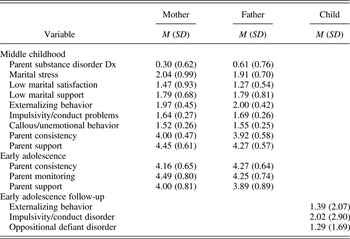
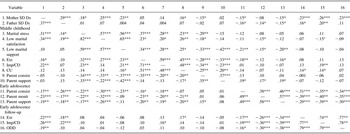
Correlations, means, and standard deviations for the sample are presented in Tables 1 and 2. There was no evidence of multicollinearity among the variables. Parents in the current sample had elevated rates of substance use disorder diagnoses in the current sample, with 35% of fathers and 19% of mothers who received a lifetime DSM-IV substance abuse or dependence diagnosis. Parents also had low to average levels of marital stress, dissatisfaction, and support, and average to high levels of support and care, monitoring, and consistent discipline. Children had average levels of externalizing behavior in line with other community samples and national norms in middle childhood (Eisenberg et al., Reference Eisenberg, Zhou, Spinrad, Valiente, Fabes and Liew2005; Frick, Reference Frick, Ollendick and Hersen1998; Hill, Coie, Lochman, & Greenberg, Reference Hill, Coie, Lochman and Greenberg2004), and at the early adolescence follow-up (Nakamura, Ebesutani, Bernstein, & Chorpita, Reference Nakamura, Ebesutani, Bernstein and Chorpita2009; Rescorla et al., Reference Rescorla, Achenbach, Ivanova, Dumenci, Almqvist, Bilenberg and Erol2007).
Means (standard deviations) for mother, father, and child constructs

Correlations among constructs for mothers (below diagonal) and fathers (above diagonal)

Note: SD, Substance disorder; Dx, diagnosis; Ext, externalizing behavior; Imp/CD, impulsivity/conduct disorder; CU, callous–unemotional behavior; consist, consistency; monit, monitoring; ODD, oppositional defiant disorder.
*p < .05. **p < .01. ***p < .001.
The correlations largely support the predicted theoretical pattern. For mothers, indicators of marital stress and children's externalizing behavior in middle childhood were negatively associated with measures of parenting in early adolescence. For fathers, indicators of marital stress in middle childhood were primarily negatively associated with measures of parenting in early adolescence, whereas measures of children's externalizing behavior in middle childhood had fewer associations with fathers’ parenting in early adolescence. During early adolescence, parenting measures were correlated within both mothers and fathers. Both mothers’ and fathers’ parenting in early adolescence were negatively associated with externalizing behavior 1.5 years later.
Full theoretical model
As an initial step, confirmatory factor analysis models were computed to individually create latent variables for marital stress and children's externalizing behavior in middle childhood, and for externalizing behavior at the early adolescence follow-up, within mothers and fathers. All confirmatory factor analysis models had good fit (root mean square error of approximation = 0.0, comparative fit index = 1.0). Measurement invariance was separately tested across mothers’ and fathers’ reports of (a) marital stress and (b) children's externalizing behavior. Scalar measurement invariance was found for both latent variables; loadings and intercepts were found to be invariant across mothers’ and fathers’ reports, and consequently, their latent variable scores were comparable (Dimitrov, Reference Dimitrov2010). Loadings for indicators at the middle childhood assessment for fathers’ report of marital stress ranged from .68 to .84, and on indicators of children's externalizing behaviors ranged from .54 to .94 (ps < .001). Loadings for indicators at the middle childhood assessment for mothers’ report of marital stress ranged from .79 to .91, and on indicators of children's externalizing behaviors ranged from .59 to .87 (ps < .001). Loadings for indicators of children's report of their own externalizing behaviors at the early adolescence follow-up ranged from .87 to .91 (ps < .001). Prior to examining the full model, an initial direct association was examined between the latent measures of externalizing behavior at the middle childhood assessment and the early adolescence follow-up assessment and found to be significant, but not to differ for mothers’ and fathers’ (B = 1.09, SE = 0.43, p = .01).
Next, the full structural multigroup model was tested across mothers and fathers, including latent constructs for children's externalizing behavior and marital stress in middle childhood (separate mother/father report), measures of parental monitoring, consistency, and support in early adolescence (separate child report of mother and father parenting), and the latent construct of children's externalizing behavior at the early adolescence follow-up (children's report of their own externalizing behavior). Mothers’ and fathers’ substance disorder diagnoses were controlled for, as well as parental consistency, and support in middle childhood (parent report), child age, gender, and ethnicity were included in both mother and father models.
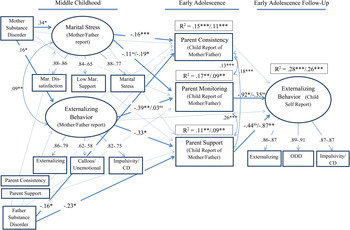
The full multigroup model was a good fit to the data, χ2 (250) = 378.42, root mean square error of approximation = 0.045, comparative fit index = 0.94, Tucker–Lewis index = 0.94. Unstandardized estimates for the full model can be found in Figure 1. All within-time correlations in middle childhood (i.e., marital stress, children's externalizing behavior, parental consistency and support) and early adolescence (i.e., parental monitoring, consistency, and support) were modeled and found to be significant.
(Color online) Full theoretical model with unstandardized results presented. Slash indicates significant difference across mothers (before slash) and father (after slash). All within-time correlations were modeled, but those not primary to the model are withheld for readability. Child age, ethnicity, and gender were controlled. Mar., Marital; ODD, oppositional defiant disorder; CD, conduct disorder. *p < .05. **p < .01. ***p < .001.

Individual pathways were then probed for significant differences across mother and father models by releasing pathways one by one and observing change in Satorra–Bentler scaled chi-square model fit. The following pathways did not differ significantly across mother and father models and were constrained to equality. For both mothers and fathers, greater levels of parental marital stress in middle childhood were associated with poorer parent consistency in early adolescence (B = –0.16, SE = 0.05, p < .001), whereas greater levels of children's externalizing behavior in middle childhood were associated with lower parental support in early adolescence (B = –0.33, SE = 0.13, p = .01).
Significant differences across mother–father models
In addition, a number of pathways significantly differed across mothers and fathers (see Figure 1). There was a significant difference between mothers and fathers in the relation of marital stress in middle childhood to children's report of monitoring in early adolescence, with a significantly stronger relation for fathers (B = –0.19, SE = 0.09, p = .04) versus mothers (B = –0.11, SE = 0.09, p = .21); Satorra–Bentler scaled χ2 (1) = 8.25, p = .004. Conversely, there was a significant difference in the relation between children's externalizing behavior in middle childhood and children's report of parent monitoring in early adolescence, with a significantly stronger effect for mothers (B = –0.39, SE = 0.12, p = .001) than for fathers (B = 0.03, SE = 0.17, p = .87); Satorra–Bentler scaled χ2 (1) = 14.71, p < .001.
There were also significant differences between mothers and fathers in the relationship between parenting in early adolescence and externalizing behavior 1.5 years later at the early adolescence follow-up, with significantly stronger effects for mothers’ monitoring (B = –0.92, SE = 0.37, p = .013) than for fathers’ monitoring (B = –0.35, SE = 0.28, p = .21); Satorra–Bentler scaled χ2 (1) = 4.29, p = .038, and significantly stronger effects for fathers’ support (B = –0.87, SE = 0.29, p = .003) than for mothers’ support (B = –0.44, SE = 0.30, p = .15); Satorra–Bentler scaled χ2 (1) = 7.23, p = .007.
There was an indirect effect within the mother model. Mothers’ report of children's externalizing behavior in middle childhood was significantly associated with self-reported externalizing behavior at the early adolescence follow-up via children's report of mothers’ monitoring in early adolescence (β = 0.055), 95% confidence interval [0.007, 0.124], p < .05. There was also an indirect effect of children's externalizing behavior in middle childhood on self-reported externalizing behavior at the early adolescence follow-up via children's report of their fathers’ support 1.5 years prior (β = 0.038), 95% confidence interval [0.006, 0.08], p < .05.
Discussion
The present study examined children's externalizing behavior and marital stress in childhood as predictors of parental consistency, monitoring, and support in adolescence, and parenting as a predictor of externalizing behavior 1.5 years later. Moderation of pathways was tested using a multigroup approach to examine distinct patterns of potential influence across parent gender. Previously, children's externalizing behavior and marital stress have only been considered separately as predictors of parenting behavior. The associations between marital stress and children's externalizing behavior in middle childhood, parenting in early adolescence, and externalizing behavior at the early adolescence follow-up were tested within a 6-year longitudinal mediated model giving greater confidence in the current direction of effects. In addition, parental substance abuse, as well as the stability of parental consistency and support over this time period, were controlled, although there were different reporters for the measures during middle childhood and early adolescence (autoregressive path estimates were low as this control was likely only partial).
In support of our hypothesis that the relationship between marital stress and parenting behaviors would be stronger for fathers as compared to mothers, marital stress had a greater association with fathers’ monitoring than mothers’ monitoring. One possible explanation for this pattern is the method by which fathers monitor and receive information regarding their children. Compared to mothers, fathers spend less time with their children and are less invested in the parenting role (Crouter, Helms-Erikson, Updegraff, & McHale, Reference Crouter, Helms-Erikson, Updegraff and McHale1999). In addition, children are known to disclose more to mothers compared to fathers, and communicate with mothers more frequently and deeply (Keijsers, Branje, VanderValk, & Meeus, Reference Keijsers, Branje, VanderValk and Meeus2010; Monck, Reference Monck1991; Noller & Baggi Reference Noller and Bagi1985). Thus, mothers are more knowledgeable about their children's daily activities through greater involvement, but mothers also monitor and solicit information more actively than fathers. Mothers monitor and acquire knowledge about their early adolescent's activities through both active (active monitoring and solicitation) and passive (receiving information without directly asking) methods (Waizenhofer, Buchanan, & Jackson-Newsom, Reference Waizenhofer, Buchanan and Jackson-Newsom2004). In contrast, fathers are more likely to only receive information about their children from their spouse (Crouter, Bumpus, Davis, & McHale, Reference Crouter, Bumpus, Davis and McHale2005; Waizenhofer et al., Reference Waizenhofer, Buchanan and Jackson-Newsom2004). Marital stress in turn is typified by poor spousal communication (i.e., silence and hostility) and a lack of communication regarding parenting behaviors (Grych & Fincham, Reference Grych and Fincham2001). Consequently, when fathers experience marital stress, they may no longer receive information about their children due to poor communication with their spouse, leading to fathers’ poorer perceived monitoring compared to mothers’ monitoring.
In addition, mothers may compensate for a poor marital relationship by investing themselves in the parent–child relationship, which may contribute to better active monitoring during early adolescence in the face of marital stress (e.g., Brody et al., Reference Brody, Pellegrini and Sigel1986; Cowan & Cowan, Reference Cowan, Cowan, Berman and Pedersen2014). This argument fits with the view that in the presence of marital conflict, mothers are better able than fathers to compartmentalize this role, negating any spillover into the parent–child relationship (Thompson & Walker, Reference Thompson and Walker1989). Marital stress could therefore affect fathers’ poorer monitoring, as compared to mothers’ monitoring, as seen in the present study.
In support of the hypothesis that children's externalizing behavior would be more strongly associated with mothers’ as compared to fathers’ quality of parenting, children's externalizing behavior had a stronger relation to mothers’ subsequent monitoring than to fathers’ monitoring. The few researchers who have examined these associations separately for mothers and fathers have found mothers’ parenting to be more strongly predicted by children's externalizing behavior than fathers’ parenting (Besnard et al., Reference Besnard, Verlaan, Davidson, Vitaro, Poulin and Capuano2013; Connell & Goodman, Reference Connell and Goodman2002; Meunier et al., Reference Meunier, Roskam, Stievenart, Van de Moortele, Browne and Kumar2011). Research also shows that mothers are more responsive to, and interact more frequently with, their children during middle childhood than do fathers (Lewis & Lamb, Reference Lewis and Lamb2003). Because mothers are more involved than fathers, mothers may be more affected by the behavioral outbursts characteristic of externalizing behavior during this period (Connell & Goodman, Reference Connell and Goodman2002). When this is the case, bidirectional transactions may continue to occur between mothers’ parenting and externalizing behavior across late childhood (Eisenberg et al., Reference Eisenberg, Fabes, Shepard, Guthrie, Murphy and Reiser1999), further affecting the quality of mothers’ parenting into adolescence (Besnard et al., Reference Besnard, Verlaan, Davidson, Vitaro, Poulin and Capuano2013). Continued exposure to externalizing behavior may contribute to mothers feeling they cannot affect their child's behavior and subsequently lead to poor monitoring in early adolescence (Pettit et al., 2001). Fathers may be less affected by externalizing behavior over time because they are less involved than mothers in parenting overall during middle and late childhood (Lam, McHale, & Crouter, Reference Lam, McHale and Crouter2012). Alternatively, fathers may view aggression as more normative and therefore be less disturbed by externalizing behavior (Lytton & Romney, Reference Lytton and Romney1991).
One possible alternative explanation of significant gender differences related to parental monitoring in adolescence may be the lack of a control variable for earlier parental monitoring in childhood. Monitoring was not measured in middle childhood because there is typically limited need for monitoring in middle childhood when children are rarely outside of adult supervision. To address this possibility, we tested for the present effects controlling for quality of parenting in childhood in supplemental analyses by including parental support and care and consistency as proxy controls for parental monitoring in childhood on parental monitoring in adolescence (see online-only supplementary materials). Similar patterns of moderation by parent gender were found. Children's externalizing behavior in middle childhood affected mothers’ monitoring in early adolescence more than fathers’ monitoring, and mothers’ monitoring in adolescence affected externalizing behavior 1.5 years later more than fathers’ monitoring. In addition, marital stress in middle childhood affected fathers’ monitoring in early adolescence more than mothers’ monitoring. These results support the pattern of significant differences across mothers and fathers related to monitoring observed in the present study and indicate they are not due to lack of control for quality of parenting, specifically monitoring, in middle childhood.
Within the full mediated model, indirect effects provided evidence for bidirectional relations between children's externalizing behavior in middle childhood and externalizing behavior at the early adolescence follow-up via (a) mothers’ monitoring and (b) fathers’ support. In initial tests, there was significant stability between externalizing behavior in middle childhood and at the early adolescence follow-up. The lack of stability in the full model reflects these indirect effects in which externalizing behaviors in middle childhood are related to later externalizing behaviors, but these effects are mediated through parenting such that children with more externalizing behavior in middle childhood have mothers with poorer monitoring and/or fathers with poorer support, which in turn result in more externalizing behavior in adolescence (Mackinnon, Fairchild, & Fritz, Reference Mackinnon, Fairchild and Fritz2007).
Bidirectional relations have previously been found between child behavior problems and both positive maternal parenting (Besnard et al., Reference Besnard, Verlaan, Davidson, Vitaro, Poulin and Capuano2013) and negative maternal parenting (Eisenberg et al., Reference Eisenberg, Fabes, Shepard, Guthrie, Murphy and Reiser1999). The current findings extend past literature by studying a longitudinal bidirectional relation between externalizing behavior across middle childhood and early adolescence and both mothers’ and fathers’ parenting. The pattern of results may indicate that child behavior problems and mothers’ monitoring, and fathers’ support, in particular, fit within a reciprocal model characterized by cyclical child–parent exchanges from middle childhood to early adolescence.
Given that children rated both parenting in early adolescence and their own externalizing behavior at the early adolescence follow-up within the full mediated model, these effects may be due to common rater bias. We investigated this in supplemental analyses by examining the correlations among parent's self-reported parenting in early adolescence and children's self-reported ratings of their externalizing behavior at the early adolescence follow-up (see supplementary materials). The same pattern of associations was broadly supported. Mothers’ and fathers’ monitoring were both associated with youths’ later externalizing behavior with a trend toward a greater association with mothers’ monitoring. Mothers’ and fathers’ support were both associated with later externalizing behavior, and only mothers’ consistency was associated with later externalizing behavior. This supports the conclusion that associations between child-rated parenting in early adolescence and child-rated externalizing behavior 1.5 years later are due to the influence of parenting on child behavior, rather than due to common rater bias.
A number of findings did not support our hypotheses. Marital stress was inversely associated with both mothers’ and fathers’ consistency. Children's externalizing behavior was inversely associated with both mothers’ and fathers’ support. These associations did not differ across mothers and fathers. The present results suggest that gender differences in the effect of marital stress and children's externalizing behavior on parenting may not extend to all aspects of parenting, but rather be specific to parental monitoring. This may be true because mothers normatively spend more time with children during this age but in the context of negative child behavior find it harder to monitor their child's behavior (Racz & McMahon, Reference Racz and McMahon2011). In the context of a stressful marital relationship, negative emotions may “spill over” into the father's parent–child relationship affecting monitoring, and other aspects of parenting, whereas mother's may be more cognizant of preventing such spillover and achieve this through regular monitoring (Cowan & Cowan, Reference Cowan, Cowan, Berman and Pedersen2014; Davies & Cummings, Reference Davies and Cummings1994). Alternatively, fathers’ monitoring may be more based on information from their spouse and when they receive poorer information in the context of marital stress perceive this as poorer monitoring (Waizenhofer et al., Reference Waizenhofer, Buchanan and Jackson-Newsom2004).
The present study offered a number of methodological advances over previous research. Using latent variables for marital stress and children's externalizing behavior allowed better measurement of primary constructs. Using parental report of independent variables (marital stress and children's externalizing behavior) and child report of parenting variables (parent consistency, monitoring, and support) strengthens the confidence in these patterns of results (i.e., evocative children's behavior) by reducing the effect of common method variance.
The current study also has limitations that must be considered. One limitation was that the current study was unable to examine the level of involvement, or time spent parenting, for mothers versus fathers. Examination of a measure of involvement by parent gender may help to further explain the present pattern of results. With regard to measures, identical measures of externalizing behavior were not available in middle childhood and the early adolescence follow-up; however, these measures were related in initial direct tests (B = 1.09, SE = 0.43, p = .01). Identical reporters on parenting measures in middle childhood would also more fully control for parenting in early adolescence. For the child externalizing behavior variables in middle childhood, alpha coefficients were in the lower range of what is considered acceptable (see McCrae, Kurtz, Yamagata, & Terracciano, Reference McCrae, Kurtz, Yamagata and Terracciano2011). In addition, having multiple reporters and methods (parent, child, teacher, and observational) would strengthen the measurement of primary study variables and reduce the possibility of method bias. In addition, the current sample included children with a broad age range who were part of a high-risk sample of parents due to elevated rates of substance use. These may limit generalizability to more normative populations. Finally, because the data in the present study were correlational in nature, causal relations could not be examined.
These results provide partial support for Belsky's process model (Reference Belsky1984; Belsky & Jaffee, Reference Belsky, Jaffee, Ciccetti and Cohen2006), in which parenting is multiply determined and in which determinants include the quality of the marital relationship and children's behavior. However, the differential patterns of results for mothers and fathers highlights the need to examine children's behavior as well as the interparental relationship as determinants of mothers’ and fathers’ parenting, and monitoring in particular. The unique associations we found for the marital relationship and fathers’ monitoring, and for children's externalizing behavior and mothers’ monitoring, have implications for prevention and intervention programs designed to promote children's well-being. The present results indicate that it may be beneficial to target different aspects of the family relationship for mothers versus fathers in interventions for preventing child psychopathology. Improved monitoring during early adolescence may be achieved for fathers by intervening in interparental conflict, whereas for mothers’ monitoring it might be fruitful to target their responses to children's externalizing behavior. In addition, for mothers, reducing externalizing behavior in early adolescence may be achieved by improving monitoring, whereas for fathers this may be achieved by providing greater support and care. The current study helps to clarify the role of two salient family processes (marital stress and children's externalizing behavior) as predictors of mothers’ and fathers’ parenting, and provides support for future studies to examine such differences.
Supplementary Material
To view the supplementary material for this article, please visit https://doi.org/10.1017/S0954579416001322.