INTRODUCTION
Neospora caninum is an obligate intracellular protozoan parasite, closely related to Toxoplasma gondii. First described in 1984 (Bjerkås et al.), it has a worldwide distribution and is a major cause of bovine abortion (Dubey et al. Reference Dubey, Buxton and Wouda2006). Infection can be transmitted either transplacentally from mother to foetus, or through ingesting feed or water contaminated with oocysts, shed by infected dogs (a definitive host of N. caninum) (McAllister et al. Reference McAllister, Dubey, Lindsay, Jolley, Wills and McGuire1998).
Experiments with cattle have demonstrated that protective immunity can be induced to prevent the transplacental transmission of N. caninum following a challenge with the parasite (Innes et al. Reference Innes, Wright, Maley, Rae, Schock, Kirvar, Bartley, Hamilton, Carey and Buxton2001; Williams et al. Reference Williams, Guy, Smith, Ellis, Bjorkman, Reichel and Trees2007). Williams et al. (Reference Williams, Guy, Smith, Guy, McGarry, McKay and Trees2003) showed that while naturally infected cows challenged with N. caninum early in gestation (10 weeks) were protected against abortion, vertical transmission of the parasites to the foetus still occurred, These studies taken together show that cattle develop a degree of protective immunity following prior exposure to the parasite and lend weight to the hypothesis that vaccination is a feasible option for controlling the infection.
Experimental mouse models of neosporosis offer an economic and convenient system for testing potential vaccination candidates. Live attenuated temperature-sensitive mutants (Lindsay et al. Reference Lindsay, Lenz, Blagburn and Brake1999), sublethal doses of live N. caninum tachyzoites (Lundén et al. Reference Lundén, Wright, Allen and Buxton2002) and live γ-irradiated N. caninum tachyzoites (Ramamoorthy et al. Reference Ramamoorthy, Lindsay, Schurig, Boyle, Duncan, Vemulapalli and Sriranganathan2006) have all induced protection in Balb/c mice against a lethal challenge with the parasite. Killed and subunit vaccines have also shown some success in inducing protective immune responses in mice. Studies using E. coli expressed recombinant antigens NCMIC3 (Cannas et al. Reference Cannas, Naguleswaran, Muller, Gottstein and Hemphill2003) and NCSRS2 (Pinitkiatisakul et al. Reference Pinitkiatisakul, Mattsson, Wikman, Friedman, Bengtsson, Stahl and Lunden2005) and virus-vectored expression of recombinant NcGRA7 (Liddell et al. Reference Liddell, Parker, Vinyard, Jenkins and Dubey2003; Jenkins et al. Reference Jenkins, Parker, Tuo, Vinyard and Dubey2004) have all induced protection in mice against a challenge with N. caninum. However, Baszler et al. (Reference Baszler, McElwain and Mathison2000) demonstrated an exacerbation of neurological disease in mice immunized with soluble N. caninum tachyzoite antigens and subsequently challenged with the parasite.
Attenuation of virulence through in vitro culture has been examined in a number of protozoan parasite species including Theileria (Preston et al. Reference Preston, Jackson, Sutherland, Brown, Schofield, Bird, Sanderson and Brown2001) and Leishmania (Daneshvar et al. Reference Daneshvar, Coombs, Hagan and Phillips2003). The main objectives of this study were to determine whether N. caninum parasites attenuated through prolonged in vitro culture (Bartley et al. Reference Bartley, Wright, Sales, Chianini, Buxton and Innes2006) will induce protection against a known virulent challenge and to compare any differences in the protective effects between the virulent and attenuated parasites.
MATERIALS AND METHODS
Parasites and experimental inocula
Neospora caninum tachyzoites (NC1 isolate) (Dubey et al. Reference Dubey, Carpenter, Speer, Topper and Uggla1988) were maintained (Innes et al. Reference Innes, Panton, Marks, Trees, Holmdahl and Buxton1995) and used to prepare experimental inocula (Bartley et al. Reference Bartley, Wright, Sales, Chianini, Buxton and Innes2006) as previously described. Briefly, N. caninum parasites cultured in Vero cell monolayers were disrupted using a sterile cell scraper (Corning, NY, USA), parasites were counted in a Neubauer haemocytometer and resuspended in phosphate-buffered saline (PBS) to produce inocula containing either 1×10⁷ or 5×10⁷ tachyzoites per ml. The virulent parasites were passaged 43 times in tissue culture (passage (p.43)) while the attenuated parasites were passaged 88 times (passage (p.88)). Prior to their use as experimental inocula, the virulent challenge parasites had been subcultured 39 times (passage (p.39)). In a previous study (Bartley et al. Reference Bartley, Wright, Sales, Chianini, Buxton and Innes2006), prolonged culture of Neospora in vitro resulted in attenuation of their virulence in vivo. The control inoculum contained the equivalent number of Vero cells present in the parasite preparations and was prepared in the same manner. Both the parasite and the Vero cells were inoculated into mice intraperitoneally (i.p.) within 1 h of their preparation in the laboratory, in a volume of 100 μl per mouse.
Experimental design
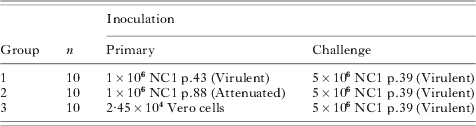
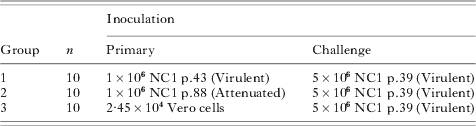
Female Balb/c mice, approximately 12 weeks old, were randomly assigned into groups (n=10), individually identified by ear-marking and fed rodent proprietary mix and fresh water ad libitum. The mice were inoculated i.p. with live N. caninum tachyzoites (see Table 1) and observed daily for 28 days post-inoculation (p.i.) On day 28 all mice were challenged i.p. with live N. caninum tachyzoites (see Table 1), defined as day 0 post-challenge (p.c.) The morbidity of the animals was assessed according to a system agreed with the UK Home Office Inspectorate (Bartley et al. Reference Bartley, Wright, Sales, Chianini, Buxton and Innes2006). All surviving mice were euthanased on day 28 p.c. by CO2 inhalation. At post-mortem examination, samples of brain were removed and stored at −20°C for analysis by N. caninum internal transcribed spacer 1 (ITS1) and quantitative polymerase chain reaction (PCR). Samples of brain, lung, liver, kidney and spleen were also removed and stored in 10% formal saline for histopathological examination, and blood was drawn from the heart and the serum was separated and stored at −20°C prior to testing.
Experimental design
(NC1 p.39 tachyzoites) – passage number 39, (NC1 p.43 tachyzoites) – passage number 43, (NC1 p.88 tachyzoites) – passage number 88.)
Serology
Serum collected at the time of post-mortem examination as previously described (Bartley et al. Reference Bartley, Wright, Sales, Chianini, Buxton and Innes2006) was examined with an indirect fluorescent antibody test (IFAT) for the detection of Neospora-specific IgG and IgM (Buxton et al. Reference Buxton, Maley, Thomson, Trees and Innes1997). Briefly, 5 μl volumes of a 1×10⁷/ml suspension of 0·2% (v/v) formalin-treated N. caninum tachyzoites were applied to each well of a 15-well multitest slide (ICN Biomedicals, Aurora OH) and allowed to dry overnight. Test sera were titrated in 2-fold dilutions from 1:16 to a final concentration of 1:4096 before addition to wells and incubated for 30 min at room temperature. Slides were washed 3 times in PBS before being incubated for 30 min with fluorescein isothiocyanate (FITC)-conjugated goat anti-mouse IgG (diluted 1:50 in PBS). They were then washed 3 times in PBS before cover-slips were mounted with buffered glycerol and viewed under an Olympus BX50 fluorescence microscope, with a U-MNB filter cube, using a ×40 objective. The endpoint was determined as the final concentration of serum demonstrating distinct whole tachyzoite fluorescence (Conrad et al. Reference Conrad, Sverlow, Anderson, Rowe, BonDurant, Tuter, Breitmeyer, Palmer, Thurmond and Ardans1993). The same procedure was used for the detection of Neospora-specific IgM with the exception that FITC-conjugated goat anti-mouse IgM was used as the secondary antibody.
Histology and immunohistochemistry
All samples were fixed and sectioned for histological and immunohistochemical analysis as described (Bartley et al. Reference Bartley, Wright, Sales, Chianini, Buxton and Innes2006).
ITS1 PCR
DNA was extracted from brain samples and stored at −20°C prior to analysis by PCR (Bartley et al. Reference Bartley, Wright, Sales, Chianini, Buxton and Innes2006). A Neospora-specific nested-PCR was used to detect the internal transcribed spacer 1 (ITS1) gene (Holmdahl and Mattsson, Reference Holmdahl and Mattsson1996) using the method previously described by Buxton et al. (Reference Buxton, Maley, Wright, Thomson, Rae and Innes1998). This produced a band of 297 bp when the products were analysed by 1·8% agarose gel electrophoresis, stained with ethidium bromide and visualized under UV light.
Quantitative SYBR green PCR
A quantitative PCR (qPCR) for the NC5 sequence of N. caninum (Kaufmann et al. Reference Kaufmann, Yamage, Roditi, Dobbelaere, Dubey, Holmdahl, Trees and Gottstein1996) was performed using the method and oligonucleotide primers described by Collantes-Fernández et al. (Reference Collantes-Fernandez, Zaballos, Alvarez-Garcia and Ortega-Mora2002). The 28S rRNA gene was chosen for the quantification of host DNA (Collantes-Fernández et al. Reference Collantes-Fernandez, Zaballos, Alvarez-Garcia and Ortega-Mora2002), while the primers to the 28S rRNA gene were also used as ‘housekeeping genes’, to act as a control to determine the presence of potential PCR inhibiting compounds in the extracted DNA samples.
To prepare standards, DNA was extracted from tissue-culture derived Neospora tachyzoites using the DNeasy Kit (Qiagen) as per manufacturers' instructions. Total DNA was determined by spectrophotometry (Beckman Coulter DU530), adjusted with distilled water to a concentration of 2000 pg/μl and used to make a serial logarithmic dilution (2000, 200, 20, 2, 0·2 and 0·02 pg/μl). Host genomic DNA was extracted and quantified as previously described from brain tissue of an uninfected mouse and used to prepare standards at 20, 10, 5, 2, 1 and 0·5 ng/μl.
The Neospora NC5 and 28s rRNA primers (MWG Biotech AG, Germany) were performed as separate assays, with each reaction containing 1× platinum SYBR green qPCR supermix UDG (Invitrogen) consisting of 0·75U platinum Taq DNA polymerase, 10 mm Tris-HCl, 25 mm KCl, 1·5 mm MgCl2, 100 μm of each deoxynucleoside triphosphate (dATP, dCTP, dGTP) and 200 μm dUTP, 0·5U uracil-DNA-glycosylase, 10 pmol of each forward and reverse primer, 6 μl ultra-pure distilled water and 5 μl DNA (25 μl total volume). All standards and samples were undertaken in duplicate. Amplifications were performed with an ABI 7000 prism sequence detector (Applied Biosystems), using the manufacturer's recommended protocol (2 min at 50°C, 10 min at 95°C, 40 cycles of 95°C for 15 sec and 60°C for 1 min), the calculated cycle threshold (Ct) was exported for analysis in Microsoft excel. Quantities of parasite and genomic DNA in samples were calculated by interpolation on the two standard curves, where Ct values were plotted against the log of known concentrations of Neospora and host genomic DNA respectively. Following amplification of both Neospora and host DNA, melting curves for each were generated by a stepwise increase in temperature from 55°C to 95°C, to ensure amplification resulted in a single PCR product and no primer-dimers.
Statistical analysis
One-way analysis of variance (ANOVA) was applied to the morbidity, weight change and on qPCR data using Minitab statistical software (v13.1).
RESULTS
Clinical observations
Group 1
The animals in Group 1 showed no clinical symptoms following the primary inoculation (1×10⁶ NC1 p.43 tachyzoites).
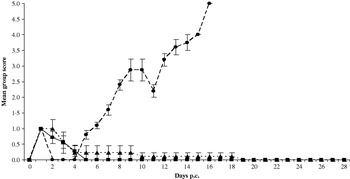
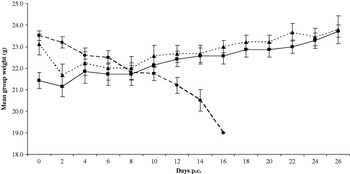
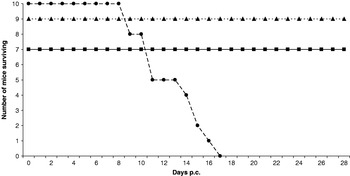
Following challenge (5×10⁶ NC1 p.39 tachyzoites), clinical symptoms, including a ruffled coat and slight weight loss, were seen from day 1 post-challenge (p.c.), resulting in a group mean maximum morbidity score of 1·0 on day 1 (see Fig. 1), the animals in this group returned to being clinically normal on day 5 p.c. Changes in the mean group weight were calculated by comparing the weight at each time-point to the weight on day 0 p.c. Group 1 demonstrated a mean weight loss on day 2 p.c. of 0·3 g, which was regained by day 4 p.c., the mice ended the experiment 2·3 g heavier than on day 0 p.c. (see Fig. 2). Group 1 suffered 0% mortality following challenge, with all the mice (n=7) surviving to the end of the experiment (see Fig. 3).
Mean group morbidity scores following challenge with virulent Neospora caninum tachyzoites. ■ – Group 1, 1×10⁶ NC1 p.43 tachyzoites. ▲ – Group 2, 1×10⁶ NC1 p.88 tachyzoites. ● – Group 3, 2·45×104 Vero cells. All groups were challenged with 5×10⁶ NC1 p.39 tachyzoites. (Error bars ± s.e.m.).

Changes in mean group weight following challenge with virulent Neospora caninum tachyzoites. ■ – Group 1, 1×10⁶ NC1 p.43 tachyzoites. ▲ – Group 2, 1×10⁶ NC1 p.88 tachyzoites. ● – Group 3, 2·45×104 Vero cells. All groups were challenged with 5×10⁶ NC1 p.39 tachyzoites. (Error bars ± s.e.m.).

Mortality rates following challenge with virulent Neospora caninum tachyzoites. ■ – Group 1, 1×10⁶ NC1 p.43 tachyzoites. ▲ – Group 2, 1×10⁶ NC1 p.88 tachyzoites. ● – Group 3, 2·45×104 Vero cells. All groups were challenged with 5×10⁶ NC1 p.39 tachyzoites.

Group 2
The animals in Group 2 showed no clinical symptoms following the primary inoculation (1×10⁶ NC1 p.88 tachyzoites). Following challenge (5×10⁶ NC1 p.39 tachyzoites), clinical symptoms including a ruffled coat and slight weight loss were seen from day 1 p.c., resulting in a group mean morbidity score of between 0·2 and 1·0, the mice returned to being clinically normal by day 18 p.c. (see Fig. 1), there was no significant difference in the morbidity scores of Groups 1 and 2 at any time-point tested following challenge. The weight loss seen in Group 2 reached a maximum of 1·4 g on day 2 p.c., this weight was regained throughout the course of the experiment and the mice ended the experiment 0·7 g heavier than on day 0 p.c. (see Fig. 2). There were no statistical differences in the mean group weights when groups 1 and 2 were compared. Group 2 suffered 0% mortality following challenge, with all the mice (n=9) surviving to the end of the experiment (see Fig. 3).
Group 3
The animals in Group 3 showed no clinical symptoms following the primary inoculation (2·45×104 Vero cells). Following challenge (5×10⁶ NC1 p.39 tachyzoites), clinical symptoms including a stiff stary coat were seen from as early as day 1 p.c. progressing through hunching, a tottering gait, a reluctance to move and weight loss; resulting in a group mean maximum morbidity score of 5·0 on day 16 p.c. (see Fig. 1). The weight loss started on day 2 p.c. with a mean group loss of 4·5 g by day 16 p.c. (see Fig. 2). The weight loss seen in Group 3 was significant (P=0·001) from day 12 p.c. onwards, when compared to Groups 1 and 2. Group 3 suffered 100% mortality following the parasite challenge, the first animals were culled on day 8 p.c. and the final mouse was culled on day 17 p.c. (see Fig. 3).
Three animals in Group 1 and 1 animal in Group 2 died on day 0 p.c. due to complications resulting from the administration of the challenge inoculum. Results from these animals were not used in any calculations.
Serology
IgM
Neospora-specific IgM titres of <1/16 were detected in all the mice from Group 1 (n=7) and Group 2 (n=9), while Group 3 had IgM titres of <1/16 (n=3), 1/16 (n=2) and 1/32 (n=3).
IgG
Group 1 demonstrated Neospora-specific IgG titres that ranged between 1/1024 (n=2), 1/2048 (n=3) and 1/4096 (n=2), while Group 2 gave IgG titres of 1/1024 (n=1), 1/2048 (n=5) and 1/4096 (n=3). The IgG titres seen in the mice from Group 3 ranged from <1/16 (n=3) to 1/16 (n=2) and 1/32 (n=3). (We were unable to collect samples from 2 mice in Group 3.)
Pathology and PCR results
The extent of the histopathological changes post-challenge, based on the number and size of lesions observed in the brain, were assessed and the presence of the parasite was demonstrated by immunohistochemistry (IHC) and Neospora-specific PCR.
Group 1
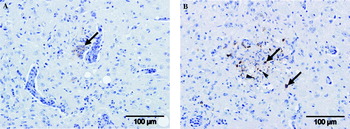
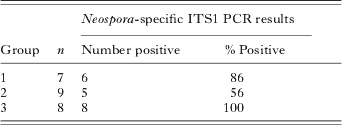
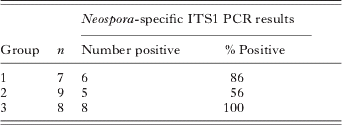
Two animals in Group 1 had no demonstrable pathology, while a third mouse showed mild mononuclear perivascular cuffs. The remaining 4 mice in Group 1 showed large severe foci of mononuclear inflammation including perivascular cuffing; severe foci of necrosis and microgliosis. One of the mice with severe lesions also had foci of mineralization in the brain, while tachyzoites and parasite antigens were demonstrated in moderate lesions associated with mononuclear infiltrates in the brain of another severely affected mouse (see Fig. 4A). Positive Neospora-specific PCR results were obtained from 6 mice in this group (see Table 2), including 1 mouse in which lesions were not detected. One mouse was negative by PCR and by histopathology and IHC.
(A) (Group 1). Neospora antigens (arrow) associated with mononuclear cells within a moderate brain lesion. (B) (Group 3). Neospora antigen associated with mononuclear cells; a tissue cyst (arrow) and tachyzoites (arrowhead) within a severe lesion.

Neospora-specific ITS1 PCR
Group 2
Histopathological lesions were not detected in 4 of the mice from Group 2. In 1 mouse there was mild microgliosis along with mild mononuclear perivascular cuffs, while in another mouse there was moderate perivascular cuffing and microgliosis. In the 3 remaining animals in the group there were large severe foci of microgliosis, necrosis and mononuclear perivascular cuffs. Parasite antigens were detected in the brains of these 3 mice by IHC, but only in a very small number of cells and these were not associated with any lesions. In 1 of the mice with severe lesions a small tissue cyst was observed and was associated with inflammation but no necrosis or microgliosis. Positive PCR results were obtained from 5 mice in this group (see Table 2) and all 5 demonstrated pathological changes. Four mice gave negative PCR results; these animals also had no pathological changes.
Group 3
One mouse in Group 3 (post-mortemed on day 10 p.c.) showed no pathology in the brain, but had moderate numbers of N. caninum parasites in the lungs. Two other mice also culled on day 10 p.c. showed foci of mild mononuclear perivascular cuffs, mild microgliosis, and mild necrosis. The remaining 5 mice in the group were all culled between days 13 and 17 p.c. and demonstrated moderate to severe mononuclear perivascular cuffs, microgliosis, and necrosis. A number of these mice also showed signs of splenic haemorrhaging and hepatic vacuolation. Parasite cysts were detected in 5 animals, 2 of these animals were post-mortemed on day 10 p.c., and in 1 of these 2 mice tachyzoites were present in the brain. In 6 mice, positive labelling for parasite antigens in infiltrating mononuclear cells were observed as well as tachyzoites and tissues cysts in brain samples analysed by IHC (see Fig. 4B). These Neospora antigen-positive cells were associated with moderate to severe lesions in all 5 of the mice. All of the mice sampled in Group 3 (n=8) gave positive Neospora-specific PCR results (see Table 2). (We were unable to collect samples from 2 mice in Group 3.)
Quantitative PCR
DNA extracted from brain samples of mice in Group 1 had a mean concentration of Neospora DNA of 0·011 pg/ng host genomic DNA (standard error of the mean (s.e.m.) ±0·004 pg). Group 2 had a mean concentration of Neospora DNA of 0·042 pg/ng host genomic DNA (±0·014 pg). When the results from Groups 1 and 2 were compared by one-way ANOVA, it was shown that there was no statistical difference (P=0·088) between the amount of Neospora DNA per ng of host genomic DNA between the two groups. The results from Group 3 gave a mean concentration of Neospora DNA of 2·519 pg/ng host genomic DNA (±0·493 pg). When the results from Groups 1 and 2 were compared (one-way ANOVA) against those of Group 3, both groups that had previously been inoculated with either virulent or attenuated parasites showed significantly less (P=0·001) parasite DNA per ng of host genomic DNA than the control animals.
DISCUSSION
Previous work showed that it is possible to attenuate the virulence of N. caninum tachyzoites through prolonged passage in tissue culture (Long et al. Reference Long, Baszler and Mathison1998; Bartley et al. Reference Bartley, Wright, Sales, Chianini, Buxton and Innes2006). This present study shows that prior exposure to these attenuated parasites is sufficient to protect against a lethal challenge of virulent parasites. Mice exposed to low doses of virulent parasites were also protected against a lethal challenge, but demonstrated more severe pathology and a greater incidence of Neospora-DNA in the brain (86% positive) post-challenge, compared to the animals inoculated with attenuated parasites (56% Neospora-DNA positive).
The mortality rate in the control (Group 3) animals reached 100% by day 17 p.c., while all the vaccinated mice were protected against the lethal challenge and survived to the end of the experiment on day 28 p.c. Previous studies in Balb/c mice have shown mortality rates of up to 70% following a subcutaneous challenge with as few as 2·5×105 NC1 strain N. caninum tachyzoites (Lindsay et al. Reference Lindsay, Lenz, Blagburn and Brake1999) and up to 95% in mice following an i.p. challenge with 5×10⁶ tachyzoites (Bartley et al. Reference Bartley, Wright, Sales, Chianini, Buxton and Innes2006). Lundén et al. (Reference Lundén, Wright, Allen and Buxton2002) previously showed that sublethal doses of live N. caninum tachyzoites were protective against a lethal challenge with the parasites; while, Lindsay et al. (Reference Lindsay, Lenz, Blagburn and Brake1999) demonstrated protection against a lethal challenge with Neospora using live attenuated temperature sensitive mutant strains of the parasite. Ramamoorthy et al. (Reference Ramamoorthy, Lindsay, Schurig, Boyle, Duncan, Vemulapalli and Sriranganathan2006) have also demonstrated protection in Balb/c mice, through vaccination with γ-irradiated tachyzoites. This vaccine offered complete protection against parasite-induced mortality, whereas all the unvaccinated control animals challenged with 2×10⁷ tachyzoites died by day 7 p.c. (Ramamoorthy et al. Reference Ramamoorthy, Lindsay, Schurig, Boyle, Duncan, Vemulapalli and Sriranganathan2006)
The clinical symptoms seen in the mice during this study were similar to those described by Lindsay and Dubey (Reference Lindsay and Dubey1989) and Lindsay et al. (Reference Lindsay, Lenz, Cole, Dubey and Blagburn1995), including rough coats, hunching, a reluctance to move, tottering gait and weight loss caused by a depressed appetite and dehydration. The naïve control mice that received the challenge of virulent parasites demonstrated a rapid onset of many of these symptoms, which resulted in 100% (10/10) of the animals in the group being culled by day 17 p.c. Animals previously exposed to the parasite showed minimal clinical symptoms of infection, with limited ruffling of the coat, demonstrating that prior exposure to the parasite was sufficient to protect against the severe morbidity associated with Neospora challenge infections in Balb/c mice. Pinitkiatisakul et al. (Reference Pinitkiatisakul, Mattsson, Wikman, Friedman, Bengtsson, Stahl and Lunden2005) made similar observations, where mice immunized with recombinant NcSRS2 antigen then challenged i.p. with 1×10⁷ live tachyzoites showed almost no morbidity; the non-immunized mice, however, showed neurological symptoms of neosporosis.
Previous studies have shown weight loss of 23% to 29·9% (Quinn et al. Reference Quinn, Miller, Ryce, Windsor and Ellis2002; Bartley et al. Reference Bartley, Wright, Sales, Chianini, Buxton and Innes2006) following inoculation of Balb/c mice with Neospora parasites. In this present study a mean weight loss of 4·5 g (23·7%) occurred in primary challenge animals, while mice previously exposed to Neospora and then challenged continued to gain weight. This demonstrates weight loss to be a good indicator of severity of N. caninum infection in Balb/c mice, as the animals exhibiting the most severe morbidity also showed the greatest percentage weight loss.
Pathological changes were seen in the brains of many of the inoculated animals, indicating that prior exposure to the parasite does not always confer complete protection against infection with N. caninum. The pathology seen in the mice that initially received the attenuated parasite was milder than that seen in the mice inoculated with the virulent parasite, where a greater incidence of large foci of severe perivascular cuffing and necrosis was observed. The pathology observed in this study was comparable to that observed in previous experimental infections of mice (Lindsay et al. Reference Lindsay, Lenz, Cole, Dubey and Blagburn1995; Long et al. Reference Long, Baszler and Mathison1998; Bartley et al. Reference Bartley, Wright, Sales, Chianini, Buxton and Innes2006). An interesting observation from this study was that there appeared to be no correlation between the presence of lesions in the brains of mice and the presence of overt clinical symptoms. Similar findings were reported by Ramamoorthy et al. (Reference Ramamoorthy, Lindsay, Schurig, Boyle, Duncan, Vemulapalli and Sriranganathan2006), where mice vaccinated with γ-irradiated tachyzoites showed no clinical signs of murine neosporosis, but at post-mortem neuropathology was observed.
Positive Neospora-specific ITS1 PCR results were seen in all the brain samples from mice in Group 3 from as early as day 10 p.c. These results are consistent with the findings of previous experiments, where positive PCR results were seen from day 7 p.i. following an i.p. inoculation with 5×10⁶ NC1 tachyzoites (Bartley et al. Reference Bartley, Wright, Sales, Chianini, Buxton and Innes2006). Parasite DNA was detected in 86% of brain samples from mice in Group 1 (which received the virulent parasites), but in only 56% of mice in Group 2 (which received the attenuated parasites). Previous work (Bartley et al. Reference Bartley, Wright, Sales, Chianini, Buxton and Innes2006) has shown that the attenuated parasites are still capable of dissemination and stage differentiation. The qPCR for Neospora DNA allowed reproducible, sensitive quantification of parasite burdens in infected mice. The qPCR results from this present study illustrated that there were significantly (P<0·001) lower levels of Neospora DNA in the brains of previously inoculated animals than was found in the brains of the control animals challenged with the virulent parasites. Prior exposure to the attenuated parasites resulted in 44% of the mice in Group 2 being PCR negative following challenge and lead to a significant reduction in the quantity of parasite DNA, compared to the control group. Although inoculation with virulent parasites also lead to a significant reduction in the quantity of parasite DNA post-challenge, only 14% of mice were PCR negative. These data would suggest that inoculation with the attenuated or virulent parasites is capable of reducing both the severity of infection and the parasite burden found in the brains of challenged animals.
The importance of the humoral immune response in mice during N. caninum infections was demonstrated by Eperon et al. (Reference Eperon, Bronnimann, Hemphill and Gottstein1999) who showed increased susceptibility to infection with the parasite in μMT B-cell deficient mice, compared to wild-type mice. In our study mice that were culled or died early in the experiment were seen to be producing N. caninum-specific IgM. Teixeira et al. (Reference Teixeira, Marques, Meireles, Seabra, Rodrigues, Madureira, Faustino, Silva, Ribeiro, Ferreira, Correia da Costa, Canada and Vilanova2005) also demonstrated production of N. caninum-specific IgM by day 7 p.c. followed by the production of IgG from about day 14 p.c., which is similar to the finding from our experiment, where all mice that survived to the end of the experiment seroconverted, producing high titres of Neospora-specific IgG. Though the role of the humoral immune response against Neospora has not been conclusively demonstrated; a likely role of antibodies would be in controlling the spread of the extracellular tachyzoite stage of the parasite (Innes et al. Reference Innes, Wright, Bartley, Maley, Macaldowie, Esteban-Redondo and Buxton2005). This hypothesis was further strengthened when Haldorson et al. (Reference Haldorson, Stanton, Mathison, Suarez and Baszler2006) showed that antibodies directed against the tachyzoite surface protein NcSRS2 inhibited the attachment and invasion of parasites in vitro. A further role of the B-cells may be in the activation of T-cells, since Teixeira et al. (Reference Teixeira, Marques, Meireles, Seabra, Rodrigues, Madureira, Faustino, Silva, Ribeiro, Ferreira, Correia da Costa, Canada and Vilanova2005) demonstrated that some CD69+ B-cells from N. caninum-infected mice were also expressing CD80 and CD86, suggesting a role in T-cell activation.
The results from our study show that prior exposure to live attenuated tachyzoites not only protects against a lethal challenge of N. caninum, but also leads to milder pathology and a lower number of PCR-positive samples compared to inoculation and challenge with virulent parasites. Prior inoculation with either the attenuated or the virulent parasites significantly reduced morbidity, mortality and quantity of parasite DNA in brain tissue, compared to the control animals following challenge of all the groups with virulent parasites. Further work is required to examine the immunological responses induced by these attenuated parasites and to determine whether vaccination with the attenuated tachyzoites can inhibit the transplacental transmission of the parasite.
The authors would like to acknowledge the Scottish Executive Environment and Rural Affairs Department for funding this study.