Introduction
Pre-existing cognitive abnormalities may be relevant to both the development (Lena et al. Reference Lena, Fiocco and Leyenaar2004) and maintenance of eating disorders (ED) (Schmidt & Treasure, Reference Schmidt and Treasure2006). For example, poor performance in set-shifting tasks (a component of executive functioning) is a possible candidate endophenotype for ED (Bulik et al. Reference Bulik, Hebebrand, Keski-Rahkonen, Klump, Reichborn-Kjennerud, Mazzeo and Wade2007; Treasure et al. Reference Treasure, Lopez and Roberts2007) as it has been found present in the acute illness, after recovery and in healthy relatives (Tchanturia et al. Reference Tchanturia, Morris, Anderluh, Collier, Nikolaou and Treasure2004; Holliday et al. Reference Holliday, Tchanturia, Landau, Collier and Treasure2005; Roberts et al. Reference Roberts, Tchanturia, Stahl, Southgate and Treasure2007).
It has been hypothesized that a cognitive style characterized by weak central coherence may also be linked to ED (Treasure et al. Reference Treasure, Southgate, Tchanturia, Lopez and Collier2006; Gillberg et al. Reference Gillberg, Rastam, Wentz and Gillberg2007; Southgate et al. Reference Southgate, Tchanturia and Treasure2007; Treasure, Reference Treasure2007; Lopez et al. Reference Lopez, Tchanturia, Stahl, Booth, Holliday and Treasure2008a, Reference Lopez, Tchanturia, Stahl and Treasureb). Weak coherence refers to the cognitive style where there is a bias towards detail accompanied by difficulties in the integrative processing of information (Happé & Booth, Reference Happé and Booth2008) and is characteristically associated with autistic spectrum disorders (ASD) (Frith, Reference Frith1989). This trait may explain the commonality between some individuals with anorexia nervosa (AN) and those with ASD (Gillberg et al. Reference Gillberg, Gillberg, Rastam and Johansson1996; Wentz et al. Reference Wentz, Gillberg, Gillberg and Rastam1999).
The purpose of this review was to systematically summarize the evidence that would support the hypothesis of weak central coherence in ED. Our hypothesis was that people with ED would show superior performance on tasks in which a detail processing style was beneficial and difficulties in those tasks in which a global processing strategy was required.
Method
Selection of studies
A two-step search of the following electronic databases was used to identify relevant papers for inclusion in the review: Medline, EMBASE, PsycINFO and ISI Web of Science. Searches were conducted in November 2006 and subsequently updated in September 2007. In step 1, a literature search was conducted using the term ‘central coherence’ to generate all the neuropsychological tests used to explore this concept. Then the search was narrowed to articles in which these tasks were undertaken in people with ED. In step 2, databases were searched for articles including words related to cognitive assessment in ED. The search included combinations of key words regarding diagnostic categories (anorexia nervosa, bulimia nervosa, eating disorders, binge eating disorder, bulimic disorders) and key words related to cognitive functioning (cognition, information processing, neuropsychology, cognitive functioning, cognitive styles, local/global processing, field dependency/independence, holistic/analytic style, abstract thinking) to ensure that papers not explicitly advertising the use of the mentioned tasks would be included.
Relevant published citations for all articles obtained were also pursued. Key investigators were contacted asking for unpublished material. A manual search was also carried out. Thirty-five tests were generated from the search of the central coherence concept mainly in relation to ASD. Only four articles used the concept in ED (Gillberg et al. Reference Gillberg, Rastam, Wentz and Gillberg2007; Southgate et al. Reference Southgate, Tchanturia and Treasure2007; Lopez et al. Reference Lopez, Tchanturia, Stahl, Booth, Holliday and Treasure2008a, Reference Lopez, Tchanturia, Stahl and Treasureb).
After the second search, only the following relevant tests were found to have been used in ED: the Block Design and Object Assembly subscales of the Wechsler Intelligence Scales, the Group/Embedded Figures Test (EFT), Rey–Osterrieth Complex Figure Test (ROFT), Matching Familiar Figures Test (MFFT), Sentence Completion Task (SCT), Homograph Reading Task (HRT) and California Verbal Learning Test (CVLT).
Paper retrieval
The search was conducted by two researchers on the basis of the following inclusion criteria:
(1) Population: participants suffering or recovered from an ED and a healthy control (HC) group.
(2) Instruments: studies specifying the use of at least one of the aforementioned tasks.
(3) Study designs: cross-sectional studies.
(4) The outcome variable was functioning on the information processing aspect of the tasks.
Selection results
Thirty-seven relevant abstracts were found and the full papers were retrieved. One paper could not be obtained (Talarczyk & Rajewski, Reference Talarczyk and Rajewski2001). Fifteen of the remaining studies were excluded as they did not include an HC group (Sours, Reference Sours1969; Hamsher et al. Reference Hamsher, Halmi and Benton1981; Small et al. Reference Small, Teagno, Madero, Gross and Ebert1982, Reference Small, Madero, Teagno and Ebert1983; Gordon et al. Reference Gordon, Halmi and Ippolito1984; Touyz et al. Reference Touyz, Beumont and Johnstone1986; Dura & Bornstein, Reference Dura and Bornstein1989; Ranseen & Humphries, Reference Ranseen and Humphries1992; Bowers, Reference Bowers1994; Kaye et al. Reference Kaye, Bastiani and Moss1995; Nakasuji, Reference Nakasuji1999; Bayless et al. Reference Bayless, Kanz, Moser, McDowell, Bowers, Andersen and Paulsen2002; McDowell et al. Reference McDowell, Moser, Ferneyhough, Bowers, Andersen and Paulsen2003; Kitabayashi et al. Reference Kitabayashi, Ueda, Kashima, Okamoto, Kooguchi, Narumoto, Wada, Yamashita and Fukui2004; Key et al. Reference Key, O'Brien, Gordon, Christie and Lask2006). Some papers omitted the raw data and the corresponding author was contacted for these if the study was published after 1996. Four studies were eliminated because the relevant outcomes were not available, including the only study using the CVLT (Fox, Reference Fox1981; Horne et al. Reference Horne, Van Vactor and Emerson1991; Bradley et al. Reference Bradley, Taylor, Rovet, Goldberg, Hood, Wachsmuth, Azcue and Pencharz1997; Steinglass et al. Reference Steinglass, Walsh and Stern2006). Finally, one study reported data published previously (Murphy et al. Reference Murphy, Nutzinger, Paul and Leplow2004). Data from two studies included repeated measures in a longitudinal study (Szmukler et al. Reference Szmukler, Andrewes, Kingston, Chen, Stargatt and Stanley1992; Gillberg et al. Reference Gillberg, Rastam, Wentz and Gillberg2007). These data were included in the review table but were not included (because of lack of independence) in the meta-analysis. Therefore, the review included a total of 17 studies.
Description of the tasks
All of the following tasks have been used to explore central coherence with the caveat that most also involve other cognitive processes.
According to the ASD literature (Happé & Frith, Reference Happé and Frith2006), tasks in which a superior detail focused processing would benefit performance are:
Block Design Test (BD; Wechsler, Reference Wechsler1949, Reference Wechsler1974)
This construction test requires putting sets of blocks together to replicate complex designs depicted on a diagram. Time and errors are measured. It has been argued that a possible mechanism involved in faster performance is a superior detail processing (Shah & Frith, Reference Shah and Frith1993). This hypothesis has been tested using a modified version of the task in which performance in two conditions of the designs, unsegmented (whole designs) and segmented (designs are broken into their constituents parts), are compared. The central coherence account predicts that those with weak coherence would benefit less from the segmentation of the designs (Shah & Frith, Reference Shah and Frith1993; Happé et al. Reference Happé, Briskman and Frith2001).
Group/Embedded Figures Test (EFT; Witkin et al. Reference Witkin, Oltman, Raskin and Karp1971, Reference Witkin, Oltman, Raskin and Karp2002)
This perceptual test measures the time taken to locate and trace 12 (or 18, in the group version) simple shapes embedded in complex designs. The main outcome is the time taken to locate the hidden shapes. A shorter time has been described as the result of a strong local processing or a bias towards detail (Baron-Cohen & Hammer, Reference Baron-Cohen and Hammer1997; Jolliffe & Baron-Cohen, Reference Jolliffe and Baron-Cohen1997).
Matching Familiar Figures Test (MFFT; Kagan et al. Reference Kagan, Rosman, Day, Albert and Philips1964; Kagan, Reference Kagan1966)
This visual perceptual test was designed to measure cognitive impulsivity. The participant is asked to identify the exact replica of a familiar object among eight very similar alternatives. The latency to identify the ‘matching’ figure and the number of errors are scored. Shorter latencies may reflect an impulsive cognitive style. However, combining latency and errors provides a measure of efficiency. People with an efficient detail focused processing are both quick and error free.
Tasks that would be favoured by global strategies are:
Object Assembly (OA; Wechsler, Reference Wechsler1974, Reference Wechsler1981)
This task involves solving five jigsaw-type puzzles depicting familiar objects and the outcome is the time taken to complete the puzzles. A shorter time suggests a better ability to create an integrated global representation from its parts (Tokley & Kemps, Reference Tokley and Kemps2007).
Rey–Osterrieth Complex Figure Test (ROFT; Osterrieth, Reference Osterrieth1944)
This visual perceptual task requires copying a diagram of a complex figure and then recalling it from memory without previous warning. The interval between copy and recall may vary from 3 to 60 min. In general, the accuracy of the drawing at copy and recall phases has been scored by a system defined by Taylor (adapted from Osterrieth, Reference Osterrieth1944; Spreen & Strauss, Reference Spreen and Strauss1998). Process measures to assess the quality of copy strategies have been developed (Savage et al. Reference Savage, Baer, Keuthen, Brown, Rauch and Jenike1999; Booth, Reference Booth2006). It has been found that the organizational strategies used to copy the figure (detail versus global) mediate the percentage of recall (e.g. Savage et al. Reference Savage, Baer, Keuthen, Brown, Rauch and Jenike1999; Lopez et al. Reference Lopez, Tchanturia, Stahl, Booth, Holliday and Treasure2008a). A global approach favours recall whereas a detail approach affects it negatively. The assumption from this mediation hypothesis is that poor recall might reflect weak visual spatial coherence.
Sentence Completion Task (SCT; Happé et al. Reference Happé, Briskman and Frith2001)
This verbal test consists of a series of sentences constructed to provoke conflict between local and global processing. The outcome is the number of ‘local’ associations and hesitation time, which is thought to be indicative of a bias to local processing or difficulties in global processing (Booth, Reference Booth2006).
Homograph Reading Task (HRT; Happé, Reference Happé1997; Jolliffe & Baron-Cohen, Reference Jolliffe and Baron-Cohen1999)
This verbal task tests the ability to process a sentence as a whole rather than on a local level. The participant is asked to read out a set of 16 sentences where the context of the sentence determines how a homograph within it should be pronounced. The number of sentences pronounced correctly indicates stronger verbal coherence.
Data synthesis
Outcomes clustered by tasks were summarized by a meta-analysis if the number of studies available was >5; this applied to BD, EFT (accuracy) and OA. For the rest of the measures Cohen's d individual effect sizes were calculated.
Meta-analyses were carried out in Stata 9.1 (Stata Corporation, College Station, TX, USA) using the user-contributed commands for meta-analyses metan (Bradburn et al. Reference Bradburn, Deeks and Altman1998) and metabias (Steichen, Reference Steichen1998). Forrest plots are used to show the meta-analysis with all the independent data available for each measure.
Cohen's d, the difference between ED and HC divided by the pooled standard deviation, was calculated for each study (Wilson, Reference Wilson2001). Cohen's d is understood as negligible (⩾0 and <0.15), small (⩾0.15 and <0.40), medium (⩾0.40 and <0.75), large (⩾0.75 and <1.10), very large (⩾1.10 and <1.45) and huge (>1.45).
The standardized effect sizes were subsequently analysed using metan. The standard error of each study's standardized effect size was calculated using the method of Cooper & Hedges (Reference Cooper and Hedges1994) and pooled using a random-effect model that allowed for between-study variation of effect sizes (Everitt, Reference Everitt2003).
Homogeneity between the trials was analysed using Cochran's Q test. Because of the small sample sizes an additional measure of heterogeneity or inconsistency I 2 [(Q−df)/Q] was calculated (Higgins et al. Reference Higgins, Thompson, Deeks and Altman2003). I 2 ranges between 0% (no inconsistency) and 100% (high heterogeneity).
The presence of publication bias was assessed informally by visual inspection of funnel plots that were corroborated by its corresponding statistical analogue, Begg's adjusted rank test (Begg & Mazumdar, Reference Begg and Mazumdar1994), and additionally by Egger's test (Egger et al. Reference Egger, Smith, Schneider and Minder1997) as implemented in metabias.
Results
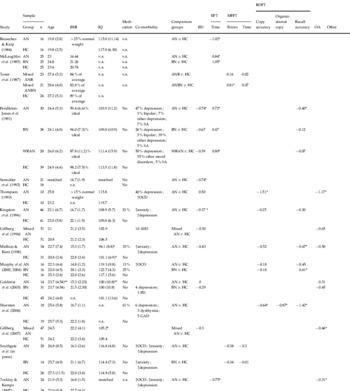
Table 1 shows a summary of the main characteristics of the studies included in the review. Most of the studies (n=13) compared people with AN with an HC group. Only six studies included people with bulimia nervosa (BN). One study included a group with weight-recovered AN (WRAN). Two studies included mixed AN groups, that is patients at various stages of illness (acute and partial recovery).
Samples and effect sizes

BMI, Body mass index; BD, Block Design Test; EFT, Embedded Figures Test; MFFT, Matching Familiar Figures Test; ROFT, Rey–Osterrieth Complex Figure Test; OA, Object Assembly; AN, anorexia nervosa; WRAN, weight-recovered AN; n.r., not reported; HC, healthy control group; ANR, restricting anorexia nervosa; SA, substance abuse; OCD, obsessive–compulsive disorder; ASD, autistic spectrum disorder; PD, personality disorder; GAD, generalized anxiety disorder; SCT, Sentence Completion Task; HRT, Homograph Reading Task.
* Significant differences between groups.
** The authors reported Age and IQ grouping AN and BN.
Summary by task
Block Design Test (BD)
BD was used in nine studies. In general, BD was used as a part of the standard measure of intelligence quotient (IQ). Lopez et al. (Reference Lopez, Tchanturia, Stahl, Booth, Holliday and Treasure2008a, Reference Lopez, Tchanturia, Stahl and Treasureb) reported the only studies using segmented versus unsegmented versions of the BD. They found no statistical differences between people with acute BN and HC across the two conditions of the tasks although people with BN performed slightly better in the unsegmented trial (d=0.2). The AN group performed worse than HC in the segmented designs (d=0.46). The BN but not the AN group benefited less from segmentation (BN d=0.37; AN d=0.02).
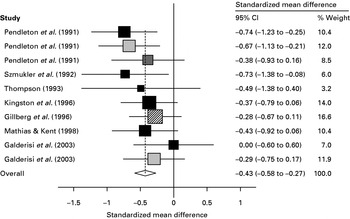
All of the studies using the original form of the task were included in a meta-analysis (Fig. 1). People with ED performed slower with a moderate standardized effect size (d=0.43, z=5.24, p<0.001). There was no evidence of heterogeneity across studies [χ2(9)=6.38, p=0.70, I 2=0.0%]. Two of the studies were outliers with a larger effect size (Pendleton Jones et al. Reference Pendleton Jones, Duncan, Brouwers and Mirsky1991; Szmukler et al. Reference Szmukler, Andrewes, Kingston, Chen, Stargatt and Stanley1992). No reason could be found from scrutiny of the studies as to why their results were atypical. The larger effect size in the study by Pendleton Jones et al. (Reference Pendleton Jones, Duncan, Brouwers and Mirsky1991) may have been confounded by the lower IQ level in the ED groups. Participants with BN also showed poor performance on this task (Pendleton Jones et al. Reference Pendleton Jones, Duncan, Brouwers and Mirsky1991; Galderisi et al. Reference Galderisi, Mucci, Monteleone, Sorrentino, Piegari and Maj2003). No evidence of publication bias was found.
Forrest plot for the Block Design (BD) meta-analysis excluding repeated measures: ■, anorexia nervosa (AN);  , bulimia nervosa (BN);
 , mixed AN;
 , weight-recovered AN (WRAN).

Embedded Figures Test (EFT)
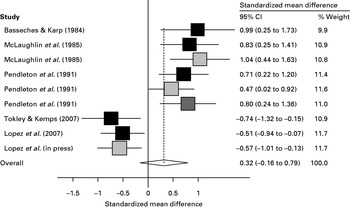
The EFT was used in six studies (Fig. 2) with an ED population. One study (Basseches & Karp, Reference Basseches and Karp1984) also administered the test to an obese group. The latter was not included in the meta-analysis but the study revealed that obese people performed worse than an HC group (d=−1.3).
Forrest plot for the Embedded Figures Test (EFT) meta-analysis: ■, anorexia nervosa (AN); , bulimia nervosa (BN); , weight-recovered AN (WRAN).

The meta-analysis revealed a high degree of heterogeneity across the studies [χ2(7)=58.8, p<0.001] with an index of inconsistency reaching 86.3%. Beggs' test revealed the existence of publication bias (z=1.98, p=0.048).
Visual inspection of the data suggested that there was a distinction between the studies carried out before 1991 and the three more recent studies. There may be technical and administration differences that account for the highly divergent results. All studies except that of Tokley & Kemps (Reference Tokley and Kemps2007), which used the Group EFT, used the original EFT. The procedure for the Group EFT is clearly defined: participants have unlimited access to the ‘hidden’ shape. Lopez et al. (Reference Lopez, Tchanturia, Stahl, Booth, Holliday and Treasure2008a, Reference Lopez, Tchanturia, Stahl and Treasureb) used the modification of the task made by Happé & Booth (Reference Happé and Booth2008), in which both the ‘hidden’ shape and the complex figure were placed simultaneously in front of the participant. This modification in the administration could explain why these more recent studies found superior function (moderate effect sizes) in the ED groups. Studies using the original version of the task, which was confounded by a memory component, found that people with ED performed poorly on the task (moderate effect sizes). In addition, in two of the studies (Basseches & Karp, Reference Basseches and Karp1984; Pendleton Jones et al. Reference Pendleton Jones, Duncan, Brouwers and Mirsky1991) the IQ in the ED group was lower than in the HC and this may have confounded the results as there is some evidence that EFT is related to intellectual ability (Flexer & Roberge, Reference Flexer and Roberge1980; Riding & Pearson, Reference Riding and Pearson1994).
Matching Familiar Figures Test (MFFT)
Only two studies using the MFFT fulfilled the criteria to be included in this review (Toner et al. Reference Toner, Garfinkel and Garner1987; Southgate et al. Reference Southgate, Tchanturia, Collier and Treasurein press). One study (Toner et al. Reference Toner, Garfinkel and Garner1987) found that the binge-purge AN group was less accurate than both the HC (d=0.81) and the restricting AN (d=0.74) groups. They found no differences in terms of response latency. Those partially recovered from a binge-purging AN were the fastest group (d=0.41) but the least accurate (d=1.23), indicative of cognitive impulsivity. Southgate et al. (Reference Southgate, Tchanturia, Collier and Treasurein press) reported no statistical differences between the ED and HC groups in number of errors, response latency and impulsivity. However, the ED groups were in general faster and more accurate than HC. The AN group was more efficient (combining speed and accuracy) than the BN and HC groups (d=0.89).
Differences in the status of the illness as well as the diagnostic subgrouping may explain some differences across studies. More studies using the efficiency index are needed.
Rey–Osterrieth Complex Figure Test (ROFT)
Copy accuracy
Six studies included an AN sample (Thompson, Reference Thompson1993; Kingston et al. Reference Kingston, Szmukler, Andrewes, Tress and Desmond1996; Mathias & Kent, Reference Mathias and Kent1998; Murphy et al. Reference Murphy, Nutzinger, Paul and Leplow2002; Sherman et al. Reference Sherman, Savage, Eddy, Blais, Deckersbach, Jackson, Franko, Rauch and Herzog2006; Lopez et al. Reference Lopez, Tchanturia, Stahl, Booth, Holliday and Treasure2008a) and two studies also included a BN group (Murphy et al. Reference Murphy, Nutzinger, Paul and Leplow2002; Lopez et al. Reference Lopez, Tchanturia, Stahl, Booth, Holliday and Treasure2008b). All were integrated in a meta-analysis. People with ED were less accurate than HC (d=0.49, 95% CI −0.88 to −0.1). There was high heterogeneity [χ2(7)=26.23, p<0.001, I 2=73.3%), mainly due to two studies with outlying results (Thompson, Reference Thompson1993; Lopez et al. Reference Lopez, Tchanturia, Stahl and Treasure2008b). Inspection of these two studies revealed elements such as a failure to match groups (Mathias & Kent, Reference Mathias and Kent1998) or a BN group highly affected by co-morbid conditions (Lopez et al. Reference Lopez, Tchanturia, Stahl and Treasure2008b), which could account for these differences. Both studies considered the effect of confounding variables such as depression. No publication bias was found.
Recall accuracy
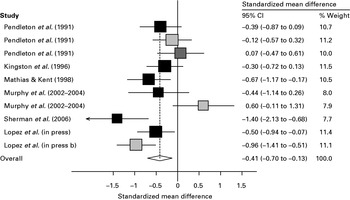
Six studies incorporated a group with AN, three a BN group, and one a recovered AN group (Fig. 3). The time intervals between copy and delayed recall varied from 20 min to 30 min. People with ED performed poorly on this task, with an overall effect size of d=0.41 and high indices of heterogeneity [χ2(9)=26.9, p<0.001; I 2=66%]. The heterogeneity could be due to the inclusion of populations with different diagnoses and in different stages of the illness. No evidence of publication bias was found.
Forrest plot for accuracy in recall Rey–Osterrieth Complex Figure Test (ROFT) meta-analysis: ■, anorexia nervosa (AN);
, bulimia nervosa (BN);
, weight-recovered AN (WRAN).

A meta-analysis of the six studies comparing AN and HC groups only was conducted and found no evidence of heterogeneity [χ2(5)=7.4, p=0.19] and a low level of inconsistency (I 2=32.8%). This suggests that poor function on this task is more related to AN (d=0.55) There was no evidence of publication bias. Sherman et al. (Reference Sherman, Savage, Eddy, Blais, Deckersbach, Jackson, Franko, Rauch and Herzog2006) found the largest effect size. It is possible that co-morbidity with anxiety and depression and the fact that over 60% of the sample in his study were on medication might account for this effect.
The data from BN group are less clear. The effect size of the three studies available varied from d=−0.96 to d=0.60. Murphy et al. (Reference Murphy, Nutzinger, Paul and Leplow2002) reported a superior performance of the BN group whereas Pendleton et al. (Reference Pendleton Jones, Duncan, Brouwers and Mirsky1991) and Lopez et al. (Reference Lopez, Tchanturia, Stahl and Treasure2008b) obtained opposite results. IQ differences and age of the participants may confound these results.
Organizational strategies (copy)
Three studies (Sherman et al. Reference Sherman, Savage, Eddy, Blais, Deckersbach, Jackson, Franko, Rauch and Herzog2006; Lopez et al. Reference Lopez, Tchanturia, Stahl, Booth, Holliday and Treasure2008a, Reference Lopez, Tchanturia, Stahl and Treasureb) explored this component and confirmed that the organizational approach mediates the effect of grouping (e.g. AN versus HC) on the deficit in visual memory in the recall, that is a detailed rather than a global approach impaired recall accuracy. The effect sizes are shown in Table 1. Lopez et al. (Reference Lopez, Tchanturia, Stahl, Booth, Holliday and Treasure2008a, Reference Lopez, Tchanturia, Stahl and Treasureb) also found that a process measure specifically developed for central coherence (Booth, Reference Booth2006) mediated the percentage of recall.
Object Assembly (OA)
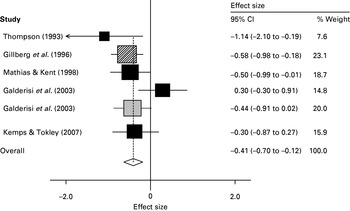
Six of the studies used this task to compare groups with AN or mixed AN and HC. Only one included a BN group (Fig. 4) and one of the studies reported repeated measures 3 years apart (Gillberg et al. Reference Gillberg, Rastam, Wentz and Gillberg2007).
Forrest plot for Object Assembly meta-analysis: ■, anorexia nervosa (AN);, bulimia nervosa (BN);, mixed AN.

People with ED take longer on this task with a moderate effect size (d=0.41, z=2.74, p=0.006), with no evidence of heterogeneity [χ2(5)=8.65, p=0.12] and moderate inconsistency (I 2=42.2%).
Although statistically there was no publication bias (all p>0.70), the trim-and-fill procedure on the funnel plot indicated that there is a small publication bias towards larger studies. After correction, the overall effect remained at a moderate level (d=0.35, p=0.02).
Two studies found that people with AN completed this task faster than controls and the studies were scrutinized to find any explanations for this (Thompson, Reference Thompson1993; Galderisi et al. Reference Galderisi, Mucci, Monteleone, Sorrentino, Piegari and Maj2003). It is possible that IQ level could be a confounding variable in the study of Thompson (Reference Thompson1993) but the atypical results from Galderisi et al. (Reference Galderisi, Mucci, Monteleone, Sorrentino, Piegari and Maj2003) are unexplained.
Gillberg et al. (Reference Gillberg, Rastam, Wentz and Gillberg2007) readministered the task to a mixed group of AN (most of them recovered) and an HC group after 3 years of first assessment and found persisting difficulties in this task in the mixed AN group (first assessment: d=−0.65, second assessment: d=−0.46).
Verbal tasks
Sentence Completion Task (SCT)
Two studies have used this task (Lopez et al. Reference Lopez, Tchanturia, Stahl, Booth, Holliday and Treasure2008a, Reference Lopez, Tchanturia, Stahl and Treasureb). Difficulties in global processing expressed in longer hesitations to provide appropriate completions were found in both AN (d=0.65) and BN (d=1.1) groups. No differences were found in the number of local completions.
Homograph Reading Task (HRT)
Two studies used this task (Lopez et al. Reference Lopez, Tchanturia, Stahl, Booth, Holliday and Treasure2008a, Reference Lopez, Tchanturia, Stahl and Treasureb). People with BN made more errors on this task (d=0.45) whereas people with AN performed on this task like the controls.
Co-morbidity
Co-morbid conditions were reported in most of the studies (see Table 1) and in some studies this was considered as a potential confounder. The majority of studies found no confounding effects of anxiety or depression (Kingston et al. Reference Kingston, Szmukler, Andrewes, Tress and Desmond1996; Mathias & Kent, Reference Mathias and Kent1998; Sherman et al. Reference Sherman, Savage, Eddy, Blais, Deckersbach, Jackson, Franko, Rauch and Herzog2006; Steinglass et al. Reference Steinglass, Walsh and Stern2006; Southgate et al. Reference Southgate, Tchanturia and Treasure2007; Lopez et al. Reference Lopez, Tchanturia, Stahl, Booth, Holliday and Treasure2008a). Three studies found that levels of anxiety were associated with poor cognitive performance (Pendleton Jones et al. Reference Pendleton Jones, Duncan, Brouwers and Mirsky1991; Szmukler et al. Reference Szmukler, Andrewes, Kingston, Chen, Stargatt and Stanley1992; Lopez et al. Reference Lopez, Tchanturia, Stahl and Treasure2008b). One study found that the level of depression decreased copy accuracy on the ROFT (Thompson, Reference Thompson1993). Obsessive–compulsive disorder symptoms were associated with poor recall in the ROFT in two studies (Thompson, Reference Thompson1993; Lopez et al. Reference Lopez, Tchanturia, Stahl, Booth, Holliday and Treasure2008a).
One study in which 10% of the AN sample met criteria for ASD (Gillberg et al. Reference Gillberg, Gillberg, Rastam and Johansson1996) observed that this subgroup had poorer performance in the OA test.
Possible confounding by medicines was reported in some of the studies. Lopez et al. (Reference Lopez, Tchanturia, Stahl, Booth, Holliday and Treasure2008a, Reference Lopez, Tchanturia, Stahl and Treasureb) and Sherman et al. (Reference Sherman, Savage, Eddy, Blais, Deckersbach, Jackson, Franko, Rauch and Herzog2006) reported no difference between those taking medicines and those who did not, whereas Kingston et al. (Reference Kingston, Szmukler, Andrewes, Tress and Desmond1996) found that medicines were associated with poor performance in the BD test.
Discussion
The aim of this review was to summarize the evidence that would support the hypothesis that people with ED have weak coherence and to compile, wherever possible, a meta-analysis of the results on tasks that are purported to involve global or detail strategies.
Overall, poorer performance (moderate effect sizes) was found in tests that may benefit from a global strategy, for example the ROFT (recall accuracy and organizational strategies), OA, SCT and HRT. Recent studies that have removed the memory component from the EFT show superior performance of the ED groups (d varied from −0.51 to −0.70), which may be attributed to a detailed strategy. This is in contrast to the older studies that found inferior performance on this task (d ranged from 0.47 to 1.02) in which recall would have been a confounding factor. People with AN and BN performed more efficiently on the MFFT, which may reflect a bias for detail. Thus, overall, these findings support the hypothesis that people with ED have weak coherence and superior detail function.
However, performance on some of the tasks, for example BD, do not fit with the hypothesis. Faster performance in this task has been thought to be the result of a superior analytical ability in people with autism (Shah & Frith, Reference Shah and Frith1993). However, as noted by Happé & Frith (Reference Happé and Frith2006), errors in the task could result from poor global integration; that is, performance on this task involves a balance between local and global approaches (Strauss et al. Reference Strauss, Sherman and Spreen2006). In this review, people with ED showed slower performance relative to HC with moderate effect size across the studies. The crucial element that is used to highlight superiority in detail functioning is purported to be the lack of advantage from segmentation. This modification of the task was used in only two studies and people with BN did have less benefit from segmentation (d=0.37). Such an effect was not found in AN.
In general, the performance on these tasks across the ED diagnostic spectrum showed little variation. Exceptions were found in the ROFT (recall) and in the verbal coherence tasks. Difficulties in the former were consistent among AN groups, whereas people with BN and those in recovery showed more variation. Thus, it is possible that poor nutrition could account for poor performance in this task. In the verbal tasks, people with BN performed poorer than those with AN. It has been hypothesized that impulsivity in BN accounts for differences in the HRT.
This review has limitations. First, only three studies aimed to test the central coherence hypothesis directly. Second, none of the neuropsychological tasks used can be said to examine purely local or global processing, some examine the trade-off between the two and some tap into other aspects of executive function and attention. Third, many studies do not provide sufficient information about how the measures were administered or whether they have been modified, and the assumption that there is enough similarity to justify summarizing the data may be flawed. Likewise, differences in the case mix, such as use of medicines, and diagnostic issues may make it difficult to merge the data.
In conclusion, the hypothesis that people with ED have weak coherence remains unproved. There is consistency in the evidence suggesting weak global processing but less suggesting superiority in local processing. This contrasts with the conclusion drawn in the systematic review of studies examining this hypothesis in ASD, which showed strong evidence for superiority in local processing but weaker evidence for a deficit in global processing (Happé & Frith, Reference Happé and Frith2006). Therefore, further research to examine specifically whether the difficulties in global processing are accompanied by superiority in detail processing is needed.
Acknowledgements
This work was made possible by a grant from the Nina Jackson Foundation for Research into Eating Disorders. C.L. was in receipt of a Ph.D. scholarship from Mideplan-Chile.
Declaration of Interest
None.