Ensemble taiko drumming (kumi-daiko) is one of the most globally successful performance genres to emerge in postwar Japan. Taiko ensembles arrange barrel-shaped wooden drums (taiko) of various sizes for stage performance, much like an orchestral percussion section. The relatively large size and placement of the drums on stage, however, necessitates much more vigorous use of the body in performance than orchestral percussion. As the physically demanding yet intricately choreographed performances of taiko ensembles drew enthusiastic audiences across Japan in the closing decades of the twentieth century, a veritable “taiko boom” ensued. With the combined support of local and national government, thousands of local taiko groups sprung up in towns, villages, and municipalities in the 1980s and 1990s (Bender Reference Bender2003). Professional taiko ensembles now routinely tour Europe and the United States, and hundreds of locally based taiko groups have formed as well outside Japan in North and South America, Europe, Southeast Asia, and Australia (Terada Reference Terada and Terada2001).
Taiko drums and taiko drumming groups have thus become increasingly visible cultural markers of contemporary Japan (Terada Reference Terada2000). While neonationalists might point to this taiko boom as evidence of renewed interest in traditional Japanese culture, such a claim would be difficult to support, as taiko groups did not even appear in Japan until well into its postwar recovery. Moreover, with repertories and choreography that borrow liberally from contemporary patterns, few taiko ensembles claim to be passing on particular folk “traditions.”Footnote 1 Instead, contemporary taiko ensembles look to the future, emphasizing creativity, dynamism, and innovation, without ignoring what the past offers in the way of musical or visual inspiration.
Nowhere is this blend of old and new more apparent than in what is perhaps the most iconic presentation of taiko drumming, a performance piece called Ōdaiko. In Ōdaiko (literally, “big drum”), a drummer, usually a man, stands naked except for a white loincloth and headband in front of an enormous drum (see figure 1). Slowly and dramatically, the drummer draws together his large bachi (wooden drum mallets) and begins to pound furiously on the instrument for more than ten minutes. Similarly clad and shrouded in darkness on the opposite side of the drum is another drummer who answers with a steady supporting cadence, making it appear as if the drum is battling back instead of yielding to the lead drummer's demands. As the muscles on the drummer's exposed back begin to strain and swell under the stress of his performance, the audience witnesses both a finely crafted display of drumming technique and a choreographed struggle for control. Man versus nature, the primordial conflict, is evoked by the figure of a “primitive” ancestor—lacking clothing but possessing a recognizably Japanese body—and his most ancient instrument, the taiko.
A drummer prepares to play Ōdaiko in a pose that has become emblematic of contemporary Japanese taiko drumming. Photograph by Mark Coutts-Smith.

The symbolic weight of this image surely accounts for its near omnipresence in posters and advertisements for taiko performances. As the preceding discussion suggests, however, the association of Ōdaiko with the ancestral culture of Japan is more superficial than substantive. This image of ancient Japanese man and nature was created just over thirty years ago by Ondekoza (鬼太鼓座),Footnote 2 a troupe of drummers dedicated to the popularization of ensemble taiko drumming (among other Japanese folk performing arts). Living communally on an isolated Japanese island and led by their founder, Den Tagayasu, Ondekoza sought to breathe new life into Japan's folk performing arts (minzoku geinō) by converting their essential motifs into dynamic stage performances. Along with creating vibrant new performances, the members of Ondekoza submitted to a grueling physical training regimen and lived a near-monastic, ascetic lifestyle.Footnote 3 Performances of Ōdaiko came to epitomize the masculine ethos and appealed to rustic Japanese values at the heart of the group's mission. They also proved extremely popular with audiences and taiko enthusiasts alike. Ōdaiko has been copied and adapted so frequently by taiko groups around the world that it has been transformed from a specific performance piece into a generic performance style.
Yet, given Ondekoza's interest in the folk performing arts and its central role in the popularization of this new drumming style, it is striking that the creative inspiration for Ōdaiko came not from a well-known folk antecedent, but rather from the a fictional presentation of festival drumming in the Japanese film The Rickshaw Man (Muhōmatsu no isshō).Footnote 4 What is more, the wearing of the loincloth (fundoshi)—one of the most distinctive and widely emulated elements of Ōdaiko—originated not in a group custom, but rather in a suggestion by the French fashion designer Pierre Cardin. Based more on projections rather than reflections of folk society, as I will argue, the creation and widespread adoption of Ōdaiko exemplifies how taiko drumming complicates facile distinctions between the manufactured “popular” culture of film and fashion and the organic “folk” culture of rural society. Furthermore, in an era of accelerating cultural globalization, the cross-border distribution of its creation highlights the importance of closely tracing transnational cultural flows in the analysis of what appear to be distinctly national-cultural forms (Allen and Sakamoto Reference Allen and Sakamoto2006; Allison Reference Allison2006).
The primary aim of this essay is to explain how these seemingly disconnected elements—a Japanese film and a French fashion designer—could shape what appears to be such a quintessentially traditional performance piece. Indeed, it is hard to fathom how these two elements could coalesce in Ondekoza's Ōdaiko without understanding in detail the ideology and personal history of the group's founder, Den Tagayasu. A child of wartime Japan, Den became enchanted by nostalgic images of premodern Japan found in the work of Japanese folklore scholars (minzokugakusha), or “native ethnologists,”Footnote 5 and by the valorization of peasant culture espoused by Mao Zedong. To Den, a film buff and aspiring auteur, the protagonist of The Rickshaw Man embodied much of the vitality that he believed had been lost in Japan's postwar modernization, and much of what Ondekoza would later attempt to recover. What is more, Den's belief that achieving international acclaim for the group would enhance their status at home led to their seminal encounter with Pierre Cardin.
This analysis of Ōdaiko is part of a larger ethnographic field study of taiko groups that I conducted over twenty-four months in multiple sites across Japan. While Ōdaiko is but one out of a large corpus of taiko pieces, and Ondekoza is but one of many professional taiko groups, the creation and stylization of Ōdaiko symbolizes many of the issues raised by the emergence of these groups in Japan. The appropriation of “traditional” instruments by taiko groups and the political struggles over their authenticity reflect the continual negotiation between inherited culture and everyday modernity in Japanese society more broadly. In line with other recent scholarly accounts,Footnote 6 the story of Ōdaiko reaffirms how the condition of modernity renders unmediated encounters with a pristine past impossible.
Den Tagayasu: Rediscovering the Folk Arts of Japan
Concern with the place of the past in a rapidly modernizing present became particularly acute during the late 1960s and early 1970s in Japan. By this time, Japan's postwar “economic miracle” had brought significant change to the everyday lives of most Japanese. Earlier, in the mid-1950s, the government had heralded a return to prewar levels of wealth and gross domestic product, but decades of even greater economic growth were yet to come. While many welcomed the rising standard of living that accompanied this economic expansion, significant numbers of Japanese began to question, as others had before, the wisdom of pursuing so thoroughly the path of Western modernity. Mass interest in a Japan before modern Japan, the Japan of myth and folklore, ushered in a surge in the popularity of folktales, folk songs, and “discourses of the vanishing” found in the work of Japan's foremost scholar of folk life, Yanagita Kunio (Ivy Reference Ivy1995, 59; Mayer Reference Mayer1978). In a number of ways, the life of Ondekoza's founder, Den Tagayasu, anticipated as well as exemplified this shift in Japanese consciousness.
Born and raised in Tokyo's “downtown” (shitamachi) area, Den came to develop an intense interest in the culture of Japan's rural periphery.Footnote 7 In 1952, after being expelled from university in Tokyo for his leadership role in a series of violent demonstrations involving the left-wing National Association of Students (zengakuren), Den fled to Kobe, where he began working at its busy port unloading cargo (Mitsuya Reference Mitsuya1994, 62). Six months later, he stole away on a steamer and spent an additional six months in Germany. The experience soured him on Europe and the Western modernity to which he and his fellow Japanese aspired. He found postwar Germany unimpressive. Several informants recalled in interviews that he felt slighted by his German shipmates, who harassed him and made him feel that he, as a Japanese man, was racially inferior. The experience made Den keenly aware of his identity as a Japanese man in a way he had not been previously. Soon after returning home, he discovered the work of Japanese native ethnologists and their depiction of a rural Japan untouched by colonial expansion and postwar modernization, as many other Japanese would decades later. Encountering this research set Den on a path that led ultimately to the founding of Ondekoza.
Den's interest in native ethnology was piqued upon reading The People Who Live on the Sea (Umi ni ikiru hitobito) by the acclaimed native ethnologist Miyamoto Tsuneichi. The book describes the culture of a rural Japanese fishing village in idyllic terms, and it radically changed young Den's conception of Japanese culture (Mitsuya Reference Mitsuya1994, 62). Den soon befriended Miyamoto, who inspired him to travel around Japan observing rural society firsthand (Sano Reference Sano2000, 146). (Later, Miyamoto would also figure importantly in Ondekoza's founding, thus establishing a direct link between Japanese native ethnology and Ondekoza's attempt to enliven the very folk culture these scholars first described.Footnote 8) Den left Tokyo and journeyed across Japan, stopping in village after village. Passing through southern Japan and Kyūshū, he came to rest on Yonaguni-jima, an Okinawan island and the southernmost point in Japan. Those who knew him recalled that it was on this island that he first encountered both the potential of the folk performing arts to impress and, in his view, the pitiful state of their decline. One night during his stay, Den was captivated by the taiko performance of an older villager who “brought a drum to the beach in the evening and played it until the sun came up” (Shinoda Reference Shinoda1994, 32). Not long after, in the spring of 1958, Den returned to the mainland to visit Sado, an island located approximately 32 kilometers off the coast of Niigata Prefecture in northern Japan.
On Sado, Den met Honma Masahiko, an acquaintance of Miyamoto Tsuneichi's and a local historian and teacher. Assuming that Den would be impressed by a demonstration of Sado's taiko, just as he had been by the taiko on Yonaguni-jima, Honma brought Den along to a performance of Sado's Ondeko (鬼太鼓, “demon drumming” in Sado dialect), a kind of ritual drum-dance performed annually at the start of the planting season to ensure good health and a plentiful harvest. The performance was sponsored by a local travel agency, and Honma recalled that Den took umbrage at this. After the performance concluded, Den exploded in invective at what he had just seen.
Ondeko is becoming nothing more than a show piece lacking in vitality (seiki ga nai). The drummers use only the strength of their hands to strike the drum, dulling the sound and exciting no passion in the listener. Taiko used to have a contagious, spiritual power, like that of a shaman—it could infect people. Traces of this remain in Shintō ritual, but Ondeko is losing this infectious power. If there is no return to its original inspiration (senzo-gaeri)—no attempt to recoup that original vitality, Ondeko will devolve into nothing more than a meaningless dance. (Honma Reference Honma1994, 11)
Emphasizing his point, Den pulled a tattered little book out of his pocket that he called his “bible.” It was a collection of sayings by Mao Zedong on the arts and on the literature of peasants.Footnote 9 He read to Honma forcefully, “The energy of literature and the arts has its source in the farming communities of the peasant!” (Honma Reference Honma1994, 11).
Honma's anecdote nicely captures how Den's interest in the folk performing arts, Maoist thought, and left-wing activism combined to focus his attention on revivifying local culture by reinvigorating folk arts. Two other experiences with Ondeko on Sado Island confirmed Den's belief in a link between vigorous community and vibrant folk arts. In one community on the southeastern edge of Sado, an elderly man told Den how, in his youth, the sound of Ondeko used to echo in villages 7–8 kilometers away. Hearing this, Den set out to find a renowned Ondeko player on the island. He learned that the man's strong arms and dynamic performance were the product of daily labor as a “sawyer” (kobiki), thus affirming Den's conviction that powerful drumming depended on a body made strong by physically demanding work. Indeed, this perception of a connection between folk labor and folk performance presages the conflation of craft production and musical artistry that would later dominate the ideology of Ondekoza.
At some point during his journeys through Japan, Den changed his name from Tajiri Kōzō (田尻耕三) to Den Tagayasu. The name change indicates a significant transformation of self-identity. To create the two-character name Den Tagayasu, Den combined the first Chinese character of his last name, which means “rice field” (田), and the first Chinese character of his first name, which means “to cultivate” (耕), to create a new personal name that reads as an activity: Den Tagayasu—“the one who cultivates rice” (田耕). This nominal reinvention expresses not only Den's enchantment with Japan's rice-growing peasantry, but also gestures toward the contribution that folkloric imagery would make in the formation of Ondekoza and the creation of Ōdaiko.
The “Demon Drummers” of Ondekoza
With financial help from Miyamoto and others, Den organized an Ondekoza Summer School (Ondekoza Kaki Gakkō) on Sado Island in the summer of 1970. The Summer School brought together public intellectuals, artists, and designers with approximately fifty young people, the majority of whom were university students from outside Sado Island. On the final day of the workshop, Den implored the young attendees to remain with him on Sado in order to form a performance troupe. He enticed them with visions of traveling around the world and raising money to start “their own university” on Sado—an “artisan academy” (shokunin daigaku)—where they would have exclusive control over faculty and curriculum.
A few young participants remained, and toward the end of the year, a core group of about six members began living communally in pursuit of their future objectives. In addition to taking care of the daily chores and readying the material objects necessary for self-sufficiency, group members began the physical conditioning needed to withstand the demands of taiko drum performances. What began as light jogs of 3–4 kilometers turned, in subsequent months, into daily runs of 30–40 kilometers. A self-imposed monasticism took over the group. They swore off alcohol and cigarettes and cut off access to television, radio, newspapers, and magazines. Free time, relations between the sexes, and risqué chatter were forbidden. They began small-scale farming, not merely to grow food but also to simulate the rhythms of agrarian life that Den believed lay at the root of the many folk dances and drum patterns they practiced.
Den emphasized the merits and philosophical importance of the group's newfound practice of running. As students whose spirits were weary from studying and from battling authority, running helped build body and mind. Den dubbed the unique performance style that resulted from Ondekoza's intense emphasis on running sōgaku (literally, “running music”) (Kashiwagi Reference Kashiwagi1994, 26). Shinoda Masahiro, Den's close friend, director of the first documentary about the group (Sado no Kuni—Ondekoza), and a marathon runner himself, has expressed perhaps most eloquently the logic underlying Ondekoza's combination of long-distance running, commitment to the craftsman ethic, and desire to reinvigorate the folk performing arts:
Ondekoza first began running as a result of their flight from the outside world. They rehabilitated their wounded spirits and flesh, as if they were reborn, and developed a new sensibility and sensitivity toward their artistic endeavors… [To do this], they had to build the physical power required by the folk performing arts, which in previous epochs were supported by the arm and leg strength forged in the practice of hard manual labor…
These days the agricultural skills and technology of old have been discarded. Foot-worn paths between rice fields have been paved with concrete, and the spades and hoes of the past have been replaced with combines and tractors. The spirits (kami-gami) of the rice fields have been driven from their lairs, and the folk arts which were once performed in service to them have been reduced to nothing more than community festivities. The strong arms and legs which once supported these folk arts have long since vanished from the face of the earth…
In the past, the people who created these folk performances had to inspire people struggling with the weight and brutality of an everyday life from which there was no salvation. They needed performances that were powerful. If the display lacked power and physical drama, it would never rouse them from their toil.
As the agricultural society that both produced and thirsted for this power has disappeared, the opportunity has come for Den's method [of training] to produce the physical strength and sensitivity necessary to perform convincingly. The hands that plucked the shamisen (three-stringed fretless lute) and the hands that struck the taiko were once wrought through the labor of the farmer and the blacksmith. With the advance of “civilization” (bunmei), these hands have been rendered weak. Ondekoza's goal is to overcome at once this debilitation and decay to return to the fundamental wellspring of the performing arts. (Shinoda Reference Shinoda1994, 32–34)
In naming his group “Ondekoza,” Den had already conflated the relationship between artisan and folk artists at the root of Shinoda's essay, as historically Ondeko were both “carpenters” and “demon drummers” (Den Reference Den1994, 3). Although the Chinese character for -za (座) typically means “seat,” the character is used in contemporary Japanese to signify a troupe of actors or musicians and formerly referred to both trade and merchant guilds. Den was well aware that the character possessed this double sense of performance troupe and trade guild, and he traced this usage to the similar class position of artisans and performers in feudal Japan. Given Den's understanding of the connection between artists and artisans, Ondekoza's professed desire to build an artisans’ academy on Sado appears less capricious. Institutionalizing the instruction and learning of trade not only makes available an alternative supporting occupation for the aging taiko player, but also ensures that the foundation for vibrant folk performing arts will endure in the well-developed bodies of newly fashioned artisan-drummers.
The Life of Muhōmatsu
As the preceding discussion suggests, Den's desire to restore through Ondekoza the vitality of folk culture and the values of the artisan (shokunin) class depended on specific impressions of Japanese folk life. In some cases, these came from the firsthand accounts of the elderly villagers whom Den encountered in his time traveling around Japan. In other cases, they came from secondary accounts in the work of Mao Zedong or native ethnologists such as Miyamoto Tsuneichi and Shibusawa Keizō, whom he idolized. None of these sources of influence, however, suggests exactly why Den chose the Japanese drum to be at the heart of Ondekoza's activities. Presumably, other instruments could have been selected instead. Why is it that Den was so strongly attached to the Japanese taiko?
Den's vision for the group was based in his formative experiences growing up in postwar Japan, but evidence suggests that his particular affinity for the Japanese drum developed from a viewing of the film The Rickshaw Man (Muhōmatsu no isshō). A climactic scene in the film features a dramatic performance of taiko drumming by the film's protagonist, Muhōmatsu. Former members of Ondekoza recalled to me how Den had made them watch the film repeatedly to illustrate his conception of the ideal taiko performer. Some even speculated that Den's desire to start Ondekoza had derived from this film's effect on him as a young man. In fact, this is exactly what Den told one interviewer (Shirai Reference Shirai1996, 12). It may have been precisely because the energetic taiko performance captured in the film existed only in the realm of fiction that he was so passionate in his attempt to recreate it. Or perhaps, as a former member of Ondekoza has suggested, reflecting back on numerous documentaries of the group, Den formed the group not merely to reinvigorate the folk performing arts but, in striking circularity, to put his own version of Muhōmatsu on screen.
The Rickshaw Man is based on the novel Tomishima Matsugorō-den (The Story of Tomishima Matsugorō), written by Kyūshū native Iwashita Shunsaku in 1939 (Iwashita Reference Shunsaku1946). In 1941, the story was adapted for dramatic use by the theater troupe Bungakuza. Two years later, director Inagaki Hiroshi and screenwriter Itami Mansaku turned it into a black-and-white film and then remade it in color in 1958 (see figure 2). Bandō Tsumasaburō and Mifune Toshirō, each the leading man of his day, were featured successively in the role of Muhōmatsu. The 1958 version starring Mifune, a veteran of such classic Kurosawa films as The Seven Samurai and Rashōmon, was internationally successful, winning the prestigious Golden Lion Award at the Venice Film Festival in the same year. In 1963 and 1965, the film was again remade by two different directors, making a grand total of four cinematic productions of the story over a period of twenty years.
The cinematic origin of Ōdaiko. This videotape cover photograph from the 1958 release of Muhōmatsu no isshō emphasizes Mifune Toshirō's brief but highly influential drum performance in the film. Photo courtesy of Tōhō Company, Ltd.

One likely reason for the successive productions of the film is the richness of the story: it is at once a tale of unrequited love, a portrait of the class-caste society of early modern Japan, and a critique of Japan's rush toward modernization. The film opens in Kokura, Kyūshū, in 1898, the thirtieth year of Emperor Meiji's reign.Footnote 10 The protagonist, Tomishima Matsugorō, is a local rickshaw driver whose raffish pugnacity has earned him the nickname Muhōmatsu (short for “wild Matsugorō”). One day while driving his rickshaw, Muhōmatsu happens upon a young child with an injured leg. Demonstrating a tender side, he picks up the child and takes him home to his parents, and then later, at the mother's request, to the hospital. The child, Toshio, turns out to be the only son of a high-ranking officer in the Japanese Army named Yoshioka. Muhōmatsu refuses to take anything in return for his generosity. Upon hearing of the helpful stranger from his wife, Yoshioka quickly realizes that the strange man is the Muhōmatsu of whom he has often heard. The officer, perhaps as a show of appreciation for his good deed or merely out of curiosity, invites Muhōmatsu to his home and has the rickshaw driver entertain him with song.
The officer soon dies from pneumonia, which he contracts while leading military exercises in the rain. Left with the burden of rearing the young boy on her own, the officer's widow asks Muhōmatsu to help show the boy how to be a man. Muhōmatsu obliges, and in the course of helping to raise young Toshio, he gradually falls in love with the boy's mother. As Toshio grows older and more self-consciously embarks on the elite track befitting his social status, he grows apart from Muhōmatsu. Muhōmatsu's feelings for the widow grow stronger, but his respect for the deceased officer, along with his recognition of the unbridgeable gap in social standing between himself and the widow, ultimately prevent him from expressing his true feelings to her. In a moment of high drama, he tells her that he can never see her or Toshio again. Now estranged from his beloved companions, Muhōmatsu stumbles home, drunk and alone, on a winter day and dies in the street of a heart attack. After his death, two bankers inform the widow that, despite his limited means, Muhōmatsu had set up an account for her and Toshio, in which remained a considerable sum.
The story is melodramatic and in the end tragic, but this alone is not why it held such interest for Den and other taiko enthusiasts. Much of the film's appeal has to do with a scene in which Muhōmatsu demonstrates the playing techniques of Kokura Gion Daiko, a type of drumming performed annually at the Kokura Gion Festival. Toshio, now in his late teens, has returned to Kokura with one of his teachers. The scene opens as Muhōmatsu, Toshio, and Toshio's teacher approach the festival procession through a crowd. In the distance, two drummers stand atop a mobile drum platform, or yagura, on either side of a medium-sized taiko (nagadō-daiko) that has been positioned horizontally on a drum riser. In the front of the festival cart, which is ringed by Japanese lanterns (chōchin), are two small hand cymbal (chappa) players. The three observers begin to converse:
Teacher: (surveying the drummers) People say that this isn't the real way to play Gion Daiko.
Muhōmatsu: Yeah, that's right. There aren't many people left around here who know how to play it the right way anymore.
Teacher: (disappointed) So, there's no way to see the real thing then. That's too bad…
Muhōmatsu: Well… I guess I could give it a try. (Ore ga chotto manegoto dake yatte-miyō ka)
Toshio: (surprised) You can play Gion Daiko?
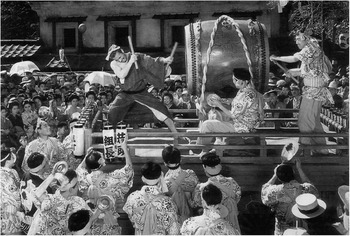
As Toshio speaks, Muhōmatsu steps onto the drum platform and asks the young drummer if he can trade in. Muhōmatsu takes the drummer's mallets, bows respectfully to the teacher, then turns to face the drum and begins playing lightly, shouting “This is called Kaeru-uchi!” Gradually picking up the tempo, Muhōmatsu calls out the name of the next pattern, “This is called Gion Daiko Nagare-uchi!” He starts to dance and sing as the crowd cheers him on. The two young chappa players forget their parts and look over at him in bewilderment. Muhōmatsu then shifts into another rhythmic pattern and yells, “Next… Isami-goma!” He pulls his right arm out of his kimono sleeve and begins twirling his sticks and playing to the crowd (see figure 3).
Mifune Toshirō as Muhōmatsu performs Kokura Gion Daiko to the cheers of the crowd below (from Muhōmatsu no isshō, 1958). The early stage presentation of Ondekoza's Ōdaiko mimics the viewing angle, playing positions, festival cart (yagura), and lanterns (chōchin) in this scene (see also figures 1 and 4). Photo courtesy of Asano Taiko.

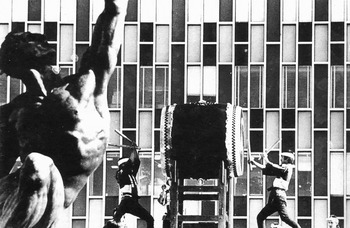
Ondekoza debuts Ōdaiko immediately after completing the Boston Marathon in 1975, a pattern they would repeat for the next several years. Note the similarity to the position of the drum and drummers in figure 3. The drummers’ costumes also recall Muhōmatsu's rickshaw uniform in the middle of figure 2. Photo courtesy of Asano Taiko.

At this moment, the camera cuts to a scene of an older man rushing out into the street with a look of astonishment on his face. Cocking his head in the direction of the music, the old man asks excitedly, “Who is that playing Isami-goma?”
“I'm not sure, but I heard that somebody just jumped in,” one of two young men rushing out after him answers.
Somewhat puzzled, the old man mumbles, “I didn't think that there was anybody left in Kokura who could play this kind of taiko…”
Another young man nearby asks, “Is this the Isami-goma you keep telling us about?”
Perking his ear toward the source of the rhythm again, the man answers with a wry smile, “That's right. This is the real Gion Daiko, so listen up!”
The camera swings back to Muhōmatsu, who shouts, “Now, Abare-uchi!” He takes out the other arm from his kimono, leaving his chest and shoulders bare, and begins playing the taiko furiously. The tempo gets faster. The sound of the drum gets louder, and the camera starts to swirl back and forth across the crowd. Scenes of huge waves crashing into rocks and billowing clouds rolling across the sky are interlaced with shots of Muhōmatsu's flailing arms, until finally the sequence fades into a series of dreamlike images.
As no other popular depiction had before, Muhōmatsu's “authentic” performance on film made taiko drumming seem “cool” (kakkō ii). In this respect, it is ironic that the “real” Gion Daiko Muhōmatsu performed on camera is not the taiko performed annually at the Kokura Gion Festival. The drum pattern was created by a kabuki drummer named Tanaka Denji.Footnote 11 The director of the film sent Tanaka, a Kokura native, back to his hometown to research the performance of Kokura Gion Daiko. Tanaka, however, did not think that the real Kokura Gion Daiko had enough impact to make it into the film. While preserving the placement of drummers on opposite sides of the taiko, rare among the folk drumming styles of Japan, Tanaka set about creating new rhythms for the rugged Muhōmatsu to play (Mogi Reference Mogi2003, 144–45).
Most important for the argument here, however, is the extent to which this film influenced Den in his conception of the ideal taiko player. Considering Den's own itinerancy, his interest in the folk performing arts, his passionate concern for the disappearing culture of the farmer and the rural artisan, and his discontent with modernizing Japan, it becomes clearer why the vigorous, proudly working-class, and locally grounded Muhōmatsu so captured his imagination. Indeed, in his enchantment with Muhōmatsu's taiko, it appears that Den was hardly alone. Oguchi Daihachi, the founder of Nagano Prefecture's O-Suwa Daiko—widely considered the first and most influential taiko ensemble in Japan—was deeply moved by the film; one of his group's first pieces is even called Isami-goma—the name of the third rhythmic pattern that Muhōmatsu shouts to the teacher during his performance (Taikology 1996, 64).Footnote 12 In addition, one author has suggested that the carpenter's apron that is common in many taiko groups derives from the one worn by Muhōmatsu in the film (Yomota Reference Yomota1996, 17; see figure 2).Footnote 13
In my own fieldwork, I was surprised to find that one of the first pieces to be taught to new members of the amateur taiko group that I joined was taken, with slight modification, entirely from the rhythms used in the film. It is even the case that Muhōmatsu's taiko display affected the development of taiko drumming in the United States. Concert literature for the Los Angeles–based ensemble Kinnara Taiko, one of the first and most influential taiko groups in the United States, notes, “Originally, our taiko was brought out once a year to accompany music during [the summer festival] Obon… One year, inspired by a film we had recently seen called Rickshaw Man starring Toshiro Mifune, we began to beat on the drum vigorously, creating rhythms and patterns quite different from those traditionally played” (quoted in Konagaya Reference Konagaya and Simon2005, 150). In sum, although the emergence of taiko groups in postwar Japan (and perhaps outside Japan as well) was not foreshadowed by Muhōmatsu's solo taiko display, the image of the ideal taiko player of the 1950s and 1960s is clearly linked to his cinematic presence.
Creating Ōdaiko
This image found its clearest expression in Ondekoza's signature piece, Ōdaiko. Initially, though, the piece looked quite different from its final form. After receiving the huge, 6-foot-diameter ōdaiko drum featured in the piece, Den instructed his drummers to work something up on it. First, they utilized a drum pattern they had learned from one of their teachers, an elderly folk drummer. The drum pattern, which is derived from an agricultural ritual in Fukui Prefecture called Hi no Taiko, has two drummers stand on the same side of a taiko that is laid on its side and secured by ropes to a small X-shaped drum riser. While one drummer maintains a steady supporting rhythm, the other drummer plays accented rhythmic patterns, twirling his mallets and performing dance-like arm and body movements called furi. To avoid hitting each other, each drummer stands slightly to the side of the drum and strikes it at a diagonal angle in a playing style called naname-uchi.
Several modifications made to the piece after this point, however, severed it entirely from Hi no Taiko and transformed it into something remarkably similar to kind of taiko performed in The Rickshaw Man. First, after building a more robust horizontal drum platform, which raised the drum above the heads of the drummers, Den suggested that the two drummers shift to the front and back of the drum. Second, he had the drummers position the drum so that its side, not its front, faced the audience, thus mimicking the camera angle in The Rickshaw Man and highlighting the movements of the drummers and their mallets (see figures 3 and 4). Third, to facilitate the quick entrance and exit of the heavy ōdaiko on stage, Den instructed the drummers to build a mobile drum platform virtually identical to the one used in the film, complete with a ring of lanterns, on which the group painted their name in Chinese characters.Footnote 14 Finally, in another move reminiscent of both Hi no Taiko and Muhōmatsu's performance, Den emphasized that the drummer playing the lead part execute various entertaining movements (furi) to accentuate his performance.
At this point, however, the practical constraints of performing on such a large drum began to override Den's artistic vision. Although various members of Ondekoza played the supporting part during this formative period, Hayashi Eitetsu, the most proficient drummer in the group, became chiefly responsible for the lead part, and it was around his strengths and limitations that the piece came to be developed. A man of small stature, Hayashi found it difficult to reach the head of the drum on its raised platform, not to mention to put power into his drum strokes. To compensate, Hayashi built a small platform on which he stood, but this failed to solve the central problem; striking the thick head of the large drum obliquely sent strong reverberations through him, making it hard for him to hit the drum with power. Inevitably, Hayashi worked harder to overcome the vibrations of the drum than he did playing expressively. He experimented with various stances, and ultimately moved around from the side of the drum to face it directly. By bending his legs, lowering his body, facing the drum, and planting one foot firmly behind him for balance, Hayashi was able to summon all his strength to strike the drum with much more facility and speed than before.
Even though this greatly improved the musical quality of his performance, it did not sit well with Den, who liked the way in which playing the ōdaiko obliquely enabled the audience to watch the drummer's entertaining furi, just as in the film. Hayashi, however, felt that he would never be able to carry off these kinds of movements convincingly, and, as he told me in an interview, “adding such furi made me feel like I was trying to curry favor artificially with the audience. Frankly, it was embarrassing.” For Hayashi, the piece was not meant to be a contrived presentation of theatrical flash; even with the presence of an accompanying drummer, he felt it was fundamentally a solo performance on the drum. To visually communicate this focus on the lead drummer even more, Hayashi suggested repositioning the drum in such a way that the back of the lead drummer directly faced the audience, thus focusing attention on the physical movements involved in the drummer's performance (see figure 1). Den initially resisted this change, but he finally relented after seeing how well audiences reacted. Over the next few years, Ondekoza continued to modify the structure of the piece, so much so that references to the original inspiration for the piece—Hi no Taiko—no longer appeared in concert programs.Footnote 15
With the benefit of hindsight, it becomes clear that Hayashi's subtle modification was both unprecedented and ironic. It was unprecedented because nowhere in Japanese festival or theatrical drumming do performers strike the ōdaiko with two drum mallets from head on (in a playing style that has come to be called shōmen-uchi). Every contemporary presentation of Japanese taiko that involves a drummer striking an ōdaiko while directly facing the drum (unless, improbably, they came on this innovation on their own), therefore, has its roots not in the rich “traditional” folk culture of Japan but in the famous Ōdaiko of Ondekoza. It is also ironic because, while Hayashi shifted his position from the side to the front of the drum in order to make up for his own physical limitations, performance in this manner has become the ultimate vehicle for the display of physical power in taiko performance. As such, although its presentation deviates slightly from its cinematic antecedent, Ōdaiko can be considered a near-perfect artistic manifestation of the power and, of course, taiko prowess that Den's ideal drummer, Muhōmatsu, represented.
Image, Body, Gaze: Pierre Cardin and the Fundoshi
Reviewing the discussion so far, one is struck by how centrally imagery figured in the creation of Ōdaiko. Alarmed by the deterioration of regional culture, native ethnologists traveled the Japanese archipelago to inscribe representations of the folk society that fell before their scholarly gaze. Through the medium of novelistic fiction, Iwashita Shunsaku invented the folk hero Muhōmatsu, whose visage later graced Japanese movie screens for three decades. Enthralled by the accounts of native ethnology and the image of Muhōmatsu's taiko, Den Tagayasu set out on a quest to create “real” versions of his imaginary hero. Modified by the sensibility of his featured performer Hayashi Eitetsu, Den succeeded in “reimaging” Muhōmatsu's taiko in a documentary of Ondekoza filmed in the early 1970s. It is thus fitting that an image from this film, filtered through the gaze of a European observer, led to the conspicuous presence of an absence—the lack of clothing on the lead drummer, save for a white loincloth (fundoshi) and headband.
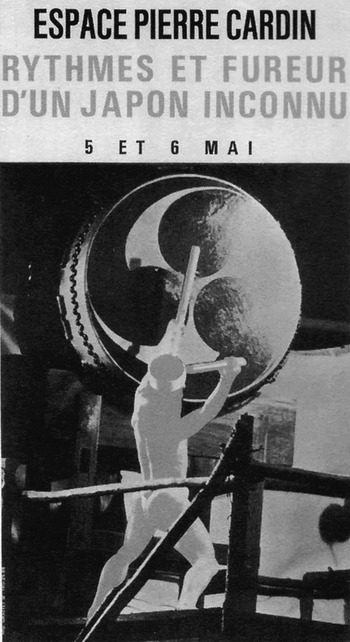
It is not uncommon to see loincloths worn by men at religious festivals in Japan, even though there is no record of taiko being played this way. The most famous example is probably the “Naked Festival” (hadaka matsuri), which takes place annually on the grounds of Saidaiji temple in Okayama, Japan. At this night festival, thousands of men dressed only in loincloths throng together as they jockey for sacred sticks hurled into the crowd by priests. Ondekoza performed at this festival in 1974. In keeping with the festival atmosphere, the male drummers donned fundoshi, while a film crew captured the performance for a documentary. The following year, the group traveled to Paris to play a series of concerts at a theater managed by the French fashion designer Pierre Cardin, the eponymous Espace Pierre Cardin, where a still from the documentary featuring Hayashi's Ōdaiko appeared on a poster advertising the performances (see figure 5).
A poster advertising Ondekoza's performance at Espace Pierre Cardin in Paris in 1975 features a drummer wearing a white fundoshi (loincloth). Following a suggestion from Cardin, this became the clothing style used in subsequent performances of Ōdaiko. Photo courtesy of Hayashi Eitetsu.

Although Den decided that the drummers should perform at the Naked Festival wearing only the fundoshi, he has insisted that the idea to perform in this style on stage came instead from Pierre Cardin: “The establishment of taiko as a performing art was to a large extent attributable to the ‘shock’ of seeing [Hayashi] Eitetsu's ‘Ōdaiko,’ especially the image of him playing in a fundoshi. As I always say, this was Pierre Cardin's idea” (Den Reference Den1994, 4; emphasis added). The custom began a few days after Ondekoza began performing at Cardin's theater, and in a manner that seems greatly understated for the impact it would later have. According to Den, Cardin approached him to ask whether he would be willing to extend Ondekoza's concert appearances. After consulting with the group, he told Cardin that they could perform for another three days. In a small gesture that ultimately had quite profound implications, Cardin responded with a “thank you” and a request that Hayashi Eitetsu, the featured taiko player in Ōdaiko, perform the piece in a loincloth for the upcoming concerts. Den promptly refused. In an interview, Den later recalled that his refusal stemmed from a belief, or perhaps some insecurity, that the “Japanese body” was not something to put on public display, “even if it was Hayashi's impressive physique” (Den Reference Den1994, 4). Those who knew him attributed this hesitation to his early experiences with his German shipmates. Whatever the reason, the hesitation was short-lived. Knowing how much the extra money would help the group, Hayashi quickly agreed to do it.
Audience approval of the change was not immediate, but gradually emerged with a distinctly homoerotic twist. Den recalled the change, probably with some exaggeration, as follows:
On the fourth day, we skipped “Yatai-Bayashi” [another Ondekoza piece] and went immediately into Ōdaiko with Hayashi wearing the loincloth. When we finished, the concert hall was completely quiet. No applause at all. People slowly filed into the lobby in a daze. They spoke to each other in hushed tones… A strange kind of gloominess filled the air. I thought to myself, “Oh no, we must have offended them.”
The next night, the same thing happened. No applause, some conversation and then everyone leaving. I said to [Hayashi] Eitetsu, “Maybe we shouldn't do it like this anymore?” “Well, we already got the money, so there's not much we can do,” he responded unflinchingly.
The next day or so, the theatre was full but this time there were surprisingly few women. And there was something odd about the air that night. It was mostly men, but the scent of perfume kept wafting up… For the first time, Ōdaiko received a huge applause. Around this time, we also noticed the long line of gay men waiting outside the theatre to see us. It was quite a scene! I still remember the looks on the faces of the security guards at the U.S. Embassy across the street… [I]t was from this time on that we started receiving standing ovations. (1994, 5)
It is not entirely certain why Cardin suggested that Hayashi wear a fundoshi while playing the big taiko. Some former members of Ondekoza suggested that he had seen film footage of Ondekoza's performance at the Naked Festival and that the concert poster made him recall the scene. Cardin apparently imagined this to be the way that Ōdaiko was commonly played in Japan. Whatever its source, his image of Ōdaiko performance became reality; the group continued to perform the piece in this manner and added the wearing of loincloths to another piece in their repertoire. More important, adopting the fundoshi transformed Ondekoza's performance of Ōdaiko. It became a kind of stage “costume” that emphasized the impressive bodies of the male drummers, not just the movements and sounds these bodies produced. Ondekoza had always been concerned with artistic presentation: the placement of instruments, choreography, and the progression of pieces. But with this change in costume, suddenly the drummers themselves—or more precisely, their toned, muscular bodies—became a central, if not the central, means of expressing their guiding ideology and artistic vision. Forged as they were in an attempt to recreate the folkways of premodern Japan, these bodies came to represent the ideals that their cinematic predecessor Muhōmatsu had earlier embodied. In fact, concert programs dating from the period between their performance in Paris and Den's departure from the group in 1981 state explicitly that Ondekoza's goal was not merely to preserve Japanese folk entertainments, but “to embody in the present the very life-force at the roots of Japan's folk performing arts” (nihonjin no seimei no gendōryoku wo saguri, nihon minzoku geinō no genten wo ima ni taigen shiyō to shite-iru no desu; emphasis added). Now marked indelibly by the gaze of an influential European observer, Ōdaiko revealed these bodies for all to see.
Conclusion
As I have argued throughout this essay, Japanese images of folk taiko performance figured importantly in the composition of the piece even before Pierre Cardin had a chance to see it. In its completed form, Ōdaiko not only became the signature piece of Ondekoza (and later Kodō), but also a display of masculine strength and control (women in the group never played Ōdaiko). Taiko players are fond of saying that village boundaries in Japan used to be demarcated based on the maximum distance one could hear the locally enshrined taiko drum. In an interview with me, Kodō's featured Ōdaiko player added to this another legend: “It is said that a dispute between two villages was once settled by a taiko contest between two groups of drummers. The drummers who lost committed ritual suicide. This is how I play the ōdaiko—as if my life depended on it.”
Since its creation by Ondekoza, Ōdaiko has been modified into a generic style of performance by countless amateur and professional taiko groups both within and beyond Japan. These groups often make adjustments to suit their performance needs (e.g., altering the drum pattern played, reducing the number of drummers to one, adding more articles of clothing to the unadorned original). However, the focus on one drummer pounding ferociously on a large drum is consistently maintained, emphasizing the tremendous effort it takes to perform with strength and skill on such an imposing instrument. In this sense, just as Ondekoza's attempt to invigorate Japanese folk performance involved “dislocating” drum patterns from their original context and rearranging them, Ondekoza's Ōdaiko has been detached from its original context and redeployed in new localities to express the powerful physicality of taiko performance. Inspired by a fictional portrayal of “real” folk culture, Ōdaiko has thus returned to communities to become part of an emergent “new” folk culture of drumming in Japan and beyond.Footnote 16
Despite the original confinement of the performance to men, professional taiko groups featuring female taiko drummers have also appropriated Ōdaiko. One of the most conspicuous examples of this is in the new Ondekoza, which was started by Den after he left the original Ondekoza in 1981 (as a result of a dispute, perhaps fitting, with his young performers over his wish to make more documentaries about the group despite substantial debts). In a new version of the piece, Den broke with custom and featured a female performer playing Ōdaiko. While she kept her taiko uniform (a yukata) on while playing, other professional groups featuring women players have adapted Ōdaiko and perform with their muscular backs exposed and highlighted, echoing the masculinity and eroticism of the original Ondekoza version (see figure 6).Footnote 17 Perhaps inspired by this, one Japanese studio has even produced an adult film that features female taiko players playing nude!
Performing masculinity: a female taiko player plays Ōdaiko on a massive taiko drum. Her costume emphasizes the musculature of her back, much like her male counterpart in figure 1. Photo courtesy of Asano Taiko.

Evoking yet again its cinematic origins, the American film Rising Sun (1993) also utilized for dramatic effect the combination of muscularity and sexuality evoked by Ōdaiko. Near the beginning of the film, the camera cuts between a reception at which a male Japanese drummer, whose exposed back faces the camera, furiously pounds on a large taiko and a conference room in which a couple have gone to have sex. The woman is killed at the conclusion of the sexual act, and the pulsating beat of the drum undergirds the rhythm of the couple's lovemaking in a manner that seems both titillating and threatening. Indeed, the masculine roar of the drum effectively symbolizes the film's central theme—namely, the specter of (what was then) Japan's prodigious and encroaching economic might.Footnote 18
Interplay between stage and screen has thus marked Ōdaiko from its inception to the present. Den Tagayasu started Ondekoza in order to bring the original vitality of Japanese folk performance to Japanese and foreign audiences. He did so based on models drawn from personal experience, folklore research, and filmic imagery. In the end, it is difficult to measure how much Ondekoza's efforts improved the withering state of regional folk arts in Japan. What is clear, however, is that Ōdaiko is representative of a new, widely appealing ensemble taiko performance culture in Japan. Although a central part of its distinctiveness derives from the input of an influential French designer, Ōdaiko has come to represent Japanese masculinity and power.
As indicated earlier, this “new” folk culture has gained popularity even beyond Japan. Since 2002, a taiko manufacturer and supporting agencies have sponsored the Tokyo International Wadaiko Contest. The contest features two sections, one for Ōdaiko performance and one for group performance, and it is decidedly international; Americans won both the Ōdaiko and group sections in 2005. Perhaps more surprisingly, Ōdaiko has returned to Cardin's Europe and inspired a revision in at least one folk drumming style. Professional male drummers in Portugal, traditionally excluded from performing on the “feminine” square frame drum, have appropriated and transformed this instrument to create a stage performance in clear emulation of Ōdaiko (see figure 7; see also Cohen Reference Cohen2008, 112–13). Dislocated once again, Ōdaiko no longer merely expresses the vigor of alienated young Japanese seeking to recover their ethnic heritage, but also channels the energy of global youth actively engaging in yet another Japanese contribution to world culture.
Inspired by Ōdaiko, male drummers in Portugal have converted the square frame drum, a “feminine” instrument typically played only by women, into the basis of a masculine performance piece. Photograph by Judith Cohen.

Acknowledgments
Research for this article in Japan was supported by a grant from the Japanese Ministry of Education. I would like to thank members of Kodō as well as Hayashi Eitetsu for generously granting me time for extended interviews. I am also grateful to Kodō, Asano Taiko Inc., HARU, and Judith Cohen for permission to use the images included in this article. I would like to thank Alex Bates, Jeffrey Bass, David K. Jordan, Jeffrey Wasserstrom, and four anonymous reviewers for their constructive criticism and helpful comments on earlier drafts of this essay. All errors and omissions are my own.