I. INTRODUCTION
In recent years, there has been growing interest in crystal structures with Z′ > 1 (Hao et al., Reference Hao, Siegler, Parkin and Brock2005a, Reference Hao, Chen, Cammers, Parkin and Brock2005b; Lehmler et al., Reference Lehmler, Parlin and Brock2004; Desiraju, Reference Desiraju2007; Bernstein et al., Reference Bernstein, Dunitz and Gavezzotti2008; Johnstone et al., Reference Johnstone, Ieva, Lennie, McNab, Pidcock, Warren and Parsons2010; Bernstein, Reference Bernstein2011; Steed and Steed, Reference Steed and Steed2015; Brock, Reference Brock2016). The underlying causes of how and why some crystal structures have high Z′ values are still not completely understood. One hypothesis is that crystal structures with Z′ > 1 are meta-stable forms of thermodynamically stable Z′ = 1 polymorph (Anderson and Steed, Reference Anderson and Steed2007) and the molecules assemble into clusters prior to reaching the highest symmetry arrangements (Das et al., Reference Das, Banerjee, Mondal, Howard, Boese and Desiraju2006; Lodochnikova et al., Reference Lodochnikova, Startseav, Nikitana, Bodrov, Klimovitskii, Klimovitskii and Litvinov2014). It has been generally accepted that in addition to causes like modulation, equi-energetic conformations, crystallization kinetics etc, structures with Z′ > 1 are consequence of conflict between different factors influencing the crystal packing, space group constraints and intermolecular interactions (Hao et al., Reference Hao, Siegler, Parkin and Brock2005a; Reference Hao, Chen, Cammers, Parkin and Brock2005b; Nichol and Clegg, Reference Nichol and Clegg2006; Owczarzak et al., Reference Owczarzak, Samshuddin, Narayana, Yathirajan and Kubicki2013; Das et al., Reference Das, Chattopadhyay, Hazra, Sureshbabu and Mukherjee2016). Steed and coworkers (Anderson et al., Reference Anderson, Probert, Goeta and Steed2011) on the basis of an exhaustive CSD (Allen and Taylor, Reference Allen and Taylor2004) analysis concluded that structures with Z′ > 1 are linked to molecular shapes that can frustrate or impose some constraints on their crystal packing arrangements.
In general, single crystal X-ray diffraction is the method of choice for determining crystal structures of molecular compounds. An intrinsic limitation of this approach is, however, the requirement to grow single crystals of appropriate size and quality that make them amenable to structure analysis. With the recent advances in X-ray powder diffraction instrumentation coupled with the developments in direct space approaches for structure solution (Pagola et al., Reference Pagola, Stephens, Bohle, Kosar and Madsen2000; Harris and Cheung, Reference Harris and Cheung2004; Favre-Nicolin and Cerný, Reference Favre-Nicolin and Cerný2004; David and Shankland, Reference David and Shankland2008), ab-initio crystal structure analysis of molecular compounds using powder X-ray diffraction (PXRD) has become a viable alternative in structural crystallography (Arlin et al., Reference Arlin, Bhardwaj, Johnston, Miller, Bardin, MacDougall, Fernandes, Shankland, David and Florence2014; Watts et al., Reference Watts, Maruyoshi, Hughes, Brown and Harris2016; Chatterjee et al., Reference Chatterjee, Dey, Pal and Mukherjee2017; Pramanik et al., Reference Pramanik, Dey and Mukherjee2019). It should, however, be emphasized that structure analysis from PXRD is significantly more challenging than that of its single-crystal counterpart (Harris et al., Reference Harris, Tremayne and Kariuki2001) and the task of ab-initio structure determination via PXRD is far more difficult when the molecule possesses considerable flexibility or the asymmetric unit contains multiple molecules (Z′ > 1). This is reflected from the CSD (Version 5.39 November CSD 2018 release) (Allen and Taylor, Reference Allen and Taylor2004) search conducted for organic structures with Z′ > 1, which revealed that out of 50 215 hits, structures of 160 (0.3%) have been solved from powder diffraction data. If we restrict our search to organic compounds crystallizing with Z′ = 3, the number of structures solved via powder diffraction approach is only 13, the corresponding number with single crystal diffraction is 2662. Out of 13 structures with Z′ = 3 that have been solved using powder diffraction method, crystal structures of only two compounds (Platteau et al., Reference Platteau, Lefebvre, Hemon, Baehtz, Danede and Prevost2005; Martin et al., Reference Martin, Fleissner, Milius and Breu2016) have been determined using laboratory PXRD data; the remaining 11 structures have been solved using either synchroton X-ray or neutron diffraction data.
In continuation to our ongoing study of structure analysis of benzoic acid derivatives (Pramanik et al., Reference Pramanik, Dey and Mukherjee2019) using PXRD and the role of weak intermolecular interactions in building supramolecular assembly, we came across the title compound, 5-(trifluoromethyl)-1-phenyl-1H-pyrazole-4-carboxylic acid (1), which crystallized with Z′ = 3. Since there are only two reports of structure analysis of molecular compounds crystallizing with Z′ = 3, the present work was undertaken. An investigation of close intermolecular contacts via Hirshfeld surface analysis of different molecules in the asymmetric unit of 1 and a few related structures is also presented. The intermolecular interactions in 1 have been correlated with the molecular electrostatic potential (MEP) calculations.
II. EXPERIMENTAL
A. Materials and methods
The compound, 5-(trifluoromethyl)-1-phenyl-1H-pyrazole-4-carboxylic acid (1) was purchased from Sigma Aldrich, NY, USA and used without further purification. PXRD data of compound 1 were collected at ambient temperature [293(2) K] with CuKα radiation (λ = 1.5418 Å) using a Bruker D8 Advance diffractometer operating in the Bragg-Brentano geometry.
B. Crystal structure determination using PXRD
Initially, the indexing of PXRD pattern of the title compound (1) using conventional method i.e. extraction of 2θ positions of first 25 peaks and input those peak positions in the indexing program TREOR (Werner et al., Reference Werner, Eriksson and Westdahl1985) was unsuccessful. Ultimately the program package EXPO-2004 (Altomare et al., Reference Altomare, Cuocci, Giacovazzo, Moliterni, Rizzi, Corriero and Falcicchio2013) was used for successful determination of unit cell parameters. The auto peak search method of EXPO-2014 (Altomare et al., Reference Altomare, Cuocci, Giacovazzo, Moliterni, Rizzi, Corriero and Falcicchio2013) shows an unresolved peak at 5.27° (2θ). The inclusion of the unresolved peak at 5.27° (2θ) along with the extracted 2θ-positions of rest of the peaks in the auto-indexing module of NTREOR (Altomare et al., Reference Altomare, Giacovazzo, Guagliardi, Moliterni, Rizzi and Werner2000) as implemented in the EXPO 2014 (Altomare et al., Reference Altomare, Cuocci, Giacovazzo, Moliterni, Rizzi, Corriero and Falcicchio2013) program package lead to a successful indexing. Given the volume of the triclinic unit cell and consideration of density of related carboxylic acid compounds, the number of formula units in the unit cell of 1 turned out to be 6. The unit cell parameters and space group assignment were validated by a Le-Bail fit of PXRD data using a pseudo-Voigt peak profile function (Thompson et al., Reference Thompson, Cox and Hastings1987) with program FOX (Favre-Nicolin and Cerný, Reference Favre-Nicolin and Cerný2004). Structure solution of 1 was carried out by global optimization of structural models in direct space, based on a Monte-Carlo search using the simulated annealing technique (in parallel tempering mode), as implemented in FOX (Favre-Nicolin and Cerný, Reference Favre-Nicolin and Cerný2004). Initial molecular geometry input in FOX was optimized with MOPAC 9.0 (Stewart, Reference Stewart2007) using the energy gradient method.
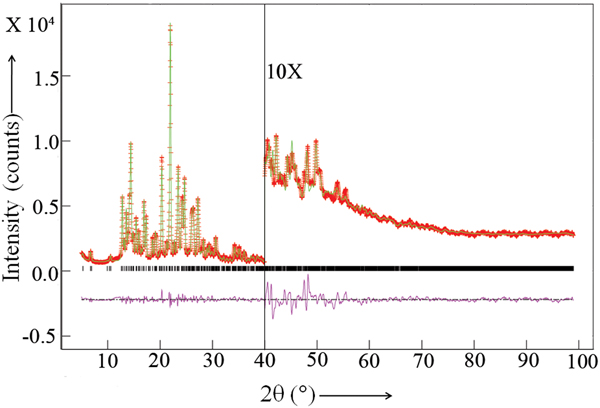
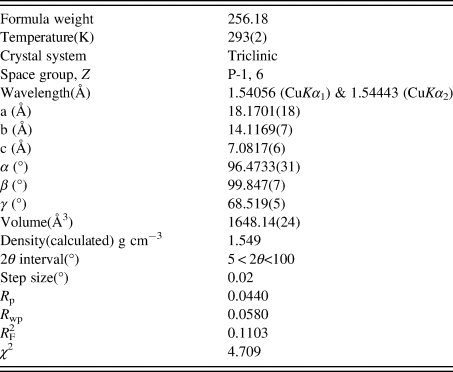
The best solution (i.e. the structure with the lowest R wp value and no unusual short contacts) was used as the initial structural model of 1 for Rietveld refinement (Rietveld, Reference Rietveld1967) with GSAS program (Larson and Von Dreele, Reference Larson and Von Dreele2000). A pseudo- Voigt peak profile function was used during Rietveld refinement and the background of PXRD patterns was modeled by a shifted Chebyshev function of the first kind with 10 points regularly distributed over the entire 2θ range. Initially, the lattice parameters, background coefficients and profile parameters were refined followed by the positional coordinates of all non-hydrogen atoms. Soft distance and angle restraints with weight value 10 for bond-distances and bond-angles were applied. The probable bond distances and angles for restraints were chosen from the CSD search (Allen and Taylor, Reference Allen and Taylor2004). Planar restraints were used for the phenyl rings with weight value of 20. Common isotropic displacement parameters were refined separately for C, O, N, and F atoms. In the final stages of refinement, preferred orientation parameters were refined using the generalized spherical harmonics model, and the order of spherical harmonics used to describe the preferred orientation was 6. Final Rietveld plot of 1 (Figure 1) showed good agreement between the observed PXRD profile and calculated PXRD pattern. A summary of crystal data and relevant refinement parameters is listed in Table I.
(Color online) Final Rietveld plot of C11H7F3N2O2 (1), Observed pattern (red cross), calculated pattern (green curve), difference curve (pink curve): The intensity in the high angle region has been multiplied by a factor 10.

Crystal data and structure refinement parameters for C11H7F3N2O2 (1).

C. Hirshfeld surface analysis
Hirshfeld surfaces (McKinnon et al., Reference McKinnon, Jayatilaka and Spackman2007) and their associated two-dimensional (2D) fingerprint plots (Spackman and McKinnon, Reference Spackman and McKinnon2002) were generated using Crystal Explorer 3.1 (Wolff et al., Reference Wolff, Grimwood, McKinnon, Turner, Jayatilaka and Spackman2012) software. The d norm (normalized contact distance) surface, 2D fingerprint plot and that delineated into individual contacts were used for decoding and quantifying intermolecular interactions in the crystal lattice of 1. The d norm is a symmetric function of distances to the surfaces from nuclei inside and outside the Hirshfeld surface (d i and d e, respectively), relative to their respective van-der-Waals (vdW) radii. A color scale of red (shorter than vdW separation), white (equal to vdW separation) and blue (longer than vdW separation) was used to visualize the intermolecular contacts. The 3D d norm surfaces were mapped over a fixed color scale of −0.22 (red) to 1.40 Å (blue). The 2D fingerprint plots of 1 were displayed by using the translated 0.5–2.5 Å range and including reciprocal contacts.
D. Computational study
MEP is an effective tool for identifying and ranking the hydrogen bond donating and accepting sites in organic compounds (Aakeröy et al., Reference Aakeröy, Wijethunga and Desper2015; Politzer and Murray, Reference Politzer and Murray2015). Density functional theory (DFT) calculations were performed in the solid state (periodic) for compound 1 with the DMol3 code (Delley, Reference Delley1990) in the framework of a generalized gradient approximation (GGA) (Perdew et al., Reference Perdew, Burke and Ernzerhof1996). The geometry optimization was carried out using BLYP correlation functional (Becke, Reference Becke1988; Lee et al., Reference Lee, Yang and Parr1988) with a double numeric plus polarization (DNP) basis set. The starting atomic coordinates were taken from the final X-ray refinement cycle, and geometry optimization was carried out without any structural constraints. The MEP surfaces of 1 were generated, and the electron densities were evaluated using an isolated molecule DFT calculation starting with the geometry optimized models as input in the DMol3 code with the same set up as earlier. The electrostatic potentials were plotted on 0.017 au electron density isosurface (Bader et al., Reference Bader, Carroll, Cheeseman and Chang1987). The MEP surfaces were mapped with a rainbow color scheme with red representing the highest negative potential region while blue represents the highest positive potential region.
III. RESULT AND DISCUSSIONS
A. Structure description
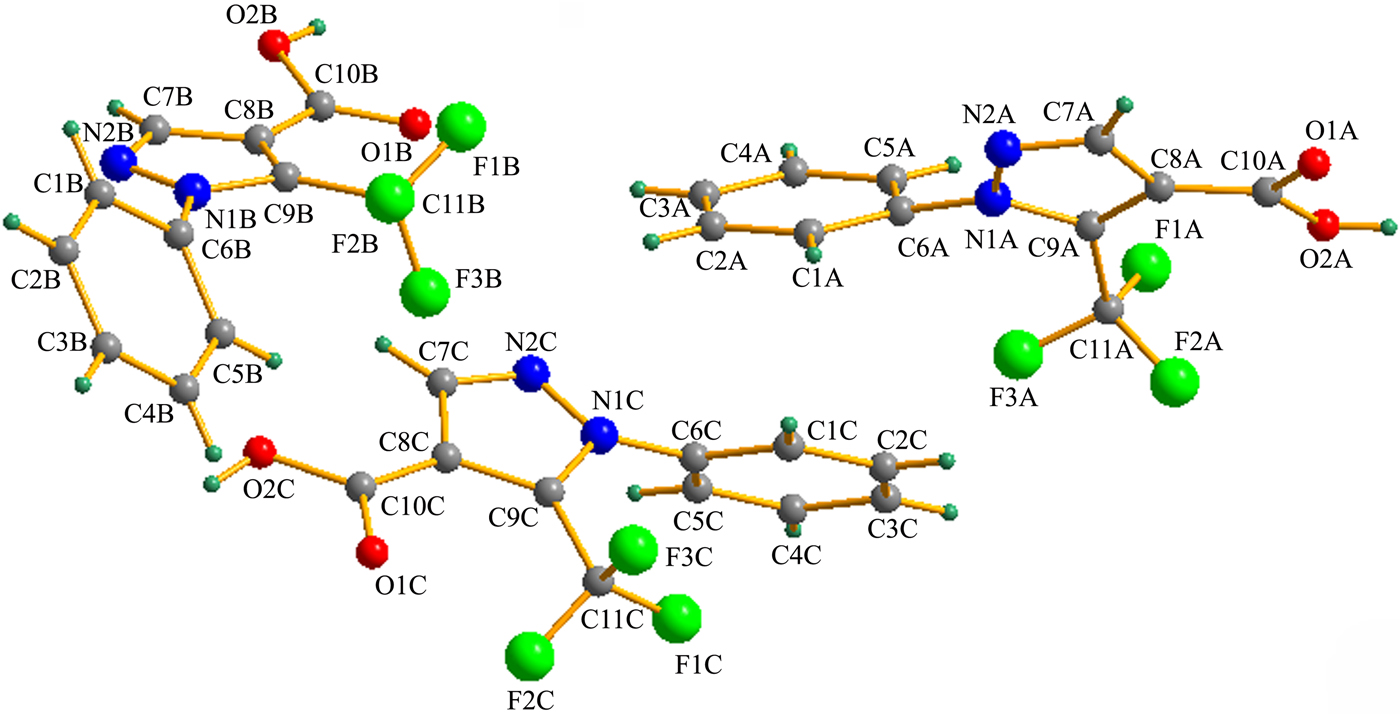
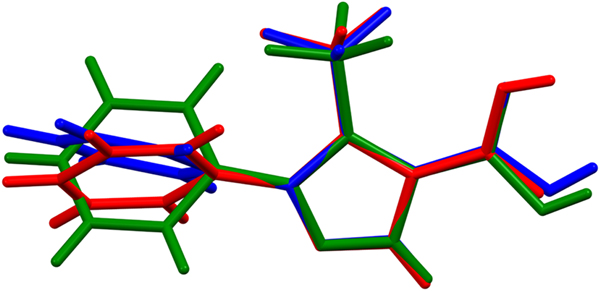
The molecule 1 consists of phenyl pyrazole carboxylic acid fragment with a trifluromethyl group substitution at the 5-position of central pyrazole ring (Scheme 1). The conformation of molecules in 1 is established by the rotational degree of freedom around the N–C bond connecting the pyrazole and benzene rings. A view of asymmetric unit of 1 containing three symmetry-independent molecules (A, B, and C) with the atom labeling scheme is shown in Figure 2. The molecules do not differ significantly in terms of geometrical parameters. An overlay of three molecules (A, B, and C) in the asymmetric unit of 1 is shown in Figure 3. The overall conformation of molecules A, B, and C can be described by the relative orientation of two planar fragments, phenyl ring (P: C1-C6 atoms) and the pyrazole moiety (Q: N1/N2/C7-C9 atoms). The dihedral angles between the least-squares planes through atoms of rings P and Q in molecules A, B, and C are 47.4(3), 48.7(3), and 60.7(4)°, respectively. The twist between rings P and Q about the C6-N1 bond differs significantly for molecules A, B, and C; the corresponding torsion angle C1-C6-N1-C9 for molecules A, B, and C is 146.0(7), −144.7(7), and −70.2(6)°, respectively (Table S1). As revealed by the torsion angle C7-C8-C10-O1 of −2.0(1), 174.7(9) and −167.5(9)° for molecules A, B, and C, the orientation of carboxylic acid group (C10,O1,O2,H2) in A differs from that of B and C because of rotation about the C8-C10 bond.
(Color online) Molecular view with the atom labeling scheme of C11H7F3N2O2 (1).

Overlay of three molecules [A (red), B (green) and C (blue)] in asymmetric unit of C11H7F3N2O2 (1).

Chemical diagram of C11H7F3N2O2 (1).

The bond lengths and bond angles of the phenylpyrazole core are comparable with those reported for similar compounds (Antila et al., Reference Antila, Baskin, Barder and Buchwald2004; Rehman et al., Reference Rehman, Elsegood, Akbar and Saleem2008; Caruso et al., Reference Caruso, Raimondi, Daidone, Pettinari and Rossi2009; Wen et al., Reference Wen, Kang, Dai, Deng and Chin2015). A MOGUL analysis of pyrazole derivatives indicates that the range of N–N distance lies between 1.210 and 1.458 Å and the observed N1-N2 bond length [1.255(6)–1.267(6) Å] in 1 is within this range. The shortening of C8-C10 bond length [1.371(6)–1.392(6) Å] in 1 is probably a consequence of π-delocalization of adjacent C8-C9 and C10-O1 double bonds. A similar MOGUL search shows that C7-N2-N1 bond angle [110.3(4)-111.7(5)°] lies within the range of C–N–N angle of [110.3°–113.1°] with a mean value of 111.6°. A superposition of molecular conformations of 1 as determined by the X-ray structure analysis and solid-state DFT calculations is shown in Figure S1. The energies of three molecular conformations of 1 (A, B, and C) as determined by isolated molecule DFT calculation are essentially similar i.e. −122.0 eV, −121.5 eV, and −121.8 eV for molecules A, B, and C, respectively.
B. Crystal packing analysis
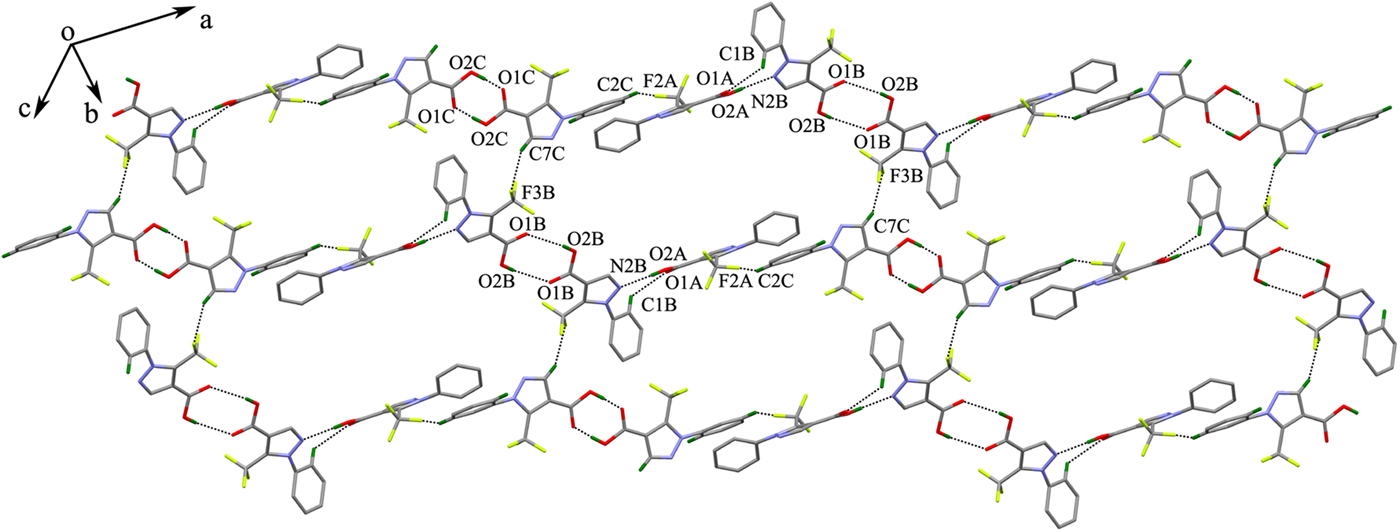
The molecules B and C in 1 are linked with themselves through pairs of intermolecular O2(B)-H2(B)…O1(B) and O2(C)-H2(C)…O1(C) hydrogen bonds (Table II) to form a typical carboxylic acid dimer with an R 22(8) synthon (Figure S2). The molecule A, however, does not facilitate such dimer formation. Similarly, the intermolecular O2(A)-H2(A)…N2(B) and C1(B)-H1(B)…O1(A) hydrogen bonds connect molecules A and B into a cyclic R 22(9) ring. The R 22(8) and R 22(9) rings are further joined by intermolecular C2(C)-H2(C)…F2(A) hydrogen bond, thus generating an infinite 1D chain of sequence…ABBACCA…(Figure S2). Adjacent polymeric chains are connected by intermolecular C7(C)-H7(C)….F2(B) hydrogen bond forming a 2D framework in the (011) plane (Figure 4). Finally, linking of parallel 2D molecular sheets via intermolecular C5(C)-H5(C)…F3(C) hydrogen bond results into a 3D architecture in 1.
(Color online) 2D molecular framework formed by C–H…O, C–H…N and O–H…N hydrogen bonds in C11H7F3N2O2 (1).

Intermolecular C–H..O, O–H…N, C–H…F, C–H…π hydrogen bonds and C–F…O halogen bond in compound C11H7F3N2O2 (1).

C. Hirshfeld surface analysis
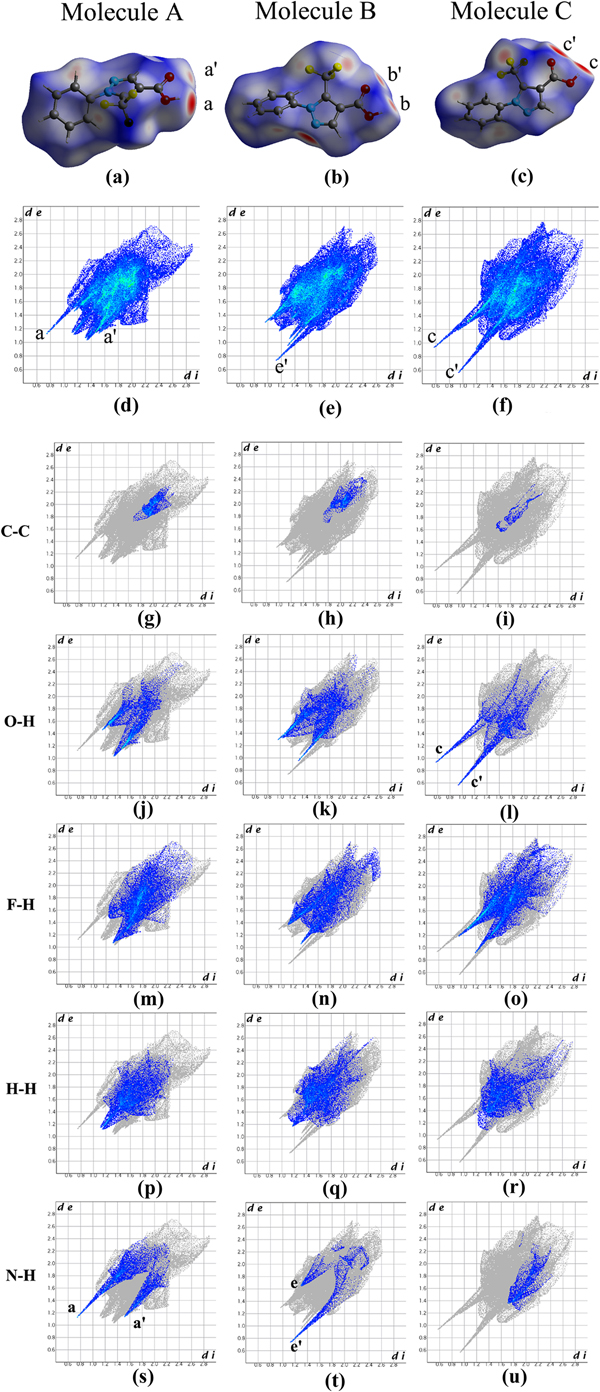
The Hirshfeld surfaces for different molecules in the asymmetric unit of 1 are illustrated in Figure 5, showing surfaces that have been mapped over a d norm range of −0.5 Å to 1.5 Å. Since Hirshfeld surface is related to a given molecular environment, it can enable a rapid and easy visualization of interactions encountered by independent molecules in the asymmetric unit of structures with Z′ > 1 (Anderson et al., Reference Anderson, Afarinkia, Yu, Goeta and Steed2006; Rohl et al., Reference Rohl, Moret, Kaminsky, Claborn, McKinnon and Kahr2008). The dominant interaction between the carboxylic O–H and O atoms of molecule C can be seen in the Hirshfeld surface as bright red spots marked as c/c' in Figure 5(c). The light red spots labeled as a/a' in Figure 5(a) and b/b' in Figure 5(b) are because of O2(A)-H2(A)…N2(B)/ C1(B)-H1(B)…O1(A) and O2(B)-H2(B)…O1(B) interactions experienced by molecules A and B. Other visible red areas in the Hirshfeld surfaces (Figure 5) are attributable to C–H…F contacts in 1. The corresponding 2D fingerprint plots of 1 (Figure 5) and that delineated into individual contact types (Figure 5) are distinctly different for molecules A, B, and C indicating a difference in their intermolecular interactions. Two sharp spikes (c/c' in Figure 5(l)) of almost equal lengths in the region of 1.4 < d e + d i<1.5 Å are characteristic of O–H…O hydrogen-bonded cyclic R 22(8) ring formed by molecule C. The spikes corresponding to N–H interactions in molecules A and B are highly asymmetric (Figures 5(s) and 5(t)). In molecule A, the donor spike (a in Figure 5(s)) because of O2(A)-H2(A)…N2(B) interaction is significantly longer compared to the acceptor spike (a' in Figure 5(s)) because of N2(A)…H4(A)-C4(A) interaction. In molecule B, however, the length of the acceptor spike (e' in Figure 5(t)) because of N2(B)…H2(A)-O2(A) interaction is more compared to the donor spike of C7(B)-H7(B)…N2(A) interaction (e in Figure 5(t)). The asymmetry in the length of spikes can be attributed to the variation of H…N distances between molecules A…A and A…B (2.01–2.77 Å) and B…A (2.01–2.96 Å). The subtle difference among the fingerprint plots for molecules A, B, and C is also apparent in terms of F…H and H…H interactions (Figure 5), which is reflected in the corresponding spikes for the F…H contacts and distribution of scattered points because of H…H interactions.
(Color online) Hirshfeld surface and 2D fingerprint plots of C11H7F3N2O2 (1).

The enrichment ratio (E) (Jelsch et al., Reference Jelsch, Ejsmont and Huder2014), defined as the ratio of proportion of actual contacts in the crystal to the theoretical proportion of random contacts, has been calculated for molecules A, B and C of 1. For pair of elements with higher propensity to form contacts, the calculated E is greater than unity; while pairs of elements, which tend to avoid contacts yield E values less than unity (Jelsch et a l., Reference Jelsch, Ejsmont and Huder2014). The E HN values for molecules A, B and C are 1.62, 1.42, and 1.44, respectively, which indicate that H…N contacts are favored in all three molecules (A, B and C) of the asymmetric unit of 1. A similar trend has been observed for H…O contacts in molecules A, B, and C with E HO values of 1.25, 1.38, and 1.50, respectively. An increased propensity of H…C contacts to form has been observed only in molecule C (E HC = 1.10), the corresponding E HC values for molecules A and B are 0.78 and 0.65, respectively. This can be rationalized following the higher percentage of H…C contacts to the total Hirshfeld surface area of 1 for molecule C (16.1%) compared to that in A (10.3%) and B (9.3%). Fluorine atom behaves somewhat differently from the other halogen atoms (Cl, Br, and I) because of its small size, weak polarizability, higher electronegativity, and strong electron-withdrawing ability. The role of H…F and O…F interactions in the crystal packing of organic compounds has been reviewed recently (Berger et al., Reference Berger, Resnati, Metrangolo, Weber and Hulliger2011). The E HF values of 1.34, 1.13, and 1.34, respectively, for molecules A, B, and C of 1 indicate an increased propensity of formation of H…F contacts. The O…F contacts are, however, favored in molecules A and B with E OF values of 1.17 and 1.07, respectively, while that in molecule C are highly disfavored (E OF = 0.37). The apparent discrepancy in the E OF values for three symmetry-independent molecules in the asymmetry unit of 1 is a consequence of the fact that only molecules A and B (not C) are involved in C–F…O interactions (Table II).
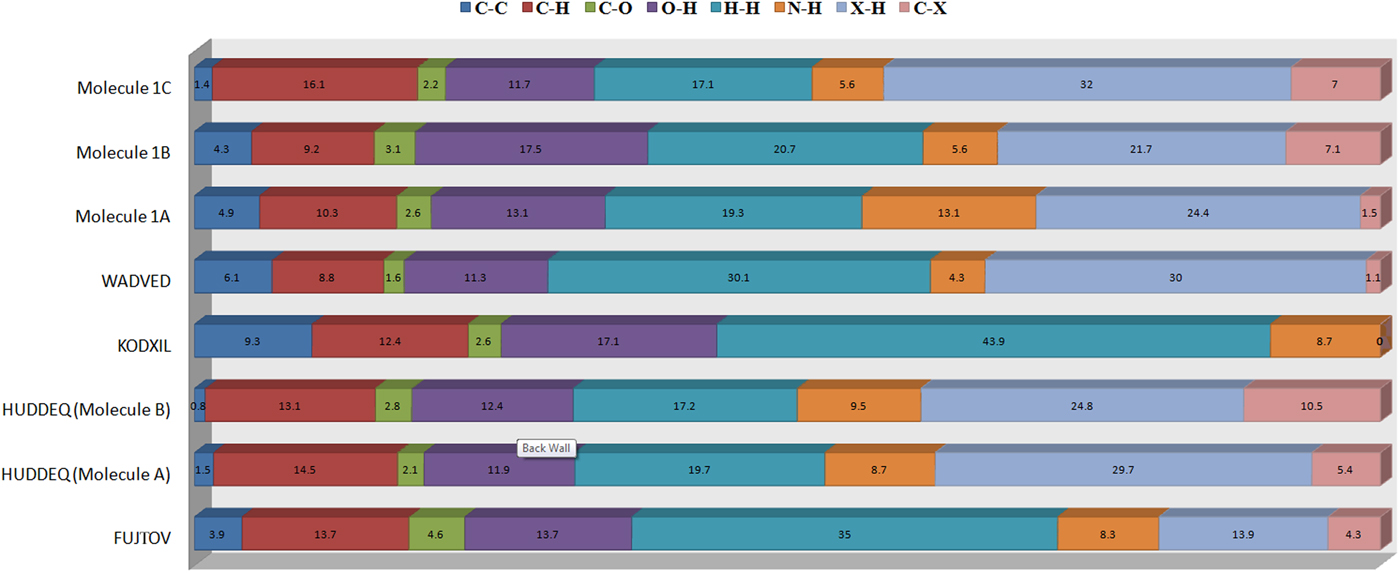
The relative contribution of different interactions to the Hirshfeld surface of 1 for molecules A, B, and C, and a few related carboxylic acid/carboxylate derivatives such as, 5-chloro-3-methyl-1-phenyl-1H-pyrazole-4-carboxylic acid (FUJTOV) (Wen et al., Reference Wen, Kang, Dai, Deng and Chin2015), 5-amino-3-(trifluoromethyl)-1-phenyl-1H-Pyrazole-4-carboxylic acid (HUDDEQ) (Caruso et al., Reference Caruso, Raimondi, Daidone, Pettinari and Rossi2009), 5-amino-1-phenyl-1H-pyrazole-4-carboxylic acid (KODXIL) (Rehman et al., Reference Rehman, Elsegood, Akbar and Saleem2008) and ethyl 3-(trifluoromethyl)-1-phenyl-1H-pyrazole-4-carboxylate (WADVED) (Antila et al., Reference Antila, Baskin, Barder and Buchwald2004), retrieved from the CSD (Version 5.39 November CSD 2018 release) is illustrated in Figure 6. The contribution of F…H interaction to the Hirshfeld surface of 1 is highest (32.0%) for molecule C, whereas the contribution of H…N and H…O interactions are maximum for molecules A and B, respectively. An enhanced contribution of H…C interactions to the Hirshfeld surface of 1 for molecule C (16.1%) compared to that in molecules A and B (9.2–10.3%) is expected since the phenyl ring of only molecule C participates in C–H…π interaction. The compound 1 bears a close structural resemblance with ethyl 3-(trifluoromethyl)-1-phenyl-1H-pyrazole-4-carboxylate (WADVED). With a change in the position of trifluoromethyl group substitution in pyrazole ring and the hydroxyl group in 1 being replaced by a ethyl group in WADVED, the contribution of H…H interactions to the Hirshfeld surface increases from 17.1- 20.7% in 1 to 30.1% in WADVED.
(Color online) Relative contribution of different interactions to Hirshfeld surface of C11H7F3N2O2 (1) and a few related structures retrieved from the CSD.

D. Molecular electrostatic potential
The MEP surfaces were calculated for molecules A, B, and C to validate the hydrogen bonding patterns in 1 (Figure S3). The MEP values around different atoms can serve as a good indicator of possible donor and acceptor sites in a molecule. In 1, the most positive potential (V s,max 74–75 kcal/mol) is linked with the hydrogen atom (H2) of the carboxylic group in molecules A, B and C. The corresponding most negative potentials (V s,min) of −35 to −42 Kcal/mol are associated with the carbonyl oxygen atom of the COOH group. Crystallographic analysis of 1 also corroborates this as intermolecular O–H…O, O–H…N and C–H…O hydrogen bonds involving molecules A, B and C form R 22(8) and R 22(9) synthons. Relatively high positive potentials surrounding the hydrogen atoms (H1-H5, H7) of the aromatic rings and negative potentials around the pyrazole nitrogen atom (N2) in molecules A, B, and C are attributable to intra/ intermolecular interactions involving these atoms.
IV. CONCLUSIONS
Crystal structure analysis of a trifluoromethyl derivative of phenyl trizole carboxylic acid (1) crystallizing with three molecules (A, B, and C) in the asymmetric unit has been carried out using laboratory PXRD data. The relative orientation between the phenyl and pyrazole rings in 1 is different for molecules A, B, and C because of rotation about the C–N bond connecting the two aromatic fragments. Significant changes in the intermolecular interactions experienced by molecules A, B and C have been observed. While the hydroxyl and the oxo groups of carboxylic moieties in molecules B and C form an R 22(8) homosynthon via intermolecular O–H…O hydrogen bond, the molecule A participates in intermolecular O–H…N and C–H…O hydrogen bonds with molecule B to generate an R 22(9) heterosynthon. The resulting pattern can be described by infinite 1D chains of sequence….ABBACCA…, which are interconnected forming a 3D framework structure in 1. The study clearly demonstrates the potential of laboratory PXRD to solve crystal structure of systems crystallizing with multiple molecules in the asymmetry unit (Z′ > 1). To the best of our knowledge, there are only two earlier reports of successful crystal structure analysis of molecular compounds with Z′ = 3 using laboratory PXRD data.
SUPPLEMENTARY MATERIAL
The supplementary material for this article can be found at https://doi.org/10.1017/S0885715619000289
ACKNOWLEDGEMENT
Financial support from University Grants Commission (UGC), New Delhi, India to SG through grant no. F. PSW-089/13-14 dated 18-March-2014, is acknowledged.