Introduction
Recent meta-analyses of randomized control trials have confirmed that cognitive behavioural therapy (CBT) is an effective treatment for major depressive disorder (MDD; Wampold et al. Reference Wampold, Minami, Baskin and Tierney2002; Butler et al. Reference Butler, Chapman, Forman and Beck2006). Yet, uncertainty remains as to the specific mechanisms by which CBT exerts its therapeutic effects (Whisman, Reference Whisman1993; Oei & Free, Reference Oei and Free1995; Garratt et al. Reference Garratt, Ingram, Rand and Sawalani2007). The current investigation examined evidence for the cognitive mediational model proposed by Beck et al. (Clark et al. Reference Clark, Beck and Alford1999) in a randomized control trial of patients with MDD treated with CBT, interpersonal therapy (IPT) or pharmacotherapy (PHT).
CBT emphasizes the role of dysfunctional cognitive processes in the onset and course of depression (Beck et al. Reference Beck, Rush, Shaw and Emery1979; Beck, Reference Beck, Clayton and Barret1983; Clark et al. Reference Clark, Beck and Alford1999; Scher et al. Reference Scher, Ingram and Segal2005). CBT is thought to reduce depressive symptoms by altering dysfunctional attitudes. Dysfunctional attitudes are defined as maladaptive, inflexible and extreme assumptions by which the self or world is judged. Dysfunctional attitudes have traditionally been categorized into two domains – interpersonal and achievement. Dysfunctional attitudes related to the interpersonal domain, referred to as a ‘need for approval’, reflect dependency and excessive need for acceptance and nurturance. Those related to the achievement domain, referred to as ‘perfectionism’, reflect self-criticism and excessive need for achievement and independence (Beck, Reference Beck, Clayton and Barret1983).
Evidence exists in support of the cognitive mediational model of CBT. Dysfunctional attitudes are elevated among patients with MDD as compared with non-depressed psychiatric or healthy controls (Hamilton & Abramson, Reference Hamilton and Abramson1983; Dobson & Shaw, Reference Dobson and Shaw1986; Hollon et al. Reference Hollon, Kendall and Lumry1986), and are ‘normalized’ when patients with MDD are treated to remission with cognitive techniques (Oei & Sullivan, Reference Oei and Sullivan1999; Furlong & Oei, Reference Furlong and Oei2002; Kwon & Oei, Reference Kwon and Oei2003). Whereas dysfunctional attitudes and depressive symptoms demonstrate absolute change over the course of treatment, dysfunctional attitudes demonstrate more relative stability than do depressive symptoms (Oliver & Baumgart, Reference Oliver and Baumgart1985; Zuroff et al. Reference Zuroff, Blatt, Sanislow, Bondi and Pilkonis1999). Moreover, dysfunctional attitudes assessed at pre-treatment predict depressive symptom severity at post-treatment (Blatt et al. Reference Blatt, Quinlan, Pilkonis and Shea1995; Zuroff et al. Reference Zuroff, Blatt, Sanislow, Bondi and Pilkonis1999). DeRubeis et al. (Reference DeRubeis, Evans, Hollon, Garvey, Grove and Tuason1990) reported that changes in dysfunctional attitudes were associated with changes in depressive symptoms for those treated with CBT but not those treated with PHT, highlighting the specific prominence of cognitive variables in the application of CBT.
Despite these lines of evidence, the cognitive mediational model of CBT has been challenged on a number of grounds. First, dysfunctional attitudes are elevated among general psychiatric controls, suggesting that they may be associated with symptoms of psychopathology most generally and not symptoms of MDD specifically (Hollon et al. Reference Hollon, Kendall and Lumry1986; Zimmerman et al. Reference Zimmerman, Coryell, Corenthal and Wilson1986). Second, dysfunctional attitude change is also associated with pharmacological treatments (Hamilton & Abramson, Reference Hamilton and Abramson1983; Simons et al. Reference Simons, Garfield and Murphy1984; Reda et al. Reference Reda, Carpiniello, Secchiaroli and Blanco1985; Schrader et al. Reference Schrader, Gibbs and Harcourt1986; Dohr et al. Reference Dohr, Rush and Bernstein1989; Imber et al. Reference Imber, Pilkonis, Sotsky, Elkin, Watkins, Collins, Shea, Leber and Glass1990; Jacobson et al. Reference Jacobson, Dobson, Truax, Addis, Koerner, Gollan, Gortner and Prince1996), suggesting that they may be a product rather than a cause of depression. Third, a number of investigations have failed to demonstrate the predictive utility of dysfunctional attitudes. Rush et al. (Reference Rush, Weissenburger and Eaves1986), for example, demonstrated that pre-treatment dysfunctional attitudes predicted only one of three measures of post-treatment depression. Similarly, Barnett & Gotlib (Reference Barnett and Gotlib1988) reported that pre-treatment dysfunctional attitudes were associated with post-treatment depression severity, but only in the context of low perceived social support.
The changes in dysfunctional attitudes and depression in patients treated with CBT can be modelled in four ways: (1) CBT causes a reduction in dysfunctional attitudes, which in turn produces reduction in depressive symptoms; (2) CBT causes a reduction in depressive symptoms, which in turn produces reduction in dysfunctional attitudes; (3) dysfunctional attitudes and depression have simultaneous, reciprocal causal effects on each other; and (4) dysfunctional attitudes and depression have no causal effects on each other, but are instead caused by a third variable (Hollon et al. Reference Hollon, DeRubeis and Evans1987). Structural equation modelling (SEM) provides an effective way to evaluate these competing models, due to its ability to compare the performance of competing models and to provide a sensitive assay of mediational effects (Shrout & Bolger, Reference Shrout and Bolger2002; Kline, Reference Kline2005; Garratt et al. Reference Garratt, Ingram, Rand and Sawalani2007).
In an earlier investigation, Burns & Spangler (Reference Burns and Spangler2001) examined the relations between depressive and anxious symptoms, and dysfunctional attitudes in a sample of out-patients with MDD treated with CBT using SEM. No causal association between dysfunctional attitudes and depressive symptoms was found; however, the lack of a comparison treatment group disallowed conclusions regarding specificity of effect associated with CBT. Moreover, although Burns & Spangler (Reference Burns and Spangler2001) distinguished between dysfunctional attitudes related to interpersonal and achievement domains, they failed to statistically model these effects separately.
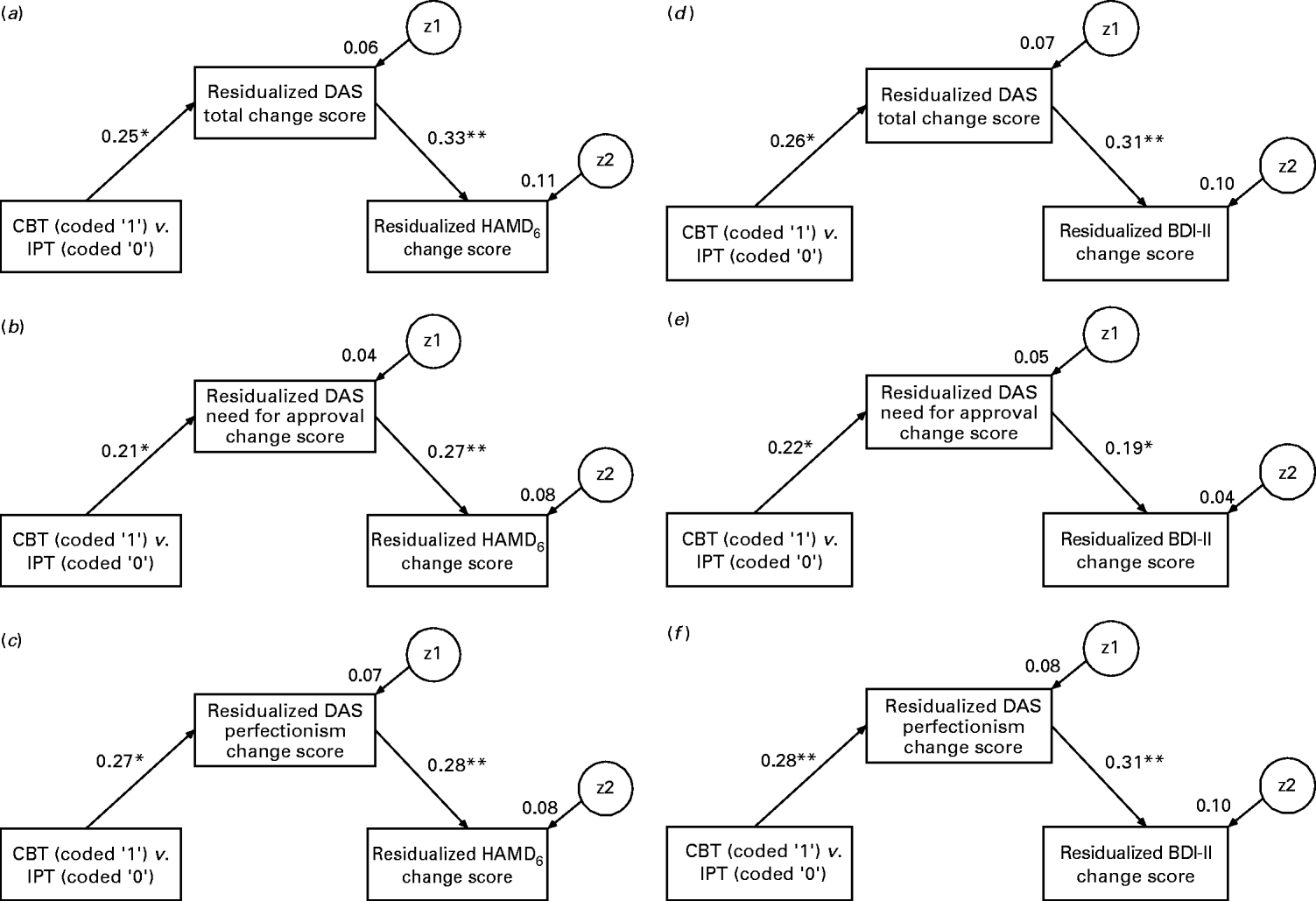
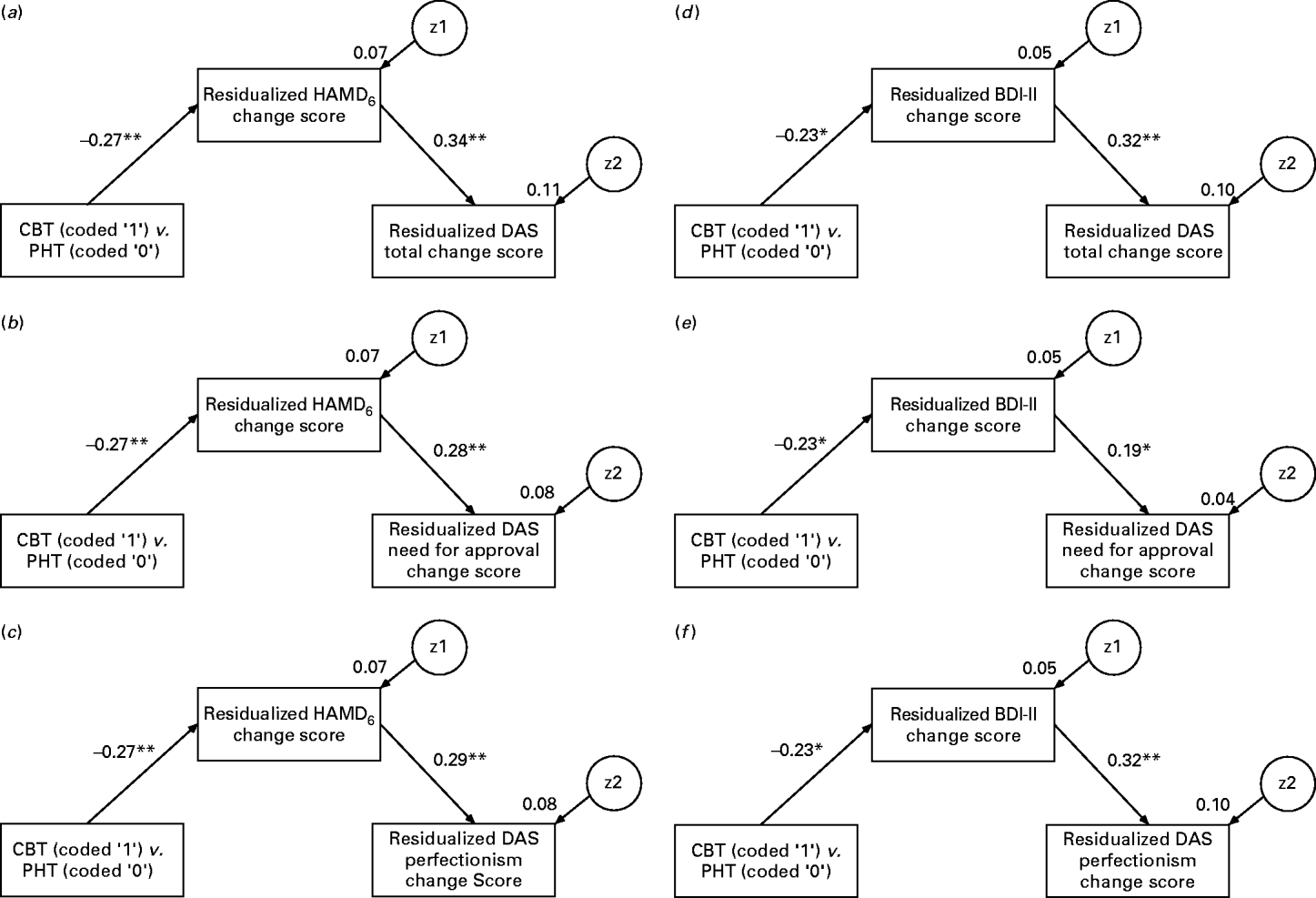
In the current investigation, we examined evidence for the cognitive mediational model in a randomized control trial including CBT, IPT and PHT treatment conditions. We tested two models using SEM: the cognitive mediational model (i.e. CBT→dysfunctional attitude change→depression change) and the ‘complication’ model (i.e. CBT→depression change→dysfunctional attitude change). The configuration of these pathways is depicted in Figs 1 and 2. For these analyses, fit indices specify which of these two models is the best representation of the relation between depression and dysfunctional attitudes, whereas parameter estimates indicate whether an association consistent with mediation is present. Two sets of models were constructed – CBT v. IPT and CBT v. PHT. These contrasts were conducted separately due to different hypotheses regarding the role of dysfunctional attitudes in the comparator treatment (see below). For each set, we used separate models in which either the Beck Depression Inventory – II (BDI-II) or the Hamilton Depression Rating Scale (HAMD) served as the outcome measure of depression severity after a full course of treatment; similarly, we separately tested the role of global dysfunctional attitudes, as well as those related to need for approval and perfectionism, for each set of comparisons.
Cognitive behavioural therapy (CBT) versus interpersonal therapy (IPT) contrast: cognitive mediational model. DAS, Dysfunctional Attitudes Scale; HAMD6, Six-Item Hamilton Depression Rating Scale; BDI-II, Beck Depression Inventory – II. * p<0.05, ** p<0.01.

Cognitive behavioural therapy (CBT) versus pharmacotherapy (PHT) contrast: complication model. HAMD6, Six-Item Hamilton Depression Rating Scale; DAS, Dysfunctional Attitudes Scale; BDI-II, Beck Depression Inventory – II. * p<0.05, ** p<0.01.

CBT v. IPT
Changes in dysfunctional attitudes are proposed to be the mechanism for treatment response in CBT; however, there is no therapeutic rationale or empirical evidence to suggest that dysfunctional attitudes play a role in treatment response to IPT (Weissman et al. Reference Weissman, Markowitz and Klerman2000). We therefore hypothesized that results would support that change in dysfunctional attitudes is the mediator for change in depression severity for CBT but not for IPT. For this comparison, we hypothesized that the cognitive mediational model would provide a good fit to the data, whereas the complication model would not. We also hypothesized that the following effects would characterize the causal pathways of the cognitive mediational model: (1) CBT will lead to greater reduction in dysfunctional attitudes compared with IPT, and (2) overall, greater reduction in dysfunctional attitudes will lead to greater reduction in depressive symptoms.
CBT v. PHT
Although the explanation for the treatment effects of PHT is silent with respect to the role of dysfunctional attitudes, there is empirical evidence to suggest that dysfunctional attitudes are reduced in patients treated with antidepressant medication (e.g. Jacobson et al. Reference Jacobson, Dobson, Truax, Addis, Koerner, Gollan, Gortner and Prince1996). In the absence of a proposed mediation effect, such dysfunctional attitude reduction may be an epiphenomenon of treatment response to PHT. We therefore hypothesized that while both CBT and PHT are associated with a reduction in dysfunctional attitudes, this reduction may be of causal significance for treatment response in CBT but a concomitant of treatment response in PHT. For this comparison, we hypothesized that the cognitive mediational model would not provide a good fit to the data, whereas the complication model wouldFootnote 1Footnote †. We further hypothesized that the following effects would characterize the causal pathways of the complication model: (1) CBT and PHT would lead to comparable reductions in depressive symptoms; and (2) overall, greater reduction in depressive symptoms will lead to greater reduction in dysfunctional attitudes.
The current investigation utilizes some of the participants included in a previous report (McBride et al. Reference McBride, Atkinson, Quilty and Bagby2006). McBride et al. examined whether individual differences in attachment style moderated treatment outcome in psychotherapy, demonstrating that attachment avoidance was associated with improved treatment response in CBT as compared with IPT. In contrast, the current investigation examines the mediational role of individual differences in cognitive variables within treatment outcome in CBT, IPT, and in PHT. Moderation can be distinguished from mediation, wherein a moderating variable outlines the conditions under which an intervention is effective, whereas a mediating variable outlines the possible mechanisms through which an intervention is effective (Kraemer et al. Reference Kraemer, Wilson, Fairburn and Agras2002). The identification of individual difference variables moderating treatment outcome can speak to treatment selection and delivery, while the delineation of individual difference variables mediating treatment outcome can contribute to the development and provision of potent, efficient treatments – in combination, resulting in treatment optimization that is both evidence-based and client-centred.
Method
Participants
The sample (n=130; 45 men and 85 women) was drawn from a group of research participants diagnosed with MDD who had taken part in a randomized treatment trial. All participants met diagnostic criteria for DSM-IV MDD as determined by the Structured Clinical Interview for DSM-IV, Axis I Disorders – Patient version (First et al. Reference First, Spitzer, Gibbon and Williams1995), were between the ages of 18 and 60 years, free of antidepressant medication, had received no electroconvulsive therapy in the past 6 months, did not have a concurrent medical illness, had minimum 8 years of education, were fluent in reading English, and had the capacity to give written informed consent. Participants were excluded if they met DSM-IV criteria for bipolar disorder, psychotic disorder, substance-use disorders, organic brain syndrome, or either borderline or antisocial personality disorder, as assessed by the Structured Clinical Interview for DSM-IV Axis II Personality Disorders (First et al. Reference First, Gibbon, Spitzer, Williams and Benjamin1997).
A total of 364 participants were assessed; 163 were excluded because they did not meet study criteria; 66 were randomly assigned to CBT, 63 to IPT and 72 to PHT. In the CBT condition, seven participants refused treatment before or immediately following randomization and 14 dropped out following treatment entry, leaving a sample of 45 (12 men and 33 women); for IPT, three participants refused treatment and 14 dropped out, leaving a sample of 46 (16 men and 30 women); for PHT, 25 participants refused treatment and six dropped out, leaving a sample of 41 (18 men and 23 women). There was no difference among participants who refused, dropped out or completed treatment for age (F=2.01, p=0.11) or sex (χ2=1.01, p=0.98). There was no difference among participants who dropped out and completed treatment on any of the pre-treatment measures, overall or within treatment condition (all t<1.30, all p>0.20).Footnote 2
Measures
Dysfunctional Attitudes Scale (DAS)
The DAS (Weissman & Beck, Reference Weissman and Beck1978) is a self-report measure of depressotypic attitudinal statements and is widely used to assess dysfunctional attitudes. The DAS has demonstrated evidence of adequate reliability and reliability (Beck et al. Reference Beck, Epstein and Harrison1983). The DAS yields two subscales: need for approval and perfectionism (Cane et al. Reference Cane, Olinger, Gotlib and Kuiper1986; Imber et al. Reference Imber, Pilkonis, Sotsky, Elkin, Watkins, Collins, Shea, Leber and Glass1990).
Beck Depression Inventory – II (BDI-II)
The BDI-II (Beck et al. Reference Beck, Steer and Brown1996) is a self-report measure of depressive symptoms. The BDI-II has good internal consistency, retest reliability, and validity (see Beck et al. Reference Beck, Steer and Brown1996; Whisman et al. Reference Whisman, Perez and Ramel2000). It is the most widely used self-report measure in depression studies.
Hamilton Depression Rating Scale (HAMD)
The HAMD is a semi-structured, clinician-rated interview designed to assess severity of depression and is the most widely used measure of depression severity in clinical trials (Hamilton, Reference Hamilton1967; Bagby et al. Reference Bagby, Ryder, Schuller and Marshall2004). The Six-Item Hamilton Depression Rating Scale (HAMD6; Bech et al. Reference Bech, Gram, Dein, Jacobsen, Vitger and Bolwig1975) is a subset of items more sensitive to change in depression severity than the full HAMD (Faries et al. Reference Faries, Herrera, Rayamajhi, DeBrota, Demitrack and Potter2000). This six-item version was used as the continuous outcome variable in this study. The full HAMD was used to calculate remission status. Remission was defined as ⩾50% decrease in HAMD scores and a final HAMD score <8 after at least 8 weeks of treatment (Frank et al. Reference Frank, Prien, Jarrett, Keller, Kupfer, Lavori, Rush and Weissman1991).
Treatment protocol
Participants in treatment conditions received 16 to 20 weeks of CBT, IPT or PHT. CBT was delivered with the use of the Greenberger & Padesky (Reference Greenberger and Padesky1995) manual; IPT with the Weissman et al. (Reference Weissman, Markowitz and Klerman2000) manual; PHT with the Canadian Network for Mood and Anxiety Treatment (CANMAT, 2001) guidelines. The medications and dosages used in the present study included: bupropion, 100–450 mg; citalopram, 20–300 mg; fluoxetine, 20–60 mg; paroxetine, 20–40 mg; phenelizine, 60–90 mg; venlafaxine, 37.5–150 mg; sertraline, 50–200 mg. All psychotherapists were master's or doctoral level psychologists, formally trained in and sponsored by experts in the delivery of either IPT or CBT. All physicians were psychiatrists with experience in the pharmacological treatment of major depression. Psychometric data were collected both at intake (pre-treatment) and within 1 week after the last treatment session (post-treatment). Further details concerning the objectives, procedures and sample are reported by McBride et al. (Reference McBride, Atkinson, Quilty and Bagby2006).
Statistical analyses
Two series of path model analyses were performed. One of two treatment condition variables (CBT dummy-coded ‘1’ and IPT coded ‘0’; or CBT coded ‘1’ and PHT coded ‘0’) served as the predictor variable. Pre-treatment to post-treatment difference scores for the total, need for approval, and perfectionism DAS, regressed on pre-treatment scores, served as either mediator or criterion variables in separate models. Pre-treatment to post-treatment difference scores for the HAMD6 and BDI-II, also regressed on pre-treatment scores, served as either mediator or criterion variables in separate models.
The cognitive mediational and complication models were evaluated with the amos 6.0 SEM program (Arbuckle, Reference Arbuckle2005), applying maximum likelihood estimation. Goodness of fit was assessed using the following indices: χ2/df ratio, with values <2.00 indicating acceptable fit (Ullman, Reference Ullman, Tabachnick and Fidell1996); confirmatory fit index (CFI), with values >0.90 indicating acceptable fit; and root mean square error of approximation (RMSEA), with values >0.1 indicative of poor fit, <0.08 acceptable fit, and <0.05 close fit (Hu & Bentler, Reference Hu and Bentler1999). The significance test for close fit is akin to that of the χ2: p<0.05 signifies that the hypothesis of close fit is rejected. Thus, a closely fitting model will have an RMSEA value <0.05 and a p value >0.05.
For the cognitive mediational model, significant regression paths from the predictor variable to the mediator variable (path a), and from the mediator variable to the outcome (path b) provide support for mediation (Shrout & Bolger, Reference Shrout and Bolger2002; Kline, Reference Kline2005). A positive path a indicates that participants in the CBT condition exhibited greater dysfunctional attitude change than those in the comparator condition (i.e. IPT or PHT). A negative path a indicates that participants receiving the comparator condition exhibited greater attitude change than those receiving CBT. A positive path b indicates that greater attitude change is associated with greater reduction in depressive symptoms; a negative path b indicates an inverse relation between attitude and depression change. Thus, positive values for paths a and b serve as support for greater dysfunctional attitude change for those treated with CBT as compared with those treated with the comparator treatment, and that this change was associated with reduction in depression severity. As there is no path or direct effect from the predictor variable to the outcome variable, any effect of the predictor necessarily occurs via the mediator – thus, this model depicts ‘complete’ mediation rather than ‘partial’ mediation.
For the complication model, a positive path a indicates that participants in the CBT condition exhibited greater depressive symptom reduction than those in the comparator condition (i.e. either IPT or PHT). A negative path a indicates that participants receiving the comparator condition exhibited greater depressive symptom reduction than those receiving CBT. A positive path b indicates that greater reduction in depressive symptoms is associated with greater attitude change; a negative path b indicates an inverse relation between depression and attitude change.
Of note, the demonstration of mediation via significant regression paths from the predictor variable to the mediator variable (path a) and from the mediator variable to the outcome (path b) within a well-fitting path model is consistent with the demonstration of mediation outlined by Kraemer et al. (Reference Kraemer, Stice, Kazdin, Offord and Kupfer2001, Reference Kraemer, Wilson, Fairburn and Agras2002). Kraemer et al. specify that mediators must (1) occur during treatment; (2) correlate with treatment; and (3) have either a main or interactive effect on outcome. In the path models discussed: (1) both dysfunctional attitude and depression symptom change occur during treatment; (2) path a indicates a correlation of the mediator with treatment; and (3) path b indicates a main effect of the mediator on treatment. Although the specifications of Kraemer et al. are traditionally conducted using analyses such as random effects regressions, SEM confers the unique advantage over regression in that it provides not only an evaluation of the adequacy of models of mediation, but also the determination of which of those models are the best representation of the data (Garratt et al. Reference Garratt, Ingram, Rand and Sawalani2007).
Results
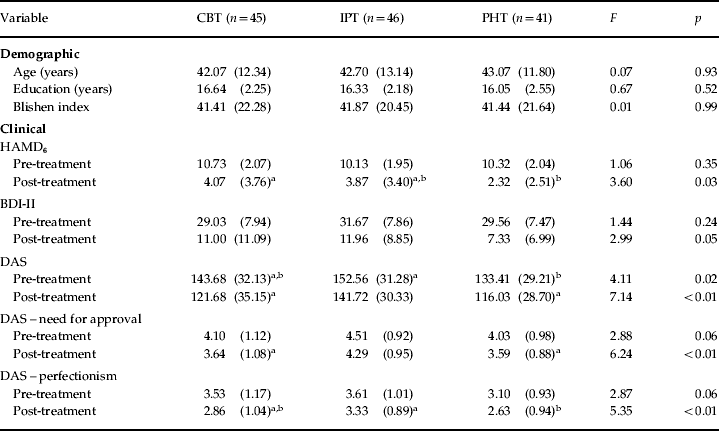
Pre-treatment demographic, and pre- and post-treatment clinical characteristics of the sample for the CBT, IPT and PHT conditions are displayed in Table 1. There were no significant differences between the participants in these treatment conditions for any of the demographic characteristics. Due to the presence of significant differences between participants for clinical characteristics, we regressed all change scores on pre-treatment variables.
Demographic and clinical characteristics of the CBT, IPT and PHT treatment groups

Values are given as mean (standard deviation).
CBT, Cognitive behavioural therapy; IPT, interpersonal therapy; PHT, pharmacotherapy; Blishen index, Canadian socioeconomic index; HAMD6, Six-Item Hamilton Depression Rating Scale; BDI-II, Beck Depression Inventory – II; DAS, Dysfunctional Attitudes Scale.
a,b For variables with a significant F, mean values with unlike superscript letters were significantly different (p<0.05).
To test overall treatment efficacy, two repeated-measures analyses of variance were performed; treatment condition was the independent variable and HAMD6 and BDI-II scores served as the dependent variables. For the HAMD6, there was a significant effect for time (F=423.69, p<0.01), but no significant time×treatment condition interaction (F=2.34, p>0.05). Similarly, for the BDI-II, there was a significant effect for time (F=515.35, p<0.01), but no significant time×treatment condition interaction (F=2.39, p>0.05), indicating comparable outcome across treatment conditions.
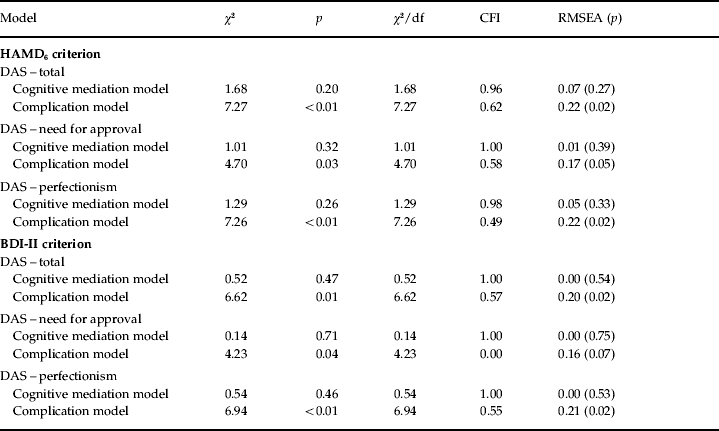
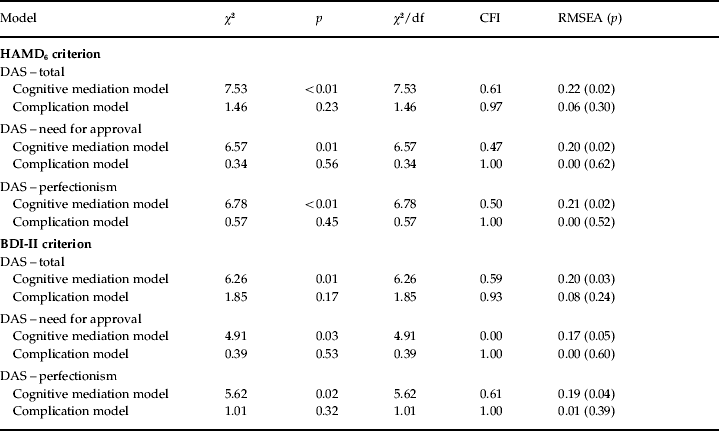
Fit statistics for the cognitive mediational and complication models contrasting CBT v. IPT are displayed in Table 2. The cognitive mediational models provided a close fit to the data, whereas the fit of the complication models was uniformly poor. Cognitive mediational model parameters are displayed in Fig. 1. Fig. 1(a–c) displays the parameter estimates associated with models utilizing residualized HAMD6 change scores; Fig. 1(d–f) displays the parameter estimates associated with models utilizing residualized BDI-II change scores. Fig. 1(a, d) displays the parameter estimates associated with models utilizing residualized total DAS change scores; Fig. 1(b, e) displays the parameter estimates associated with models utilizing residualized need for approval DAS change scores; Fig. 1(c, f) displays the parameter estimates associated with models utilizing residualized perfectionism DAS change scores. Participants receiving CBT exhibited greater dysfunctional attitude change than those receiving IPT, and greater attitude change was associated with greater depressive symptom change. These effects held for global and specific dysfunctional attitudes, and self-reported and interviewer-rated depression symptom severity. This pattern of results supports the proposition that any treatment effect of CBT occurs through dysfunctional attitude reduction.
Fit statistics for models contrasting CBT v. IPT

CBT, Cognitive behavioural therapy; IPT, interpersonal therapy; df, degrees of freedom; CFI, confirmatory fit index; RMSEA, root mean square error of approximation; HAMD6, Six-Item Hamilton Depression Rating Scale; DAS, Dysfunctional Attitudes Scale; BDI-II, Beck Depression Inventory – II.
Fit statistics for the cognitive mediational and complication models contrasting CBT v. PHT are displayed in Table 3. The complication models provided a close fit to the data, whereas the fit of the cognitive mediational models was uniformly poor. Complication parameter estimates are displayed in Fig. 2. Fig. 2(a–c) displays the parameter estimates associated with models utilizing residualized HAMD6 change scores; Fig. 2(d–f) displays the parameter estimates associated with models utilizing residualized BDI-II change scores. Fig. 2(a, d) displays the parameter estimates associated with models utilizing residualized total DAS change scores; Fig. 2(b, e) displays the parameter estimates associated with models utilizing residualized need for approval DAS change scores; Fig. 2(c, f) displays the parameter estimates associated with models utilizing residualized perfectionism DAS change scores. Participants receiving PHT exhibited greater depressive symptom reduction than those receiving CBT, and greater depressive symptom change was associated with greater attitude change. These effects held for global and specific dysfunctional attitudes, and self-reported and clinician-rated depressionsymptom severity. The most adequate interpretation of this pattern of results is that any reduction in dysfunctional attitudes during PHT occurs through depressive symptom reduction.
Fit statistics for models contrasting CBT v. PHT

CBT, Cognitive behavioural therapy; PHT, pharmacotherapy; df, degrees of freedom; CFI, confirmatory fit index; RMSEA, root mean square error of approximation; HAMD6, Six-Item Hamilton Depression Rating Scale; DAS, Dysfunctional Attitudes Scale; BDI-II, Beck Depression Inventory – II.
Discussion
The current investigation examined support for the cognitive mediational model of depression, namely, that changes in dysfunctional attitudes play a mediating role in the relation between treatment and changes in depressive symptoms. Our hypotheses regarding the contrast between CBT and IPT were confirmed – CBT was associated with greater dysfunctional attitude change compared with IPT, and greater dysfunctional attitude change was associated with greater reduction in depressive symptoms. This cognitive mediational model replicated across a global measure of dysfunctional attitudes, as well as specific measures of need for approval and perfectionism; these results held for both self-reported and clinician-rated measures of depressive symptoms. An alternative complication model, in which dysfunctional attitudes are proposed to be epiphenomena of depression severity, did not provide a good fit to the data. Our hypotheses regarding the contrast between CBT and PHT were only partially confirmed – PHT was associated with greater depressive symptom reduction compared with CBT, and greater depressive symptom reduction was associated with greater dysfunctional attitude change. This complication model replicated across global and specific measures of dysfunctional attitudes, as well as self-reported and clinician-rated measures of depressive symptoms. This line of evidence suggests that changes in dysfunctional attitudes during treatment with PHT may be by-products of depressive symptom resolution, whereas those during treatment with CBT may be of causal significance. Whisman (Reference Whisman1993) proposed that the essential elements of the cognitive mediational model are that dysfunctional attitude change covaries with depressive symptom reduction, and that dysfunctional attitude change is specific to CBT. Garratt et al. (Reference Garratt, Ingram, Rand and Sawalani2007), however, noted that cognitive change can occur during alternative treatments. These authors suggested that the optimal test of such ‘cognitive specificity’ is a contrast between CBT and PHT – wherein dysfunctional attitude change may or may not occur within PHT, but should not be of causal significance. This pattern of results satisfies these specifications.
This study has several strengths, including random assignment of patients with MDD to three evidence-based interventions. Effects were also replicated across both self-report and interviewer-rated outcome measures. There are some limitations, however. First, dysfunctional attitudes and depressive symptoms were assessed at only two time points during the present study: pre- and post-treatment. The lack of additional assessments prevents the demonstration that changes in dysfunctional attitudes temporally preceded changes in depressive symptoms. A complete test of the cognitive mediational model would therefore require the demonstration that dysfunctional attitude change preceded depression reduction. Second, the lack of additional antecedents prevented the examination of other alternative models of the association between dysfunctional attitudes and depression discussed by Hollon et al. (Reference Hollon, DeRubeis and Evans1987). Additional mediators, such as automatic thoughts (Kwon & Oei, Reference Kwon and Oei2003) and emotional regulation disruption (Siegle et al. Reference Siegle, Carter and Thase2006), would also help to elucidate the cognitive processes involved in CBT of depression. Future studies might apply similar methods of statistical modelling to test the mediating effects of other variables thought to play a role in the onset and maintenance of depression. Third, while there were no significant differences between the participants who refused, dropped out or completed the treatment protocol, the participants within the PHT treatment group may have differed from the remainder of the sample due to increased rate of refusal in this condition.
The current investigation provides support for the cognitive mediational model of CBT for depression, as any treatment effect of CBT occurred through dysfunctional attitude reduction. In contrast, results suggested that dysfunctional attitude change may be a mere concomitant of treatment response to PHT, as they were instead consistent with reduction in dysfunctional attitudes during PHT occurring through depressive symptom reduction. There is no evident mediating role of dysfunctional attitudes within IPT. These results provide support for the assertion that dysfunctional attitudes may play a mediating role in CBT, whereas they may be simply a by-product of treatment response within PHT. The lack of a causal role for dysfunctional attitudes during treatment with PHT is consistent with the proposition that CBT results in lasting cognitive change, whereas PHT may instead result in the deactivation of dysfunctional cognitions. Indeed, recent empirical work indicates that both CBT and PHT affect similar neural pathways, albeit by different mechanisms (Goldapple et al. Reference Goldapple, Segal, Garson, Lau, Bieling, Kennedy and Mayberg2004), and the serotonin system has been implicated in not only antidepressant targets of action, but dysfunctional attitudes (Meyer et al. Reference Meyer, Joule, Sagrati, Carella, Hussey, Ginovart, Goudling, Kennedy and Wilson2004). However, in contrast to those treated with CBT, patients treated to remission with PHT exhibit dysfunctional attitudes following a sad mood induction, and such attitudes are associated with subsequent relapse (Segal et al. Reference Segal, Gemar and Williams1999). This line of investigation contributes to this literature, with the goal of facilitating the identification of active versus inactive or redundant components of treatment, and ultimately, the development of novel interventions that effect the same changes and/or the improvement of existing interventions that may not optimally emphasize therapeutic components.
Acknowledgements
This study was supported by an operating grant from the Ontario Mental Health Foundation (OMHF) awarded to R. M. B. (principal investigator and senior responsible author) and C.McB. (co-investigator), an OMHF Senior Research Fellowship awarded to R. M. B, and a Canadian Institutes of Health Research Postdoctoral Fellowship awarded to L. C. Q.
Declaration of Interest
None.