Children's production of errors in wh-questions provides an interesting test case for theoretical approaches to language acquisition and syntactic development. Construction-based accounts argue that children formulate questions using lexically specific frames (e.g. What is [THING] [PROCESS]? or What does [THING] [PROCESS]?) and that error patterns reflect the item-specific nature of children's wh-questions (Ambridge, Theakston, Lieven & Tomasello, Reference Ambridge, Theakston, Lieven and Tomasello2006). Based on data from Norwegian, a Germanic V2 language, Westergaard (Reference Westergaard2009) argued that some non-target consistent forms such as omission of verbs or wh-words are incompatible with constructivist accounts. According to Westergaard's account, omission errors disconfirm the constructivists' assumption that children primarily rely on frequent input patterns (specific wh-word+verb frames) when formulating interrogatives.
In the current study, we present data from German children's production of wh-questions to investigate whether wh-omission errors occur in lexically specific frames and whether input properties such as prosodic patterns or discourse givenness may influence their production.
In reports of German-learning children's wh-questions it has been found that children omit the utterance initial wh-word especially during early stages of development (Clahsen, Kursawe & Penke, Reference Clahsen, Kursawe and Penke1995; Tracy, Reference Tracy, Tracy and Lattey1994). Interestingly, wh-word omission has also been reported to occur frequently in other Germanic V2 languages such as Dutch (Van Kampen, Reference Van Kampen1997), Swedish (Santelmann, Reference Santelmann, Josefsson, Platzack and Håkansson2004) and Norwegian (Westergaard, Reference Westergaard2009), but, to our knowledge, has not been reported systematically for English. Other examples of errors in German children's early wh-questions include verb doubling (Penner, Reference Penner, Hoekstra and Schwartz1994), subject omission (Hamann, Penner & Lindner, Reference Hamann, Penner and Lindner1998), verb omission (Steinkrauss, Reference Steinkrauss2009) and non-inversion errors (Wode, Reference Wode1975).
However, overall little is known about the frequency with which German children produce these different types of errors in formulating questions. Therefore, we performed a detailed longitudinal analysis of the different types and rates of errors in German children's wh-questions. Our hypothesis was that German children would show high error rates of verb omission and omission of wh-words, as this seems to be the most common error in wh-questions across typologically similar languages.
The second objective of the current study concerned the factors that might explain wh-omission errors. We wanted to know whether wh-omission occurs in lexically specific frames and whether input properties such as prosodic characteristics of caregiver speech may have an influence on error patterns. We hypothesized that if lexical specificity constrains the production of errors, we would not expect lexical overlap between those questions with omission and those without. However, if lexical specificity alone does not constrain the production of errors, additional factors have to be considered in order to explain under what conditions utterance-initial wh-elements are omitted. Two possibilities are that omission errors might be influenced by pragmatic factors (given information in utterance-initial position being omitted more often than new information), and prosodic factors (unstressed elements being omitted more often than stressed).
STUDY 1
METHOD
Speech corpus
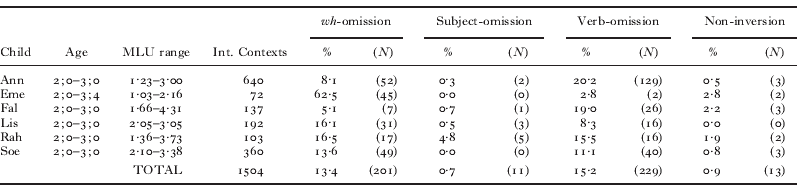
All wh-questions were extracted from the longitudinal data of six children from the Szagun corpus (Szagun, Reference Szagun2004), available from the CHILDES database (MacWhinney, Reference MacWhinney2000). The analyzed utterances were only taken from typically developing children. The recordings were made every six weeks during the children's third year of life. The results reported here are based on data collected when the children were between 2 ; 0 and 3 ; 0. The data for Emely were taken from recordings between 2 ; 0 and 3 ; 4 in order to obtain a higher number of utterances. The mean length of utterance (MLU) was calculated in words per utterance by the first author. MLUs for the children ranged between 1·03 and 2·10 at age 2 ; 0 and between 2·16 and 4·31 at age 3 ; 0 (Table 1). We classified all wh-questions according to MLU stages: stage I (1–1·99), stage II (2·0–2·49), stage III (2·5–3·0) and stage IV (>3·0).
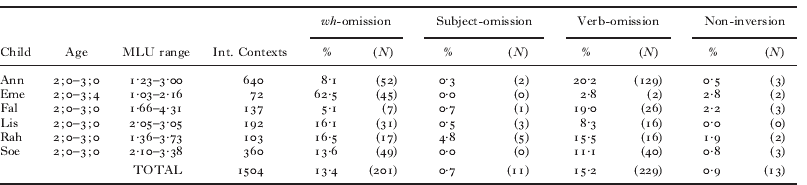
Total numbers and percentages of errors produced in children's wh-questions
Error coding
The first author coded the following types of errors: wh-omission errors, verb-omission errors, subject-omission errors and non-inversion errors. Verb doubling errors, which have also been reported, were not found in the data.
(a) wh.omission. wh-omission errors were defined as interrogative question structures containing a verb in initial position (their status as questions was determined from the context, including intonation and the interlocutor's response).
(1) macht das pferd?
doing the horse?
‘(What) is the horse doing?’ (Ann, 2 ; 5)
(b) verb.omission. wh-questions containing a wh-word but no verb were coded as verb-omission errors.
(2) wo die pfanne?
where the pan?
‘Where (is) the pan?’ (Soe, 2 ; 6)
(c) subject.omission. wh-questions containing a wh-word and a verb, but which did not have a subject were coded as subject-omission errors.
(3) wo is?
where is?
‘Where is (X)?’ (Lis, 2 ; 4)
(d) non.inversionerrors. Non-inversion errors were determined by position of the finite verb. Since in German wh-question finite verbs occur in second position (i.e. after the wh-word), questions that deviated from the verb-second word order were coded as word order errors.
(4) warum eine frau das ist?
why a woman that is?
‘Why is that a woman?’ (Eme, 2 ; 9)
(e) interrogativecontexts. In order to give percentages of error types, we summarized erroneous structures and correct questions as interrogativecontexts. For the purposes of wh-word specific analysis, we furthermore identified two subcategories of interrogative contexts: wo-contexts (‘where’-contexts) and was-contexts (‘what’-contexts). Single-word wh-questions, embedded wh-questions and fragments were excluded from the analysis (e.g. Welche X? (‘Which X?’), Wie bitte (‘Pardon?’), Was für ein X? (‘What kind of X?’), Warum nicht (‘Why not?’), [Wh] denn? (‘[Wh] denn [particle]?’). We also excluded seventy-seven questions that contained neither a verb nor a wh-word. These structures were only marked with the modal particle denn, which is commonly used in German wh-questions.
Coding reliability
A second rater was trained in error coding by the first author and coded a total of 180 interrogative contexts from all six children (12% of the data). The level of agreement between coders was 97·2% (Cohen's Kappa=0·93, p<0·001, N=180).
RESULTS
Overall error rates
Children produced errors in approximately 30% of their questions. Table 1 shows a clear pattern of these errors. First, the omission of utterance-initial elements (wh-words and verbs) is the most common error for all children. Verb-omission occurred in 15·2% and wh-omission occured in 13·4% of all wh-questions, which is comparable to the findings of Clahsen et al. (Reference Clahsen, Kursawe and Penke1995), who reported a wh-omission rate of 19%. Second, non-inversion errors and subject-omission errors are extremely rare and do not occur in all children. Most of the children's non-inversion errors contained a finite verb in final position. However, there were also four instances in which children produced a non-finite verb in final position, but no finite verb in second position (e.g. Wo der passen? ‘Where this fit?’). Furthermore, there are large individual differences in both the production rate of wh-questions as well as occurrences of particular types of errors. For example, Emely produced the lowest number of wh-contexts, but showed the highest rate of wh-omission errors (62·5%). However, a closer look revealed that 92·5% of Emely's wh-less questions consisted of only two lexical formulas: (Was) ist das? ‘(What) is that?’ and (Wie) heisst der? ‘(How) is he called?’, each of which occurred in a single but different recording session.
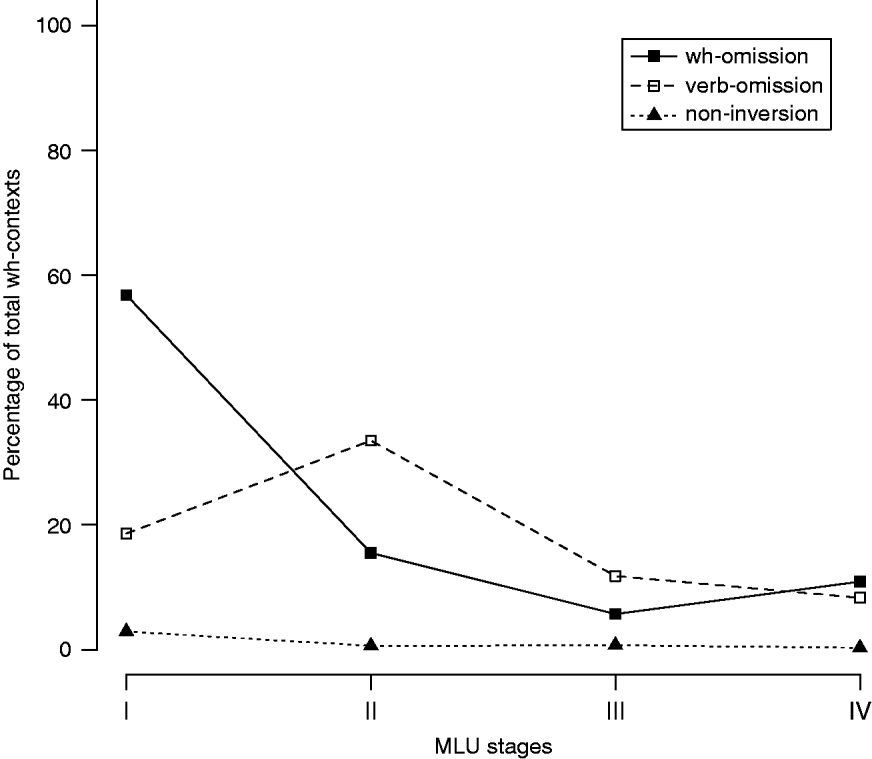
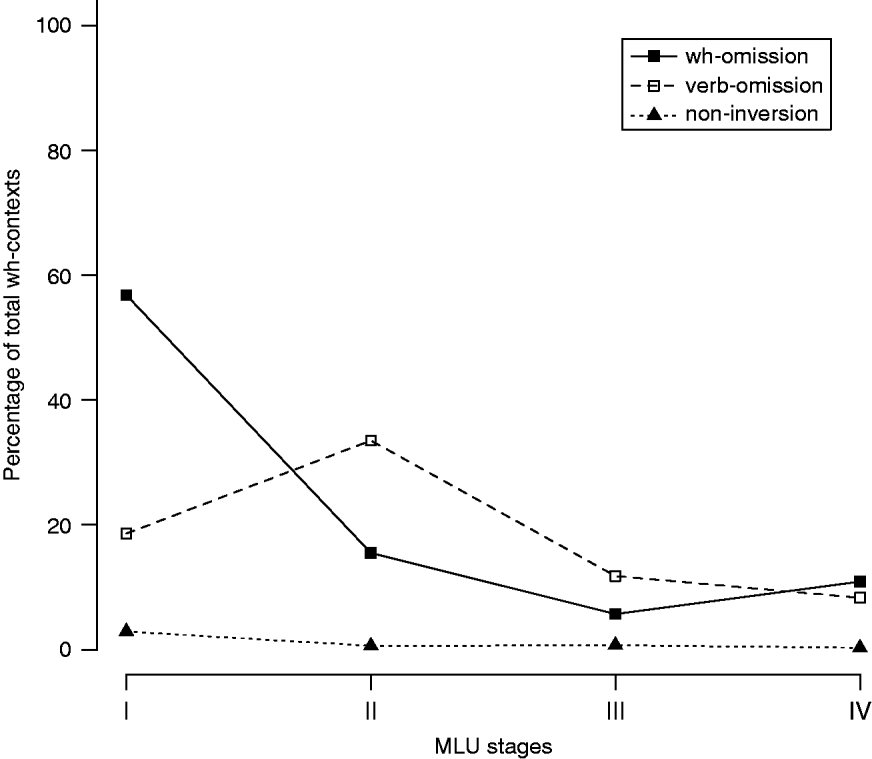
Figure 1 shows the distribution of error rates across MLU stages. The omission of wh-elements and verbs is a phenomenon that is particularly characteristic of the MLU stages I and II. One reason for the decline in error rates might be that omission of elements is bound to specific lexical frames that constitute the majority of question constructions in early phases, but the proportion of these decreases as children acquire more types of wh-questions.
Error rates for wh-omission, verb-omission and non-inversion errors across MLU stages.
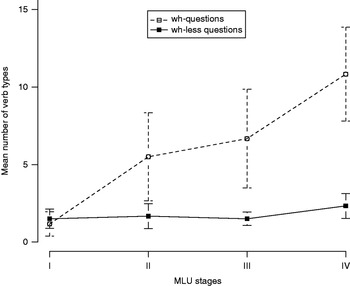
We compared the use of verb types in wh-overt and wh-less questions across MLU stages. Figure 2 shows the mean number of different verb types produced at each MLU stage. The results indicate that an increase in the use of verb types was seen only for wh-overt questions, but not for constructions in which the wh-word was omitted. A lexical analysis showed that children omit wh-words only with a limited set of verbs. All wh-omission errors occurred with one of the following eight verbs (including their inflectional forms): machen (‘do’), passen (‘fit’), kommen (‘come’), gehören (‘belong’), haben (‘have’), heissen (‘be called’), gehen (‘go’), and the copula. Furthermore, 78% of all wh-omission errors occurred in a set of five lexical frames: (Was) ist das ‘(What) is that’ (N=97), (Wie) heisst der/die/das ‘(How) is he/she/it called’ (N=28), (Was) machst du ‘(What) are you doing’ (N=17), (Was) macht der/die ‘(What) is he/she doing (N=8)’, (Wo) kommt das hin ‘(Where) does this go’ (N=7). What these frames have in common is that they contain a pronoun in subject position. Next, we checked whether wh-less questions and wh-overt questions differ with respect to lexical specificity in the verb position and the subject-NP for each child individually.
Mean number of verb types used in wh-less and wh-overt questions across MLU stages. Error bars show standard errors.

Verb use and type of subject-NP
From the sample of wh-overt questions, we extracted all non-subject questions and all instances of the construction [WH COP NP] and coded how many different verb types occurred in the position following the wh-word and whether the subject was realized pronominally or as a full NP. We applied the same coding procedure for wh-less questions.
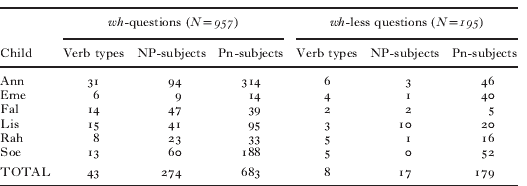
Total numbers of verb types and type of subject-NPs in wh-questions and wh-less questions
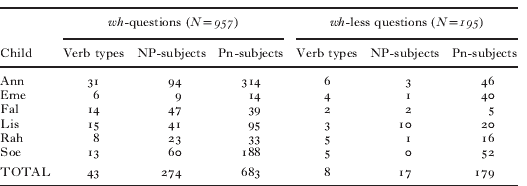
We found that all children use more verb types in overt wh-questions than in wh-less questions (see Table 2). For Ann, Fal, Lis and Soe this difference was more pronounced than for the other two children (Eme and Rah), who also showed the lowest production rate of interrogative contexts overall. However, although children tended to produce fewer verb types in wh-less questions, these verbs were not restricted to wh-less questions. Four of six children (Ann, Fal, Lis and Soe) used all verbs from their wh-less questions in wh-overt questions as well. Rahel produced two verb types in both structures (copula, kommen ‘come’) and Emely three verb types (copula, heissen ‘be called’, gehören ‘belong’). With respect to subject-NP type, children predominantly used pronoun subjects in wh-questions as well as in wh-less questions (71·4% and 91·3%, respectively). However, the type of subject realization did not distribute equally over the two structures with pronouns being more frequent in wh-less questions (χ2(1, N=1152)=28·59, p<0·001).
Omission as complexity reduction?
Bloom (Reference Bloom1990) proposed that the omission of sentential elements could be explained as a general cognitive strategy to reduce the complexity of an utterance. He found that sentences with longer verb phrases (VP) tend to be produced less often with a subject than sentences with shorter verb phrases. Therefore, we tested whether such a VP length effect could also be found in the case of omission errors in wh-questions. The MLU for wh-questions was 4·28, and 2·93 for wh-less questions. Subtracting the wh-word from every overt wh-question yielded a VP length of 3·28, a number that was still significantly larger than the MLU of wh-less questions (t(293)=4·54, p<0·001). Therefore we conclude that children do not omit the wh-word in order to reduce the length of the utterance. This argument is further supported by the fact that 96% of all wh-less questions contain a semantic ‘light’ verb (so they are not more semantically difficult either).
wh-specific errors
When considering errors in children's language we must always note whether the incidence of errors patterns uniformly across different types of lexically specific structures. To answer this question, we analyzed the rates of omission errors in wo-contexts and was-contexts. Overall, there were 750 wo-contexts and 614 was-contexts, which together constituted 90·7% of all interrogative contexts.
Table 3 shows the number of omission errors for was-contexts and wo-contexts. The rates of verb-omission are very similar in both contexts, with 16·6% of all wo-contexts (n=124) and 15·1% of all was-contexts (n=93) missing a verb. Although it is not possible to determine which verb the child intended to produce, it seems that in the vast majority of cases it is the copula that has been dropped. It should be pointed out that in was-contexts the rate of copula omission might be overestimated. This is because the singular form of the copula ist and the wh-word was are often reduced into one contracted form for which it becomes hard to distinguish whether the copula is present or not. But the key finding is that a large difference in error rates was found for the omission of different wh-words. The data shows that the wh-word was is significantly more likely to be dropped than the wh-word wo (χ2(1, N=387)=75·13, p<0·001). The wh-word is missing in only 3·1% of all wo-contexts (n=23), compared to 23·9% of all was-contexts (n=147).
Children's omission errors for different wh-contexts (Szagun corpus)

DISCUSSION
Summarizing the results, we find a clear pattern of errors that young German-learning children produce when forming wh-questions. First, omission of utterance-initial elements such as the wh-word or the verb in second position can be identified as the main source of error. Taken together, in 28·6% of all interrogative contexts, either the wh-word or the verb is omitted. Second, non-inversion errors constitute a rare phenomenon. Interestingly, similar low rates of word order errors have also been reported for other V2 languages (for Swedish, see Hansson & Nettelbladt, Reference Hansson and Nettelbladt2006).
An analysis at the lexical level revealed that wh-omission errors are restricted to particular lexical items. First, children mostly drop the wh-word was but preserve the wh-word wo. Second, wh-omission errors occur only with a small set of verbs throughout all MLU stages. Third, almost all wh-less questions contain a pronoun subject following the verb, indicating that the referent of the subject-NP is given in the discourse or even present in the interaction. Finally, the majority of children used verbs occurring in wh-less questions in wh-overt questions as well, suggesting that additional factors other than lexical specificity must be involved in the omission of wh-words.
Notice that the lexical pattern of wh-less constructions has important implications for the prosodic structure of these frames. In our data, the vast majority of wh-less questions have the lexical form [(WH) VERB Pn]. According to Lambrecht (Reference Lambrecht1994), in constructions of the form [WH VERB NP], NPs whose referents have already been established in discourse (as indicated by their pronominal form) are unlikely to receive an accent. The sentence accent in these constructions therefore falls onto the verb, giving wh-less questions a strong–weak stress pattern. It is important to point out that this is true for semantically light as well as semantically heavy verbs, since utterances must have at least one accent to be informative (Lambrecht & Michaelis, Reference Lambrecht and Michaelis1998).
These information structure considerations as well as the observation that lexical specificity alone cannot explain wh-omission point to the possibility that omission errors might result from a prosodic constraint, as proposed by Gerken (Reference Gerken1991; Reference Gerken1994). According to Gerken's account children tend to omit weakly stressed elements and favour the production of strong–weak sequences over weak–strong sequences. We investigated this hypothesis in a second study by analyzing the prosodic characteristics of different types of wh-questions in German child-directed speech (CDS).
STUDY 2
Gerken (Reference Gerken1991) proposed a metrical account to explain English children's omission of sentential subjects. According to her hypothesis, the speech production system of English-learning children around the age of two is influenced by a prosodic constraint favouring strong–weak sequences over weak–strong sequences. More precisely, children tend to omit weakly stressed syllables that cannot be parsed into a trochaic foot. Furthermore, Gerken (Reference Gerken1994) has shown in an imitation experiment that weak syllables in utterance-initial position are more likely to be dropped than weak syllables in utterance-internal or -final position. Since German, like English, shows a predominant trochaic stress pattern in multisyllabic words, it is likely that young German-learning children operate with similar production constraints. We reasoned that if the prosodic characteristics of the ambient language influence children's production, the different omission rates of wh-words in was- and wo-questions might be traced to specific stress patterns associated with wh-questions in German child-directed speech.
METHOD
Speech corpus
Since the Szagun corpus analyzed in Study 1 is not linked to sound files, wh-questions for acoustic analysis were taken from the dense German child language corpus of Leo (Behrens, Reference Behrens2006), for which the sound files were available to us. To check whether Leo himself produced wh-less questions, a short analysis of Leo's wh-questions from age 2 ; 1 to 2 ; 5 (MLU range 1·67–2·12) was performed according to the same coding scheme described above. During this period Leo produced forty-three wh-questions. In five of these questions Leo omitted the wh-word (11·3% of all wh-contexts). No instances of wh-omission errors were found in the months 2 ; 4 and 2 ; 5. Thus, Leo showed a compatible developmental trajectory to that of the children in the Szagun data. We therefore analyzed the input Leo received to check how characteristics of maternal utterances might have influenced the observed patterns.
Sentence material
We extracted sixty maternal wh-questions that the mother produced during the child's third year of life. In order to match the use of verb forms and to obtain a sample that was large enough for statistical analysis, we chose the three most frequent wo+verb combinations and the matching was+verb combinations (10 instances per combination):
• Wo ist (‘Where is’) Was ist (‘What is’)
• Wo sind (‘Where are’) Was sind (‘What are’)
• Wo kommt (‘Where comes’) Was kommt (‘What comes’)
Coding
A professional phonetician (native speaker of German) coded the sound files for presence of stress on the wh-word. The files were presented in a randomized order. The first author (also a native speaker of German) coded the complete set of sound files for reliability. The agreement rate was 85% (Cohen's kappa=0·81, p<0·001, N=60). This agreement rate lies within a well-established range for judging the presence of accents on words in sentential contexts for German (Grice, Reyelt, Benzmüller, Mayer & Batliner, Reference Grice, Reyelt, Benzmüller, Mayer, Batliner, Bunnell and Isardi1996).
RESULTS
Table 4 shows the distribution of accents across wo-questions and was-questions. The results indicate that the wh-word in wo-questions is accented significantly more often than the wh-word in was-questions (Fisher's exact test; p=0·02).
Distribution of accents on wh-words in child-directed speech (Leo corpus)

DISCUSSION
An intonation unit in spoken language contains more than just one accent, i.e. pre-nuclear and nuclear pitch accents. Thus, an accented wh-word is not automatically the most prominent part of the utterance. However, speakers strongly tend to avoid accenting two adjacent lexical elements (Selkirk, Reference Selkirk1984; Speyer, Reference Speyer2008). With respect to wh-questions this means that if the wh-word is accented, this automatically prevents the verb following the wh-word from being accented as well. Furthermore, in wo-questions the NP following the verb prototypically is a full NP (e.g. Wo ist X? ‘Where is X?’), which receives a topic-establishing accent (Lambrecht, Reference Lambrecht1994). In was-questions, on the other hand, the NP following the verb prototypically is a pronoun whose referent has been activated in previous discourse and it is therefore not stressed, i.e. the accent falls onto the verb (e.g. Was MACHT der? ‘What is he DOING?’).
These information structure considerations help to explain the main result of Study 2, that is, that was-questions in German CDS have a tendency to show an initial weak–strong pattern, whereas wo-questions do not.
GENERAL DISCUSSION
The current study addressed whether German children's errors in wh-questions reflect prosodic patterns of the input and whether errors distribute uniformly across different types of wh-constructions. With respect to the latter question, we found clear evidence that errors of wh-omission tend to occur more frequently in was-questions than in wo-questions. The explanation for this pattern of errors may be found in both pragmatic and prosodic factors, which, of course, are intimately intertwined in the information structure of sentences in all languages. In the following, we discuss the discourse–pragmatic and the prosodic account of omission errors and evaluate which explanation accounts best for our data.
Where do omission errors come from?
Two types of factors are often assumed to influence omission errors in child language: the metrical structure of the target utterance and the givenness status of information (Gerken, Reference Gerken1994; Hughes & Allen, Reference Hughes, Allen, Bamman, Magnitskaia and Zaller2006). The present analysis suggests that prosodic factors do have an influence on omission errors in wh-questions, although experimental data is needed to distinguish more clearly between the two accounts.
A discourse–pragmatic explanation of omission errors would predict that children drop the wh-word in contexts where the designatum of the wh-word is inferable from the preceding discourse or present situation. Santelmann (Reference Santelmann, Josefsson, Platzack and Håkansson2004), for example, proposed for wh-less questions in child Swedish that children produce these structures in analogy to so-called topic-drop constructions. Similarly, Jordens and Dimroth (Reference Jordens, Dimroth, Gagarina and Gülzow2006) suggest that children acquiring Dutch order constituents sequentially on the basis of functional categories such as topic, linking element and predicate. Thus, in the child's grammar the utterance-initial position is identified as the topic-position, which has an anchoring function towards discourse. According to Santelmann's account, as well as Jordens and Dimroth's proposal, children learn that the utterance-initial position (topic position) can be left empty if the topic expression is inferable from the context and they overgeneralize this knowledge to wh-questions.
Although German, as Swedish and Dutch, allows topic-drop constructions and they seem to occur frequently in CDS (Hamann & Plunkett, Reference Hamann and Plunkett1998; Hamann, Reference Hamann2002), it is not clear whether children derive a functional interpretation of the utterance-initial position for wh-questions based on declarative topic-drop constructions. In fact, wh-questions are functionally quite distinct from declarative topicalized structures and are generally analyzed as focus-argument constructions rather than topic-argument constructions (see Lambrecht, Reference Lambrecht1994). What is pragmatically presupposed in wh-questions is not the wh-expression (the initial position), but the open proposition (everything following the wh-word). Thus, by asking Who is coming tonight? the speaker presupposes that someone will be coming tonight (and that the hearer is in a position to identify that person).
Crucially, an account of wh-less questions in analogy to topic-drop constructions would have to explain the asymmetry in omission errors between the wh-words was and wo. Such an explanation would have to show that in child-directed speech the designatum of the wh-word wo (i.e. the location or moving direction of an entity) is not inferable from the context, whereas the designatum of the wh-word was is inferable.
Alternatively, the metrical account predicts that during the early stages of development children omit unstressed syllables, which cannot be parsed into the prosodic constituent foot (Demuth, Reference Demuth, Lust, Suñer and Whitman1994). This prosodic constraint influences children's production of multisyllabic words as well as grammatical morphemes, such as determiners. Gerken (Reference Gerken1991) showed that children are more likely to omit the second weak syllable (definite article) than the first weak syllable (-es) in the phrase KISSes the PIG, because it is not part of a foot. Furthermore, Freudenthal, Pine and Gobet (Reference Freudenthal, Pine, Gobet, Lewis, Polk and Laird2007) used a computational modelling approach to demonstrate that the rate of English children's optional infinitive errors (e.g. he go home) can be simulated as the omission of function words, i.e. the omission of the modal will from he will go home, based on the metrical characteristics of the children's input. These findings demonstrate how a model that relies on learning from frequent input patterns in child-directed speech including the prosodic characteristics of that input can successfully account for the production of errors. This is generally in line with the results of the current study.
A metrical account might also explain why we do not see similar rates of wh-less questions in English children's early speech. The metrical account would predict that the sequence Wh+AUX does not exhibit a weak–strong pattern, because the auxiliary or copula in English non-subject wh-questions is almost never stressed. In line with this hypothesis is the observation that English children frequently omit the copula or the auxiliary verb in wh-questions (e.g. where he going?). For example, Rowland, Pine, Lieven and Theakston (Reference Rowland, Pine, Lieven and Theakston2005) report for the Manchester corpus auxiliary/copula omission rates between 24% and 50% across MLU stages. These authors have also found some lexically specific omission patterns and speculate that phonological factors might explain their findings (e.g. copula are being more likely to be omitted than copula is). However, it remains an empirical question whether the omission of auxiliary verbs and copula forms in English children's wh-questions and the omission of wh-words in German children's wh-questions can be accounted for by the same prosodic constraint operating on children's early production.
In sum, the two studies presented here indicate a relationship between children's omission rates and the prosodic characteristics of interrogative questions and suggest that construction-based approaches have to take into account prosodic structure in addition to discourse–pragmatic factors and lexical specificity to explain the full range of the data.