In the last decade, recommendations of health organisations have been focussed on patient-centred care, and the same trend has been seen in medical research. The Bristol inquiry of 2001 urged doctors to include their patients as active participants in their own care.Reference Coulter and Dunn 1 Developing this in an interdisciplinary context within the hospital and across various stakeholders has been shown to be important for consistency,Reference Kitson, Marshall, Bassett and Zeitz 2 safety, and high-quality care. 3 The benefits of involving patients in all steps of medical care are apparent, as their feedback and participation lead to increased “consumer” satisfaction and improved delivery of care. The practical and potential benefits of integrating patients, however, are much more elusive in medical research.
The Australian and New Zealand Fontan Registry was developed in 2008 to define the late outcomes of patients surviving with a single ventricle physiology, and to develop the research tools necessary to improve these outcomes.Reference Iyengar, Winlaw and Galati 4 Over the subsequent decade, a tight relationship was developed between the Fontan Registry and its stakeholders. We believe that our experience might enlighten those wanting to develop a closer relationship between their research and the targeted patient population.
Patients’ involvement in Fontan research
Participation in the Steering Committee
After just a year of its development, Professor Fiona Stanley, a prominent Australian figure in Registry-based research, recommended that we incorporate patients and their parents in the Steering Committee. The initial idea was that the parents and patients would warrant the validity of our research and be our advocates in case of conflicts or adverse events. Until then, the Committee comprised key players in the field of paediatric and adult care for CHD emanating from each state of Australia and from New Zealand. Since then, we have added to the Committee patients and parents from the two countries and, more recently, a representative of our new advocacy group. Their role was to represent the community, approve or disapprove the research activity, and review the quality of all communication to patients and families.
The Fontan Registry website (www.fontanregistry.com)
The creation of a website for a large research project is conventional practice. It provides easily accessible and up-to-date information about research undertaken, advertises research projects and events, and provides an avenue to feed research results back to the Fontan community and the wider public. It remains difficult to ascertain the benefits of this, as the reach of such websites is often difficult to measure. It has been a marginal, but necessary, source of communication for patients and families who were outside the reach of the Registry – in particular, for international patients.
The Fontan Registry Facebook page (www.facebook.com/anzfontanregistrys)
The creation of the Facebook page has been an immediate measurable success. In a matter of a couple of years, the number of followers increased to 1170, a large number considering that the current number of patients alive in the Region is 1415. Regular updates and stories are posted each week, with some being viewed up to 13,883 times. There is no doubt that the Facebook page has given an enormous thrust to our capacity to bilaterally communicate with this community, and for the community to build up contact between families.
The Fontan education day
Since 2014, we have held a yearly meeting in the main centres: namely, Melbourne, Sydney, and Auckland. The day is an interactive meeting targeting patients with a Fontan circulation and their families. Some formal presentations on the most current research are given, and this is interspersed with patients and families narrating experiences from their Fontan journey. Importantly, the day has been a platform to relay the most recent raw, unfiltered results of our research to the patient community. In the process of communication with the patient community most of us have been guided by the principle of providing only peer-reviewed research to the families. This practice usually means that the lag between the patient participating in a research project and the time by which the results reach him or her is several years. We believe that patients should know the results of the research in which they participated before it reaches the international community, as they are the most involved in it and are entitled to make their own conclusions. Future research projects are advertised and the assembly is gauged through interactive sessions. The gathering of 150–250 participants constitutes an extraordinary experience and opportunity. It was fundamental in the creation of a true community and has been a tremendous driving force for the development of our research. We have been consistently getting very positive feedback, as this day is seen as the best opportunity to not only gather information about outcomes but also build links with other members of the community.
The creation of the Australian and New Zealand Fontan Advisory Committee
Following the first education day in 2014, an advocacy group was created by parents and patients. The Registry was created by medical practitioners with a research focus, although it was felt that the Fontan community needed a voice of its own. The mission of the Australian and New Zealand Fontan Advisory Committee is to optimise health and support for children, young people, and adults with a Fontan circulation. The first task of the group was to perform a survey to identify the main concerns and needs of the families and patients. As the lack of psychological support during the families’ journey was flagged, the group gathered a taskforce to facilitate the provision of specialised psychological care; further, carers or parental support groups were also established.
A web of communication platforms
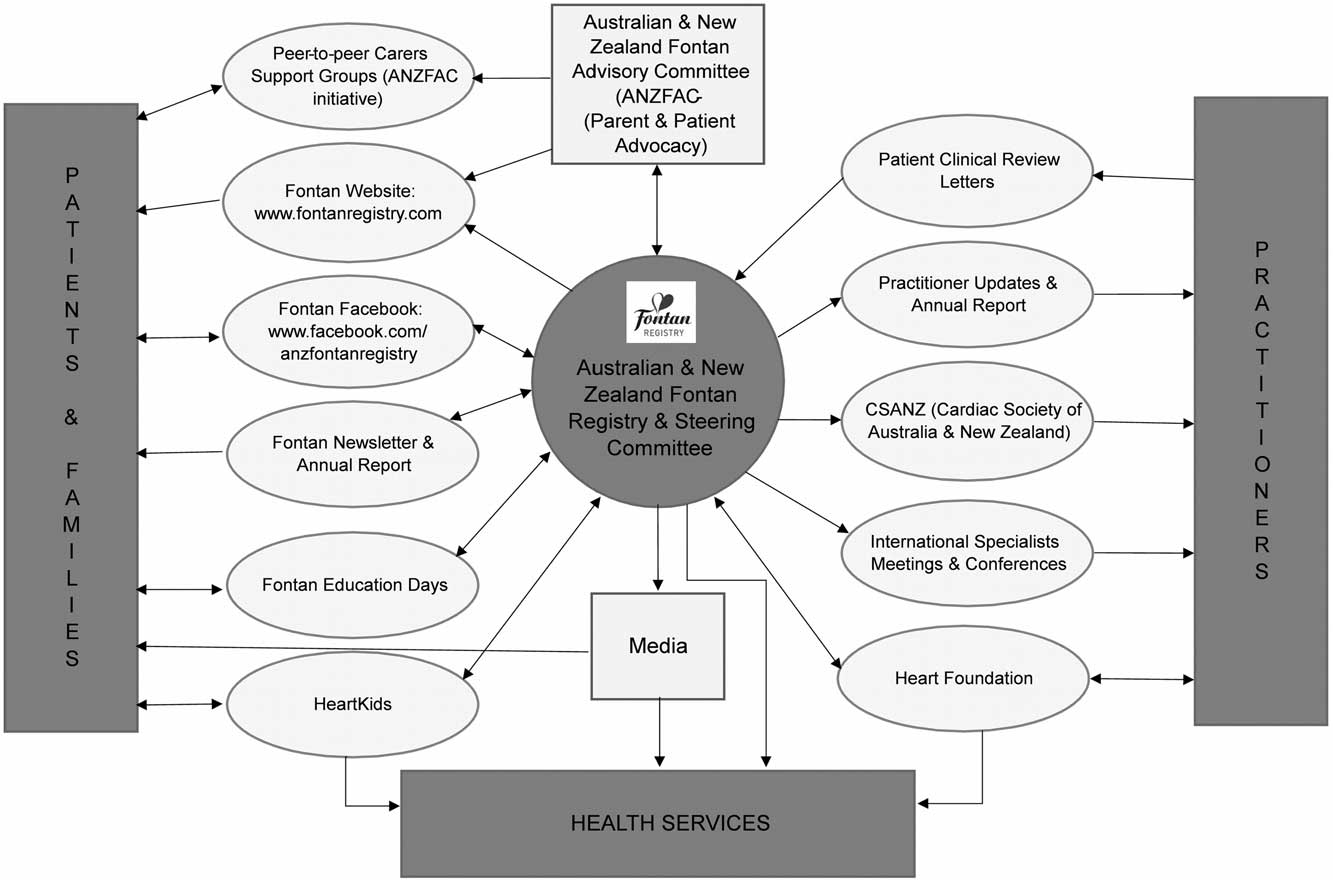
In 2014, a partnership was created under the umbrella of the National Health and Medical Research Council (NHMRC), the Australian National funding agency. It brought together all paediatric and adult hospitals involved in the treatment of CHD, the National Heart Foundation, and HeartKids – the parents’ association for CHD. Over time, several lines of communications were established between the Registry, the patients, and the representatives of the health system and support organisations, with the Registry acting as a central conduit between these stakeholders (Fig 1).
Consumer, practitioner and health service interactions with Fontan Registry research

Benefits of involving parents and patients in research
Safeguarding the project
The initial reason for involving patients and their families was to defend the project if any adverse event was reported or if public representation was necessary. This has not been the case so far and, unexpectedly, this benefit has been the least important.
Control the messages provided to the families
At the beginning of our project, some of the families involved had received very little information on the long-term outcomes expected after a Fontan surgery, and messages on survival came as an exceptional shock to some of these families. Our initial communication with the families, the extent of information provided, and the way it was worded were screened by the participants of the Registry Steering Committee. As a practical example, we progressively tried to stop using the phrase “Fontan patients” in favour of “children, adolescents and adults with a Fontan circulation” as most of these young patients feel healthy and are not defined by their CHD.
Adjust the investigations
The patient representatives have proven very useful in evaluating the feasibility of our studies in terms of type of studies, the best way to communicate with our consumers, and the research time-frame.
Building a community
The creation of the Facebook page, the education day, and the advocacy group have developed separate families into a community that exchanges their experiences and lobbies for improvement in their care. The peer-to-peer support provided by others who have been through a similar journey as themselves has been extremely helpful in improving well-being. It has been clear in other conditions that lobbying from the patient community was the best way to improve delivery of care, with the best example being from the cystic fibrosis community.Reference Stevens and Marshall 5 , Reference Siracusa, Weiland and Acton 6
Ideas for new research
One of the unexpected consequences of the improved relationship with our research participants has been the discovery of new avenues for research. By gathering a large community of patients, some previously unidentified issues surfaced. As an example, symptoms of migraines and leg cramps seem to be reported with an unexpected frequency. Both symptoms could be easily explained by increased systemic venous pressures and increased systemic vascular resistances, respectively.Reference Lambert, d’Udekem and Cheung 7 We also found that the delivery of our research along with the report of patients’ experiences gave a much clearer picture of the reality faced by our patients. By providing our patients with the opportunity to express themselves, some ideas emerged much more clearly. In particular, the benefits of exercise and the potential deleterious impact of cyanosis related to patent fenestrations were becoming intuitively more evident. In Australia and New Zealand, we also discovered that 40% of cardiologists see fewer than 5 Fontan patients. There is knowledge and expertise to be gained by seeing a large and diverse cohort of them at once that cannot be compared with any research undertaking.
Participation rate in research projects
The expected participation rate in a research project including invasive investigations that bear no potential of direct benefit for the patients has been reported to be limited to 10–19%.Reference Pickering, Kunkel, Fitton, Ashburn and Jenkinson 8 In a recent cross-sectional study of the liver and renal function in those patients, our participation rate reached 35%, and we had to turn away patients still wanting to participate because of a limited project budget, a fact that we attribute to the benefits of our close relationship with our Fontan community.
Increasing the weight of our work
In an era when patient involvement is increasingly recognised as primordial, and shortage of funding makes access to research even more difficult, our capacity to claim that our research is embraced and supported by the patient community strongly underlines the importance of our funding applications. This also creates more opportunities for research translation when it is closely connected to the patient community affected – an area in which funding providers are placing increasing importance. Research presentations have also been made to international cardiology meetings by medical students living with a Fontan circulation. These presentations are all the more powerful when they are given by some bright young individuals who themselves benefitted from this surgery.
Satisfaction
In our research, we all work to improve the patients’ outcomes, but this goal seems elusive and abstract at times when we are not in close contact with those who will benefit from our endeavours. Providing the results of research directly to those who participate in it, and to those who will benefit most from it, is an extraordinary experience that surpasses the delivery of a talk even at the most prestigious international meeting. We all share memories of giving a presentation to a half-empty room of peers who, for the most part, are struggling against unsurmountable boredom and sleepiness. How much more thrilling it is to deliver the same talk to a packed audience that is listening to every word you are saying? The perception of their enthusiasm, their support, and their gratitude is the reason we are performing this research.
In conclusion, working closely with the community of patients involved in the research presents numerous advantages. Not only will they be your advocates and your counsellors, they will also considerably increase the weight and relevance of your research, and provide you with unexpected satisfaction for the ungrateful work that your research can be. They are the reason why you undertake the research, and hence should be given their rightful due in your work.
Acknowledgements
The authors thank the Victorian Government’s Operational Infrastructure Support Program for support provided to the Murdoch Children’s Research Institute.
Financial Support
This work was supported by a NHMRC Partnership Grant (1076849). Yves d’Udekem. is a Clinician Practitioner Fellow of the National Health and Medical Research Council (NHMRC) (1082186).
Conflicts of Interest
Yves d’Udekem. is a consultant for the companies MSD and Actelion.