Introduction
Monorchiid trematodes are fish parasites that normally develop into sporocysts in marine bivalves (Lauckner, Reference Lauckner and Kinne1983; Cremonte et al., Reference Cremonte, Kroeck and Martorelli2001), and members of the genus Asymphylodora Looss, 1890 (subfamily Asymphylodorinae Szidat, 1943) have rediae that develop in gastropods (Lauckner, Reference Lauckner and Kinne1983; Našincová & Scholz, Reference Našincová and Scholz1994). The Asymphylodorinae have now been transferred to the Lissorchiidae (Madhavi, Reference Madhavi, Bray, Gibson and Jones2008). To date, 18 monorchiid cercariae that develop in sporocysts in bivalves have been described, and only two of them are from the southern hemisphere (Cremonte et al., Reference Cremonte, Kroeck and Martorelli2001; Gilardoni et al., Reference Gilardoni, Posadas, Kroeck and Cremonte2011), whereas the life cycles of seven species are known, all from the northern hemisphere (Martin, Reference Martin1940; Young, Reference Young1953; DeMartini & Pratt, Reference DeMartini and Pratt1964; Bartoli, Reference Bartoli1965; Maillard, Reference Maillard1975; Stunkard, Reference Stunkard1981a, b; Bartoli et al., Reference Bartoli, Jousson and Russell-Pinto2000). The metacercariae occur in marine environments, either in the same species of bivalve or in different bivalves, and the adults live in the intestines of teleost fish (see table 1 in Cremonte et al., Reference Cremonte, Kroeck and Martorelli2001).
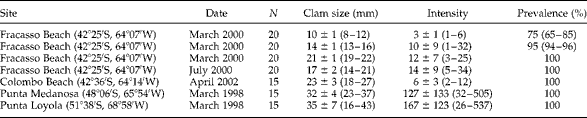
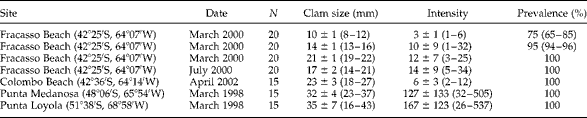
The prevalence (%) and intensity (± standard deviation) of metacercaria of Proctotrema bartolii from the incurrent siphon of the clam Darina solenoides collected along the Patagonian coast, Argentina; N=number of clams examined, with shell length in millimetres given as ± standard deviation and the numbers in brackets representing ranges.
The presence of adult monorchiids in the south-western Atlantic Ocean has been described in teleost fish from Brazil (Amato, Reference Amato1982; Kohn et al., Reference Kohn, Fernandes and Cohen2007), the Patagonian coast of Argentina, and Antarctic sub-Antarctic waters (Szidat, Reference Szidat1950; Gosztonyi, Reference Gosztonyi1979; Zdzitowiecki, Reference Zdzitowiecki, Wägele and Sieg1997; MacKenzie, Reference MacKenzie2003; Carballo et al., Reference Carballo, Laurenti and Cremonte2011). Proctotrema bartolii Carballo, Laurenti & Cremonte 2011 (Monorchiidae) was described in natural and experimental adults obtained from the silversides Odontesthes smitti and Odontesthes nigricans (Pisces: Atherinopsidae) and the mullet Eleginops maclovinus (Eleginopidae) at the San José Gulf and Nuevo Gulf on the Patagonian coast.
The clam Darina solenoides (King & Broderip, 1832) (Mactridae) was reported as suspected to act as the first and second intermediate hosts of P. bartolii (Carballo et al., Reference Carballo, Laurenti and Cremonte2011). Indeed, one of the most fundamental characteristics of a parasite is the spectrum of host species used at each stage in its life cycle; however, this information is not available for many parasite species (Combes, Reference Combes2001). Certain species show a marked specialization for one host or very few hosts, particularly if the ecosystem in which they live offers numerous taxonomically related species to exploit (Rhode, Reference Rhode1993). The aims of the present work were to elucidate the life cycle of P. bartolii at San José Gulf (type locality) on the Patagonian coast and to identify the spectrum of hosts that could be involved. The geographic distribution of P. bartolii is also provided.
Materials and methods
Study site and geographical distribution
Fracasso Beach (42°25′S, 64°07′W) is located on the south-east coast of the San José Gulf, Península Valdés, Chubut Province, Argentina. Península Valdés is a Protected Provincial Area and was declared a Natural Human Patrimony site (UNESCO). Darina solenoides is the dominant invertebrate of the intertidal zone at Fracasso Beach (Hernández et al., Reference Hernández, Bala and Musmeci2008) and is distributed in the south-western Atlantic Ocean from the San Matías Gulf throughout the Magellan Region (Carcelles, Reference Carcelles1950). Other significant components of the invertebrate assemblages are the clam Tellina petitiana d'Orbigny, 1845 (Tellinidae), which inhabits the lower intertidal level, the gastropod Buccinanops globulosus (Kiener, 1834) (Nassariidae), and the polychaetes Glycera americana Leidy, 1855 (Glyceridae), Travisia sp. (Opheliidae) and Laeonereis acuta (Treadwell, 1923) (Nereidae) (Zaixso et al., Reference Zaixso, Lizarralde, Pastor, Gomes-Simes, Romanello and Pagnoni1998; Hernández et al., Reference Hernández, Bala and Musmeci2008). Silversides are present along the coast throughout the year and the mullet mainly in the autumn, when they are caught by artisanal fishermen using coastal nets.
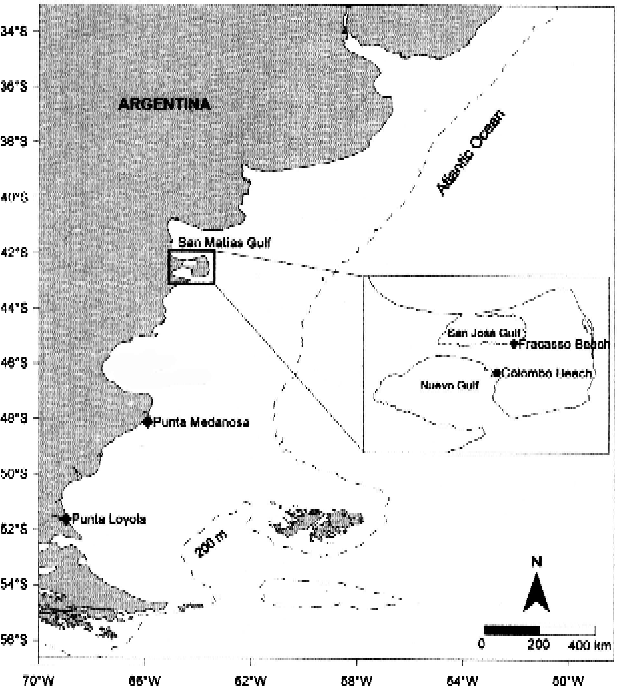
To determine the geographic range of P. bartolii, samples of D. solenoides were collected at the following locations: Colombo Beach (42°36′S, 64°14′W), Nuevo Gulf; Punta Medanosa (48°06′S, 65°54′W), and Punta Loyola (51°38′S, 68°58′W) in Santa Cruz Province (fig. 1). These sites encompass almost the entire distribution area of D. solenoides. The clams were immediately fixed in 10% seawater formalin and examined using a stereomicroscope. The number of metacercariae was recorded. The maximum shell lengths of clams were measured with a calliper and the prevalence and the intensity of infection (only in the incurrent siphon) were calculated for each locality. The intensity of infection between localities was compared with a Kruskall–Wallis test and pairs comparison. In all cases, the parasitological indices of Bush et al. (Reference Bush, Lafferty, Lotz and Shostak1997) were used.
Map showing the distribution of Proctotrema bartolii (Digenea: Monorchiidae) along the Patagonian coast, Argentina; the area in the rectangle (Península Valdés) is enlarged on the right.

Study of intramolluscan stages
The specimens of D. solenoides were collected in August 1999, March 2000, July 2000, and monthly from November 2001 to November 2002 (except May). About 200 clams were collected on each occasion. The cercariae were studied from emitted specimens. The larvae (sporocysts, cercariae and metacercariae) were studied in vivo using both neutral red and Nile blue stained and unstained specimens. The larvae were killed with heated seawater and were immediately fixed with 10% formalin, preserved in 70% ethanol and stained with Semichons's acetocarmine. After being cleared with creosote, the larvae were mounted in Canada balsam and measured. Drawings were made with the aid of a camera lucida, and the measurements are given in micrometres (μm), followed by the range in parentheses. Some of the fixed metacercariae were dehydrated and dried by rinsing for a few minutes in hexamethyldisilazane. The metacercariae were then gold-coated for observation; the samples were photographed using a Jeol JSM-6460LV scanning electron microscope (SEM).
The sporocysts, cercariae and metacercariae of P. bartolii and whole, parasitized D. solenoides from the sampled localities were deposited in the Parasitological Collection, Centro Nacional Patagónico (CNP-Par 02-05), Puerto Madryn, Argentina.
Prevalence, behaviour and site of infection of intramolluscan stages
For each clam collection, approximately 200 clams were maintained in individual flasks for the observation of cercarial emission. Those clams emitting cercariae were used as the sources of the infective material. The clams were exposed to light to stimulate the emission of cercariae, and the penetration behaviour of cercariae was observed using a stereomicroscope.
The prevalence of P. bartolii sporocysts and metacercariae was calculated for 60 specimens of D. solenoides, and the samples were sorted according to three size classes of shell length (8–12, 13–16 and 17–23 mm). Several specimens were dissected under a stereomicroscope to establish the precise location of the sporocysts and metacercariae in the host. The soft parts of five whole infected clams were fixed in Davidson's fixative, stored in 70% ethanol, and later dehydrated, embedded and sectioned (thickness 5–7 μm) following standard histological protocols. The sections were stained with Harris's haematoxylin–eosin. To establish the precise location of the metacercariae, a total of 60 clams were dissected, and the metacercariae were counted in each affected organ. The intensity of metacercarial infection in the incurrent siphon among three size classes of shell length (8–12, 13–16 and 17–23 mm) was compared with a Kruskal–Wallis test and pairs comparison.
Six uninfected clams were selected for experimental infection in July 2000 (the clams that did not emit cercariae) and were exposed to a great quantity of emitted cercariae; the clams were dissected after 48 h for the metacercariae, which were then measured and counted. Because the prevalence of metacercariae was 100%, it was not possible to obtain uninfected individuals. Therefore, the intensity of infection in 20 naturally infected clams of the same size (average of 17 mm, range of 14–21 mm) and date of collection (July 2000) was calculated and then compared with the intensity of those experimentally obtained, using a Kruskal–Wallis test.
Macroinvertebrates as the second intermediate hosts
To establish the existence of other macroinvertebrates acting as the second intermediate host for P. bartolii, samples of T. petitiana (n= 167; August 1999, March 2000 and December 2001), B. globulosus (n= 61; April 2001), G. americana (n= 56; August 1999, April 2001 and December 2001), Travisia sp. (n= 86; August 1999, April 2001 and December 2001) and L. acuta (n= 17; April, 2002) were collected. The specimens were immediately fixed in 10% seawater formalin, stored in 70% alcohol and examined for parasites. Moreover, an experimental infection was performed by placing a large number of cercariae in a small flask with one specimen of each species (five replicates) and then dissecting after 48 h to identify the metacercariae. To determine the location and the effects of the metacercariae, three individuals of G. americana were dissected using a stereomicroscope. The soft parts were fixed in Davidson's fixative, stored in 70% ethanol, and later dehydrated, embedded and sectioned (thickness 5–7 μm) following standard histological protocols. The sections were stained with Harris's haematoxylin–eosin.
Results
Study area and geographical distribution
Proctotrema bartolii was present in all of the sites sampled, which extend through almost the entire distribution range of D. solenoides (fig. 1). Table 1 shows the prevalence and intensity of infection at the different localities. The intensity of metacercarial infection and the clam size were higher in the southern localities (Punta Medanosa and Punta Loyola) than in the type locality, Fracasso Beach, which is located at the northern limit of the distribution (H= 48.76; P< 0.0001). The clams from Colombo Beach had the lowest intensity of metacercarial infection, but did not present significant differences with Fracasso Beach (P= 0.23). The differences between the two southern localities (Punta Medanosa and Punta Loyola) were not significant (P= 0.47).
Description of intramolluscan stages
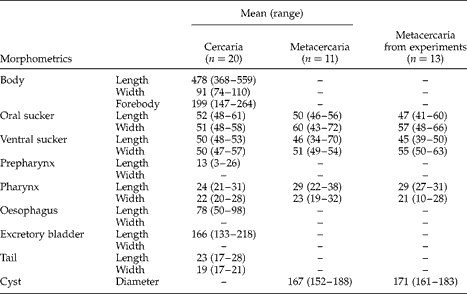
Measurements are given in table 2.
Mean measurements (μm) of cercariae and metacercariae of Proctotrema bartolii, with the range of measurements given in brackets; n=number of larval stages measured.
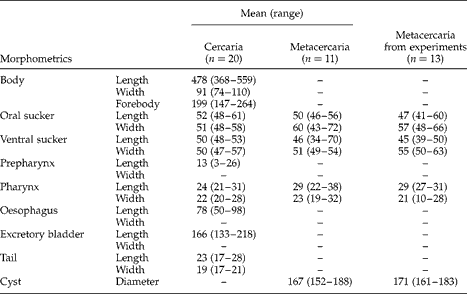
Measurements of sporocysts (n= 10): body length, 1551 (760–7300); body width, 235 (180–290). Forebody is the distance from the anterior body end to the anterior edge of the ventral sucker.
Sporocysts
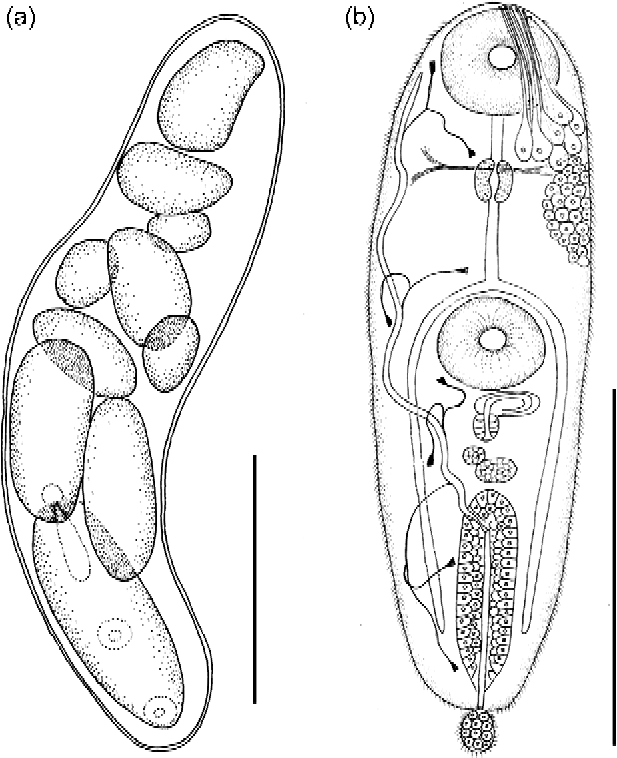
Microcercous cercariae develop in colourless, immobile, thick-walled sporocysts (fig. 2a). Eight to 14 cercariae (average: 10) at different developmental stages were found in each sporocyst.
Line drawings of the larval stages of Proctotrema bartolii (Digenea: Monorchiidae) that are parasitic in the clam Darina solenoides from the Patagonian coast: (a) sporocyst; (b) cercaria, ventral view, the flame cells of the left side are omitted, the penetration glands of the right side are omitted. Scale bars: (a) 300 μm; (b) 200 μm.
Cercariae
Elongated body (fig. 2b). Tegumental spines in transverse rows, same sizes for all body lengths. Seven pairs of penetration glands. Oral sucker opening subterminally. Ventral sucker equatorial. Sucker ratio 1:1. Caeca reaching almost to the end of body. Prominent cystogenous cells scattered through body parenchyma. Genital primordia present, located between ventral sucker and end of excretory vesicle. Testis ovoid, located anteriorly to excretory vesicle. Ovary pretesticular. Excretory bladder I-shaped, with thick wall and narrow lumen, open dorsally, subterminally at end. Flame cell formula: 2 [(2+2)+(2+2)] = 16. Tiny knob tail, spiny.
Metacercariae
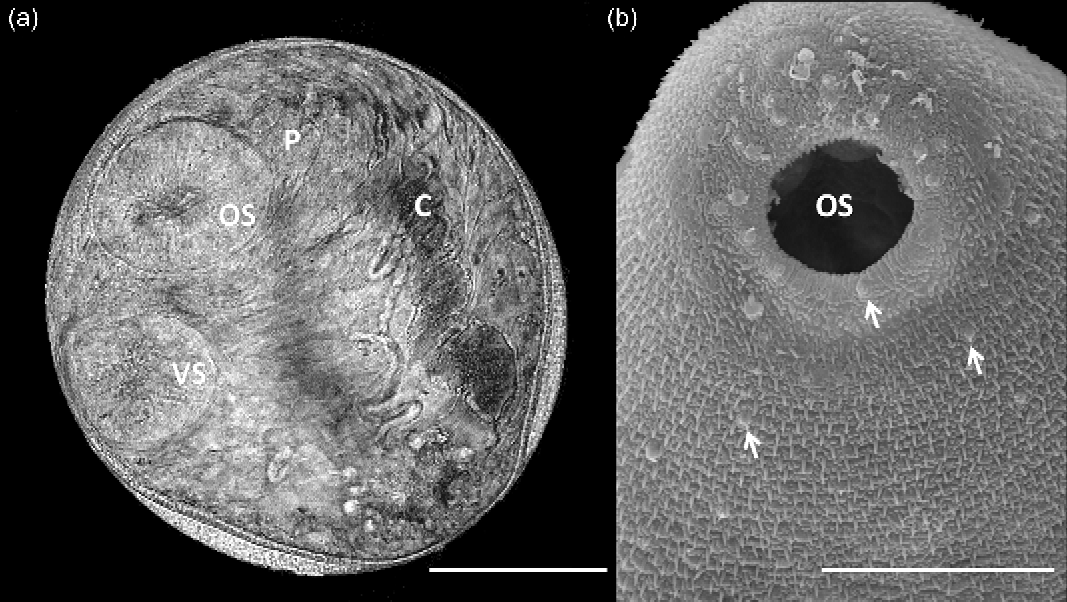
Cyst (fig. 3a) rounded, translucent and membranous. The metacercariae excyst (fig. 3b) when applying pressure to the coverslip. Tegumental spines in transverse rows, same sizes for all body lengths. Inner circle of approximately ten papillae in oral sucker and approximately six papillae in ventral sucker (only observed by SEM; fig. 3b). Three longitudinal rows of papillae distributed ventrally from anterior end to ventral sucker level. Genital primordia as in the cercariae.
Metacercaria of Proctotrema bartolii (Digenea: Monorchiidae) that are parasitic in the clam Darina solenoides from the Patagonian coast: (a) encysted metacercaria in vivo; (b) excysted metacercaria by SEM. Abbreviations: C, caeca, OS, oral sucker; P, pharynx: VS, ventral sucker; the white arrows indicate papillae. Scale bars: (a) 100 μm; (b) 20 μm.
Prevalence, behaviour and site of infection of intramolluscan stages
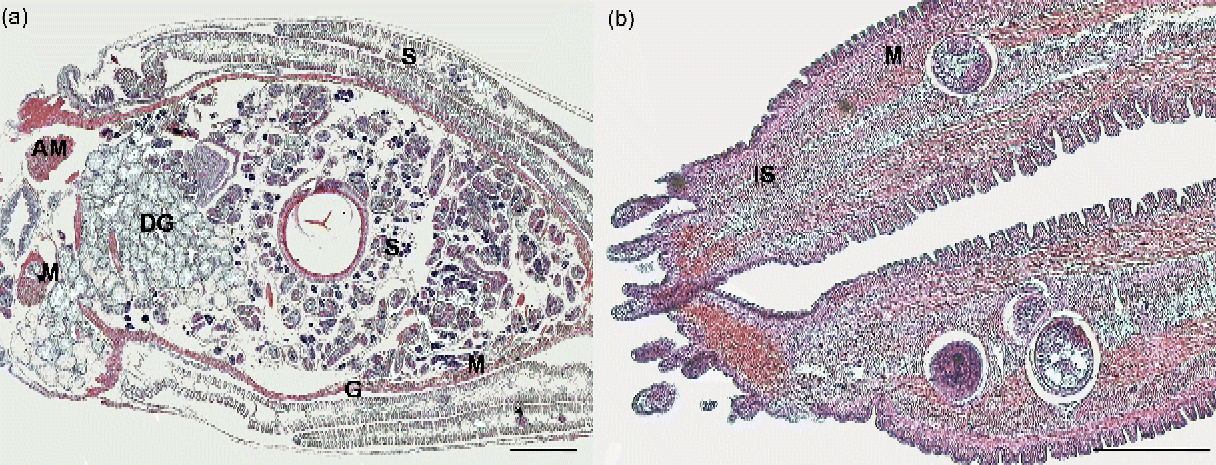
Proctotrema bartolii utilizes only the clam D. solenoides as both the first and second intermediate hosts in the natural environment. The overall prevalence of sporocysts was 5% (5% in clams 8–12 mm long, 0% in clams 13–16 mm long and 10% in clams 17–23 mm long). The sporocysts with cercariae were located mainly in the gonad and also occupied the digestive gland and gills at high intensities (fig. 4a).
(colour online) Histological sections (haematoxylin and eosin stain) of the clam Darina solenoides from the Patagonian coast. (a) Sporocysts of Proctotrema bartolii in the gonad and gills, and metacercariae in the adductor muscle and gills. (b) Metacercariae of P. bartolii in the siphons. Abbreviations: AM, adductor muscle; DG, digestive gland; G, gill; IS, incurrent siphon; M, metacercaria; S, sporocyst; the black arrow shows a metacercaria in the gills. Scale bars: (a) 500 μm; (b) 100 μm.
The cercariae were expelled in a contracted form by the excurrent siphon one by one or in groups of two or more (up to 10). The cercariae then attached to the bottom of the flask via their minute tails, mainly to a particle or by adhering to each other, forming groups; the larvae moved by adhering their tails and their oral suckers. Some cercariae display a parabolic trajectory from the excurrent siphon, arriving directly at the incurrent siphon. Once they arrived at the exposed part of the mantle, the foot or the siphons, the cercariae adhered by their tails and then remained for a few minutes with the oral sucker on the tissue until they penetrated. They did not exhibit photo-orientation.
The prevalence of metacercariae increased with the size (H= 16.24; P< 0.0003) of the clams (table 1) and mainly affected the incurrent siphon (table 3). The intensity of infection in the incurrent siphon of the two bigger size classes (13–16 and 17–23 mm) did not present significant differences (P= 0.83), but these two presented significant differences with the small size class (8–12 mm) (P< 0.0001). The metacercariae were located to a lesser degree in the excurrent siphon, mantle, orbicular muscle, adductor muscles, gills and siphon retractor muscles (table 3, figs 4a and b).
The prevalence (%) of Proctotrema bartolii metacercariae per organ in three sizes of clams, Darina solenoides, at Fracasso Beach.

The experimental infections of D. solenoides exposed to the emitted cercariae resulted in a higher intensity and a different location of the metacercariae in comparison with the naturally infected clams. The intensity of infection in the incurrent siphon from experimentally infected clams presented significant differences from that of naturally infected clams (H= 13.33; P< 0.0003). After 48 h of infection, the mean intensity and range of the experimentally infected clams was 185 ± 61 (31–123), whereas the mean intensity and range from the naturally infected clams collected on the same day was 14 ± 9 (5–34). In the experimentally infected clams, 32% of the metacercariae were located in the incurrent siphon, 32% in the foot, 22% in the orbicular muscle, 10% in the excurrent siphon, 1.4% in retractor muscle of the siphon, 0.18% in the border mantle muscle and 0.6% in adductor muscle. In contrast, 78% of the metacercariae were in the incurrent siphon, 13% in the foot, 3% in orbicular muscle, 5% in the excurrent siphon, 0.7% in the border mantle muscle and 0.35% in retractor muscle of the siphon in the naturally infected clams.
Macroinvertebrates as second intermediate hosts
All of the examinations for the natural infections and the attempts to obtain experimental infections in the gastropod B. globulosus and the polychaetes Travisia sp. and L. acuta were negative. In the case of the clam T. petitiana, seven out of nine individuals exposed to emitted cercariae became infected: metacercariae were found in the incurrent and excurrent siphons, mantle and foot. In the case of the polychaete G. americana, three individuals from the five exposed to the emitted cercariae became infected. In the histological sections, the metacercariae were found mainly in the parapods and also in the coelom, with a strong haemocyte host reaction.
Discussion
Proctotrema bartolii uses the clam D. solenoides (Mactridae) as the first and second intermediate hosts in the waters along the Argentinean Patagonian coast. The cercariae possess a tiny knob tail and are only capable of crawling. The larvae are expelled by the excurrent siphon and enter the same individual or others of the same species, encysting as metacercariae mainly in the tip of the incurrent siphon. The adults develop in the silversides O. smitti and O. nigricans (Pisces: Atherinopsidae) and in the mullet E. maclovinus (Eleginopidae), which acquire the infection by ingesting the siphons of D. solenoides or the entire clam. Experimental infections with the metacercariae of P. bartolii in the siphons of D. solenoides and the development and maturation of the juveniles in Odontesthes spp. and E. nigricans were successful (Carballo et al., Reference Carballo, Laurenti and Cremonte2011).
Cremonte et al. (Reference Cremonte, Kroeck and Martorelli2001) have summarized the life cycles of the monorchiid species known around the world. According to the four established morphological groups of monorchiid cercariae (Cremonte et al., Reference Cremonte, Kroeck and Martorelli2001), the cercariae of P. bartolii belong to group 4 because they possess a tiny knob tail and do not have ocelli. Other cercariae belonging to this group are Cercaria caribbea XXXVI Cable, 1953, Lasiotocus minutus (Manter, 1931), Lasiotocus elongatus (Manter, 1931) and Monorchiid cercaria sp. (Cable, Reference Cable1956; Holliman, Reference Holliman1961; Stunkard, Reference Stunkard1981a, b; Cremonte et al., Reference Cremonte, Kroeck and Martorelli2001). The cercariae described herein can be distinguished from those of L. minutus because the latter has a sac-shaped excretory vesicle and its ventral sucker is smaller than the oral sucker (sucker ratio 1:0.75 versus 1:1) (Stunkard & Uzmann, Reference Stunkard and Uzmann1959; Stunkard, Reference Stunkard1981a). The cercariae described in the present report can be distinguished from those of C. caribbea XXXVI and L. elongatus because of the smaller body sizes of the latter (276 μm C. caribbea XXXVI, 180–210 μm L. elongatus and 478 μm P. bartolii). In addition, C. caribbea XXXVI has a long and sinuous prepharynx with longitudinal muscles (Cable, Reference Cable1956; Holliman, Reference Holliman1961; Stunkard, Reference Stunkard1981b). Finally, the cercariae of P. bartolii differ from the unidentified monorchiid cercaria described by Cremonte et al. (Reference Cremonte, Kroeck and Martorelli2001) because the latter have a long excretory vesicle reaching the oral sucker level and the ventral sucker is located in the anterior part of the body. Additionally, the metacercariae described in the present report can be distinguished from those of L. minutus and Monorchiid cercaria sp. because the latter have a gelatinous, sticky sac that surrounds the cyst with two adhesive elongations. In contrast, L. elongatus individuals lack such elongations but have smaller cysts (70–75 μm in diameter versus 152–188 μm).
The 18 known monorchiid species cercariae develop in bivalves belonging to the Order Veneroida (Cremonte et al., Reference Cremonte, Kroeck and Martorelli2001). The life cycle of P. bartolii is very similar to those of Monorcheides cumingiae, Postmonorchis donacis and Paratimonia gobii because the cercariae are expelled by the excurrent siphon, re-enter the same individual or others of the same species and encyst as metacercariae mainly in the incurrent siphon (Martin, Reference Martin1938, Reference Martin1940; Young, Reference Young1953; Stunkard, Reference Stunkard1974; Maillard, Reference Maillard1975; Bartoli, Reference Bartoli1984). Furthermore, in L. longicystis, for which cercariae have not been described, the metacercariae are mainly located in the incurrent siphon (Bartoli, Reference Bartoli1965).
Proctotrema bartolii uses only the clam D. solenoides as the first and second intermediate hosts and the fish O. smitti, O. nigricans and E. maclovinus as its definitive hosts in its natural environment. Sporocysts with cercariae were found at a low prevalence (5%) on the first intermediate hosts. In the naturally infected clams, the intensity of metacercarial infection was 78% higher in the incurrent siphon than in the other organs affected. However, the intensity of metacercarial infection was more uniform in all of the affected organs in the experimentally infected clams. It is evident that metacercariae can encyst in any muscular tissue of their host. Yet, the accumulation of metacercariae in the incurrent siphon has ecological implications: a siphon filled with metacercariae seems to be less contractile than a healthy siphon and, consequently, more exposed to the fish that are browsing the clam siphons.
With regard to the other macroinvertebrates that share the beach with D. solenoides, the clam T. petitiana and the polychaete G. americana became experimentally infected by the metacercariae; however, these hosts are not naturally parasitized: D. solenoides is found over a large extent of the intertidal zone, whereas T. petitiana is restricted to the lower intertidal zone (where D. solenoides is not present) (see Figure 1 in Cremonte, Reference Cremonte2004). Taking into account that the cercariae have a tiny knob and are only capable of crawling, they seem to be incapable of infecting of T. petitiana.
The metacercariae enter G. americana successfully, but the polychaete produces a highly haemocytic reaction in the invaded tissues that is capable of destroying the metacercariae. This polychaete is distributed in all of the intertidal Darina zones (Table 1 in Cremonte, Reference Cremonte2004) and serves as food for coastal silversides (Carballo, Reference Carballo2008). Combes (Reference Combes2001) explained the mechanism responsible for the formation of host ranges, proposing the ‘filters’ concept. The probability that the encounter and compatibility filters will be opened exactly to the same degree in two or more host species is very low. In the case of T. petitiana, the compatibility filter is opened, but the encounter filter is closed because the intertidal zones do not overlap. In the case of G. americana, the encounter filter is open, but the compatibility filter is closed, and the parasite–host association does not exist. Furthermore, the polychaete is capable of eliminating the parasite through its defence mechanisms.
Darina solenoides is located in isolated intertidal populations along its range on the Patagonian coast, wherever fine sand flats occur. The parasite (metacercariae on the incurrent siphon) was found at all of the sampled beaches from Fracasso Beach (42°25′S, 64°07′W) to Punta Loyola (51°38′S, 68°58′W), with prevalences ranging from 75 to 100%. Proctotrema bartolii seems to be an endemic parasite of the fauna of the Magellan Province and is distributed where its intermediate host (the clam) is present. Fracasso Beach is located in the northernmost part of the distribution area of D. solenoides (fig. 1), as evidenced by the smaller sizes of the clams and the lower intensities of parasite infections when compared with the situation in the southernmost sites (table 1).
This work is the first description of the life cycle of a monorchiid digenean and a Proctotrema sp. in the southern hemisphere. The metacercariae encyst in the substratum in three of the nine monorchiid species for which the life cycles are partially or completely known; in eight cases, the metacercariae encyst in the same venerid and in other clam species. It seems that the strategy of parasitizing the bivalve siphons was widely adopted in the monorchiids that are successfully transmitted to fish acting as the definitive hosts (Martin, Reference Martin1940; Young, Reference Young1953; Bartoli, Reference Bartoli1965; Maillard, Reference Maillard1975). The life cycle of P. bartolii is characterized for a narrow spectrum of intermediate hosts, exhibiting both morphological and behavioural adaptations to enhance the transmission of the parasite.
Acknowledgements
The authors thank Joaquín Pardiñas and Ema Klaich for their help in the field. We also thank Laura Gonzalez and Marianne Watts for their reviews and the improvement of the manuscript after their suggestions. The field work was conducted in a Protected Natural Area of Chubut Province with permits from the Secretaría de Turismo y Areas Protegidas. The authors are members of the Consejo Nacional de Investigaciones Científicas y Técnicas (CONICET). This work was funded by ANPCyT (PICT 01374-Préstamo BID) and PIP CONICET to F.C.