Del Giudice's model of different reproductive strategies for females versus males hinges critically on the assumption that boys show more avoidant attachments and girls more ambivalence in the developmental period after early childhood. Attachment research in infancy and early childhood did not detect gender differences, whereas, according to Del Giudice in the target article, the picture changes “dramatically” in middle childhood. The question we address here is: Does the picture indeed change, and if so, in what respect?
Del Giudice lists seven studies to document this radical change. The three studies using the Coping Strategies Questionnaire (CSQ) should, however, be discounted as sources of evidence because patterns of attachment behavior and mental representations of attachment cannot be validly assessed by means of self-reports. Children as well as parents lack insight into their own attachment interactions and relationships, in particular when they are insecurely attached. Their insecurity distorts their self-perception (for meta-analytical evidence, see Van IJzendoorn et al. Reference Van IJzendoorn, Vereijken, Bakermans-Kranenburg and Riksen-Walraven2004).
Four pertinent studies remain (Del Giudice, in press; Granot & Mayseless Reference Granot and Mayseless2001; Kerns et al. Reference Kerns, Abraham, Schlegelmilch and Morgan2007; Toth et al., personal communication, October 19, 2007). Only the Kerns et al. (Reference Kerns, Abraham, Schlegelmilch and Morgan2007) study produced results contrasting with Del Giudice's model, showing that female 9–11-year-olds were more often classified as avoidantly attached relative to male participants. The other studies pointed to the expected direction of insecure boys being more often avoidant and insecure girls more often ambivalent.
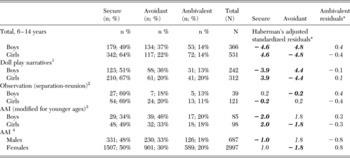
In our Leiden Attachment Research Program, we assessed quality of attachment in two studies on 7-year-old children (Gilissen et al. Reference Gilissen, Bakermans-Kranenburg, Van IJzendoorn and Linting2008; Pannebakker Reference Pannebakker2007), and in one study on 14-year-olds (Beijersbergen et al., in press). Furthermore, after a brief literature search, we found pertinent studies by Ammaniti et al. (Reference Ammaniti, Van IJzendoorn, Speranza and Tambelli2000), Bureau et al. (Reference Bureau, Beliveau, Moss and Lepine2006), and Gloger-Tippelt and Koenig (Reference Gloger-Tippelt and Konig2007) on children aged 6–10 years. Following on Del Giudice's focus on the secure, avoidant, and ambivalent categories, we excluded the category of disorganized attachment, or used forced classifications when available. The combined distribution of secure, avoidant, and ambivalent attachments across all samples (including those discussed by Del Giudice) is 49% secure, 37% avoidant, and 14% ambivalent attachments for boys. For girls, the distribution is 64% secure, 22% avoidant, and 14% ambivalent attachments (see Table 1). Haberman's adjusted standardized residuals show significant differences between boys and girls for the secure (fewer boys) and the avoidant (more boys) classifications, but not for the ambivalent classification.
Distributions of attachment in middle childhood and adulthood

* Significant adjusted standard residuals in bold
1 Del Giudice (Reference Del Giudice2008); Gilissen et al. (Reference Gilissen, Bakermans-Kranenburg, Van IJzendoorn and Linting2008); Gloger-Tippelt et al. (Reference Gloger-Tippelt and Konig2007); Granot & Mayseless (Reference Granot and Mayseless2001); Kerns et al. (Reference Kerns, Abraham, Schlegelmilch and Morgan2007); Toth et al. (2006)
2 Bureau et al. (Reference Bureau, Beliveau, Moss and Lepine2006); Pannebakker (Reference Pannebakker2007)
3 Beijersbergen et al. (in press); Ammaniti et al. (Reference Ammaniti, Van IJzendoorn, Speranza and Tambelli2000)
4 Van IJzendoorn & Bakermans-Kranenburg (in preparation)
Dividing the studies according to their assessment procedures (doll play narratives based on Bretherton et al. Reference Bretherton, Ridgeway, Cassidy, Greenberg, Cicchetti and Cummings1990; Cassidy Reference Cassidy1988), observations of separation/reunion (Main & Cassidy Reference Main and Cassidy1988), and modified Adult Attachment Interview (AAI; Hesse Reference Hesse, Cassidy and Shaver1999; Main et al. Reference Main, Kaplan, Cassidy, Bretherton and Waters1985), we only found gender differences in the set of studies using narratives (see Table 1). Apparently, the gender effect is measurement-specific, and systematic errors of measurement might be the source of these differences. Narrative procedures might focus more on content than on coherence, contaminating formal avoidance with substantive “macho” accounts. In addition, differences in verbal abilities between boys and girls in this age group may play a role (Verschueren & Marcoen Reference Verschueren and Marcoen1999). It should be noted that in Granot and Mayseless' (2001) study, secure children (mostly girls) had significantly higher scores on cognitive achievement, and avoidant children (predominantly boys) had the lowest scores on cognition.
Furthermore, the gender difference in studies with doll play narratives is restricted to boys showing more avoidant attachments, and not less or more ambivalence than girls. In the narrative approach, boys do follow the predicted pathway of avoidance, but girls do not prefer the ambivalent attachment strategy (see Table 1). In the observational studies, no gender differences in middle childhood have been documented. In the two studies using the AAI, boys were only slightly under-represented in the secure category and were not significantly over-represented in one of the insecure categories (Table 1).
It should be noted that numerous studies on attachment representations in adulthood using the Adult Attachment Interview – the gold standard for assessing attachment representations, which is independent of cognitive abilities (Hesse Reference Hesse, Cassidy and Shaver1999) – have not come up with any replicable gender differences in dismissing versus preoccupied attachments. In a meta-analysis of studies using the AAI (Van IJzendoorn & Bakermans-Kranenburg Reference Van IJzendoorn and Bakermans-Kranenburg1996), and in a recent update (Van IJzendoorn & Bakermans-Kranenburg Reference Van IJzendoorn, Bakermans-Kranenburg, Steele and Steele2008; in preparation), we traced 17 studies on 687 males and 59 studies on 2997 females (mostly parents of reproductive age). The distribution of males was 33% dismissing, 48% secure, and 18% preoccupied attachments, while the distribution of females was 30% dismissing, 50% secure, and 20% preoccupied attachments. No significant gender difference was found (see Table 1).
We conclude that Del Giudice's model has a brittle empirical basis. We did not find systematic and method-independent gender differences in middle- or late-childhood attachments, nor were any gender differences in adulthood present in studies using the gold standard to assess attachment representations. The speculative model badly needs some repairs to accommodate with an obstinate empirical reality.