A considerable degree of controversy surrounds the date and significance of sites of broadly Christian character of c ad 400–1000 in south-western Britain.Footnote 1 This frequently focuses on the morphology of known medieval parish churchyards, particularly their circular or oval shape. In conjunction with other evidence, this is taken to demonstrate their ‘Cornish’ or ‘Celtic’ character and/or their early date.Footnote 2 The thrust of the present paper is to suggest that a rather different picture emerges when the characteristics of a substantial range of potentially early medieval south-western Christian sites are taken together and examined in a broader geographical, topographical and historical context in conjunction with their morphology. This conclusion may also have a wider relevance for sites beyond the south west.Footnote 3
The study of such sites in the past has generally been confined geographically to the area of modern Cornwall. But, given the very fluid linguistic, cultural and political circumstances in the south west in this period, particularly the early part of it, any consideration of the development of early Christian sites must also involve that area east of the Tamar where such indications as the incidence of inscribed and decorated stones suggest the existence of an early medieval society comparable to that west of the river.Footnote 4 Accordingly, this paper addresses a substantial and geographically compact region of south-western Britain, defined by the present counties of Devon and Cornwall along with the Archdeaconry of Taunton, in west Somerset.
Topographically, this region possesses large areas of upland, such as Dartmoor and Exmoor, and many smaller areas of rough grazing. Detailed evidence suggests that, in the earlier phases of the period, the territories occupied by most communities included scattered settlements and access to grazing, but that, as new and smaller estates were created, settlement and arable were consolidated in many areas, and special arrangements were then made for access to the moors.Footnote 5 A contrast thus developed between the older surviving patterns of scattered settlement, generally in the less agriculturally productive areas of woodland pasture, and the consolidated settlements with larger fields in the better land (although some of these may well have had an older base). The significance of this for the study will appear in due course.
Site Types and Chronology
A large range of sites is relevant to this enquiry, including not only medieval parish churches, but also unenclosed burial sites and chapel sites, because it is clear that many sites changed their characters during their long history, perhaps more than once.Footnote 6
Unenclosed or lightly enclosed sites
A range of unenclosed, or lightly enclosed, burial grounds came into and went out of use within the late Roman/post-Roman period, and probably on into the period up to ad 1000. Some of these were relatively large, while others consisted of one, two or three burials scattered across the landscape. Some have been claimed as Christian, such as Kenn (Devon), which had at least four mausolea and more than 300 regularly organized graves,Footnote 7 and Cannington (Somerset), which had a cemetery with regular burials and a focal grave,Footnote 8 but there is no direct evidence for Christian practice at either site. The only certain Christian site is that at Carnsew (Cornwall), a characteristic late Roman inhumation burial within a small enclosure with an inscribed stone that could date to the late fifth or very early sixth century. Overall, then, sites of this type suggest a broad cultural mix.
Evidence for the dating of unenclosed burial grounds in Devon and Cornwall is scanty.Footnote 9 The graveyard at Kenn gave radiocarbon dates suggesting use from the fifth to the eighth centuries,Footnote 10 and Cannington seems to fit within this broad range.Footnote 11 Such dating fits with the broader picture given by similar sites, such as Henley Wood (Somerset),Footnote 12 and Tandderwen (Clwyd) and the Atlantic Trading Estate (Glamorgan).Footnote 13 The tradition clearly continued for a long time. The hamlet at Mawgan Porth (Cornwall), of tenth- to eleventh-century date, had its own cist grave plot, with separate areas for adults and infants, and no evidence for Christian observance.Footnote 14
Enclosed burial grounds
Although as a group these sites may overlap chronologically with unenclosed or lightly enclosed burial grounds, visually there is a sharp contrast. Enclosed sites clearly have a relationship to the development of the parochial system, in place by about ad 1100. Virtually all parish churches possess enclosed burial grounds today, and seem to have done so for a considerable period. The number of parish churchyards in being by ad 1100 is unclear, however, and parishes were certainly formed after this date, though sites elevated to parochial status post-1100 may already have been in use for unofficial burial for some time, which is why all the parishes in existence by 1950 have been included in this study. In Cornwall there are 213 relevant sites, including seven on Scilly; in Devon there are 454, including Lundy but excluding those inside and immediately adjacent to Exeter's city walls; and in the Archdeaconry of Taunton, there are 174.Footnote 15
Excavated information relating to the origins of parish churchyards is sparse, largely for the obvious reason that most are still in use. A substantial cemetery of mixed dug and cist graves has been excavated just south of the Wadebridge to Delabole road, although its detailed relationship to the Norman parish church of St Endellion (Cornwall), just north of the road, is not clear.Footnote 16 Burials have been found from time to time north of the churchyard at Phillack (Cornwall), which possesses a possibly early chi-rho carving,Footnote 17 and where the yard gateway produced a fragment of sixth-century African slip ware.Footnote 18 St Materiana, the parish church of Tintagel (Cornwall), and St Carantoc, at Crantock (Cornwall), may have their roots in similar graveyards, but there was no dating evidence.Footnote 19
The earliest documentary evidence bearing on parish graveyards appears in the tenth-century text preserved in the Vatican Library (ms Reginensis Latinus 191),Footnote 20 which implies that a number of graveyards, probably including churches, existed by then.
Monastic sites
Some enclosed sites functioned as religious communities, recognizable as such by their collegiate character, by records of their landed endowments and by references to church-scot (payments for the support of the clergy) and burial fees.Footnote 21 The known group is unlikely to be complete.Footnote 22 These houses are a very mixed group and throughout their lives they all followed a variety of practices. Here they will all be called ‘monasteries’ for want of a better collective word.Footnote 23
It is generally considered that the earliest monasteries were those created by British speakers, although it does not follow that all such British houses are older than all English ones. They are often assumed to have begun in the sixth century, following the First Life of St Samson, which seems to include information deriving from the late sixth or early seventh centuries, but this cannot be demonstrated.Footnote 24 Very little is known about their internal history up to the point when their lands began to be of interest to West Saxon kings. Probably they differed considerably in origin and in history and we do not know what, if any, pastoral duties they undertook. It is important to recognize that British establishments were founded east of the Tamar. There are probable sites at Stoke St Nectan and Braunton (north Devon), Watchet, Congresbury, probably Glastonbury and perhaps Banwell (Somerset) and at Sherborne (north Dorset).Footnote 25
West Saxon kings and bishops (and sometimes people not even at this social level) started to found monasteries in east Devon and Somerset after around ad 600. Again, very little is known of the character and history of all but the most important of these. The earliest monastery founded by Anglo-Saxon speakers in the region is perhaps that at Exeter in ad 670,Footnote 26 and new foundations, and some re-foundations, continued to be made across the area throughout the seventh to tenth centuries, if not later.
Glastonbury,Footnote 27 Congresbury,Footnote 28 St Michael's MountFootnote 29 and Padstow (Cornwall)Footnote 30 have all seen programmes of excavation, and have all produced imported post-Roman pottery fragments (in some quantity at Congresbury). The relevance of these finds to early ecclesiastical activity is unclear, although all these sites have claims to be considered early. Post-Roman cemetery sites are known at Watchet and Banwell,Footnote 31 but these are not on the sites of the later parish graveyards. Small-scale excavation at St Buryan (Cornwall) suggested that there were two or three phases in the boundary pre-dating the present wall. The earliest may have been the perimeter of an Iron Age/Romano-British enclosure, reused by the early church. When the wall was rebuilt in comparatively recent times, it was outside the old boundary and enclosed a larger space.Footnote 32
Some monasteries have a charter, or other documentary, evidence, of varying degrees of reliability, suggesting they were in existence before 900.Footnote 33 Many West Saxon monasteries lacked significant lands and were dependent instead upon the payment of legally required dues. Ine's Laws make it clear that church-scot was for this purpose,Footnote 34 and in the later tenth century the expectation was that such houses would still receive church-scot as well as some tithes. Possibly the monasteries endowed with land were among the earliest, with kings being reluctant to alienate such large amounts of land by the time the second generation was founded. The early involvement of these institutions in pastoral care cannot be taken for granted, but that probably did evolve over time at a large number.Footnote 35
Chapel sites
It is clear that there was once a large range of chapel sites across the peninsula.Footnote 36 In Cornwall, a substantial number survived, or were remembered long enough, to be recorded in the early decades of the twentieth century.Footnote 37 Mid-eighteenth-century records show that, at this date, Devon had over 100 such sites, surviving in part or in whole, or remembered locally,Footnote 38 and Somerset the same.Footnote 39 Many of these are clearly late medieval, but others are associated with poorly recorded finds of human remains, apparently Christian burials. Some had their own cultic practices and a few have early monuments or ancient-looking enclosures.
Dating evidence for chapel sites is very thin. Those at Trebelsue, St Columb Major, Penraine, St Minver, Constantine, St Merryn and Trevone (all Cornwall) were all near, and perhaps associated with, unenclosed burial sites, and so were those of Tean, Samson and Tresco (on Scilly).Footnote 40 Chapel sites with possible early features are poorly dated, with the exception of Merther-Uny Chapel, in Wendron parish (Cornwall), which has a ninth-/tenth-century cross and proved, on excavation, to have an enclosure probably of the same date.Footnote 41 Two chapel sites, at Trevarrick, in Lelant, and Bosworgy, in St Columb Major (both Cornwall), have inscribed stones, suggesting at least a sixth-century focus. St Blazey Gate (Cornwall) had a cemetery with a cross, and a number of examples have attached burials. In Devon, the chapel site at Revelstoke has what seems to be part of a tenth-century cross incorporated into its fabric.Footnote 42 Two Somerset sites, associated with St Reyne, at Windwhistle in Chard, and St Wite, at Whitedown, Cricket St Thomas, may possibly have a unique saint attached to them. These features strongly suggest that an unknown number (but perhaps many) later medieval chapel sites had originally been much more significant, and had acted as the principal Christian focus in their areas, with burial grounds and associated features.
Inscribed and decorated stones
Inscribed and decorated stones form the most substantial evidence bearing upon the dating of all these sites.Footnote 43 On balance, those with horizontal inscriptions probably belong to the late fifth or early sixth centuries and those with vertical filial inscriptions belong to the sixth, but continued into the seventh century, and possibly even later.Footnote 44 This usefully broad dating scheme will be used here.
Sites with datable stones are of mixed character.Footnote 45 The sites at Tresco and Tavistock (Devon) now show no signs of enclosure. Only one stone, at St Kew, is at a monastic site. Trevarrack (Cornwall) was a chapel site, but never became a parish church, and Bosworgy (Cornwall) may have been the same.Footnote 46 The rest are all parish sites. The site dedications are equally mixed: some, such as Cuthbert, at Cubert (Cornwall), and All Saints, at Buckland Tout Saints (Devon), are likely to be post-ad 1000 and were either given to sites without patrons or supplanted older names, while others, such as Gwennek and Madern, are local personal names.
The existence of the stones suggests that some sites that were to become medieval parish churchyards had been founded by around ad 600, as were some sites that never achieved more than chapel status. Monastic sites do not normally seem to have had such stones, with St Kew the exception, so we seem to be dealing with a lay custom. Of course, it must also be remembered that the existence of an inscribed stone gives a date only to the existence of the site itself; it does not allow a presumption of date to any site features. Some graveyards may have begun by the gradual accretion of burials close to an originally isolated stone, and elsewhere a stone may have been added to a site already in use; probably both happened, and at places with more than one stone, such as LundyFootnote 47 and Lewannick (Cornwall), the later examples were almost certainly added to a burial ground already in use.Footnote 48
Place Names
The relevant Brittonic place-name elements have been discussed fairly recently and very thoroughly, and these will be dealt with briefly here, highlighting their directly relevant features. Some English elements need rather longer consideration.
*Lann
The Old Cornish (OC) place-name element *lann, the equivalent of the Early Welsh llan, has been generally thought to mean progressively ‘rough meadow’, ‘enclosed meadow’, ‘enclosure’, ‘enclosed cemetery’ and ‘ecclesiastical enclosure’, although the periods at which these various meanings were current remains unclear.Footnote 49 Padel has suggested that the Cornish word came to mean ‘church-site with settlement’, the settlement being the churchtown, the farm which, in Cornwall and Devon, is close to the church and closely associated with it.Footnote 50 The earliest use of the element in south-western place names possibly occurs in the ninth-century charter relating to Lawhitton,Footnote 51 and certainly in tenth-century charters, such as that relating to Lanow (St Kew), both in Cornwall.Footnote 52 It appears in the Vatican Library's ms Reginensis Latinus 191,Footnote 53 also tenth-century, although, of course, these occurrences do not necessarily date the beginning of this use of the word. In Cornwall, very few Christian sites that did not gain parochial status in the later Middle Ages have *lann names, suggesting that there is a link between the use of the element in place names and the emerging parochial network.Footnote 54
Sims-Williams has suggested that ‘various apparent instances’ of Old English loca (‘enclosure’ and ‘land’) could conceal the ancestors of Welsh llog (‘place’, probably ecclesiastical) and llan.Footnote 55 Several Devon place names are candidates for this type of shift. Landskerry, in Milton Abbot, is first recorded in this form in 1544, although Landcombe, in Molland, recorded as Langcombe in 1270, is perhaps less likely to be relevant. There is also Lank Combe, in Brendon, in an area with several indications of pre-Anglo-Saxon Christianity, which was recorded in the Domesday survey as Lancoma.Footnote 56
*Merther
The dating evidence offered by this place name has been reviewed recently in detail.Footnote 57 OC *merther, the equivalent of the Early Welsh merthyr, is generally thought to mean ‘saint's grave’ or ‘place holding the body of a saint’. However, selective processes were plainly at work, since there are ten sites with this place-name element in Cornwall, not all of which had relics (such as the two place names associating *merther and Euny, in Wendron and Redruth), and there are places without the element that claimed holy bodies. The excavation evidence from Merther-Uny in Wendron suggested that the burial use of the site began shortly before 1000.
Stow
Stow is a common English place-name element, and probably began as the simplex, or unqualified, place name ‘Stow’. It has long been recognized as conveying the meaning ‘place, place of assembly, holy place’,Footnote 58 though its history has been little examined.Footnote 59 From perhaps the seventh/eighth centuries, it began to be linked with a saint's name (usually male) to indicate his personal ownership of the site where people gathered, as at Felixstowe (Lincolnshire), and these formations probably continued for some time. Effectively, the element could be used as the equivalent of ‘church’. Later, probably not until the tenth/eleventh centuries, it could be linked with a number of other elements, to describe particular places. This type of use could be very late: Gorandstowe, in Weare Gifford (Devon), embodies the thirteenth-century family name Gurand, showing that the element continued to be used in place-name formation well after the Conquest period.Footnote 60
There is a very substantial cluster of more than twenty apparently ancient stow names in north-west Devon and north-east Cornwall,Footnote 61 some of which belong to parish churches and some to chapels. On the Welsh/English linguistic border, llan and stow seem to have been regarded as meaning the same thing,Footnote 62 and the same seems to have been true of *lann and stow in the Cornish/English linguistic border. It is possible that some of the stow names may have been given by English speakers to sites that they found in existence when they arrived, which for this area means around ad 700, although none of the sites have features that would give them so early a date. Alternatively, and perhaps more likely, English speakers may have used the formula of saint's name + stow as a way of creating an English name following the Cornish practice for place-name making.
Stoc
In some ways, the use of English stoc, ‘standing place’, giving names with stock and stoke, parallels that of stow.Footnote 63 The use of stoc as a formation element in place names had a wide date range, in which ‘standing place for cattle/dairy area’ seems to have been an early usage, implying perhaps a sense of ‘bringing together’. This came to mean ‘out-lying or dependent settlement’, where presumably the management of most cattle took place in the early large estates. Like stow, it could be linked with a word implying Christian cult use, perhaps suggesting that originally it too meant simply ‘a place where people stood together’, and it could occasionally be used as an alternative to stow in monastic place names.Footnote 64
Thus Halstock, in Okehampton, and Halstock Wood, in Belstone (both Devon), mean ‘holy place’. Stoke St Nectan (Devon) and Kewstoke (Somerset) both have stoc plus their patron's name, and both are probably names unique to their sites. It is interesting to note that a significant number of Devon's local saints are associated with stoc names, which point up monastic connections – thus Nectan, at Stoke St Nectan, Humbert, at Stokenham, and Ernmund, at Stoke Flemin; Tavistock, with its patron Rumon, may also belong here. Frithelstock (Devon), which links the element with a personal name, may be an early church or an estate church.Footnote 65 Two chapel sites – at Revelstoke (Devon) and Poundstock (Cornwall, dedicated to Winwaloe) – have stoc names, and Revelstoke chapel seems to possess a fragment of probably tenth-century sculpture in its fabric.
Sometimes there seems to have been an early confusion between stoc and stocc, ‘tree stump/trunk, log’,Footnote 66 and this may have meant that sometimes the original use referred not to the nature of a religious site as a ‘standing place’, but to the fact that it was enclosed by a timber fence. The archaeological evidence is lacking, but, in practical terms, it seems likely that churchyards that do not show evidence of apparently ancient earth-and-stone banks in areas like north Devon, and where the place names demonstrate abundant woodland, were fenced. Of course, these could have been put up at any given site over a very long period, and obviously the shape of a fenced enclosure is easier to change than that of a bank.
Minster
Minster, from Latin monasterium, has also come to have a range of connotations in modern study.Footnote 67 As a place-name element, minster is common in the west country generally, usually preceded by a topographical element – often a river name, as at Axminster and Exminster (both Devon), or by a personal name. It is rare as a minor place name, but there is Norminster, in Abbots Bickington (Devon), which presumably relates to the holders.
Burh
Old English (OE) burh means a fortified place, and was regularly used for a wide range of embanked or walled sites, including hill forts, Roman and Anglo-Saxon fortifications and the defended sites organized by Alfred and his successors. It was also widely used to denote monastic sites, as at Aylesbury (Buckinghamshire) and Fladbury (Gloucestershire), where it presumably refers to the enclosure surrounding the site. Monastic names ending in burh in the south west are Glastonbury and Congresbury. Occasionally, and Congresbury is a case in point, the monastery was situated within a hill fort, so the site could have attracted the name for either or both reasons.
Eglos
OC eglos, ‘church’,Footnote 68 is used to create place names west of the Tamar, and OE circ(e) east of the river (and generally in southern Britain), but dating is difficult in both languages. In Cornwall a distinction can be made between those eglos names associated with the patron's name (of which there are twenty-one), those associated with a descriptive element (five), and those that take their names from their district (two: Eglospenbro, one of the names for Breage (Cornwall), meaning ‘church of the district of Penbro’, and perhaps Eggleros, Phileigh (Cornwall), if this means ‘church of the district of Rosland’). This strongly suggests that the sites functioned as churches for the local community. It may be significant that, unlike *lann, eglos is often linked with other elements to give *forth-eglos, ‘church-way’, and treviglos, ‘church-farm’. In Lanteglos (of which there are two instances, both in Cornwall), the elements *lann and eglos are combined.
Circe(e)
Circe(e) appears as an element in the name of a parish once in Cornwall (Marhamchurch, the significance of which is doubtful) and five times in Devon, in a style which suggests that these are not the result of the name creation associated with manorial fragmentation. Two of these are Cheriton Bishop and Cheriton Fitzpaine, where the formation of a place name coupling circe(e) and tun perhaps suggests that the church was already there when the tun was set up. Churchstow, in the south of Devon, combines circe(e) and stow, and looks like an early use of both elements to describe an important ecclesiastical place. A chapel in Stoke St Nectan is called Cheristow, but this is in the area of north-east Cornwall and north-west Devon where stow is used very frequently (see above). The place name Whitechurch (Devon) is usually taken to describe a whitewashed church or one built of whitish stone. In either case, the name suggests a building unusual and distinctive enough to have given its name to its parish. There is also Marychurch, but this seems to have been monastic in origin. Care is needed, because Hawkchurch and Honeychurch (both Devon) seem clear instances of estate churches.Footnote 69 In west Somerset, there is only St Michael Church, where again the name suggests a relatively early origin.
Wic, leah and geard
Brief attention may be drawn to the ecclesiastical use made of the OE place-name elements wic, ‘settlement, dairy farm’, and leah, ‘clearing, pasture’. In three parishes, Germansweek, Panscrasweek (both Devon) and Week St Mary (Cornwall), saints’ names have been added to wic. It is unlikely that this means more than that the dairy-farming areas of three large early territories had became separate manors and parishes. Germanus was a famous saint, and there is a dedication to Pancras in Exeter, which easily accounts for the dedications. In north Devon, Mariansleigh and Romansleigh, referring probably to Mary, the principal saint of Tavistock Abbey, are almost certainly later formations, suggesting that these churches were built in woodland clearings, in an area where the place names generally make it clear that it was extensively wooded in the early medieval period. The names, though, do suggest that unnucleated settlement was characteristic of the area for some considerable time.
OE geard, ‘yard’, was the usual element added to ‘church’ to create ‘churchyard’, meaning the consecrated area within the church wall, within which burials took place. It was normally used in this generic sense and not employed to create specific place names. Nonetheless, it is worth noting that the basic meaning of OE geard is ‘enclosure’, which brings English usage into line with the use of OC *lann.
Sanctus
Throughout the area, sanctus, ‘holy, saint’, plus personal name, is used to create parish place names over an uncertain, but clearly lengthy, period. In Devon and west Somerset, the place names with ‘saint’ all seem to be secondary creations, reflecting the breakup of a substantial post-Conquest manor. In Cornwall, where there are more than forty examples (not counting those places that seem to have monastic origins), it seems likely that some of these names are those of the earliest churches in any given area, and were simply one local way of naming a church and a parish in a region where ecclesiastical names tended to be used for localities. It is, of course, possible that some of the Cornish names may also have arisen through similar processes of manorial fragmentation, in places where the primary name was itself a name that included the element sanctus, necessitating a completely new name for the detached portion, which might take the same format.
Place names in general
One of the few points to emerge with any certainty from the place-name evidence is the way in which the categories are not distinct, but (at least by the time records are available) were used as equivalents of each other, depending on circumstances and the language(s) the writers (and their informants, perhaps) were using. It is suggestive that, in the Welsh Marches, Kenderchurch (Herefordshire), for example, was called Lanncintir in 1066–87, Santi Kenedri around 1200 and Kend(er)-Church(e) in 1397;Footnote 70 Dingestow (Gwent) was ecclesia Dingad in the ninth century, Merther Dingad in 1119, Llandingat in the twelfth century and Dingestow by 1610.Footnote 71 Each record of a church name merely gives what the given site was known as at that particular moment in time and cultural circumstance, and we cannot conclude that it did not, or could not, have had other names. This means that lists of names with the element *merther, or similar, are hazardous, and when this is coupled with the dating problems posed by the name elements, it is clear that their diagnostic value is limited. The Cornish *merther names are concentrated in south-west Cornwall, and may reflect the interpretations of an influential group associated at some point with the house at St Keverne, for example, rather than a conversion-period reality.
This need not mean that the names given to burial grounds are without significance, but it does mean that the effects of fashion and aspiration must be considered together with other factors.
Dedications and Hagiographical Traditions
The cults of the saints in south-west Britain have been the subject of much work by Gilbert Doble and Nicholas Orme, and some of their historiographical complexities have been reviewed by the present author.Footnote 72 It is important to make clear the distinction between any saintly name itself and its appearance in a hagiographical record. The name and its attachment to a given site may (or may not) be earlier than the hagiography; in any case, the intention was to create a historical context for the name, and to connect it with a web of matters of contemporary significance. As time passed, further quasi-historical layers and identifications were added to bring the hagiographical story in line with developing contemporary needs. It is also important to remember that hagiographical writers tended to elide different individuals with the same or similar names throughout ecclesiastical history.
Across Britain, the first records of dedication names are generally later than ad 900, and they can be very late. Dedications were also changed to fit local developments or fashions in piety.Footnote 73 In the south west (as elsewhere) the development of cults, particularly those with ‘Celtic’ connections, was a feature of the tenth, twelfth and nineteenth centuries. The first time that local patrons were consistently added to any maps came with the Tithe Apportionment recordings of the 1830s and the work of the Ordnance Survey in Devon and Cornwall in 1875–88, both of which may have inspired some parsons to discover (or invent) lost patrons, just as they were finding (or inventing) medieval features in the church fabric and holy wells in their churchyards.
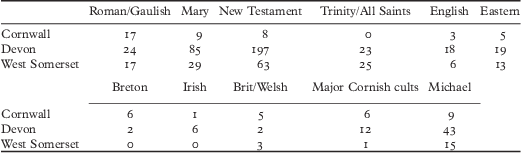
Appearances can be very deceptive. The church at Morebath, in north-west Devon, is the cult site of the Exeter saint, Sidwell, known from the early ninth century, if not before. Much might have been made of this if we did not know that the Sidwell cult was introduced to the church in 1520 by the parson, Christopher Trychay, in the final years of Catholic England.Footnote 74 Great care is thus needed in drawing inferences from dedicatory names. Precise figures for the groups of dedications are difficult, but the approximate totals can be given as in Table 1.
A numerical analysis of church dedications and their possible origins

It is helpful to consider these in three main categories: saints unique to their principal churches (which may also have attracted a range of additional cult sites), saints that have substantial cults in the Brittonic-speaking and Irish worlds generally, and universal saints. As has often been pointed out, when the names of monastic founders are subtracted, Cornwall has many unique parish saints, while Devon and west Somerset have virtually none.
Thus, out of the parish church dedication names, Cornwall has more than 100 unique to their sites (almost all British names) and only about ten of these are the names of monastic founders. By contrast, Devon has only five unique names out of 441 known medieval parish church dedications. Three of these are Anglo-Saxon (Sidwell, outside Exeter, probably originally Sidefulle or similar; Humbert, at Stokenham; and Ermund, at Stoke Fleming).Footnote 75 One is either Anglo-Saxon or British (Uritha at Chittlehampton, where there was a shrine and a substantial later medieval cult),Footnote 76 and one is British (Brannoc, at Braunton). It is possible that Nectan (of Hartland), also British, should be added to this list. It is noticeable that all of these Devon individuals have claims to be seen as the founders of monasteries, and if they were, then their foundations would naturally take their names. West Somerset has 174 parish dedications. The only certain unique name is British: Decumen, at Watchet, who founded a monastery there. Beuno, at Culbone, is less certain and may be the Welsh saint, or the dedication might be derived from the place name.
Chapel sites also sometimes have unique cults associated with them. Cornwall has at least eight such sites, including Metherderwa, in Camborne, which links the place-name element *merther (see above) and the unique saint Derwa, and Fentongollen, in Michael Penkeval, where the unique name Gollen is attached to a well. North-west Devon has two chapels in Harland associated with Wenn and Heligan. In Somerset, Windwhistle, in Chard, has a site associated with Rayne. All of these are Brittonic names except for Rayne, which is uncertain. Broadly, the distribution of these chapel cults reflects that of the parish cults.
The earliest documentary evidence for south-western dedications is the tenth-century Vatican manuscript already mentioned,Footnote 77 a wholly Cornish source, which lists forty-eight Brittonic names, most of them unique and many very obscure.Footnote 78 Collectively, the names suggest the possibility that the Vatican list brings together saints who were believed to have been associated with those places in their lifetime. It is probable that the original source had additional information to explain the association. Given the character of much related material, this was probably genealogical, as saints were believed to have descended from a single ancestor figure, possibly deriving from outside Cornwall. Like the charter of ad 969,Footnote 79 which delimits the estate of Lamorran near Probus (eventually to become a parish dedicated to St Moren), and calls the estate ‘Lannmoren’, or ‘the enclosed graveyard of Morran’, the Vatican list clearly shows that a network of Christian sites, almost certainly graveyards, had emerged by the mid- to late tenth century, dedicated to named individuals unique to that site, who are often still the patron today.
A list of mostly unique names, first recorded in 1478, but possibly also with its origins in the tenth century, is the south-western version of the list of names of the Children of Brychan,Footnote 80 which William of Worcester found at St Michael's Mount, and which apparently had twenty-two names. A version of the same list was seen by John Leland less than a century later and his account of the Children is slightly different.Footnote 81 Fifteen of the names can be identified with the dedicatory names of Cornish parishes with some certainty,Footnote 82 while in Devon, Nectan, apparently the senior of the Children, is the dedicatory of Hartland (or Stoke St Nectan), and John is the dedicatory of Instow. Several of the sites associated with the list show a high degree of circularity in their morphology, but most do not.
According to material recorded in 1478, by William of Worcester,Footnote 83 and in 1538, by Leland,Footnote 84 there may also once have been a similar list (or lists) naming saints believed to have come from Ireland, and those we have are also mostly unique to their churches. None of the relevant graveyards is very large, although St Buryan has the well-marked circular enclosure we would expect at a monastic site. Collectively, these documents reinforce the suggestion that the unique Cornish names were often associated with their sites before, say, 950, and that they have a genuine relevance to the very early history of their churches, but this need not mean that they were necessarily the monks or hermits of hagiographical tradition.
The remaining dedicatory classes can be dealt with much more swiftly. There are, across the area, a number of dedications to the names of saints who figure in broader Cornish, Welsh, Breton and Irish hagiography, and almost all of them are enmeshed in the confused traditions produced by a thousand years’ worth of hagiography.Footnote 85 Most (or all) of these cults seem to be post-ad 700 creations. The ‘universal’ saints are a very mixed bag and they account for the great majority of the Devon and west Somerset dedications. Some of these dedicatory groups may have their own significancesFootnote 86 but, taken together, they represent the dedicatory habits normal across England from the time of Augustine's mission onwards.
This excursion into hagiography enables a significant point to be made about the sites where the dedicatory names are apparently part of a ‘collective’ tradition, involving their appearance in the Vatican list, the Children of Brychan traditions and the traditions of Irish origins: a number of these have (or have had at various times) eglos names. Six of the sites on the Vatican list come into this category, as do five of the sites associated with Brychan. Six of the sites with associated Irish hagiography and four of the sites with Breton hagiography have eglos names. Of the thirty known parish churches to which eglos has been attached,Footnote 87 twenty-one are in these groups, which seems too large a number for the connection to be accidental. Given the community nature of the eglos churches, demonstrated by Eglospenbro (see above), this might be explained as a desire on the part of their communities to develop traditions giving their church patron external links, or to associate him/her with an external origin.
Among the Brychan dedications, one has the element ‘church’ and three stow, probably, as we have seen, here meaning ‘church’ (Cheristow means ‘church place’). Stoke St Nectan has the related element stoc, and two of the three sites dedicated to Bridget have stow names.Footnote 88 Poundstock has a Breton dedication (Winwaloe). It is perhaps possible that, in the eastern part of the peninsula, these characteristics are sometimes associated with community church sites, like the Cornish sites that carry eglos names and have this kind of saintly tradition, even though Poundstock and Cheristow seem unlikely candidates as important churches.Footnote 89
Morphology
The shape and area of the churchyards have been examined for their degree of curvilinearity and size, and for the relationship of these features to other factors (the results are presented in figures S1 to S3, published as Appendix B with the online version of this paper).Footnote 90 Most of the parish churchyards and known monastery complexes once had or still have substantial enclosures, and so do a few of the chapel sites. Some of these appear as banks of earth and stones, often topped by fully grown trees, such as holly and yew, and known in the two counties as Devon or Cornish hedges; these also occur as the boundaries of lanes and fields. Others have lighter banks, walls of stone or brick, and hedges or fences. In practice, many burial grounds now have a mixture of these features in the course of their earliest visible boundary circuits. Often, the enclosure is freestanding for some or all of its line, and is (partially) surrounded with roads or paths.
Monastic sites
The results of this analysis show that certain or probable monastic sites tend to have circular enclosures, a feature more marked in the west, but visible in the east too.Footnote 91 Sometimes the boundary around the graveyard is only the innermost of a set of nested, circular boundaries: at Stoke St Nectan, for example, there are two roughly circular enclosures, the inner one perhaps around the church and the outer one marking some kind of precinct. Axminster also has two. These monastic boundaries are poorly dated, but they are part of a wider pattern, visible across the British Isles and Gaul (to go no further afield), in which the edge of an early monastery complex was well marked, often with roughly circular boundaries, presumably to emphasize its distinction from the outside world. It is worth remembering that, although earlier Roman sites had rectangular enclosures, many later ones, like some of the Saxon Shore installations (whatever their exact function was), or the walls of most cities, were also roughly circular or oval.
Parish burial grounds
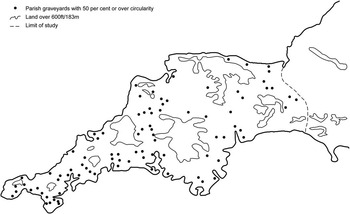
In west Somerset, fourteen parish sites were found to have boundaries with at least 50 per cent circularity, and a further six had 75 per cent, together representing some 11 per cent of the total. The only evident common characteristic is a certain tendency to cluster on the edges of Exmoor, as do Bathealton, Dunster, Luxborough, Porlock, Withiel Florey and Selworthy. In Devon, fifteen sites were half-circular or slightly more, and eight were three-quarters-plus, giving together 5 per cent. Morebath was one of these, as was Lustleigh with its inscription. The original, presumably British, name of Lustleigh is not known, but none of the Devon sites have names including *lann. The sites appear along the south coast, with a line along the flank of the Blackdown Hills, together with a few in the east side of the Tamar valley and others on the flanks of Dartmoor (fig 1).
South-western Britain, showing the distribution of parish graveyards with 50 per cent or more circularity. Map: author

Cornwall has thirty-three sites in the half-plus group, and a further twenty-nine in the three-quarters-plus group, a total of 28 per cent. The sites are concentrated in the Lizard and Penwith, and up the spine of the peninsula, with noticeable groupings around the edges of Hensbarrow and Bodmin Moor. Three (Lewannick, Madron and St Hilary) have inscribed stones. Ten of these Cornish sites carry the eglos element in their place names, including Treneglos, which combines tref (‘farmstead, hamlet’) and eglos. Trewen also takes its name from a lay settlement. Sixteen of these Cornish sites carry the *lann element, but fourteen do not. Some of them, like Sancreed, have post-ad 900 stone crosses, as have some that now only have small lengths of curved boundary, such as Cardinham.
Among the Cornish stow names, only one (Jacobstow) has a score in the half-plus group; and in Devon, only Instow. In Somerset, West Quantoxhead, where the stow element is not attached to the church itself but to the neighbouring land, has a score of 75 per cent. Of the names including stoc, Poundstock (Cornwall) scored 50 per cent, Stocklinch St Mary, Lydiard St Lawrence and Chardstock (all Somerset) scored 50 per cent or more, but Devon showed none. No particular significances are noticeable here. Overall, no significant groupings are observable, when the various categories of place name, curvature, size and associated monument are put together.
Chapel sites
Of the chapel sites, Merther-Uny has a strongly marked curvilinear enclosure bank, which seems to have begun as a domestic settlement. Around ad 1000, it was enlarged, used as a burial ground and equipped with a stone cross and eventually a church building.Footnote 92 It is unlikely to be alone, and these sites would repay further study.
Broader occurrence of curvilinear ecclesiastical boundaries
Churchyards that now have substantial curvilinear or partially curvilinear enclosing banks, often standing alone at the focus of local roads and tracks, are very noticeable in Wales. It is important to note, too, that such sites are by no means limited to the south west and Wales. Fieldwork in the south-east Midlands has demonstrated a significant number of such parish church sites, for example at Oadby, Hallaton, Medbourne and Hoby (Leicestershire), at Winwick, Maxey and Grendon (Northamptonshire),Footnote 93 Braunston (Rutland) and Winslow (Buckinghamshire).Footnote 94
Factors Affecting Churchyard Morphology
Formal enclosure
A wide range of factors has affected churchyard morphology from the early medieval period to the time of the earliest surviving plans. Work in France, as at Rigny (Indre et Loire), has demonstrated the tendency for some churchyards to be successively reduced over time, reflecting the polarization of burial close to the church around ad 1000, the construction of the first boundary wall and the consolidation of settlement around the church in the course of the twelfth/thirteenth centuries, followed by the exclusion of non-funerary activity from the churchyard during the sixteenth century, all resulting in considerable morphological changes.Footnote 95 In Britain, the dates at which churchyard walls or banks were built is almost never known, but this does not mean that they always accompanied the establishment of an estate burial ground or church. Contractions of burial grounds have been recognized at some sites, including Crantock, St Endellion and the chapel sites listed previously, and this probably accompanied the first enclosure.
Liturgical rites through which graveyards might be made sacred by a bishop, creating the very special emotions attached to burial in ‘consecrated ground’, developed only in late Anglo-Saxon England,Footnote 96 and will have taken some time to become the norm across the English dioceses. Such a consecration would have been one natural moment for building a yard enclosure. Equally it is possible that solid formal walls, gates and pathways to the church doors may have accompanied the enhanced range of parish ceremonies, such as Corpus Christi processions, that characterized the twelfth to early sixteenth centuries. Complex histories of enclosure creation may well have been much more common than we realize.
Use of churchyards and informal works
It is salutary to remember that, during the medieval and early modern periods, churches functioned as village halls and churchyards operated as public open spaces for a wide range of activities, as well as for burial. Indeed, the sources sometimes suggest that conflict between parson and parishioners over the use of the churchyard was one of the long-running stories of village life. A few examples give the flavour of what this involved. In 1665, the churchwardens at Luxulian (Cornwall) recorded that: ‘the swine of Robert Vage have and still do pasture and in a shameful manner in the churchyard and make deep holes and we present him for the same and also Susan his wife for that she being reproved for the same by our minister Mr Sharpe told him that they should eat and drink there in despite of his teeth and swearing by the … that she did not care a fart for him’.Footnote 97 Nor, evidently, did she care for the burials the pigs exposed, and her jibe to the parson suggests that it was not his first concern either. Henderson notes that in 1330 John Coke, Vicar of Veryan (Cornwall), was given licence to ‘ditch and empark’ his glebe. The bounds ran from the cemetery stile, and returned there.Footnote 98 We do not know how usual this was, but since glebes usually abutted the churchyard, such works could both alter the churchyard perimeter and generally confuse the picture. The semicircular earthwork at the Old Vicarage, St Eval (Cornwall), once considered early ecclesiastical, turns out to be a modern garden feature.Footnote 99 At Chagford (Devon), John Jurdeston paid for ‘a cottage situate within the churchyard’ in 1502,Footnote 100 and clergymen were involved in numerous deals relating to access and grazing.
All this assorted activity required a great deal of repair and maintenance. At Pilton (Somerset), the Churchwardens’ Accounts tell us of a series of repairs to the churchyard gate in 1507, 1514 and 1522, and in 1514 eight loads of stones were needed ‘for making off the chyrcheyerd walle’.Footnote 101 At Morebath (north-east Devon), the Accounts for about 1532 tell us that the substantial farmers in the parish were each responsible for repairing (or building?) 22 feet of the churchyard enclosure (hage), and the smaller farmers 11 feet, to cover the length from the east to the west church stiles, so that ‘ys churche yerde ys closyd & schalbe fro thens’.Footnote 102 At Ashburton (Devon), stone and sand was brought in and the church wall repaired in 1516–17; this was needed again in 1546–7, and further work was done in 1550–1, in 1555–6, in 1572–3 and in 1577–8.Footnote 103 In Cornwall,Footnote 104 the accounts for Landewednack show a series of hedging jobs in the churchyard between 1676 and 1694.Footnote 105 At Zennor, the church wall was ‘built’ in 1830–3, with a new gate and stile, and in 1834–5 the churchyard was enlarged, necessitating more work on the wall in the next year; it was worked on again in 1847–9.Footnote 106 At South Hill, the year 1846 saw ‘16 days work building the church hedge’ and 1847 ‘4 days work drawing a bay in a bank on the south side’.Footnote 107 Churchyards were thus the scene of constant comings and goings on the part of animals, shoppers, party-goers and rubbish-dumpers and of workmen unloading building materials and carrying out major building and re-building works, having accidents with carts and carrying out very frequent repairs.
Other factors affecting morphology
The chief building material in many parts of Cornwall, Devon and west Somerset was stone, frequently granite and often in the form of relatively large rounded boulders, taken off the fields. It is difficult to build square corners with this material (and hence in part the ‘quaint’ appearance of many ancient landscapes in the south west), a process accentuated when the Devon or Cornish hedge, whether enclosing a churchyard or used as a settlement boundary, was continually being augmented as more stone was cleared from the fields, an activity capable of making substantial morphological changes over a millennium or so.
Changing settlement patterns are also very relevant. During the fifth to the eighth centuries west of the Tamar, and possibly in north-west Devon too, the enclosed settlement sites known as ‘rounds’, whose present Cornish place names often include the element caer, were being replaced by open sites with names characterized by the element tref. There is evidence that this was associated with monastic foundation and that it was accompanied by some shrinkage of the settlement, so that the old sites and their farmlands relapsed into rough grazing.Footnote 108 The deserted old enclosure was thus available to be used as a burial ground: evidence from St Helens (Lundy), Merther-Uny and St Buryan suggested secular settlement pre-dating the ecclesiastical use of the site, so that what had been the home of the living became the home of the dead. Occasionally, larger existing enclosures were used (various types of these are fairly common throughout the area), as at St Denis, where the saint's name is plausibly seen as a formation from OC dinas, ‘enclosure’, and which came late to full parish status. Henderson suggested that Mawnan church, which is set within a substantial enclosure on a promontory on the River Helford, occupies an ancient earthwork.Footnote 109
Some local topographical developments could create misleading appearances. Evidence from Wales, at least, suggests that circular churchyards can result from land allotment rather than the intentional enclosure of a Christian site.Footnote 110 In the south west, a number of sites show topographical evidence of an enclosure larger than, and possibly earlier than, the present churchyard, as at Kingsteignton, Tiverton and Ugborough (all Devon) and Locking (east Somerset). As far as is known, none of these had early monastic connections, and the enclosed effect may be the result of tenurial arrangements, like those in Wales, or may simply represent one natural course of development in a locality centred on a church.
Clearly, over time, there has been ample scope for large – or small but gradually accreting – changes in the shape and nature of churchyard boundaries and, given the human tendency to cut corners, it is likely that some shapes became more, rather than less, circular. We are not entitled to presume that the shape of any churchyard has remained fixed since an early period in the history of the site.
Discussion
A number of issues arise from all this. One, of overriding significance, is that the evidence base as it stands is not strong in important respects. Neither the place-name elements attached to individual sites nor their morphological features can be taken as secure, given the potential for change. It must be accepted that documents give a snapshot of only one moment in time, and that sites, many of which are well over a thousand years old, encapsulate many such moments. This serves to underline the very great cultural complexity that such long-term focal monuments embody; the true extent of this complexity can only be appreciated when all kinds of relevant sites are considered together, rather than just the parish churches, important though these are.
Historical considerations
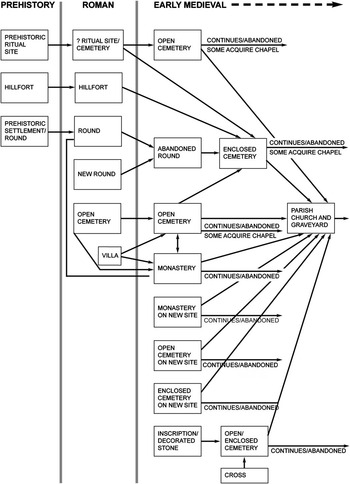
It is clear that individual burial sites were going out of, and coming into, use over the generations, that their functions could change over time and that, at any given time, at least as late as ad 1000, various types of site were in use across the region (fig 2 endeavours to express this chronological and cultural process). This progression broadly matches what seems to have happened in Wales.Footnote 111 Ongoing work suggests that this pattern is also broadly true of southern and midland Britain (although some of the chronology may be somewhat different) and, indeed, of adjacent areas such as northern and western Gaul. It may be, however, that the course of developments in Ireland, and parts of northern Britain, was rather different.
The development of ecclesiastical sites in south-western Britain. Diagram: author

Parish churches are a relatively clear group, at least by around ad 1100, and the existence of early medieval monasteries is generally recognized. There is reason to think, however, that there was a further group of churches, with burial grounds, for which the best term may be ‘mother churches’. The sites with eglos and circ(e) names may belong here, and so may those that had families of dependent chapels over which they exercised various rights, becoming parish churches by the later medieval period. In Devon such churches cluster, for example, around the south coast; Brixham had three dependencies, as did the neighbouring church of Paignton (an important manor of the Bishop of Exeter from at least late Anglo-Saxon times). Churchstow had one, and West Alvington, five. Such sites are best represented in east Somerset, where, for example, Somerton had two chapels and Huish Episcopi one, but in the west, Wiveliscombe, Hawkridge, Wellington, Old Cleave and Kingston St Mary all eventually had one dependency.Footnote 112 Further potential candidates might be the two Cheritons, Churchstow, Marychurch (if this was not a minster), Whitchurch (all Devon), St Michael Church and West Quantoxhead (west Somerset). Like the Cornish churches with eglos plus a territorial name, these eastern examples clearly originally had responsibility for substantial tracts, which would eventually become several parishes.
These churches seem to post-date the foundation of most of the larger, possibly landed, monasteries but to pre-date the emergence of estate churches. They were intended specifically to provide pastoral care. Often they were established in large royal manors (like Bradstone, Woodbury and Yealhampton, all Devon), some of which (such as Woodbury) were to become the meeting places of hundred courts, the conjunction of royal tun, hundred court and community church creating a social, economic and bureaucratic focus, which often developed into a market town.Footnote 113 Perhaps elsewhere they were created by local enterprise. Some of these churches received the payments due to monasteries and they were probably difficult to distinguish from the smaller monastic houses; in practice, we might think of a slope rather a divide, which is the situation implied by Aethelred ii's ordinance of 1014.
Topographical considerations
The tendency for enclosures with high degrees of circularity to be situated on the flanks of upland, or in areas of poor arable potential, has already been noticed. These are also the areas that yield abundant quantities of large stones. They are likely to have been thinly occupied by scattered settlements since the pre-Roman period. Their burial grounds, whatever date they were set up, are likely to have been in convenient but fairly isolated positions, and to have become the focus of local networks of paths (which often survive). It is likely that such cemeteries would be roughly circular in shape, and would acquire roughly circular enclosures, as a result of their isolated position, the paths and the building materials available. This kind of settlement landscape survives in many upland parts of the area, and the parish of Morebath, Exmoor, is a good example.
Such settlement patterns may be the survival of what was once a more general pattern. Broadly, throughout the area, settlement up to perhaps ad 700 was generally scattered and comprised individual homesteads and hamlets, together with perhaps some nucleated sites. Post-ad 700, in southern Britain generally, economic and political pressures encouraged an effort towards greater productivity, which, increasingly over time, created some much larger field systems and nucleated villages, usually in the areas of better land.Footnote 114 These communities became the centres of relatively small estates, which developed estate churches, many of which survive as parishes and parish churches. Sometimes such settlements accreted around an existing isolated and roughly circular burial ground, preserving or changing this as local circumstances determined, a process that can be seen in the north Devon parishes. Sometimes a new circular site was established, following the fashion for what such sites were expected to look like. Elsewhere, the new burial ground took a more regular shape, particularly if it was part of a newly built or planned village. With many local variations, the same broad process may have occurred across much of southern Britain, helping to account for similar patterns of freestanding roughly circular churchyards, many of which seem to be located in what were originally rough grazing areas, and rectilinear ones elsewhere.
Place and personal name considerations
The ecclesiastical use of *lann, meaning enclosure, may well have developed as a way of describing monastic sites. As already noted, the use of *lann cannot be demonstrated to have been used before the tenth century, but probably it was used to describe a monastic site from the time when it acquired an enclosure, at or very soon after its foundation. The Anglo-Saxon place-name element-bury, and perhaps both stow and stoc, carry similar meanings. In OC *lann was usually linked with the personal name of the monastic founder, and this happened in the Anglo-Saxon speaking area also, as at Stoke St Nectan, but the usual English custom seems to have preferred a topographical reference, while the founder's name was remembered in the local cult alone.
At western non-monastic sites, there does not seem to be any particular correlation between the use of *lann and the existence of a substantial length (say 50 per cent) of curved enclosure. Indeed, it is possible that originally the term *lann indicated simply ‘an enclosure’ without any reference to the shape or nature of the boundary. As has been noted, some sites further east have name elements suggesting enclosure, and for all the use of geard, ‘enclosure’, as the name for the burial ground, is generic. The separation of the sacred and the profane was clearly at some point a key factor at all these sites, regardless of the physical form the boundary took.
In the Old Cornish speaking area, parishes often have two ecclesiastical names: that of the parish itself, embodying a personal name linked with an ecclesiastical element, and that of the church, another personal name, that of the dedicatee. Probably both names commemorate individuals who were important in the founding and earlier history of the site.Footnote 115 About 969, King Edgar gave (or confirmed in ownership) ‘Lannmoren’ to Alfeah Gerent and his wife Morwrei; her name looks as if it might have a family connection with the saintly name Moren, from whom the estate took its name.Footnote 116 This hints that the parish name commemorated an earlier land holder, who organized the site, and the dedicatee name that of the holy man, perhaps a parish priest or an associate of a local monastery, who had originally served at the site. Both would have been buried there.
In the Anglo-Saxon speaking areas, the traditions of nomenclature were different. Estate churches were usually, although not always, dedicated to a standard saint of the Western Church, and the church was always known by this name, while the parish took a topographical or habitative place name, with elements like worthig, often linked with an Anglo-Saxon personal name;Footnote 117 here the estate, not the parish, sometimes took the local man's name, and early incumbents (of whatever kind) were forgotten. This difference in custom between the speakers of the two languages should not blind us to the possibility that what actually happened on the ground was much the same.
Concluding Thoughts
This study has drawn attention to the very considerable complexity of the long, slow cultural shift that turned a pagan society into a Christian one in the south-west peninsula, through the crucial process of the embedding of Christian practice in community life. It is clear that much of the evidence, in the form of place names, morphology, dedication and tradition, cannot be taken as fixed. It is equally clear that sites were coming into and going out of use, and being made over in all kinds of ways to satisfy changing needs and fashions, and that all kinds of sites must be taken into account.
The study suggests that the morphology of parish sites, as we now see it, has much to do with topographical situation, and with the development of settlement and land-use patterns at the local level, together with much varied community activity. The regional scope of the study also suggests that the pattern of Christian development across the region was much the same, although the Brittonic-based monasteries were probably a little earlier than their eastern counterparts. Two languages were spoken in the region throughout the time span considered here; this seems to have produced two different traditions of place-name nomenclature, which may, but equally may well not, have had a significant influence on the development of the Christian sites.
The study has wider implications. A range of sites similar in all respects to those in the south west also appear widely across midland and southern Britain, including Wales, and here again work is showing similar topographical and historical patterns of development. Southern Britain generally presents a mosaic of local environments bound together by very broadly similar patterns of land use and social development. It is possible that the making of a Christian society here has at least as much to do with the interaction of these factors, encouraged, of course, by kings and bishops, as it has with much wider linguistic and ‘ethnic’ issues.
Strategies for further research should include the completion of other regional studies along the lines of this one, further examination of potential ‘mother churches’, and excavation aimed at clarifying the chronology of enclosures. Only more work along these lines can enlarge our understanding of how medieval communities felt, thought and built.
ABBREVIATIONS AND BIBLIOGRAPHY
- Abbreviations
- BAV
-
Bibliotheca Apostolica Vaticana, Vatican City
- Bodleian
-
Bodleian Library, Oxford
- CRO
-
Cornwall Record Office