Introduction
Birth spacing, defined as the interval between successive births, has been of major interest in demographic research (Rutstein, Reference Rutstein2005; Conde-Agudelo et al., Reference Conde-Agudelo, Rosas-Bermudez and Kafury-Goeta2007). This is because short birth intervals contribute to high birth rates, and poor maternal and child outcomes such as low birth weight, pre-term birth and maternal mortality (Bener et al., Reference Bener, Saleh, Salameh, Basha, Joseph, Samson and AlBuz2012; Khan et al., Reference Khan, Bari and Latif2016). The World Health Organization (WHO) and other international organizations recommend waiting at least 3–5 years between births to reduce infant and child mortality and also to benefit overall maternal health (Rutstein, Reference Rutstein2005; WHO, 2007). Furthermore, birth interval has been reported to have a significant effect on a child’s health and physical and mental capabilities (Khan et al., Reference Khan, Bari and Latif2016).
Nigeria is a high-fertility country with a Total Fertility Rate (TFR) of 5.7 children per woman, which is among the highest in the sub-Saharan Africa region (NPC/Nigeria & ICF International, 2014). In Nigeria, the average birth interval is 31 months (NPC/Nigeria & ICF, 2014). This is partially explained by the low level of contraceptive use in the country, which is 15% (NPC/Nigeria & ICF International, 2014). Low contraceptive uptake makes birth spacing difficult to achieve. Well-spaced births reduce competition among children for breastfeeding, food and other resources in the family (Howell et al., Reference Howell, Holla and Waidmann2016). It also gives the mother time to engage in other personal endeavours that will contribute to household income and their economic development, such as employment, business and education (Howell et al., Reference Howell, Holla and Waidmann2016).
A number of studies have showed that short birth spacing is a risk factor for childhood mortality (Gyimah & Fernando, Reference Gyimah and Fernando2002; Rutstein, Reference Rutstein2005; Conde-Agudelo et al., Reference Conde-Agudelo, Rosas-Bermudez and Kafury-Goeta2007; Khan et al., Reference Khan, Bari and Latif2016). However, in sub-Saharan Africa and most other developing countries where spacing between births is short, very little attention has been given to the possibility of a reverse relationship whereby child mortality may also affect birth spacing. Child death could affect fertility through biological and behavioural pathways (Gyimah & Fernando, Reference Gyimah and Fernando2002). This can either be through exerting a physiological effect, influencing length of birth interval, or a replacement effect, in which couples continue to procreate in an attempt to reach a desired number of surviving offspring. Therefore, the aim of this paper was to investigate the effect of child death on birth spacing among women of reproductive age in Nigeria. The findings of this study would be helpful in reminding local and possibly nationwide policy-makers of the current situation of fertility and birth spacing in the study area and to help design appropriate strategies for encouraging better practice of optimal birth spacing, thereby achieving further declines in fertility and maternal and child mortality. It is also hoped that the results of this research will help inform health care planners and programme managers in designing specific and scientifically sound interventions to encourage the utilization of family planning and optimal birth spacing.
Methods
Study design and sample
This study was a secondary analysis of nationally representative cross-sectional data from the Nigeria Demographic and Health Survey (NDHS), 2013. Analysis was based on survey women’s birth histories; that is, the birth re-code datasets of the 2013 NDHS. The analytical sample comprised 188,986 live births to women of reproductive age (15–49 years) in the five years before the survey.
Study variables
The outcome variable was birth spacing, measured as the time to succeeding birth and was defined as the number of months between successive births. The birth history data used for the study captured each birth to a woman as a separate record (case). The independent variables were grouped into two types: the main explanatory variable ‘child death’ and the control variables, which include mother’s employment status, religion, educational status, age at birth of child, marital status, place of residence and region of residence. Potential confounders were identified from the existing literature.
Data analysis
The length of birth spacing among the sample women was estimated using event history or survival analysis techniques. The log-rank test was used to compare the time to succeeding birth across various explanatory variables. The Cox proportional hazards model was employed to assess the independent relationship between death of the preceding child and time to next birth. The Cox model is appropriate for analysing time-to-events in the presence of censored observations. Censored cases require special treatment in estimating their exposure time, so normal regression procedures could not be used. To overcome this problem, the Cox proportional hazards model was used as this assumes that censored individuals are at risk of experiencing the event at the mid-point of the interval. Censored cases in this study were children that were without succeeding births at the time of data collection.
Results
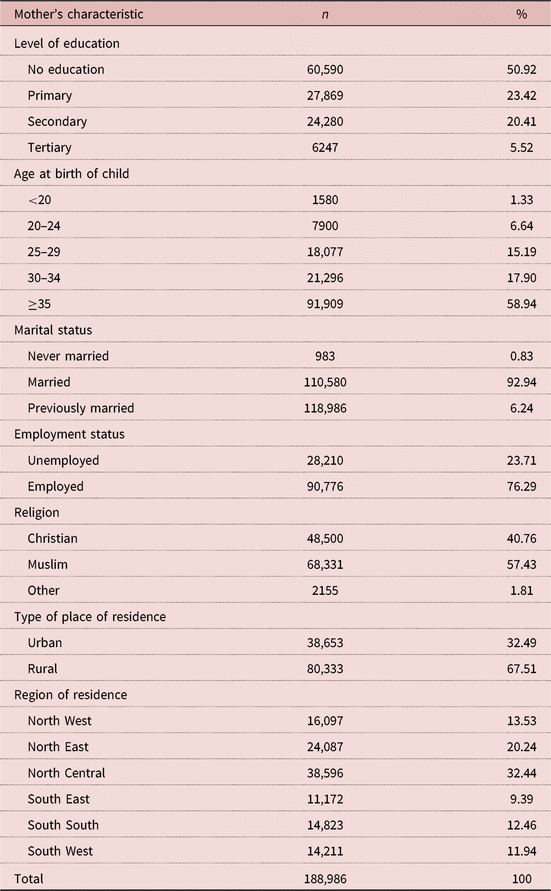
Table 1 provides a detailed description of the socio-demographic background characteristics of the live births included in the study sample. About 50% of total births were born to women with no education. About 8 out of 10 births (76%) belonged to mothers who were employed, while unemployed mothers had 24% of the total births. The North East had the highest percentage of births (20%), while the South East region had the lowest percentage of total births.
Distribution of births by selected demographic and socioeconomic characteristics of the mother, Nigeria 2013

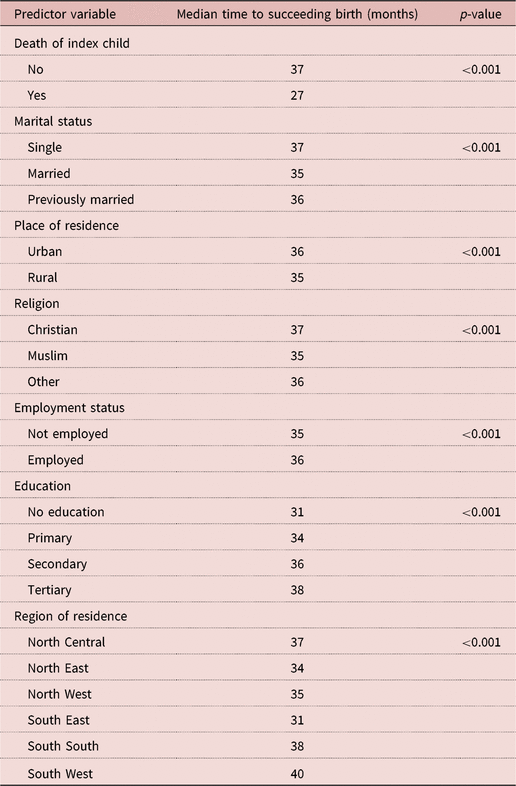
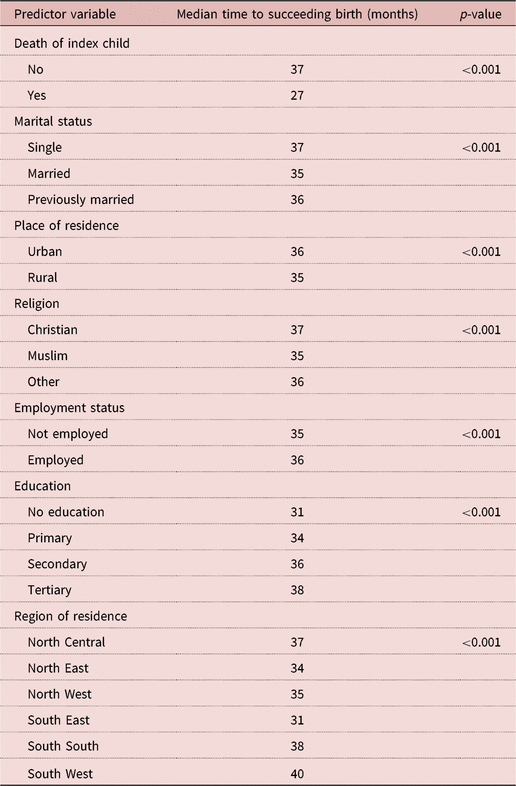
Table 2 shows the median time to succeeding births (in months) by selected maternal variables. Mothers who experienced a child death had a median time to next birth of about 27 months, whereas mothers who did not experience a child death had a median time to succeeding birth of about 37 months. Mothers who had a tertiary level of education had a longer median time to next birth (38 months) compared with mothers with only secondary (36 months), primary (34 months) or no education (31 months).
Median time to succeeding births (in months) by selected maternal variables in Nigeria
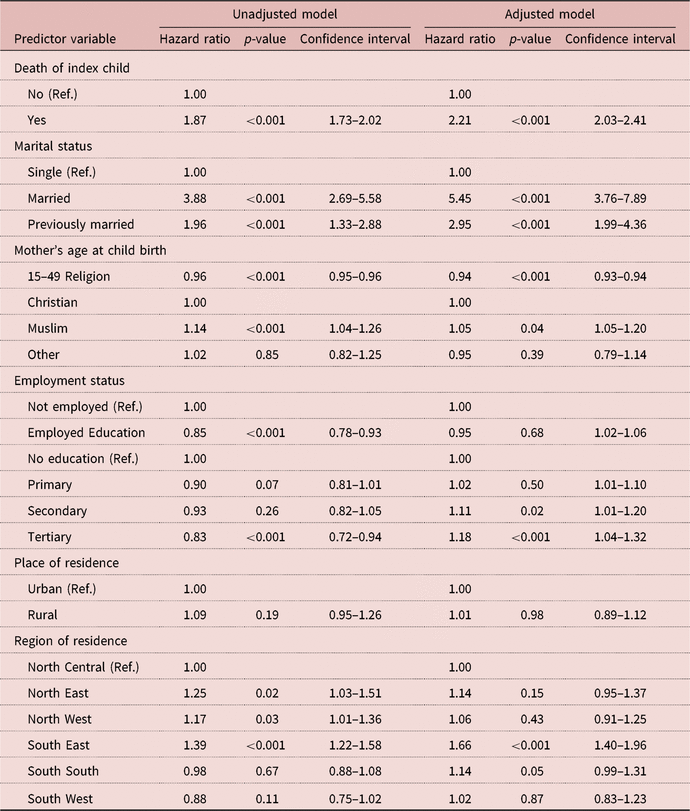
The right-hand panel of Table 3 shows the adjusted hazard ratio from Cox proportional hazard regression of the independent variables by the time to next birth, controlling for other covariates. When controlling for other variables, the likelihood of a next birth was higher when an index child died compared with when an index child survived (HR=2.21, 95% CI: 2.03–2.41), and the relationship was statistically significant.
Results from Cox proportional hazards model for the effects of child death and other variables on the time to next birth
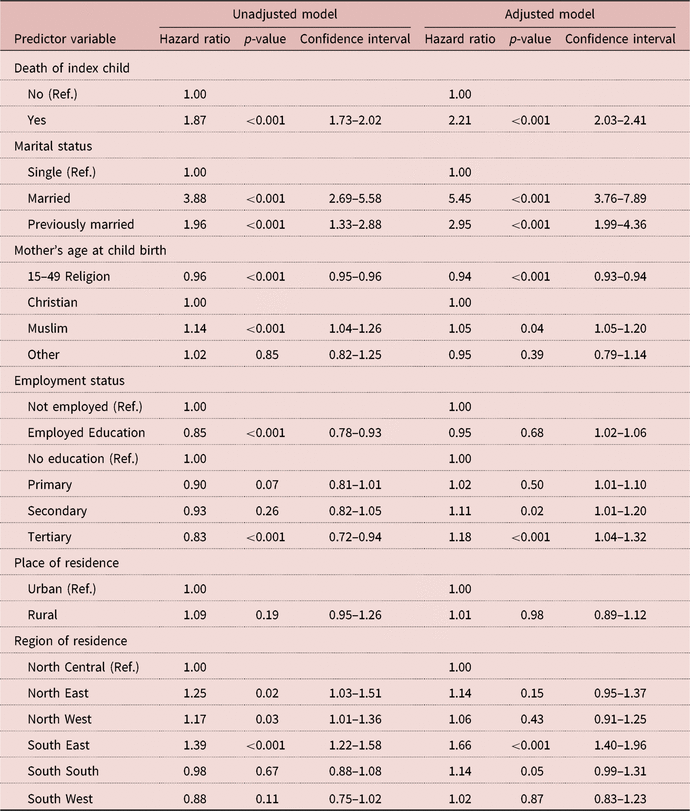
Ref., reference category.
As a mother’s age increased, she had a lower risk (HR=0.94, 95% CI: 0.93–0.94) of having a next birth after the death of a preceding child. The relationship between mother’s age and time to next birth was statistically significant.
Table 3 also shows that when controlling for other covariates, mothers who were Muslims had a higher risk of having a next birth when compared with Christian mothers (HR=1.05, 95% CI: 1.05–1.20).
When controlling for other covariates, the mothers who had secondary education (HR=1.11, 95% CI: 1.01–1.20) and tertiary education (HR=1.18, 95% CI: 1.04–1.32) had higher risks of having a next birth when compared with mothers who did not have any formal education.
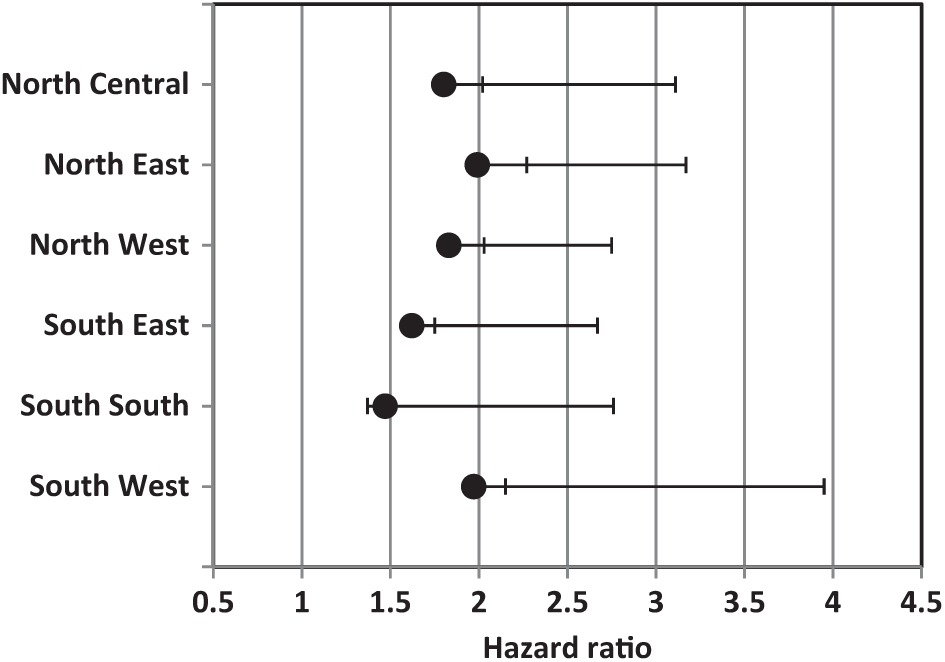
Figure 1 indicates that after stratifying the Cox hazard model by geo-political region, in all regions, there was a higher chance of having a next birth when the index child had died. The South West region had the highest risk (HR=1.79, 95% CI: 1.97–3.77) of having a next birth after the death of a child, while the South East region recorded the lowest risk (HR=1.49, 95% CI: 1.62–2.54) of having a next birth after the death of a child. These results show that regionally, there was no major difference in the fertility decision of mothers to have a next birth after the death of a preceding child.
Geo-political regional differentials in the effects of child death on the time to next birth in Nigeria using Cox proportional hazard regression analysis.

Discussion
The aim of this paper was to investigate the effect of child death on birth spacing among women of reproductive age in Nigeria. Birth interval is one of the major determinants of fertility level, especially in populous countries. According to the NDHS (2013) policy brief, the TFR has been stagnant over time in Nigeria, and measures must be put in place to reduce this rate if the country’s desired population size is to be achieved. Increasing the length of birth spacing will help to achieve this goal.
The study’s analysis reveals that the interval for the next birth tends to be shorter due to death of a child. This may be as a result of the couple making a conscious effort to replace a lost child sooner, which is known as ‘the child replacement effect’ (Setty-Venugopal & Upadhyay, Reference Setty-Venugopal and Upadhyay2002). Coital frequency may increase after the death of an index child. Secondly, the death of an infant leads to cessation of breastfeeding, which may also increase the chance of pregnancy (National Research Council, 1998). The emotional desire to replace a deceased infant, and the resumption of sexual activity following the termination of breastfeeding, may contribute to a rise in the risk of having a next birth sooner following an infant’s death. This hypothesis aligns with the child replacement theory, which postulates that child mortality experiences may affect subsequent fertility of couples by exerting a physiological effect, influencing length of birth interval, or a replacement effect, in which couples continue to procreate in an attempt to reach a desired number of surviving offspring (Cain & Cain, Reference Cain and Cain1964).
The chances of having a next birth after a child death were compared across geo-political regions of Nigeria. A slight variation in the likelihood of having a next birth was found among the six regions, but they all had hazard ratios greater than 1.00. This indicates that, although Nigeria is a multi-ethnic and multi-cultural country, fertility decisions and the behaviour of mothers towards replacement and reproduction are similar across geo-political regions.
Mother’s education was one of the most important measures that showed statistical significance in its association with birth spacing, which was found to increase with educational attainment. This also is in conformity with the findings of studies in several countries, which have shown that mothers with no education are less likely to space births than mothers with education (Wusu, Reference Wusu2012; Grundy & Kravdal, Reference Grundy and Kravdal2014; Khan et al., Reference Khan, Bari and Latif2016). This might be due to the fact that educated women are more likely to use contraception to prolong their birth spacing (Oni & McCarthy, Reference Oni and McCarthy1986; Solanke, Reference Solanke2017) and may have the knowledge regarding the negative effect of short birth intervals as well as benefits of small family size. When other covariates were adjusted, women with tertiary education had a higher likelihood of having a next birth when compared with women with no education. This could be due to the fact that more educated mothers in the present study may have married later in life and subsequently hurried to establish a family. Another possible hypothesis could be that more educated mothers may wish to compress childbearing into fewer years and participate in other non-childbearing activities (Wusu, Reference Wusu2012), but further quantitative and qualitative research would be required to investigate this claim.
A statistically significant association was also observed between the length of birth interval and age of mother. In line with other studies (Wineberg & McCarthy, Reference Wineberg and McCarthy1989; de Weger et al., Reference de Weger, Hukkelhoven, Serroyen, te Velde and Smits2011), this study revealed that mothers who belonged to the younger age group were more likely to have a short birth interval compared with those in the older ages. This can be partly explained by the notion that younger mothers are less likely to have exposure to health care information about family planning and optimal birth spacing than older mothers. Similarly, the NDHSs of 2008 and 2013 showed that the space between births increased as mothers’ age increased, such that the lowest and highest intervals were among mothers in the younger age groups (15–19 years) and mothers in the older age groups (40–49 years), respectively. This increase in birth interval with maternal age may be attributed to the decreasing fecundity and fecundability associated with age, as a result of ovarian and hormonal changes (Selemani et al., Reference Selemani, Mwanyangala, Mrema, Shamte, Kajungu and Mkopi2014).
This study was limited in its inability to determine the temporal sequence of the variables under study, such as the time at which the woman attained a certain educational level or moved to a particular residence type. Similarly, the study was unable to ascertain if information on the birth histories of the sampled women was affected by recall bias. The study utilized cross-sectional datasets, and as a result, there was a tendency for child deaths to be under-reported. Omission of deaths can affect levels and patterns of child deaths, so also misreporting of age at death (heaping). This is because the data quality assessment done for the 2013 NDHS data indicated that the surveys yielded reliable mortality data. Contraceptive use histories between successive births were not available in the dataset and therefore could not be controlled for in the multivariate model. These limitations do not reduce the strength of the study but are areas that require further exploration.
In conclusion, child mortality is a factor that affects the length of birth interval across geo-political regions in Nigeria. Therefore, interventions aimed at lengthening birth intervals and reducing child mortality should be strengthened across the whole country. Post-partum counselling, which may include family planning counselling and special intervention programmes designed to educate bereaved mothers or couples who have experienced a child death, is important to enlighten women about the dangers of short birth intervals. Strategies to ensure the education of women to a higher level should be encouraged. Education for women and girls should include reproductive health education, which should emphasize the importance of spacing births and advocate the use of modern family planning methods.
Given that this study was unable to test the effect of breastfeeding history and contraceptive use after the death of a child, further research could explore this relationship using longitudinal data collected over a period of time or a mixed method approach to capture expansive information. Awareness of this relationship may be critical for policy intervention and programmes on birth spacing.
Author ORCIDs
Jude Ewemade https://orcid.org/0000-0002-5049-5238
Funding
This research received no specific grant from any funding agency, commercial entity or not-for-profit organization.
Conflicts of Interest
The authors have no conflicts of interest to declare.
Ethical Approval
The authors assert that all procedures contributing to this work comply with the ethical standards of the relevant national and institutional committees on human experimentation and with the Helsinki Declaration of 1975, as revised in 2008.