Cervical cancer is the second most common cancer in females globally and in New Zealand there are over 150 new cases detected each year (21;Reference Parkin and Bray26). Cervical cancer has a high mortality rate, with over fifty cervical cancer deaths registered each year in New Zealand (21). Traditionally, prevention of cervical cancer has relied on cervical screening, which in New Zealand is done through a national program. However, screening is merely an indicator of cervical cancer, as it identifies cytological abnormalities but does not prevent their formation. Currently, New Zealand offers cervical screening to females aged between 20 and 69 every 3 years.
A national vaccination program for the prevention of cervical cancer was introduced in New Zealand in September 2008, when the vaccine was offered free of charge to females born in 1990 and 1991. From 2009, the program was extended to all 12-year-old females through a school-based program (22). The vaccine protects against two oncogenic types of the human papillomavirus (HPV), accounting for approximately 70 percent of all cervical cancers (Reference Wheeler and Dennis34). Because the vaccine does not offer protection against the other less prevalent oncogenic types of HPV, continued screening for abnormalities is still required later in life (Reference Schiffman, Castle, Jeronimo, Rodriguez and Wacholder30). Several countries, including New Zealand, that have introduced national HPV vaccination programs have therefore chosen to keep the existing cervical cancer screening programs in place; only a few have recognized that changes to screening policies may be required (Reference Koulova, Tsui and Irwin16).
While several studies around the globe have found the vaccine to be cost-effective, little attention has been given to its potential impact on the cost-effectiveness of current cervical screening programs (Reference Newall, Beutels, Wood, Edmunds and MacIntyre25). As more females are vaccinated, overall prevalence of HPV infection, and therefore cervical cancer, is expected to decline. This study examines whether the current screening policy in New Zealand will remain relevant and cost-effective in the presence of the vaccination program, and whether variations to the current screening policy would improve the efficiency of the screening program. While HPV is known to be linked to several other cancers, including anal, vaginal, penile, and oropharyngeal cancer (Reference Muñoz, Castellsagué, de González and Gissmann23), the impact of the HPV vaccine on these cancers was omitted from this study as its aim was to investigate only the connection between the vaccine and screening for cervical cancer.
MATERIALS AND METHODS
Model Structure
A Markov model was developed to depict the natural history of HPV and the current cervical screening policy in New Zealand. The model, which was designed using TreeAge Pro software (developed by TreeAge Software Inc., MA), consisted of twenty-three mutually exclusive Markov states (Supplementary Figure 1, which can be viewed online at www.journals.cambridge.org/thc2011020). The model followed a hypothetical cohort of 100,000 12-year-old girls, assumed to be HPV naïve, through to 85 years of age or death, who at any given time could only reside in one health state.
Model Calibration
The model was calibrated to reflect the New Zealand incidence and mortality rates for cervical cancer and precancerous lesions. To do this, calibration was applied to the branch where no vaccine was available, and screening occurred according to the current screening policy. The calibration process involved applying a range of transition probabilities found in the literature to produce results as close as possible to the most recent New Zealand cervical epidemiological data. Three health states were used to calibrate the model: the number of High-grade Squamous Intraepithelial Lesions (HSIL) cases identified, the number of cervical cancer cases identified and the number of deaths due to cervical cancer. The variables used for model calibration were those of the natural history of HPV and cervical cancer, and included HPV infection, progression to LSIL, HSIL, and Cancer (stages I–IV), as well as regression from HSIL, LSIL, and HPV infected states.
Probabilities and Costs
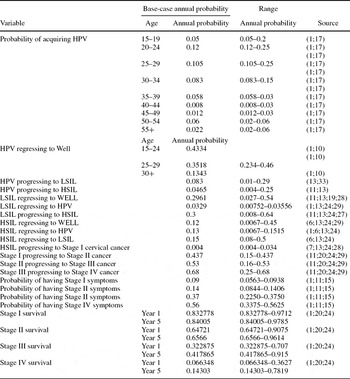
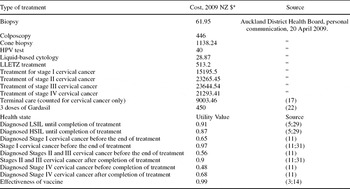
The probability of being infected with HPV, as well as the transition probabilities, were age-specific where possible, with the probabilities being obtained from the international literature (Table 1). The costs associated with screening, treatment of pre-cancerous lesions, cervical cancers, and vaccination costs were New Zealand specific, and were obtained from the Ministry of Health and the Auckland District Health Board (ADHB) (Table 2). Utility values for each of the health states in the model were obtained from the international literature (Table 2).
Probabilities Used in the Model

Costs and Utilities Used in the Model

* At the time study was carried out - NZ $1 = 0.64USD; 0.39 GBP; 0.45 EUR.
Alternative Strategies
The base case scenario was “No vaccine” with the current New Zealand screening strategy of screening women aged 20 to 69 every 3 years. The model compared several alternative scenarios with the base case. As well as presence of the HPV vaccine, these scenarios varied across three factors—age of initiation of screening, screening intervals, and age of screening cessation. Several international reviews and articles were searched and the upper and lower values for the three factors were found (Reference Anttila, Ronco and Clifford2;4;9;Reference Linos and Riza18). In this study, alternative scenarios included three possible ages for screening initiation (Reference Maxwell, Carlson and Ochoa20, Reference Newall, Beutels, Wood, Edmunds and MacIntyre25, and Reference Schiffman, Castle, Jeronimo, Rodriguez and Wacholder30 years) and three possible ages for screening cessation (69, 65, and 60 years). Screening intervals of either 3 or 5 years were then applied, resulting in eighteen alternative screening scenarios.
Initially, in each of these eighteen scenarios, the vaccine uptake level was assumed to be 90 percent, this being the target of the New Zealand Ministry of Health for the vaccination program (22). However, each scenario was also considered with 30 percent, 50 percent, and 70 percent vaccine coverage rates, to investigate the cost-effectiveness of screening should the target coverage rate not be reached. Thus, the study compared eighteen screening scenarios across four vaccine coverage rates, resulting in a total of seventy-two strategies being considered. Vaccination was assumed to have life-long duration; however, this was subject to sensitivity analysis described below.
Analysis
Cohort analysis for each of the alternative strategies described above was performed to identify the number of cases of HSIL, cervical cancer and cervical cancer deaths, the costs incurred, life years gained, and quality-adjusted-life-years (QALYs) gained. Incremental cost-effectiveness ratios (ICERs) were then estimated to determine the cost-effectiveness of the strategies compared with the base-case as well as to other strategies. Future costs and QALYs were discounted at a rate of 3 percent.
Single and multivariate sensitivity analyses were performed on all transition probabilities, costs, and utilities. The ranges used for the transition probabilities in the sensitivity analyses were determined from the literature and are presented in Table 1. As the transition probabilities were estimated from several published studies, there was insufficient original information available to carry out probabilistic sensitivity analyses. In the absence of sample distributions for costs and utilities, costs were varied by 40 percent each way and utilities by 20 percent. Screening coverage, estimated to be 73 percent for the base case, was varied between 40 percent and 80 percent. Vaccine durations of 10 and 20 years were also tested in the sensitivity analyses. Furthermore, one-way sensitivity analyses were undertaken to assess whether or not the results of the model were sensitive to a higher discount rate for both costs and QALYs of 5 percent and a lower rate of 1 percent, both in line with international practice. In addition, costs alone were discounted at 1 percent, 3 percent, and 5 percent per annum while QALYs were not discounted.
RESULTS
Calibration Results
Calibration of the model resulted in the base case scenario producing epidemiological results very similar to the actual cases of HSIL, cervical cancer cases, and cervical cancer deaths in New Zealand. The model resulted in a complete match in the predicted number of cervical cancer cases identified (7.4 per 100,000 women), a close match in predicted number of cervical cancer deaths (2.4 per 100,000 women predicted by the model, compared with an actual rate of 2.6), and a reasonably close prediction of 971 cases of HSIL identified per 100,000 women, compared with an actual figure of 1130 per 100,000.
Cohort and Cost-effectiveness Results
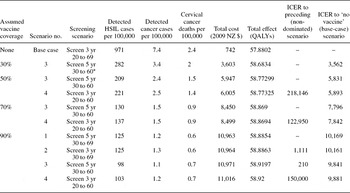
The results of the cohort and cost-effectiveness analyses are presented in Table 3, with the strategies being ordered according to their total cost for each rate of vaccine coverage. Only those strategies that were not dominated by any other strategy (in terms of lower benefits and/or higher costs) are included in the table. Introduction of the vaccine, even at a low uptake rate of 30 percent, results in a dramatic reduction in HSIL and cervical cancer cases identified, as well as cervical cancer deaths—around 38 percent reduction for each. However, total costs increase significantly with the introduction of the vaccination program. Both health benefits and total costs are further increased as vaccine coverage increases. As would be expected, strategies where screening commenced at a higher age and/or ceased at a younger age were generally associated with higher HSIL detection rates but lower numbers of cancer cases detected and cancer deaths.
Cost, Effectiveness, and Incremental Cost-Effectiveness of QALYs Gained

* Situation 1 year after introduction of the vaccine.
The incremental cost-effectiveness of scenarios compared with the “No Vaccine” base case (presented in Table 3) range between NZ$3,562 and $10,169 per QALY gained. If vaccine uptake remains as low as 30 percent, then screening every 5 years between the ages of 30 and 60 (scenario 3) would be the most cost-effective screening strategy. Scenario 3, closely followed by scenario 4, is also the preferred screening strategy for vaccine uptake rates of 50 percent, 70 percent, and 90 percent.
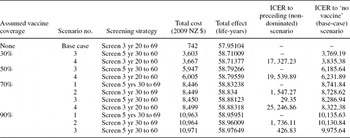
The results of the life-years gained analysis are presented in Table 4. These results suggest that the difference between QALYs gained and life-years gained is very small in each of the corresponding scenarios. This can be explained by the fact that only a very small proportion of the 100,000 cohort end up in a Markov state with decreased utility, and the fact that these events take place much later in time, and, therefore, are heavily discounted. Due to these similarities, the analysis of life-years gained resulted in the same (or at least very similar) strategies becoming cost-effective, with screening every 5 years between the ages of 30 and 60 (scenario 3) being the preferred strategy, closely followed by screening every 3 years between the ages of 20 and 60 (scenario 4).Footnote 1
Cost and Incremental Cost-Effectiveness of Life-Years Gained

Sensitivity Analyses
The model appeared to be sensitive to only three variables: HPV infection rates, cost of three doses of the HPV vaccine, and discount rates. It was not sensitive to changes in other transition probabilities, or in costs and utility values.
An increased rate of HPV infection in the population resulted in an increased cost-effectiveness of screening strategies with a vaccine uptake of 90 percent, while the strategies with no vaccine, or low vaccine uptake, became less cost-effective as the HPV infection rates increased. Increasing the cost of the three doses of HPV vaccine resulted in a small decrease in the cost-effectiveness of strategies with 90 percent vaccine uptake. Similar results could be observed in the sensitivity analysis on vaccine duration, with 90 percent vaccine uptake strategies become slightly less cost-effective as the duration of the vaccine decreased from life-long to 20, and then further to 10 years. This was done in the model by returning to pre-vaccine infection rates after a given vaccine duration period. However, herd immunity is not accounted for by this model, and lower HPV infection rates after vaccine weans are likely. The results also appeared to be sensitive to discount rates for both costs and QALYs gained. Increasing the discount rate for costs alone resulted in increasing cost-effectiveness of strategies with high vaccine uptake, while an increase in the discount rate for QALYs alone had little impact on strategies with the vaccine, but increased the cost-effectiveness of the “no vaccine” base case. However, even with discount rates of 5 percent for both costs and QALYs, and a vaccine uptake rate of 90 percent, scenario 3 (i.e., screening every 5 years between the ages of 30 and 60) remained the most cost-effective scenario with an ICER of $6,334 compared with “no vaccine” base case.
DISCUSSION
This study suggests that, compared with the baseline of “no vaccine and current screening”, regardless of whether the vaccine uptake reaches 30 percent, 50 percent, 70 percent, or 90 percent, the most cost-effective screening strategy would be screening women between the ages of 30 and 60 every 5 years (scenario 3), closely followed by scenario 4. Incremental cost-effectiveness analysis comparing the scenarios with each other rather than with the base case, demonstrates that they are more cost-effective compared with scenarios with the same screening intervals but wider screening age ranges. Furthermore, sensitivity analysis indicates that these scenarios are the most cost-effective options even if two additional booster shots are required for the vaccine to remain effective.
Importantly, scenarios with reduced intervals and/or narrower screening age ranges are favored over the current policy of screening women aged 20 to 69 every 3 years, indicating that the reductions in HPV infections, and, therefore precancerous lesions and cancer due to the vaccine are so high, that the cost of more intensive screening outweighs the health benefits.
Generally, those scenarios with less intensive screening policies were found to be more cost-effective than those with more aggressive approaches to screening. Increasing the age of screening initiation, and thus narrowing the screening age range, results in decreased costs and, in some cases, increased cost-effectiveness of these strategies. Decreasing the age at which screening stops has a similar effect. The reductions in screening age range result in savings on costs of screening and follow-up, but this is outweighed by the potential QALY loss.
The differences in QALYs gained between strategies with and without HPV vaccine are not as marked as the reductions in the epidemiological indicators, detailed in Table 3. This can be partially explained by the timing of the events that decrease the number of QALYs gained. As the model follows a cohort of 12-year-old girls, they are unlikely to develop HSIL until early to mid-thirties and cervical cancer until their forties or fifties. Therefore, the gain in QALYs from prevention of precancerous lesions and cancer is not until much later in life and the value of these QALYs is reduced by the discounting process. These findings are consistent with other studies which have reported a relatively low increase in QALYs gained from the HPV vaccine while the epidemiological outcomes of HSIL and cancer decrease significantly (Reference Debicki, Ferko and Demarteau7;Reference Elbasha, Dasbach and Insinga8;Reference Hillemanns, Petry and Largeron12). This also explains the similarity between Life Years and QALYs gained, as the decrease in utility occurs later in life (and is, therefore, discounted) and these events are relatively rare.
Counter-intuitively, QALYs gained in each of the strategies increased marginally as the screening intensity decreased. This is because increased intensity of screening detects more cases of HSIL but no additional cases of cancer or cancer deaths. As detected HSIL was attributed a lower utility value, a reduction in the number of HSIL cases identified resulted in a gain in QALYs.
The issue of vaccine uptake is central to this study. While the strategies considered the ambitious target of 90 percent vaccine coverage, the actual uptake level may be lower. The public's reaction to this vaccine has been mixed in New Zealand, and a coverage rate of only 30 percent 6 months after the vaccine's introduction did not appear to be very encouraging. However, New Zealand has had recent experience with other controversial vaccines, such as MeNZB™, a meningococcal vaccine, which, like the HPV vaccine, was introduced chiefly as a school-based program for people under the age of 20 (22). While the MeNZB™ vaccine fell short of its 90 percent target uptake rate, 80 percent coverage of the eligible population was achieved within 2 years (22). Although different issues exist around the HPV vaccine, the MeNZB™ experience indicates that achieving high vaccine uptake through a school-based program is a realistic goal in New Zealand.
The model results did not appear to be sensitive to screening coverage. This is important, given concerns of reduced screening coverage after vaccine introduction (Reference Techakehakij and Feldman32). Reduced screening is likely to result in reduced costs as well as health outcomes, therefore cost-effectiveness is not affected as both QALYs and costs decline. The sensitivity analysis also revealed that the results were particularly sensitive to HPV infection rate. It indicated that, the higher the infection rate, the more cost-effective strategies with high vaccine uptake will be, meaning that the cost-effectiveness of these strategies improves as more health benefits are gained for the same cost.
It is likely that the estimates for HPV infection rates were reasonably accurate, as the model predicted epidemiological outcomes fairly accurately. However, lack of New Zealand-specific data on HPV infection rates means that the uncertainty still remains and the strategies may be more cost-effective if the actual HPV incidence is higher than predicted.
Herd immunity, unaccounted for by the model in this study, could have an impact on the cost-effectiveness of the vaccine, as the extent of the vaccine's efficacy is likely to have been underestimated if herd immunity occurs. If the vaccine wanes, herd immunity would maintain a reasonably low infection rate, meaning that the less intensive screening scenarios will still be favored. Furthermore, due to the static approach of this model, the efficacy of the vaccine in the higher coverage rates scenarios may have been underestimated. This suggests that the findings of this study should be regarded as conservative.
Policy Implications
Introducing the HPV vaccine to New Zealand is likely to result in significant reductions of HPV infections, consequential precancerous lesions, and cases of and deaths from cervical cancer, especially if the Ministry of Health vaccine uptake target of 90 percent is achieved. However, the predicted reductions in epidemiological indicators of cervical carcinogenesis render the current cervical screening policy not cost-effective, as the costs of reasonably intensive screening outweigh the benefits associated with this screening, given the significantly reduced number of precancerous lesions which screening targets.
Moving to a less intensive screening program by increasing the age of screening initiation, decreasing screening cessation age, and increasing screening intervals would improve the cost-effectiveness of the screening program in the presence of the HPV vaccine. Furthermore, regardless of the vaccine coverage rate, the least intensive screening strategy of screening women aged 30 to 60 with 5-yearly intervals should be favored. While previous experiences of school-based vaccination programs have been reasonably successful in New Zealand, some of the current public views of the HPV vaccine may hinder the vaccine uptake, and, therefore, the associated benefits.
The benefits of the vaccine will not be seen until at least the 2020s, when the first vaccinated cohort of girls aged 12 in 2009 reach their mid-twenties—the age at which precancerous lesions are first detected. It is likely that uncertainties surrounding the vaccine uptake will be clarified by then, and if a sufficiently high number of girls have been vaccinated, the current cervical screening strategy should be gradually replaced with a less intensive one. It is, therefore, important to focus on increasing the HPV vaccine coverage rate in New Zealand.
CONTACT INFORMATION
Elizaveta Sopina, MPH (e.sopina@auckland.ac.nz), Research Associate, Toni Ashton, PhD (toni.ashton@auckland.ac.nz), Associate Professor, Health Systems, School of Population Health, Faculty of Medical and Health Sciences, The University of Auckland, Private Bag 92019, Auckland 1142, New Zealand
CONFLICT OF INTEREST
Both authors report they have no potential conflicts of interest.