Introduction
India is home to diverse animal genetic resources with a large inventory of livestock including 535.78 million livestock and 851.81 million commercial and backyard poultry birds. In addition to the dairy sector, piggery forms an important enterprise that supports the poorest sections of Indian society. The specific aspects of pig farming such as high fecundity, short generation (farrowing) interval and better feed conversion efficiency help it in improving the livelihood of farmers. The pig population in India has shown a decreasing trend (12.03% decrease) since the last census with a current population of 9.06 million (Livestock Census Report, Reference Report2019). In India, 10 registered and well characterized breeds and several varieties (crossbred and composite) have been developed across its varied agro-climatic zones. Pigs are reared mainly in the north-eastern regions of India with increased expansion seen recently in its northern states. In addition to mis-management, the economics of pig rearing is threatened by different factors that mainly include increased disease incidence and inadequate breeding interventions.
Statistical modelling of breeding data pertaining to various traits is needed to elucidate their genetic parameters with considerable accuracy that can, in turn, be used in breeding plans for improvement in animal performance. Body weight is an important index of growth in meat-based animal species. Weight at birth and other pre-weaning stages possess higher significance in determining the performance of animals during later stages of life (Quiniou et al., Reference Quiniou, Dagorn and Gaudré2002). These traits determine the profitability of piggery as an enterprise. Higher mortality during pre-weaning stages is mostly attributed to lower birth weight of piglets (Roehe, Reference Roehe1999; Feldpausch et al., Reference Feldpausch, Jourquin, Bergstrom, Bargen, Bokenkroger, Davis, Gonzalez, Nelssen, Puls, Trout and Ritter2019). The body growth in young ones is determined by many factors including the direct genetic effect of individual’s own genotype along with contributions from the maternal effect (Penasa et al., Reference Penasa, Cecchinato, Dal Zotto, Blair, López-Villalobos and Bittante2012). The maternal effect has two major components, i.e. genetic and environmental, that may affect the performance of young ones (Mondal et al., Reference Mondal, Kumar, Dubey, Sivamani and Dutt2014). The genetic component of maternal effect modulates the performance of offspring by sample transmission of half of the dam’s additive genes. The environmental component of the maternal effect plays its part mainly through differences in mothering ability, lactation performance, nursing and/or the uterine environment (Wolf and Wade, Reference Wolf and Wade2009; Nguyen et al., Reference Nguyen, Knap, Simm, Edwards and Roehe2021). The multi-factorial environmental component also plays a significant part in variation within these traits. Many studies have recommended the incorporation of direct additive genetic and maternal effects (genotype as well as environment) for genetic analysis of pre-weaning body weights in different species (Ekiz et al., Reference Ekiz, Özcan, Yilmaz and Ceyhan2004; Mandal et al., Reference Mandal, Neser, Rout, Roy and Notter2006; Lôbo et al., Reference Lôbo, Lôbo, Paiva, De Oliveira and Facó2009; Prince et al., Reference Prince, Gowane, Chopra and Arora2010). It is really important to use optimal statistical models for elucidation of genetic parameters that incorporate appropriate random and fixed effects and are conducted on large populations (Wolf and Wade, Reference Wolf and Wade2016; Ahmad et al., Reference Ahmad, Khan, Chakraborty, Rather, Shanaz, Alam and Ganai2021). Ilatsia et al. (Reference Ilatsia, Githinji, Muasya, Okeno and Kahi2008) reported the introduction of bias in genetic analysis when either maternal effects or litter effects are ignored, especially in studies related to body weight of young ones during pre-weaning stages.
Restricted maximum likelihood (REML) and Bayesian methodology are two analytical approaches that are routinely used for the estimation of (co)variance components and genetic parameters in animal breeding (Malhado et al., Reference Malhado, Mendes Malhado, Amorim Ramos, Souza Carneiro, Siewerdt and Pala2012). According to Carneiro et al. (Reference Carneiro, De Assis, Euclydes, Torres and Lopes2007), the Bayesian methodology is well justified for analyzing small populations or datasets and provides some advantages over REML-based procedures (Silva et al., Reference Silva, Viana, Faria and de Resende2013; Lopes et al., Reference Lopes, Ferreira, Lobo and Rosa2017). Bayesian methodology is based on a priori information on the unknown parameters and inferences drawn from datasets, which are supported by posterior distribution (Hossein-Zadeh, Reference Hossein-Zadeh2017). The Gibbs sampling algorithm generates posterior distributions for random sample estimation of parameters (Magnabosco et al., Reference Magnabosco, Lôbo and Famula2000).
To the best of our knowledge, no study has been undertaken involving the Bayesian analysis of pre-weaning body weights in Landlly piglets, while using different animal models. Therefore, the present investigation was undertaken to study the appropriateness of different statistical models (incorporating different random effects) regarding their fit on body weights at pre-weaning and weaning stages and elucidate the genetic parameters of these traits in Landlly pigs.
Materials and methods
Animals, farm location and management
The present study was based on 15,453 records generated on pre-weaning and weaning body weights in Landlly piglets, maintained under organized conditions at the Swine Production Farm, ICAR-Indian Veterinary Research Institute, Izatnagar, Bareilly, India. The swine production unit was established in the year 1971 under the ambitious All India Coordinated Research Project (AICRP) of Government of India. The programme aimed to develop crossbred pig varieties and assess their performance under varied agro-climatic conditions of India. Landlly pigs were developed after crossing purebred exotic Landrace pigs with indigenous Desi sows, followed by back-crossing of first generation piglets with Landrace boars to generate animals with 75% exotic inheritance. The crosses were maintained and further propagated through inter-se mating. The farm is located along North-Western plains of Uttar Pradesh, India (79.43°E longitude and 28.37°N latitude) and is situated at a height of around 172 m above mean sea level. The animals experience tropical climate with hot summers during which temperature crosses 35°C and winters are moderately cold. The farm maintains animals under organized conditions of nutrition, management and healthcare practices for their optimal production and reproduction performance. Pigs are fed according to the age group and physiological status. Piglets are fed creep ration containing high protein (21%), energy (3360 kcal/kg body weight) and lysine (0.89%) content from 3rd week onwards up to weaning (6 weeks) age. Piglets are injected with 1 ml iron dextran on the 4th and 14th days of their life to prevent the incidence of piglet anaemia.
Data generation and statistical analysis
Data on Landlly piglets, maintained under organized farm conditions over a period of 7 years from 2014 to 2020, were recorded for weekly body weights from birth to weaning. The present study included 15,453 data points on 2462 piglets born to 91 sires and 159 dams over four different generations. The study was based on body weights from birth to 6 weeks of age (w0, w1, w2, w3, w4, w5 and w6) in Landlly piglets. Birth weight was recorded within 24 h of birth. Weaning of piglets was done at 6 weeks of age. The data structure, descriptive structure and other details are summarized in Table 1.
Data structure and descriptive statistics of body weights in Landlly piglets

w0: birth weight; w1: weight at first week; w2: weight at second week; w3: weight at third week; w4: weight at fourth week; w5: weight at fifth week; w6: weight at sixth week/weaning.
Different programs of BLUPF90 were invoked in the present study for processing data and elucidation of (co)variance components and genetic parameters. BLUPF90 comprises a family of programs written in Fortran 90/95 and is routinely used for animal breeding and genomic data analyses. Data were initially renumbered by invoking the RENUMF90 algorithm of the BLUPF90 program. Genetic analysis were undertaken by incorporating animal models with a combination of different random factors such as direct additive genetic effect of individual, direct maternal genetic effect and permanent environmental effect of dam. All models included parity (ordered into four levels: 1–4), year of birth (coded into seven levels: 2014–2020), sex (two levels: male and female), season of birth (coded into three levels: season 1: November to February with low temperature and high humidity conditions; season 2: March to June with high temperature and low humidity conditions; and season 3: July to October with high temperature and high humidity conditions) and generation (ordered into four levels: 1–4) as fixed effects. The classification of season into three levels was based on a temperature–humidity index recorded over different seasons. The age of dam at farrowing, in which the piglet was born, was taken as a covariate in all the models. Various animal models used for fitting the data on body weights at seven different life stages in Landlly piglets are presented below:
-
Model I: Animal model incorporating direct additive genetic effect only
 $$\rm y = Xb + {Z_1}a + e$$
-
Model II: Animal model incorporating direct additive genetic and maternal genetic effects
$$\rm y = Xb + {Z_1}a + {Z_2}m + e\;\,Cov\left( {a,\,m} \right) = 0$$
-
Model III: Animal model incorporating direct additive genetic and maternal genetic effects along with covariance between them
$$\rm y = Xb + {Z_1}a + {Z_2}m + e\,\,\,\,\,\,\,Cov\left( {a,\,m} \right) = A\sigma _{am}$$
-
Model IV: Animal model incorporating direct additive genetic, maternal genetic and permanent litter effects
$$\rm y = Xb + {Z_1}a + {Z_2}m + {Z_3}{p_e} + e\,\,\,\,\,Cov\left( {a,\,m} \right) = 0$$
-
Model V: Animal model incorporating direct additive genetic, maternal genetic and permanent litter effects along with covariance between former two effects
$$\rm y = Xb + {Z_1}a + {Z_2}m + {Z_3}{p_e} + e\,\,\,\,\,\,\,Cov\left( {a,\,m} \right) = A\sigma _{am}$$


where y is a vector of observations on different body weights of Landlly piglets; b is a vector of fixed effects with incidence matrix X; a ∼N (0, Aσ2 a) and m ∼N (0, Aσ2 m) are vectors of direct and maternal additive genetic effects with incidence matrices Z1 and Z2, respectively; pe∼N (0, Iσ2 pe) is a vector of random maternal permanent environmental effect with incidence matrix Z3; e ∼N (0, Iσ2 e) is a vector of random residual effects. Random effects were sampled from a normal distribution with zero mean and variance–covariance matrix as:
 $${\rm{Var}}\left( {\matrix{
a \cr
m \cr
c \cr
e \cr
} } \right) = \left( {\matrix{
{{\rm{A}}{\sigma ^2}_a} \hfill & {{\rm{A}}{\sigma _{{\rm{am}}}}} \hfill & 0 \hfill & 0 \hfill \cr
{{\rm{A}}{\sigma _{{\rm{am}}}}} \hfill & {{\rm{A}}{\sigma ^2}_{\rm{m}}} \hfill & 0 \hfill & 0 \hfill \cr
0 \hfill & 0 \hfill & {{\rm{I}}{\sigma ^2}_{{\rm{pe}}}} \hfill & 0 \hfill \cr
0 \hfill & 0 \hfill & 0 \hfill & {{\rm{I}}{\sigma ^2}_{\rm{e}}} \hfill \cr
} } \right)$$
The systemic effects and the (co)variance components were assumed to follow a uniform priori Gaussian distribution for Bayesian analysis. Whereas, the conditional distributions of the direct additive genetic, direct maternal genetic, permanent environmental and residual variances were assumed to follow the inverse Wishart distribution (Sorensen and Gianola, Reference Sorensen and Gianola2002).
We used a chain of 200,000 iterations (150,000 Markov Chain runs with discard of initial 50,000 runs as burn-in) and integrated univariate density functions for elucidating the marginal posterior distribution of each parameter. A thinning interval of 100 was used for each chain during the analysis. Convergence was assessed based on autocorrelation estimates and visual inspection of sample trace plots. GIBBS2F90 was invoked to conduct Gibbs sampling for univariate linear mixed models in the study and generate samples for variance components while the POSTGIBBSF90 program was used to summarize these samples and produce post-statistics. Deviance information criteria were used for deciding the appropriateness of different models (Spiegelhalter et al., Reference Spiegelhalter, Best, Carlin and Van Der Linde2002) on body weight data on Landlly pigs. In situations under which two models were found to possess the same DIC estimate, the model with the lesser number of parameters was taken as best fit for the trait. The se_covar function was used in the parameter files, while invoking different algorithms for calculation of heritability and corresponding standard error estimates.
The correlation estimates between additive genetic and maternal genetic effects were calculated using the formula given below:
 $${{\rm{r}}_{{\rm{am}}}} = {{{\sigma _{am}}} \over {\sqrt {\sigma _a^2} *\;\surd \sigma _m^2}}$$
The standard error of correlation estimates was estimated using the formula provided below:
 $$S{e_r} = \sqrt {{{1 - {\rm{\;}}{{\rm{r}}^2}} \over {{\rm{n}} - 2}}} $$
where r = correlation estimates between additive genetic and maternal genetic effects for the same trait under consideration.
Results and discussion
Selection of models
In the present study, five different animal models were fitted on body weight data in Landlly piglets using iterative Bayesian algorithm. Convergence of iterative runs was based on autocorrelation of the chain of samples at different time-lag points. Estimates nearer to zero indicated optimal convergence for a particular iterative chain. Furthermore, sample trace plots were visually inspected for the presence of any trends to evaluate the convergence. Trace plots show the evolution of sample estimates along the length of iterative runs within a specific chain. Absence of trends in trace plots is indicative of convergence of the runs on the chain of samples (Lynch, Reference Lynch2007).
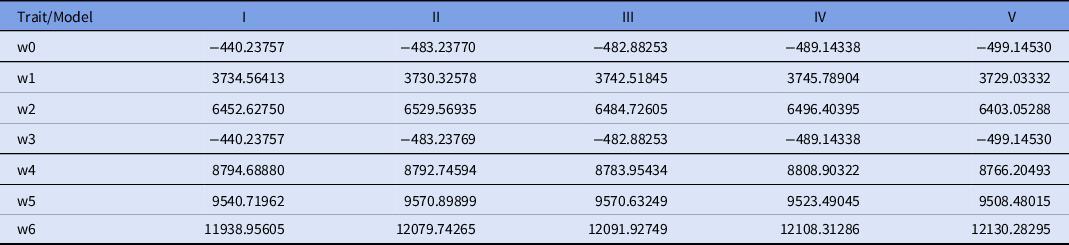
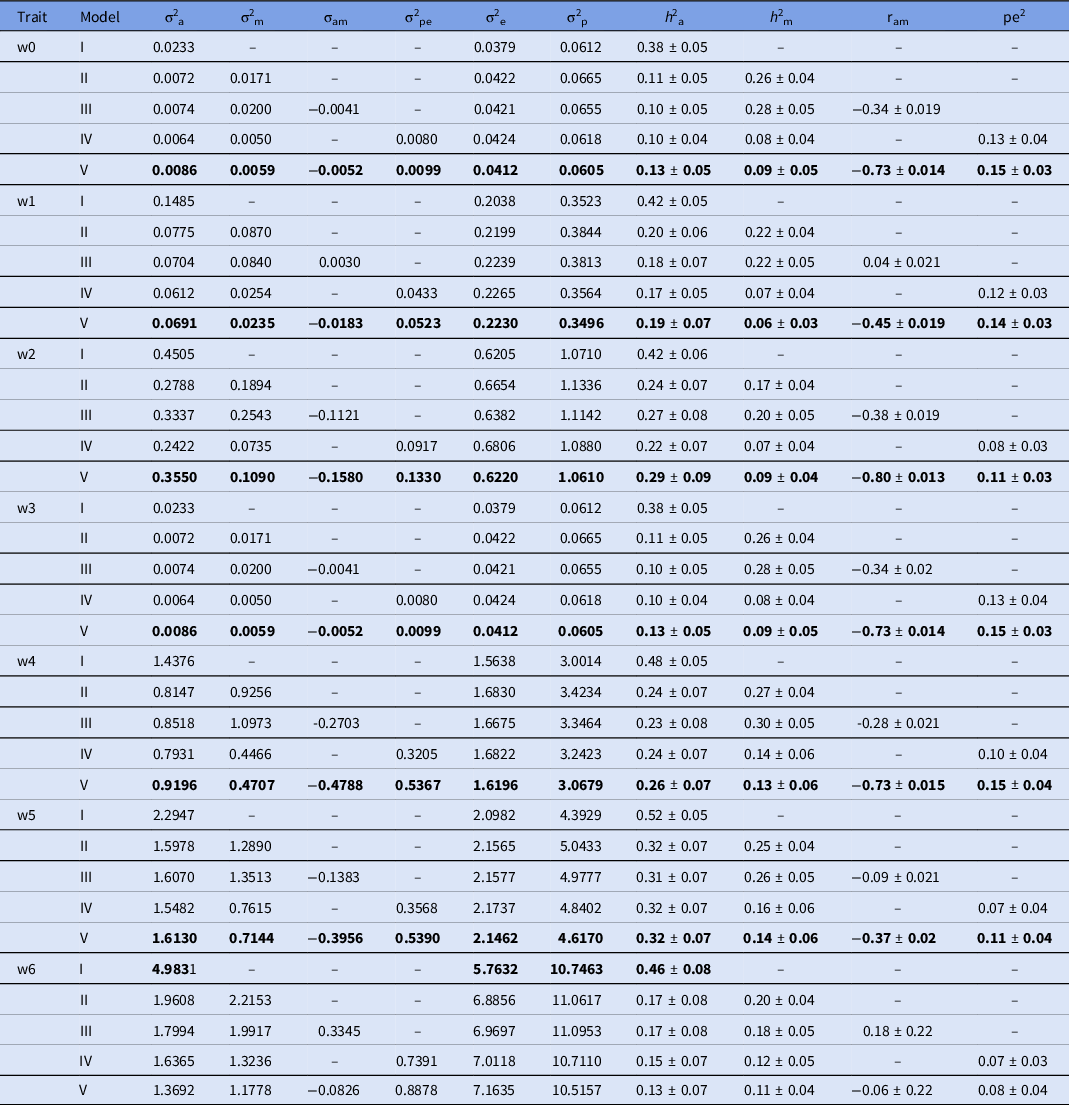
Appropriateness of different models regarding their ability to explain the variation in different body weights was based on DIC. Model V best fitted the data pertaining to all pre-weaning traits (w0–w5), based on DIC estimates for different models (Table 2). Model I incorporating only the direct additive genetic effect was the most appropriate for explaining the variation in weaning weight. The analysis showed that genetic as well as environmental components of maternal effect caused variation in pre-weaning body weights. It stressed the importance of these random effects to be included in genetic models while assessing pre-weaning body weights in piglets. Similar to our results, Hermesch et al. (Reference Hermesch, Luxford and Graser2001), Solanes et al. (Reference Solanes, Grandinson, Rydhmer, Stern, Andersson and Lundeheim2004), Chimonyo and Dzama (Reference Chimonyo and Dzama2007) and Alves et al. (Reference Alves, Schenkel, Brito and Robinson2018) reported the importance of direct additive genetic and maternal effects (genetic and permanent environmental components) to study the variation in birth weight and weight at 3 weeks of age (w3) in different pig populations. Omission of these effects in the analysis may lead to bias in the estimation of genetic parameters. The estimates of direct heritability decreased gradually on addition of these random effects. i.e. from 0.38, 0.42, 0.42, 0.38, 0.48, 0.52 and 0.46 in model I to 0.13,0.19, 0.29, 0.13, 0.26, 0.32 and 0.13 in model V for w0, w1, w2, w3, w4, w5 and w6, respectively (Table 3).
Deviance information criterion (DIC) estimates for different models used on body weights in Landlly piglets

w0: birth weight; w1: weight at first week; w2: weight at second week; w3: weight at third week; w4: weight at fourth week; w5: weight at fifth week; w6: weight at sixth week/weaning.
(Co)variance components and genetic parameter estimates for weekly body weights in Landlly piglets through different animal models

Values in bold signify the estimates from the best-fit model.
w0: birth weight; w1: weight at first week; w2: weight at second week; w3: weight at third week; w4: weight at fourth week; w5: weight at fifth week; w6: weight at sixth week/weaning; σ2a = direct additive genetic variance; σ2m = maternal additive genetic variance; σam = covariance between direct and maternal additive genetic effects; σ2pe = maternal permanent environmental variance; σ2e = residual variance; σ2p = phenotypic variance; h2d = σ2a/σ2p = heritability of direct genetic effect; h2m = σ2m/σ2p= heritability of maternal genetic effect; ram = σam/σaσm = correlation between direct and maternal genetic effects; pe2 = σ2pe/σ2p = maternal permanent environmental variance as a proportion of phenotypic variance.
Inclusion of the maternal effect in model II considerably reduced the additive genetic variance in each trait. Thereafter, the additive genetic variance was retained in different models when additional random effects were incorporated in comparison with model II. The total variance in pre-weaning traits (w0–w5) was best partitioned in model V with the combination of additive, maternal genetic and maternal environmental variances. Model I was the best fit for weaning weight (w6). The estimate of additive genetic variance and direct heritability were reduced for w6 on inclusion of other random effects in different models. The estimate of maternal heritability for w6 in model II was 0.20, which was further reduced in other models on incorporation of additional random factors.
(Co)variance components and genetic parameters
The marginal posterior distribution of (co)variance components (direct additive genetic, direct maternal genetic, maternal permanent environment and residual) for body weights across different models have been summarized in Table 3. The estimates of direct additive genetic heritability, maternal genetic heritability, litter heritability (maternal permanent environmental variance as proportion to total variance) for body weights in Landlly piglets is also presented in Table 3.
The direct additive genetic heritability (direct heritability) for birth weight (w0) ranged from 0.10 to 0.38 across five different models applied in the study. The estimate was low (0.13) for the best-fit model (model V). Low estimate (0.09) of direct heritability has also been reported by Roehe (Reference Roehe1999) in different pig lines on using similar Bayesian analysis. In concurrence with our study, low heritability estimates (0.10 – 0.15) have been reported for birth weight in crossbred pig population in India (Mondal et al., Reference Mondal, Kumar, Dubey, Sivamani and Dutt2014) and Yorkshire piglets (Alves et al., Reference Alves, Schenkel, Brito and Robinson2018). Similarly, low heritability has been reported in other pig populations with estimates ranging from 0.04 to 0.07 (Grandinson et al., Reference Grandinson, Lund, Rydhmer and Strandberg2002; Tomiyama et al., Reference Tomiyama, Kanetani, Tatsukawa, Mori and Oikawa2010; Dufrasne et al., Reference Dufrasne, Misztal, Tsuruta, Holl, Gray and Gengler2013). However, higher heritability estimates for birth weight in piglets have been reported by Ilatsia et al. (Reference Ilatsia, Githinji, Muasya, Okeno and Kahi2008) and Dufrasne et al. (Reference Dufrasne, Wavreille, Piedboeuf and Gengler2014) in Large White and Pietrain crossbred pig populations, respectively.
The direct heritability estimates ranged from 0.17 to 0.42 and 0.22 to 0.42 for w1 and w2, respectively, considering different effects in models (Table 3). A low estimate (0.19) of direct heritability was recorded for w1, whereas w2 showed a moderate estimate of direct heritability (0.29) under the best-fit models (model V). Tomiyama et al. (Reference Tomiyama, Kanetani, Tatsukawa, Mori and Oikawa2010) reported a low direct heritability estimate of 0.19 for body weight in Berkshire piglets at 2 weeks of age using a similar animal model. The direct heritability estimate for w3 ranged from low (0.10) to moderate (0.38) across different models. The estimate for w3 was 0.13 under the best-fit model (model V). In concordance with our results, Canario et al. (Reference Canario, Lundgren, Haandlykken and Rydhmer2010) reported a low estimate (0.18) of direct heritability for body weight at 3 weeks age in Norwegian Landrace piglets. Solanes et al. (Reference Solanes, Grandinson, Rydhmer, Stern, Andersson and Lundeheim2004) and Chimonyo and Dzama (Reference Chimonyo and Dzama2007) also reported low estimates (0.03–0.13) of direct additive genetic heritability for w3 in Yorkshire and Mukota piglets, respectively.
The direct heritability for w4 ranged between 0.23 and 0.48 across different models. The estimate of direct heritability was moderate (0.26) for w4 under the best-fit model (model V). Mondal et al. (Reference Mondal, Kumar, Dubey, Sivamani and Dutt2014) reported a low estimate of direct heritability (0.11) at the 4-week stage in Landrace × Desi synthetic piglets in India. A still lower direct heritability estimate of 0.03 has been reported by Zhang et al. (Reference Zhang, Bidanel, Burlot, Legault and Naveau2000) at this age in the Tiameslan composite pig line. The direct heritability for body weight of Landlly piglets at 5 weeks of age (w5) ranged from moderate (0.31) to high (0.52). Its value was 0.32 under the best-fit model (model V). Chimonyo et al. (Reference Chimonyo, Dzama and Bhebhe2008) reported a low estimate of direct heritability (0.16) for w5 in Mukota piglets. Direct heritability for weaning weight (w6) in Landlly piglets ranged between 0.13 and 0.46 across various models incorporating different combinations of random effects. The estimate of direct additive genetic heritability was high (0.46) for the best-fit model (model I). Our results for weaning weight corroborated with the findings of Dufrasne et al. (Reference Dufrasne, Wavreille, Piedboeuf and Gengler2014), who reported a high estimate of direct heritability for weaning weight in Pietrain crossbred pigs. Similarly, Okon et al. (Reference Okon, Ngere and Ibom2009) reported a high estimate (0.44) of direct additive heritability for weaning weight. Furthermore, Mondal et al. (Reference Mondal, Kumar, Dubey, Sivamani and Dutt2014) also reported an estimate of 0.40 for body weight of Landrace × Desi synthetic piglets in India using model I in their REML-based analysis.
The maternal genetic heritability (maternal heritability) for birth weight varied between 0.08 and 0.28 across different fitted models. The estimate of maternal heritability for birth weight was low (0.09) under the best-fit model. In agreement with results from this study, low estimates of maternal heritability for birth weight have been reported by Grandinson et al. (Reference Grandinson, Lund, Rydhmer and Strandberg2002), Canario et al. (Reference Canario, Lundgren, Haandlykken and Rydhmer2010), Dufrasne et al. (Reference Dufrasne, Misztal, Tsuruta, Holl, Gray and Gengler2013), Mondal et al. (Reference Mondal, Kumar, Dubey, Sivamani and Dutt2014), Alves et al. (Reference Alves, Schenkel, Brito and Robinson2018) and Dong et al. (Reference Dong, Tan, Cai, Li, Wu and Wu2020) in Yorkshire, Norwegian Landrace, composite (terminal cross developed after mating Duroc sires with Large White × Landrace crossbred dams), Landrace crossbred, Yorkshire and Landrace pigs, and Large White pig populations, respectively.
The maternal heritability estimate for w1 ranged from 0.06 to 0.22 across different models. Its estimate was low (0.06) for the best-fit model. Conversely, the maternal heritability ranged between 0.07 and 0.20; and 0.08 to 0.28 for w2 and w3, respectively. The maternal heritability estimate was low for w2 and w3 with a similar estimate of 0.09 under the best-fit models (model V each). Similar to our results, Hermesch et al. (Reference Hermesch, Luxford and Graser2001) and Tomiyama et al. (Reference Tomiyama, Kanetani, Tatsukawa, Mori and Oikawa2010) reported low estimates (0.07–0.13) of maternal heritability for w2 in three maternal pig lines, maintained at Bunge Meat Industries and Berkshire piglets, respectively. A low estimate of maternal heritability for body weight at 3 weeks of age has also been reported earlier by Solanes et al. (Reference Solanes, Grandinson, Rydhmer, Stern, Andersson and Lundeheim2004) in Yorkshire piglets.
The estimate of maternal heritability for w4 ranged from 0.13 to 0.30. The estimate was 0.13 (low) under the best-fit model (model V). Similarly, maternal heritability ranged between 0.14 and 0.26 for w5 in Landlly piglets. A similar estimate of 0.11 for maternal genetic heritability has been reported for body weight at the 5th week of age by Zhang et al. (Reference Zhang, Bidanel, Burlot, Legault and Naveau2000) in the Tiameslan composite pig line. Across different models used for w6, the maternal heritability ranged between 0.11 and 0.20. However, the most appropriate model describing the variation in w6 was model I, incorporating only additive genetic effect in it.
The estimate of litter heritability (c2) for birth weight (w0) was 0.15 under the best-fit model. Similar to our results, Kaufmann et al. (Reference Kaufmann, Hofer, Bidanel and Künzi2000), Chimonyo and Dzama (Reference Chimonyo and Dzama2007), Dufrasne et al. (Reference Dufrasne, Wavreille, Piedboeuf and Gengler2014) and Alves et al. (Reference Alves, Schenkel, Brito and Robinson2018) reported low estimates of litter heritability in Large White, Mukota, Pietrain crossbred and Yorkshire pig populations, respectively. However, higher estimates of c2 have been reported for birth weight by Mondal et al. (Reference Mondal, Kumar, Dubey, Sivamani and Dutt2014) and Dong et al. (Reference Dong, Tan, Cai, Li, Wu and Wu2020) in Landrace crossbred and Large White piglets, respectively.
The estimate of litter heritability (c2) was low for w1 (0.14) and w2 (0.11). Similar to our results, a low estimate of c2 (0.07) has been reported for w2 by Tomiyama et al. (Reference Tomiyama, Kanetani, Tatsukawa, Mori and Oikawa2010) in Berkshire piglets. Hermesch et al. (Reference Hermesch, Luxford and Graser2001) have reported a higher estimate of litter heritability (0.22) at 2 weeks of age in three pig lines maintained at Bunge Meat Industries. The estimate of litter heritability ranged from 0.13 (model IV) to 0.15 (model V best fit) for w3. In near concordance to our results, Solanes et al. (Reference Solanes, Grandinson, Rydhmer, Stern, Andersson and Lundeheim2004) reported an estimate of 0.19 for litter heritability (c2) at 3 weeks of age in Yorkshire piglets. Conversely, the estimate of litter heritability (c2) varied between 0.10 and 0.15 for w4 in models IV and V, respectively. The estimate of c2 decreased after w4 and reached 0.11 under the best-fit model.
Similarly, c2 estimates for w5 and w6 ranged from 0.07 and 0.11, and 0.07 to 0.08, showing the lesser importance of a maternal permanent environment with advanced age. However, model I with only additive genetic effect was the best fit for weaning weight in Landlly piglets. Most of the correlation estimates between additive genetic and maternal genetic effects for a specific trait were negative, with their magnitude varying from 0.37 to 0.80 for pre-weaning traits (w0–w5).
Genetic parameters’ trend across the age
The present study showed that birth weight in Landlly piglets was affected by additive genetic and maternal effects of dam (genetic as well as environmental components). Low direct heritability for birth weight indicated that genetic makeup has a lesser contribution to overall variation in birth weight of Landlly piglets. Low estimates of direct, maternal and litter heritability signified the lesser contribution of the individual’s own genotype and maternal effect on variation in body weight at the first week of age. Conversely, much of the variation may be attributed to environmental sources in terms of climate and nutrition.
Early weights, especially birth weight and w1, showed low heritability (direct and maternal) estimates. Low estimates are attributable to many factors that primarily include the parturition stress on sows and pre-/post-natal stress on piglets. Parturition stress in sows has been reported to produce a prolonged effect on subsequent performance of sows (in terms of fertility and other reproductive parameters), as well as that of piglets (Peltoniemi et al., Reference Peltoniemi, Björkman and Oliviero2016). It also leads to altered immunity states and reduced birth weight in piglets (Jarvis et al., Reference Jarvis, Moinard, Robson, Baxter, Ormandy, Douglas, Seckl, Russell and Lawrence2006; Beydoun and Saftlas, Reference Beydoun and Saftlas2008; Couret et al., Reference Couret, Jamin, Kuntz-Simon, Prunier and Merlot2009; Otten et al., Reference Otten, Kanitz, Couret, Veissier, Prunier and Merlot2010; Collier et al., Reference Collier, Williams, Carroll, Welsh and Laurenz2011; Tuchscherer et al., Reference Tuchscherer, Otten, Kanitz, Gräbner, Tuchscherer, Bellmann, Rehfeldt and Metges2012). There is abrupt change in the physiological processes and feeding pattern of sows during the transition period from gestation to post-farrowing (lactation) stages. It primarily affects the feeding pattern and body metabolism of sows (Mosnier et al., Reference Mosnier, Etienne, Ramaekers and Père2010) and possibly causes increased environmental variation in early body weights of piglets. Sow lactation, being related to its metabolism and one of the important limiting factors for early piglet development, is another important factor that causes variation in birth weight of piglets (Hawe et al., Reference Hawe, Scollan, Gordon and Magowan2020). These factors were consistent with estimates of permanent environmental effects found in the present study that remained constant until w5 and decreased thereafter. Furthermore, it led to an increased significance of the maternal effect as against the additive genetic effect of the piglet itself, which was signified by consistently negative correlation (ram) estimates. Improvement in early weights can be attained by providing uniform and optimal environment to the piglets.
The estimates of direct heritability were moderate for w2 (0.29), w4 (0.26) and w5 (0.32), while it was low for w3 (0.13). The direct heritability for weaning weight (w6) was high (0.46). The effect of abrupt introduction of creep ration and adaptation period thereof may be responsible for a reduction in the heritability estimate for w3. The piglets may not have been able to express their genotype fully at this stage. However, this claim needs more research before reaching any conclusion. The moderate direct heritability estimate for w2 implied considerable variation to be under genetic control that can be exploited in selection programmes. Among early pre-weaning weight (until w4), moderate heritability was recorded for w2 that can aid in the selection of animals for optimal weaning and post-weaning performance. However, it will be dependent on correlation estimates between the traits under consideration. The contribution of the maternal effect (genotype and environment) remained low for w2. The results revealed the moderate contribution of the additive genetic effect on variation in w4; selection at this stage may therefore yield a moderate response.
The highest effect of maternal environment on body weights was found at birth and subsequently at the 3rd and 4th weeks of age. Low estimates of direct and maternal heritability implied lesser chances of improved response if the selection was based on w3. It was also inferred that lesser variation in body weight was under genetic (direct additive and maternal) control at 3 weeks of age. The estimates of maternal heritability were lower than litter heritability (c2) across different pre-weaning traits from w0 to w4, which indicated the higher contribution of maternal permanent environment to variation in these body weight traits. However, the maternal genetic variance increased above maternal environmental variance for w5 and w6. With advanced age, the importance of maternal environment decreased when compared with maternal genotype for optimal body weight at these stages.
The high but negative correlation (ram) estimates between direct additive genetic and maternal genetic effect for body weights were indicative of the antagonistic relationship between additive genetic and maternal genetic effects. The antagonistic relationship indicated the increased significance of the maternal genetic effect of the dam during prenatal life of the piglets compared with direct additive genetic effect of piglet itself. The nutritional support from sow to young one(s) during pre- or post-natal life has a significant effect on various aspects of piglet development, especially during the initial stages. Its strongest evidence is provided by experimental studies in which the manipulation of feeding levels (feeding rate as well as quality) have been reported to affect many important traits such as offspring number, litter weight and sex ratio (Du, Reference Du2006). Maternal nutrition is important for placental growth, vascular development and nutrient transport and it produces long-term consequences on the anatomy, physiology, and metabolism of piglets (Godfrey and Barker, Reference Godfrey and Barker2001; Belkacemi et al., Reference Belkacemi, Nelson, Desai and Ross2010). Change in feed composition such as inadequate maternal dietary protein and/or carbohydrate levels during pregnancy have been reported to increase the incidence of low weight piglets at birth with reduced skeletal muscle and adipose tissue in them (Rehfeldt et al., Reference Rehfeldt, Stabenow, Pfuhl, Block, Nurnberg, Otten, Metges and Kalbe2012). All these factors increase the importance of maternal effect in determining the body weight of piglets at birth and pre-weaning stages.
Conclusion
The results from the present study revealed the effect of the direct maternal genetic and permanent maternal environment component on weekly body weights during pre-weaning stages in Landlly piglets. The body weight of piglets at the second week age showed a moderate estimate of direct heritability which implied that improvement in body weight may be expected if selection is made at this stage. The maternal permanent environment contributed more to variance in pre-weaning body weights in piglets until the 4th week of age compared with the direct maternal genetic effect. Inclusion of the maternal additive genetic and maternal permanent effect into models for the genetic analysis of pre-weaning body weights of piglets resulted in better partitioning of variance.
Acknowledgements
The authors would like to acknowledge the support of the Director, ICAR-IVRI during the study.
Conflict of interest
The authors have no conflict to declare regarding this publication.
Funding information
No funding was received exclusively for this research work.