INTRODUCTION
The diversity and composition of seedling communities has been shown to be determined by dispersal and post-dispersal environmental factors (Norden et al. Reference NORDEN, CHAVE, CAUBÈRE, CHÂTELET, FERRONI, FORGET and THÉBAUD2007, Reference NORDEN, CHAVE, BELBENOIT, CAUBÈRE, CHÂTELET, FORGET, RIÉRA, VIERS and THÉBAUD2009). Invasive thicket-forming shrubs have been reported to decrease native herbaceous species diversity and tree seedling abundance in temperate (Collier et al. Reference COLLIER, VANKAT and HUGHES2002, Hartman & McCarthy Reference HARTMAN and McCARTHY2008) and subtropical (El-Keblawy & Al-Rawai Reference EL-KEBLAWY and AL-RAWAI2007) regions of the world, and also decrease native tree seedling growth in tropical regions (Honu & Dang Reference HONU and DANG2000). Woody shrubs could potentially bring about these changes by acting as filters in both dispersal as well as niche processes. At the dispersal stage, the possibility of the habit of an invasive alien species affecting the process of heterospecific seed arrival itself by either acting as a facilitator or barrier is poorly understood.
Thicket-forming invasive woody plants are known to alter prevalent light conditions, potentially creating post-dispersal barriers to the germination and persistence of seedlings. For example, light in the understorey was lowest under Elaeagnus umbellata, an alien invasive, as compared with other native evergreen shrubs in the eastern coast of North America (Brantley & Young Reference BRANTLEY and YOUNG2010). However, in seasonally dry forests, the effect of shading on seedling growth and survival is not understood well. In such forests, while shaded areas have been shown to support higher densities of seedlings overall (Lieberman & Li Reference LIEBERMAN and LI1992), increased light availability has been shown to be beneficial during the wet season, supporting increased seedling growth, but detrimental during the dry season, resulting in seedling desiccation and high mortality (Gerhardt Reference GERHARDT1996, McLaren & McDonald Reference McLAREN and McDONALD2003).
We explore the effects of thicket-forming invasive species on native seedling communities using Lantana camara as a model system. At the dispersal stage, we expected Lantana camara thickets to act as a barrier to mechanically dispersed species (S. Prasad, pers. comm.). Because of its preferential use by mammals as an area for rest and concealment (Sawarkar Reference SAWARKAR1984) and because the density of certain frugivorous birds increases with increasing L. camara densities (Aravind et al. Reference ARAVIND, RAO, GANESHAIAH, UMA SHAANKER and POULSEN2010), we also expected the frequency of occurrence and abundance of such species to be higher under thickets. Lantana camara thickets provide shade even in the dry season (pers. obs.). At the post-dispersal stage, we expected the seedlings of species with affinity for dry-forest habitats with prevalent open canopy to be rare under thickets and those with affinity for moist-forest habitats with prevalent closed canopy to be more abundant under thickets. Species common to both dry- and moist-forest habitats (henceforth referred to as ‘ubiquitous’ species) were not expected to show any response to the presence of dense L. camara thickets. Eventually, the composition of seedling communities under L. camara thickets was expected to be determined by a combination of dispersal characters affecting seed arrival and forest habitat characters affecting seedling survival.
STUDY SPECIES
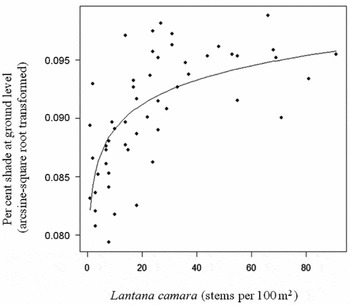
Lantana camara L. (Verbenaceae), a perennial thicket-forming shrub of Central and South American origin is considered one of the world's ten worst invasive plants (Cronk & Fuller Reference CRONK and FULLER1995). In India, it grows up to an elevation of 2000 m asl, across a wide range of habitats (Matthew Reference MATTHEW1971). In the heavily infested areas at the study site, Lantana camara attains densities of up to 91 stems per 100 m2 (Figure 1) and dense thickets have mean biomass values of 3.1 kg m−2 (R. Sukumar, H.S. Suresh & H.S. Dattaraja, unpubl. data). Lantana camara flowers, which are pollinated by a number of lepidopteran (Dronamraju Reference DRONAMRAJU1960) and thysanopteran species (Mathur & Mohan Ram Reference MATHUR and MOHAN RAM1978), exhibit change in colour post-pollination. The plant produces large numbers of seeds dispersed by generalist frugivorous birds and mammals (Bisht & Bhatnagar Reference BISHT and BHATNAGAR1979) and coppices vigorously if damaged mechanically and also post-fire (Hiremath & Sundaram Reference HIREMATH and SUNDARAM2005, pers. obs.).
Plot of per cent shade versus Lantana camara stem density (number of stems per 100 m2). The fitted line (y = 0.003ln(x) + 0.082, adjusted R2 = 0.43, P < 0.001) indicates that shade increases as a logarithmic function of L. camara stem density. Light measurements were taken at the four corners of sixty 10 × 10-m plots with varying number of L. camara stems per unit area, using a densiometer. Per cent shade per plot was calculated by averaging these values, and was plotted against L. camara stems per unit area after arcsine-square root-transformation.

STUDY SITE
Located in the southern Indian state of Tamil Nadu, Mudumalai is a designated Wildlife Sanctuary and National Park (321 km2, 11°30′–11°39′N, 76°27′–76°43′E), a part of the Nilgiri Biosphere Reserve, a Project Elephant Reserve and more recently a Tiger Reserve. The altitude of MWLS is about 300–1200 m asl with a major part of the reserve lying at an altitude of 900–1000 m. The average annual rainfall decreases from 1800+ mm in the west to about 600+ mm in the east, creating a strong west–east rainfall gradient (Sukumar et al. Reference SUKUMAR, DATTARAJA, SURESH, RADHAKRISHNAN, VASUDEVA, NIRMALA and JOSHI1992). Consequently, the western part of Mudumalai has semi-evergreen and moist deciduous forest, the central part has dry deciduous forest and the eastern end has dry thorn forest (Sharma et al. Reference SHARMA, SHETTY, VIVEKANANDAN and RATHAKRISHNAN1977). The sanctuary also experiences dry-season ground fires. The Mudumalai Forest Dynamics Plot (henceforth referred to as MFDP) has an area of 50 ha and is located centrally in MWLS and receives 1274 ± 292 mm of rainfall annually (average estimated from 1990–2009), mostly between April–November. The average monthly maximum temperatures in the MFDP range from a low of 25.5 °C ± 0.5 °C in August to a high of 31 °C ± 0.3 °C in April, while the average monthly minimum temperatures similarly range from 13.9 °C ± 0.5 °C in January to 18.2 °C ± 0.7 °C in April (all averages computed from 1990–2009). The MFDP was set up in 1988–1989 with the aim of understanding the long-term vegetation dynamics of the dry forest where the recruitment and mortality of tagged stems (>1 cm dbh) of tree species is monitored annually and growth is monitored once every 4 y (Sukumar et al. Reference SUKUMAR, DATTARAJA, SURESH, RADHAKRISHNAN, VASUDEVA, NIRMALA and JOSHI1992). Dominant canopy tree species of the MFDP are Lagerstroemia microcarpa, Terminalia crenulata, Anogeissus latifolia and Tectona grandis, while the dominant understorey tree species are Helicteres isora, Cassia fistula, Catunaregam spinosa and Phyllanthus emblica. Lantana camara has become a dominant shrub in the understorey since 2002 (Suresh et al. Reference SURESH, DATTARAJA and SUKUMAR2010).
METHODS
Sampling plots
In the MFDP, Lantana camara distribution has been recorded at 10 × 10-m scale since 1989. Annually, a density distribution map of the same is prepared by assigning each plot of 100 m2 to one of five unique L. camara density categories. A plot is defined as ‘L. camara absent’ (LA henceforth) when there are no visually detectable stems of this invasive in the 100-m2 area and ‘L. camara very dense’ (LD henceforth) if >70% of the plot is covered by L. camara thickets. The density distribution map for the year 2006 was used for selecting plots belonging to LA and LD categories for enumerating seedlings of native tree species, as they offered the most scope for comparison with respect to our objectives.
Seedling enumeration
We randomly selected a total of sixty 100-m2 plots, 30 from LA and 30 from LD categories. Since the distribution map used for this selection was about 1 y old at the time of this study, a few stems of L. camara were found even in LA plots. However, thicket-forming stems were restricted to LD plots and no thickets were present in LA plots. In order to determine whether L. camara thickets reduced light availability at ground level, per cent shade at ~50 cm from the ground was measured using a densiometer, at four corners of each plot. These values were then averaged to get mean per cent shade per plot. All native tree stems from 10–100 cm height were classified as ‘seedlings’ and enumerated in 2-m strips along the four sides of each 100-m2 plot. The total area enumerated in a plot was thus 64 m2. Seedlings of Catunaregam spinosa were very abundant and difficult to quantify across the sampled area, and were therefore enumerated in 4-m2 subplots at the four corners of each 100-m2 plot. Their total abundance across the sampled area was estimated from the same.
Determination of species characteristics
Species were grouped according to their dispersal mode as animal- or mechanically (wind/explosive) dispersed based on the classification provided for trees of Mudumalai by Murali & Sukumar (Reference MURALI and SUKUMAR1994). Animal-dispersed species were further subdivided into mammal- and bird-dispersed species (S. Prasad, pers. comm.). Species were further classified according to forest habitat affinities as (1) dry-forest species, (2) moist-forest species or (3) ubiquitous (Table 1). This classification was based on a comparison of tree species abundances across nineteen 1-ha plots spread along the west–east axis of MWLS (H. S. Dattaraja & R. Sukumar, unpubl. data). The 1-ha plots were grouped into dry-forest habitat (dry deciduous and dry thorn forest types, having open canopy) and moist-forest habitat (moist deciduous and semi-evergreen forest types, having closed canopy) plots and abundances of species were compared. Tree species which were significantly more abundant in the moist deciduous and semi-evergreen plots were classified as moist-forest species, whereas those that were significantly more abundant in dry deciduous and dry thorn forest plots were classified as dry-forest species. Species that showed no significant difference in abundance across forest plots were classified as being ‘ubiquitous’. For species that were very rare and did not have comparable abundances, but were recorded in the MFDP during the present study, broad habitat preferences as described in regional floras (Matthew Reference MATTHEW1983, Saldanha Reference SALDANHA1984, Reference SALDANHA1996; Saldanha et al. Reference SALDANHA, NICOLSON and RAMAMOORTHY1976) were used (Table 1).
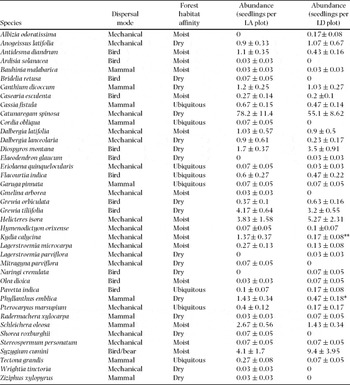
Dispersal modes, forest habitat affinities and abundances of forty species enumerated in sixty 10 × 10-m plots. Species nomenclature follows Matthew (Reference MATTHEW1983), Saldanha (Reference SALDANHA1984, Reference SALDANHA1996) and Saldanha et al. (Reference SALDANHA, NICOLSON and RAMAMOORTHY1976). Wilcoxon rank sum test was used to compare mean seedling abundances (number of seedlings per plot) between plots where Lantana camara thickets were absent (LA) and where they were very dense (LD). ** = P < 0.001, * = P < 0.05.

Statistical analyses
Per cent shade values per plot were arcsine-square root transformed and plotted against Lantana camara stem density (number of stems per 100 m2). An appropriate function was then fitted to the data. Generalized linear models (GLMs) with binomial error family and logit link, followed by post hoc pairwise tests of proportions, with P-values corrected by the false discovery rate method (Benjamini & Hochberg Reference BENJAMINI and HOCHBERG1995) were used to compare occurrence (presence/absence) of seedlings of different dispersal-habitat groups in LA and LD plots. GLMs with negative binomial error family to control for overdispersion in the data (Crawley Reference CRAWLEY2007), followed by post hoc Wilcoxon rank sum test with P-values corrected by the false discovery rate method, were used to compare seedling abundances in LA and LD plots. Model simplification was done using stepwise removal of interactions and the model with the lowest AIC was retained (Crawley Reference CRAWLEY2007). Catunaregam spinosa, the most abundant species by far in this study, was a potential outlier in prediction of trends of seedling distribution and abundance. All analyses were performed both with and without C. spinosa abundance. In order to determine whether group responses were affected by species-specific responses, we also tested whether presence/absence and abundance of seedlings of individual species was different between LA and LD plots, using pairwise tests of proportions and Wilcoxon rank sum test respectively with P-values corrected for multiple comparisons by the false discovery rate method. All community and species-level analyses were performed in the statistical programming software R (Ihaka & Gentleman Reference IHAKA and GENTLEMAN1996).
RESULTS
A total of 40 species of woody plants – 23 canopy tree species, 12 understorey tree species and four shrubs – were represented in the seedling community, of which most species were very rare (Table 1). Per cent shade per plot increased as a logarithmic function of number of Lantana camara stems per 100 m2 (y = 0.003ln(x) + 0.082, n = 60, adjusted R2 = 0.43, P < 0.001, Figure 1).
Community results – occurrence of seedling groups under Lantana camara
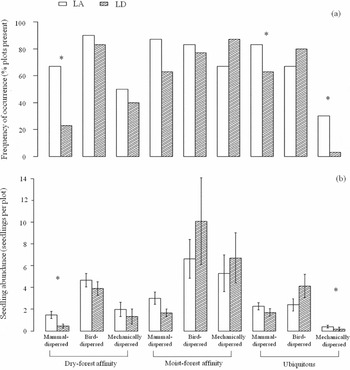
The presence/absence of seedlings depended upon the three-way interaction between L. camara density, forest habitat affinities as well as dispersal mode (Appendix 1). Model inferences did not change on excluding Catunaregam spinosa from the analysis. Dry-forest, mammal-dispersed (two-sample test of equality of proportions, df = 1, χ2 = 9.69, P = 0.009) and ubiquitous, mechanically dispersed species (two-sample test of equality of proportions, df = 1, χ2 = 5.88, P = 0.05, Figure 2a) were found to be present in a significantly lower number of LD than LA plots. On excluding C. spinosa from pairwise comparisons, ubiquitous mammal-dispersed species were also found to occur significantly less frequently under L. camara thickets (two-sample test of equality of proportions, df = 1, χ2 = 11.1, P = 0.008, Figure 2a).
Frequency of occurrence of species groups under and outside Lantana camara thickets. Frequency was calculated as the proportion of plots in which species belonging to different dispersal and forest-habitat groups were represented by at least one seedling, and then converted to percentage. LA = plots without L. camara thickets, LD = plots with very dense L. camara thickets, * = P < 0.05, two-sample test of proportions with continuity correction. Catunaregam spinosa has been excluded from this figure (a). Mean number of seedlings per plot of species groups under and outside Lantana camara thickets. Abundance of Catunaregam spinosa, a ubiquitous, mammal-dispersed species, has not been included in calculating mean abundance for this figure. * = P < 0.05, Wilcoxon rank sum test (b).

Community results – abundance of seedlings under Lantana camara
The abundance of seedlings was best explained by all the two-way interactions between L. camara density, dispersal mode and forest habitat affinities, but not the three-way interaction between these factors (Appendix 1). Model inferences did not change on excluding Catunaregam spinosa abundances. Dry-forest mammal-dispersed species were found to be significantly more abundant in LA plots as compared to LD plots (Wilcoxon rank sum test, W = 641, n = 60, P = 0.002, Figure 2b) as were ubiquitous mechanically dispersed species (Wilcoxon rank sum test, W = 565, n = 60, P = 0.009, Figure 2b). Pairwise results did not change on excluding C. spinosa abundances.
Species-specific results
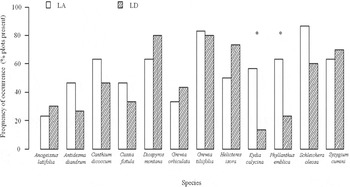
Most species found in the sampled plots had very low sample sizes to be considered for individual analyses. We therefore considered only 11 species for this analysis: Catunaregam spinosa, Syzygium cumini, Phyllanthus emblica, Helicteres isora, Cassia fistula, Grewia tiliifolia, Antidesma diandrum, Kydia calycina, Canthium dicoccum, Diospyros montana and Schleichera oleosa. Of these, Phyllanthus emblica and Kydia calycina were present in significantly lower number of LD plots as compared to LA plots (two-sample test of proportions, df = 1, χ2 = 8.21, P < 0.001; χ2 = 10.5, P < 0.001 for P. emblica and K. calycina respectively, Figure 3). The abundance of these two species was also significantly lower under L. camara thickets (Wilcoxon rank sum test, n = 60, W = 628, P = 0.019; W = 655, P < 0.001 for P. emblica and K. calycina respectively; Table 1). No other species were affected by the presence of L. camara thickets.
Frequency of occurrence of species under and outside Lantana camara thickets. LA = L. camara thickets absent, LD = L. camara thickets very dense, * = P < 0.05 (two-sample test of proportions with continuity correction). Catunaregam spinosa has been excluded from this figure. Frequency of occurrence was calculated as the proportion of plots in which at least one seedling of the species was present and then converted to percentage, under and outside L. camara thickets.

DISCUSSION
Seedling community under Lantana camara
Our results indicate that the impacts of L. camara may be manifesting at the level of groups of species that share forest habitat affinities and dispersal mode. Recent literature on L. camara, however, has only focused on its impact on overall species richness and abundance of native species, without considering these traits (Kohli et al. Reference KOHLI, DOGRA, BATISH and SINGH2004, Murali & Setty Reference MURALI and SETTY2001, Sharma & Raghubanshi Reference SHARMA and RAGHUBANSHI2006, Reference SHARMA and RAGHUBANSHI2007). Contrary to expectation, seedlings of mammal-dispersed species were less frequent under L. camara thickets. Since this was true for both dry-forest and ubiquitous species, we infer that this group of species may be limited by L. camara more at the dispersal stage than at the recruitment stage. This could arise if L. camara acted more as a barrier restricting movement of frugivorous mammals, rather than as a refuge for them. Such a situation could also arise if L. camara thickets were outcompeting other plants that herbivores graze or browse upon, reducing the occurrence of herbivores in such patches. This seems to be the case at the study site, where over the past 20 y, and especially since 2002, L. camara thickets have been observed to replace other understorey vegetation such as grasses (R. Sukumar, H.S. Dattaraja & H.S. Suresh, unpubl. data). Ubiquitous mechanically dispersed species were also rarer under L. camara thickets, indicating that, for this group of species, L. camara is a dispersal barrier rather than recruitment barrier as the other ubiquitous dispersal guilds were unaffected by the presence of thickets. Seedling abundances mirrored seedling presence/absence patterns, with dry-forest mammal-dispersed species and ubiquitous mechanically dispersed species being less abundant under L. camara thickets. Contrary to expectation, however, moist-forest bird-dispersed species were not more abundant under L. camara thickets. This may be due to the fact that this category is dominated by two species – Syzygium cumini and Grewia tiliifolia. Abundances of both these species are not affected by the presence of L. camara thickets (Table 1). For this group of species, community response may thus be determined more by the patterns exhibited by the most abundant species in the group than by forest habitat affinities.
Species response to Lantana camara
Individual species respond to the presence of an invader in different ways. In our study, we found that certain species are affected at the dispersal stage while others are affected at the recruitment stage by the presence of L. camara. Phyllanthus emblica, a dry-forest species chiefly consumed and dispersed by the Indian chevrotain Moschiola indica Gray and the spotted deer Axis axis Erxleben (Prasad et al. Reference PRASAD, PITTET and SUKUMAR2010), shows significantly lower presence and abundance under L. camara thickets. Phyllanthus emblica has also been observed to be less abundant under dense L. camara at Achanakmar-Amarkantak Reserve, a dry forest in central India (Sahu & Singh Reference SAHU and SINGH2008). This seems to indicate that P. emblica is limited by L. camara thickets at dispersal as well as at the recruitment stage. In the same study, the mean abundance of S. cumini (moist-forest affinity, bird-dispersed) in higher altitudes and that of Cassia fistula (ubiquitous, mammal-dispersed) was also found to be higher under dense L. camara, predicted responses that were not supported statistically by our own study. The presence and abundance of Kydia calycina seedlings (mechanically dispersed, moist-forest affinity) was lower under dense L. camara indicating that the thickets were probably acting as a barrier to the dispersal of this species.
Sprouting in seedlings – a confounding factor
Of the nine groups of species and the eleven individual species examined, very few of our predictions were actually realized, possibly because sprouting is an adaptive strategy in tropical dry forests. Plants are known to sprout vegetatively in response to disturbances such as fire, drought and herbivory (Bellingham & Sparrow Reference BELLINGHAM and SPARROW2000, Bond & Midgley Reference BOND and MIDGLEY2001, Grubb Reference GRUBB1977, Sukumar et al. Reference SUKUMAR, SURESH, DATTARAJA, SRINIDHI, NATH, Burslem, Pinard and Hartley2005). Mudumalai is subjected to seasonal drought, annual rainfall deficit as well as anthropogenic fires with a return interval of 3.3 y (Kodandapani et al. Reference KODANDAPANI, COCHRANE and SUKUMAR2004) and is also home to several large herbivorous mammals (Sukumar et al. Reference SUKUMAR, SURESH, DATTARAJA, SRINIDHI, NATH, Burslem, Pinard and Hartley2005). It is therefore expected that several woody species would show adaptive sprouting and may thus persist for years in the size class considered as ‘seedling’ i.e. 10–100 cm. Except for S. cumini which had shown gregarious fruiting in the year (2006) previous to our study and thus mass seedling recruitment, we were unable to determine the actual age of seedlings of other tree species. This could potentially confound our results as seedlings of certain species may have been persisting even before L. camara became a dispersal-limiting factor. In the MFDP the occurrence of L. camara thickets has been very recent (or at least since the MFDP was set up in 1988). The 30 LD plots that were examined in this study were thicket-free on an average of 69% of the time during 1989–2006 (R. Sukumar, H.S. Dattaraja & H.S. Suresh, unpubl. data). While seedlings need to invest in both above- and below-ground biomass production, sprouts can use subterranean reserves to grow (Miller & Kauffman Reference MILLER and KAUFFMAN1998). Sprouting species would be less likely to be affected by the presence of L. camara thickets and therefore overcome the dispersal- and recruitment-limiting barrier created by L. camara. In Mudumalai also, sprouting has been hypothesized to be a key factor governing recruitment of saplings (Sukumar et al. Reference SUKUMAR, SURESH, DATTARAJA, SRINIDHI, NATH, Burslem, Pinard and Hartley2005). The ability to sprout from subterranean vegetative structures post-disturbance damage probably make this forest community a resilient system, as is common in other dry forest ecosystems (Murphy & Lugo Reference MURPHY and LUGO1986).
Implications for dry-forest dynamics
Along with prevalent disturbances such as drought, fire and damage by large herbivores, invasive species can also alter the plant communities in tropical dry forests. Invasive species may also directly facilitate the occurrence of other disturbances, or alter disturbance intensity and duration (Gordon Reference GORDON1998). For example, the African grass Melinis minutiflora, may rapidly accumulate biomass, increasing fuel load at forest edges resulting in an increase in fire frequencies, thus affecting the regeneration of forest species at savanna-forest boundaries (Hoffmann et al. Reference HOFFMANN, LUCATELLI, SILVA, AZEUEDO, MARINHO, ALBUQUERQUE, LOPES and MOREIRA2004). A similar hypothesis has also been proposed for L. camara which also rapidly accumulates woody biomass in the form of thickets and may facilitate the occurrence of fires in the form of a positive feedback loop (Hiremath & Sundaram Reference HIREMATH and SUNDARAM2005). Therefore, apart from the direct predicted effects, there could be other indirect consequences of L. camara invasion. Invasive species are also known to cause changes in plant community composition by indirectly modifying the prevalent environmental conditions (Gordon Reference GORDON1998). Our study shows that while L. camara thickets do not affect the occurrence of most species, they may reduce the abundance of seedlings of dry-forest, mammal-dispersed species and ubiquitous, mechanically dispersed species. Follow-up of the fate of marked seedlings under dense L. camara over several years is required in order to determine if these thickets are able to alter seedling community composition in the longer term.
ACKNOWLEDGEMENTS
We thank the Tamil Nadu Forest Department for granting us permission to conduct this study at Mudumalai and the Ministry of Environment and Forests, Government of India for funding this study. We thank M. Bomman, Kunmari, B. Bomman, Krishna and Pauli Mara for their invaluable field skills and help with data collection. We also thank Dr Soumya Prasad for help with initiating and developing the concept, Dr Kavita Isvaran, Dr Liza Comita and Dr Simon Queenborough for help with analyses, Professor G.S. Bhat for support and Nandita Mondal for suggestions and inputs.
Model simplification and results (as recommended in Crawley Reference CRAWLEY2007). ‘p/a’ denoting presence/absence, measured as frequency of occurrence of traits, and abundance of seedlings were modelled (using generalized linear models, with binomial and negative binomial error structures respectively), as a function of presence of Lantana camara thickets, dispersal mode and forest habitat affinity. The main effects are: L – L. camara thicket category (LA – thicket absent/LD – thicket very dense), H – forest habitat affinity (dry-forest/moist-forest/ubiquitous), D – dispersal mode (mammal/bird/mechanical). Representation of models is as given in Crawley (Reference CRAWLEY2007), where L*H*D = L + H + D + L×H + L×D + H×D + L×H×D, and ‘×’ denotes an interaction between the main effects. Catunaregam spinosa was super-abundant across the sampled area, and potentially an outlier in the analysis. All models were run both with and without C. spinosa.