In the long history of operatic exoticism, Giacomo Puccini's Madama Butterfly (1904/6) and Turandot (1924/6) occupy particularly prominent positions.Footnote 1 These two works have been commonly viewed as late exemplars of orientalist opera and as marking the end of that tradition. Some scholars have emphasized the ways in which these operas allegedly diverged from the nineteenth-century model of operatic exoticism and in which Puccini achieved new forms of ‘exotic authenticity’. These operas have even been hailed as having transcended orientalist representation entirely.Footnote 2 However, rather than signalling an end to operatic orientalism or a break with that tradition, these operas have proved to be two of the most influential in this lineage, and they continue to inspire numerous other works of exotic representation in myriad genres across the globe. Furthermore, the scholarship that these two operas have prompted – particularly quests to identify exotic melodic sources and to prove details of an imagined exotic authenticity – has shaped our approach to orientalist musical representation more generally.
Over the course of the past century, scholars have been tracking down Japanese melodic sources for Madama Butterfly and Chinese sources for Turandot. Two important musical themes in Madama Butterfly have instigated particularly extensive searches for exotic sources. Both of these themes were even more prevalent in earlier versions of the score.Footnote 3 The first, which I will refer to as ‘Butterfly's theme’, is directly associated with the titular heroine herself, forming the climaxes of her entrance and of the love duet at the end of Act 1 and appearing in her vocal line as she proclaims her destiny and her devotion to Pinkerton. The second theme is associated with Butterfly's memories of her deceased father and with her grim Japanese patrimony more generally, and I will refer to it as the ‘Patrimony theme’. A common assumption has been that Puccini, attempting to achieve exotic authenticity and employing Japanese melodies throughout the score, based these two pentatonic themes on Japanese folk tunes as well. Given the prominence of these themes, identifying their source will shape our understanding of the opera, of Puccini's compositional process and of his approach to exoticism. The source itself will reveal nineteenth-century routes of musical globalization and once again call into question notions of exotic authenticity.
Puccini did go to some lengths to draw on Japanese music when representing the Japanese in his score, efforts that have been repeatedly documented by scholars. He consulted published collections of Japanese traditional melodies, met the wife of a Japanese ambassador, probably attended the performance of a Japanese actress, and ordered recordings of Japanese music.Footnote 4 It is well known that Puccini employed several famous Japanese melodies in composing Madama Butterfly, including ‘Sakura, Sakura’ and ‘Miyasan’/‘Tonyare-bushi’. ‘Miyasan’ (‘Noble Prince’), in particular, was familiar in the West through its prominent appearance as ‘Miyasma’ in Gilbert and Sullivan's The Mikado (1885). It is associated in Puccini's opera particularly with Yamadori, the noble Japanese prince who attempts to woo the abandoned Butterfly in Act 2, Part 1, and thus suggests that Puccini occasionally selected exotic melodies on the basis of correspondences between their translated titles and his drama.Footnote 5 Puccini's use of Japanese melodies clearly marks the Japanese characters as exotic, and these melodies most often stand out from the context of the opera's late Romantic Italian style. Scholars have identified several possible printed sources for many of these melodies. However, Puccini, as I will reveal here, turned to another musical source entirely for Butterfly's theme and the Patrimony theme, both of which he employed quite extensively in the opera.
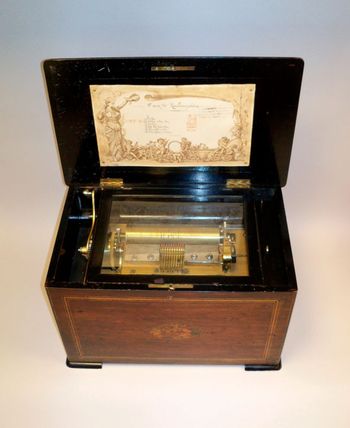
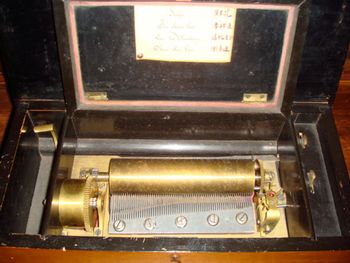
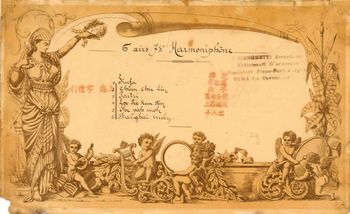
We have known since 1920 that Puccini borrowed melodies from a music box owned by Baron Edoardo Fassini-Camossi as he worked on his final opera, Turandot, in Bagni di Lucca. This music box has been commonly referred to as the ‘Fassini box’.Footnote 6 I have discovered that Puccini had also turned to a music box for exotic inspiration some 18 years earlier, during the composition of Madama Butterfly. The Murtogh D. Guinness Collection of Mechanical Musical Instruments and Automata at the Morris Museum in Morristown, New Jersey, holds a ‘harmoniphōne’ – a c.1877 Swiss-made, six-tune cylinder music box with reed organ – that plays Westernized versions of Chinese folk tunes and includes its original tune sheet (or programme card) identifying the titles of these melodies (see Figure 1).Footnote 7 This box's musical programme includes both what appear to be the direct sources for Butterfly's two crucial themes and melodies employed by Puccini in Turandot. I will offer evidence below suggesting that Puccini may have heard and handled this very artefact during the period in which he composed Madama Butterfly. The ‘Fassini’, ‘Guinness’ and other late nineteenth-century music boxes playing these and other Chinese tunes were manufactured in Switzerland and France, rather than in China, and thus bear witness to nineteenth-century routes of global musical circulation.Footnote 8

The specific moments in Madama Butterfly when these two melodies are heard suggest that Puccini might have been aware of their Chinese titles and subject matter. I will consider how this knowledge might shape interpretations of the opera and how it supports the argument that Puccini's initial conception of Madama Butterfly was more sardonic than the powerfully melodramatic 1906 version that entered the repertory. Puccini's orchestrations also point to the pervasive role played by this mechanical source. In fact, the characteristic sound of music boxes – relatively higher and exact pitch, detached articulation, clear and bright timbre, and rhythmic precision – is more evident in Butterfly and Turandot than is the style of any East Asian music. The Chinese melodies on both the Guinness and the Fassini music boxes (the latter of which I have also relocated and investigated) additionally point to unnoticed connections between Puccini's two orientalist operas.
Chinese melodies appearing on late nineteenth-century Swiss music boxes may be traced to the transcriptions of Frederic ‘Fritz’ Bovet, a member of the famous Swiss watch-making family. Bovet apparently collected melodies in China in 1845 specifically so that they could be pinned onto music-box cylinders in Switzerland that would then be marketed back in China. Given that Puccini featured these melodies in his operas and thereby influenced numerous later composers of musical exoticism, Bovet's role in music history is not insignificant. By featuring the famous Chinese folk song ‘Jasmine Flower’ (or ‘Fresh Flowers’) prominently in Turandot, Puccini not only reaffirmed this tune as the representative token of Chinese music in the West but also reinforced its pre-eminent status within China itself. Puccini's operas never sound very much like Chinese traditional music, but some Chinese music came to sound very much like Puccini.
In this article, I will first discuss the source I have discovered for the two themes most clearly associated with the exotic heroine in Madama Butterfly, noting previous attempts to identify sources for these melodies, the appearances of both melodies throughout the opera and the significance of their titles and original Chinese lyrics. I will also reconsider Puccini's connections to the Fassini family, the role of the Fassini music box in the composition of Turandot, and the larger implications for our understanding of the relationship between Puccini's two orientalist operas. I will briefly report on other surviving boxes that play these tunes and will consider how these Chinese melodies came to be pinned onto Swiss-made music-box cylinders in light of the transmission history of Chinese music to Europe, and how this points to musical globalization in the nineteenth century. Finally, I will indicate the broader influence of Puccini's use of these tunes and the ways in which his scores may have reinforced a mechanical style in exotic representations of East Asia more generally. I suggest that Puccini's encounter with the brief tunes on these otherwise unremarkable music boxes resulted in a much broader global musical impact over the course of the past century.
Assuming authenticity
Assumptions of Puccini's devotion to an ideal of exotic authenticity have driven scholarship on Madama Butterfly for over a century. As early as 1909, Georg Capellen revealed that Puccini had drawn melodies from collections of Japanese songs and koto pieces arranged for piano, and that the influence of these printed sources extended to his harmonizations.Footnote 9 In 1936, Mosco Carner set the stage for most later studies of exoticism in Puccini's operas by identifying specific Japanese melodies appearing in Butterfly and Chinese melodies heard in Turandot. He claimed that earlier examples of musical exoticism in European music represented little more than ‘superficial indulgence in artistic sport’.Footnote 10 In addition, Carner stated that Puccini had developed multiple motifs from fragments of other Japanese and Chinese melodies, respectively, in these two operas. For example, he argued that the first two bars of Butterfly's theme had been developed from a ‘Japanese Spring Song’ that appeared in the Isawa Shuji/Georg Capellen 1904 collection.Footnote 11 Though this specific attribution is particularly unconvincing, Carner continued to list this source for Butterfly's theme in his 1958 biography of the composer and in subsequent editions.Footnote 12 Carner's work has been followed over the decades by multiple attempts to revise and expand his list of Japanese sources for Butterfly and Chinese sources for Turandot.Footnote 13
Kunio Hara – revisiting Capellen – has recently demonstrated that Puccini drew more extensively on the 1894 and 1895 publications of Japanese songs arranged for piano by the Austrian Rudolf Dittrich than was previously known.Footnote 14 Hara argues that Dittrich's publications were the most important printed source for Puccini as he composed the opera, and notes that some of the Japanese melodies Puccini employed had already been shaped by Western influence, particularly those of the gunka genre.Footnote 15 The quest for additional Japanese melodic sources for Puccini's Butterfly may very well continue to yield results. Indeed, I have identified a separate publication by Dittrich – apparently not previously investigated by Puccini scholars – that also appears to have served as a source for Puccini. Dittrich's piano arrangement of ‘Rakubai’ (‘Falling Plum Blossoms’) – a ‘Japanese song with koto’ published separately by Breitkopf & Härtel in Leipzig in 1894 – seems to have shaped two significant moments in Puccini's opera. In Act 1, when Butterfly displays her personal items and Pinkerton enquires about her father's sword, the fortissimo orchestral gesture (marked ‘Largamente’) is taken from the opening of ‘Rakubai’, at the same pitch and with the same harmonization as in the Dittrich publication (see Examples 1a–b). This quotation occurs within a patchwork of exotic melodic sources, following a statement of the Japanese ‘Sakura, Sakura’ and ‘Ha-Uta’ and immediately succeeded by the Patrimony theme, a Chinese melody from the Guinness music box to be discussed below. Puccini probably selected this arresting musical gesture for its declarative force rather than for any association with the text of ‘Rakubai’/‘Falling Plum Blossoms’ (presented by Dittrich in German and English translation) and its opening statement that ‘the year is returning with the spring day!’ The equally assertive opening gesture of Act 2, Part 2 (heard after spring has arrived in the opera) seems to echo this same gesture from ‘Rakubai’, with the descending motif transposed down a major third.Footnote 16

Multiple scholars have also claimed that Puccini's orchestration choices reveal the influence of exotic music. Carner pointed to Puccini's orchestration of Butterfly's theme in its first appearance at her entrance to illustrate the composer's ability to ‘convert the color-wealth of exotic music into a wholly personal and original style’, and he claimed that the ‘charm of this passage lies chiefly in the delicacy and unfamiliar tonal quality of its instrumentation’.Footnote 17 Motivated by Puccini's orchestration and his own assumptions concerning exotic authenticity in the opera, Carner came to refer to Butterfly's theme as ‘the Japanese “Bell” theme’.Footnote 18 I argue that, rather than echoing any form of Japanese music, this style of orchestration approximates the rather more familiar sounds of late nineteenth-century European music boxes.
Puccini's orchestrations in Butterfly continue to be upheld as one of several indicators of his authentic engagement with Japanese music and culture in the opera. In a study focused on the exotic authenticity of staging and design, Helen Greenwald states that Puccini had achieved ‘a beautifully coherent score, inspired at least in part by borrowed melodies and idiomatic gestures, an intellectual and artistic step beyond the faceless efforts of his predecessors’.Footnote 19 Greenwald argues that ‘Puccini went beyond generic “Orientalism” or japonisme in both the visual dimension of this work, and in the portrayal of Butterfly herself.’ She further postulates that Puccini may have known more about Japanese culture than can be documented, and that even his use of stereotypes of exotic representation ‘transcends “Orientalism”’, concluding that the opera is ‘more profoundly “authentic” than has usually been argued’.Footnote 20 Some scholars have offered interpretative claims based on the relative presence or absence of allegedly authentic exotic markers at specific moments in the opera. Both Peter Ross and Michele Girardi, for example, claim that the first appearance of the Butterfly theme in the opera received an exotic, Japanese-inspired orchestration that was then stripped away during the heroine's confessional aria to Pinkerton, ‘Io seguo il mio destino’, in order to signal her attempt at self-Westernization.Footnote 21 Ralph Locke has similarly described the setting of Butterfly's theme in this aria – a ‘rapturous melody’ that ‘freely incorporates certain pentatonic features’ – as enacting ‘the very transformation of which Cio-Cio-San is singing: the process of turning from an Easterner into a Westerner, even to the extent of her adopting Pinkerton's religion’.Footnote 22 Locke's interpretations are based on the view that Puccini's orchestration was ‘clearly intended to approximate the sounds of Japanese music […] or at least the impression that such sounds often made on Westerners’.Footnote 23 I should note here that composers of orientalist works commonly pile on exotic markers when first introducing an exotic character or setting and then often pull back from such overt representations once the exotic associations have been established.
Puccini's ‘exotic’ orchestrations highlight specific themes in the score and have inspired continued searches for exotic melodic sources. The attempt to identify and interpret Puccini's use of exotic sources in Madama Butterfly has been aimed particularly at the two primary themes associated with the heroine. Scholars searching for Japanese sources for Butterfly's theme and the Patrimony theme have pointed to brief passages in published Japanese songs that Puccini might have consulted. In 1986, Kimiyo Powils-Okano rightly questioned Carner's attribution of a ‘Japanese Spring Song’ (identified as ‘Hana saku haru’) as a source for Butterfly's theme.Footnote 24 However, numerous commentators on the opera have continued to cite Carner's ‘Japanese Spring Song’ as the melodic source. For example, in a 2004 publication Julian Budden described Butterfly's entrance in these terms:
Dovetailed into the final cadence is another Japanese song, Hana sakuharu [sic] (Blossoming Spring), couched in the familiar ‘black note’ scale common to folksong throughout the world. If flutes, piccolo, bells and harp with octave grace-notes give the melody an exotic flavour, the harmonies, together with an expressive extra note outside the scale (an appoggiatura, to give it its technical name), are strictly European. No theme will depict more movingly Butterfly's determination to reach out into the world of her lover. Appropriately, it will recur at the point where she confesses to having converted to his religion (‘Io seguo il mio destino’).Footnote 25
Arthur Groos, who has offered the most carefully considered discussion of the multiple possible sources of Japanese melodic influence in the opera to date, suggested an alternative source for Butterfly's theme. A few of Puccini's sketches for the opera are held at the Accademia Filarmonica, Bologna, and these manuscripts include one sheet – not in the composer's hand – containing four Japanese melodies that Groos cites as ‘an early indication of [Puccini's] interest in original Japanese music’.Footnote 26 The first of these melodies is marked ‘Vivace’, and Groos claims that ‘the seven-note phrase in measures 3–4 resembles the melody of Butterfly's entrance, which seems to be marked as Japanese by the use of octave grace notes and pizzicato’ and concludes ‘for the moment’ that Butterfly's theme represents ‘a creative adaptation of the Vivace’.Footnote 27 The resemblance, however, is slight, as Groos acknowledges.Footnote 28
The search for a Japanese model for the Patrimony theme has been equally fraught. In 1909, Capellen referred to this theme as a ‘japanischen Motive’ without suggesting a source.Footnote 29 In 1986, Powils-Okano claimed that this theme was based on a few bars of the Japanese song ‘Ume no haru’ (‘Spring of Plum Blossoms’) and suggested a rather overwrought explanation for why Puccini would have selected this particular song to serve as what she termed the ‘exile motif’.Footnote 30 The musical resemblance between the Patrimony theme and ‘Ume no haru’ is very slight and both Groos and Hara have rightly debunked this attribution.Footnote 31 Groos notes that the theme is ‘clearly associated with a mysterious, even religious, patriarchal power’.Footnote 32 Though doubting the attribution, Groos refers to the source of this theme as ‘pseudo-“Ume no haru”’ and notes its appearance at the end of Butterfly's ‘Io seguo il mio destino’, in which she ‘attempts to express her own subjectivity and her own desire’ in A major, only to be countermanded by the Patrimony theme appearing forcefully in A minor in the orchestra. This juxtaposition suggests to Groos a ‘conflict between West and East’ that is ‘being fought in the psyche of Cio-Cio-San herself’.Footnote 33
Though most scholars have searched diligently for Japanese sources, occasional notes of doubt may be heard in the extensive commentary on Madama Butterfly. For example, David Rosen has referred to the two different Japanese sources that have been offered for Butterfly's theme as being indicative of the underlying ‘difficulty in distinguishing between original and invented “Japanese melodies”’ in the opera.Footnote 34 Back in 1909, Capellen even wondered whether a theme that characterizes Butterfly's relatives was actually of Chinese origin.Footnote 35 It is clear from his letters that Puccini was initially determined to locate and use Japanese melodies in a bid to create exotic authenticity in his score. Finding enough suitable Japanese melodies apparently did not prove easy. However, after travelling to attend a performance by the Japanese actress Sadayakko in April 1902, Puccini wrote: ‘I'm working. And I didn't interview Sada Yacco. But I have here a lot of material of the yellow race that will do for me.’Footnote 36 Some scholars have assumed that this letter indicates that by spring 1902 Puccini finally had all the Japanese material he needed. Perhaps, instead, Puccini – not uniquely – was making a broader reference to East Asian peoples in his use of the term ‘yellow race’.
Butterfly and the Chinese erotic: ‘Shiba mo’
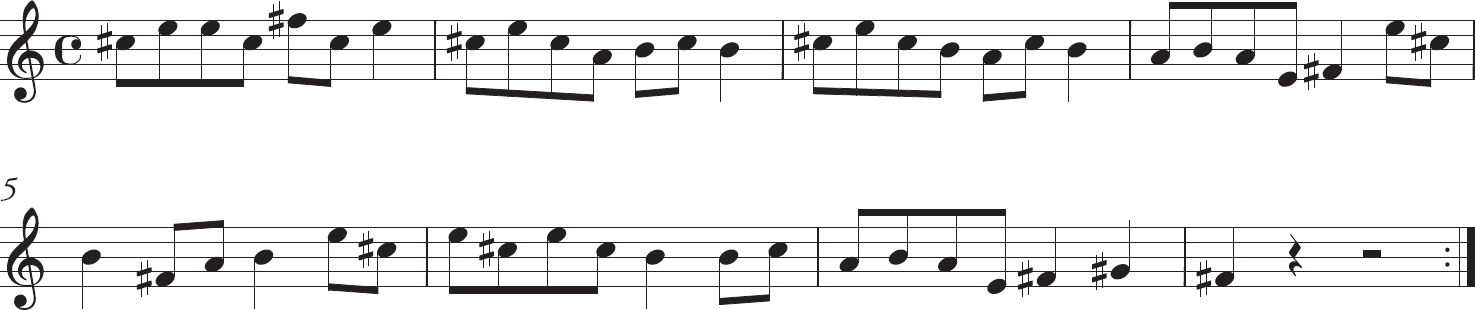
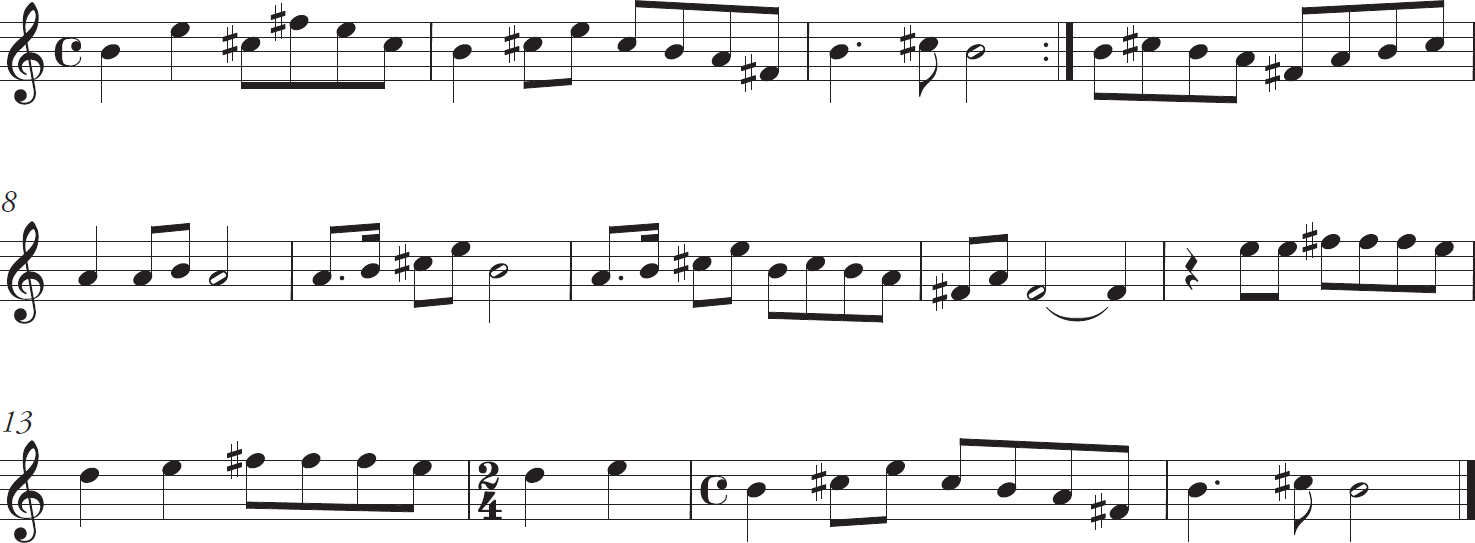
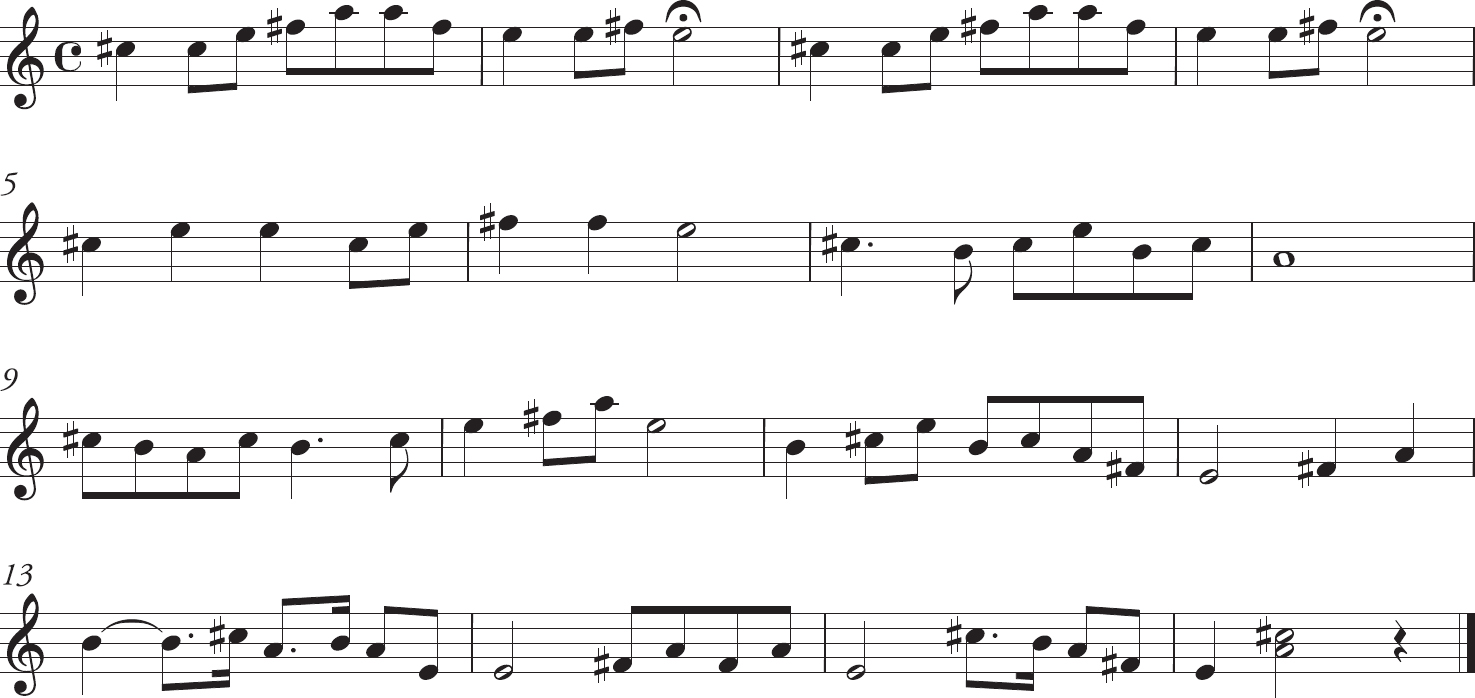
The piece on the Guinness music box that served as the source for Butterfly's theme appears last. The tune is a Westernized, music-box version of the Chinese folksong ‘Shiba mo’ (see Example 2).Footnote 37 This is the melody most closely associated with Butterfly herself, the melody that Budden referred to as ‘almost the mirror of the soul of Butterfly’ (‘quasi lo specchio dell'anima di Butterfly’).Footnote 38 This melody, either in part or in its entirety, appears at multiple significant moments in the opera, and most often diverges from the music-box model only in minor details. It often appears in conjunction with the Patrimony theme, as though these two tunes from the music box – probably encountered by Puccini early in his compositional process – formed a pair in the composer's mind. (Both melodies occur more frequently in Act 1 than later in the opera.)Footnote 39 Furthermore, when employing ‘Shiba mo’ Puccini occasionally seems to make the orchestra imitate the sound of a music box, even going so far as to set the opening of the tune at a fast music-box clip, with mechanical bird whistles in Act 2, Part 2, following Butterfly's long night anticipating Pinkerton's return.

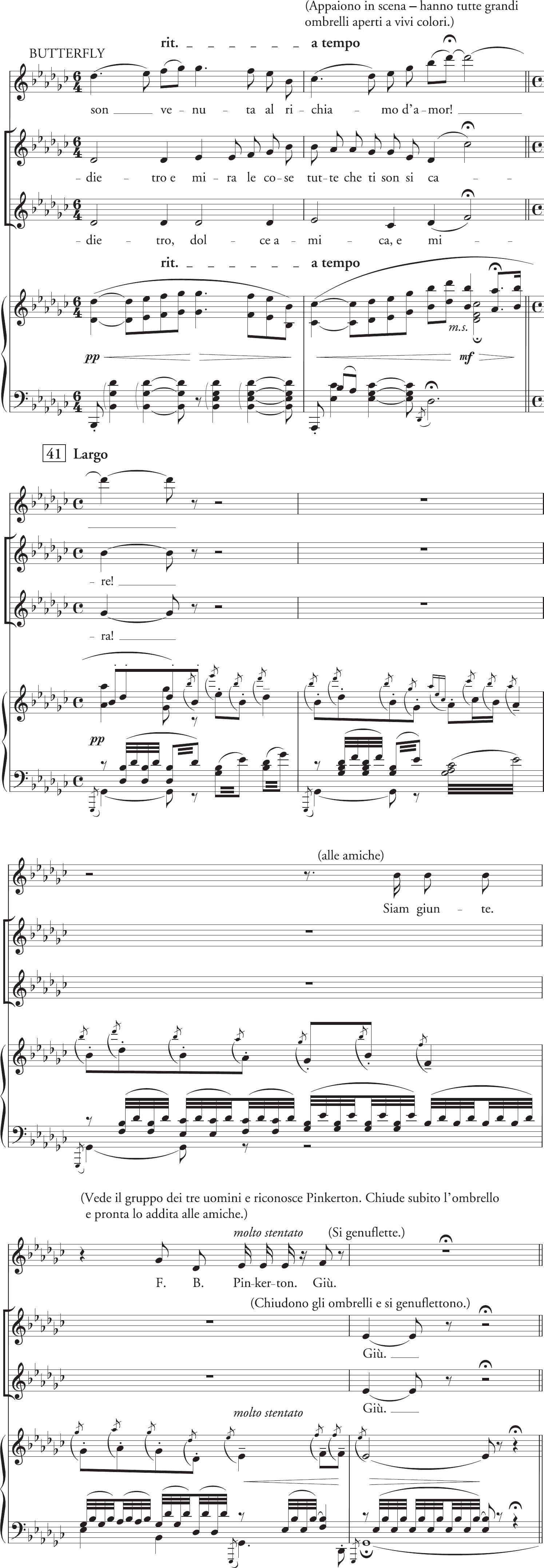
Butterfly's entrance in the opera, befitting an exotic heroine in any orientalist opera, is other-worldly.Footnote 40 We hear her friends singing bell-like ‘ah's and her voice floating above from afar as they gradually enter from offstage. Butterfly remarks on the beauty of the setting and how she is exceedingly happy to be getting married. These disembodied voices and the floating pulse enhance the mystery and appeal of this exotic woman both for Pinkerton and for Puccini's intended audience. This entrance music climaxes with a slightly modified statement in the orchestra of the first half of ‘Shiba mo’ (see Example 3).Footnote 41 In Puccini's orchestration of this moment – featuring staccato flute, piccolo, glockenspiel and octave grace notes in the harp – the orchestra itself sounds somewhat like a music box.Footnote 42 Act 1 ends with Butterfly and Pinkerton's love duet, climaxing with a more grand, fortissimo orchestral statement of the first half of ‘Shiba mo’. Thus the two emotional and musical climaxes in Act 1 – the pillar moments of Butterfly's arrival and the departure of the two lovers from the stage – both blossom into the ‘Shiba mo’ tune. Fragments of the melody appear elsewhere in the score. A trace of the first bar of the melody might even be audible in the twittering flute just before Butterfly is indirectly referenced in the marriage broker's statement: ‘This is your wife's devoted maid’ (Act 1, rehearsal figure 8). The first half of ‘Shiba mo’ is clearly heard in augmented rhythmic values in the solo violin, starting as Butterfly flirts with Pinkerton, offering him more compliments, and continuing as Sharpless comments on Butterfly's name (Act 1, rehearsal figure 43, bars 2–8).

In the original 1904 version of her aria ‘Io seguo il mio destino’, ‘Shiba mo’ was heard in its entirety twice, as it is on the Guinness music box, and in the same key.Footnote 43 (In the final version of the opera the first statement was cut.) This is by far the most crucial statement of Butterfly's theme in the opera. At this moment in Act 1, Butterfly speaks privately to Pinkerton. She explains how she went to the mission alone and has decided to abandon her people and religion for his sake. As she begins her confession, a solo clarinet plays Butterfly's theme – perhaps Puccini chose the clarinet to imitate the timbre of the Guinness music box's reed organ. Butterfly then sings to the entire melody of ‘Shiba mo’ herself, with slight modifications, as she explains that she is following her destiny by devoting herself to Pinkerton. Here, Puccini transformed the music-box melody into one of the most expansive, lyrical and personal statements by the opera's heroine (see Example 4).Footnote 44

Given the numerous appearances of this theme, some commentators have suggested that its dramatic association cannot easily be pinned down. Budden referred to the theme as multivalent, noting, for example, that the melody had appeared comically with an ‘almost impertinent’ character in the first edition of the opera when Butterfly discusses her uncle the Bonze.Footnote 45 Vera Micznik has also focused on this particular theme.Footnote 46 Like Budden, she states that the meaning of the theme changes with each appearance. For example, she suggests that the theme appears in connection with the compliments Butterfly offers Pinkerton, ignoring that this moment occurs just before Sharpless speaks and comments on Butterfly's name.Footnote 47 To my mind, this particular occurrence of ‘Shiba mo’ cements the association of the theme with Butterfly, rather than indicating that Puccini had a variety of associations in mind for this melody. Micznik also refers to the theme as the ‘geisha motive’, claiming that it represents Butterfly's clichéd behaviour, her façade, rather than her identity.Footnote 48 Finally, Micznik states that at the very end of Act 1 ‘the obedient geisha motive pounds obsessively’.Footnote 49 I hear no hint of obsessive violence at this moment. Instead, ‘Shiba mo’ serves as the triumphant climax to the love duet before delicately fading with the falling curtain.
The musical evidence detailed above strongly suggests that Puccini encountered the ‘Shiba mo’ melody on a music box rather than in any printed source. However, no musical details indicate why he would have selected this particular theme rather than another music-box Chinese tune to represent Butterfly. Consideration of the title and lyrics of this folk song suggest an explanation. ‘Shiba mo’, identified as a xiaodiao or ‘little ditty’, is a rather significant Chinese folksong.Footnote 50 The title can be translated as ‘The Eighteen Touches’ or ‘The Eighteen Strokes’ and is sometimes referred to as ‘The Erotic Massage’. This song has been deemed one of the most famous and frequently banned erotic songs in all of China.Footnote 51 Singing ‘The Eighteen Touches’ was outlawed in 1868 and 1952, for example, and folk-music scholars were discouraged by the Chinese government from collecting and publishing this song throughout the twentieth century.Footnote 52
The song has nevertheless appeared in numerous genres and in a range of melodic variants throughout China, including in operatic contexts, and is delivered in the voice of a male lover celebrating 18 parts of a woman's body in explicit detail, moving caress by caress from head to toe.Footnote 53 In multiple theatrical versions the male persona (perhaps a lustful sailor like Pinkerton himself) is associated with a boat. In her fieldwork, Schimmelpenninck found that the song was often performed by migrants from northern Jiangsu who would dress up in a paper boat and rock this boat as they sang.Footnote 54 The 1920s Ningbo opera Floating Boat includes a male character who sings ‘The Eighteen Touches’ while operating a boat with two sisters.Footnote 55 The explicit eroticism of this song apparently has encouraged private performance in acts of sexual foreplayFootnote 56 and has proved embarrassing for at least some theatrical performers. One performer involved in a command performance of the opera Boat on the Marshes for Japanese occupational forces in 1942 related that in the ‘Eighteen Touches’ episode the audience ‘wanted us to include all the obscene actions, thus humiliating young Yang Feifei [a female performer] for their own entertainment’.Footnote 57 This scandalous song was even enjoyed by Westerners in China. For example, in a 1906 memoir by an Australian naval officer who had been stationed in China, we are told that at the dining houses he frequented:
You cannot hear a word the people are saying, even at the next table, on account of the noise the girls are making. They play on all sorts of stringed instruments, and sing in that falsetto voice which you hear all over China.
If you like they will sing you Sinfa (The Bunch of Roses), which is a sentimental song, or you can have Shap-pat-mo (the Eighteen Touches), which is a bad song.Footnote 58
Given Puccini's particular sense of humour and the specific moments in Madama Butterfly where this melody appears, it is highly likely that he knew the subject matter of ‘Shiba mo’. The possibility that Puccini embedded a private erotic joke into this opera by choosing this melody specifically for moments when the Japanese geisha offers herself to the lustful American might seem incongruous in such a famously tragic work; however, as Groos has noted, much of this opera is actually comic in nature and was even more clearly so in its earliest versions.Footnote 59 Julian Smith argued that the opera was quite sardonic in its initial form, but acknowledged that it ‘may seem difficult today to credit Puccini with the intellectual and emotional toughness with which the early version of Butterfly is instilled’.Footnote 60 Puccini's original version of the opera included in the first act a great deal of comic material depicting Butterfly's foolish relatives. Additionally, in the 1904 version Pinkerton comes across as a truly ugly American, a coarse and crass sailor unable to resist making demeaning comments about the Japanese even as they prepare to celebrate his wedding. In the 1906 version that has been most often performed ever since, Pinkerton is a somewhat more sympathetic character who even delivers a regretful final aria near the end; and, in general, this version is far more melodramatic than the 1904 original.Footnote 61
Pinkerton's blatant evaluation and celebration of Butterfly's physical beauty is paralleled quite clearly by the position of the male persona in ‘The Eighteen Touches’. Pinkerton is anxious to make his way to the bridal chamber from the very beginning of the opera. To put the matter bluntly: the business of inspecting the house with the marriage broker, greeting the geisha and her friends, meeting the relatives and undergoing the wedding ceremony is all but an extended period of foreplay for Pinkerton, delaying the dramatic and musical moment of climax when he eagerly leads Butterfly into the house to consummate their marriage at the end of Act 1 and ‘Shiba mo’ rings forth. Knowing the pornographic source for this melody, our emotional engagement with the climax of the love duet might now be somewhat altered.
Butterfly, Turandot and exotic patrimony: ‘Bangzi’ and ‘Loc Tee Kun Tzin’
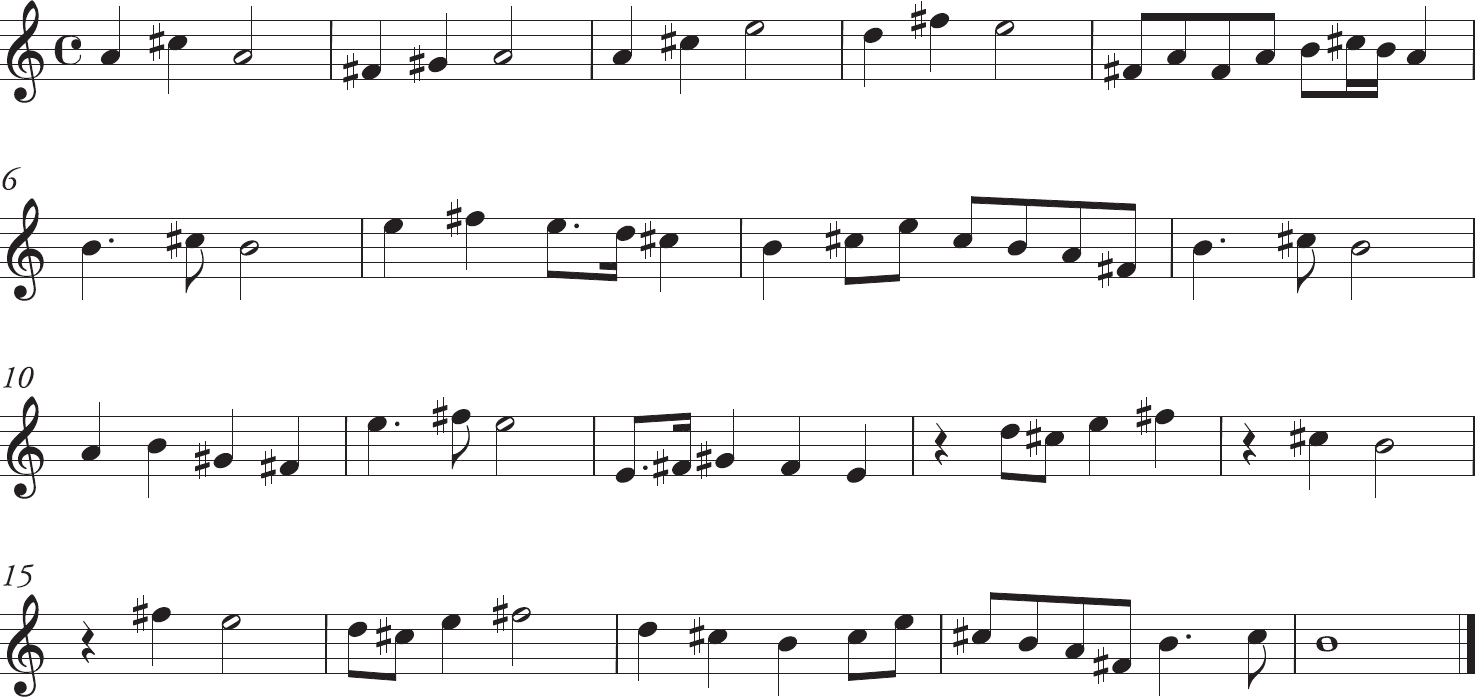
The other musical motif closely associated with Butterfly – the Patrimony theme – appears within two of the other Chinese melodies included on the Guinness music box. This distinctive motif appears twice in the third piece on the Guinness box, in bars 7–9 and 16–19 (see Example 5).Footnote 62 Puccini uses this melody at multiple points in Madama Butterfly. When the American consul Sharpless enquires about Butterfly's father (Act 1, rehearsal figure 49) and she responds ‘morto’, we hear this tune, which in the 1904 version was immediately followed by a full statement of ‘Shiba mo’ marked spigliato as Butterfly mentioned her other relatives. The Patrimony theme, in its full form with bars 5 and 6 from the Guinness tune serving as a closing gesture, also appears when the marriage broker Goro explains to the Americans that Butterfly's father committed suicide on orders from the Emperor (Act 1, rehearsal figure 77; figure 79 in the 1904 vocal score). A truncated statement of the Patrimony theme is forcefully stated in the orchestra at the conclusion of her ‘Shiba mo’-based aria ‘Io seguo il mio destino’ after Butterfly bluntly states that she will reject her people and past (see Example 4 above). In the 1904 version of the opera Butterfly casts aside the statuettes of her ancestors at this moment. In the 1906 version she declares her love and embraces Pinkerton, another gesture signifying a rejection of her patrimony.

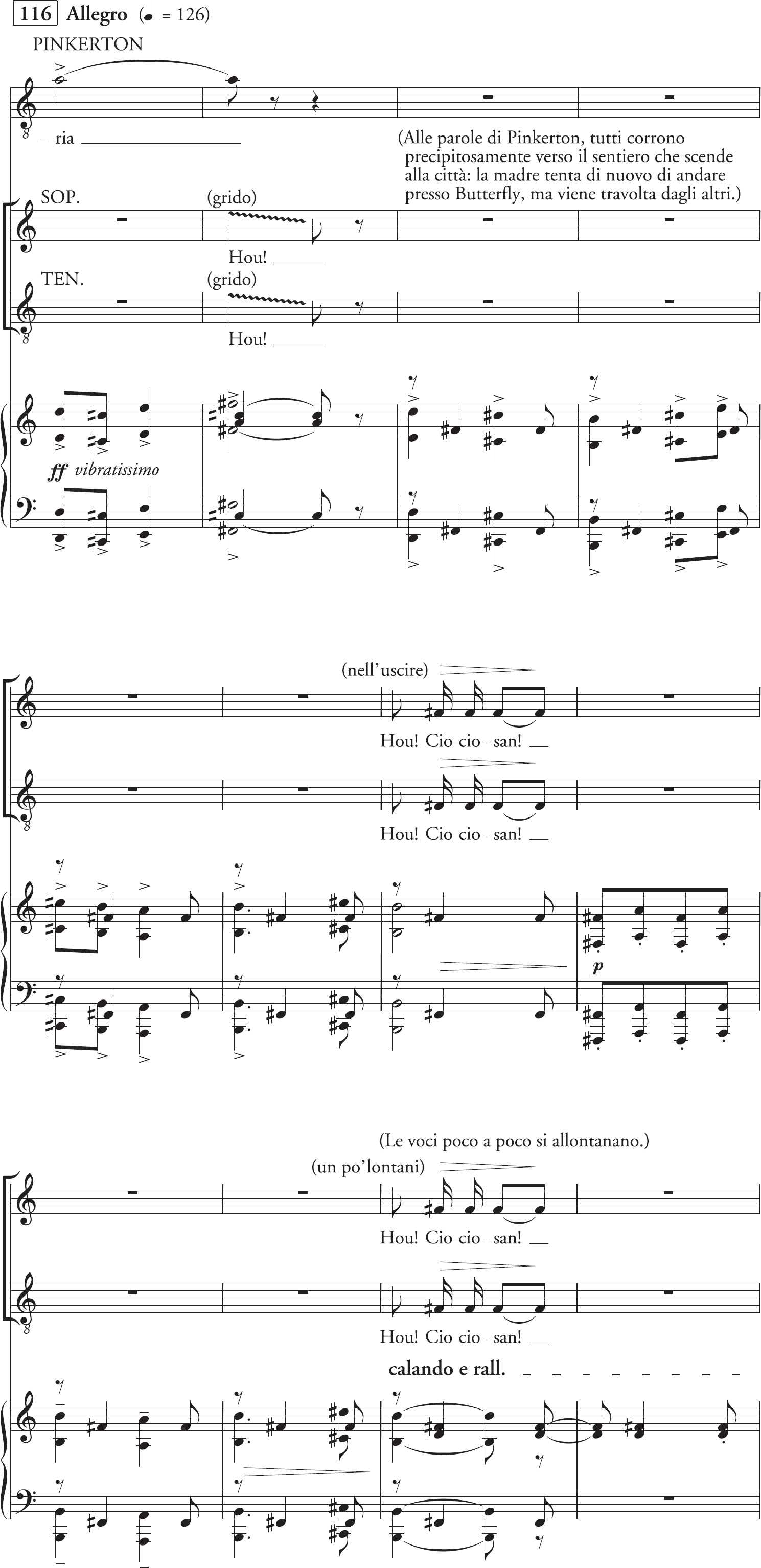
The most striking and complete statement of the Patrimony theme occurs when Pinkerton dismisses Butterfly's entire family and friends after her uncle the Bonze denounces her for having abandoned her religion (Act 1, rehearsal figure 108; figure 116 in the 1904 vocal score). At this moment, when Pinkerton separates Butterfly from her Japanese heritage for ever, we hear the exact motif from the third melody on the Guinness box and in the same key. Indeed, even the quaver F♯ from bars 8 and 18 – missing in other statements of this theme in the opera – appears here in Puccini's score in the bassoon, second violin, viola and cello. This full statement of the theme concludes with bars 5 and 6 of the Guinness melody (see Example 6).Footnote 63 Puccini's use of this particular rocking gesture – which also occurs when the Patrimony theme is heard late in the opera, as Butterfly kisses the blade and reads the inscription on the sword that her father had used to commit suicide and that she will soon employ herself – suggests that this Chinese piece served as the exact source for this motif in Madama Butterfly.Footnote 64

The title on the music box's tune sheet for this third melody appears as ‘Poutzi’ in transliteration, and as ‘Bangzi’ in Chinese characters. On other surviving music-box tune sheets from the period the title appears as ‘Pontzi’ and ‘Pantsé’ – the u seems to have been a scribal error on the Guinness box. The Chinese word can refer to the form of Chinese opera known as ‘clapper opera’ and to the ‘clapper’ or woodblock featured in that operatic genre.Footnote 65 However, the term also refers to a famous form of punishment in imperial China and to the bamboo rod that was used for beating the soles of the victim's feet. The transliteration ‘Pantse’ points to this meaning, and this Chinese form of punishment appears to have caught the European imagination in the nineteenth century. For example, an 1849 book published in London refers to ‘pantse’ as a ‘paternal correction’ that the Chinese emperor himself meted out on his courtiers.Footnote 66 Reports on the nineteenth-century martyrdom of Jesuits in China also refer to ‘pantse’ as a form of punishment.Footnote 67 It is possible that Puccini recognized the transliterated term and selected this melody from the music box to serve as the theme specifically associated with the punishment of Butterfly's father by the Emperor and with her own punishment, an ultimate sacrifice resulting from her rejection of her Japanese patrimony in favour of the American barbarian Pinkerton.Footnote 68
The Patrimony theme holds an even greater significance for our understanding of Puccini's operas. In addition to its appearances in ‘Bangzi’ shown in Example 5 above, the motif also occurs twice – without its closing gesture – in the fourth tune on the Guinness box (see Example 7).Footnote 69 This piece is entitled ‘Loe Tee Kun Stin’ on the Guinness tune sheet but appears in a more accurate transliteration as ‘Loc Tee Kun Tzin’ (‘The Sound of Gold Coins Striking the Floor’) on other music boxes from the period. Puccini scholars have long known that nearly all of ‘Loc Tee Kun Tzin’ was used as the Emperor's theme or ‘Imperial Hymn’ in Turandot, though the title of the Chinese song was not previously known. The theme appears in a solemn setting at rehearsal figure 39 in Act 2, scene ii, after the Emperor agrees to allow Calaf to attempt the riddles. ‘Loc Tee Kun Tzin’ appears again triumphantly and completely as on the Fassini and Guinness music boxes to conclude Act 2 (rehearsal figure 68) in Turandot.

Thus there is a musical connection between Madama Butterfly and Turandot that has gone unnoticed until now and that the Guinness box has helped to make clear. The appearance of this motif in both operas in association with exotic fathers further links these orientalist works. The solution to this melodic enigma has thus been before our ears ever since the première of Turandot. However, long-held assumptions concerning Puccini's devotion to ‘exotic authenticity’ have obscured multiple connections between his two orientalist operas. As is so often the case, words get in the way as our terminology and categories shape how we hear music and may even render us deaf. On closer inspection, the opening bars of Turandot seem to pick up in medias res exactly where the final bars of Madama Butterfly left off (see Examples 8a–b).Footnote 70 Furthermore, both heroines are accorded two musical themes depicting the allure and the fatality of the exotic woman, the first of a lyrical nature and the other of a more aggressive, forbidding cast. Finally, indulging in some interpretative fantasy play, we might even ask whether Turandot in 1924 has the 1904 Butterfly herself in mind when she justifies her ruthless riddles and decapitations of would-be suitors by telling of a long-lost tragic female relative who had been ruined by a foreign male. In Turandot, the foreign male finally proves his devotion and we get the happy ending long deferred in Madama Butterfly.Footnote 71

Puccini, the Fassinis and music-box migrations
In light of the revelations from the Guinness music box, it is important to revisit the often-told tale of how Puccini consulted a ‘Chinese’ music box in August 1920 at the Bagni di Lucca home of Baron Edoardo Fassini-Camossi (1871–1941) and how this instrument influenced the composition of Turandot. Puccini's visit to Fassini was immediately leaked to the press and then later retold in the librettist Giuseppe Adami's books on the composer. Interestingly, the journalist reported that Puccini had been listening to ‘la musica di una vecchia canzone cinese’, rather than to an ‘ancient Chinese music box’.Footnote 72 Later accounts of this event rely on a brief report offered two decades later by Adami,Footnote 73 who claimed that Puccini had surprised his collaborators one day in Bagni di Lucca by setting a music box in Fassini's home to play the ‘Imperial Hymn’ as they arrived to visit him. Adami described the tune on the box as having been played ‘con la solennità di una cerimonia sacra ed augurale’ (‘with the solemnity of a sacred ceremony and greeting’) – a rather poetic, but inaccurate, description of the music-box performance style.Footnote 74 He mentioned only this one melody in his 1942 publication; however, in an earlier publication that is rarely cited by Puccini scholars he remarked on the composer's achievement of exotic ‘authenticity’ and noted that Puccini also borrowed from the music box a second melody that he employed for the music of the three ministers, Ping, Pang and Pong.Footnote 75 Oddly, Adami did not mention the most famous melody Puccini borrowed from the music box for Turandot: ‘Mo Li Hua’ or ‘Jasmine Flower’. Finally, in both publications, Adami also misled Puccini scholars by stating that Baron Fassini had served at the Italian embassy in China for many years.
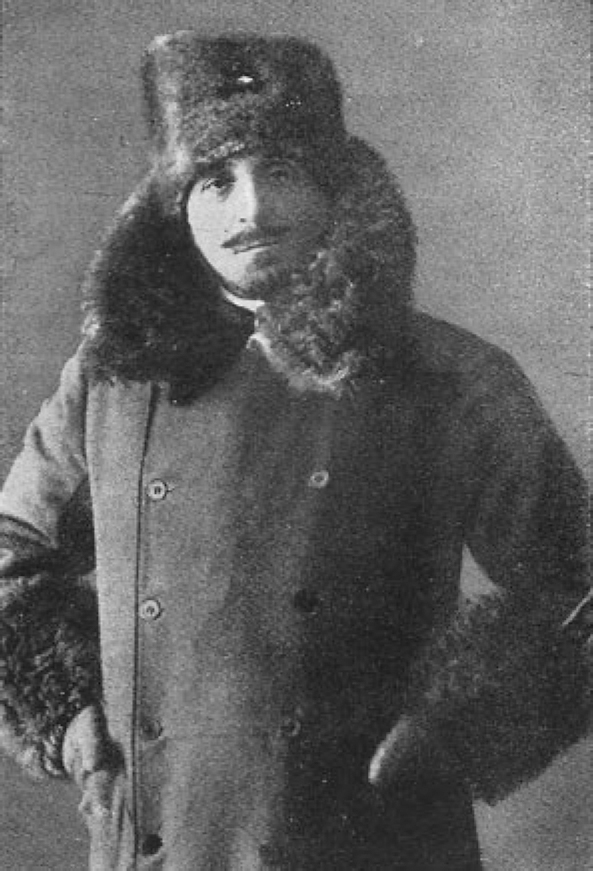
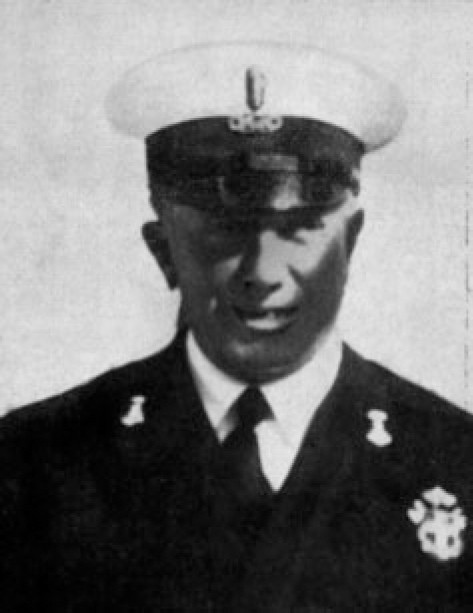
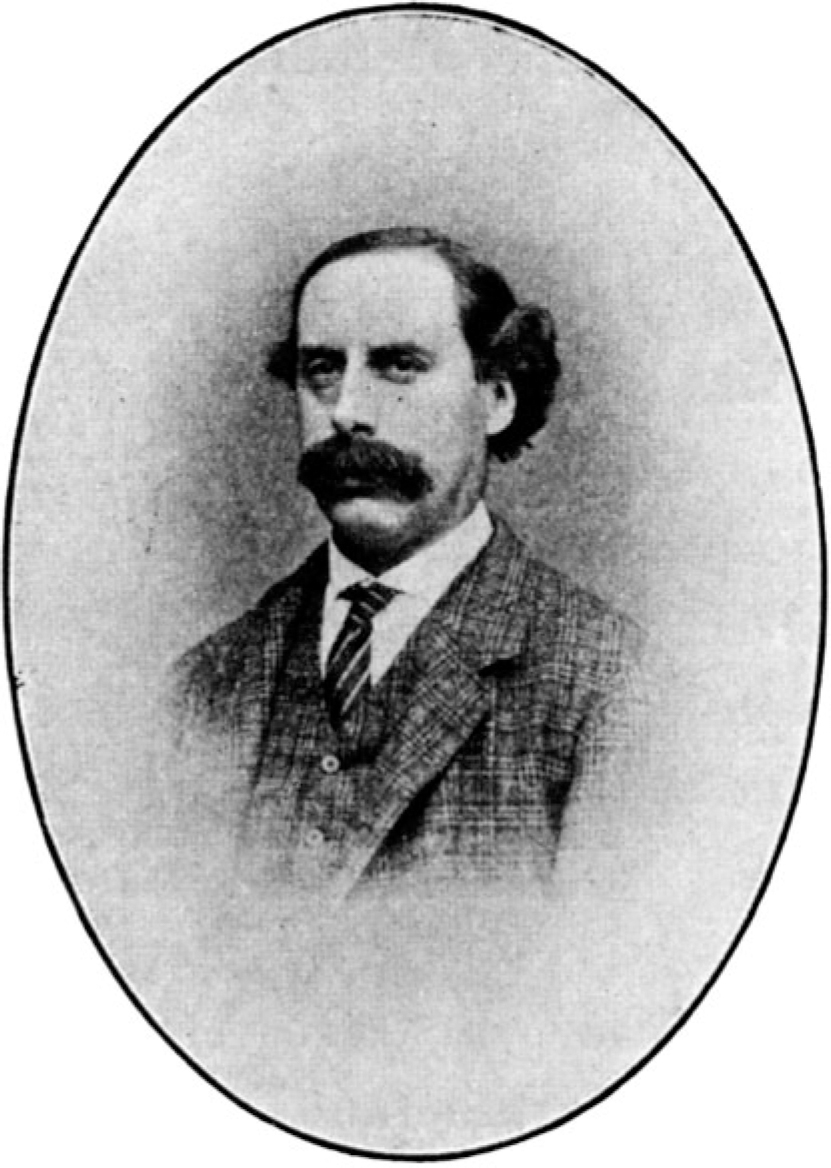
Baron Fassini (see Figure 2) was not a member of the Italian foreign service in China, but rather a veteran of the 1900 campaign to suppress the Boxer Rebellion and of a military mission through China to Siberia at the end of the First World War in 1918–20 to reclaim Italian prisoners.Footnote 76 (He was also an amateur composer with rather amateurish published songs and violin and piano pieces to his credit.Footnote 77) I have determined that Fassini probably acquired his music box or boxes and other Chinese souvenirs at the highly popular and notorious ‘loot auctions’ sponsored by the foreign legations in Peking following the successful suppression of the Boxers.Footnote 78 Fassini returned to China en route to Siberia as a commander of the ‘black battalion’ of the Italian Expeditionary Force (C.S.E.O., Corpo di Spedizione in Estremo Oriente), arriving in Shanghai on 30 August 1918.Footnote 79 The purpose of this military operation was to lead the so-called irredenti. These were conscripted soldiers of the Austro-Hungarian army, but of Italian nationality, who had been sent by Austria during the First World War to the Eastern front and who then fought for Italy and were imprisoned by the Russians when the Russian Revolution broke out in 1917.Footnote 80 The mission was successful, and as his troops prepared to leave for home, the Baron was approached by some 80 agitated Russian women claiming to be the wives of Italian soldiers under his command and demanding to board the troops’ train in order to travel to Italy with their new husbands. Allegedly, Baron Fassini assuaged their anxiety by instructing them to board the last car on his train. Just before the train departed, the final car was decoupled – thus leaving behind the disappointed contingent of Russian Butterflies.Footnote 81 Fassini and his troops returned to Italy in April 1920, only a few months before Puccini's visit to Bagni di Lucca during the composition of Turandot. It is certainly possible that Fassini had acquired more souvenirs from China on this later visit, though he would have had more opportunity to do so at the conclusion of the Boxer Rebellion.

On 5 February 1965 the Fassini music box was found and recorded by Michael Rose and Hans Hammelmann in Rome at the home of Fassini's widow just in time for a BBC Third Programme radio broadcast about Turandot in the series ‘Birth of an Opera’.Footnote 82 Apparently, the Baroness Gina Fassini-Camossi – in her 80s at the time – was thrilled to have her late husband's association with the great composer memorialized on the air. Given their pressing deadline with the BBC, Hammelmann and Rose – who were joined by William Weaver – did not interview the Baronessa concerning her husband's collection of Chinese souvenirs, nor did they take photographs of the music box. Hammelmann did transcribe the transliterated titles appearing on the music box's tune card, but this information was not included in their broadcast. This particular music box was later featured on Italian television in the 1970s and 80sFootnote 83 and, most prominently, by Weaver in a 1974 Metropolitan Opera intermission broadcast.Footnote 84 In his intermission feature, Weaver offered his memories of his visit to Baroness Fassini's home and described the music box as having been a ‘very ordinary looking, little brown wooden box, not in the least exotic’. Weaver played recordings of three of the melodies from the music box and noted their appearances in Turandot. Harold Powers, relying on Weaver's broadcast and brief report, later offered in his study of the opera a thorough account of Puccini's use of these and other Chinese tunes.Footnote 85 Subsequent scholars have based their discussion of the role of the Fassini box in the composition of Turandot primarily on Powers.
I have relocated the Fassini music box and am able to offer details missing from earlier discussions of the influence of this instrument in Puccini's final opera (see Figure 3).Footnote 86 This music box plays four Chinese melodies and includes their titles both in transliteration and in Chinese characters on its tune card, which Puccini would have seen in 1920. As we have known, three of these melodies appear in Turandot. The most famous Chinese song, now commonly referred to as ‘Mo Li Hua’ (‘Jasmine Flower’), but also known as ‘Xian Hua’/‘Sinfa’ (‘Fresh Flowers’) in Cantonese, as it appears on this tune sheet, signals the seductive and glorious aspects of the fairy-tale Chinese princess and appears first on this box.Footnote 87 (Note that in their hymn of supplication to Turandot, Puccini's Children's Chorus sings that ‘tutto fiorirà’ / ‘everything will bloom’ if only she would appear.) The second melody played by this box (and not found on the Guinness box) was employed by Puccini for the first entrance of the three Chinese Ministers (‘Ferma! che fai?’). The romanization of the second and fourth titles was inadvertently switched by the scribe on this tune sheet. ‘Chun Chic Lin’ (‘Chuan Zhu Lian’) or ‘String of Pearls’ actually corresponds to the Chinese characters appearing on the tune sheet for the title of the second tune, and ‘Tov Chun Lin’ or ‘Upside Down Spring Festival Couplets’ is the title of the fourth melody, which Puccini did not employ in his operas.Footnote 88 The third tune, labelled correctly as ‘Loc tee Kuntzin’, or ‘The Sound of Gold Coins Striking the Floor’, served as an ‘Imperial Hymn’ for Turandot's father, the Emperor, as noted above. All three of the melodies from this music box that Puccini employed in Turandot appear in their initial or fullest versions in the score in the same key as on the box. Comparing recordings of Weaver's Metropolitan Opera 1974 intermission broadcast, new recordings of the Fassini music box and the original tapes made for the BBC broadcast held by Rose, I have determined that the Metropolitan Opera broadcast lowered the pitch of these three tunes by a semitone.

The Swiss made a great many music boxes featuring Chinese melodies for export to China in the late nineteenth century.Footnote 89 Different music boxes featured different subsets of the same 10–12 Chinese tunes that were consistently reproduced. The same tune frequently appears in different keys on different boxes, and timbral differences between surviving boxes are quite striking, as discussed below. Given that each cylinder was pinned by hand, numerous variations could and did result, including the addition of extra ornamentation and changes in pitch and rhythm. All the musical details I have noted strongly indicate that the Guinness box (or a twin) served as Puccini's source for Madama Butterfly and that the Fassini box served as his source for Turandot, though I will also suggest that Puccini may have consulted the Guinness box at that late point in his career as well.
It is quite striking that the five tunes Puccini borrowed from these music boxes (two from the Guinness, and three from the Fassini) appear in their fullest forms in both operas at the same pitch as they appear on the respective boxes. This reinforces the claim that these music boxes served as his sources. However, it remains unclear why Puccini kept the melodies at their original pitch. Perhaps he composed the sections of these operas that feature the music-box tunes first, or at least somewhat in isolation from the rest of the score, and, having either memorized the tunes at pitch or referring to a now lost transcription, saw no reason to change their keys. Or perhaps he desired to have these moments in his scores correspond to the music boxes as closely as possible and retained the keys deliberately as a private gesture to his sources.
The Guinness music box offers additional evidence substantiating my claim that Puccini consulted a music box as he composed Madama Butterfly. Unlike many surviving music boxes, the Guinness retains its original tune sheet, which allows this musical artefact to serve as a Rosetta stone for this historical discovery (see Figure 4).Footnote 90 The title of each melody appears on the left of the tune sheet in non-standard transliteration. Neither ‘She pah moh’ nor any of the multiple variant spellings that appear on surviving tune sheets allows us on its own to identify the actual title of the Chinese melody. Fortunately, all the titles also appear on the right in Chinese characters. When this box arrived in China someone took the time to listen to the melodies and to note their correct order on the box. This is a remarkable visible trace of an auditory experience. Indeed, these Chinese characters are what prompted me to notice and listen to this particular music box at the Morris Museum. The Chinese characters appearing in sixth place spell ‘Shiba mo’, and thus the order of the titles for the last two tunes was inadvertently switched when this tune sheet was written in Switzerland.Footnote 91 By including the title in both transliteration and (in correct order) in Chinese characters, and including a well-preserved cylinder featuring the melody, the Guinness box allows us to identify the source and significance of Butterfly's most important theme.Footnote 92

None of my conclusions and interpretations concerning Puccini's operas or the broader significance of these Swiss music boxes are dependent upon the composer having encountered the Guinness box itself, rather than a lost twin. However, a good deal of physical evidence suggests that he may very well have done so. First, the tune sheet on the Guinness box includes further information that suggests the possibility that Puccini heard the Guinness box. Towards the left side of the sheet the name of the famous Shanghai Hengdeli department store that carried Swiss watches and music boxes in the late nineteenth century is written in Chinese characters. This offers further proof that this particular music box did indeed travel to China. More surprisingly, the name of an instrument repair shop and store in Rome (Bianchetti) stamped in the upper right corner reveals that – unlike so many other Swiss-made music boxes exported to China – this box returned to Europe and was even owned in Italy. This particular musical establishment existed at this address (Via Cavour 206) at least as early as 1903.Footnote 93 This reveals that the Guinness music box may well have been in Italy during the period of Madama Butterfly's composition. Of those boxes that returned to Europe from China, few had the combination of melodies that appeared in Puccini's operas, and fewer still would have passed through Italy and in time for an encounter with the composer.Footnote 94
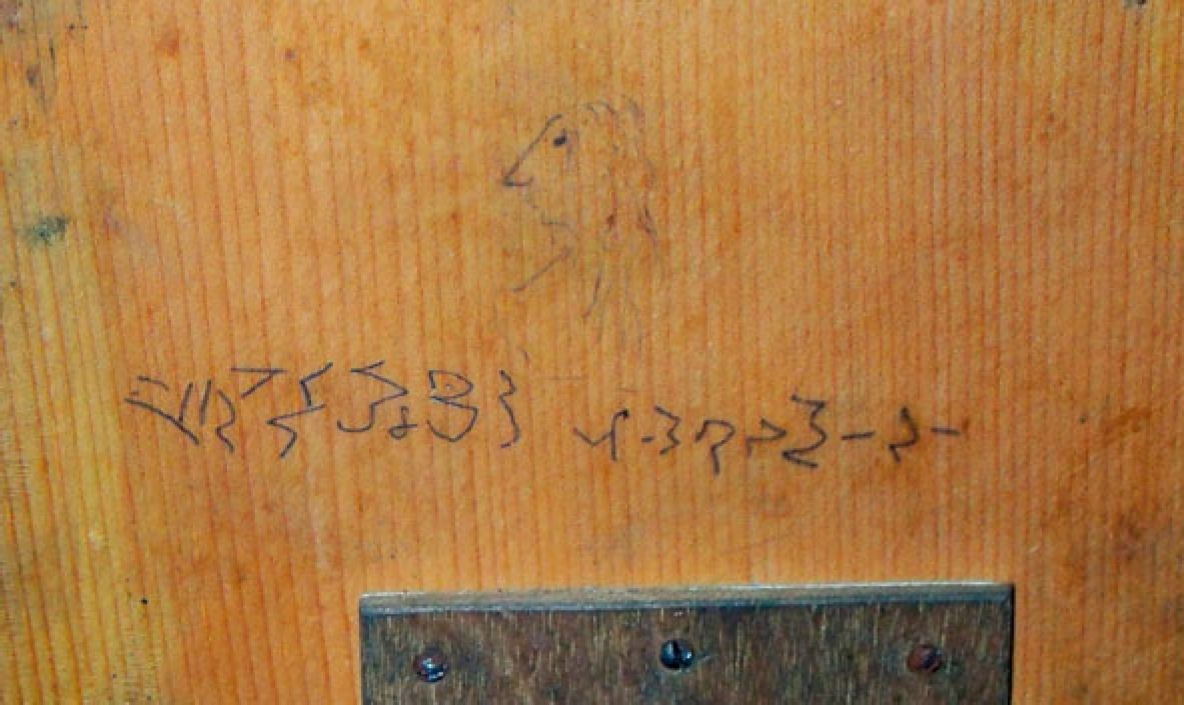
Further evidence exists deep within the Guinness music box. By removing two screws one can easily remove the entire mechanism from the wooden box and gain access to the hidden bellows housed below the cylinder. (Given Puccini's interest in the mechanical, I can easily imagine him wishing to see the source of the reed-organ sound if he had encountered the Guinness box or another harmoniphōne.) On the board attached beneath the bellows material there is a pencil drawing of a female figure in profile and a cryptic inscription (see Figure 5).Footnote 95 I initially assumed that the drawing and the inscription must have been made by an Italian repairman or by another European attempting humorously to imitate some form of Asian script. However, it is well known that Puccini, as well as his friends and associates (including the tenor Enrico Caruso), enjoyed drawing caricatures. Of course, we do not know whether the female figure inside the Guinness box was intended to represent Butterfly herself, but the drawing is not entirely dissimilar from Puccini's caricature style.Footnote 96 Furthermore, and far more crucially, I have concluded that multiple markings in the inscription below the caricature closely resemble Puccini's handwriting as found on numerous manuscripts.

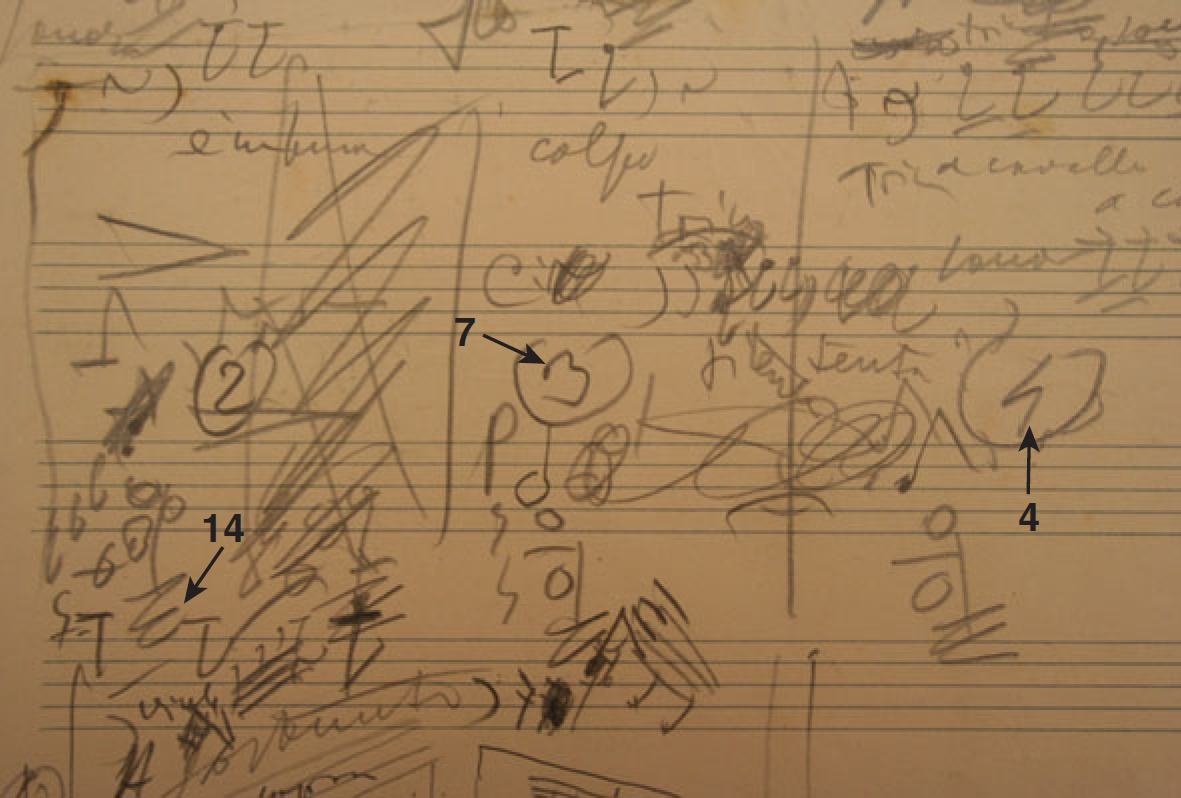
The score that Puccini held during rehearsals of Madama Butterfly in Milan in 1904, and that is now held in the Sibley Library at the Eastman School of Music, includes many markings made by the composer.Footnote 97 I have also consulted Puccini's drafts of Madama Butterfly and sketches and manuscripts for La fanciulla del West and his other works held at the Morgan Library and Museum in New York and at the Beinecke Library at Yale University, as well as published reproductions of sketches for Madama Butterfly held at the Accademia Filarmonica in Bologna.Footnote 98 The markings on the music-box bellows board tend to be a bit more angular than similar markings in his manuscripts, but this is probably due to the difference in writing on paper as opposed to wood. Several of these markings closely resemble Puccini's somewhat idiosyncratic forms of musical and numerical notation. In Figure 6, I have isolated and numbered each marking for ease of reference and will summarize my findings below using this numbering system.Footnote 99 The annotated illustrations provided here (see Figures 7 and 8) offer but a sample of the numerous possible images demonstrating the close correspondences between Puccini's documented handwriting and this Guinness box inscription.Footnote 100


Markings 2, 13 and particularly 16 closely resemble Puccini's crotchet rests found throughout his manuscripts from the first decade of the twentieth century.Footnote 101 The fourth marking is similar to Puccini's typical 2/4 time signature, with the lower half matching Puccini's handwriting for the numeral 4 precisely.Footnote 102 The third marking matches a musical accent mark or decrescendo in several of his scores,Footnote 103 and the sixth is identical to the way in which he wrote the numeral 8 as in an octave marking, page number or date.Footnote 104 Puccini's numeral 3 occasionally resembles the markings appearing in seventh and eleventh positions here.Footnote 105 The fourteenth marking is found in Puccini's manuscripts at multiple spots,Footnote 106 and the fifteenth and seventeenth markings might be his (or any composer's) tenuto signs.
If this inscription was indeed made by Puccini, it remains to be explained how he would have encountered the Guinness music box (or any music box playing ‘Shiba mo’) during the period of Madama Butterfly's composition. As noted, very few of the Swiss-made music boxes exported to China would have migrated back to Europe in time and fewer still would have been owned by an acquaintance of the composer. Puccini's visit to Baron Edoardo Fassini in 1920 to listen to a music box may not have been a unique event in his compositional career, as we have assumed. Unpublished letters made available to me by a descendant of the Fassinis indicate that Puccini had long known the family and was a friend of Baron Alberto Fassini-Camossi (1875–1942), Edoardo's brother (see Figure 9).Footnote 107 Baron Alberto Fassini was a naval officer, a founder of the first Italian film studio, an entrepreneur in manufacturing synthetic silk and, later, a member of the Mussolini government who, among other duties, worked in 1938 to encourage Italian tourism in the new African colonies.Footnote 108 A signed and dated autograph portrait by Puccini indicates that Puccini knew Alberto Fassini and his wife at least as early as 1906.Footnote 109 Could Edoardo Fassini have brought back the Guinness box, along with other Chinese souvenirs, from China in 1901 and given it to his brother Alberto as a trophy souvenir of his expedition?Footnote 110 Though it now seems clear that Puccini encountered two well-travelled music boxes playing Chinese melodies at crucial moments in his compositional career, we may never know exactly when and where the first encounter took place.

Bovet and the boxes: pinning Chinese tunes in Switzerland
How did Chinese tunes come to be pinned onto late nineteenth-century Swiss music boxes? These music boxes represent one milestone in the broader history of crosscultural musical transactions between Europe and China in the eighteenth and nineteenth centuries. Until the middle of the nineteenth century, the primary source of knowledge and transcriptions of Chinese music had come to Europe through the writings of French Jesuit missionaries, particularly through the compilations of missionary reports published in the 1730s by Jean-Baptiste du Halde and then through writings on Chinese music by Jean-Joseph-Marie Amiot, who travelled to China in 1750.Footnote 111 An early nineteenth-century English source on Chinese music frequently mentioned in Puccini scholarship is John Barrow's Travels in China (1805). Barrow offered disparaging remarks on Chinese music generally, but is best known for including among his transcriptions the music and two verses of ‘Moo Li Hua’. In Barrow's printed lyrics, the phrase ‘fresh flowers’ (‘sien wha’/‘sinfa’) appears in the first verse and a reference to ‘jasmine flowers’ (‘Moo-lee-wha’/‘Mo li hua’) in the second.Footnote 112 The most crucial transcriptions of Chinese music for Puccini scholarship were published by J. A. van Aalst in 1884.Footnote 113 This publication served as the source for a couple of the Chinese melodies employed by Puccini in Turandot.Footnote 114 A few other significant studies of Chinese music appeared in the early twentieth century, and several of these included transcriptions of Chinese folk melodies.Footnote 115
Throughout this more than 150-year period, transcriptions of some of the same Chinese melodies appear repeatedly, and, save for ‘Sinfa’/‘Mo Li Hua’, these do not include the tunes that appear on Swiss music boxes. Instead, the 10–12 Chinese melodies featured on nineteenth-century music boxes were brought to Europe in 1845 by Frederic ‘Fritz’ Bovet (1824–1914; see Figure 10).Footnote 116 Bovet was a member of the hugely successful Swiss watch-making family that was particularly known for its success in exporting watches to China in the nineteenth century. The Bovet brand sold so well that ‘Bo wei’ became the word for ‘watch’ in southern China. As a multinational firm based in London, with offices in Canton and Macao, and manufacture in their hereditary home in Switzerland, the ‘Bovets of China’ were clearly captains of globalization.Footnote 117 Swiss artisans had been celebrated since the eighteenth century in Europe as manufacturers of ingenious mechanical musical objects. These decorative objects included snuff boxes (tabatières), watches and even rings (playing the original ringtones), and thus served as personal and portable sources of music for those who could afford these luxurious commodities. By the mid-nineteenth century, the dominant form of mechanical reproducible music in the home was the cylinder musical box, the majority of which were created in the Jura valley region of Switzerland and just over the border in France.Footnote 118 Seeking to expand their export business to include mechanical music, and perhaps to offset losses during the Opium Wars period, the Bovets decided to market musical snuff boxes and then cylinder music boxes featuring Chinese songs in China.

The Bovets soon determined that to be successful in this new venture they would need first to acquire Chinese melodies. Fritz Bovet was an accomplished violinist and an amateur composer of a published string quartet, and later served as the vice-consul for France in Canton during the Second Opium War. (Like Fassini, Bovet was involved in suppressing colonial rebellion in China.) He apparently offered numerous violin recitals during his years in China and, most crucially, in 1845 transcribed an initial set of ten Chinese melodies.Footnote 119 Selections from Bovet's modest collection of Chinese melodies were soon pinned onto numerous cylinder music boxes for export to China and appeared later on disc boxes and player-piano rolls for domestic consumption in Europe and the USA. (We do not know, of course, whether he was aware that one of his selections was a notorious erotic folksong, nor whether the inclusion of this piece on these technological wonders from the West enhanced or diminished their marketability.) The global impact of Bovet's collection of Chinese tunes has not previously been fully appreciated.
At the start of the twentieth century, the sinologist J. Dyer Ball reported that ‘The different classes of persons, whose living, more or less, depends on China trade, will appear evident, when we recall the fact that during 1899 no less than 2,566 musical boxes were imported into Shanghai alone.’Footnote 120 It is impossible to know what percentage of the Swiss music boxes exported to China in the late nineteenth century featured Chinese melodies, but it is striking that the number of such boxes currently held in Europe and the USA appears to be comparatively low. With the assistance of numerous collectors and museum curators, and by searching auction catalogues and lists published by music-box societies, I have been able to locate only 18 cylinder boxes from the nineteenth century that play Chinese melodies, and this number includes the Guinness box at the Morris Museum and the Fassini box held by the Ghiotti family.Footnote 121 Thirteen of these music boxes include their original tune sheets, but only one, in addition to the Guinness and Fassini, includes the titles in Chinese characters. I have been able to study recordings of 12 of these boxes. ‘Sinfa’ – occasionally designated on tune sheets as ‘the national hymn’ or ‘the old national air’ of China – appears on nearly every cylinder and disc music box that includes any Chinese melodies. ‘Shiba mo’ appears somewhat less frequently. There seems to have been a maximum set of 12 melodies, with cylinders of six or eight tunes being the most common. Frequently, the same title appears on tune sheets in reference to different melodies, and the same melody is often identified differently on the various boxes. (Swiss precision apparently did not extend to the matching of transliterated titles to pinned tunes when it came to Chinese melodies.) Orientalist decoration on a few of these boxes announces their musical contents, but most of the wooden boxes and tune sheets are devoid of any decoration that might signal China.
Three of the music boxes that I have studied play all five of the melodies that Puccini heard and employed in Madama Butterfly and Turandot. As noted above, the keys and specific melodic details suggest that none of these boxes could have served as the sole source for Puccini, even though all of the tunes are present on these three artefacts. Two of these are 12-tune cylinder music boxes, one owned until recently by Philippe Rouillé, the other held at the Musical Wonder House in Maine, and they feature prominent accompaniment from bells, woodblock and a drum. In addition, these boxes include musical introductions to the tunes that are often in a distinctly different style. As Swiss music-box manufacturers added all the bells and whistles to the accompaniment of these Chinese melodies, these mechanical instruments moved further away from serving as a possible form of recording technology that could transport exotic melodies to domestic parlours. Of course, all of the tunes on these music boxes had already been filtered through the sieve of European notation in Bovet's transcriptions, and so Puccini's use of music boxes as a source of influence was not really different in kind from his use of notated tunes from printed collections. Indeed, though they offered a deceptive sonic realization of these melodies, music-box renditions should be understood as existing even further from any Chinese source. By first transcribing the tunes in Western notation, and then through the very act of pinning them onto comb cylinders, the Swiss stripped away from these Chinese melodies many of the musical features that mark them as stylistically Chinese.
Global resonance of the mechanical boxes: ‘Mo Li Hua’/‘Sinfa’
With Madama Butterfly and Turandot, Puccini shaped – and continues to shape – the sonic image of East Asia in the West. To the extent that he attempted to imitate the timbre and stylistic features of the mechanical music boxes in certain passages of these operas, Puccini helped to reinforce the stereotype of Asians as mechanical, wind-up dolls in the Western imagination. Although Puccini may or may not have paused to consider that the ‘Chinese’ music boxes he encountered – despite having been brought to Italy from China – had been manufactured in Europe, he probably casually accepted the music they played as ‘Chinese’. Or perhaps he realized that ‘exotic authenticity’ in musical representation exists entirely in the realm of illusion. This is not to deny that retracing the tracks of influence – even towards mirages of exotic authenticity – may well lead to historical discoveries of broad import. The characteristic sound of cylinder music boxes had long been associated generally with representations of the ‘mechanical’, and mechanical-sounding music came to signal East Asia through the works of numerous composers in diverse genres, including (quite prominently) these two orientalist operas by Puccini.Footnote 122
Alexandra Wilson, citing the early reception of Turandot, has noted mechanical aspects in Turandot's character, and Arman Schwartz has pointed to traces of a general mechanical aesthetic running throughout Turandot as further evidence of the Fassini music box's influence on that opera.Footnote 123 Schwartz is certainly correct in stating that Puccini was interested in the technology of the music box and not just in its ‘Chinese’ features.Footnote 124 However, Schwartz does not pursue the musical implications of this unique source by tracing the music box's influence on texture and timbre throughout the score.Footnote 125 Although not as evident as in the score for Madama Butterfly, several additional passages in Turandot might be heard as signalling a music-box style of orchestration, marked in particular by the use of triangle, glockenspiel, xylophone, celesta and harp. Such moments include, for example, the passage early in Act 2, scene i, as Pong and Pang declare that they will summon the ‘bonzes for singing / And bonzes for mourning’ (13 bars before rehearsal figure 3), and later in the orchestral insertions within the ritualistic exchanges between the Emperor and Calaf (Act 2, scene ii, rehearsal figures 36–9). Assuming that in 1920 Puccini had access to both the Fassini box and either the Guinness box or another similar box that played ‘Sinfa’/‘Mo Li Hua’ (see Example 9),Footnote 126 perhaps the unusual decision to call for offstage saxophones as accompaniment for the full statement of ‘Sinfa’/‘Mo Li Hua’ by the Children's Chorus was inspired by the timbre of a reed-organ music box.

Puccini was far from being the only Euro-American composer who employed these specific Chinese melodies in the late nineteenth and early twentieth centuries. It is even possible that other European and American composers heard the tunes Bovet collected as reproduced on mechanical musical instruments. However, most of the scores employing Chinese melodies in this period that I have located suggest that published transcriptions or live musical performances, rather than mechanical instruments, served as sources for these composers. The peripatetic French saxophonist and composer Ali Ben Sou Alle (Charles-Valentin Soualle), who settled in London in 1848 and then travelled widely in the 1850s, composed pieces inspired by his travels. His Souvenirs de la Chine for soprano saxophone and piano features ‘Loc Tee Kun Tzin’ in a version melodically quite close to that which appears on the Swiss music boxes.Footnote 127 At the historical moment when Baron Edoardo Fassini first travelled to China in 1900, Harry Partch's missionary parents fled the Boxer Rebellion and brought their limited knowledge of Chinese folksongs back home to the USA. Partch grew up hearing his mother sing Chinese songs, and in his Seventeen Lyrics of Li Po (1931–3) he employed the tunes ‘Mo Li Hua’/‘Sinfa’ (in ‘On Hearing the Flute in the Yellow Crane House’) and ‘Madame Wang’ (in ‘On Hearing the Flute at Lo-Cheng One Spring Night’), which had appeared in van Aalst's transcriptions and on the music boxes. In standard orientalist fashion – in which different exotic nations are perceived equivalently – Edgar S. Kelley had employed ‘Mo Li Hua’/‘Sinfa’ rather obsessively in the ‘At the Wedding’ movement of his remarkable 1894 Aladdin. None of these examples feature the telltale signs of influence from mechanical instruments that I have noted in Puccini's operas.
Although multiple Western composers introduced their audiences to some of the same Chinese melodies through their scores, Puccini's operas clearly had the most lasting impact. For example, by featuring ‘Sinfa’/‘Mo Li Hua’ from the Fassini box so prominently in Turandot, Puccini not only ensured that the melody would repeatedly be employed to represent China in film scores and other genres in the West, but also reaffirmed its paramount position within China itself and shaped how Chinese composers would employ the melody in their works into the twenty-first century. ‘Sinfa’/‘Mo Li Hua’ consistently appeared as the first selection on nineteenth-century Swiss music boxes featuring Chinese melodies, including both the Fassini and Guinness boxes, and it retains its status as the most commonly referenced traditional Chinese melody globally.
More recent appearances of ‘Sinfa’/‘Mo Li Hua’ point to an even greater historical significance for the global impact of Bovet's Chinese song collection. For example, Tan Dun employed this melody, in a setting clearly inspired by Puccini's, in his Symphony 1997 composed in celebration of the handover of Hong Kong.Footnote 128 Tan and his co-composer Wang Hesheng drew upon this tune again in the official music for the medal ceremonies at the Beijing 2008 Summer Olympics, employing bronze bells and a jade-stone orchestra for this musical contribution. This was perhaps the most high-profile appearance of the melody on the international stage. As Tan put it: ‘From Puccini to the Beijing Olympics, this melody is a gift from the Chinese people to the world's athletes.’Footnote 129 However, when news of the 2010–11 ‘Jasmine Revolution’ in Tunisia began to spread, the Chinese government attempted to suppress this most beloved Chinese song, ‘Jasmine Flower’, and even the flower itself.Footnote 130 The cycles of cross-cultural musical exchange set in motion by Bovet and these Swiss music boxes in 1845 continue in the twenty-first century.
The global resonance of these music boxes has clearly been quite extensive and has involved multiple circles of cross-cultural influence, representation and transmission. The Swiss imagined they knew what the late nineteenth-century Chinese consumer wanted: music boxes featuring Chinese, rather than European, folk tunes. In China, dealers occasionally added the song titles in Chinese characters hoping to entice Chinese customers, to further sinicize the boxes and, perhaps inadvertently, to correct the mislabelling of the Swiss. And yet the Swiss inescapably offered the Chinese Westernized versions of their melodies, for the very mechanism of the cylinder music box demanded a Western approach to pitch, as did the initial process of transcribing in Western notation. Having been pinned onto the music-box cylinders, the transcribed status of these Chinese tunes was thereby veiled, for music boxes are received as recording devices, suggesting in this case a false Chinese fidelity through their sounding. Those boxes that eventually made their way back to the West were received and continue to be heard today as authentic presentations of Chinese music. Without the ability to produce sliding pitch and varied timbre, however, these music boxes sound very little like a Chinese realization of these melodies. Furthermore, Madama Butterfly and Turandot – both compelling, moving and entertaining orientalist operas – really sound very little like Chinese or Japanese music, despite the many claims that have been made to the contrary. Puccini's musical orientalism emerges as not fundamentally different from that of his operatic predecessors or, for that matter, as different as we might expect it to be from his many successors across the globe. Like an endlessly entertaining music box, orientalism itself continues to be rewound.
My research on the Guinness music box would not have been possible without the expertise, patience and steady encouragement of Jere Ryder at the Morris Museum in Morristown, New Jersey. I am indebted to several Puccini scholars for their advice, particularly to Arthur Groos and Gabriella Ravenni. Cornelius Kubler and Ping Wang provided crucial translations of multiple Chinese inscriptions, and Bibiana Gattozzi proved an invaluable research assistant and skilful Italian translator. I am also grateful for the editorial assistance of Hannah Lewis. In 2012–13 I presented this research at the Morris Museum, Tufts University, the University of California, Davis, the University of California, Berkeley, Cornell University, the Knickerbocker Club in New York City, and the annual meeting of the American Musicological Society in Pittsburgh, and I benefited from comments made by participants at each of these events. Special thanks are due to Ethan and Maia. Supplemental material for this article (sound clips for Examples 2, 5, 7 and 9) as well as colour versions of Figures 1 and 3–8 may be accessed here: <http://dx.doi.org/10.1080/02690403.2015.1008863>. Sound clips for Examples 3, 4 and 6 may be accessed at <http://music.williams.edu/profile/wsheppar/>.