INTRODUCTION
Over the past 40 years, the global trade of oil by sea has steadily increased, excluding a brief fall during the worldwide economic recession that was experienced in the early 1980s (ITOPF [The International Tanker Owners Pollution Federation] 2012). Despite this trend, both the annual total number of accidental oil spill incidents and volume of oil spilled from tankers have significantly decreased over the last 40–50 years (Burgherr Reference Burgherr2007; ITOPF 2012). This has been attributed to the introduction of several international agreements and at least in part to the development of an internationally coordinated system of enhanced port state control (PSC) (McDorman Reference McDorman2000; Knapp & Franses Reference Knapp and Franses2009; Alló & Loureiro Reference Alló and Loureiro2013). This improvement should be commended, but as long as significant quantities of oil continue to be transported by ocean-going vessels, the risk of large-scale and catastrophic oil spills will persist (Alló & Loureiro Reference Alló and Loureiro2013).
Data gathered by the International Tanker Owners Pollution Federation (ITOPF) indicates the greatest proportion of the total volume of oil spilled by tanker accidents has been associated with large-scale spill events (ITOPF 2012). A total of 5.75 million tonnes of oil was recorded lost as a result of nearly 10 000 reported tanker incidents, almost half (2.80 million tonnes) accounted for by the 25 largest tanker spills on record (ITOPF 2012). Large oil spills have higher potential for causing significant environmental damage and are more likely to result in higher costs (Peterson et al. Reference Peterson, Rice, Short, Esler, Bodkin, Ballachey and Irons2003; Burgherr Reference Burgherr2007; Alló & Loureiro Reference Alló and Loureiro2013).
In 1989, the Exxon Valdez ran aground and spilled 37 000 tonnes of crude oil off the coast of Alaska. Responding to this catastrophe, the United States Congress introduced legislation that required that new tankers trading in USA waters be fitted with double hulls (Marine Board Reference Board1998). In a double-hulled design, all cargo tanks are protected by ballast tanks that provide a barrier between the oil being transported and the surrounding marine environment (Burgherr Reference Burgherr2007). In 1992, the international community followed suit and amendments were made to Annex I of the 1983 International Convention for the Prevention of Pollution from Ships (MARPOL), requiring double-hull tankers within the global tanker fleet (IMO [International Maritime Organization] 1992).
Ships with single hulls have been associated both with more severe, and more costly accidents than ships with double hulls (Alló & Loureiro Reference Alló and Loureiro2013). However, double hulls may not have commonly existed as a vessel design long enough to make a fair comparison of performance. In 1990, only 4% of tankers in the global fleet had a double hull design (Marine Board Reference Board1998), increasing to c. 56% in 2004 (EMSA [European Maritime Safety Agency] 2005). Additionally, concerns have been raised in the past about the ability of the double hull design to prevent massive spills in the event of a high speed accident (Marine Board Reference Board1998). If a collision or grounding event resulted in the penetration of the two metre ballast tank barrier that the double hull design incorporates, spills could potentially be even worse than those associated to other tanker designs (Marine Board Reference Board1998; D. F. Dickins Associates Ltd 1995).
In addition to MARPOL, a number of other important international agreements have been introduced over the past 40 years, creating a strong set of legislative instruments that currently govern the global tanker fleet (Knapp & Franses Reference Knapp and Franses2009). However, some claim that the implementation and enforcement of obligations under these agreements has fallen behind for some flag states (Thuong Reference Thuong1987; Höfer Reference Höfer2003). Under the United Nations Convention on the Law of the Sea (UNCLOS), the flag state of a vessel is the state which the vessel is formally registered under and, as such, is responsible for exercising its jurisdiction and control in administrative, technical and social matters over vessels flying its flag. In an effort to address the failure of some flag states in adequately fulfilling these obligations, regional arrangements for PSC have emerged (Mansell Reference Mansell2009). To date, nine memoranda of understanding (MoU) have been adopted, and each require that member states subject a targeted percentage of vessels visiting their ports to inspections; attempting to ensure international standards of safety and pollution avoidance are being met (Anderson Reference Anderson2002). All of these arrangements have been modelled after the Paris MoU on PSC, which was the first of these agreements to be established in 1982 (McDorman Reference McDorman2000).
The shipping industry is highly competitive and there exists a strong incentive for cutting costs (UNCTAD [United Nations Conference on Trade and Development] 2012). Financial benefits can potentially be derived from avoiding globally agreed standards (SSY Consultancy & Research Ltd 2001). Vessel owners may do this through adopting the increasingly common practice of using ‘flags of non-compliance’, also known as ‘flags of convenience’ (Bergantino & Marlow Reference Bergantino and Marlow1998; Thuong Reference Thuong1987; Gianni Reference Gianni2008). Confusingly, both terms have been used interchangeably within the literature, particularly with respect to the fishing industry (Miller & Sumaila Reference Miller and Sumaila2014). Here, we define flags of non-compliance (FoNCs) as the flags of states that exhibit consistent patterns of failure in compliance with international obligations (FAO [Food and Agriculture Organization of the United Nations] 2009; Miller & Sumaila Reference Miller and Sumaila2014). When a vessel is flying the flag of a state that does not match the state of vessel owner control or residence, in this paper, we describe this vessel as flying a flag of convenience (FoC) (Miller & Sumaila Reference Miller and Sumaila2014).
The ability of vessels to use FoCs is a controversial loophole within maritime law that may reduce labour costs and facilitate the avoidance of taxes (Roat Reference Roat1980; Thuong Reference Thuong1987; Bergantino & Marlow Reference Bergantino and Marlow1998). However, when this loophole is used to access registration with an FoNC, vessel owners may be purposefully trying to make use of registries that are notorious for not having, or strictly enforcing manning, maintenance and safety standards (Tolofari et al. Reference Tolofari, Button and Pitfield1986; Toh & Phang Reference Toh and Phang1993; Alderton & Winchester Reference Alderton and Winchester2002a ). Due to the lower standards that are more common within the FoNC fleet, the casualty rate of these vessels has been considerably higher than that of vessels which are more strictly regulated (Zwinge Reference Zwinge2011).
Considering the recognized association that FoNCs have with lower standards of vessel safety and lax adherence to anti-pollution legislation, it seems logical to hypothesize that flag-use may be an important factor influencing the risk of tanker involvement in accidental oil spills. In fact, a recent study found that the average annual number of spills and volume of oil spilled were both significantly higher for vessels flying FoCs than for all other vessels (Burgherr Reference Burgherr2007). In addition, in considering vessels that have been involved in large-scale spills for which cost data was available, those flying FoNCs caused accidents that resulted in significantly more damages (the sum of the total claims filed for compensation) than other types of vessels (Alló & Loureiro Reference Alló and Loureiro2013).
The aim of this study was to examine the topic of flag-use and its potential association to oil spill risk in more detail. The specific objectives were to (1) characterize the flag-use of the current global oil tanker fleet; (2) characterize the flag-use of the group of vessels involved in the 100 largest accidental oil spills on record and (3) identify which types of flag-use could potentially be of greatest concern in relation to the risk of tanker involvement in large-scale oil spills.
METHODS
We consulted the global database IHS (Information Handling Services) Sea-web (www.sea-web.com) of all maritime vessels over 100 gross tonnes (GT) with a unique identification number required under the International Maritime Organization (IMO) International Convention for the Safety of Life at Sea (SOLAS) for all cargo vessels ≥300 GT (FAO 2013). Information for 8035 vessels in the category ‘oil tankers’, including ‘crude oil tankers’, ‘oil products tankers’, ‘bitumen tankers’ and ‘coal/oil mixture tankers’ was extracted in July 2013.
Sea-web also indicated the identities of the flags that were associated with the 104 vessels that had been involved in the 100 largest recorded accidental oil spill incidents involving tankers since 1967 (Appendix 1, Table S1, see supplementary material at Journals.cambridge.org/ENC). A list of these vessels was obtained from the ITOPF in June 2013. A database of oil spills from tankers, combined carriers and barges, gathered from published sources, vessel owners and insurers (ITOPF 2012) was used to derive the amounts of oil recorded as spilled in each incident, including that which burned or was left in sunken vessels.
Locations of ownership control (where available) or residence were determined in addition to flag identities for all oil tankers in the current global fleet from Sea-web. The flags of all vessels were then categorized according to a variety of flag classification types. We applied terms that have been proposed for the international fishing fleet (Miller & Sumaila Reference Miller and Sumaila2014) to the oil tanker fleet and list of vessels that had been involved in the 100 largest oil spills. Flag types included ‘flags of non-compliance’ (FoNCs), ‘flags of integrity’ (FoIs), ‘flags of partial compliance’ (FoPCs) and unlisted flags (Appendix 1, Table S2, see supplementary material at Journals.cambridge.org/ENC), defined below.
FoNCs were those that exhibited consistent patterns of failure in compliance with international agreements that promote minimum safety and environmental standards. The FoNC states here included those with the highest rates of vessel detention resulting from inspections by the United States Coast Guard (USCG) or any of seven regional MoU on PSC. These flag states were either listed on the USCG's Annual Targeted Flag List with seven points (USCG 2012) or, following the Paris and Tokyo MoU, qualified as black listed flag states (see Paris PSC MoU 2012 for an explanation of the calculations applied).
FoIs were those belonging to states that exhibited consistent patterns of compliance with major international agreements that promote minimum safety and environmental standards. The FoI states included were those that had the lowest rates of vessel detention resulting from inspections by any of seven regional MoU on PSC. Following the Paris and Tokyo MoU, the FoI States were those of white listed administrations (Paris PSC MoU 2012).
FoPCs were those states that had occasionally failed in assuring vessels under their jurisdiction complied with international agreements that promote minimum safety and environmental standards. The FoPC states were those that had moderate rates of vessel detention resulting from inspections by the USCG or any of seven regional MoU on PSC. These flag states were either listed on the USCG's Annual Targeted Flag List with two points or, following the Paris and Tokyo MoU, qualified as grey listed flag states (Paris PSC MoU 2012).
Unlisted flags were those that were not encountered the minimum number of times (30 inspections within a three-year time period) to allow for designation on a targeted flag list by the USCG or any of seven regional MoU on PSC.
Ownership and flag information from all vessels was used to calculate the percentage of vessels registered under each flag state that was nationally owned. The computed values give an indication of how common or accessible each flag has been recently for foreign owners of oil tankers (Appendix 1, Table S2, see supplementary material at Journals.cambridge.org/ENC). The flags of all vessels that were involved in oil spills were classified based on inspections data only from the Paris MoU on PSC from the years 1995–1997 for all spills prior to 1997, and from 1999, 2002 and 2003 for the spills that occurred during these years (Appendix 1, Tables S1 and S3, see supplementary material at Journals.cambridge.org/ENC). As the Paris MoU is the oldest of all PSC agreements and thus recorded inspections data from the earliest years available (1995–1997), it was assumed that this data provides the best representation of flag state performance for the earlier years when spills occurred. Categorization of this group of vessels and any comparative analysis that was carried out following this was completed twice; once including all vessels in the original list and once excluding vessels registered with the Liberian flag. This exclusion was made as it was observed that despite the Liberian flag being associated with 34% of all of the largest spills and 37% of the total volume of oil spilled (Appendix 1, Table S1, see supplementary material at Journals.cambridge.org/ENC), during the first years from which inspection data are available from the Paris MoU, Liberia was classified as a white listed flag state (Appendix 1, Table S3, see supplementary material at Journals.cambridge.org/ENC). Although it is possible that historically Liberia has always been a responsible and compliant flag state, given the track record with large-scale spills, we decided that this should be considered when examining patterns of flag-use amongst this group of vessels.
Lastly, the composition of flag types within the current global oil tanker fleet was compared to that of the vessels that have been involved in the largest 100 oil spills. The chi-square goodness-of-fit test with Yates correction was used to test whether the flag composition of the vessels involved in oil spill events (FoNC vessel versus all other groups combined) was significantly different from those of the current global oil tanker fleet.
RESULTS
Flag-use of the global oil tanker fleet
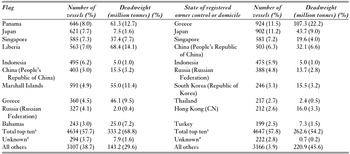
Although a total of 133 different flags were associated with the 8035 oil tankers currently listed within the Sea-web database, the ten largest registers by vessel number and by deadweight tonnage (DWT) represented the flags of 58% and 79% of the global oil tanker fleet, respectively (Table 1). Flags from Panama, Japan, Singapore and Liberia each represented 7–8% of the fleet by vessel number, and flags from Liberia, Panama and the Marshall Islands each represented 11–14% of the fleet by DWT. Vessels for which the flag state was unknown represented 4% of the fleet by vessel number and 2% by DWT. Similarly, the top ten states where beneficial ownership was recorded as being held were associated with 58% of the global oil tanker fleet by vessel number and 62% by DWT, although the composition of ownership differed with that of registration (Table 1). Owners based out of Greece and Japan each owned just over 11% of the total fleet by vessel number, and 22% and 9% by DWT, respectively.
Top ten most common flags and states of registered owner control or domicile of oil tankers listed within Sea-web (n = 8035), by number of vessels. aUnknown flags and states not included in top ten total.

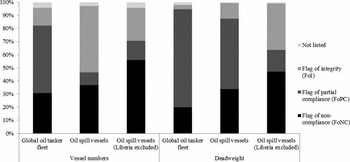
FoPCs were the most common, representing 51% of all of the 7741 flagged vessels, or 75% of the total flagged DWT, followed by FoNCs (31% of vessels, 20% of total DWT) and FoIs (14% of vessels, 3% of total DWT) (Fig. 1). Unlisted flags represented 4% of all flagged vessels (2% of total DWT).
The flag type composition of the global fleet of flagged oil tankers listed in Sea-web (n = 7741 vessels, 476 million DWT) and of all flagged oil tankers involved in the 100 largest spill incidents, calculated both with (n = 103 vessels, 8.5 million DWT) and without (n = 68 vessels, 6.1 million DWT) inclusion of Liberian flagged vessels.

Panama and Indonesia had the most FoNC vessels, representing 27% and 21%, respectively, of all FoNC vessels. Considering fleet capacity, Panama was also the largest register by far, representing 65% of total FoNC vessel DWT. Zanzibar (Tanzania) was the second largest FoNC register, representing just 6% of DWT, though Indonesia was third with 5% of DWT. Owners from Indonesia held ownership of more vessels that were flagged with FoNCs than owners from any other state, owning 20% of all FoNC vessels, though this amounted to only 5% of the total DWT. Considering fleet capacity, owners from Japan held ownership of the majority of the total DWT of FoNC vessels (25%), followed by South Korea (13%).
Though flags in all three categories ranged from having 100% foreign ownership to 100% national ownership, FoIs had the greatest average percentage of national ownership (78%), followed by FoPCs (67%), with FoNCs having the lowest national ownership (42%) (Appendix 1, Table S2, see supplementary material at Journals.cambridge.org/ENC).
Flag-use and tanker oil spills
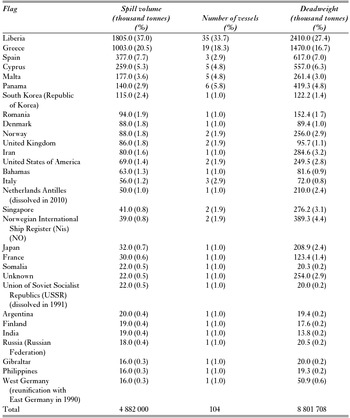
The Liberian flag was associated with 35 of 104 large scale oil spill incidents all representing 37% of the total volume of oil spilled (Table 2). The Greek flag was second, representing 18% of tankers and 21% of all oil spilled, 28 other flags each represented no more than 6% of all vessels involved in oil spills. One incident involved a vessel with an unlisted flag. The majority of accidents that involved Liberian-flagged vessels occurred prior to 1980 (31 out of the 35 accidents, 89%), whereas accidents involving vessels flying the flags of all other states were not clustered within any particular time period (Appendix 1, Table S1, see supplementary material at Journals.cambridge.org/ENC). The majority of all recorded accidents within this dataset also occurred prior to 1980 (75 out of 104, or 72%).
Flags of the oil tankers involved in the 100 largest oil spills (n = 104).

Fifty per cent of all of the 103 flagged vessels, or 54% of total flagged DWT were registered to FoIs, 37% of the vessels or 34% of total DWT were flagged to FoNCs, and 10% of the vessels or 12% of total DWT were flagged to FoPCs (Fig. 1). Tankers registered under unlisted flags represented 3% of all flagged vessels involved in spills (1% of total DWT). When spill events involving the Liberian flag were excluded, 56% of all of the 68 non-Liberian flagged vessels, or 47% of total non-Liberian flagged DWT were registered to FoNCs, 25% of the vessels or 35% of total DWT were flagged to FoIs, and 15% of the vessels or 17% of total DWT were flagged to FoPCs (Fig. 1). Tankers registered under unlisted flags represented 4% of all non-Liberian flagged vessels involved in spills (2% of total DWT).
The prevalence of certain types of flag-use amongst the group of vessels that have been involved in the largest oil spill incidents did not appear to be consistent with the patterns observed within the larger dataset of all oil tankers (Fig. 1). However, although the percentage of vessels flagged with FoNCs was higher amongst vessels that had been involved in oil spills, flag composition of the vessels involved in oil spill events (FoNC vessel versus all other groups combined) was not significantly different from that of the current global oil tanker fleet (χ2 = 1.49, df = 1, p > 0.05). Yet, when Liberian vessels were excluded from the list of vessels that had been involved in oil spills, the flag composition of this group of vessels was significantly different (χ2 = 19, df = 1, p < 0.001). The Panamanian and Liberian flags were dominant within both lists of vessels. However, despite being common within the global fleet, the Indonesian, Chinese and the Marshall Islands flags were not flown by any of the vessels that had been involved in the largest 100 oil spill accidents on record.
DISCUSSION
This study suggests that flag-use and specifically the use of FoNCs may be linked with the likelihood of vessels becoming involved in large-scale oil spill accidents. It is difficult however, from these historical data, to make conclusions that are directly applicable to the tanker fleet as it currently exists. The vessel data from oil spill accidents have been retrieved from a period of time throughout which the maritime fleet experienced changes in size, age, composition, technology and governance (Yannopoulos Reference Yannopoulos1988; Burgherr Reference Burgherr2007; UNCTAD 2012). Other factors that are no longer influential may have had an effect on the likelihood of spill accidents occurring in the past. In addition, the existence and characteristics of certain flag states or registries may have changed over time (Matlin Reference Matlin1990; SSY Consultancy & Research Ltd 2001; UNCTAD 2012).
Improvements in international legislation on vessel safety and avoidance of pollution have been credited for the observed reductions in annual numbers of spills and total volumes spilled over the past 40–50 years (Burgherr Reference Burgherr2007; ITOPF 2012; Alló & Loureiro Reference Alló and Loureiro2013). The transition from single to double-hulled vessels in particular may have greatly improved the safety of the global fleet and influenced the age composition of the fleet (Burgherr Reference Burgherr2007; Knapp & Franses Reference Knapp and Franses2009; Alló & Loureiro Reference Alló and Loureiro2013). Only 4% of existing global oil tanker tonnage was built over 20 years ago (UNCTAD 2013) and none of the largest tanker accidents have occurred after the transition of the tanker fleet to double-hull design became mandatory (ITOPF 2012). Regardless of whether the global tanker fleet as a whole now has a reduced risk of becoming involved in an oil spill as a result of improvements in vessel design, if oil continues to be transported, the risk of spills will remain. Any additional factors that may increase this risk or facilitate the continuation of practices that carry an increased risk by some vessels operating within the current tanker fleet should be identified.
Many registers appear to have the intention of complying with international standards. Many of the most important international agreements concerning vessel safety and pollution avoidance have a very high level of ratification or acceptance, including some FoNC states. Regardless of whether a state has officially shown a commitment to these agreements however, the degree to which obligations have been implemented and enforced may vary among states, preventing the achievement of global standards (Thuong Reference Thuong1987; Höfer Reference Höfer2003; Knapp & Franses Reference Knapp and Franses2009).
Since the early 1980s, a global system of regionally-coordinated PSC agreements has emerged. This approach has largely been influenced by the early efforts of European governments to reduce the global presence of substandard shipping, importantly through the introduction of the Paris MoU on PSC in 1982 (McDorman Reference McDorman2000). Based on historical inspections and detentions records, it appears as though PSC measures are helping to improve the safety and environmental standards of some of the larger and older registers (Alderton & Winchester Reference Alderton and Winchester2002a ; Appendix 1, Table S3, see supplementary material at Journals.cambridge.org/ENC). However, it is not entirely clear what amount of influence these measures have had on the overall reduction of substandard vessels within the shipping sector (McDorman Reference McDorman2000). Within the current system of international maritime governance, it is acceptable and relatively easy for vessel owners to occasionally change the flag of their vessels. Thus, they can choose to re-flag under a register that does not actively promote and enforce minimum safety and environmental standards (Alderton & Winchester Reference Alderton and Winchester2002b ). A number of flag states have historically maintained poor detention records (such as Cambodia) and in addition, new poorly-performing flags have been appearing within PSC inspection records in recent years with increasing frequency (for example, Togo and Saint Kitts & Nevis; Alderton & Winchester Reference Alderton and Winchester2002a , Reference Alderton and Winchester b ; Appendix 1, Table S3, see supplementary material at Journals.cambridge.org/ENC).
Vessel owners may choose to register with FoNCs to avoid the expense of costly upgrades as their vessels age and equipment becomes outdated. The age of a vessel may also therefore influence the likelihood of vessels being involved in oil spills although there seem to be no significant differences in spill numbers and volumes between tanker age categories (Burgherr Reference Burgherr2007).
The effective enforcement of standards by open registers that may hold jurisdiction over thousands of vessels whose owners have little or no ties to the flag state is undoubtedly difficult to achieve (Thuong Reference Thuong1987; Höfer Reference Höfer2003). Proponents of the open registry system, or the use of FoCs, claim that the credibility and performance of many of the older and larger open registers is improving (Matlin Reference Matlin1990), and PSC records support this view (Appendix 1, Table S3, see supplementary material at Journals.cambridge.org/ENC). A number of flag states that preside over a low percentage of nationally owned vessels were categorized as FoIs and the list of FoNCs included flags that appear to be closed to foreign owners (Appendix 1, Table S2, see supplementary material at Journals.cambridge.org/ENC). It is perhaps unhelpful then to characterize all FoCs in the same way (Alderton & Winchester Reference Alderton and Winchester2002a , Reference Alderton and Winchester b ), but a system which allows registration with foreign flags (FoCs) surely makes it easier for vessel owners to access FoNCs. Although FoCs are not necessarily FoNCs, the average percentage of nationally owned vessels under registers that fell into each flag category was lowest for the group of flags that had been categorized as FoNCs (42% versus 67% for FoPCs and 78% for FoIs; Appendix 1, Table S2, see supplementary material at Journals.cambridge.org/ENC). This implies that FoNCs are as a group easier to access than FoIs or FoPCs.
If the elimination of substandard vessels is sought, international efforts should be made to ensure that vessel owners are deterred from registering with those FoNCs that are also highly accessible to foreign owners (for example Cambodia, Comoros or Kiribati; Appendix 1, Table S2, see supplementary material at Journals.cambridge.org/ENC). In addition, political measures could be taken to put pressure on flag states that operate all other FoNCs (such as Bangladesh and Indonesia; Appendix 1, Table S2, see supplementary material at Journals.cambridge.org/ENC) to improve effective jurisdiction over ships flying these flags. Importantly, though PSC measures are clearly useful, this system of surveillance and control functions as a safety net, and so the responsibilities of flag states in preventing the existence of substandard vessels in the first place should be prioritized (Plaza Reference Plaza1994). If a substandard vessel is detected while at port, the risk of that vessel causing environmental damage has already been present within the coastal waters of the inspecting state.
The common use of FoCs and FoNCs (Gianni Reference Gianni2008; UNCTAD 2012) has loosely phrased international legislation allowing this controversial business strategy to persist (Hayashi Reference Hayashi2001). Attempts to close loopholes through the clarification of existing terms or the introduction of additional legislation have been met with much opposition (Llácer Reference Llácer2003; D’Andrea Reference D’Andrea2006). The financial incentives for choosing to use a foreign flag are substantial, and, to some extent, savings in transportation costs may eventually be transferred to consumers (Matlin Reference Matlin1990). Depending on the nationalities of the selected crew, vessels that are flagged to an open register can have annual crew costs amounting to two to four times less than those of vessels flagged to a typical North European closed register (Llácer Reference Llácer2003; Bergantino & Marlow Reference Bergantino and Marlow1998). The exploitation of workers from low income countries that accept lower standards of pay is a reality of globalization. However, cheaper workers may also increase the risk of accidents due to human error, a potential consequence of poor training, lack of motivation, understaffing, stress and fatigue (Hayashi Reference Hayashi2001). Vessel owners can also avoid paying taxes through the FoC system, and reduce their costs of vessel maintenance and safety (Thuong Reference Thuong1987; Sehgal Reference Sehgal2010). Thus, it seems unlikely that open registers and the use of FoCs will disappear from the global shipping sector anytime soon. The international community is currently using other approaches in attempts at reducing the number of substandard vessels in operation.
The private sector is playing a role in developing industry tools that address concerns in regards to sub-standard shipping; the Oil Companies International Marine Forum (OCIMF) has the Ship Inspection Report Programme (SIRE) which maintains a database of up-to-date inspection-related information about tankers and barges (see www.ocimf.com/SIRE/Introduction). Mandating inspections carried out by port states while vessels are loading or unloading cargo is one specific approach that has gained popularity (Thuong Reference Thuong1987; Yannopoulos Reference Yannopoulos1988; SSY Consultancy & Research Ltd 2001). The European Union (EU) is continuing efforts to improve and strengthen international control mechanisms. In addition to enshrining PSC measures within EU legislative framework (such as EC 2009), the EU has also considered imposing sanctions against classification societies that fail to adequately enforce ship safety standards (SSY Consultancy & Research Ltd 2001). With a limited ability to obtain certification from the more dubious classification societies, owners of substandard vessels will find it difficult to finance and insure their vessels.
CONCLUSIONS
This study has shown that flag-use and specifically that of FoNCs could be addressed to decrease the likelihood of vessels becoming involved in large-scale oil spill accidents. If businesses and vessel owners within the oil industry wish to prove they are doing everything they can to reduce the risk of involvement in an oil spill, the use of FoNCs should be avoided. Vessel owners should be deterred from registering with FoNCs that are highly accessible to foreign owners (such as St Kitts & Nevis), and political measures should be taken to put pressure on flag states that operate all other FoNCs to improve effective jurisdiction over ships flying these flags. Vessel owners who choose to make use of the FoC system should instead be encouraged to employ well trained, well paid crew and be comfortable operating under the jurisdiction of a flag state that is committed to the highest standards of safety and pollution avoidance.
ACKNOWLEDGEMENTS
We thank colleagues within the Fisheries Economics Research Unit at the University of British Columbia for insightful discussions and the International Tanker Owners Pollution Federation Limited (ITOPF) for providing data. This work was funded by the Social Science and Humanities Research Council of Canada (SSHRC) (grant number 756–2012–0659). Sumaila acknowledges the support of the Global Ocean Commission.
Supplementary material
To view supplementary material for this article, please visit Journals.cambridge.org/ENC.