INTRODUCTION
The reproductive cycle of the sea urchin Paracentrotus lividus (Lamarck, 1816) has been widely studied throughout its distribution area: from the northern limit in Ireland (Byrne, Reference Byrne1990) and Brittany (Allain, Reference Allain1975; Spirlet et al., Reference Spirlet, Grosjean and Jangoux1998) to the southern limit, in the Canary Islands (Girard et al., Reference Girard, Hernández, Toledo, Clemente and Brito2006) and Morocco (Bayed et al., Reference Bayed, Quiniou, Benrha and Guillou2005), through the Mediterranean Sea (Fenaux, Reference Fenaux1968; Lozano et al., Reference Lozano, Galera, Lopez, Turon, Palacin and Morera1995; Guettaf, Reference Guettaf1997; Sánchez-España et al., 2004). In the north of Spain, the reproductive cycle has been studied by several authors (Haya de la Sierra, Reference Haya de la Sierra1990; Catoira, Reference Catoira, Emson, Smith and Campbell1995), but only those studies conducted in the intertidal (Haya de la Sierra, Reference Haya de la Sierra1990) included histological sections. The ecological and economic importance of this benthic invertebrate is the main reason for all these studies. Paracentrotus lividus is a key species in hard bottoms, where it plays an important role, creating a specific ecosystem the ‘sea urchin barrens’, which are characterized by the absence of macroalgae and the presence of encrusting coralline algae (Kempf, Reference Kempf1962; Vukovic, Reference Vukovic1982; Verlaque & Nedelec, Reference Verlaque and Nedelec1983; Verlaque, Reference Verlaque1987). The economic importance of P. lividus throughout its distribution area lies in the collection of their roe. This has resulted in overfishing in France (Allain, Reference Allain1975; Régis, Reference Régis1979), Ireland (Byrne, Reference Byrne1990; Barnes et al., Reference Barnes, Verling, Crook, Davidson and O'Mahoney2002) and recently in Italy (Gianguzza et al., Reference Gianguzza, Chiantore, Bonaviri, Cattaneo-Vietti, Vielmini and Riggio2006; Pais et al., Reference Pais, Chessa, Serra, Ruiu, Meloni and Donno2007). Spain is one of the most important producers of sea urchin roe in the EU, with more than 740 T/year fished only in the Autonomous Region of Galicia (north-west of Spain) in 2008 (www.pescadegalicia.com).
In spite of the numerous studies which have analysed the reproductive cycle of P. lividus, some aspects are still not fully clear yet (Boudouresque & Verlaque, Reference Boudouresque, Verlaque and Lawrence2001). For example, it is not well known which environmental factors trigger spawning. The role of the temperature and photoperiod in the reproductive cycle is not clear and the influence of other environmental variables has not been thoroughly studied. This work aims at contributing to fill this gap in knowledge as well as to study the reproductive cycle of the sea urchin in the Cantabrian Sea, an area where P. lividus has been little researched.
MATERIALS AND METHODS
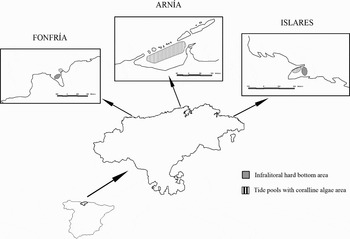
Specimens from 3 localities of the Cantabrian coast (western Bay of Biscay; Figure 1): Fonfría (43°23′35″N 4°15′58″W), Arnía (43°28′26″N 3°55′03″W) and Islares (43°24′21″N 3°17′37″W) were used in the current study. In Fonfría and Islares sea urchins were collected from two different habitats: tidal pools with coralline algae and infralittoral rock bottoms. In Arnía, only tidal pools were sampled. The small size of the intertidal specimens resulted in a collection of individuals of different size-ranges from the two habitats under study. Sea urchins collected from tide pools had diameters ranging from 30 to 43 mm while those from subtidal populations had diameters ranging from 55 to 70 mm.
Location of the sea urchin sampling sites on the Cantabrian coast (north of Spain).

The tide pools in this work are similar to the ones described by Byrne (Reference Byrne1990) in Ireland and they are pink due to a crust of coralline algae lining the substratum. All three localities showed similar pool characteristics: sea urchins in this habitat were found in dense aggregates and rarely reached 50 mm in diameter. Other species, like the anemone Anemonia sulcata or the ophiuroid Amphipholis squamata coexist with P. lividus. Despite similar characteristics between the three intertidal populations, important differences were observed in the exposure and size of the tide pools. The main differences between the tide pools were observed in Arnía. In this site the pools are bigger and are more often isolated from the sea than in the other sites. In the second habitat (infralittoral hard bottom) sea urchins were sampled to a depth-range between 2 and 4 m, showing dense P. lividus populations but without forming barren grounds. The sea urchins of Islares were found on a flat limestone bottom with large rocks. The density of sea urchins was high coupled with a poor presence of macroalgae and abundant presence of Anemonia sulcata. On the other hand, Fonfría sea urchins were collected from a sheltered area with a dense seaweed cover favoured by a close turbot farm. Sampling was conducted in the early morning, during low tides and the last week of each month on consecutive days. Sampling started in May 2004 and finished in September 2005. In October 2004 only intertidal samples were taken. Moreover, in May 2004 Fonfría intertidal samples were not collected and the same occurred in June 2004 regarding the samples of Arnía. At least 15 individuals were collected from each sample. Temperature was measured at the sea surface and inside the tide pools. Finally, water samples (5 l) were collected in plastic bottles to estimate chlorophyll concentration, using the acetone method (SCOR–UNESCO, 1966). Apart from the in situ measurement, surface temperature data of an oceanographic buoy (Triaxis model) with continuous measurements was also used as a reference (data supplied by: Puertos Del Estado). This buoy was located in a coastal area of Bilbao (43°23′9″N 3°7′9″W), near Islares. Photoperiod data were supplied by the National Astronomic Observatory.
Sample treatment
The sea urchins were measured with a Vernier calliper. The specimens were wet-weighed and dissected. The gonads were set aside for calculation of the gonad index. We used the wet gonad index (WGI) because it is the most commonly used in the literature since it is easier and simpler than others. The WGI was calculated using the formula:

For each population, at least five urchins were used for the histological sections. Previous studies have shown that mature gonads do not differ between males and females (Byrne, Reference Byrne1990; Guettaf, Reference Guettaf1997; Spirlet et al., Reference Spirlet, Grosjean and Jangoux1998; Sánchez-España et al., Reference Sánchez-España, Martínez-Pita and García2004) and therefore we studied only female gonads. At least 5 females were analysed from each sample. In each female, one of the five gonads was stored at −20°C for histological observations. Before microscope observations, the gonads were de-frozen and preserved in Bouin's fluid, embedded in paraffin, sectioned at 7 µm and finally stained with haematoxylin and eosin (Guettaf, Reference Guettaf1997). The histological sections were carried out on samples taken from June 2004 onwards, except for animals from the Islares intertidal and Arnía, where histological sections were conducted on animals collected already in May 2004. The sections were analysed by using an optical microscope and classified depending on the development stage of the germ cells. The pattern of ovarian growth in P. lividus has been categorized by several authors but in different ways (Byrne, Reference Byrne1990; Guettaf, Reference Guettaf1997; Spirlet et al., Reference Spirlet, Grosjean and Jangoux1998; Sánchez-España et al., Reference Sánchez-España, Martínez-Pita and García2004). In this study Byrne's classification was used due to the complete characterization of the ovarian development and the easy interpretation of the results. This classification characterizes the ovarian development in six stages: Stage I (recovery stage), Stage II (growing stage), Stage III (premature stage), Stage IV (mature stage), Stage V (partly spawned) and Stage VI (spent stage). The Kruskal–Wallis test was used to compare the means between the different groups and Dunnet's T3 test to conduct multiple comparisons. Student's t-test was also used to compare different groups with only two variation levels. We mainly used the non-parametric test due to the heterocedasticity of the data.
RESULTS
Wet gonad index (WGI) seasonality
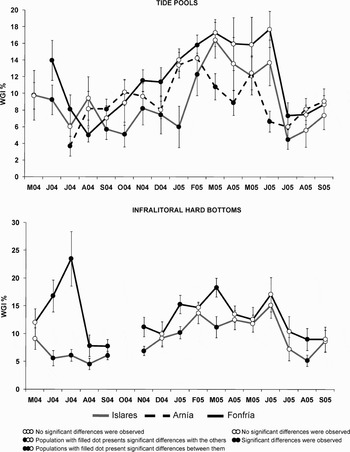
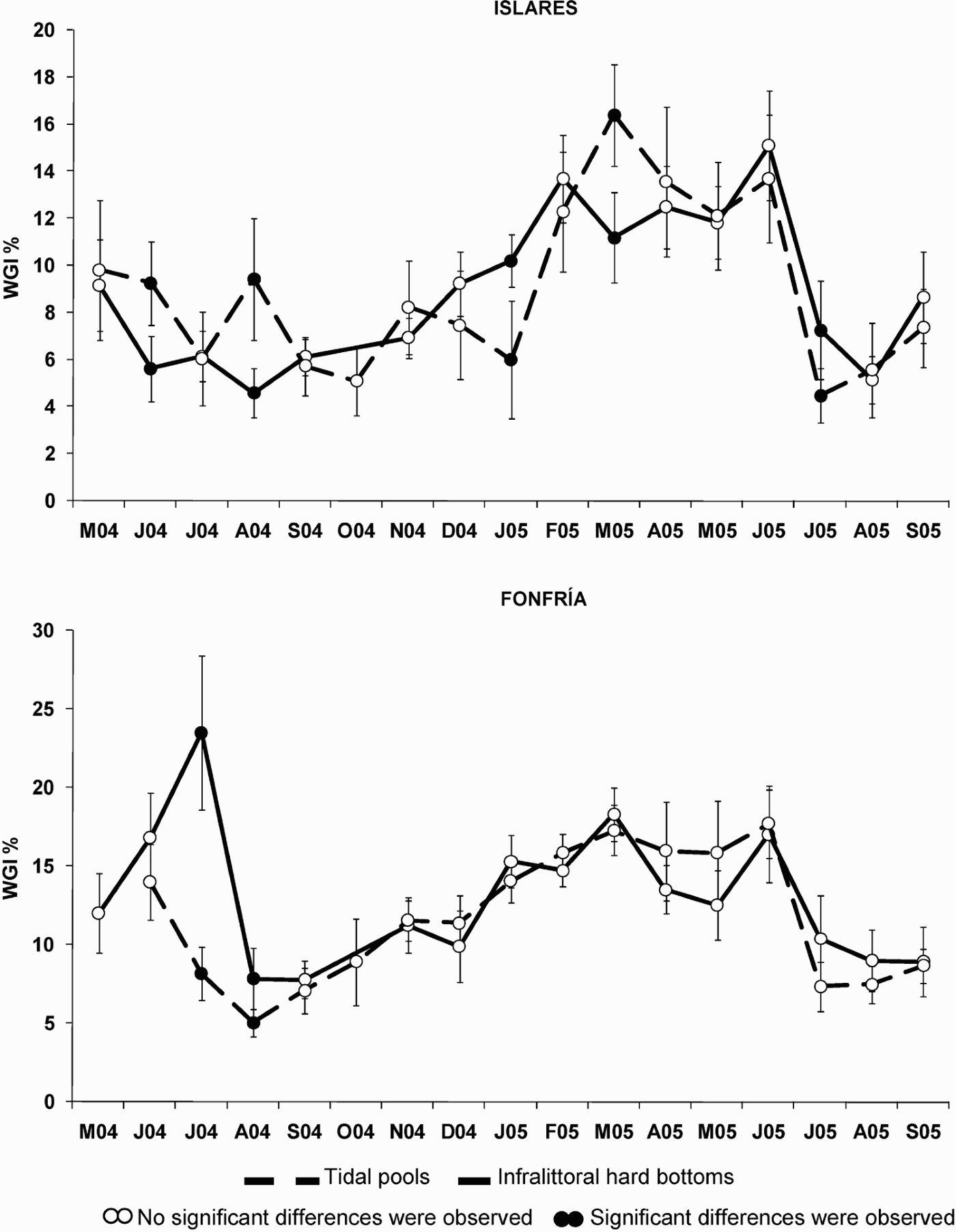
The seasonality of the WGI was analysed statistically using the Kruskal–Wallis test for all populations together and separately for each population. In all cases the results revealed a strong effect of time (P < 0.001) on the WGI. Moreover, the differences in the WGI between populations were analysed month-to-month using the Student's t-test, except for comparing the three intertidal localities. In this case, Dunnet's T3 test was used. The results of these analyses are represented in Figure 2 (populations of different habitat) and Figure 3 (populations of different locality) with the WGI temporal trend.
Temporal trends of the wet gonad index (WGI) in infralittoral hard bottoms and tide pools. The differences were considered significant if P < 0.05. Bars represent the 95% confidence interval.

Temporal trends of the wet gonad index (WGI) in Islares and Fonfría. The differences were considered significant if P < 0.05. Bars represent the 95% confidence interval.
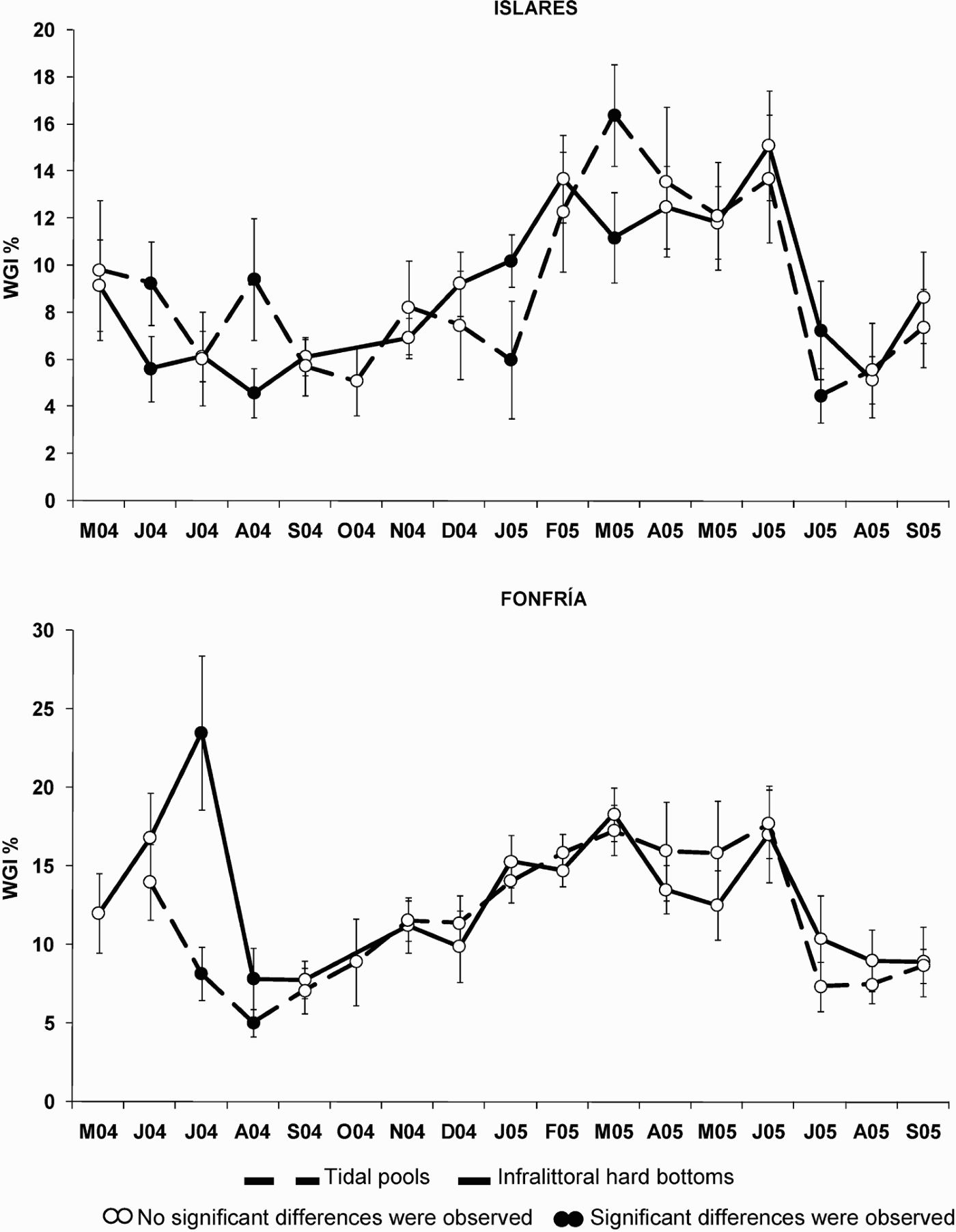
The WGI seasonal pattern was similar in the five populations (Figures 2 & 3) especially in 2005. This year all the populations presented the same pattern with maximum values in February–March and minimum values in July–August. Between maximum and minimum values a decline in the WGI was observed in two phases: the first one in March–April and the other one in June–July. The decrease found in the WGI was slighter during the spring months than in July. Moreover, Islares subtidal and Arnía presented this spring decrease in March, one month earlier than the rest of populations, producing significant differences in this month (March 2005 in Figure 2). This earlier decrease in WGI was also observed in June 2005 in Arnía urchins. In 2004, significant differences between populations and years were found. The main differences in WGI between populations were observed in specimens from different localities (especially Fonfría; Figure 2), while sea urchins from the same localities but different habitats were more similar (Figure 3). The breeding season observed in 2004 was different from that of 2005, even though March and April in 2004 were not sampled. These differences were especially important in the subtidal habitat, with significant differences between Fonfría and Islares in June, July, August and September 2004 (Figure 2). In the Islares populations the WGI summer peak of 2005 was not found in 2004, while in the Fonfría subtidal populations, the 2004 peak was delayed by one month in comparison with 2005. Declines in the WGI during autumn and winter were frequent in intertidal urchins. In some cases these falls had a high impact on the WGI and lasted for 2 months, causing significant differences between the intertidal populations (January 2005 in tide pools; Figure 2). This seasonality of WGI could have been confused with spawning were it not for the histological sections.
Furthermore, the effect of time in the WGI was analysed comparing months for each population separately. Consecutive months and the same months of different years are only included (Table 1). The results show that the Islares and Fonfría subtidal populations were the only ones presenting significant differences in their WGI during the same month of different years. No significant differences were found in the remaining populations between the two years under study. The most important differences in WGI between consecutive months were found in June and July 2005 in three of the five populations. Furthermore, in the Arnía population such differences were found in May and June 2005, one month earlier than in the other populations, due to early spawning. The Fonfría subtidal population was the only one not presenting significant differences in summer 2005. The spring declines in WGI were less pronounced and the subtidal population of Fonfría was the only one which showed significant differences during this period. WGI declines in summer 2004 were not as marked as the ones of 2005 and significant differences were only found in the Fonfría populations.
Results of the Dunnet's T3 test conducted between the different months of each population. Consecutive months (with significant differences, P < 0.05) and the same month of different year (with significant differences, P < 0.05) are only included.

Histological sections
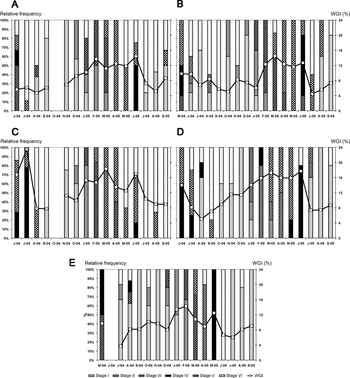
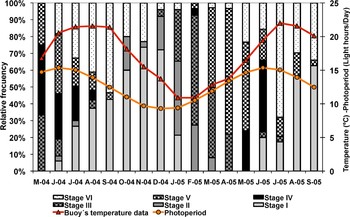
The relative frequencies of ovarian maturity stages of the five populations studied are illustrated in Figure 4. Observations of histological sections started in May (Islares intertidal and Arnía populations) and June. The presence of Stage V and Stage VI gonads indicates that sampling in 2004 occurred after the beginning of the spawning period. The end of the breeding season in 2004 was observed during July and August. During these months Stages III, IV and V had disappeared and were replaced by gonads in phases VI and I. This pattern was observed in all localities with the exception of Fonfría, especially in the subtidal individuals. Here, urchins showed an increase of Stage IV relative frequencies in July, from 28.6% in June to 77.78% at the end of July 2004. This increase in the presence of specimens of Stage IV in the Fonfría subtidal coincided with a strong increase in the WGI during this month. The intertidal urchins of Fonfría did not show the same increase in the ovarian maturity stage, but their spawning was prolonged until September 2004, being the last population to finish the breading season. After the breading season, the nutritive phagocytes initiated a recovery period in the gonad by the storage of periodic acid-Schiff + (PAS +) droplets (Byrne, Reference Byrne1990). During this period, the gonads developed from Stage VI to Stage I and the storage of nutritive material induced an increase in the WGI. This period started between June and August (depending on populations) and peaked in September, October and November. In the same time, vitellogenesis started in some urchins. The first individuals with Stage II gonads appeared in the Islares and Arnía intertidal samples in October. Stage II gonads were observed in subtidal individuals of Islares and Fonfría in November and finally, in intertidal animals of Fonfría in December. The gonad cycle continued in all populations. The first sea urchins with gonads in Stage III were observed in Arnía, during December and one month later in the remaining populations. Although the vitellogenesis started in October, this process was not general until December and January, coinciding with the shortest photoperiod. In February the Stage III gonads were the most abundant (68% of the sea urchins were at this stage) and even specimens in Stages IV and V were found. Stage V was observed in March for all the populations, being most abundant among Fonfría urchins. Development of gonads continued and Stage V was present in 75.86% of the sea urchins studied by April. It is important to mention that most of these urchins started their spawning directly from Stage III without reaching Stage IV.
Temporal trends of the relative frequency for each gonad stage and of the wet gonad index (WGI) in the five populations: Islares subtidal (A); Islares intertidal (B); Fonfría subtidal (C); Fonfría intertidal (D); Arnía (E).

In other studies the breeding process continued until the disappearance of Stage V and the appearance of specimens in Stage VI (Byrne, Reference Byrne1990; Spirlet et al., Reference Spirlet, Grosjean and Jangoux1998), however this was not observed in the breeding season of 2005 in our study. The Arnía population showed a high number of sea urchins in Stage V in April 2005 but all the specimens observed in May 2005 were of Stage IV. The remaining populations behaved in the same way but with a month's delay with respect to these dates. The detection of sea urchins in Stage IV coincided in all cases with a recovery of the gonad index, as was observed in the Fonfría subtidal during the summer of 2004. The breeding season ended during June (in Arnía) and July 2005, coinciding with the longest photoperiod. All populations had a high proportion of sea urchins at Stage VI or even at Stage I during these months, although some specimens from the intertidal sites presented gonads in Stage V until the end of September.
Temperature and photoperiod
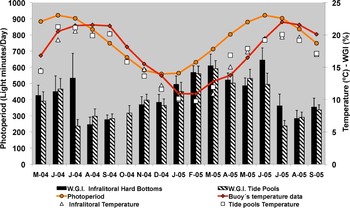
Temperature and photoperiod values measured during the study are shown in Figures 5 & 6. The main differences between temperatures measured in situ and values obtained from the buoy were observed in the tide pools during spring. Differences of more than 3°C were observed in April 2005 (Figure 5). Subtidal populations presented small differences although 2°C of difference were observed in May 2004 and July 2005. Most of the in situ temperatures presented lower values than those obtained from the buoy. These differences may be explained by the fact that in situ measurements were made early in the morning. For both measurements (buoy and in situ), the lowest temperature values were obtained during January and February, coinciding with the highest WGI values, while the highest temperature values (registered in August and July) coincided with the lowest WGI values. Thus, the pattern of the surface temperature presented inverse values compared to the WGI dates (Figure 5). Furthermore, the WGI recovery process (during autumn and winter) coincided with a decrease in temperature, while declines in the WGI occurred during spring, coinciding with an increase of this environmental factor. Nevertheless, the relationship between temperature values and the WGI dates is not always clear, and during May and July high temperatures were not related to a decrease in the gonad index. In Figure 6, temperature values from the Bilbao buoy and photoperiod values are represented against the composition of gonad developmental stages. The highest temperature values registered during July and August coincide with the presence of urchins in Stage VI. The temperature increase observed in April is related to the presence of most of the urchins in Stage V during this month. The relation between WGI and the photoperiod is quite important. The lowest photoperiod values were registered in December, coinciding with an increase in the presence of Stage II gonads. In January, most of the urchins were in gonad Stage II. By the end of June, the photoperiod started to decrease again and at this point most individuals had completed their breeding season. However, some exceptions can be observed, like the spawning peak during July shown by the Fonfría population (2004), or the presence of urchins in Stages IV and V in August and September in some of the populations.
Temporal trends of the wet gonad index (WGI) (for each habitat sampling), surface temperature and photoperiod. Bars represent the 95% confidence interval.

Histogram showing relative frequencies of ovarian stages in histological sections. Lines show temporal trend in surface temperatures data and photoperiod.

Chlorophyll
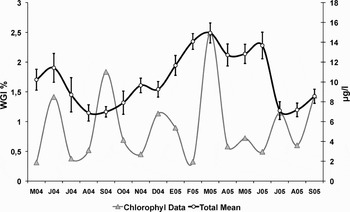
Variations in chlorophyll concentration are shown in Figure 7 and they were as expected for the Cantabrian Sea, i.e. showing a peak in the summer and another one smaller in the autumn (Diez et al., Reference Diez, Secilla, Santolaria, Gorostiaga and Sheppard2000). The peak observed in March is the most important one of the whole studied period, showing an average value for the five populations of 1.95 µg/l followed by the average observed in September 2004, 1.88 µg/l, and 1.28 µg/l in September 2005. The main relation between the chlorophyll content and the breeding season was observed in March 2005, when the beginning of spawning coincided with the highest values of chlorophyll concentration.
Temporal trend of the chlorophyll concentration and wet gonad index (WGI) (monthly mean of all the sea urchins studied).

DISCUSSION
Spawning of Paracentrotus lividus on the Cantabrian coast starts in March and lasts until September, with one or two main spawning periods per year (depending on year and population) at the beginning of spring and during the summer. In 2005, spawning started in March and for most of the urchins it continued through April. Spring spawning started with gonads in Stage III. Sea urchins at this stage can spawn and release mature gametes, while others are still developing (Byrne, Reference Byrne1990; Spirlet et al, Reference Spirlet, Grosjean and Jangoux1998). This spawning did not show an important impact on the WGI as indicated by the absence of significant differences between March and April in most of the populations (Table 1). Such a contradiction between gonad index and histological sections, reflected also in the winter WGI decrease, has been observed by several authors (Lozano et al., Reference Lozano, Galera, Lopez, Turon, Palacin and Morera1995; Spirlet et al., Reference Spirlet, Grosjean and Jangoux2000; Sellem & Guillou, Reference Sellem and Guillou2007) and has been explained by the double role of the gonads as reproductive organs and nutritive stores. The double function of the gonad can cause variations in gonad weight not only in relation to the reproductive cycle but to the nutritive state as well (Fuji, Reference Fuji1960; Ebert, Reference Ebert1967; Gonor, Reference Gonor1973; Pearse, Reference Pearse1981). During May 2005 and June 2005 the WGI increased and the gonad reached Stage IV in many individuals, indicating a decline in the release of gametes. Following the halt in spawning, the WGI went through a second decline during June (in Arnía) and July (in the rest of populations) producing significant differences in the WGI in four of the five populations under analysis (Table 1). Such a double decrease in the WGI has already been described in previous studies on P. lividus (Crapp & Willis, Reference Crapp and Willis1975; Guettaf, Reference Guettaf1997; Spirlet et al., Reference Spirlet, Grosjean and Jangoux1998; Gago et al., 2003; Sellem & Guillou, Reference Sellem and Guillou2007). However, the only study which related the WGI to histological sections found the beginning of spawning to occur two months after the initial decline in the WGI (Spirlet et al., Reference Spirlet, Grosjean and Jangoux1998). In the Mediterranean Sea a double spawning in spring and autumn has been described by several authors (Fenaux, Reference Fenaux1968; Lozano et al., Reference Lozano, Galera, Lopez, Turon, Palacin and Morera1995; Fenaux & Pedrotti, Reference Fenaux and Pedrotti1988; Pedrotti & Fenaux, Reference Pedrotti and Fenaux1992, Reference Pedrotti and Fenaux1993; Pedrotti, Reference Pedrotti1993; Lopez et al., Reference Lopez, Turon, Montero, Palacín, Duarte and Tarjuelo1998; Barbaglio et al., Reference Barbaglio, Sugni, Di Benedetto, Bonasoro, Schnell, Lavado, Porte and Candia Carnevali2007). The results described by Barbaglio et al. (Reference Barbaglio, Sugni, Di Benedetto, Bonasoro, Schnell, Lavado, Porte and Candia Carnevali2007) show that between both spawning periods (spring and autumn) gonads develop a new reproductive cycle and present Stages I, II and III. On the contrary, our results showed two spawning events but not two reproductive cycles, since the gonads did not start a new cycle between spawning periods.
In this study differences in the gonad index between sea urchins from different localities but the same habitat (Figure 2) were more important than between urchins of the same locality but different habitat (Figure 3). Fonfría showed the biggest differences among localities, with the highest gonad index value in the two habitats sampled (Figure 2). This population was located in a cove with high levels of organic material produced by a turbot (Scophthalmus maximus) farm dumping its residues close to the area where the sea urchins were sampled. Many studies have shown that organic pollution of this kind enhances gonad growth in echinoids (Allain, Reference Allain1975; Tortonese, Reference Tortonese1965; Zavodnik, Reference Zavodnik1987; Delmas & Régis, Reference Delmas and Régis1992). Moreover, recently Cook & Kelly (Reference Cook and Kelly2007) have demonstrated that cultivation of P. lividus in an integrated open-water salmon (Salmo salar) farm increases sea urchin growth and roe production. The sea urchins sampled at Arnía also showed some important differences compared to the other populations under study. The main difference was that in Arnía, the WGI decreases of spring and summer were observed a month earlier than the remaining populations. Differences in the histological sections were smaller than those in the gonad index and the three localities displayed similar reproductive cycles. However, there were some differences during August 2004 and June 2005. In August 2004 a considerable second spawning was observed in the Fonfría populations, especially in subtidal urchins. In contrast, such spawning was not observed in the other populations. Probably, the Fonfría sea urchins optimum nutritional state, deduced from this high WGI (Gonor, Reference Gonor1973), may explain the second spawning period, allowing the animals to prolong their reproductive cycle. The relationship between the nutritional state and the reproductive cycle in P. lividus does not influence exclusively the gonad index value since several authors have observed a relationship also with the duration of the gonad cycle (Pearse, Reference Pearse1969; Pearse & Cameron, Reference Pearse and Cameron1991; Cameron, Reference Cameron1991). In June 2005 the differences were related to the early start of the second spawning in Arnía. In this case temperature may explain the early beginning since optimum temperature values induce faster gonad development in P. lividus (Spirlet et al., Reference Spirlet, Grosjean and Jangoux2000; Shpigel et al., Reference Shpigel, McBride, Marciano and Lupatsch2004). The tidal pools of Arnía remain long time isolated from the sea in each tide cycle. For this reason, Arnía urchins were exposed to higher temperature values than the ones measured in the subtidal habitats (April and May; Figure 5) and even higher than in tide pools of the other locations. The higher temperatures probably enhanced the rapid gonad development in the urchins of Arnía, which entered Stage IV and spawned one month before to the rest of the populations.
Despite the considerable number of studies on the reproductive cycle of P. lividus, few investigations have related this cycle to temperature and photoperiod (Byrne, Reference Byrne1990; Spirlet et al., Reference Spirlet, Grosjean and Jangoux1998) with only two studies focusing on such a relationship (Spirlet et al., Reference Spirlet, Grosjean and Jangoux2000; Shpigel et al., Reference Shpigel, McBride, Marciano and Lupatsch2004). Spirlet et al. (Reference Spirlet, Grosjean and Jangoux1998) proposed that photoperiod may control P. lividus maturation, while temperature might enhance the vitellogenesis process. Six years later, Shpigel et al. (Reference Shpigel, McBride, Marciano and Lupatsch2004) observed that long days inhibit vitellogenesis while short days enhance it. In our study a similar relationship between photoperiod and vitellogenesis was observed. The gametes development starts in winter (short photoperiods) and stops in summer (long photoperiods; Figure 6). On the other hand, the role of the temperature is not clear in the literature. Laboratory studies (Spirlet et al., Reference Spirlet, Grosjean and Jangoux2000; Shpigel et al., Reference Shpigel, McBride, Marciano and Lupatsch2004) have not resulted in a clear relationship between temperature and gametogenesis regulation. Furthermore, field studies about P. lividus gonad cycle indicate this possible relationship. In sites where the water temperature remains always at optimum levels for P. lividus reproduction, sea urchins develop reproductive strategies independently of the period of the year (Guettaf, Reference Guettaf1997; Sanchez-España et al., 2004). However, in places where the temperature values are not at an optimum for the reproduction of P. lividus during the whole year, the reproductive strategies are likely to be more limited. These occur in the North Atlantic populations (including the current study) with low winter temperatures (8–12°C) and in some Mediterranean populations with low temperatures during winter and high values in summer (Fenaux, Reference Fenaux1968). In North Atlantic populations the spawning period takes place between spring and summer (Allain, Reference Allain1975; Haya de la Sierra, Reference Haya de la Sierra1990; Byrne, Reference Byrne1990; Catoira, Reference Catoira, Emson, Smith and Campbell1995; Spirlet et al., Reference Spirlet, Grosjean and Jangoux1998; Gago et al., Reference Gago, Range, Luís, Feral and David2003). Winter spawning has been only described by Crapp & Willis (Reference Crapp and Willis1975), but these authors did not use histological sections in their study. In North Atlantic populations, the spawning period starts earlier at lower latitudes. In Irish urchins (Byrne, Reference Byrne1990) Stage II were first observed during March and April, with temperature values between 7.5 and 10°C and 700–800 minutes of light per day, while spawning took place in June. In Brittany (Spirlet et al., Reference Spirlet, Grosjean and Jangoux1998) the first urchins with growing oocytes were observed in November, although vitellogenesis did not become general until February, with temperatures around 10°C and 648 minutes of light per day. In our study, the first urchins in Stage II where observed in October but this stage was not observed in a high proportion until December or January (with temperature values between 10 and 12°C and 549 minutes of light per day). In all cases vitellogenesis began at around 10°C, but with shorter photoperiods at the lowest latitudes. Temperatures over 24°C inhibit vitellogenesis (Spirlet et al., Reference Spirlet, Grosjean and Jangoux2000; Sphigel et al., 2004). It is possible that this effect occurs also below 9–11°C, explaining the delayed vitellogenesis and eventually spawning of the northern populations (even with short photoperiod), exposed to such temperatures during the winter months. Such an inhibition by low temperatures may also explain the larger size of the gonads observed in the northern populations, since Stage I (the recovery stage) prevailed during the whole winter, enhancing the nutrient storage and the gonad size.
In general, P. lividus adapts its reproductive cycle to the oceanographic conditions without spawning under 12–13°C and over 22–24°C, a hypothesis already suggested by Fenaux (Reference Fenaux1968). In the current study, the existence of an environmental trigger is supported by several evidences. In the first place, the beginning of the spawning period was observed simultaneously in all populations during March, despite the geographical distances between localities and the different habitats sampled. Moreover, in a high percentage of the gonads analysed in spring, spawning started at gonad Stage III, without reaching Stage IV and hence interrupting the gonad cycle. During March 2005 an increase in temperature from 10.9°C (at the end of February) to 13°C (at the end of March, with several days with temperatures over 13°C) coincided with the beginning of spawning in all populations. Exactly 13°C was also the limit observed by Byrne (Reference Byrne1990) and (Spirlet et al., Reference Spirlet, Grosjean and Jangoux1998) for the beginning of spawning in P. lividus. An increase in temperature greater than 13°C in the presence of mature urchins may trigger spawning in individuals with an advanced gonad development. On the other hand, temperature is not the only possible environmental factor affecting spawning. Phytoplankton blooms also may trigger spawning as well. This has been described for the sea urchin Strongylocentrotus droebachiensis (Himmelman, Reference Himmelman1981; Starr et al., Reference Starr, Himmelman and Therriault1990) and for other marine invertebrate species (Himmelman, Reference Himmelman1981; Smith & Strehlow, Reference Smith and Strehlow1983). In the case of P. lividus this role is controversial: some studies have suggested that phytoplankton blooms may trigger spawning in this species (Spirlet et al., Reference Spirlet, Grosjean and Jangoux1998, Bayed et al., Reference Bayed, Quiniou, Benrha and Guillou2005, Fenaux, Reference Fenaux1968, Lozano et al., Reference Lozano, Galera, Lopez, Turon, Palacin and Morera1995), while other studies have not observed spawning until several months after the phytoplankton bloom (Byrne, Reference Byrne1990). The linkage between phytoplankton blooms and spawning could be direct, as in Strongylocentrotus droebachiensis (Starr et al., Reference Starr, Himmelman and Therriault1990) or indirect and then triggered by other oceanographic cues connected to the phytoplankton blooms (such as temperature increases). In our study, the spring phytoplankton bloom, a usual phenomenon in temperate seas (Díez et al., 2000), was observed by the end of March, coinciding with spawning in the five populations. In the Cantabrian Sea, phytoplankton blooms, temperature increases or a combination of both may play a key role in triggering spring spawning of P. lividus. However, not all spawning events occur in the presence of an environmental trigger. During the second spawning season in summer, gamete release happened in the absence of the above mentioned environmental triggers, with temperatures remaining stable around 20°C and with low levels of chlorophyll for most of the sites. Moreover, for all the populations the second spawning period did not take place at the same time during the two years. During this period, gamete release occurred from gonads in Stage IV (mature gonad) in both years. In the absence of environmental triggers the urchins complete their gonad development. When the gonad reaches Stage IV and stores enough gametes, it is possible that an internal process starts and triggers the spawning. Paracentrotus lividus present a very wide range of reproductive responses to environmental conditions around all the distribution area, spawning in spring, summer, autumn or winter. Only a complete knowledge of the role of the environmental factors in the reproductive cycle of this species will enable an understanding of the variability observed in reproductive strategies of P. lividus.
ACKNOWLEDGEMENTS
We are grateful to Raquel Garcia for her invaluable support with all the phases of this paper, to the Menntun team for the help with the English translation, to the Department of Histology and Cell Biology of the University of the Basque Country for the technical support in the histological sections, to the people of the Ecology group of the University of Cantabria for their kind support, and two anonymous referees for their critical revision and useful suggestions which greatly improved the manuscript.