INTRODUCTION
Imagine overhearing a pet shop customer saying, ‘Show me the large rabbit’. Literally, the speaker is denoting a single entity that is a rabbit and large; it says nothing about other, non-large rabbits. However, another way to understand that utterance is to consider the speaker's choice of words (in using the adjective large) as a way to distinguish the mentioned rabbit from another smaller-sized one or perhaps from several smaller ones in her purview. This access to contextual features – the recognition that there are other rabbits around and that non-large ones can be removed from consideration – qualifies as a pragmatic inference because it goes beyond what is linguistically encoded in the utterance. It is called a contrastive inference because it assumes that the mention of one object creates a contrast with other similarly named objects in the speaker's reference set.
How can one describe this extralinguistic processing? One prominent way is to consider a standard Gricean account, which decodes the literal meaning of an utterance as a step in a process that ultimately arrives at the speaker's intended meaning (Grice, Reference Grice1957). Given that interlocutors are guided by expectations of informativeness, truthfulness, relevance, and so on, a violation of an expectation would compel a listener to look for alternative interpretations that lead to the speaker's intended meaning. One prominent example of such an expectation is expressed through the Maxim of Quantity (Grice, Reference Grice and Davis1975) by which speakers should: (i) make their contribution as informative as is required, and (ii) not make their contribution more informative than is required. When the literal meaning of an utterance does not satisfy these expectations (e.g., when an utterance is either overinformative or underinformative), hearers are entitled to assume that the speaker intended something more by way of an implicature. In the Show me the large rabbit example above, the listener would arrive at a pragmatic interpretation by assuming that the modifier in the utterance is overinformative if one were referring to a single rabbit; therefore, by implicature, the listener would assume that there were two or more rabbits to speak of and that there was one or more that the customer did not want passed.
The Gricean perspective fits well with the literature on contrastive inference-making and mostly because investigations of pragmatic infelicities can be made so readily apparent. For example, consider how an adjectival modifier such as large in Show me the large rabbit can be used to describe a scene containing a single rabbit; this would render the utterance overinformative. Now, imagine a scenario in which the speaker does not use a modifier when referring to the rabbit in a context that shows two rabbits; this makes it possible to test an underinformative utterance. The facility with which one can operationalize over- and underinformativity has made the testing of children's detection of infelicitous cases related to contrastive inference widespread. Remarkably, the interest to do so began even before Grice graced the developmental literature (e.g., Ackerman, Reference Ackerman1981; Ironsmith & Whitehurst, Reference Ironsmith and Whitehurst1978; Whitehurst, Reference Whitehurst1976). It is no surprise then that contrastive inferences continue to be studied in a context of under- and over-informativeness even today (e.g., for recent work, see Morisseau, Davies & Matthews, Reference Morisseau, Davies and Matthewsin press).
In this paper, we argue that children's performance with infelicity does not advance our understanding about the way felicitous cases work, nor are they entirely revealing about the development of pragmatic processes more generally. To make this clearer, we take the following three steps. First, as we review the literature, we describe why investigations into infelicity do not enhance our understanding of pragmatic processes on three counts. Namely, we argue that: (a) investigations on infelicity detection rely mostly on metalinguistic judgments, which are only distantly related to successful contrastive inference-making; (b) many accounts treat infelicity detection as tantamount to pragmatic processing when it is not obviously the case and; (c) investigations centered on infelicity assume that one can transform Grice's normative account into a psycholinguistic model, and such efforts have been largely abandoned in other related areas of experimental research. Second, we turn to a neighboring literature on scalars to demonstrate how the developmental literature has helped discern the way a very similar pragmatic process works, and without relying on metalinguistic judgments or on psycholinguistic applications of Grice's original model. By doing so, we turn away from the felicitous/infelicitous distinction and underline the difference between the linguistically encoded reading and an enriched pragmatic one. Finally, we introduce a novel task whose aim is to isolate pragmatic contributions in contrastive inference-making scenarios, while relying on felicitous statements throughout. The original task is at the center of three experiments whose data indicate that contrastive inference-making is an effortful and optional process across the age span and even for adults. These bring contrastive inference-making data in line with other experimental pragmatic investigations with children.
The ubiquity of infelicity in contrastive inference investigations
Articles have long compared children's performance on ‘ambiguous’ vs. ‘informative’ sentences (Ackerman, Reference Ackerman1981) or performance with ‘incomplete’ (underinformative) vs. ‘redundant’ (overinformative) vs. ‘contrastive’ sentences (Whitehurst, Reference Whitehurst1976). For example, in an early investigation that used production as a measure, Ironsmith and Whitehurst (Reference Ironsmith and Whitehurst1978) showed that five- to eight-year-old children rarely ask for clarification when an utterance instructs them to select one referent that could in fact refer to two (the Experimenter would say ‘I am thinking of the person with antennae’ when there were two representations of people with antennae). Meanwhile, nine- to twelve-year-olds ask for clarification (‘which one?’) reliably more often in such situations (see also Ackerman, Reference Ackerman1981; Ackerman, Szymanski & Silver, Reference Ackerman, Szymanski and Silver1990; for a review see Flavell, Speer, Green, August & Whitehurst, Reference Flavell, Speer, Green, August and Whitehurst1981). However, infelicity tests are arguably unnatural because they force a participant to not only doubt the conversational capacities of the speaker, but to focus on features of an exchange that are usually taken for granted. The research question essentially becomes: At what age or in what sort of tasks do children stand up to a questioner? While we still consider infelicity detection intriguing and revealing, we just want to point out how testing a child for her awareness of informativity constraints is not the same thing as describing and isolating the features that make contrastive inference-making go through. It is also not surprising that felicitous uses are understood more readily than the detection of infelicitous ones (Ironsmith & Whitehurst, Reference Ironsmith and Whitehurst1978) among children. If one can better understand the pragmatic mechanisms involving felicitous uses, one will be in a better position for understanding contrastive inferences. This cannot be said about investigations about infelicitous cases; investigations of infelicity are not in a position to shed light on felicitous uses.
Another drawback of focusing on felicity judgments is that such a research strategy ends up assuming that children's ability to detect infelicity gets superimposed onto pragmatic accounts. For example, Davies and Katsos (Reference Davies and Katsos2010) had five-year-old children evaluate under-informative and over-informative referential expressions. When a cartoon character said Pass me the star when there were two (making the statement underinformative), children – unlike the adult controls – considered the instruction ‘natural’ significantly more often. However, when five-year-old participants were asked to reward the speaker for the ‘way he (the puppet) asked for the object’, both the five-year-olds and adults considered the underinformative statements equally wanting. From data like these, Katsos and colleagues (Davies & Katsos, Reference Davies and Katsos2010; Katsos & Bishop, Reference Katsos and Bishop2008) argue that differences between children and adults with respect to pragmatic abilities are due to their being more pragmatically tolerant than adults. Davies and Katsos write that ‘[children] do not consider pragmatic violations to be grave enough to warrant a rejection of or objection to the offending utterance’. This might well be the case, but it is also fair to say that infelicity detection is not tantamount to contrastive inference-making per se. It is, at best, a step in that direction (and only if one is a strict Gricean as we describe directly below).
Finally, any view that assumes that infelicity detection is paramount in contrastive inference-making is also assuming that infelicity is the driving force of contrastive inference-making, which would require the adoption of Grice's principles as the basis of a psycholinguistic model (one often called the Standard Pragmatic Model). At its simplest, it would be a three-step process that involves (i) the computation of the semantic/literal meaning; (ii) the recognition of a violation of a maxim; and (iii) the computation of an intended meaning through implicature. Grice's cooperative principle and maxims, however, were designed to provide a rational reconstruction of what should happen during a conversation between two rational agents; Grice's proposed theory was a normative account for human communication and not a processing account.
Appreciating what adjectival modifications can offer pragmatics
One could gain a finer appreciation of contrastive inference, not by making distinctions between felicitous and infelicitous cases, but by understanding that pragmatics makes a contribution to utterance understanding that is distinguishable from the utterance's linguistically encoded meaning. Examples like Show me the large rabbit provide two readings: one where the sentence can be taken at face value (the linguistically encoded meaning would be about a singular rabbit that is considered large), and another pragmatic reading, where the interpretation of the speaker's meaning coincidentally eliminates other rabbits from contention. While the modifying adjective perhaps allows for a gain in information in the contrastive case on-line (where there are two like objects), it is nevertheless optional since the listener can have a sufficiently meaningful interpretation of the speaker's sentence without the pragmatic enrichment. When a child hears ‘Point to the large rabbit’ and indeed points to the bigger of two, there is no doubt that pragmatic processes are taking place (the child essentially enriches large to ‘larger of two’), but such tasks are not designed to isolate pragmatic interpretations and to see how they become isolated developmentally. To put it another way, tasks in the developmental literature have not fully explored contrastive inference within a framework that aims to separate pragmatic readings from linguistically encoded ones.
Another advantage of a focus on the linguistically encoded/pragmatic distinction is that it would allow researchers to bring investigations of contrastive inference into line with other pragmatic studies, and especially scalar inferences, the most microscopically analyzed pragmatic inference in the experimental literature. These concern target sentences in which ‘scalar’ terms, such as some, or, and might, are assumed to allow for non-enriched readings (the one that coincides with the sentence's linguistically encoded meaning) or for more informative pragmatic readings. Consider Some monkeys like bananas. A linguistically encoded interpretation of Some (with which the utterance can be glossed as ‘some and possibly all monkeys like bananas’ or ‘at least one’) can suffice for the hearer, but the potential to derive a scalar inference comes into play when an addressee renders the utterance more informative (leading to a pragmatic interpretation that can be glossed as ‘some but not all monkeys like bananas’ or ‘only some monkeys like bananas’). In terms of its informational value, the narrowed reading can be viewed as nested in the literal one. This means the truth conditions are more restrictive in the narrowed, pragmatic readings. As has been argued in the past, common inferences like scalars are inferences that optionally play a role in such enrichment through narrowing; they are not steadfastly linked to the words that could prompt them but to the situation and the demands that call for them (see Noveck & Sperber, Reference Noveck, Sperber and Burton-Roberts2007; Noveck & Spotorno, in press).
Developmentally speaking, enriched readings occur more frequently with age, indicating that younger participants are more likely than older ones to rely on non-enriched readings. This is supported by findings showing that children are less likely than adults to reject (as false) underinformative sentences such as Some boxes contain a token when presented with four boxes each containing a token. The developmental trajectory (from non-enriched to enriched) is present consistently and across multiple languages (French, Greek, Italian, English, and German, to name a few), and even as types of underinformative sentences vary (Guasti, Chierchia, Crain, Foppolo, Gualmini & Meroni, Reference Guasti, Chierchia, Crain, Foppolo, Gualmini and Meroni2005; Noveck, Reference Noveck2001; Papafragou & Musolino, Reference Papafragou and Musolino2003; Pouscoulous, Noveck, Politzer & Bastide, Reference Pouscoulous, Noveck, Politzer and Bastide2007). For example, Noveck (Reference Noveck2001) showed that ten-year-olds are more likely than adults to accept underinformative sentences such as Some elephants have trunks, indicating that they are less likely than adults to enrich such utterances (with meanings that can be glossed) as Some but not all elephants have trunks. While largely replicating Noveck (Reference Noveck2001), Guasti et al. (Reference Guasti, Chierchia, Crain, Foppolo, Gualmini and Meroni2005) showed that explicit training with seven-year-olds improves children's ability to draw scalars, but that they never achieve adult levels of performance for most scalar terms and that the effects of instruction do not last beyond the training session itself for most children.
These sorts of investigation have supported the notion that semantic readings are often sufficient for making on-line interpretations with utterances containing scalars, and it is readings with enrichments that come with extra costs, even if they are relatively light. There is also little evidence that utterances containing scalar expressions are always enriched. This can be seen most prominently in developmental paradigms (Huang & Snedeker, Reference Huang and Snedeker2009; Noveck, Reference Noveck2001; Papafragou & Musolino, Reference Papafragou and Musolino2003; Pouscoulous et al., Reference Pouscoulous, Noveck, Politzer and Bastide2007), as we summarize below. By juxtaposing scalar data with contrastive inference, one ought to expect similar developmental patterns among the two. The only difference between the two inferences is that contrastive inference scenarios can be transformed so that they test for both under- and overinformativity, while scalars cannot readily be used for tests of overinformativity. In any case, they are similar enough so that one could make the three following predictions: (i) linguistically encoded meanings of adjectivally modified utterances can appear to be viable readings when a task distinguishes between these and pragmatic interpretations; (ii) more obviously, pragmatic interpretations should become more prominent with age; and (iii) adults will not necessarily reach ceiling.
The present investigation
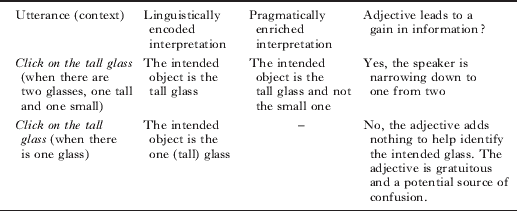
To summarize the above review, there is a gap in the developmental literature related to contrastive inference. Until now, studies on contrastive inference have focused on infelicitous cases. They have not shown how the presence of the adjectival modification is a cue to seek out new enriching information and to determine what sorts of information become available through pragmatic processing (see Table 1). Gaining access to pragmatic information, which we presume is effortful and optional, has not been isolated, leading to incomplete accounts of contrastive inference.
A summary of when and how an adjectival modifier in a referential statement leads to an enriched interpretation

The main goal of the present study therefore is to investigate the ability of drawing contrastive inferences in a task where both linguistically encoded and pragmatic readings are viable and without recourse to questions about felicity. Our aim here is to determine the extent to which hearers exploit the presence of an adjective in a situation where the gain in information is inferentially available (and useful) and where effort (through developmental trajectories) is detectable. This new situation would need to maintain the constraints observed in the prior developmental studies, but in which both readings are feasible. We also do not assume that there should be differences among adjective types. At their most basic, test sentences containing any adjectival modification, even of the color type ‘the brown rabbit’ (and where the adjective is post-nominal, as in the le lapin marron in French), ought to encourage listeners to consider that there are other rabbits in the speaker's purview.
In this investigation, all sentences are felicitous. In the game we developed, a participant follows an exchange between two interlocutors while the two are looking specifically at a pair of cards drawn from an upturned collection of (three or) four cards. When one interlocutor says to another Show me the brown rabbit, the participant – who knows the identity of all the cards – is in a position to determine that the speaker's use of brown implies that the pair of cards (at which both the speaker and listener are looking) represent the two rabbits in the collection. Questions to the participant are designed to determine whether she can guess the identity of the second card. The presence of the adjective ought to be a strong indication that there is indeed another rabbit in the speaker's hand.
We describe the task in greater detail below. For now, we point out that Experiment 1 tested ten-year-olds and adults, and that Experiments 2 and 3 tested seven-year-olds, ten-year-olds, and adults. The evolution of the experiments reflects adjustments made to the task over the course of the investigation with the aim of replicating our original developmental finding in Experiment 1 while making the participant's task even clearer and thus simpler in subsequent Experiments. Each experiment aimed to characterize a possible developmental trend and to determine whether adults reach ceiling. Throughout, we ask the following two main questions: Would the youngest participants reveal a pragmatic competence by responding in a way that defies predictions based on chance? To what extent do adults pragmatically enrich sentences when there is an adjectival modifier in the sentence? Note, too, we also investigate whether cases with no modifying adjective encourage participants to infer a lack of contrast.
EXPERIMENT 1
The experimental setting included the Speaker (the Experimenter), an Addressee-confederate (who simply listened and demonstrably complied with the Speaker's requests), and the Participant. Each experimental trial began with the Speaker placing two identical sets of four cards – depicting conventional objects or animals – in front of herself and the Participant. The Speaker's cards were face down so that nobody could see the objects depicted in that set. The Participant's cards were turned upright but placed in front of the Participant (as will become clear, this feature of the task was modified in the latter experiments so that the cards were visible only to her; see Figure 1). Much like Sedivy, Tanenhaus, Chambers, and Carlson's (Reference Sedivy, Tanenhaus, Chambers and Carlson1999) seminal paradigm, each experimental set contained a target object (e.g., a brown rabbit), a contrast object (e.g., a white rabbit), and two unrelated objects (e.g., a cat and a goat). The Experimenter selected two cards from her set in an apparently random fashion and then showed them to the Addressee. At this point (while looking at the two chosen cards), the Speaker asked the Addressee-confederate to point to one of the cards through a referring expression. Crucially, the referring expression in the Experimental condition included an adjective that modified the noun (e.g. ‘Show me the brown rabbit’ [Montre-moi le lapin marron]). This is the modified condition. Another Experimental condition contained no modification (e.g. ‘Show me the rabbit’' [Montre-moi le lapin]). This is the non-modified condition. Once the Addressee unambiguously pointed to the named cards, the Experimenter then placed that card on the table in front of the Participant. At this point, the Speaker was in the position to ask the Participant what was the other card (among the three remaining) that the Speaker was holding.
Fig. 1.

If a participant were to exploit the presence of the adjective in the Speaker's choice of words (e.g., hearing ‘the brown rabbit’) and to compute a contrastive inference, she should select the Contrast object (i.e., the white rabbit). Following the same line of reasoning, if a participant were to exploit the lack of adjective (e.g., hearing ‘the rabbit’), she should choose one of the unrelated cards at random as their best guess for the second card; i.e., they should avoid the Contrast object (the white rabbit) as the Speaker's other card. In this case, the Speaker could have disambiguated, but did not. Note that the Speaker can be assumed to be optimal throughout and that utterances can be readily interpreted with enrichment or without. By putting the participant in a position to surmise what the interlocutors are seeing, while viewing candidate options herself, the Participant is in the position to determine the contents of the two cards.
METHOD
Participants
Forty French native speakers (twenty children and twenty adults) participated voluntarily in the experiment. Children were ten years old (M=10;5, range 10;1 to 11;0) and were all students in the same fifth-grade class (Cours Moyen 2ème année in the French system) in a local primary school in Lyon, France. The adult participants were university students between eighteen and twenty-nine years old (M=22;1) at a local university in Lyon.
Design
The experiment had a 2×2 mixed factorial design. Two age groups were distinguished: Children and Adults. The variable Adjectival Modification was administered within-subjects and refers to whether the utterance contained an adjectival modification (Modified condition) or not (Non-Modified condition).
Materials
A total of nineteen sets of cards were created; eight of which were for two experimental conditions (four sets for each of two conditions). The other sets were designed to be fillers (8) or for training purposes (3). Each set consisted of four cards, with each card depicting a familiar object. One category of objects was represented per set (see the ‘Appendix’ for a list of experimental and filler items). For the eight experimental trials, the Target object and the Contrast object belonged to the same subordinate category (e.g., rabbits), and as such could be referred to by the same noun, e.g., the brown rabbit and the white rabbit; the two other unrelated objects belonged to one of two different subcategories from the same general category (mammals), e.g., a cat and a goat. Two utterances for each experimental trial were created, one with an adjectival modification used in the Modified condition (‘Show me the brown rabbit’) and one with a bare noun (‘Show me the rabbit’), used in the Non-Modified condition. Even though the Target object could be either one of two objects (e.g., one of the two rabbits) in the Non-Modified condition, the Target object was, in fact, the same one used in the Modified condition. This way, when we measure the percentage of contrast object choices as a dependent measure in the two conditions, we are referring to the same object throughout. Note that we include prenominal and postnominal modifiers (French allows for both, with postnominal adjectives being much more common). Five experimental items contained a postnominal adjective and three contained prenominal adjectives (see ‘Appendix’). Given that this is not an on-line study, we do not consider this variable relevant. Finally, there were four classes of adjectives: color, size, new–old, and open–closed. Each class was represented by two items (see ‘Appendix’).
The filler trials were of two types. One type included four sets that resembled those in the experimental trials and which contained a contrast set (e.g., a blue robot and a red robot) and two unrelated objects (a teddy bear [nounours in French] and a puppet). The Experimenter's utterance asked the Addressee to point to, say, the puppet. At this point, the Participant's task was to (genuinely) guess what was on the other card. The utterance was not designed to refer to either of the contrasted objects. We will refer to these as genuine-guesses. The cards for the other four filler trials contained no contrasts. Although all the objects were ‘unrelated’, they were representatives of the same category (e.g., consider a tomato, a squash, an onion, and a lettuce). In this condition, the Experimenter would ultimately ask for two objects. In this type of filler, there was no guess to make, which is why we call these easy-identifications. These were designed to make sure that all named objects were identifiable and to provide situations that require minimal effort in the context of the invented game. Overall, we generated two lists so that, whilst all sixteen sets were used for each Participant, the sets containing contrasts in the Modified and Non-Modified conditions could be used, in a balanced fashion, for either condition.
Three training trials were prepared, which consisted of four cards with no contrasting objects. In two of these trials, the exchange was similar to the easy-identification situation. The third training trial resembled one of the genuine-guess trials, the sole difference being that one of the options included a colorful object (a monkey) in order to make one choice more salient.
Procedure
Participants were tested individually in a session that lasted approximately 20 minutes. Children participants were tested in the library of their school. The experimental session took place during normal class time, which they left momentarily, one at a time, to participate in the experiment. After the session was completed, the child returned to the class. Adult participants were tested at the library of a local university.
All trials began with the presentation of an envelope with two sets of four cards. One set was exposed on the table in front of the Participant and another in front of the Speaker. The Participant was shown that the two sets were identical. The Speaker then turned the cards from her set over and mixed them up. The four cards in front of the Participant remained exposed as a reminder of the four cards that the Speaker was using. Once shuffled, the Speaker placed the four cards face down and then took out two apparently at random (in fact, the cards had secretly coded marks on them).
All trials concerned getting information about one card. The Speaker stated her referential utterances to the Addressee in an even tone of voice, without undue emphasis on the modifying adjectives. In the Modified condition, the Participant heard, e.g., ‘Show me the brown rabbit’, which is henceforth the Target object (see Figure 1a), and in the Non-Modified condition Participants heard, e.g., ‘Show me the rabbit’. At this point, the Addressee pointed to the card in the Speaker's hand (see Figure 1b). The Speaker then removed that card from her hand and showed it to the Participant before putting it on the table (see Figure 1c). Then, the question at the heart of the manipulation arose: ‘In your opinion, what is the other card?’ (as can be seen in Figure 1d). Importantly, after each of these prompts, the Speaker did not show whether the Participant was correct. As far as the participant was concerned, the Speaker was always cooperative. The Speaker noted the Participant's response.
The situation surrounding the genuine-guesses was similar to the two Experimental conditions except that the Speaker's utterance referred to an unrelated object (e.g., ‘Show me the puppet’). Again, the Participant is asked the same question after being shown the Target object: ‘In your opinion what is the other card?’ Finally, the situation in the easy-identification condition was also similar to the other three in that the Speaker had the Addressee first point to one of the four unrelated objects (e.g., ‘Show me the tomato’). After the Addressee pointed to the Target object, the Speaker made a second request about the second card: ‘Show me the lettuce.’ At this point, the Speaker asked the same question: ‘In your opinion, what is the other card?’
The experiment started with the Speaker introducing the rules of the game and the specific roles and tasks for each member of the triad. This was followed with the three training trials. After these, the eight experimental and eight filler trials were administered in a random order.
Statistical analysis
Statistical analyses performed over the selection data are an implementation of a linear mixed-effects logistic regression. In a mixed-effect regression the dependent variable is modeled as a function of fixed effects and random effects. The fixed effects correspond to the independent variables of the experimental design, in this case Age group (Adults and ten-year-olds) and Modification (presence or absence of adjectival modification of the noun). The random effects correspond to the subjects sampled from the population and to the items used and also sampled from the population of possible items. Data were analyzed treating participants and items as crossed random factors (Bates, Reference Bates2005). The regression is logistic because our dependent data are categorical (Barr, Reference Barr2008; Jaeger, Reference Jaeger2008). We used a model-comparison approach to test the significance of each effect. With this approach, the statistical significance of a given parameter (effect) is tested by comparing the difference in fit of two models, the full-model (containing all parameters) and the restricted-model from which the parameter being tested is removed. The distribution used to test the difference in model fitting is chi-square. Data were analyzed using the R package lme4. Finally, effect sizes (ES) for the planned comparisons are provided as the absolute value of the difference between group means in log-odds.
RESULTS
Participants in both groups performed at ceiling in the two Easy-identification training trials. That is, all participants across groups (100%) selected the objects referred to by the Experimenter. The third guessing trial was carried out with no difficulty either. The guesses in the Genuine-Guess filler condition were similar for children and adults (47·5% of the children guessed that the other card was among the contrasted objects and 45% among the adults did). Together, these results show that participants in both age groups understood the game similarly.
As can be seen in Figure 2, adults select the Contrast object 77·5% of the time in the Modification condition. This selection rate is significantly higher than the one for ten-year-olds, who select the Contrast object at a rate of 53·8% in this condition (χ 2(1)=5·69, p <·05, ES=1·08). When the noun is not modified, the Contrast object selection rate among adults is 17·5% (i.e., they ‘correctly’ select one of the two unrelated objects 82·5% of the time). This figure in the Non-Modified condition is significantly lower for adult participants than for ten-year-olds, who selected the Contrast object 42·5% of the time (χ 2(1)=7·34, p <·01, ES=1·25 ). As these figures indicate, there is a reliable interaction between Age group and Modification (χ 2(1)=23·26, p <·001). Taken together, what we will call the contrast object gap (the percentage difference between Modified and Non-Modified conditions) is 60% for Adults and 11·3% for the ten-year-olds.
Mean of Contrast object Selection Proportion per condition and age group in Experiment 1. Error bars represent the standard error.

Given that everyone sees the Mentioned object (e.g., the brown rabbit in the Modified condition), the probability of choosing the Contrast object by chance among the remaining objects is 33%. When we submit each group probability to a one-sample t-test, we find that Adults select the Contrast object in the Modified condition at rates that defy predictions based on chance (t(19)=8·22, p <·001). In the Non-Modified condition, the probability of choosing the Contrast object by chance is also 33%, and adults select it at rates that are below chance levels (t(19)=–2·36, p <·05). Children, in contrast, select the Contrast object at rates that are above chance levels in the Modified condition (t(19)=2·54, p <·05), but at rates that are comparable to chance in the Non-Modified condition (t(19)=1·20, p=·246).
Figure 3 summarizes individual performance. The proportion of Contrast object selection is depicted for the Non-Modified condition on the x-axis and for the Modified condition on the y-axis. The digits on the plot represent the number of participants that provide each specific combination of Contrast object selection rate across the two Experimental conditions. The upper left corner of the graph thus represents those who are optimally pragmatic. These participants consistently infer a contrast when the noun is modified and consistently avoid doing so when it is not. The diagonal and its proximities represent the zone in which participants do not distinguish between a modified and unmodified noun, and thus select the Contrast object equally across conditions. It can be observed that eight adults fall into this ‘optimally pragmatic corner’, whereas none of the children do. Interestingly, children's tendency to select the Contrast object, independently of the linguistic input, can be observed as one looks toward the upper right corner of the right panel. There are three children who select the Contrast object in all experimental trials.
Fig. 3.

DISCUSSION
Our results show that children are not as reliable as adults in drawing a contrastive inference. When an adjective is added to a noun phrase, adult participants generally infer the presence of another object having the same noun in the speaker's referential domain. Even though the children select the Contrast object at rates above chance levels when the noun was modified, they do so to a lesser extent than adults. Moreover, adults infer the absence of the Contrast object in the referential domain when the noun was not modified more reliably than the children, who are at chance levels.
Although these results are quite clear, we remain concerned that the paradigm is not tapping completely into participants' pragmatic abilities. Part of this concern lies with the fact that adult participants are not at ceiling with the adjectival modification cases. One potential account for the adults' performance (as well as the children's) could be related to participants' beliefs about what the speaker considered to be the relevant referential domain. Since the speaker and addressee see all four cards before selecting the two cards that take part in the speaker's instruction, it is possible that the adjectival modification is understood to address, not the two cards selected but, all four cards that are apparent to everyone. If all four cards are considered when the speaker says ‘Show me the brown rabbit’, it is possible that the insertion of the modifier is useless to the addressee and that participants' responses reflect that. With that potential critique in mind, we modified the paradigm slightly in Experiment 2 so that it is eminently clear for a participant that only she is aware of all four cards and that the interlocutors are aware of the identity of only the two cards under discussion.
EXPERIMENT 2
Experiment 2 had three objectives. First, we aimed to replicate the main findings of Experiment 1. Second, we addressed our concern about the design of Experiment 1 described above. Thus, the procedure in Experiment 2 made it clear to the Participant that only she knows the identity of all four cards while also making it clear that the Speaker and the Addressee were dealing with two drawn at random. Third, and partly in the light of the above adjustment which we assumed will improve performance on the task, we included seven-year-olds in order to determine whether there are developmental differences to be mined among younger children.
METHOD
Participants
Sixty participants were tested: 20 seven-year-olds (M=7;3, range 6;8 to 8;2), 20 ten-year-olds (M=10;9, range 10;3 to 11;3), and 20 adults (M=23;8, range 19;9 to 28;4). Children were students of a public primary school at Lyon, France. All seven-year-olds attended the same class (Cours Elémentaire 1ère année) as did the ten-year-olds (Cours Moyen 2ème année). Adult participants were university students at a local university in Lyon.
Procedure
The general experimental procedure was similar to that of Experiment 1, except for one change in the game. In this new version, all eight cards were given to the Participant in an envelope. The Participant was asked to put one set of cards in front of her on a small display stand (resembling an enlarged Scrabble tiles holder) and the other four on the table face down (much as in Experiment 1). The Speaker then mixed the cards on the table before picking out two cards seemingly at random. To all appearances, the participant was the only one to know the contents of the entire set of cards while the speaker and listener only knew the two cards that were randomly selected by the speaker. Besides this change in the game's procedure, the rest of the interaction proceeded as Experiment 1.
RESULTS
As in Experiment 1, performance on the training trials showed that the participants understood their task. As far as the non-Experimental trials are concerned, all participants in the three age groups selected the mentioned objects in the Easy-Identification trials 100% of the time. Choices in the Genuine-Guess items were similar for children and adults (51·2% of the seven-year-olds, 43·7% of the ten-year-olds, and 55% of the adults chose one of the items that is contrasted).
The results in the Experimental conditions reveal that there is general progression toward suitably exploiting the presence of the modifier to choose the Contrast object and suitably exploiting the absence of the modifier to choose a non-contrasting object (see Figure 4). In the Modified Condition, the seven-year-olds, ten-year-olds, and the Adults chose the Contrast object at rates of 35·0%, 62·5%, and 78·8%, respectively. Adults select the Contrast object reliably more than the ten-year-olds (χ 2(1)=3·89, p <·05, ES=·78), and the ten-year-olds select the Contrast object reliably more often than the seven-year-olds (χ 2(1)=9·13, p <·01, ES=1·13). In the Non-Modified condition, the seven-year-olds, ten-year-olds, and the Adults chose the Contrast object at rates of 30·0%, 30·0%, and 11·3%, respectively. As can be seen, the decrease in the Contrast object selection rate is not constant across age. Adult participants' rates are reliably lower than those of the ten-year-olds (χ 2(1)=7·08, p <·01, ES=1·22), but the ten-year-olds do not differ from the seven-year-olds (χ 2(1)=0·00, p=·981, ES=0). Therefore, we find an interaction between Age Group and Modification (χ 2(2)=38·65, p <·001). The contrast object gap is 5%, 32·5%, and 67·5% for seven-year-olds, ten-year-olds, and Adults, respectively.
Mean of Contrast object Selection Proportion per condition and age group in Experiment 2.

Much as in Experiment 1, the Contrast object selection rate in the Modified Condition was above chance levels among Adults (t(19)=7·87, p<·001) and ten-year-olds (t(19)=4·43, p <·001). In the Non-Modified condition, only adults were below levels predicted by chance, (t(19)=4·72, p <·001), while the ten-year-olds' performance was comparable to chance (t(19)=–0·51, p=·617). For the seven-year-old group, Contrast Selection rates were at chance levels for both the Modified condition (t(19)=0·31, p=·758) and the Non-Modified condition (t(19)=–0·45, p=·659). Analyses of individual performance – shown in Figure 5 – reveal that none of the seven-year-olds participants and only one of ten-year-olds is optimally pragmatic. In contrast, seven adults are.
Fig. 5.

DISCUSSION
The aim of Experiment 2 was identical to that of Experiment 1. However, we made a modification that was designed to better guarantee that the participants understood that the two cards viewed by the Speaker and the Addressee were the only two that the Participant should consider. This way a modifier or a lack of one will be clearly referring to one card and the three remaining cards are just options for identifying the second card. As in Experiment 1, the adults perform in the intended way most often and the ten-year-olds are less adult-like. Interestingly, the ten-year-olds here are slightly more successful than those in the previous experiment. We also included seven-year-olds and found their performance to be at chance levels throughout, making them less successful than the ten-year-olds.
The results largely replicate those of Experiment 1. The general pattern uncovered in Experiment 1 remains with Adults defying chance predictions in both conditions and the ten-year-olds doing so in the Modified condition only. The developmental progression remains and it extends downward to seven-year-olds. Nevertheless, there is some justification in arguing that the adjustments made encourage success on the task among the ten-year-olds, particularly in choosing the non-contrasting card. The Contrast object gap (the percentage difference between Modified and Non-Modified conditions), especially for the ten-year-olds, grows considerably across the two Experiments (from 11·3% to 32·5%), indicating that the change made had a salutatory effect. Nevertheless, these adjustments do not create adult-like performance among the ten-year-olds. Interestingly, the modification made here does not dramatically increase Adults' rates of Contrast object selection either, even though there remained room for improvement.
EXPERIMENT 3
Experiment 3 had two objectives that went above and beyond Experiment 2. Besides wanting to replicate the main findings of Experiment 1 again, we aimed to address a second concern about the design of Experiments 1 and 2: the number of available options. Having three options can negatively (or positively) affect preference choices (see Simonson & Tversky, Reference Simonson and Tversky1992) and, after the outcomes of Experiments 1 and 2, we considered that having two unrelated objects instead of one in sets containing contrasts (thus prompting participants to randomly choose one unrelated or the other in the Non-Modified condition) could end up being distracting. Thus, the procedure in Experiment 3 used the same clarifying procedure as Experiment 2, but also reduced the number of options for the second card to two in all experimental conditions. In the Non-Modified condition, there was just one unrelated card to choose as an option, which amounts to less noise. As in Experiment 2, we included seven-year-olds.
METHOD
Participants
Sixty participants were tested: 20 seven-year-olds (M=7;8, range 7;5 to 8;1), 20 ten-year-olds (M=10;9, range 9;8 to 11;3), and 20 adults (M=24;3, range 19;10 to 30;11). Children were students of a public primary school in Lyon, France. All children attended the same class (seven-year-olds are in Cours Elémentaire 1ère année and ten-year-olds are in Cours Moyen 2ème année). Adult participants were university students at a local university in Lyon.
Procedure
The experimental procedure is similar to that of Experiment 2. The only difference is that there are two sets of three cards in each envelope. No other changes were made.
RESULTS
As in the prior Experiments, training presented no challenges. As for the Control trials, all participants in the three age groups selected the mentioned objects in the Easy-Identification trials 100% of the time, indicating that they understood the game. Participants' choices in the Genuine-Guess fillers are irrelevant here since all choices were one of the contrasted objects.
In the Modified condition, we find that 50% of the seven-year-olds, 72·5% of the ten-year-olds, and 81·3% of the Adults selected the Contrast object, revealing a monotonic increase (see Figure 6). Although the ten-year-olds in this Experiment select the Contrast Object at rates that are comparable to the Adults (χ 2(1)=0·77, p=·370, ES=·50), the ten-year-olds select the Contrast object reliably more often than the seven-year-olds (χ 2(1)=5·633, p <·05, ES=·97). In the Non-Modified condition, there is a steady decrease in the selection of the Contrast object in this condition across age groups as seven-year-olds, ten-year-olds, and Adults chose the Contrast Object at rates of 41·3%, 30%, and 8·8%, respectively. Adult participants selected the Contrast object in this condition at a rate that is reliably lower than for the ten-year-olds (χ 2(1)=7·19, p <·01, ES=1·50). The ten-year-olds did not differ from the seven-year-olds (χ 2(1)=1·49, p=·222, ES=·49). Taken together, the Contrast object gap (the percentage difference between the two conditions) is 72·5% for Adults, 42·5% for the ten-year-olds, and 8·7% for the seven-year-olds. Confirming this summary, there is an interaction between Age Group and Modification (χ 2(2)=45·09, p <·001).
Mean of Contrast object Selection Proportion per condition and age group in Experiment 3.

Much as in the Modified condition of Experiments 1 and 2, Adults select the Contrast object at rates that are above chance levels (which is now·5) (t(19)=5·00, p <·001). As in Experiment 2, the ten-year-olds' selection rate for the Contrast object in the Modified condition is also above chance levels (t(19)=3·94, p <·001). In contrast, the Contrast Selection rates in the Modified condition for the seven-year-old group remains at chance levels (t(15)=0·0, p=·1).
As in the Non-Modified condition of Experiments 1 and 2, Adults are below levels predicted by chance (t(19)=–12·57, p <·001) and, much as in Experiment 2, the seven-year-olds' performance is comparable to chance (t(19)=–1·32, p=·201). However, unlike in the prior experiments, the ten-year-olds this time defy chance predictions in the Non-Modified condition (t(19)=–2·43, p <·05). Analyses of individual performance – shown in Figure 7 – reveal that none of the seven-year-olds and two of ten-year-olds are optimally pragmatic. In contrast, eleven adults are.
Fig. 7.

DISCUSSION
The results largely replicate those of Experiments 1 and 2, with Adults defying chance predictions throughout and with the seven-year-olds performing at chance levels throughout. The ten-year-olds, however, approach adult levels of competence in the Modified condition but not in the Non-Modified condition. The adjustment made to the task – to remove one of the unrelated cards from the set of options – appears to encourage pragmatically valid choice selection among the ten-year-olds; however, once again, the changes do not create thorough adult-like performance.
Interestingly, the adjustment made to the task does not dramatically increase Contrast object selections for the youngest and oldest participants (when compared to results from the prior experiments). Among adults, rates of Contrast Object selection in the Modified condition continue to hover at around 80% and in the Non-Modified condition at around 10%, even though the probability of choosing the pragmatically justified card increases dramatically. The Contrast object gap remains low for the ten-year-olds when compared to the Adults and any resemblance to the adults is due mostly to their responses in the Modified condition. The phenomena reported in the prior Experiments appear robust.
GENERAL DISCUSSION
The goal of this paper has been to investigate the extent to which an adjectival modification prompts a contrastive inference in a context where a participant is in the position to provide a response that is based either on (a) the linguistically encoded reading of the utterance, which simply denotes that a single, named entity was chosen by a listener, or on (b) a pragmatically enriched reading that is informationally richer (by implicitly distinguishing the named object from another similarly named referent). We argued that this would represent progress for investigations of contrastive inference because it does not rely on the detection of infelicitous cases and it would bring the work on contrastive inference in line with prior studies of other similar pragmatic phenomena, viz. scalars. Overall, we approached this investigation with the expectation that the distinction between the two readings would be discernable among school-aged children.
The exchange participants witness in the experimental setting is akin to one in which a colleague asks her co-worker to ‘bring the gray stapler from my office’ (see Birner & Ward, Reference Birner and Ward1994). The listener is not asked to do anything Herculean, even if he has never seen the (gray) stapler in question. The same holds for a child who hears such an exchange (and who is, by analogy to our task, in view of the sought item). The child is not required to detect infelicity through a metalinguistic judgment nor is she required to produce an utterance with a contrast. She simply has to see what else of informational value can be derived in a game that asks the participant to seek some out. The task incorporates features from previous studies. Being directly inspired by visual search tasks, the experimental items always feature a contrasting pair (Nadig & Sedivy, Reference Nadig and Sedivy2002) and, by creating a game situation, it clearly has links to previous work as well (Brédart, Reference Brédart1984; Ironsmith & Whitehurst, Reference Ironsmith and Whitehurst1978). Unlike the previous developmental tasks, however, we do not measure pragmatic sophistication based on detecting infelicity (e.g., ambiguity) in a speaker's utterance, nor do we compel participants to make metalinguistic judgments (e.g., Davies & Katsos, Reference Davies and Katsos2010; Ironsmith & Whitehurst, Reference Ironsmith and Whitehurst1978). The context created here is such that the participant is presented with utterances that can be interpreted in two different ways (either literally or as enriched). This is a subtle but important development for the literature.
In order to isolate the effort required to carry out contrastive inference-making, we investigated children and adults based on the common assumption that children have fewer resources than adults for carrying out pragmatic inferences (see Noveck, Reference Noveck2001; Pouscoulous et al., Reference Pouscoulous, Noveck, Politzer and Bastide2007). We investigated seven-year-olds (Experiments 2 and 3), ten-year-olds (Experiments 1–3), and adults (Experiments 1–3). Changes made to the task in Experiments 2 and 3 were designed to make access to contrastive inference more likely. Thus, in Experiment 2, we made it clearer to the participant that the cards in the Speaker's hand were the only two that the interlocutors saw and that only the participant had visually access to all four cards. In Experiment 3, we further simplified the task by removing one of the unrelated cards. Note that children younger than seven have been shown to be able to detect felicity of similar reference situations (Davies & Katsos, 2012), so if contrastive inference were to be considered as equivalent to detecting felicity, even seven-year-olds (who were introduced to the task in the latter two, more accessible Experiments) should be able to perform at above chance levels on these user-friendly tasks.
It is not terribly surprising to report that our results show that there is a developmental trend in the ability to draw a contrastive inference. What is surprising is that seven-year-olds' performance is at chance, even on the final version of the task that was designed to simplify access to the inference. Arguably, this shows that claims based on judgments of felicity at even younger ages do not necessarily translate into competence in drawing contrastive inference. On the older end, adults' above-chance performance indicates that they can profit from the presence of an adjectival modifier to surmise that there is a contrasting object in the speaker's purview; however, they remain far from ceiling across all experiments. Despite efforts to simplify the task across the three experiments, roughly 20% of adults remain at, or near, chance performance in the Modified condition. That is, the presence of the adjectival modification does not automatically prompt adults to look for contrasts of the mentioned noun, even when the only other possible alternative is evident in this optimally friendly task.
The ten-year-olds are intermediate performers in that their contrastive inference performance consistently defies predictions based on chance in the Modified condition. They are also the closest to being a bellwether of the adjustments made to the task. Their rate of Contrast object selections climbs by roughly 9% with each adjustment (with the caveat being that the likelihood of choosing the Contrast object in Experiment 3 increases anyway by virtue of the fact that there a fewer alternatives to choose from). One can see that the task appears to be a valid measure of contrastive inference performance because (a) the developmental pattern remains robust across the three experiments, and (b) the adjustments make only slight headway in transforming the developmental trends.
It should be noted that adjective types had no effect on the way they were interpreted. Neither the position of the adjective (pre- versus postnominal) nor their classes (color, size, old–new, open–closed) played a role (see Table 2). The nature of the task (an off-line comprehension task embedded in a game) can partly explain this since participants were asked to answer without any constraint of time. Therefore, it is conceivable that they could fully consider the whole expression before their answer was noted. Although previous results in the sentence-processing literature (e.g., Sedivy et al., Reference Sedivy, Tanenhaus, Chambers and Carlson1999) suggested that the preference for contrastive interpretation could depend on the type of adjective used (color adjectives, for instance, do not seem to trigger strong preferences for contrastive interpretations), no such effect was observed in our experiment.
Contrast Object Mean Selection Proportion by adjective position (prenominal or postnominal) and by adjective class

Another novel feature of the task is that it can be used to determine whether participants exploit the absence of a modifier as an indication to avoid choosing the Contrast Object (i.e., in the Non-Modified condition). This is arguably a harder task and for two reasons. One is that the inference relies on rendering an utterance informative based on noticing an absence. Making inferences from non-mentioned information is renowned for being harder than the affirmative cases (e.g., see base-rate neglect in Kahneman & Tversky's research program; Kahneman & Tversky, Reference Kahneman and Tversky1973; Tversky & Kahneman, Reference Tversky, Kahneman, Kahneman, Slovic and Tversky1982). The other is that the utterance remains temporarily ambiguous when a participant says, e.g., ‘Show me the cat’ when there are in fact two possible candidates for it (of which only one is in the speaker's hand). In the Non-Modified condition, then, the participant might be tempted to see which cat is the designated object rather than note the utterance's informational value. This amounts to a distraction which could interrupt pragmatic inference-making (see De Nys & Schaeken, Reference De Neys and Schaeken2007, for effects of dual tasks on scalar inference-making). One can see that the Non-Modified condition prompts high rates of ‘correct’ performance among adults that is comparable to performance in the Modified condition. Whereas roughly 20% of adults fail to choose the contrast item in the Modified Conditions across the three Experiments, roughly 12% in the Non-Modified conditions do choose the contrasting item (which is, for lack of a better term, ‘incorrect’). One can see, however, that the ten-year-olds' performance in the Non-Modified condition is consistently weaker when compared to the Modified condition. For example, the ten-year-olds' performance does not defy predictions based on chance in the Non-Modified condition in Experiments 1 and 2, whereas they do defy predictions based on chance in the Modified condition across all three experiments.
It could be argued that adults' non-optimal performance is due to specific features of the task. Here, we consider three criticisms of the paradigm that we have heard in presenting this work orally as well as our reactions to each of them. The first is that adult production studies show that noun phrases often – around one-third of the time – include gratuitous modifiers (Engelhardt, Bailey & Ferreira, Reference Engelhardt, Bailey and Ferreira2006; Sedivy, Reference Sedivy2003). That is, our critique about infelicity in the prior studies is negated by the fact that people produce gratuitous modifiers at least part of the time. Our response is that in many cases, noun modifications do not necessarily need to be understood in a contrastive way to be relevant (this is consistent with our claim that pragmatic enrichments are not always attached to adjectival modifiers and that their linguistically encoded meanings can be the basis of readings). In any case, it strikes us that an experimental task that investigates contrastive inference ought to use contrasts judiciously. Without that the import of the contrasting information is weakened. Besides, the use of gratuitous modifiers would only weaken the likelihood that participants would take information-gaining steps when they come across one. Our task encourages subjects to be sensitive to the contrastive function of the adjective. Despite that, we do not get ceiling performance even among adults.
A second potential account for performance (and especially adult performance) in the Modified conditions could be that the speaker uses neutral prosody throughout. We avoided prosodic stress generally in order to minimize variability across trials. More importantly, we neutralized prosody because its presence would introduce a confound. That is, the Non-Modified condition would have not only the absence of the adjective, but no comparable prosodic stress. In any case, data from prior work have shown that prosodic stress has no effect or minimal effects in referential tasks; it appears that it is the adjectival modifier itself that plays a dominating role in creating contrasts and that prosody adds little or nothing to such a task (Sedivy et al., Reference Sedivy, Tanenhaus, Chambers and Carlson1999, Experiment 2). In general, lexical factors appear to dominate over prosodic ones (see Moore, Harris & Patriquin, Reference Moore, Harris and Patriquin1993). That said, it remains to be seen how prosodic stress would affect performance. We would anticipate that prosodic stress would modulate performance at any given age but that it would not affect the reported developmental trajectory.
A third potential criticism is that the task requires participants to be engaged overhearers who are making judgments in the light of a witnessed exchange. In that respect, the task has avoided being metalinguistic but it is inviting metarepresentations because the Participant is required to draw out a pragmatic interpretation based on what the Addressee is thought to have seen; this might dampen participants' interpretational processes and perhaps the likelihood of drawing a contrastive inference. Our response is that the introduction of representations of others' perspective was essential for creating felicity throughout. Indeed, the Addressee – and the Participant – need to take the speaker's perspective into account in order to explain the presence of the adjective in the utterance by way of its contrastive function. While this feature might actually explain why the youngest participants here appear less likely than adults to carry out these pragmatic inferences, it is nevertheless difficult to explain why a seven-year-old would be at chance levels. For adults, the amount of metarepresentation for this task should be trivial and they are not at ceiling despite efforts to make the task simpler across the investigation. Further explorations could clarify the extent to which representing others' knowledge is in play here.
In a nutshell, this work brings investigations of contrastive inference into line with those of other similar pragmatic phenomena, namely on scalar inferences (see Noveck & Reboul, Reference Noveck and Reboul2008). By creating a task where either of two readings is viable, participants' choices reveal the extent to which pragmatic interpretations naturally occur and how they develop, much as in the scalar inference literature. Critically, as been shown for scalars, the current work argues that contrastive inferences cannot be viewed as presupposed background information for either children or adults.
It is common practice in the developmental literature to get children to demonstrate some competence of some ability at younger and younger ages (see Pouscoulous et al., Reference Pouscoulous, Noveck, Politzer and Bastide2007; Southgate, Chevallier & Csibra, Reference Southgate, Chevallier and Csibra2010). This is useful, especially when declarations are made along the lines of ‘Children need to be (insert age) before they start doing (some adult-like ability)’. In the case of pragmatic processing, we are not aware of people making those sorts of claims. Nevertheless, efforts are often made to show how strong children are at something. In the case of contrastive inference-making, it has focused on infelicity detection. While it is worthwhile knowing that children can be shown to be strong at detecting infelicity at young ages, such a quest does not really address pragmatic development of contrastive inference per se. Such investigations also leave the impression that children are adult-like when they are not.
Viewed through a pragmatic lens, the findings presented here are consistent with a corpus of studies showing that pragmatic inferencing can be captured developmentally, while underlining that it requires some amount of effort even though it might appear relatively easy computationally to adult intuitions. In line with other work on linguistic–pragmatic phenomena such as scalars (Guasti et al., Reference Guasti, Chierchia, Crain, Foppolo, Gualmini and Meroni2005; Noveck, Reference Noveck2001; Pouscoulous et al., Reference Pouscoulous, Noveck, Politzer and Bastide2007), idioms (Levaroto, Nesi & Cacciari, Reference Levaroto, Nesi and Cacciari2004), metaphoric reference resolution (Noveck, Bianco & Castry, Reference Noveck, Bianco and Castry2001), and irony (Keenan & Quigley, Reference Keenan and Quigley1999; Pexman & Glenwright, Reference Pexman and Glenwright2007), the present findings on reference show that processing utterances in order to access a speaker's meaning evolves throughout childhood. It also recalibrates the lowest ages at which children can be said to be adult-like. It is difficult to argue from data such as these that contrastive inferences are easy to exploit even in highly felicitous situations.
Appendix
Full list of items.