




No CrossRef data available.
The Political Economy of IMF Lending in Africa
Published online by Cambridge University Press: 01 November 2004
Abstract
Why has IMF lending achieved such poor results in Africa? Is it because the Fund imposes the wrong conditions, or because it fails to enforce them? Analysis of monthly data on 53 African countries from 1990 to 2000 shows that the IMF's loans-for-reform contract lacks credibility because donor countries intervene to prevent rigorous enforcement. Countries that have influence with developed-country patrons—as measured by U.S. foreign aid, membership in postcolonial international institutions, and voting profiles in the UN—are subject to less rigorous enforcement (shorter program suspensions). They have more frequent program suspensions, because they violate their conditions more often. The IMF will have to become more independent in order to become an effective champion of reform.
Information
- Type
- ARTICLES
- Information
- Copyright
- © 2004 by the American Political Science Association
Africa has been on the front lines of International Monetary Fund (IMF) policy-based lending for 30 years, yet it has not made substantial progress in achieving economic growth or in implementing the policies that the IMF encourages. Twenty-eight African countries had per capita GDP under $1 per day in the 1990s, and only 15 reached levels above $3 per day in 1995 dollars. Fourteen African countries had higher real per capita GDP in 1980 than in 2000. Meanwhile, during those two decades foreign debt rose from half the GDP to 1.2 times the GDP, and the average African country's dependence on development assistance increased, surpassing 10% of the GDP. Since 1990, 35 African countries have spent a total of 205.5 years in IMF programs, participating on average 45% of the time. Africa has become paradigmatic for critics from both sides of the political spectrum who argue that IMF programs are harmful rather than beneficial (Easterly 2001; Stiglitz 2002).
Why do IMF programs rarely achieve their goals? Prior research suggests several possible answers. Vreeland finds that participating in IMF programs reduces growth and redistributes income away from the poor, and he concludes that the conditions are to blame. In fact, he argues, governments participate in IMF programs in order to shift the distribution of income to benefit owners of capital, regardless of the consequences for national economies (Vreeland 2003). An alternative interpretation, however, is that IMF programs fail to promote growth because their conditions are not implemented or enforced. From this perspective, repeated lending to poorly governed countries has created a tradition of “recidivism” and dependency (e.g., Bird, Hussain, and Joyce 2004 and Conway 2003). IMF lending generates moral hazard: By providing long-term financing to countries that fail to reform themselves, it creates incentives to pursue unwise economic policies—unless the loans are firmly linked to enforceable conditions. African case studies provide evidence that the IMF tends to disburse tranches of loans even when countries do not meet the required conditions (Killick 1995).
This alternative diagnosis suggests a radically different cure. If the conditions are the problem, the solution is to reform IMF conditionality or get the IMF out of the business of policy-based lending. If enforcement is the problem, on the other hand, the solution is to reform the IMF to remove the institutional obstacles to effective enforcement. The key to choosing between the rival diagnoses is to investigate enforcement. Is the IMF enforcing the conditions attached to its loans? Furthermore, if enforcement is indeed the problem, the pattern of enforcement should provide clues as to which institutional obstacles have to be reformed.
Vaubel advanced a principal-agent interpretation of the IMF: The Fund has an interest in lending money, because it justifies its budget and increases its organizational slack by acquiring new clients and satisfying old ones. Its principals (the industrial countries that supply most of its resources) prefer that the IMF enforce conditionality, but the Fund has no incentive to do so (Vaubel 1986).1
This is by no means Vaubel's only criticism of the Fund, but this is how he explains the pattern of lending and conditionality. Vaubel did not use the term principal-agent approach, which came into common use subsequently.
These alternative views lead to opposite predictions. If the IMF fails to enforce its conditions because it shirks its responsibilities, we should expect to see the most enforcement in cases where the Fund's principals are most directly interested: in important countries, where crises might destabilize the world financial system, and where the principals are willing to make the effort to monitor the Fund's performance. On the other hand, if the IMF is unable to enforce its conditions because its principals are tempted to interfere, we should see failure to enforce conditions precisely in the countries of greatest interest to the leading donor countries, where the temptations are most compelling. Furthermore, the rival explanations lead to diametrically opposed reform proposals. If the problem is out-of-control agency, the logical reform prescriptions are to increase oversight, to limit the Fund's discretion with rigid rules, and to reduce the scope of its activities. On the other hand, if we face a commitment problem on the part of the leading states, the opposite reform is recommended: The IMF's institutional independence should be strengthened, and opportunities for interference by the leading donor countries should be curtailed.
Africa is a particularly interesting testing ground for these arguments. If weak enforcement of IMF conditions is indeed the reason for poor economic performance, we should find patterns of weak enforcement in Africa, where the IMF's programs have been singularly ineffective. If, to the contrary, the IMF consistently enforces its programs in a region that flounders nevertheless, something other than failure to enforce conditions must be at work. On the other hand, Africa is the region where one might least expect to find evidence to support the hypothesis that international influence explains ineffective enforcement, since African countries find themselves almost uniformly at the bottom of the international hierarchy of influence and prestige. If we find evidence that IMF lending is highly politicized even in Africa, this suggests that the well-known cases of Russia and Argentina are not exceptional. The data cover 53 African countries over the 11 years 1990–2000.2
The data and replication package are available on the author's web page: http://www.rochester.edu/college/PSC/stone. The economic time series come from the IMF's main statistical publication, International Financial Statistics (IFS). The political variables were gathered from a number of electronic and print sources, including the Correlates of War (COW) project (University of Michigan and Pennsylvania State University), the State Failure Project (University of Maryland), and Keesings. Other sources are referenced below. Punishment intervals and episodes in good standing were coded based on inferences from IMF loan disbursement data and other publications. Because of missing economic data, the estimation was performed on a set of 10 data sets generated using NORM (Schafer 1999) to impute missing data. The standard errors and confidence intervals of substantive effects reported in the text were adjusted to reflect this.
CREDIBILITY
The IMF was created as an institution to safeguard the stability of the international financial system. The Fund is the agent of the advanced industrial countries that provide the majority of its resources, and these countries have a strong interest in guaranteeing financial stability and encouraging policies that lead to conservative fiscal management, privatization, and trade liberalization in the developing world. If the Fund is unable to enforce its rules, these interests will suffer. What is it that makes an international institution unable, or unwilling, to fulfill its mandate?
I argue that the obstacle to credible enforcement is the classic time consistency problem. The leading board members value the institution of conditionality because it mitigates the moral hazard created by a lender-of-last-resort such as the IMF; furthermore, it serves their interests in opening markets. However, in particular cases there are always trade-offs involved in enforcing conditionality, and the temptation to compromise can be compelling. Donors may fear that cutting off financial support will destabilize a valuable ally or alienate a moderate regime. Even relatively weak countries may have bargaining leverage in particular cases, such as when a leading donor wants to launch a peacekeeping mission in a neighboring territory. Under these circumstances, countries that have influence with the key players in the IMF Executive Board can use it to force the Fund to compromise.
Stone (2002) formalizes this argument in an infinitely repeated game of incomplete information, where the actors are the IMF, an arbitrary number of countries, and international investors. Countries benefit from macroeconomic stability and the capital flows that come from a stable investment climate, but they face a temptation that varies over time to renege on their commitments to the IMF. Instead of modeling the IMF Board explicitly, the model assumes that the Fund internalizes the interests of its principals, so there is no action on the principal-agent front. Along with its principals' interests, however, the Fund inherits their commitment problem, because it pays a cost when it denies financing to a potential borrower. The size of the cost depends on the importance of the country at stake, so it is more costly to punish large countries when their programs go off-track. Since the benefits of maintaining reputation are constant and the cost of punishing depends upon the size of the borrower, it is not credible to punish important countries as rigorously as ordinary countries. In equilibrium the Fund draws a distinction between the two types of borrowers and punishes violations by less important countries more severely. In practice, variations in the severity of punishment take the form of relaxing the conditions in some cases after a program has been suspended, to make it easier to get back on track. In the model, some countries are required to meet their original targets in order to restore their good standing, while others are merely required to make a policy improvement. The consequence is that less important countries are more effectively deterred from breaking their commitments. More important countries defect more often; they are punished more frequently, but less severely.
This model has some of the tragic character that is familiar in strategic games with commitment problems. It would be Pareto improving if the Fund were somehow able to commit to imposing the more rigorous punishment on important and ordinary borrowers alike, and indeed it would “tie its hands” at the outset of the game if it could. The important borrowers would then be able to commit themselves to stable macroeconomic policies and avoid frequent interruptions of their IMF programs, and the Fund would not find itself in the embarrassing position of continually meting out inconsequential punishments. However, in the absence of some exogenous commitment device—that is, as long as it reflects the immediate interests of its Executive Board—the Fund cannot commit to a course of action that might not turn out to be optimal when the time came to carry it out.
A testable implication of this argument is that there should be an association between measures of a borrowing country's importance to the IMF's leading board members and the enforcement of IMF programs. The key dimension for measuring enforcement is the duration of what I call the punishment interval: the length of time in which a country is unable to draw on IMF funds after it deviates from program targets and is declared “off-track.” Although the IMF sometimes fails to suspend countries' access to financing altogether when they deviate from their programs, this is not typical. A recent survey of IMF programs in the 1990s by Fund researchers found that 70% of programs were interrupted for non-compliance at some point (Ivanova et al., 2002). In most cases, the IMF suspends loan tranches automatically when countries fail to meet performance criteria, without any discussion by the Executive Board or the senior management. Most of the variation in enforcement comes at the next stage, when the Executive Board must approve a resumption of lending, and may choose to soften the conditions.
In order to test this hypothesis, it is necessary to create measures for the concept of international influence. Influence has to have an object—someone who is influenced—so good measures should relate to the interests or policies of particular donor countries. This rules out measures such as population or GDP. In addition, influence can be exerted for various reasons, so I look for measures that touch on various dimensions of donor countries' interests. I test my hypothesis using foreign aid flows, membership in post-colonial international institutions, and voting in the UN General Assembly.3
I also used various measures of foreign trade flows, but none of these measures was significant, and they are not reported. It is likely that since African countries are so poor, whatever influence they can exert lies elsewhere; however, if this analysis were replicated in Latin America, I would expect trade flows to play an important role.
Foreign aid is the most diffuse measure of influence. Donors give aid for a variety of reasons, but the distribution of aid across countries reflects the relative priority donors attach to them. While it can represent a bribe, and aid is always connected with various kinds of conditionality, the elements of conditionality are notoriously weak, and most of the variance arises at the appropriations stage rather than at the disbursement phase. Aid is not particularly effective at promoting goals such as economic development in Africa, which is consistent with the interpretation that the aid is tied to other agendas besides its nominal objectives.4
See, for example, Burnside and Dollar 2000, Dollar and Pritchett 1998, and Knack 2001. Goldsmith (2001) finds evidence that aid is weakly related to democratic development and economic reform in Africa but concludes that the effects are so weak that aid would have to reach levels of 90% of GDP to make a substantial difference.
Stone (2002) finds that enforcement of IMF conditionality programs is strongly related to U.S. foreign aid but not to aid from other countries. One might expect a different pattern in Africa, where the postcolonial powers are more engaged, but specifications that included British aid, French aid, or aggregate aid from the OECD countries excluding the United States found no significant effects.
By contrast, membership in postcolonial international institutions provides more precise grounds for favoring some countries over others. Britain and France maintain extensive contacts with their former colonies and treat the cultivation of postcolonial international institutions as the centerpiece of their respective foreign policies in Africa, so membership in those institutions is an indication of strong connections to the former colonial powers. Britain promotes the Commonwealth of Nations, a loose regime that has gradually evolved into a “good governance” club. For example, South Africa was readmitted to the Commonwealth after the end of Apartheid, and Zimbabwe was recently expelled after coming under severe criticism for confiscating land holdings. Members are expected to respect human rights and pursue recommended economic policies, and in return they receive benefits in terms of foreign aid and trade preferences (the correlation between Commonwealth membership and British aid is 0.49), accord one another special diplomatic status, and attend multilateral summit meetings.
France has pursued the most consistent and vigorous policy of nurturing its ties with its former African colonies and has applied an explicit carrot-and-stick approach combining foreign aid, trade and monetary policy, and military intervention. France has formal military agreements with most CFA Franc Zone members, has stationed troops in the capitals of several of them to deter coup attempts, and frequently intervenes in times of civil unrest.6
Stasavage (2002) notes that France scaled back its military commitments to CFA Zone members in the 1990s, closing bases in Chad and the Central African Republic. While it maintained garrisons in Gabon, Ivory Coast, and Senegal, it did not intervene in the 1999 coup in Ivory Coast which he argues may undermine the value of CFA Zone membership.
The CFA Franc Zone was created in 1945 and currently consists of 14 members. The acronym originally stood for Franc des Colonies Françaises d'Afrique (Franc of the French Colonies of Africa). In 1958 it became Franc de la Communauté Française d'Afrique (Franc of the French Community of Africa). Currently, the CFA Franc is a common currency for two different currency areas, each with its own central bank and each with its own interpretation of the acronym. For members of the West African Economic and Monetary Union (WAEMU) it now means franc de la Communauté Financière d'Afrique (franc of the African Financial Community), and for members of the Central African Economic and Monetary Community (CEMAC) it means franc de la Coopération Financière en Afrique Centrale (franc of Financial Cooperation in Central Africa). The CFA franc was pegged to the French franc until France's accession to EMU and has since been pegged to the euro. Its convertibility is guaranteed by the French Ministry of Finance.
Finally, the most precise grounds for discriminating among countries are their foreign policies. I measure the political affinity of African countries for potential foreign patrons by using measures of the similarity of their votes in the UN General Assembly (Barro and Lee 2002; Oatley and Yackee 2000; Thacker 1999). The best measure is an S-score (Gartzke, Jo and Tucker 1999; Signorino and Ritter 1999), which measures the similarity between two voting profiles as the length of a line between two points in a multidimensional issue space. I assume that patrons are not concerned about how African countries vote in the UN General Assembly but, rather, that these votes are unimportant enough to serve as a sincere measure of countries' foreign policy preferences.
These three dimensions of international influence measure different things. Foreign aid is a monetary measure of how much importance the donor attaches to a particular country or regime, but says nothing about why particular countries are important. Membership in institutions, on the other hand, represents a clear alignment of economic policies and is a key measure of African countries' compliance with the preferences of leading countries in the international system. Votes in the UN General Assembly, again, capture something quite different, the similarity of two countries' foreign policies. Taken together, these variables offer a nuanced view of the politics of enforcing IMF conditionality programs.
POLITICAL CONSTRAINTS
Africa poses a difficult challenge for the IMF because it is the most impoverished and misgoverned region of the world. There were 25 successful coups and 71 coup attempts in the 53 countries and 11 years covered by this study (1990–2000), an average of one and one-third attempted coups per country, or about 6.5 per year. At any point in time, an average of 17% of the countries in the region were plunged into civil war, and an average of 13% of the sample met the Polity IV standard for a collapse of central authority. Sudan, for example, fought a civil war for most of the decade, while harboring refugees from Eritrea and supporting guerrillas fighting against its neighbors Ethiopia and Uganda, and was even bombed by the United States. Somalia, Liberia, Sierra Leone, Rwanda, and Zaire/Congo have all become synonymous with human suffering and misery, and even the relatively stable Ivory Coast has descended into chaos.
These political conditions surely interfere with the implementation of IMF programs. While quantitative studies of IMF programs have neglected political constraints, a growing case-study literature treats them as central (e.g., Biersteker 1993 and Haggard and Kaufman 1995). However, there is no consensus that IMF officials consciously take political constraints into account. Indeed, the authors of case studies often fault the Fund for pursuing an undifferentiated, one-size-fits-all approach to economic reform and stabilization that deliberately neglects political constraints. Some prominent critics have argued that this is a major reason why Fund programs fail (Stiglitz 2002). In contrast, if the IMF acts like a rational, strategic actor, we should expect it to take all of the relevant constraints into account when it chooses to suspend or resume financing. This study therefore incorporates two competing theories of how domestic political variables influence IMF lending: a political constraints theory and a strategic lender theory. The political constraints perspective assumes that domestic political conditions exercise their effects by preventing governments from implementing their agreements with the IMF: High constraints lead to more defections from agreements and, therefore, more and longer program interruptions. The strategic lender perspective assumes that the Fund adapts its lending decisions to domestic political conditions by waiving or modifying performance criteria when political constraints are intense, so that high levels of constraints may lead to shorter program interruptions.
Political variables are important in three ways. First, the preferences of governments should determine their implementation of IMF programs, and this in turn should influence the duration of punishment intervals and the incidence of program interruptions. A literature in comparative politics argues that a left–right economic policy dimension is meaningful to voters and comparable over time and across countries (e.g., Gabel and Huber 2000 and Powell 2000). I measure preferences using a seven-point partisanship scale, ranging from −3 (far left) to 3 (far right).8
The sources of information were Nohlen, Krennerich, and Thibaut 1999, Political Parties of the World 2001, and Quinn 2001. The scale points represent “far left,” “left wing,” “center left,” “center,” “center right,” “right wing,” and “far right.”
Formal models of macroeconomic policy suggest that the degree to which decision makers discount the future should play a key role in explaining variation in economic policy. The most convincing models of macroeconomic policy are based on the concept of time inconsistency: In the long run, agents are better off if they choose policies of fiscal and monetary restraint, but there are short-run benefits from pursuing discretionary deviations instead. Consequently, governments that place a high value on the future relative to the present pursue less inflationary policies (Barro and Gordon 1983; Rogoff 1985). Previous studies have used the estimated probability that a parliamentary government falls as a measure of discount factors and have found this to have a significant influence on patterns of IMF lending and economic policy (Stone 2002) as well as on economic growth (Alesina et al. 1996) and the onset of financial crises (Leblang and Bernhard 2000). The measure has strong theoretical support, since the discount factor in an infinitely repeated game and the probability that a finitely repeated game of indefinite duration continues for another period are mathematically equivalent.9
In Prisoner's Dilemma, for example, solving for the discount factor necessary to support a cooperative subgame perfect equilibrium for any given punishment strategy in the infinitely repeated game is mathematically equivalent to solving for the continuation probability necessary to support a cooperative subgame perfect equilibrium in the finitely repeated game of indefinite duration without discounting.
Barro (1991) found that measures of political violence reduce growth, but Londregan and Poole (1990) found no effect of military coups on growth. Cukierman, Edwards, and Tabellini (1992) found that expected coups increase inflation.
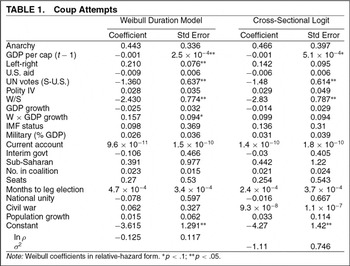
The first stage of the analysis was to estimate a model to predict coup attempts, and this was done using two models: a Weibull model of the duration of episodes between coup attempts and a time series cross-sectional logit model with random effects, where the dependent variable was the incidence of a coup attempt.11
Alt, King, and Signorino (2001) show that it is possible to estimate the same quantities regardless of whether the data are presented as durations or as discrete events and argue that when the data contain duration dependence, a model derived from a Weibull distribution performs better than frequently used alternatives (Beck, Katz, and Tucker 1998).

Coups in Africa are not easy to predict; if they were, presumably they would never succeed. Initiating a coup is a highly risky undertaking that succeeds about 35% of the time. Nevertheless, the results are intuitive. The duration model is presented in relative-hazard form, so the coefficients have the same qualitative interpretation as in the logit model: Positive coefficients are associated with a higher probability that the event occurs. Thus, for example, states coded as being in a state of anarchy—either a regime transition or a collapse of central authority as coded by Polity IV—have an increased incidence of coup attempts. The results are qualitatively similar in the two specifications, but several coefficients are more significant in the duration model.
Adam Przeworski and coauthors (2000) argue that income is the prime prerequisite for political stability, and I find that the strongest predictor of coup attempts is poverty (low levels of per capita GDP). For the poorest countries in Africa, such as Ethiopia, Liberia, and Somalia, the risk of a coup is about 18% in the first year after the last one, while the average country, Egypt—whose per capita GDP was still under $3 per day for most of the decade—faces a risk of only 3%, and a country that is a standard deviation richer, such as Mauritius, faces a risk of less than 1%. With 95% confidence, Mauritius should go at least 80 months longer between coups than Liberia. Seventy percent of the coup attempts occurred in countries with per capita GDP of less than $1 per day.
Right-leaning governments were another significant risk factor. Governments of the far right were subject to a 12% risk of a coup in their first year, while center governments faced only a 7% risk, and left-wing governments a 4% risk. Economic reforms that upset entrenched elite interests, lower the living standards of the urban poor, or threaten established patterns of political corruption are a dangerous undertaking in Africa. Economic reform is highly risky behavior in political systems built on graft (Bates 1981).
Goldsmith (2001) found that U.S. aid reduced the probability of a coup, but the effect, although statistically significant, was very weak. In contrast, I find that the effect of U.S. aid is not statistically significant (p<.16), but the coefficient is in the right direction and probably quite large in substantive terms (since U.S. aid is measured in millions of dollars). In other words, it is likely that U.S. aid has an important effect on African coups, but the data do not allow us to determine whether the effect is positive or negative. However, I find that voting with the United States in the UN General Assembly is associated with a significant reduction in coup attempts. Countries one standard deviation below the mean S-score have an 8% chance of a coup in the first year, while countries one standard deviation above the mean have only a 4.5% chance. With 90% confidence, the effect of a standard deviation change extends the time to the next coup attempt by at least 11 months. It may not be foreign aid itself that reduces the risk of coups but, instead, other dimensions of economic or security cooperation that are correlated with aid.
A long line of research has argued that violent regime change is less likely under democracy than under authoritarian regimes because peaceful means of government turnover are available (Huntington 1968; Londregan and Poole 1990). Bueno de Mesquita et al. (2003) provide an argument that links instability to two parameters of institutional design that are related to democracy: the size of the minimum winning coalition and the size of the selectorate that chooses the leader. They argue that the incentive for insiders to attempt to replace an incumbent government depends on the benefits they receive from the status quo, which in turn depends on the ratio of the size of the winning coalition (W) to the selectorate (S). Coalition insiders are highly dependent on the incumbent if they are easily replaced, which is the case when W is small and S is high. Under those conditions the incumbent can keep most of the benefits of governing, and coalition members will be tempted to carry out a coup. Coups should be less likely when institutional arrangements leave elites satisfied, which happens when the W/S ratio is high. The results here are very interesting for this debate: I find that the Polity IV measure of democracy does not have a significant relationship with African coups, but the W/S ratio does. Both results are robust to alternative specifications, and the substantive effects are strong: With 95% confidence, a one-standard deviation increase in the W/S ratio (0.27 on a scale that runs from zero to one, since W is a subset of S) extends the expected time between coup attempts by more than four years.12
Bueno de Mesquita et al. (2003, 132–36) describe the measures they use for W, S, and W/S as “crude” approximations of winning coalition and selectorate sizes. They are transformations of selected components of the Polity IV scale—LEGSELEC for S and XRCOMP, XROPEN, and PARCOMP, plus REGTYPE (Banks 1996), for W—that best represent these institutional features. W takes five values, S takes three, and W/S takes 10 because of the transformation the authors use to avoid dividing by zero.
A corollary is rejected by these data, however. Bueno de Mesquita et al. (2003) argue that large-coalition incumbents are rewarded by better survival prospects when they follow economic policies that are in the general interest, while incumbents in small-coalition systems survive longer if they provide particularistic benefits to their followers. They argue that the interaction term between growth and the size of the winning coalition should be associated with longer survival times. The result here is the opposite, however: growth appears to reduce the odds of coup attempts more in small-coalition systems (p<.1).
IMF status—coded one when an IMF program has been suspended or a country is not currently under a program and zero when a country is under a program in good standing—is included in the model to investigate the possibility that IMF lending decisions affect political stability. The most compelling argument against enforcing IMF programs rigorously is that suspending financing when countries go off-track typically makes things worse. If it led to a dramatic worsening of the investment climate or a collapse of the exchange rate, the punishment might increase the risk of political violence. Since violent regime change is responsible for much of the long-term poverty in Africa, one might argue that it is acceptable to sacrifice the IMF's credibility if enforcing the conditions would lead to political instability that ultimately impoverishes the countries the IMF is trying to help. The results reject this line of argument, however. There is no evidence that coups are less likely when a country is in good standing; evidently, IMF financing simply does not play an important role in the calculations of African colonels.
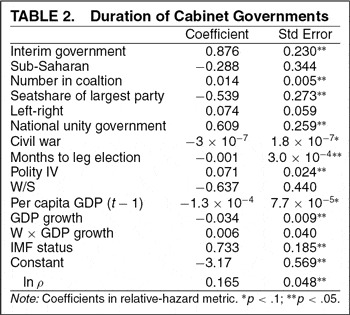
The next stage of the analysis was to estimate a Weibull model to predict government duration. The results are presented in Table 2.

The coefficients reported are in relative-hazard form, so positive coefficients indicate shorter durations, or higher probabilities that governments will fall. Thus, for example, it is no surprise that the duration of interim governments is shorter than average. Government survival is not discernibly different in sub-Saharan Africa than in North Africa, but governments composed of large coalitions fall sooner, and governments last longer when the leading party has more seats in parliament. Oversized, “National Unity” governments are short-lived. These governments are formed in response to the underlying uncertainty of the political landscape; for example, Ivory Coast formed one after the 1999 coup. A state of civil war appeared (at the .075 confidence level) to slightly deter those who might otherwise bring down the government. Governments last longer when the next scheduled elections are far in the future. This reflects the growing incentives for minor coalition members to jump ship as elections approach and the higher opportunity cost of bringing down a government at the beginning of its term.
Governments that rate higher on the Polity IV scale are shorter-lived. Since only countries coded as having cabinet governments are included in this part of the analysis, this means that variations in the quality of democracy are significant predictors of government longevity. The least democratic governments were expected to last at least eight months longer than the most democratic, with 95% confidence. This is broadly consistent with the argument of Bueno de Mesquita et al. (2003) that incumbents in broad-coalition systems are more frequently replaced. However, while the broad measure of democratic governance, Polity IV, is strongly related to government turnover, the narrower institutional measures proposed by Bueno de Mesquita et al., such as the ratio of the winning coalition to the selectorate (W/S), are not.13
The coefficient of W/S is in the predicted direction but is not significant, and neither were W or S, singly or together, or their interactions with the logarithm of time. This is not due to multicollinearity, although W/S is highly correlated with Polity IV (.61). Models that drop Polity IV generate the same results.
Per capita income is weakly associated with cabinet stability, but nominal GDP growth has an impressive effect on the duration of cabinet governments. Cabinet governments have a 48% chance of falling in their first year when growth is one standard deviation below the mean and a 30% chance of falling when growth is one standard deviation above. The expected duration was at least 2.2 months longer for the faster-growing countries with 95% confidence. This is consistent with the intuition that governments have better political fortunes during good times, and this provides an incentive for governments to pursue policies that expand the economy. It is striking that the incentive is so clear, even in countries whose democratic institutions are as weak as is the case throughout most of Africa. The interaction between the size of the winning coalition and growth was included to test whether the incentives are stronger in large-coalition systems as Bueno de Mesquita et al. (2003) predict, but the results are negative.
IMF status was included in the model once again to test the hypothesis that IMF financing promotes political stability, and indeed IMF financing is associated with a reduced risk that a cabinet government collapses. (IMF status is coded zero when countries are under programs in good standing.) Governments are expected to last at least four months longer with 95% confidence when they have IMF programs in good standing, and the best estimate is that they last more than a year longer. This is a marked contrast to the IMF's failure to influence coup attempts.14
Smith and Vreeland (2004) also find that IMF programs extend leadership tenure in democracies when they are not accompanied by severe economic distress, and they argue that the leaders of large coalitions are rewarded for good economic management. They find opposite effects on the tenure of nondemocratic leaders, which is parallel to the finding here that IMF lending has different effects on various mechanisms of reselection.
MODELS OF IMF PROGRAM ENFORCEMENT
In the second stage of the analysis, I estimate a series of models of program enforcement. Variables are defined for IMF status (good or bad, depending on whether a country has access to IMF financing) and for the duration of the current interval, which is the dependent variable. A Weibull model is estimated for the pooled data, and all of the covariates are interacted with IMF status in order to retrieve their effects on the transition probabilities from good standing to bad and from bad standing to good. IMF status is included as a dummy variable in order to allow the two sets of covariates to have different intercepts. This approach controls for correlation in the errors of the two theoretically interdependent processes. I use a simulation method to correct for the estimation uncertainty of the predicted covariates, the probabilities of coup attempts and governments falling.15
I draw 10 samples from the data with replacement, estimate the coup attempt and government fall equations and generate 10 sets of predicted values for the full data set using the stored betas, and replicate the second stage of the analysis (of IMF lending) 10 times. The betas reported are the means of the betas from the 10 runs, and the standard errors are computed using the formula

where q is the beta of interest, Sq2 is the sample variance of beta across the m point estimates, m is the number of imputed data sets (in this case, 10), and SE(qj) is the estimated standard error of q from data set j (Schafer 1999). This is a conservative approach to hypothesis testing, which accepts a higher probability of Type II errors in return for reducing the probability of Type I errors; implementing it inflates the standard errors of all of the covariates. However, none of the results presented below change qualitatively if the probabilities of coup attempts and governments falling are dropped from the specification.
Hypotheses that assume that the IMF makes strategic distinctions based on political constraints or international influence hold economic policies constant, so they should be tested using controls for economic policy. Consequently, I estimated a series of models that use only economic policy variables to explain a country's standing with the IMF, searching inductively for the variables and functional forms that best account for variations in punishment and program suspensions. I used a range of specifications and gave the benefit of any doubt to the economic variables that play a role in IMF conditionality.
Two important conclusions follow from this exercise. First, the economic variables that formally determine compliance with IMF programs—inflation, domestic credit, and reserves—have surprisingly weak effects on IMF lending in Africa. This is a sharp contrast to findings in other regions, where macroeconomic variables such as inflation and change in domestic credit were strong predictors of IMF lending behavior (Mody and Saravia 2002; Stone 2002; Vreeland 2003). Tables that show the robustness of these results were omitted here to save space but are available from the author. Inflation and change in domestic credit were not significant in any specification, including various lags, logarithms, and moving averages, in combination with other variables or excluding them. Since domestic credit targets figure so prominently in IMF program design, however, I retained the specification that came closest to significance as a control.
The second conclusion is that there is an important distinction to be drawn between program suspensions and the duration of punishment intervals. Three economic variables have significant effects on program suspensions: the logarithm of the lagged decline of central bank reserves, the five-month lagged moving average of changes in the exchange rate, and short-term government debt. Central bank reserves have the expected effect: When reserves decline precipitously, IMF programs are suspended. The exchange rate tells an interesting story: A devaluation several months in the past increases the expected duration in good standing. This must be capturing variation in program design, since some programs are designed to accompany devaluations and some are designed to help defend a pegged exchange rate. Programs that foresee devaluation of the exchange rate are easier to implement than programs that require the exchange rate to remain fixed, because devaluation is consistent with accumulating reserves and increasing government revenues. Finally, high levels of short-term debt are associated with longer than average spells in good standing. This is consistent with the interpretation that governments that are highly dependent on the goodwill of the financial markets are less willing to jeopardize their good standing with the IMF.
In contrast, only one economic variable was found to have a significant effect on the duration of punishment intervals: High levels of short-term government debt are associated with longer punishment intervals. Since short-term debt is also associated with longer episodes in good standing, this probably does not mean that indebted countries are more tempted to violate their agreements. Rather, since heavily indebted countries are very vulnerable to markets when their programs go off-track, it is probably very difficult for them to get back on-track, which reinforces their reluctance to violate their program conditions in the first place. The lagged logarithm of the decline of reserves was significantly associated with longer punishment intervals in a specification that included only economic variables, but this effect disappeared when controlling for short-term debt and did not return in any of the richer models presented in Table 3. The fact that the variables that measure compliance with IMF conditions do not help to explain the duration of punishment intervals is consistent with the argument advanced above. Program suspensions are based on technical criteria, but the renegotiation of targets and resumption of stalled programs are based on politics.

Alternative interpretations are possible, of course. It could be that the economic data are poor; however, the data come from the IMF and are the same data that Fund staff use to assess program compliance. Perhaps I am measuring the wrong variables. IMF researchers report that structural criteria are missed more frequently than macroeconomic indicators; on the other hand, they are also less likely to lead to program suspensions (Ivanova et al., 2002). However, it is a telling finding that reserves—which are among the most frequently applied performance criteria—predict program suspensions but not the duration of punishment intervals. The most persuasive interpretation is that the length of program interruptions in Africa simply has little to do with the formal criteria of IMF programs.
Models of Punishment Duration
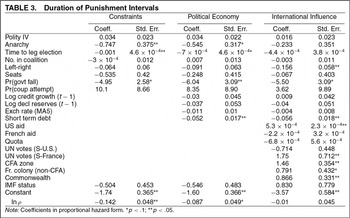
I first estimate a model to test the political constraints hypothesis, which holds that fragmented coalitions, weak support in parliament, unstable and left-leaning governments, and imminent elections cause countries to renege on their commitments to the Fund and make it difficult to make the policy corrections necessary to bring programs back on track. In that case, these conditions should be associated with longer punishment intervals. Since this model assumes that political variables have their effects through economic variables, it excludes the economic covariates. Alternatively, the strategic lender hypothesis argues that the IMF conditions its decisions to lend to countries directly on these variables, in which case the opposite coefficients are expected: The Fund should be generous to unstable governments with fragmented coalitions, weak parliamentary support, and imminent elections and should be less demanding of left-leaning governments that take greater risks when they adopt IMF austerity programs. In this case, however, the hypothesis is that the Fund considers political variables as reasons for lending, given known economic policies, so to test it I estimate a model that includes the economic covariates that were significant predictors of IMF lending. Next, I estimate a model of international influence. The hypothesis here is that a borrowing country's political connections to the leading donors affect the Fund's lending decisions, given economic policies and domestic political conditions, so all of these variables are included. Table 3 presents the results that pertain to punishment intervals.
The coefficients of two domestic politics variables support the constraints hypothesis. Countries in a state of anarchy are subject to longer punishment intervals. Indeed, this category represents several of the rare basket cases that have defaulted on IMF loans, such as Somalia, and it is hard to imagine how a country run by warlords and without any central authority could meet the technical standards to qualify for IMF assistance. Second, governments that face substantial risks of falling have longer punishment durations, which is consistent with the hypothesis that this probability is a good proxy for the government's discount rate. Governments that discount the future heavily because they expect to fall in the near future are unlikely to make long-term policy investments. The scale of the effect cannot be determined precisely, however, because of the estimation uncertainty of the predicted probability. The best estimate is that the effect of increasing the probability of the government falling by one standard deviation increases the average length of the punishment interval by four months, but with 95% confidence we can only say that the effect is at least one-third of a month. It may, however, be much larger. Surprisingly, Polity IV, number of parties in the governing coalition, and support in the legislature (seats), have no significant effects on punishment durations. Each of these variables influences the probability of government falling, however, so they have indirect effects. Apparently, in Africa, institutional constraints on the executive exercise their influence through their effects on political stability, rather than through the policy formulation process.
Two variables point in the opposite direction. First, an approaching election reduces the duration of punishment intervals, which suggests that the Fund is less willing to enforce conditions rigorously on the eve of an election. The effect is extremely small, however. Second, the left–right partisanship of the government has a strong effect, and it is surprising. Left-wing governments are punished longer than right-wing ones, on average: The simple correlation is negative, because right-wing governments have preferences similar to the IMF's over economic policies. However, the opposite effect emerges in the full model, which controls for international influence. Controlling for economic policy, domestic political circumstances, and international influence, the IMF is substantially tougher on right–wing governments. With 95% confidence, far-right governments are punished at least four months longer than far-left governments on average. This suggests that the IMF is rather savvy about what it can get away with, and it pushes right-wing governments harder because they are more willing to reform.
The final model incorporates measures of international influence: U.S. and French aid, S-scores measuring the association between African countries' votes in the UN General Assembly and those of the United States and France, and membership in the two major postcolonial international institutions, the CFA Franc Zone and the Commonwealth of Nations.16
I tried a number of other specifications, and the results reported here are robust to the inclusion or exclusion of other variables. Trade variables, British aid, British voting in the UN, and aggregate OECD aid excluding the United States were insignificant predictors of punishment durations and program interruptions.
U.S. aid has a significant and robust relationship with the duration of punishment intervals. African countries that receive substantial amounts of aid from the United States suffer substantially shorter punishment intervals. This is consistent with the argument made here that the United States exercises influence over the IMF in Africa when it suits U.S. purposes and, therefore, shares in the blame for the deterioration of the IMF's credibility there. The size of IMF quotas, on the other hand, is not associated with the duration of punishment intervals, so it is clear that sheer size is not sufficient to get you a check from the IMF if you represent an African country. This underlines the significance of the result for U.S. aid. It is not simply the case that U.S. aid correlates with the size of a country, and economic size explains IMF behavior. Rather, U.S. aid measures the political capital countries enjoy in Washington, which corresponds to Washington's willingness to draw on its influence at the Fund. Furthermore, only aid from the United States has this effect: Specifications that used French or British aid, or aggregate OECD aid excluding the United States, found no significant effects. The effect of U.S. aid is potent. A one–standard deviation shift in U.S. aid is associated with a shift in the punishment period that ranges between less than one and 3.5 months. The shift between the top and the bottom of the aid scale in Africa increases the punishment period by at least 4.7 months, and the best estimate is that it produces a fourfold increase in the average punishment period, from less than six to almost 24 months. Egypt represents the top of the aid scale, and Egypt was able to use its special role in Middle Eastern politics to win extraordinary debt relief and virtual immunity from IMF conditionality in the early 1990s.
Although African foreign policy postures as measured by votes in the United Nations did not appear important compared to those of the United States or Britain, the correspondence with French votes was powerful. African countries that typically vote with France in the UN receive sharply shorter punishment intervals: With 95% certainty the range between the lowest and the highest S-scores in the data set (−0.09 to 0.88) reduced punishment durations by more than seven months.17
An early version of this paper circulated with a different result for the S-score with France, which was an error. The results reported here are robust and do not depend on the inclusion of any of the other variables.
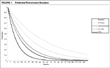
In addition, the variables measuring postcolonial institutional connections have strong substantive effects in the expected direction. Countries that joined the CFA Zone or the Commonwealth had substantially shorter punishment intervals. Some of this could be attributed to the credibility-enhancing effects of membership in a monetary union (the CFA Zone) or the degree to which joining the Commonwealth implies accepting certain norms regarding democratic politics and good governance, but I argue below that the results of the analysis of program suspensions casts doubt on that interpretation. Furthermore, the Commonwealth is a very loose regime, and by the 1990s the CFA Zone was no longer a credible guarantee of tight monetary or fiscal policy, because France tolerated substantial deviations in an effort to bolster political stability—one consequence of which was the devaluation of 1994 (Stasavage 2002). In any case, it is striking that members of these institutions suffer much shorter interruptions of their programs even controlling for economic policy variables. The best estimate is that membership in the CFA decreases punishment durations by almost 17 months, and membership in the Commonwealth reduces punishment durations by a year. With 95% confidence, the effect of CFA membership is at least six months; the effect of Commonwealth membership is very imprecise, however, ranging from two weeks to two years. The postcolonial international institutions have no formal linkage to the IMF, but the informal connection is very potent. Figure 1 illustrates the predicted effects of international influence variables on the length of punishment episodes.18
The baseline is membership in neither the CFA nor the Commonwealth of Nations, the mean level of U.S. aid ($32 million), and an S-score one standard deviation below the mean. The other lines represent membership in one organization, an S-score one standard deviation above the mean, and $2 billion in U.S. aid, which is approximately the average level Egypt received in the first four years of the decade.

Predicted Punishment Duration
When combined, the aid, institutional membership and UN voting variables suggest an interesting pattern of variation in how donor countries exercise their influence over the IMF. Both France and Britain had institutionalized patterns of diplomatic courtesy and economic cooperation with their former colonies, and their patronage was extended to all of their former colonies that participated in the CFA Zone or the Commonwealth, respectively. In addition, however, France was interested in African countries' foreign policies, because France had a far-flung set of military and economic commitments to defend on the continent. Consequently, France rewarded and punished African countries for their foreign policy positions, as measured by their voting patterns in the UN. Neither Britain nor the United States was terribly concerned about African countries' foreign policies in the 1990s, so they did not. Finally, the United States pursued a diverse set of goals in Africa in the 1990s that had more to do with economic policy and promoting democracy than with security, and it was willing to intervene at the IMF on behalf of the countries that it regarded as most important or most compliant with its objectives, which also received the largest shares of its foreign aid. Aid from Britain or France was not a significant predictor of their behavior at the IMF, probably because British and French interests in Africa were more narrowly defined.
Models of Program Interruptions
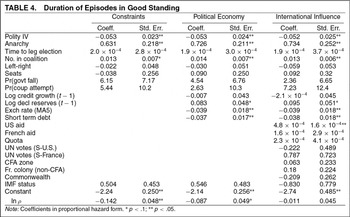
Table 4 reports the results of estimating the same three models on program interruptions. Consistent with the argument above, economic variables account for most of the variation in program interruptions: Program interruptions are automatic when the targets are missed. The only result that strongly supports the domestic constraints hypothesis is the coefficient for anarchy. Even this cannot be pinned down very precisely: With 95% confidence, countries in the midst of a regime change or a collapse of central authority lose their good standing with the IMF between 1.5 and 16 months sooner than those that are not. There is weak evidence that large numbers of coalition partners make a program more likely to be suspended, but the expected effect on the duration of episodes in good standing of adding a party to a coalition government is not more than a couple of weeks. The expected duration is 1.4 months shorter for very large coalitions, with more than seven parties (more than one standard deviation above the mean). The other domestic politics variables are all insignificant, although left–right partisanship, the proportion of seats in parliament belonging to the major governing party, and the probability of a government falling all have the expected signs.

Only one domestic variable points in a direction that could be interpreted as evidence of a strategically accommodating IMF: Democracies are subject to much less frequent suspensions of their programs. With 95% confidence, the most democratic countries in Africa remain in good standing at least nine months longer on average than the least democratic. The IMF was sensitive to the criticism that rigorous conditionality had threatened the survival of new democracies in the 1980s, and perhaps it responded in the 1990s by offering gentler conditions to democracies. However, the theory proposed here predicts that such beneficial treatment should show up in the duration of punishment intervals, not in the duration of periods of good standing, and the effect of democracy on punishment intervals is insignificant. Furthermore, if democracies were subject to favored treatment in terms of punishment durations, this should lead to more frequent program interruptions rather than to long periods in good standing, because democracies would then be less deterred by the prospect of punishment. The longer spells in good standing that democracies enjoy are more consistent with an alternative interpretation: Democracies respond to the interests of broader constituencies than authoritarian regimes and, consequently, are compelled to provide more public goods, such as economic reform and good governance, and fewer private goods, such as corruption (Bueno de Mesquita et al. 2003). This is also consistent with findings in post-Communist countries, in which democracy was associated with longer spells in good standing with the IMF and, also, with more rapid and extensive economic reform (Stone 2002).
The theory implies that since countries that receive large amounts of U.S. foreign aid are subject to shorter punishment intervals, they should face weaker incentives to comply with IMF conditions. Consequently, they should violate their program conditions more often and suffer more frequent program suspensions. The data support this conclusion. U.S. foreign aid is strongly associated with shorter periods in good standing in Africa, supporting the hypothesis that international influence leads to low credibility, which in turn leads to frequent program violations. With 95% confidence, the predicted episode in good standing is at least nine months longer for countries that receive no aid than for Egypt at the height of U.S. largesse. It is possible that this represents a corrosive effect of aid on economic policy and domestic politics, as some scholars have alleged, but it also represents an alternative interpretation of those findings (e.g., Burnside and Dollar 2000, Dollar and Pritchett 1998, and Knack 2001). Consistent with the argument above, if U.S. aid is a proxy for influence, and international influence undermines the authority of the IMF, previous studies that find negative effects of aid may actually be finding the effects of weakening the IMF's credibility. At a minimum, those who want to use these effects as evidence of a negative impact of aid per se have to explain why U.S. aid has such an impact, but aid from France, Britain, and other OECD countries does not.
The effects of other measures of international influence on episodes in good standing do not clearly support or disconfirm the theory. Countries that vote like France in the UN or that are members of the CFA zone or the Commonwealth of nations all suffered shorter-than-average punishment intervals, so the theory predicts that they should also have shorter-than-average episodes in good standing; if international interference undermines the credibility of the conditionality contract, it should cause economic policies to deteriorate. None of these coefficients is significant. The four variables that indicate affinity to France all have coefficients in the expected direction, however, and they are jointly significant at p<.15 (one-tailed). The effect of UN voting scores is substantively very important: The best estimate is that the range of S-scores observed in the data accounts for a difference in the expected duration in good standing of more than a year. A standard deviation of French aid ($346 million) accounts for another month, and membership in the CFA Zone for a further month. Imprecise though the estimated effects are, they suggest that the United States is not the only country that undermines the credibility of the IMF in Africa; the former colonial powers play a role as well. Since these results are imprecise and only marginally significant, however, they cannot be counted as strong evidence for the theory.
On the other hand, the absence of a positive association between institutional membership and duration in good standing reinforces the political interpretation of the effect of these variables on punishment intervals observed above. The Commonwealth and the CFA exercise some influence over the economic policies of their members, and CFA Zone members delegate control over monetary policy. If it were the case that the earlier finding that membership in these institutions leads to shorter punishment intervals were attributable to better economic policies, membership should also be associated with longer durations in good standing. Since members of these institutions do not pursue policies that lead to longer episodes in good standing, however, there is no reason to suppose that their policies are better when their programs have been suspended. Rather, it appears that whatever salutary influence these institutions have on economic policy is negated by the fact that their institutional umbrellas undermine the credibility of IMF conditionality.
CONCLUSIONS
This article attempts to unravel the puzzle of IMF involvement in Africa. In spite of intensive engagement by international financial institutions, Africa has failed to develop economically for the past 30 years. Instead, African governments have persisted in pursuing market-distorting policies that impoverish agricultural workers, promote the flight of human and financial capital, encourage widespread corruption, and lower real incomes across the board. The IMF has developed programs to dismantle this set of policies and has attempted to use conditional lending to create incentives for governments to implement them, but the experience of several decades is that the policies persist, the programs are not implemented, and the lending continues. Why?
Critics of the IMF differ in their diagnoses. One set of critics argues that the IMF chooses the wrong policies to encourage, while another argues that the Fund fails to promote growth because it fails to enforce its conditions. The first diagnosis suggests that the IMF should change its policy advice, or relax conditionality; the second suggests that the IMF should be reformed to enforce the existing conditions more consistently. The empirical question that divides the critics is how consistently IMF conditions are in fact being enforced. I find that IMF program conditions are not enforced consistently in Africa. Economic variables predict program suspensions, but the variables that measure the implementation of IMF conditions are not correlated with the key indicator of enforcement, the duration of punishment intervals. On the contrary, the variables that best explain the duration of punishment intervals are measures of international influence.
Among critics who argue that the enforcement of IMF conditions is too lax, there is again a divergence of opinion: One camp claims that the Fund willfully neglects to enforce conditionality; it is an agent without the will to enforce its principals' interests. To the contrary, I argue that the IMF fails to enforce its conditions for the opposite reason: because its principals, the major donor countries, interfere. Enforcing conditionality is, of course, in their long-term interests, but in particular cases they stand to gain more short-term benefits by relaxing the pressure on particular borrowers. The theoretical question that divides the critics of IMF enforcement is whether the fundamental problem is the IMF's agency or the principals' commitment. The empirical implication of the agency view is that the IMF's conditions should be enforced more consistently when countries are important, and the implication of the commitment view is that enforcement is more consistent when they are not.
My results reject the agency hypothesis and provide strong support for the commitment hypothesis. IMF program conditions are enforced less rigorously when the borrowing countries receive large amounts of U.S. aid, belong to postcolonial international institutions that link them to France or Britain, or have voting postures in the UN similar to France. Countries with close ties to the major donor countries receive the international equivalent of a slap on the wrist, while ordinary countries have to achieve their targets to get their financing. Furthermore, countries with close ties to the United States or France have their programs interrupted more frequently, as the strategic theory of IMF credibility predicts. Undeterred by short punishments, they are free to flaunt the IMF's conditions. These findings are particularly striking, since African countries generally rate so poorly on the scale of international influence. If IMF lending is thoroughly politicized in Africa, the celebrated cases on other continents—Russia, Argentina, Brazil, and others—are not as exceptional as they might seem.
Calls to reform the IMF have focused on ways to limit the IMF's discretion and rein in its autonomy. These findings, however, suggest that the conventional wisdom about the causes of IMF program failure has it backward, and accepting these policy recommendations would make the problem worse, rather than better. The IMF is effective in creating incentives for reform when its threats to withhold financing are credible. The obstacle to enforcing these threats is interference by the major donor countries. The solution, therefore, is more delegation. If the IMF is to function like an international central bank for developing countries, it will have to be independent. In the meantime, we can expect the IMF to continue lending to Africa without achieving significant progress.
The support of the National Science Foundation under NSF Grant SES-9974663 is gratefully acknowledged, as are the contributions of three research assistants, Kris Ramsay, Robert Walker, and Jared Zichek. Thanks go to the German–American Fulbright Commission, the Stiftung Wissenschaft und Politik, and the University of Rochester for generously providing a year of leave. Thanks for comments are due to Ashoka Mody, Strom Thacker, James Vreeland, Thomas Willett, and audience participants at the Research Department of the IMF, the Conference on the Political Economy of the IMF, Yale University, and the 2002 APSA Annual Meeting.
References
Abdelal Rawi.
2001.
National Purpose in the World Economy: Post-Soviet States in Comparative Perspective.
Ithaca, NY:
Cornell University Press.
Alesina Alberto,
Sule 0zler,
Nouriel Roubini, and
Phillip Swagel.
1996.
“Political Instability and Economic Growth.”
Journal of Economic Growth
1
(June):
189–
211.Google Scholar
Alt James,
Gary King, and
Curtis S. Signorino.
2001.
“Aggregation among Binary, Count and Duration Models: Estimating the Same Quantities from Different Levels of Data.”
Political Analysis
9
(Winter):
21–
44.Google Scholar
Banks Arthur S.
1996.
Political Handbook of the World.
New York:
CSA.
Barro Robert J.
1991.
“Economic Growth in a Cross-Section of Countries.”
Quarterly Journal of Economics
106
(May):
407–
43.Google Scholar
Barro Robert J., and
David B. Gordon.
1983.
“Rules, Discretion, and Reputation in a Model of Monetary Policy.”
Journal of Monetary Economics
12
(January):
101–
21.Google Scholar
Barro Robert J., and
Lee Jong-Wha.
2002.
“IMF Programs: Who Is Chosen and What Are the Effects?”
National Bureau of Economic Research Working Paper
8951.
Bates Robert H.
1981.
Markets and States in Tropical Africa: The Political Basis of Agricultural Policies.
Berkeley:
University of California Press.
Beck Nathaniel,
Jonathan N. Katz, and
Richard Tucker.
1998.
“Taking Time Seriously: Time-Series-Cross-Section Analysis with a Binary Dependent Variable.”
American Journal of Political Science
42
(October):
1260–
88.Google Scholar
Biersteker Thomas, ed.
1993.
Dealing with Debt: International Financial Negotiations and Adjustment Bargaining.
Boulder, CO:
Westview Press.
Bird Graham,
Mumtaz Hussain, and
Joseph Joyce.
2004.
“Many Happy Returns? Recidivism and the IMF.”
Journal of International Money and Finance.
23
(March):
231–
51.Google Scholar
Bueno de Mesquita Bruce,
Alastair Smith,
Randolph M. Siverson, and
James D. Morrow.
2003.
The Logic of Political Survival.
Cambridge, MA:
MIT Press.
Burnside Craig, and
David Dollar.
2000.
“Aid, Policies and Growth.”
American Economic Review
90
(September):
847–
68.Google Scholar
Conway Patrick.
2003.
“Duration and Recidivism in IMF Programs: Evidence from the Period 1973–1992.”
Working paper.
University of North Carolina.
Cukierman Alex,
Sebastian Edwards, and
Guido Tabellini.
1992.
“Seigniorage and Political Instability.”
American Economic Review
82
(June):
537–
55.Google Scholar
Dollar David, and
Lant Pritchett.
1998.
Assessing Aid: What Works, What Doesn't, and Why.
New York:
Oxford University Press.
Easterly William.
2001.
The Elusive Quest for Growth: Economists' Adventures and Misadventures in the Tropics.
Cambridge, MA:
MIT Press.
Feng Yi.
1997.
“Democracy, Political Stability and Economic Growth.”
British Journal of Political Science
27
(July):
391–
418.Google Scholar
Gabel Matthew J., and
John D. Huber.
2000.
“Putting Parties in Their Place: Inferring Party Left-Right Ideological Positions from Manifestos Data.”
American Journal of Political Science
44
(January):
94–
103.Google Scholar
Gartzke Erik,
Dong-Joon Jo, and
Richard Tucker.
1999.
“The Similarity of UN Policy Positions, 1946–96.”
Version 2.5. http://www.vanderbilt.edu/~rtucker/data/a_nity/un/simila.
Goldsmith Arthur A.
2001.
“Foreign Aid and Statehood in Africa.”
International Organization
55
(Winter):
123–
48.Google Scholar
Haggard Stephan, and
Robert R. Kaufman.
1995.
The Political Economy of Democratic Transitions.
Princeton, NJ:
Princeton University Press.
Huntington Samuel P.
1968.
Political Order in Changing Societies.
New Haven, CT:
Yale University Press.
Ivanova Anna,
Wolfgang Mayer,
Alex Mourmouras, and
George Anayiotos.
2001.
“What Determines the Success or Failure of Fund-Supported Programs?”
Working paper.
Washington, DC:
IMF.
Killick Tony.
1995.
IMF Programmes in Developing Countries: Design and Impact.
London:
Routledge.
Kirshner Jonathan.
1996.
Currency and Coercion: The Political Economy of International Monetary Power.
Princeton, NJ:
Princeton University Press.
Knack Stephen.
2001.
“Aid Dependence and the Quality of Governance: A Cross-Country Empirical Analysis.”
Working paper.
World Bank.
Leblang David, and
William Bernhard.
2000.
“The Politics of Speculative Attacks in Industrial Democracies.”
International Organization
54
(Spring):
291–
324.Google Scholar
Londregan John B., and
Keith T. Poole.
1990.
“Poverty, the Coup Trap, and the Seizure of Executive Power.”
World Politics
42
(January):
151–
83.Google Scholar
Mody Ashoka, and
Diego Saravia.
2002.
“Catalyzing Private Capital Flows: Do IMF Programs Work as Commitment Devices?”
Working paper WP/02.
Washington, DC:
IMF.
Nohlen Dieter,
Michael Krennerich, and
Bernhard Thibaut, eds.
1999.
Elections in Africa: A Data Handbook.
Oxford:
Oxford University Press.
Oatley Thomas, and
Jason Yackee.
2000.
“Political Determinants of IMF Balance of Payments Lending: The Curse of Carabosse?”
Working paper.
University of North Carolina at Chapel Hill.
Political Parties of the World. Vol. 5.
2001.
Detroit, MI:
Gale Research Co.
Powell G. Bingham, Jr.
2000.
Elections as Instruments of Democracy: Majoritarian and Proportional Visions.
New Haven, CT:
Yale University Press.
Przeworski Adam,
Michael E. Alvarez,
Jose Antonio Cheibub, and
Fernando Limongi.
2000.
Democracy and Development: Political Institutions and Well-Being in the World, 1950–1990.
Cambridge:
Cambridge University Press.
Quain Anthony.
2001.
The Political Reference Almanac, 2001–2002.
Arlington, VA:
PoliSci Books.
Rogoff Kenneth.
1985.
“The Optimal Degree of Commitment to an Intermediate Monetary Target.”
Quarterly Journal of Economics
100
(November):
1169–
90.Google Scholar
Schafer Joseph L.
1999.
“Multiple Imputation: A Primer.”
Statistical Methods in Medical Research
8
(January):
3–
15.Google Scholar
Signorino Curtis S., and
Jeffrey M. Ritter.
1999.
“Tau-b or Not Tau-b: Measuring the Similarity of Foreign Policy Positions.”
International Studies Quarterly
43
(March):
115–
44.Google Scholar
Smith Alastair, and
James Vreeland.
2004.
“The Survival of Political Leaders and IMF Programs.”
Working paper.
Yale and New York University.
Stasavage David.
1997.
“The CFA Franc Zone and Fiscal Discipline.”
Journal of African Economies
6
(March):
132–
67.Google Scholar
Stasavage David.
2001.
“When Do States Abandon Monetary Discretion? Lessons From the Evolution of the CFA Franc Zone.”
Working paper.
London School of Economics.
Stiglitz Joseph E.
2002.
Globalization and Its Discontents.
New York:
W. W. Norton.
Stone Randall W.
2002.
Lending Credibility: The International Monetary Fund and the Post-Communist Transition.
Princeton, NJ:
Princeton University Press.
Thacker Strom C.
1999.
“The High Politics of IMF Lending.”
World Politics
52
(October):
38–
75.Google Scholar
Vaubel Roland.
1986.
“A Public Choice Approach to International Organization.”
Public Choice
51:
39–
57.Google Scholar
Vreeland James Raymond.
2003.
The IMF and Economic Development.
Cambridge:
Cambridge University Press.
Coup Attempts
Duration of Cabinet Governments
Duration of Punishment Intervals
Predicted Punishment Duration
Duration of Episodes in Good Standing
 You have Access
- 297
- Cited by
Comments
No Comments have been published for this article.