INTRODUCTION
Research on learners’ output and corrective feedback (CF) has attracted plenty of attention in the field of second language (L2) acquisition. For years, scholars have investigated the language-learning potential of output and its role in drawing learners’ attention to form (Swain, Reference Swain, Cook and Seidlhofer1995 et passim). However, producing oral and/or written output per se may not be enough unless learners receive sufficient feedback. Several studies (Cumming, Reference Cumming1990; Qi & Lapkin, Reference Qi and Lapkin2001; Swain, Reference Swain, Cook and Seidlhofer1995; Swain & Lapkin, Reference Swain and Lapkin1995, Reference Swain and Lapkin2002) have acknowledged that the processing of CF can engage learners in noticing (Schmidt, Reference Schmidt1990) and focus on form (FonF; Long, Reference Long, Ritchie and Bhatia1996), which have been claimed to have a positive impact on interlanguage development. Despite the central position that oral CF occupies in L2 acquisition research (Lyster, Saito, & Sato, Reference Lyster, Saito and Sato2013), the way in which written CF can contribute to L2 acquisition has been understudied until recently. As Santos, López-Serrano, and Manchón (Reference Santos, López-Serrano and Manchón2010) pointed out, the L2 writing research agenda has mainly addressed issues related to the learning-to-write dimension and not the writing-to-learn dimension (Byrnes & Manchón, Reference Byrnes and Manchón2014; Manchón, Reference Manchón2011).
It is within this backdrop that the present study investigated what Basque-Spanish adolescent English as a foreign language (EFL) learners noticed and incorporated when engaged in a three-stage writing task, what the learners’ attitudes toward receiving model texts were and whether these models could be effective as language-learning tools.
LITERATURE REVIEW
Numerous studies to date have considered the key role of noticing (Schmidt, Reference Schmidt1990) for L2 learning. It has been claimed that it is by producing output that such noticing is promoted as learners are made aware of the gaps in their interlanguage (Selinker, Reference Selinker1972). Several early studies on learners’ written output (Adams, Reference Adams2003; Cumming, Reference Cumming1990; Lapkin, Swain, & Smith, Reference Lapkin, Swain and Smith2002; Qi & Lapkin, Reference Qi and Lapkin2001; Swain & Lapkin, Reference Swain and Lapkin1995) acknowledged the potential role of composition writing for L2 learning. They all showed that noticing while writing led to modified output and suggested that certain cognitive processes (including grammatical analysis) involved in problem solving could facilitate L2 learning. Qi and Lapkin (Reference Qi and Lapkin2001) found that noticing without understanding had a lower impact than noticing with understanding on L2 learning; thus they suggested that L2 writing pedagogy should engage in not only promoting noticing but also finding ways to promote a higher quality noticing (e.g., guided vs. unguided noticing, as in Santos et al., Reference Santos, López-Serrano and Manchón2010).
Most of these studies used a CF technique known as reformulation, in which the learner's text is rewritten but maintains the content of the original intact. Another type of CF that has been much less explored is the use of models, which are good examples written by native or near-native speakers of the language that are not contingent on learner output (Hanaoka, Reference Hanaoka2006b). The implicit signaling of errors in both feedback forms has been claimed to push learners to actively attempt to identify and understand their mistakes, a process that may lead to deeper processing and, ultimately, language development (Sachs & Polio, Reference Sachs and Polio2007). Some researchers (Hanaoka, Reference Hanaoka2006b; Yang & Zhang, Reference Yang and Zhang2010) have considered that both feedback types play complementary roles. Thus, while models may serve to address alternative forms and to develop the original content, reformulations might promote noticing of linguistic inadequacies. Yet, Manchón (Reference Manchón2011) pointed out that there is a clear need to do research in EFL writing contexts and to further explore the extent to which models can lead to language learning.
The pioneering study by Hanaoka (Reference Hanaoka2007) examined what Japanese college students of different proficiency levels spontaneously noticed while composing a story in response to a picture prompt (Stage 1) and while comparing their original output to two native-speaker models (Stage 2). Hanaoka also studied how the nature of such noticing affected subsequent learning in their immediate (Stage 3) and delayed revisions (Stage 4). Participants (n = 37) were asked to write down all the problematic features they noticed (PFNs) in the first stage and the solutions noticed in the models (i.e., features noticed—henceforth FNs) in the second stage. These notes were later tallied and grouped into four different categories depending on their nature (lexical, grammatical, content, and other features). Hanaoka examined the number of features noticed and incorporated (FNIs) by the participants in the immediate and delayed revisions considering two variables, the nature of the FNIs, and whether the FNIs were related to the FNs noticed in Stage 2 or not. The findings indicate that the participants were able to identify the linguistic features they lacked, to autonomously find solutions in the feedback provided, and to integrate them into further revisions. Hanaoka reported that the participants overwhelmingly identified lexical features, and that, interestingly, those features that were related to the problems participants had faced through output were incorporated at a higher rate and retained longer. More proficient learners noticed significantly more features than the less proficient learners, and they attended to form better.
This study was replicated by Martínez Esteban and Roca de Larios (Reference Martínez Esteban and Roca de Larios2010), who investigated the role of models in individual and collaborative EFL writing. The participants were 17 Spanish secondary school pupils at a low-intermediate proficiency level who completed a three-stage writing task. The results revealed that the students noticed mainly lexical problems at the composing stage, and that they could not find sufficient solutions to those problems in the models probably because they had not been adapted to their proficiency level, which made noticing exceedingly challenging. The researchers reported that the participants incorporated a reasonable number of features in their revisions, thus supporting the role of models as a form of written feedback.
Coyle and Roca de Larios (Reference Coyle and Roca de Larios2014) explored the role played by error correction and model texts on the noticing and subsequent revisions of written output by 11- and 12-year-old EFL children (n = 46) who engaged in a three-stage collaborative writing task. The results indicated that children noticed and incorporated mainly lexical features. Moreover, learners in the error correction condition were found to report more noticing of grammar at the comparison stage, which later resulted in higher accuracy in their revisions. The participants in the model condition, in contrast, directed most of their attention toward language chunks and content.
Cánovas Guirao, Roca de Larios, and Coyle (Reference Cánovas Guirao, Roca de Larios and Coyle2015) studied the effectiveness of model texts as a form of CF with children ages 10–11 engaged in a three-stage writing task. Their findings indicate that higher-proficiency learners noticed and incorporated more features than students with a lower proficiency. Moreover, in line with Hanaoka (Reference Hanaoka2007), the learners focused mainly on lexis. The improvement of both the experimental and control groups led Cánovas Guirao et al. (Reference Cánovas Guirao, Roca de Larios and Coyle2015) to acknowledge the potential influence of task repetition.
Regarding the impact of individual differences on written output, several studies have analyzed students’ attitudes toward the learning potential of writing (Manchón & Roca de Larios, Reference Manchón, Roca de Larios and Manchón2011) and their engagement with certain types of feedback such as reformulations (Storch & Wigglesworth, Reference Storch and Wigglesworth2010) and error correction (Hyland, Reference Hyland and Manchón2011). However, learners’ beliefs on the use of models as a form of feedback have only been analyzed in Hanaoka (Reference Hanaoka2007)—participants’ willingness to receive the models—and in Yang and Zhang (Reference Yang and Zhang2010)—short interviews to elicit comments on reformulation and modeling. These scholars did not focus on investigating how the learners’ attitudes could affect their performance in subsequent revisions, though. Therefore, this study addresses this gap by including a background questionnaire on the use and perceived effectiveness of models.
On the basis of the literature review briefly presented above, the present study entertained the following research questions:
1. What aspects of language do young EFL learners of different proficiency levels notice while writing a composition on their own?
2. What aspects of language do young EFL learners of different proficiency levels notice as they compare their texts to two models? Are there any differences between the students who received some guidance on noticing and those who did not?
3. What are the effects of Stage 1 (composing) and Stage 2 (comparison) noticing on subsequent revisions?
4. What is the participants’ attitude toward models as a form of feedback? How does this affect their noticing and performance in subsequent revisions?
THE STUDY
Context and Participants
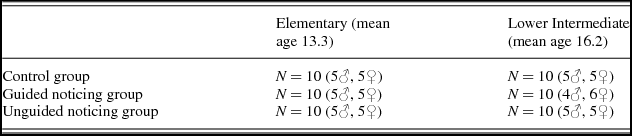
The present study was carried out in the Basque Autonomous Community (Spain). The participants were 60 Basque-Spanish bilinguals (31 females and 29 males), 30 of whom came from a secondary school (mean age 13,3, elementary level) and 30 from a high school (mean age 16,2, lower-intermediate level). Three groups were distinguished at each proficiency level: (a) a control group, which completed the composing and rewriting stages but did not receive the models; (b) a guided noticing (GN) group, which completed the three stages and used a guided form of noticing in the comparison stage; and (c) an unguided (UN) noticing group, which completed the three stages but used a nonguided form of noticing. Table 1 summarizes details of the participants:
Details of the Participants in the Study

Tasks and Procedures
In the Stage 1 writing task, or composing stage (pretest), the participants received the visual prompt (Appendix A), a sheet (Sheet 1) to write their text, and another sheet (Sheet 2) to write down whatever problems they had while writing on Sheet 1. The visual stimuli consisted of six color pictures related to free-time activities and did not include any explanatory text. Although the learners were given oral instructions in Basque at the beginning of the experiment, directions were also written at the top of each sheet in the same language. As in Hanaoka (Reference Hanaoka2007), Sheet 2 provided specific examples of note-taking: “I don't know how to say X in English”; “I wrote X, but I'm not sure if this is correct”; “What is the past tense of X?”; and “I'm not sure whether the picture is describing X or Y.” No word limits were imposed, and the students could take notes in the language of their choice. A time limit of 20 minutes was imposed because of class-time restrictions. Yet, all the participants were able to finish the task within the time allotted.
At the end of Stage 1, the participants were told that they were going to receive two model texts to review their drafts. However, before that, they had to indicate how eager they were to receive the models in a 5-point Likert scale (1 = not at all and 5 = very much). This task took them about 2 minutes. Then, Sheet 2 was collected. The students kept their original drafts and the visual prompt for Stage 2.
At this second stage, the students received the two models (Appendix B) and Sheet 3. Two models (A and B) were used to reduce the chances of the participants copying from a single model and to increase the chances of participants providing solutions to their problems. One of the models was written by a native speaker of English and the other one by a highly proficient speaker. The participants were asked to write all the differences they could notice between their original texts and the models on Sheet 3. However, the procedure that the UN and the GN groups followed differed. As in Hanaoka (Reference Hanaoka2007), the former merely listed the differences following the examples provided at the top of Sheet 3 (Appendix C): “I couldn't say X but A/B puts Y”; and “I have expressed this idea as X, and A/B puts it as Y”; “I thought the past tense of the verb X was Y, but A/B writes Z.” In contrast, following Santos et al. (Reference Santos, López-Serrano and Manchón2010), the GN group filled in a noticing table (Appendix D) where the participants (a) annotated their errors and their corresponding solutions, (b) decided what type of error it was (lexical, grammatical, or discourse) and (c) stated whether they accepted or refused the solution and why. This group was also provided with the specific examples given above. This form of noticing was chosen in order to encourage a deeper processing. Before the task, oral instructions were given in Basque, and students were allowed to use Basque, Spanish, or English to write on Sheet 3. A time limit of 20 minutes was given.
At Stage 3, the rewriting task, each participant was given a copy of his or her original text and was asked to rewrite it, trying to incorporate the differences noticed between the models and their drafts. The task lasted between 15 and 20 minutes. The learners had not been informed of this task in advance, with the purpose of avoiding their memorization of the models.
At the end of the three stages, the students were asked to complete an exit questionnaire based on Marsden (Reference Marsden2006) and Marsden and Torgerson (Reference Marsden and Torgerson2012) to obtain qualitative information about their attitudes toward composing in response to a picture prompt and toward models as a form of CF.
Analysis
The primary data source in the study consisted of (a) 60 original compositions, (b) 60 sets of notes made during Stage 1, (c) 40 sets of notes made during the comparison stage, and (d) 60 sets of revised compositions. Moreover, 40 answers to the exit questionnaire and the answers to the Likert scale that measured eagerness to receive the models were also used. All these data were analyzed both quantitatively and qualitatively.
For research Questions 1 and 2, noticing was operationalized in the form of note-taking, that is, written language-related episodes (LREs; Swain & Lapkin, Reference Swain and Lapkin1995). As Hanaoka and Izumi (Reference Hanaoka and Izumi2012) noted, this technique may especially fail to capture vaguely conceptualized ideas, fleeting thoughts, and hard-to-verbalize notions. However, note-taking has some advantages, and it was used as the main data collection method for several reasons. First, for practical issues, the recording of think-aloud protocols or the use of similar alternative methods was not a viable option in noisy classrooms. Second, being an introspective method, note-taking can indicate more precisely the learners’ focus of attention while on task because of the lack of influence of factors such as memory loss (Bowles & Leow, Reference Bowles and Leow2005).
In order to analyze the aspects the participants noticed, students’ written LREs were classified into three categories: PFNs while composing in Stage 1, FNs in the comparison with the models, and FNIs in Stage 3. Moreover, PFNs and FNs were further classified into four categories: lexis, grammar, content and discourse, and other. Some examples from the present data set follow:
Lexis: items in which the students referred to their inability to find or spell a lexical item in Stage 1 (1) or features where the students acknowledged a previously unknown word in Stage 2 (2):
1. I don't know how to write ‘columpio’ in English.” (Stage 1 PFN)
2. “I have written ‘hula-hop,’ but it should be ‘hula hoops’.” (Stage 2 FN)
Grammar: items that focus on tenses (3) and choice of preposition (4), among others.
3. “I don't know whether I have used the correct tense in ‘have changed’.” (Stage 1 PFN)
4. “I wrote ‘on the picture,’ but in the models they use ‘in the picture’.” (Stage 2 FN)
Content and discourse: features related to the content of the compositions (5) and the way ideas are expressed (6):
5. “I haven't described the background, whereas A/B models do.” (Stage 2 FN)
6. “I have written in the first picture, in the second picture, while A describes the pictures without an introduction.” (Stage 2 FN)
Other: features that were difficult to classify in any of the categories mentioned. For instance, in (7) the participant gives his evaluation of one of the models without referring to any specific aspect.
7. “I think that Model B is well written.” (Stage 2 FN)
PFNs were classified as either solvable or unsolvable in order to obtain a more accurate picture of the learners’ incorporation of problematic features. A solvable PFN is a feature for which at least one of the models provides a solution. For example, many participants noted that they needed a lexical item for the Spanish word columpio; see (1). Both Models A and B provide a solution for it: swing. Therefore, PFNs involving columpio were classified as solvable. On the other hand, an unsolvable PFN refers to a feature for which neither Model A nor B offers a solution. For instance, one of the participants noted that she did not know how to spell fifth. However, none of the models used this word. Consequently, this PFN was classified as unsolvable.
Note that a feature attempted in the revision stage was counted as incorporated even if it contained minor mistakes. For instance, if a learner noticed the lexical item swing, but misspelled it in the revision as swiing, it was still counted as an incorporated feature. In contrast, we did not count as incorporation those features that the students incorporated in their revisions, but did not explicitly discuss in their notes. This might have happened because the learners were not able to explain the problematic features or because writing down all of them was physically demanding.
Furthermore, to analyze the relationship between proficiency (elementary vs. lower intermediate) and depth of noticing (GN vs. UN) and number of features, the total frequencies of PFNs, FNs, and FNIs were tallied separately for each of the four categories, for each of the proficiency levels, and for each of the treatment groups. The LREs by the participants were also analyzed qualitatively to trace them across the stages and in the final composition. For interrater reliability, 10% of the whole sample of PFNs and FNs was coded by a second researcher, and agreement was found to be 100%.
Finally, two sources of data were considered to analyze the participants’ attitude toward models: first, a 5-point Likert scale where learners were asked to report their eagerness to receive the models and, second, an exit questionnaire that gathered information on learners’ appreciation of the feedback tool in terms of usefulness and entertainment. This tool included Likert scale questions, yes/no questions, and open questions. The answers were both quantitatively and qualitatively analyzed.
RESULTS
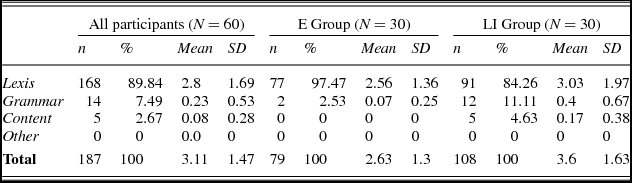
Our first research question asked about the aspects of language the participants would notice while writing. Table 2 shows that the learners noted a total of 187 PFNs; the average is 3.11 PFNs per participant, which is slightly lower than Hanaoka's (Reference Hanaoka2007) 3.5 PFNs per participant. Moreover, those features were overwhelmingly lexical (89.84%), which suggests that the learners’ attention at this stage was primarily focused on finding the right words to express their ideas.
Frequencies and Proportions of PFNs

Note: E = elementary; LI = lower intermediate.
Looking at between group differences, lower-intermediate learners noted significantly more PFNs than elementary learners (t(49) = 2.07, p = 0.04). In addition, a MANOVA test was conducted to analyze the effect of proficiency on the groups’ means for each of the categories (i.e., lexis, grammar, and contentFootnote 1). The multivariate (Wilks's lambda test statistics = 0.79, F(3,56) = 4.85, p = 0.00), and univariate tests revealed that there were significant differences in the grammar (F(1,58) = 6.42, p = 0.01) and content (F(1,58) = 5.80, p = 0.02) categories. These results suggest that although both elementary and lower-intermediate learners were mainly concerned with finding the appropriate vocabulary, the students with a higher proficiency also paid attention to other aspects.
Data were further analyzed to check for significant differences between the various treatment groups at each proficiency level. One-way ANOVAs were conducted to analyze whether there were significant differences between the three treatment groups in the amount of PFNs noticed, and no significant differences were found in the elementary (F(2,27) = 1.43, p = 0.26) or in the lower-intermediate levels (F(2,27) = 0.26, p = 0.77). MANOVA tests were used to check for significant differences in the type of PFNs noticed by the different treatment groups at each proficiency level, but none rendered significant differences (Wilks's lambda test statistics = 0.73, F(2,27) = 1.73, p = 0.2 in the elementary group and Wilks's lambda test statistics = 0.73, F(6,50) = 1,08, p = 0.39 in the lower-intermediate group). This indicates that the learners assigned to each of the treatment groups were initially similar in their focus of attention.
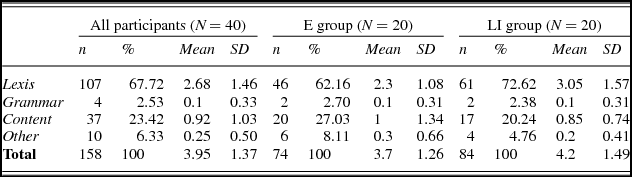
Our second research question asked about what aspects of language the participants noticed while comparing their texts to the models provided and whether there would be any difference between the GN and UN groups. As seen in Table 3, the learners noted 158 FNs (mean = 3.95), and consistent with Stage 1 noticing, the largest proportion of FNs was lexical (67.72%). However, one difference was that almost 24% of the FNs were related to content and expression.
Frequencies and Proportions of FNs

Note: E = elementary; LI = lower intermediate.
A t test showed that although lower-intermediate students noticed more FNs than the elementary students, this difference was not statistically significant (t(37) = 0.75, p = 0.46). Similarly, a MANOVA revealed that the students’ proficiency did not have a significant effect on the nature of the categories (i.e., lexis, grammar, content, or other), so they focused their attention on (Wilks's lambda test statistics = 0.89 F(4,35) = 1.02, p = 0.41).
Data were also analyzed to check for significant differences between the treatment groups at each proficiency level: t tests were conducted to determine whether the means of the FNs noticed by the GN and UN groups differed. Although the GN group noticed more FNs than the UN group, the differences were statistically significant neither in the elementary (t(17) = 1.56, p = 0.13) nor in the low-intermediate groups (t(17) = 2.03, p = 0.06). Univariate tests revealed that the elementary GN group focused significantly more on content (F(1,18) = 4.84, p = 0.04), whereas the lower-intermediate GN group focused significantly more on lexis (F(1,18) = 15.94, p = 0.00), when compared to their corresponding UN groups.
A total of 65 FNs (about 41%) were related to Stage 1 PFNs. These mainly involved the noticing of words that the participants wanted to use in their original compositions but did not know in English or that they misspelled. On the other hand, the 93 FNs (about 59%) that were not related to the Stage 1 PFNs represented the noticing of new content and alternative ways of expression.
In order to answer our third research question (What are the effects of Stage 1 and Stage 2 noticing on subsequent revisions?), the 187 PFNs noticed by the students in Stage 1 were first classified as either solvable or unsolvable. Out of those 187 PFNs, 140 (74.87%) were solvable and 47 (25.13%) unsolvable. In line with previous results, an overwhelming number of the solvable PFNs in this study were lexical (n = 128), while those in the grammar (n = 7) and content categories (n = 5) together made up less than 10% of the total.
The learners in the treatment groups noticed 63.33% of the solutions and incorporated 71.93% of them in the revision task. Moreover, 12 participants (7 elementary and 5 lower intermediate) incorporated 15 additional lexical items in their revisions without noting them in the comparison stage, pointing at incomplete note-taking. The learners in the control groups, on the other hand, incorporated 4 out of the 27 solvable PFNs (14.81%). The difference between the treatment and the control groups was significant (z = 2.88, p = 0.00): Learners in the treatment groups incorporated significantly more PFNs than those in the control groups (z = 2.88, p = 0.00), thus confirming the effectiveness of models as a form of feedback and discarding the influence of task repetition.
In addition, data from the treatment groups were further analyzed to determine whether proficiency had a significant effect on Stage 2 noticing and Stage 3 incorporation of solvable PFNs. Although the students in the lower-intermediate group noticed and incorporated more solvable PFNs, this difference was not significant either in Stage 2 noticing (z = −1.88, p = 0.06) or in Stage 3 incorporation (z = −1.10, p = 0.27) at the α = 0.05 significance level.
Moreover, the performance of the treatment groups at each proficiency level was analyzed to assess the effect that quality of noticing could have had on the noticing and incorporation of solvable PFNs. At the elementary level, the UN group noticed (z = −2.44, p = 0.02) and incorporated (z = −3.45, p = 0.01) significantly more solutions to PFNs than the GN group. At the lower-intermediate level, the GN group noticed and incorporated more features, but the difference with the UN group was not significant (for noticing: z = 0.42, p = 0.67; for incorporation: z = 1.03, p = 0.30).
Our fourth research question wondered about the learners’ attitude toward models and how this attitude could affect performance. We obtained the mean scores of the participants’ answers to three 5-point Likert scales that measured (a) the learners’ eagerness to receive the models, (b) their level of enjoyment while using them, and (c) their appreciation of their usefulness as a form of feedback. The participants in this study were not very motivated (M = 2.42, SD = 1.03) to read the models. This contrasts with the findings in Hanaoka (Reference Hanaoka2007), where the mean score in the same scale was 4.3 (SD = 0.86). However, a one-way ANOVA revealed that there were significant differences in the students’ willingness to receive the models (F = 5,10; df = 3; p = 0.00), and the t tests conducted post hoc showed that the elementary UN group was significantly more eager than the other three groups—namely, the elementary GN group (t(17 = 4,57; p = 0.00), the lower-intermediate UN group (t(18) = 2,52; p = 0.02), and the lower-intermediate GN group (t(17) = 2,36; p = 0.03)—to read the models and to use them as a form of feedback. No significant differences were found among the rest of the groups.
As for the usefulness and enjoyment of modeling, the students’ answers revealed that although they found the models quite useful (M = 3.46, SD = 1.07), they did not really enjoy them (M = 2.7, SD = 0.97). A qualitative analysis of the responses was valuable to obtain a more detailed picture of these beliefs. Many participants reported that model texts offered them the opportunity to learn new vocabulary, forms of expression, and ideas on content. However, a few other participants stated that the English level of the models was too high, and that this made it difficult for them to correct their writings. Even the participants who valued the activity referred to the usefulness of models rather than to the interest the activity itself arose in them. Only 37.5% of the participants answered that they would like their EFL teacher to use this feedback method in the future. Many referred to their lack of interest in writing in general, to their lack of motivation to learn English, and to their self-efficacy beliefs. Thus, the learners’ attitudes seem to be influenced by many factors other than the nature of the feedback technique itself.
Finally, two multiple regression tests were conducted to analyze the effect learners’ attitude had on noticing and incorporation. The tests showed that although there was not any significant correlation in the number of FNs in Stage 2 (F = 0.504; df = 4; p = 0.72), there was a significant correlation in their incorporation (F = 2.95; df = 4; p = 0.03). Thus, those participants who rated models higher in terms of entertainment and those who said they would like their teachers to use this feedback method were found to have incorporated significantly more features in their revisions.
DISCUSSION
The main goal of this study was to investigate what language features adolescent EFL learners noticed and incorporated when engaged in a three-stage writing task and what their attitudes were toward models as a feedback technique. Our findings suggest that (a) learners notice gaps in their interlanguage when producing written output and processing feedback and that (b) most of this noticing is lexically driven. In the composing stage, the problems were often formulated in terms of lack of knowledge or potential solutions to the problems encountered, while in the comparison stage, they were expressed in terms of awareness of the problems. This concern with lexis fully confirms the data reported by Hanaoka (Reference Hanaoka2007) and other studies investigating attentional processes in free-writing tasks (e.g., Cánovas Guirao et al., Reference Cánovas Guirao, Roca de Larios and Coyle2015; Coyle & Roca de Larios, Reference Coyle and Roca de Larios2014).
Such a lexical bias could be an artefact of two main factors. First, it may be the consequence of learners operating with limited processing capacities (VanPatten, Reference VanPatten1996), thus searching for content words first and focusing on grammatical forms only if their resources are not fully depleted. Second, the “priming” effect of output (Izumi, Reference Izumi2003) may have pushed the participants to address the holes they noticed while composing by looking for relevant word forms in the two models. Nevertheless, it should be noted that during the comparison stage, learners also noticed new gaps in their original output and that, indeed, increased attention was paid to the content of the texts and their expression. These results are in line with Hanaoka (Reference Hanaoka2007) and Martínez Esteban and Roca de Larios (Reference Martínez Esteban and Roca de Larios2010) and indicate the useful role of models to promote noticing and to diversify participants’ concerns.
As for the effect of noticing on subsequent revisions, the results indicated that the participants in the treatment groups noticed about two-thirds (63.33%) of the solutions available, which points at a strong relationship between Stage 1 and Stage 2 noticing. These findings are in line with Coyle and Roca de Larios (Reference Coyle and Roca de Larios2014) and Hanaoka (Reference Hanaoka2007), who observed that what learners noticed while composing greatly influenced what they paid attention to in the comparison task. From a psycholinguistic perspective, this can be explained with the Zeigarnik (Reference Zeigarnik and Ellis1999) effect—incomplete tasks create anxiety in the human mind and thus tend to be retained in memory better. Similarly, this effect may also predict the incorporation and retention of solutions in subsequent revisions. In this study, after noticing nearly two-thirds of the solutions available, the participants who had access to the models incorporated almost 72% of the relevant forms even though the models and the noticing sheet were taken away. Similar results were also found by Hanaoka (Reference Hanaoka2007). This seems to indicate that apart from engaging learners in the noticing of gaps and in the search for solutions, output serves to encourage learners to incorporate the solutions identified.
Another important finding was that while the learners in the control groups provided a solution to 14% of the problems identified in Stage 1, those in the treatment groups incorporated a relevant form in 45% of the cases, ruling out task repetition effects (Cánovas Guirao et al., Reference Cánovas Guirao, Roca de Larios and Coyle2015). Moreover, it should be noted that the learners who were provided with models incorporated other additional features they did not identify as problematic while producing output. This may indicate that models, as opposed to other error correction, are useful to provide learners’ with alternative lexis, forms of expression, and content.
The data in this study showed that the more proficient group noticed significantly more PFNs in the composing stage and that the learners’ focus of attention was more varied because the lower-intermediate learners noticed significantly more grammatical and content features than the elementary learners, who almost uniquely focused on lexis. Similarly, in the Stage 2 comparison task, higher-proficiency learners noticed more features. However, the difference was not significant in this case, and there were no differences in the nature of the FNs. Moreover, although the more proficient group noticed and incorporated a higher percentage of solutions to their PFNs, the difference was not significant. Consequently, these results add only partial support to previous studies that showed that more advanced learners produced more LREs and understood their nature better (Hanaoka, Reference Hanaoka2007). Nevertheless, it seems to suggest that spontaneous form-focused tasks using models may be more beneficial for students with a higher proficiency than those in the present study.
The results of the study showed that the GN groups both at the elementary and lower-intermediate levels noticed more features in the comparison stage. Although the difference did not reach significance, there seems to be a tendency for guidance to promote noticing.
The results also showed that guided note-taking was particularly useful in the lower proficiency levels to help learners direct their attention to aspects other than lexis, since the participants in the GN group noticed significantly more content features than those in the UN group, who mostly focused on lexis. This finding seems to support Yang and Zhang's (Reference Yang and Zhang2010) claim that learners with a lower proficiency level have to be guided and trained in their noticing and processing of feedback.
Nevertheless, the effect of guidance in the incorporation of solutions to Stage 1 PFNs is less straightforward. On the one hand, data from the lower-intermediate group showed that, even if the difference did not reach significance, the GN group incorporated more features than the UN group. On the other hand, the results in the elementary group indicated that, at this level, learners who did not receive any guidance incorporated significantly more solutions to Stage 1 PFNs than those who received guidance. As a consequence, it may seem that the study lends partial support to, or even contradicts, Qi and Lapkin (Reference Qi and Lapkin2001), who had claimed that noticing with comprehension was associated with greater intake. However, the findings should be interpreted with caution, since they might have been influenced by other factors.
First, as Hanaoka (Reference Hanaoka2006a) and Sachs and Polio (Reference Sachs and Polio2007) acknowledged, it is possible that even noticing with understanding needs some rehearsal in order to be incorporated in long-term memory. This would highlight the importance of designing extended practices and activities to reinforce the linguistic forms noticed. Second, it may be the case that Santos et al.’s (Reference Santos, López-Serrano and Manchón2010) method was not effective enough to represent awareness at the level of understanding. Learners in the GN group might have completed the task by simply identifying the differences between their output and the models without engaging in a deeper level of understanding.
Third, the analysis of the students’ attitudes toward modeling showed that the elementary UN group was significantly more motivated than the rest of the groups to receive the models. This might have resulted in a deeper noticing and processing of the feedback, which could explain why this group noticed and incorporated significantly more features.
The results of the study showed that participants had a rather negative attitude toward modeling and writing. The Likert scale that measured their willingness to compare the writings with the models revealed their reluctance to receive this type of feedback, which contrasts with the high motivation levels showed by the participants in Hanaoka (Reference Hanaoka2007). This difference could be due to the age of the learners in the two studies: undergraduate students in Hanaoka (Reference Hanaoka2007) and adolescents in the present study.
The answers to the exit questionnaires also showed that although the students found the models useful to learn new vocabulary and ways of expression, most of them did not enjoy the activity because it was long and boring. In this sense, operationalizing noticing in the form of note-taking might have added an extra physical demand that negatively affected learners’ attitude. Because of all these reasons, more than half of the participants (62.5%) reported that they would not like their teachers to incorporate this type of feedback in their teaching practices.
However, the qualitative analysis of the responses revealed that this negative attitude was influenced by many other factors that were not intrinsic to the technique: the students’ lack of interest in writing, their lack of motivation to learn English, their low self-efficacy beliefs, the secondary role they think writing plays in L2 development, and the feedback conventions shaped by previous language instructions. The large majority of the students reported not having used this technique before.
Furthermore, the quantitative analysis carried out indicated that those students who showed a more positive attitude toward modeling incorporated more features in subsequent revisions. These results add support to Hyland (Reference Hyland and Manchón2011), Kormos (Reference Kormos2012), and Storch and Wigglesworth (Reference Storch and Wigglesworth2010), who claimed that writing, noticing gaps, and engaging in problem-solving tasks are laborious activities that require extensive engagement and high levels of motivation for learning to occur.
CONCLUSION
The present study investigated the role of models as a form of CF in a three-stage writing task carried out by 60 EFL adolescent learners. The findings have highlighted the important noticing function of output, given that the learners were able to autonomously notice their language gaps—mostly lexical—to find solutions in the models provided and to incorporate them in subsequent revisions, regardless of their proficiency and of the type of guidance received. However, this group of learners showed a rather negative attitude to reading the models, although those who rated them higher in terms of enjoyment and those who would like their teachers to use this CF technique were found to have incorporated significantly more target features in their revisions. Some pedagogical recommendations could be made in light of these findings. For example, it seems crucial to assess and adapt the models to the learners’ proficiency level so that they can understand the texts without feeling frustrated and, thus, find solutions to the problems they find. Besides, considering that improving the quality of noticing is crucial to enhance the incorporation and retention of features, it would be ideal to provide learners with extended practice on how to use models and on how to allocate their attentional resources. For instance, teachers could design follow-up pair, group, or class discussions to clarify problematic issues. In addition, this collaboration could help reduce the workload involved in writing tasks, thereby prompting a more positive attitude toward writing and modeling.
The present study has certain limitations that need to be acknowledged. First, the fact that learners incorporated more features than they reported noticing points at incomplete note-taking. As a result, it is necessary that future studies triangulate the findings employing different introspective methods such as think-aloud protocols. Second, this study mainly focused on the incorporation of solutions to the PFNs noticed in Stage 1 and disregarded the incorporation of other features that may reflect an overall development of the students’ interlanguage. As a consequence, we believe that the features incorporated but not related to Stage 1 PFNs should also be tallied to obtain a more complete insight of the language learning potential of models.
Third, the future research agenda should investigate learners’ beliefs by using more sophisticated questionnaires, interviews, observations, or diaries, since these individual differences seem to have a great influence on the relationship between noticing and language learning. It should also consider whether more detailed guidance than the one provided in this study would lead to higher noticing quality. Finally, the results of the study may be regarded as evidence of uptake rather than acquisition. Future studies should use longitudinal designs to investigate the long-term effects of modeling as well as the evolution in learners’ beliefs as they become more familiar with the feedback technique.
Acknowledgments
The first author acknowledges funding from grant IT904-16 (Basque Government) and UFI11/06 (University of the Basque Country, UPV/EHU). Both authors are grateful to Oiartzo Batxilergo Ikastola, IES Usandizaga-Peñaflorida-Amara BHI and all the students who made this project possible. Thanks also go to Vicente Núñez Antón (Department of Econometrics and Statistics, University of the Basque Country) for his assistance with the statistical analysis.
APPENDIX A. VISUAL STIMULI
Write a text in response to the pictures you see. Use Sheet 1 to write the text and Sheet 2 to write down all the difficulties you face while doing the exercise.

Sheet 1
Write a text describing the set of pictures given to you in this sheet.
Sheet 2
Please write down any difficulty or doubt that you may have had when writing the text. You can use the following expressions if you find them useful, but you can also use your own words:
• I do not know how to say/write ______ in English.
• I wrote ______, but I am not sure if this is correct.
• What is the past tense of ______?
• I am not sure whether the picture is describing ______ or ______.
APPENDIX B. THE MODELS
Compare the following models with your own text. What differences do you notice? Use Sheet 3 to write down the differences.
A (Native speaker)
At home, a boy is lying on the couch playing video games. He is staring at the screen and focusing on doing the best he can. In the park, two young children are playing on swings. The girl is sitting normally, while the boy is swinging face-first. Nearby, a group of kids is rolling a large rubber ball around the playground. Smiling and laughing, they seem to be enjoying themselves as they draw the envy of the rest of the kids. Back inside, a boy is working on a laptop. Listening to headphones, he might be playing a game for fun or working with a study tool. Another boy is sitting on the floor watching television. While enjoying the program, he is also sipping a drink from his cup. On a lawn outside, three girls are playing with hula hoops. They are certainly having a good time as they try to keep the hula hoops up as long as possible. However, it can be a challenging activity, as two of the girls are finding it difficult.
B (Proficient L2 speaker)
In the first picture, a 10-year-old boy is sitting on a sofa playing computer games. He looks bored, maybe due to the fact that he is playing alone indoors, probably at home. In the second one, two kids are playing on swings in a park. There is a big field and a forest in the background of the picture. In the following photograph, a group of children is playing with a big ball in a park. In the background of the image we can see more children and some adults supervising them as well. In the fourth photo, a boy is studying or playing with a laptop. He has got some headphones, thus he may be listening to music too. The kid seems to be in the kitchen because there is a microwave behind him. In the next picture, a little boy is watching TV while having a drink. There are some toys and a handcraft on the floor, so he could be in a playroom. Finally, three girls who may be siblings or friends are playing with the hula hoops. They may be on holidays in a campsite, as there are some tents at the background.
APPENDIX C. SHEET 3: UNGUIDED NOTICING GROUP (UNG)
Please compare your text with the two models provided (A and B) and note down all the differences that you find. You can use the following expressions if you find them useful, but you can also use your own words:
• I could not say/write the word ______, but A/B puts it this way ______.
• I have expressed the idea ______ this way, but A/B puts it this way ______.
• I thought the past tense of the verb ______ was ______, but A/B writes it this way ______.
APPENDIX D. SHEET 3: GUIDED NOTICING GROUP (GNG)
Please compare your text with the two models provided (A and B) and note down all the differences that you find following the table below.