

CASE STUDY
The subject of the case study is a 45-year-old woman, with a history of chronic abdominal pain secondary to severe uterine endometriosis. The surgical management approach chosen was hysterectomy and bilateral salpingo-oopherectomy, facilitated by laparotomy. A general anaesthetic was performed, and post procedure the patient was transferred to the Post Anaesthetic Care Unit (PACU) with a Laryngeal Mask Airway (LMA) in place. After ∼5 minutes the patient began to regain consciousness and expelled the LMA, assuming control of her protective reflexes (coughing, swallowing) and maintaining her own airway. It was at this point that the patient began to look distressed; she was agitated, restless and began to hold her abdomen at the laparotomy site.
PAIN
Pain is described by the International Association for the Study of Pain (IASP) as ‘an unpleasant sensory and emotional experience associated with actual or potential tissue damage or described in terms of such damage’ [Bonica, Reference Bonica1979, p. 250].
The pathophysiology of pain is complex and uniquely subjective to the individual experiencing it [Shaw, Reference Shaw2006]. One patient's severe pain is another's discomfort and no two persons will have an equal pain experience [MacLellan, Reference MaClellan2006].
Tissues in the body contain nociceptors that are specialised sensory nerves; damage to local tissue causes electrical impulses to travel from the nociceptors along synaptic pathways to the dorsal horn of the spinal cord where they are modulated according to an individual's own characteristics such as tolerance and threshold [O'Hara, Reference O'Hara1996]. At this junction or ‘gate’, impulses can be blocked or allowed to pass via the central nervous system to the thalamus, where defensive mechanisms are enacted, either by sensory – ‘that is painful’, or motor – recoil from danger [Watt-Watson and Donovan, Reference Watt-Watson and Donovan1992], or a combination of both.
Acute pain is described as occurring recently, usually having a finite existence and an established cause [Spacek, Reference Spacek2006]. The pain experienced following major abdominal surgery is nociceptive, arising from the physical trauma of the operation [MacLellan, Reference MaClellan2006].
Generally the time span for acute pain healing is considered to be weeks to months [Loeser and Melzack, Reference Loeser and Melzack1999].
When acute pain is experienced for a sustained period, the nociceptors and nerve pathways are exposed to inflammatory mediators for an extended time, leading them to become sensitised both peripherally and centrally. This in turn creates a heightened sensitivity to painful stimuli and a reduced discriminatory threshold to the stimulation [Malow and Olson, Reference Malow and Olson1981]. The IASP describe chronic pain as that which persists after the time expected for natural healing [Merskey and Bogduk, Reference Merskey and Bogduk1994], in fact chronic pain could last indefinitely, with symptoms only able to be managed.
PELVIC PAIN
Endometriosis is a prevalent disease of child bearing aged women [Hansen et al, Reference Hansen, Chalpe and Eyster2010]. Endometriosis is a condition whereby cells from the inner lining of the uterus (endometrium) migrate and are detected outside the uterus. The endometrial cells continue to be influenced by a hormonal cycle and haemorrhage regularly, eventually forming fibrotic lesions and sometimes so-called ‘chocolate cysts’, which, if ruptured, can cause severe tissue adhesion [Chamberlain and Hamilton-Fairley, Reference Chamberlain and Hamilton-Fairley1999].
A common symptom of endometriosis is severe pain, which impacts on all activities of daily living. Hansen et al [Reference Hansen, Chalpe and Eyster2010] discuss the possible links between endometriosis and pain, acknowledging the mystery surrounding the specific mechanisms involved, but suggested that abnormal tissue growth associated with recurring haemorrhage and fibrotic development is a process with a high degree of suspicion [The Practice Committee of the American Society for Reproductive Medicine, 2008].
The diagnosis of endometriosis and subsequent commencement of appropriate treatment varies greatly. A study in New Zealand by Huntington and Gilmour in Reference Huntington and Gilmour2005 discovered that significant delays in diagnosis of 5 to 10 years were not uncommon given the range of conditions presenting with similar symptoms.
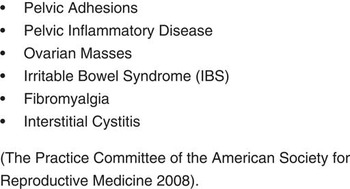
Conditions presenting a differential diagnosis to endometriosis.

Seventy percent of women presenting with chronic pelvic pain will have endometriosis as an element of their diagnosis [The Practice Committee of the American Society for Reproductive Medicine, 2008].
PSYCHOSOCIAL INFLUENCES
The pain experience is not centred on physical phenomena alone. There is a complex cycle of past experiences, emotions, spiritual beliefs, and social factors in motion. By acknowledging the influence that the psychological component of the pain experience can have, the patient can be cared for in a more holistic manner [Hansen and Streltzer, Reference Hansen and Streltzer2005].
The human emotional processing centre is contained within the limbic system, it is here that the electrical impulses emanating from the injury are processed and modulated into an emotional feeling. Hansen and Streltzer [Reference Hansen and Streltzer2005] postulated that by performing a frontal lobotomy, a human would still be aware of a painful stimulus but would not relate any emotional meaning to it and therefore would not perceive it as a painful experience.
Past experiences guide human development and influence the future directions taken. The patient had experienced moderate pain with cyclical worsening on a daily basis for 3 years. The pain had impacted on her personal and social relationships, and subsequent withdrawal from the local community.
PAIN ASSESSMENT IN PACU
Patient sedation is a challenging aspect of successful pain assessment in the PACU [Heikkinen et al, Reference Heikkinen, Salanterä, Kettu and Taittonen2005]. A common misconception is that post-anaesthetic patients are asleep, when in fact they are emerging from a chemically induced coma [Hatfield and Tronson, Reference Hatfield and Tronson2008].
Regular and appropriate pain assessment is essential for achieving a satisfactory patient management outcome [Malviya et al, Reference Malviya, Voepel-Lewis, Burke, Merkel and Tait2006]; however, achieving this in reality is a complex task [McCaffrey, Reference McCaffrey1983]. Brown [Reference Brown2008] believes that by using a pain assessment tool effectively, the nurse is empowering the patient to give an objective description of a subjective situation, with the nurse facilitating using simple adjectives. Even though the patient may use their own descriptive terms, they can usually be correlated against the assessment tool. Exploring and assessing the patient's feelings and emotions is an important step in establishing a therapeutic relationship [Brown, Reference Brown2008]. Herr et al [Reference Herr, Coyne and Key2006] believe that self-reporting of pain by the patient should be the gold standard.
The pain assessment tool used in the Author's PACU is a Verbal Rating Scale (VRS), whereby the patient is asked to describe their pain using 1 of 5 adjectives: none, mild, moderate, severe or excruciating. This particular pain assessment tool is used throughout the adult services of the entire local healthcare organisation, by the different professions (nursing, medicine, physiotherapy). This allows for continuity of care throughout the entire patient journey continuum; Koya-Rawlinson [Reference Koya-Rawlinson2009] believes that continuity is a key ingredient.
The advantages of the VRS are its relative simplicity, the speed by which it can be used and interpreted and its almost universal application. The tool does have disadvantages; the one-dimensional perspective, focusing entirely on intensity and ignoring other aspects such as the area affected, and the psychological impact, so-called multi-dimensional pain assessment. However, in a critical environment such as the PACU where patients often present with severe pain, delaying treatment to perform a complex pain assessment is unjustifiable [Brown, Reference Brown2008].
It must however be appreciated that the PACU nurse should remain mindful that patients are individuals and as such have their own unique characteristics and issues [Brown Reference Brown2008].
When the patient emerged from anaesthesia it became quickly evident that even though she was not fully conscious she was in severe discomfort. She was displaying non-verbal signs of pain; including guarding of the abdomen, groaning, crying and agitation. A Checklist of Non-verbal Pain Indicators (CNPI) has been developed for use with cognitively impaired adults suffering from dementia [Feldt, Reference Feldt2000] and for unconscious patients in the intensive care unit [Odhner et al, Reference Odhner, Wegman, Freeland, Steinmetz and Ingersoll2003], however, the author believes that it is entirely feasible to use the principles of the tool to assess semi-conscious patients rousing from anaesthesia [Wicker and O'Neil, Reference Wicker and O'Neil2010].
PAIN ASSESSMENT BARRIERS IN THE PACU
A paper by Brown [Reference Brown2008] acknowledges that there are varied components that affect appropriate pain assessment in the PACU setting, such as age, comprehension and cognitive factors. As well as the effects of anaesthesia, sedation, stress, trauma, sleep deprivation and the attitudes and competency of the assessor. The only method to overcoming some of these barriers is the provision of appropriately trained professionals, who take the time to listen and properly assess patients presenting with these factors. It is also important for those assessing pain to try and disassociate their own personal pain experiences and remove any prejudices from the assessment process [MacLellan, Reference MaClellan2006].
IMMEDIATE PAIN MANAGEMENT
The management of pain should begin in the operating theatre with the anaesthetist administering regular analgesia throughout the procedure, and appropriate use of local anaesthetic infiltration by the surgical team. However, acute pain remains problematic in the PACU [Ene et al, Reference Ene, Nordberg, Sjöström and Bergh2008].
The provision of analgesia is a primary responsibility of the PACU nurse [Wilding et al, Reference Wilding, Manias and Mccoy2009]. Initially the author's main priority was to commence immediate analgesia administration. The anaesthetist had prescribed intravenous morphine to be titrated to effect. As a Registered Nurse with extended training and competence in the administration of intravenous opioids, and taking into account that the patient was maintaining their own airway, breathing spontaneously with oxygen saturations of 99% on 6 litres of oxygen per minute by face mask and rousable to verbal stimulus, the author prepared and administered a 2.5 milligram intravenous bolus of morphine.
OPIOID ANALGESIA
Morphine is a naturally occurring alkaloid extracted from the opium poppy. It works by binding with opioid receptors located in various body structures such as brain, spinal cord and peripheral nerve endings. Here it acts as an agonist to naturally occurring opioids and stops nerve impulse transmission at both central and peripheral levels [Macintyre and Schug, Reference Macintyre and Schug2007].
Intravenous opioids such as morphine are chosen as first line therapy in immediate post-anaesthetic care because of their rapid onset of action, making them suitable for titration and observation of effect [Aubrun et al, Reference Aubrun, Monsel, Langeron, Coriat and Riou2002].
In the Author's PACU, intravenous opioids are administered in titrated doses to achieve a satisfactory pain score for the individual patient. Five-minute gaps are left between doses to allow the drugs to reach a peak efficacy, before reassessing the patient to establish effect. The achievement of an effective opioid blood plasma level or Minimum Effective Analgesic Concentration (MEAC) is the aim of individual drug titration [Macintyre and Schug, Reference Macintyre and Schug2007].
Observing the achievement of MEAC involved continuous observation of the patient's non-verbal cues and an easing of their distress. As the patient was responsive to verbal stimulus and had stable vital signs, it was evident that they were not experiencing unwanted side effects.
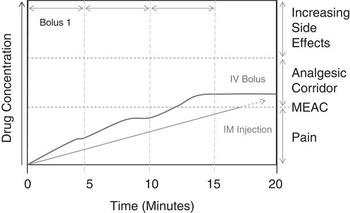
Comparison of intravenous vs. intramuscular analgesic effect (from Macintyre and Schug, Reference Macintyre and Schug2007).

The above graph demonstrates the difference in absorption rates between intravenous bolus and intramuscular (IM) injection. With the IM injection potentially even rising into the unwanted side effects zone and remaining there for some time before eventually falling away before another injection can be administered. This causes an unwanted peak and trough effect, with the patient receiving inconsistent analgesia [Krenzischek et al, Reference Krenzischek, Windle and Mamaril2004]. Therefore, it is demonstrated that the intravenous route of administration is superior in terms of analgesic onset [Krenzischek et al, Reference Krenzischek, Windle and Mamaril2004] and bioavailability – percentage of the drug that is available to be utilised in the systemic circulation [Trounce, Reference Trounce2000].
The safety of the patient is not compromised because of the close continuous monitoring and high staff–patient ratio in the PACU. However, it is important for the administering practitioner to be aware of and alert to the potential complications of opioid administration, that is, respiratory depression, sedation and nausea, risks, which are heightened due to the potency of the intravenous route [Wicker and O'Neil, Reference Wicker and O'Neil2010]. It is standard practice in the author's PACU, for all patients having opioids administered to receive supplemental oxygen.
Management of respiratory depression involves ensuring a clear airway, increasing supplemental oxygen, preparing naloxone (400 micrograms in 10 millilitres saline) and titrating slowly in 40 microgram boluses until the respiratory rate increases above 8 per minute. Care must be used, as rapid administration can cause rapid antagonism of opioids with the patient experiencing intense pain, and possible cardiovascular instability. Naloxone's duration of action is shorter than the opioid it is antagonising, so repeat administration may be required, therefore close monitoring of the patient's vital signs is required [Pasero and McCaffery, Reference Pasero and McCaffery2000].
MULTIMODAL ANALGESIA
Other drugs utilised for the patient's pain management were paracetamol and a Non-Steroidal Anti Inflammatory Drug (NSAID). Paracetamol is taken widely throughout the world for analgesia although its exact mechanism of action is uncertain [Groudine and Fossum, Reference Groudine and Fossum2011]. Paracetamol is available in the author's PACU as an intravenous infusion (1 gram in 100 millilitres) and administered over a minimum of 15 minutes. Care has to be taken that the patient weighs more than 50 kilograms due to high bioavailability and potential hepatoxicity in prolonged use, for patients between 33 and 50 kilograms, a reduced dose is required [MHRA, 2010].
The NSAID prescribed and administered was Ketorolac. NSAID's mechanism of action is thought to centre on the inhibition of prostaglandin and other inflammatory mediators, which are responsible for sensitising nociceptors following trauma. They have side effects such a gastrointestinal haemorrhage, and are therefore contraindicated in patients with gastric ulcers [Allen et al, Reference Allen, Hopewell and Prentice2004]. The use of different drugs in combination therapy is termed a ‘multimodal approach’ [Groudine and Fossum, Reference Groudine and Fossum2011, p. 74]. Multimodal analgesia was introduced to reduce the sole dependence on opioids and therefore the number of adverse occurrences, such as respiratory depression and excessive sedation associated with them [Buvanendran and Kroin, Reference Buvanendran and Kroin2009]. As well as the analgesia administered, increased use is being made of local anaesthetic infiltration at the wound site both prior to incision and wound closure by the surgeon [Buvanendran and Kroin, Reference Buvanendran and Kroin2009].
NON-PHARMACOLOGICAL INTERVENTIONS
Evidence from the literature suggests that the pre-operative education of patients is essential for successful pain outcomes. The content of this education is vitally important, with emphasis placed upon what the patients can do for themselves in terms of positive attitude and coping strategies. Over enthusiastic discussion about the actual pain experience is shown to increase the post-operative distress endured [Melzack and Wall, Reference Melzack and Wall1988; Macintyre and Schug, Reference Macintyre and Schug2007].
A study by Kain et al in Reference Kain, Sevarino, Alexander, Pincus and Mayes2000 examined the relationship between pre-operative anxiety and post-operative pain in women undergoing hysterectomy. From a sample size of 53 women treated for non-malignant disease, it was shown that there was a correlation between pre-operative anxiety and post-operative pain, however, in the women who displayed pre-existing anxiety traits there was no additional increase in their pain experience. Thus, demonstrating the need for effective anxiety reduction, in terms of education and the promotion of coping strategies. The authors of the study acknowledge that the degree of anxiety will differ between patients and their individual circumstances [Kain et al, Reference Kain, Sevarino, Alexander, Pincus and Mayes2000].
The author concedes that not all pre-operative information will be retained by the patient after surgery, but feels this places the PACU nurse in a strong position to reinforce the coping strategies taught preoperatively, for example, positive mental attitude, deep-breathing, relaxation, distraction, etc. These techniques were used by the author to help the patient to relax and take control of her pain. It was also important for the author to maintain a sense of realism in the fact that the patient had pre-existing chronic pain, and the author would not be able to remove all of her discomfort, but also remain positive and reassure the patient that it was possible to achieve a bearable pain state.
PATIENT CONTROLLED ANALGESIA (PCA)
Once the patients’ pain had become more bearable, the issue of maintaining this state needed to be addressed. The Anaesthetist had already discussed the options for post-operative pain relief with the patient so the commencement of a PCA system did not surprise her. PCA describes the use of an electronic medical device by patients to administer their own intravenous opioid medication, in small regular boluses, on demand [Parsons and Preece, Reference Parsons and Preece2010]. PCA is known as a maintenance therapy, and therefore it is of critical importance that the patient's pain is bearable before it is commenced [Rawal, Reference Rawal1998].
Inherent in the concept of PCA is its integrated safety features to prevent adverse occurrences. The drug concentration, drug bolus, dose duration and inter bolus lock out period are all programmed and dual practitioner checked upon set-up. The syringe containing the opioid is locked behind a clear plastic panel, and key access is required before re-programming of the pump can occur [Heath and Thomas, Reference Heath and Thomas1993]. Once the patient is connected and given the handset they are empowered to control the administration of their own analgesia. In the patient's case the syringe contained morphine and she could demand a bolus every 5 minutes, with the author continuing to monitor and document her respiratory rate, sedation, pain and nausea scores regularly to evaluate the therapy's effectiveness and detect potential complications early. However, a fundamental safety principle of PCA is that if the patient became drowsy due to the medication then they would cease to make demands on the handset and therefore not receive further boluses [Heath and Thomas, Reference Heath and Thomas1993]. Therefore, only the patient should use the handset.
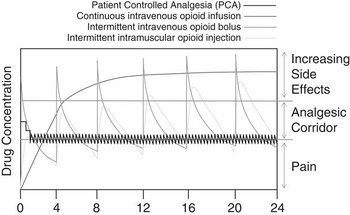
The graph below represents the efficacy of PCA compared with continuous intravenous opioid infusion, intermittent intravenous opioid bolus and intermittent IM opioid injection.
Demonstration of the effectiveness of PCA at maintaining MEAC (from Macintyre and Schug, Reference Macintyre and Schug2007).

It demonstrates the ability of PCA to maintain analgesic plasma concentrations inside the therapeutic window, and also the wide variation in the effect of the other methods [Macintyre and Schug, Reference Macintyre and Schug2007].
It is important to note that PCA is not the sole form of pain management and other forms of analgesia should continue such as regular paracetamol and a NSAID. Once the pain has eased, the intravenous opioid can be stepped down to an oral opioid preparation such as dihydrocodeine or tramadol [Macintyre and Schug, Reference Macintyre and Schug2007].
CONCLUSION
By examining the immediate post-operative care provided, the author has highlighted the case of a patient with pre-existing chronic pain being admitted to hospital for major surgery, and how their acute pain experience is influenced by their chronic condition, and their own personal psychology. The importance of effective and appropriate pre-operative education cannot be understated.
Even though the profile of pain management and awareness amongst healthcare professionals has increased over the years, as well as the level of understanding regarding the mechanisms of pain, along with new types and applications of drug and adjunct therapies, the problem of post-operative pain persists.
Pain assessment tools are critical in establishing an effective nurse–patient relationship in an area of nursing where contact time is limited, and swift competent assessment is required.
It is important to be mindful that pain is a uniquely subjective experience and remember that pain is; ‘whatever the experiencing person says it is and exists whenever he says it does’ [McCaffery, Reference McCaffery1968]. However, it should be acknowledged that even a patient who cannot verbally communicate can display signs of pain and discomfort.