Cardiovascular physiologic changes in pregnancy include increases in stroke volume, heart rate, and circulating blood volume. Reference Sanghavi and Rutherford1 While pregnancy is well tolerated by many women with cardiovascular disease, there are risks, including arrhythmia, heart failure, and thrombotic events. Reference Silversides, Grewal and Mason2,Reference Drenthen, Boersma and Balci3 Therefore, risk stratification and careful monitoring are essential for pregnant women with cardiovascular disease. Reference Mehta, Warnes and Bradley4,Reference Regitz-Zagrosek, Roos-Hesselink and Bauersachs5 Guidelines recommend routine echocardiographic monitoring for many of these women, but there are limited data about the real-world impact of echocardiography on clinical care. Reference Mehta, Warnes and Bradley4,Reference Regitz-Zagrosek, Roos-Hesselink and Bauersachs5
Echocardiography is a validated, safe way to assess changes in cardiac structure and function, but it is not without costs to patients and the healthcare system. Reference Marwick6,Reference Petersen, Friebel and Ferrari7 Efforts outside of pregnancy have focused on minimising its use in situations in which it has low utility. Reference Douglas8 Currently, there are little data to guide clinical decisions about the timing and frequency of echocardiography in pregnancy. Given the current focus on maximising quality and safety while minimising excess procedural costs, such data are essential for optimal clinical management.
Echocardiographic changes such as increases in cardiac chamber size and minor increases in valvular regurgitation are known to occur in healthy pregnant women, and increases in valve gradients and declines in ventricular function have been described in some pregnant women with cardiovascular disease. Reference Savu, Jurcut and Giusca9–Reference Samiei, Amirsardari and Rezaei13 The frequency at which these changes are seen in pregnancy and the impact of echocardiographic findings on clinical management is not well defined.
In this observational study performed in a tertiary referral centre population, we examined echocardiographic changes in cardiac structure and function in pregnant women with cardiovascular disease, with a specific focus on CHD, as it is the most common diagnosis subgroup among pregnant women with heart disease. Reference Canobbio, Warnes and Aboulhosn14 We also sought to understand the impact of routine echocardiography on clinical management.
Materials and methods
We performed a retrospective review of pregnant women with known or suspected cardiovascular disease seen in the Maternal Cardiac Program at Oregon Health and Science University from 12/2016 to 7/2020. The Maternal Cardiac Program is a multidisciplinary programme consisting of cardiology, maternal foetal medicine, and anaesthesia services at an academic medical centre serving as a tertiary referral centre for Oregon, southern Washington, and parts of Idaho and Northern California. Standard practice at our institution is to order echocardiograms in the 1st (baseline) and 3rd trimesters of pregnancy for women with moderate or complex CHD, and every 4-8 weeks in women with aortopathy. The use of echocardiography for other types of cardiovascular disease is highly clinician-dependent.
Clinical data were abstracted from the electronic health record and entered into a secure RedCAP database. Major cardiovascular events were recorded and defined as sustained arrhythmia, left or right heart failure, thromboembolism, stroke/transient ischaemic attack, aortic dissection, or maternal death. Cases of preeclampsia/eclampsia and gestational hypertension were also recorded. Modified World Health Organization classification was determined based on clinical status at the beginning of the pregnancy. Echocardiograms and clinical notes were reviewed by a cardiologist to determine if each echocardiogram had resulted in a significant change in clinical management. In cases in which the rationale for changes in management were not clearly delineated in the medical record and the echocardiogram was unchanged from the prior study or normal, we recorded no change in clinical management based on the echocardiogram. Significant structural and/or functional changes between echocardiograms were noted based on the attending cardiologist interpretation at the time of the study. Images were reviewed by a cardiologist as needed for confirmation. Significant changes were defined as (1) an increase in regurgitation or stenosis by at least one grade to moderate or greater severity, (2) a decrease in left ventricular ejection fraction or right ventricular ejection fraction by ≥1 grade, (3) an increase in right ventricular systolic pressure by ≥ 10 mmHg, or (4) ≥3 mm change in aortic size. Severity of valvular regurgitation and stenosis was measured based on American Society of Echocardiography guidelines, which incorporate multiple echocardiographic parameters as opposed to relaying on gradients or valve area alone. Reference Zoghbi, Adams and Bonow15,Reference Baumgartner, Hung and Bermejo16
To facilitate comparison, analyses were performed by diagnosis groups. The following diagnosis groups were included as they were felt to be physiologically and haemodynamically distinct from one another: CHD, cardiomyopathy, aortopathy and other. Descriptive statistics were generated using STATA, and chi-square tests were used to assess for significant differences between groups (StataCorp, College Station, TX). The study was approved by the Institutional Review Board of Oregon Health and Science University.
Results
Study cohort and clinical outcomes
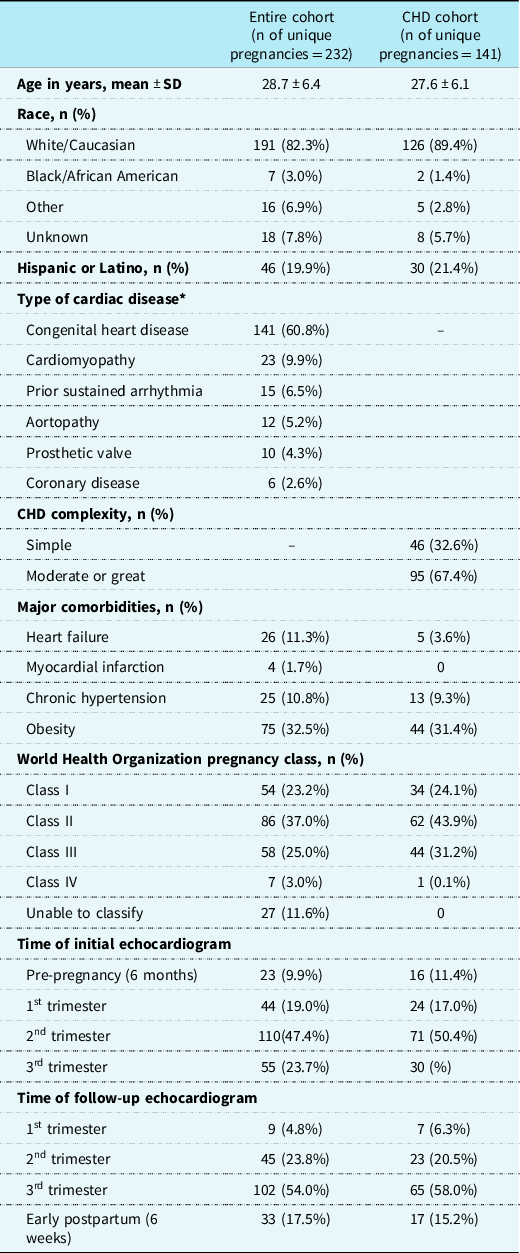
The cohort consisted of 232 pregnancies in 182 unique women. 141 pregnancies (60.8%) were in women with CHD (Table 1). The mean age at the time of delivery was 28.7 ± 6.4 years. 95 of the CHD pregnancies were in women with moderate or great complexity CHD (n = 95, 67.4%). The second most common diagnosis was cardiomyopathy (n = 23, 9.9%), followed by a history of sustained arrhythmia (n = 15, 6.5%), and aortopathy (n = 12, 5.2%). 82.3% of pregnancies were in women who identified as White (n = 191), and 19.9% (n = 46) were in women who identified as Hispanic or Latina. The most common modified World Health Organization pregnancy class was II (n = 86, 37.0%), followed by class III (n = 58, 25.0%) and class I (n = 54, 23.2%). There were seven pregnancies in women with class IV disease at the onset of pregnancy, in which pregnancy is considered contraindicated (3.0%).
Demographic and clinical characteristics by diagnosis

* Other in entire cohort: Asian: 2, Hawaiian/Pacific Islander: 5, Native American/Alaska Native: 3, Multiracial: 5.
Other types not listed due to space considerations, with n = number of pregnancies: Syncope: n = 21, frequent premature ventricular contractions: n = 7, valve disease: n = 11, heart block: n = 6, non-sustained arrhythmias: n = 5, hypertensive heart failure of pregnancy: n = 1, prior cardiac arrest: n = 1, pulmonary hypertension: n = 2.
The most common cardiovascular complication was preeclampsia or eclampsia, which occurred in 29 pregnancies (12.5%), followed by gestational hypertension in 16 (6.9%). There were 20 (8.6%) pregnancies complicated by cardiac events. Sustained arrhythmias occurred in six pregnancies (2.6%). Left and/or right heart failure occurred in 16 pregnancies (6.9%). There was one thromboembolic event (0.4%). There were no strokes or aortic dissections and no maternal mortality in this cohort.
Initial echocardiographic findings
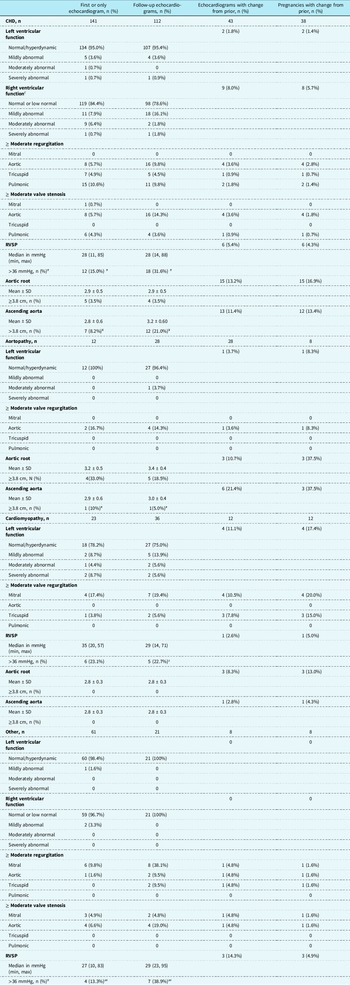
421 echocardiograms were included for analysis (Table 2). A single echocardiogram was performed in 116 pregnancies (50.2%). The remaining pregnancies had at least 2 echocardiograms (range: 1–9, median = 2). Baseline and follow-up echocardiographic findings are shown in Table 2, by diagnosis. Baseline left ventricular dysfunction was more common in the cardiomyopathy group (21.8%) than in the CHD group (5.0%), the aortopathy group (0%), or in other diagnoses (1.6%). Right ventricular dysfunction was most common in those with CHD (21.4%). There was no baseline right ventricular dysfunction in those with aortopathy or cardiomyopathy. Valvular stenosis was most common in the CHD group, with aortic stenosis being the most common subtype (5.7%). Similarly, valvular regurgitation was most common in CHD, with pulmonary regurgitation being the most common subtype (10.6%). A right ventricular systolic pressure >36 mmHg was not present in any patients with aortopathy, but was present in 15.0% of baseline echocardiograms in CHD, 23.1% in cardiomyopathy, and 13.3% of those with other types of cardiovascular disease.
Changes in echocardiographic parameters in patients with CHD, aortopathy, and cardiomyopathy as well as other diagnoses. Categories in which there were no clinically significant abnormalities were excluded. The final column denotes the number of unique pregnancies in which a change in the listed parameter was detected. Because multiple echocardiograms were done in some pregnancies, this number may differ from the number of echocardiograms

∞ RVSP = right ventricular systolic pressure.
€ Number of echocardiograms on which the right ventricular function was measurable was 140 (initial) and 110 (follow-up).
π Number of echocardiograms on which the RVSP was measurable was 80 (initial) and 57 (follow-up).
¥ Number of echocardiograms on which the ascending aorta was well visualised was 85 (initial) and 57 (follow-up).
* Number of echocardiograms on which the ascending aorta was well visualised was 10 (initial) and 20 (follow-up).
± Number of echocardiograms on which the RVSP was measurable was 14 (initial) and 22 (follow-up).
∞* Number with RVSP is 30 (initial) and 18 (follow-up).
Some patients appear in multiple diagnosis groups.
Categories omitted due to no abnormalities: valvular stenosis (cardiomyopathy), right ventricular function (cardiomyopathy), right ventricular function (aortopathy), valve stenosis (aortopathy), RVSP (aortopathy), aortic size (other).
Changes in echocardiographic findings
The study included 189 follow-up echocardiograms, 67 of which demonstrated a change in at least one significant echocardiographic parameter (35.5%). These are subdivided by the most common diagnosis groups in Table 2. Details of cases with a significant change in ventricular function, valvular regurgitation, or right ventricular systolic function are provided in Supplementary Table 1. In the entire cohort, eight (3.4%) pregnancies were complicated by a decline in left ventricular function. Nine (3.8%) were complicated by a decline in right ventricular function. Changes in left ventricular function were common in women with underlying cardiomyopathy, occurring in 17.4% of pregnancies (n = 4), but rare in those with CHD, occurring in only 1.4% (n = 2). Left ventricular dysfunction occurred in one woman with aortopathy, in the setting of a new diagnosis of peripartum cardiomyopathy. Conversely, worsening right ventricular function occurred in nine CHD pregnancies (8.0%), but was not seen outside of CHD.
A ≥10 mmHg increase in right ventricular systolic pressure was observed in 5.3% of pregnancies overall (n = 10). This represents 4.3% of pregnancies with CHD (n = 6), 5.0% of pregnancies with cardiomyopathy (n = 1), and 4.9% of those with other cardiovascular disease. There were no significant increases in right ventricular systolic pressure in those with aortopathy.
Worsening valvular regurgitation was more common than worsening valvular stenosis. Increased mitral regurgitation was seen in six pregnancies overall (4.9%), representing 20.0% of women with cardiomyopathy (n = 5) and 1.6% of women with other cardiovascular disease (n = 1). An increase in aortic regurgitation was observed in nine (7.8%) pregnancies overall, representing 2.8% of CHD pregnancies (n = 4) and 8.3% of pregnancies in women with aortopathy (n = 1). Pathologic pulmonary regurgitation was only observed in those with CHD, with 3.4% experiencing worsening pulmonary regurgitation in pregnancy. Increases in tricuspid regurgitation were rare overall (4.9%) although in women with cardiomyopathy they occurred in 15.0%. Valvular stenosis was most common in pregnancies affected by CHD and worsened in 2.8% (aortic, n = 4) and 1.4% (pulmonic, n = 2) of pregnancies, respectively. When aortic valve gradients were examined in isolation, 50% (n = 6) patients with moderate or severe stenosis at baseline had an increase in their peak gradient by ≥0.5 m/s. Of those with moderate stenosis at baseline, 67% (n = 4) had gradients which increased into the severe range during pregnancy (≥4 m/s).
Increases in the dimensions of the aortic root and ascending aorta were seen in 33 (14.2%) of pregnancies. An increase in the aortic root size was seen in 9.5% (n = 22), and an increase in the size of the ascending aorta was seen in 9.1% (n = 21) of pregnancies. These changes were most common in women with CHD (increase in size of the aortic root: 13.2% of pregnancies (n = 15), increase in size of the ascending aorta: 13.4% (n = 12)) and aortopathy (aortic root: 37.5% (n = 3), ascending aorta 37.5% (n = 3)), but were also seen in women with cardiomyopathy (aortic root: 13.0% (n = 3), ascending aorta: 4.3% (n = 1)).
There was no association between echocardiographic changes and cardiac events in pregnancy (p = 0.11). The association was significant after excluding changes in aortic size and limiting the definition of significant changes to changes in ventricular function, valvular regurgitation/stenosis, or right ventricular systolic pressure (p = 0.03).
Changes in clinical management triggered by echocardiography
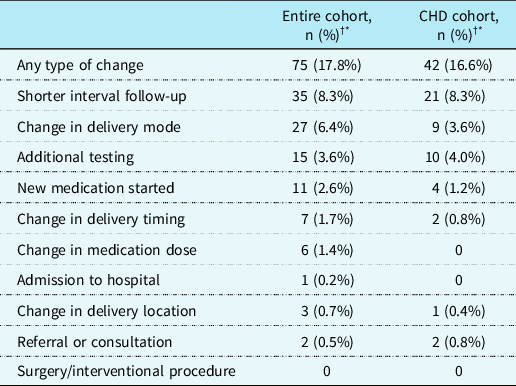
Table 3 lists the changes in management triggered by echocardiograms in the entire cohort and in women with CHD. A total of 75 (17.8%) echocardiograms in the entire cohort and 42 (16.6%) in the CHD cohort resulted in an active management change. Of the 75 echocardiograms resulting in a clinical management change, 45 were baseline echocardiograms and 30 were follow-up echocardiograms. Of the 30 follow-up echocardiograms, 16 (53%) had a change in a significant echocardiographic parameter which prompted the management changes. The remainder were unchanged from prior echocardiograms. The remaining management decisions were made based on echocardiograms which were interpreted as unchanged from the prior study. The most common management change was scheduling a shorter interval follow-up (entire cohort: n = 35, 8.3%; CHD: n = 21, 8.3%). Echocardiographic findings triggered a change in recommendations for the mode of delivery in 27 cases (6.4%), for example from assisted to unassisted vaginal or vice versa. Additional testing, such as cardiac MRI or catheterisation, was recommended in 15 cases (3.6%) in the overall cohort. Admission to the hospital, changes in delivery location, and referral or consultation to a different service were uncommon outcomes, occurring after fewer than 1% of echocardiograms.
Description of changes in clinical management triggered by echocardiography

* In some cases, more than one type of management change was made.
† Total number of echocardiograms is 421 for the entire cohort, and 253 for the CHD cohort, including both baseline and follow-p echocardiograms.
Discussion
Our study is a pragmatic examination of the impact of echocardiography on clinical care in pregnant women with cardiovascular disease. We demonstrate that most routine echocardiograms obtained in pregnant women with heart disease do not result in a change in clinical management. Of the roughly 18% of echocardiograms that did result in a management change, the most common change was shorter interval clinical follow-up. Major changes in management, such as admission to the hospital or consideration of surgery, were rare outcomes overall and were not commonly made based on echocardiographic changes. Almost half of changes in management were made after echocardiograms which were interpreted as unchanged from prior echocardiograms either during or prior to pregnancy, supporting the fact that echocardiography is most commonly utilised as an adjunct to other clinical data and not as a primary driver of clinical decision-making.
In addition to examining changes in clinical management after echocardiography, we examined changes between baseline and follow-up echocardiograms. We found that 35% of follow-up echocardiograms had a clinically significant change from the prior echocardiogram. We found no association between having a significant echocardiogram change and subsequent cardiovascular event when changes in aortic size were included. The association was significant when we excluded changes in aortic size. While this finding must be interpreted with caution given the overall low number of cardiovascular events in this study, it suggests that changes in aortic size may be more likely to be incidental or related to technical factors, as opposed to other changes which are more likely to be linked to clinically relevant hemodynamic changes.
Importantly, the fact that a minority of routine echocardiograms ordered in pregnancy result in a change in clinical management does not mean that most echocardiograms are clinically inappropriate or unnecessary. Since adverse cardiovascular outcomes in pregnancy are rare but serious events, a stable echocardiogram may play an important role in confirming the clinical management strategy and stratifying patients with respect to risk of adverse outcomes around the time of labour and delivery. Additionally, changes in management that include altering mode of delivery and timing of delivery have important maternal and neonatal health implications. In the current era of cost containment, however, it is worthwhile to examine the routine use of echocardiography with respect to overall costs and quality of care. Reference Marwick6,Reference Shaw, Blankstein and Jacobs17 Our study suggests that further studies to define which patients are most likely to benefit from echocardiography in pregnancy would be impactful and could potentially result in cost savings and a decreased testing burden for patients. Furthermore, more work is necessary to better understand the association between the use of echocardiography in pregnancy and clinical outcomes.
Like prior studies, our cohort included a heterogeneous group of women with a variety of cardiac diagnoses. Reference Silversides, Grewal and Mason2 The diversity of cardiovascular phenotypes in pregnancy presents a barrier to management standardisation, as findings can be difficult to generalise across anatomic and physiologic groups. Importantly, there are key differences between those with CHD and other types of structural heart disease. In our cohort, those with CHD were more likely to have valvular dysfunction both on the initial echocardiogram and in follow-up and were more likely to have or develop right ventricular dysfunction. This is consistent with the known range of pathologies in women with CHD and their risks in pregnancy. Reference Canobbio, Warnes and Aboulhosn14 Women with CHD were unlikely to have a decline in left ventricular function. In contrast, those with cardiomyopathy were more likely to have or develop left ventricular dysfunction than right ventricular dysfunction. Interestingly, a significant proportion of follow-up echocardiograms in women with CHD and aortopathy revealed an increase in aortic size. This finding is consistent with other studies that have shown a potential predisposition to aortic enlargement and/or dissection in certain women in pregnancy. Reference Narula, Devereux, Malonga, Hriljac and Roman18,Reference Horiuchi, Kamiya and Ohuchi19 However, these findings must be taken in the context of the known variability in aortic measurements on echocardiography. Reference Goldstein, Evangelista and Abbara20
The recognition that certain groups are at higher risk of specific echocardiographic changes is important, as it may allow for future management strategies that are less intensive of time and/or resources. For instance, dramatic improvements in ultrasound technology now allow for the use of handheld echocardiography in a variety of clinical contexts. Reference Qaseem, Etxeandia-Ikobaltzeta and Mustafa21 While its role in pregnancy has yet to be defined, point of care ultrasound directed at a specific clinical question (e.g., left ventricular or right ventricular function) may soon be a viable option for pregnant women without concerning changes in their clinical status or a need for a complete echocardiogram.
As a retrospective study based on pragmatic clinical management, our study has several limitations. Decisions about whether or not each echocardiogram changed management were made by chart review. While clinical decision-making was well-delineated in the majority of charts we reviewed, in some cases the study cardiologists needed to make judgments based on limited data. We aimed to include only echocardiograms that were obtained as part of routine clinical management, and not in the setting of acute decompensation. However, we cannot be sure that a small percentage of the included studies were done in the setting of an acute clinical concern. Lastly, this was an observational study based on management practices at a single institution. We suspect that there is significant variability across centres with respect to the frequency of cardiac imaging in pregnancy, and our findings may not be generalisable across sites or outside of United States-based populations.
To our knowledge, this is the first study to specifically examine the clinical utility of echocardiography in pregnancy. We found that in a diverse cohort of pregnant women with cardiovascular disease at an academic referral centre, a small but significant proportion of echocardiograms resulted in a change in clinical management. Given the complex physiology of cardiac disease in pregnancy, more work is needed to understand which pregnant patients truly need echocardiography and at what interval during pregnancy.
Supplementary material
To view supplementary material for this article, please visit https://doi.org/10.1017/S1047951122001135
Acknowledgements
None.
Financial support
This research received no specific grant from any funding agency, commercial, or not-for-profit sectors.
Conflicts of interest
None.