Introduction
Over 44 million adults in the United States of America (USA) represent the primary source of help for relatives or friends needing long-term care due to functional disabilities (National Alliance for Caregiving & American Association of Retired Persons, 2004), with an estimated economic value of approximately US $306 billion in 2005 (National Family Caregivers Association and Family Caregiver Alliance 2006). For the care-giver, informal care-giving is associated with increased financial challenges and opportunity losses at work (Johnson and Lo Sasso Reference Johnson and Lo Sasso2001) and declines in physical and psychological health (Navaie-Waliser et al. Reference Navaie-Waliser, Feldman, Gould, Levine, Kuerbis and Donelan2002). Eventual absence or strained family support is associated with increased use of institutional long-term care (Gaugler et al. Reference Gaugler, Davey, Pearlin and Zarit2000; United States Department of Health and Human Services and the Administration on Aging 2004).
When institutionalised long-term care is needed, the burden of cost shifts from the family to the public with Medicaid and Medicare financing 60 per cent of institutional care for older adults with chronic disabilities in the USA (Catlin et al. Reference Catlin, Cowan, Hartman and Heffler2008). To counter this potential over-reliance on and cost of institutional long-term care in the USA, policy revisions for the last 30 years have increasingly promoted supportive services for care recipients, such as the Medicaid Home and Community-Based Service Waivers programme, and for care-givers with the passage of the National Family Caregiver Support Programme (NFCSP) under the Older Americans Act (OAA) Amendment of 2000 (Doty Reference Doty2010). With the recent passage of health-care reform in the USA, many provisions offer further support to family care-givers, including increased funding for in-home care and training opportunities for both formal and informal care-givers. Furthermore, the Community Living Assistance Services and Supports Act (CLASS Act), part of the health reform in the Patient Protection and Affordable Care Act of 2010, creates a voluntary long-term care insurance that would offer a cash benefit to cover a range of community support services (The Staff of the Washington Post 2010).
Along with the USA, many other countries are responding to the needs of care-givers through national long-term care policies. Examples include the United Kingdom's Carers (Recognition and Services) Act 1995, and the similar strategies to support care-givers in other industrialised nations through respite care allowances and direct payments to care-givers (Gibson, Gregory and Pandya Reference Gibson, Gregory and Pandya2003; Jacobs et al. Reference Jacobs, Xie, Reilly, Hughes and Challis2009). Under these federal policies, funds are allocated to provide services such as information and assistance, individual counselling, support groups, trainings, residential and institutional respite care, and supplemental services to informal care-givers in addition to the support services directed at the care recipient (i.e., personal care, homemaker services).
Unfortunately, Jacobs et al. (Reference Jacobs, Xie, Reilly, Hughes and Challis2009) reported a lack of empirical studies on support for care-givers, suggesting this public policy priority is often overlooked. Furthermore, the actual use of support services by care-givers is minimal (United States Department of Health and Human Services and the Administration on Aging 2004). Although some qualitative studies report that the low use of supportive services by care-givers may be attributable to service barriers such as unavailability, unawareness and unaffordability (Morgan et al. Reference Morgan, Semchuk, Stewart and Arcy2002; Schoenberg and Coward Reference Schoenberg and Coward1998), the assumed relationship between service use barriers and care-giver service use rarely has been empirically investigated. Therefore, this study will add to the literature on care-giver support services by examining an important question of how service use barriers may negatively influence care-giver service use.
Behavioural Model of Health Service Use
This study relies on the Behavioural Model of Health Service Use to explain individual determinants of care-giver support service utilisation with a particular focus on the influence of service use barriers (Anderson Reference Anderson1995). Starting with the acknowledgement that the health-care system and the external environment influence service utilisation, the model then increases in specificity as it describes the predisposing characteristics, enabling resources and need factors that lead to an individual's use of services.
Predisposing factors include demographic characteristics, social structures and beliefs. These factors may help predict the likelihood of a person to use services, but none are considered to be a reason in itself to seek care. Similarly, the enabling factors facilitate or hinder a person's use health services. These means are inclusive of several service barriers (e.g. service availability, affordability, quality and bureaucratic complexity), personal resources and one's supportive network. The third factor, service needs, represents the most immediate cause for health service utilisation and is usually measured by disability, physical, behavioural or cognitive symptoms, and other perceptions of illness severity (Anderson and Newman Reference Anderson and Newman2005). Bass and Noelker (Reference Bass and Noelker1987) extended this model to care-giving research by emphasising the dyad of analysis, so that care-giver properties are considered alongside care recipient factors.
Care-giver service utilisation
The benefits of support services for care-givers and care recipients are a frequent topic of study. Even though the evidence for support services delaying institutionalisation is inconclusive (Mason et al. Reference Mason, Weatherly, Spilsbury, Golder, Arksey, Adamson and Drummond2007), use of these formal services is associated with reductions in care-giving hours and other negative consequences for the care-giver, such as depression, burden, health deterioration and social isolation (Agree et al. Reference Agree, Freedman, Cornman, Wolf and Marcotte2005; Bass, Noelker and Rechlin Reference Bass, Noelker and Rechlin1996; Cavaye Reference Cavaye2006; Gaugler et al. Reference Gaugler, Kane, Kane, Clay and Newcomer2003, Jarrott Reference Jarrott2000; Ostwald et al. Reference Ostwald, Hepburn, Caron, Burns and Mantell1999; Schwarz and Blixen Reference Schwarz and Blixen1997; Zarit et al. Reference Zarit, Stephens, Townsend and Greene1998). Formal service use is also linked to improvements for the care recipients, such as decreased problem behaviours and cognitive problems (Cavaye Reference Cavaye2006; Leitsch et al. Reference Leitsch, Zarit, Jarrott, Greene and Stephens2001; Zarit et al. Reference Zarit, Stephens, Townsend and Greene1998).
Nevertheless, a low number of care-givers are using these services. The US Department of Health and Human Services and the Administration on Ageing (2004) reported that only 2 per cent of identified care-givers (N=440,000) used care-giver support services. The Alzheimer's Association and National Alliance for Caregiving (2004) also found that only 9 and 11 per cent used respite services and support group services, respectively.
Thus, many studies have been involved in examining determinants associated with care-giver service use (Bookwalla et al. Reference Bookwalla, Zdaniuk, Burton, Lind, Jackson and Schulz2004; Cavaye Reference Cavaye2006; Hayden and Heller Reference Hayden and Heller1997; Leitsch et al. Reference Leitsch, Zarit, Jarrott, Greene and Stephens2001; Smith Reference Smith2003). Existing research does provide guidance on other predisposing, enabling and need factors to consider when understanding care-giver service use. For predisposing factors, gender disparities are present, with a higher proportion of male care-givers receiving services (Allen Reference Allen1994; Laditka, Pappas-Rogich and Laditka Reference Laditka, Pappas-Rogich and Laditka2001), and older adults who are non-white, did not graduate from high school, or had lower incomes (resource variable) are significantly less likely to use homemaker or home modification services (Li Reference Li2006).
In addition to our focus on service use barriers as enabling factors, research indicates that personal resources (i.e. Medicaid, private insurance and care-giver capacity) and social networks (i.e. informal support, co-residence with care recipients and family relationship) are important. For example, lower levels of informal support increase the use of formal services (Miller and McFall Reference Miller and McFall1991; Smith Reference Smith2003). Another study found that co-residence with a care recipient may increase use of assistive devices, while separate residences are likely to promote use of personal care assistance and homemaker services (Cavaye Reference Cavaye2006). Type of relationship is also predictive, since spousal care-givers have an increased likelihood of receiving services in comparison to adult children (Kosloski and Montgomery Reference Kosloski and Montgomery1994).
For need factors, other research does still indicate the importance of both the care-giver and care recipients' needs, such as care-giver burden (Bass, Noelker and Rechlin Reference Bass, Noelker and Rechlin1996; Smith Reference Smith2003), care recipients' physical impairments (Miller and McFall Reference Miller and McFall1991), and care recipients' cognitive impairments (Bass, Looman and Ehrlich Reference Bass, Looman and Ehrlich1992).
Aside from a few descriptive and qualitative studies focusing on service use barriers (Morgan et al. Reference Morgan, Semchuk, Stewart and Arcy2002; Schoenberg and Coward Reference Schoenberg and Coward1998), previous research has rarely empirically investigated the relationship between service use barriers and actual service use by care-givers. Toseland et al. (Reference Toseland, McCallion, Gerber and Banks2002) did examine predictors of a comprehensive list of services for persons with dementia and their family care-givers, and it was one of the few to highlight the importance of access barriers, insurance coverage, transportation, and assistance from other informal helpers.
Alternatively, Brodaty et al. (Reference Brodaty, Thomson, Thompson and Fine2005) reported that care-givers' perceived need for services and limited awareness of available services are key reasons for non-service use in a sample of Australian care-givers of people with dementia and memory loss. In a study by Schoenberg and Coward (Reference Schoenberg and Coward1998) for older adults, limited awareness, transportation issues and programme eligibility are identified as community-based service barriers in rural areas, while limited supply of services is problematic in urban areas. Another study by Morgan et al. (Reference Morgan, Semchuk, Stewart and Arcy2002) with a sample of Canadian rural care-givers of older adults with dementia indicated that the stigma associated with dementia, lack of privacy and anonymity, beliefs and attitudes, lack of awareness, and limited acceptability and accessibility of services are barriers to using community-based services. Despite the meaningful contributions of these studies, a more comprehensive understanding of specific service use barriers is needed.
Another reason that more research is needed is that prior studies of informal care-givers' service use mostly have focused on a single service type or a summary count of services used by care-givers. That is, research has constrained our knowledge regarding the actual breadth of available services. Through an empirical configuration, Hong's (Reference Hong2010) analysis of care-givers' patterns of service utilisation advanced our understanding of the interrelatedness of ten separate services (i.e. financial information, support group, respite service, day care/senior centre, personal/nursing care, house work, meal delivery, transportation, house modification and assistive devices). Three patterns of service use were evident: light service users, selective in-home service users and multiple service users. To further expand upon our understanding of care-giver service utilisation, this study incorporates Hong's (Reference Hong2010) innovative approach of using these three service patterns as the primary outcome variable when examining service barriers specifically.
Rationale of the study
Two limitations are raised in our systematic literature review: first, most research has focused on individual service users' behaviour determinants with minimal attention to the influence of service use barriers; second, a narrow range of services or even a single service was reviewed although care-givers may use diverse services concurrently in reality. Such research hardly encompasses the array of potential services for care-givers. Thus, a more comprehensive understanding of both types of services and potential service use barriers is needed.
To further extend this area of research, our study focuses an expanded list of potential barriers to understand overall care-giver service use patterns, along with individual care-giver behaviour and enabling resources. Using a nationally representative data set in the USA, this study aims to identify various service use barriers for each type of service and for overall service use across comprehensive services, and to examine the effect of service use barriers on care-givers' service use patterns. Key research questions include: (a) What are the barriers to care-giver service use among a comprehensive list of care-giver supportive services?; and (b) How are these barriers related to service use patterns, while controlling for other predisposing, enabling, and needs factors? By understanding how barriers are related to service use patterns, these findings can inform efforts to improve the service delivery system and to overcome the gap between available services and actual use by care-givers and their care recipients.
Method
Data
The 2004 National Long-Term Care Survey (NLTCS) and its supplemental Informal Caregiver Survey (ICS) offer a unique data set for examining demographic, health and functional status in community-dwelling, disabled elderly and their informal care-givers in the USA. The nationally-representative sample of the NLTCS and ICS involves community-dwelling Medicare beneficiaries aged 65 or over with chronic disabilities and their primary informal care-givers (N=1,924). Chronic disabilities were defined as having any limitation in activities of daily living (ADL) and instrumental activities of daily living (IADL) of at least three months' duration. For our study, the sample included 1,908 dyads of older adults since we omitted 14 paid primary care-givers (e.g. paid employees or someone hired from assisted living centres or organisations).
The study had less than 10 per cent missing values, with the exception of care-givers' co-residence (32%), family income (33%), care-givers' age (22%) and care recipients' cognitive impairment (19%). To minimise bias related to missingness, Multiple Imputation by Chained Equations was performed. This method provided greater robustness for missing categorical variables without using the multivariate normality assumption by looping through all missing values of incomplete data and accounting for each conditional density of a variable given all other variables (Ambler, Omar and Royston Reference Ambler, Omar and Royston2007). The ICE procedure in Stata 10 software was used, and all the parameters were averaged with extended data sets per the imputation procedure.
Measurement
Service use patterns
This study used the outcome variable in Hong's (Reference Hong2010) previous study, which was estimated using Latent Class Analysis. Using ten services to support care-givers directly and indirectly (financial information, support group, respite service, day care/senior centre, personal/nursing care, house work, meal delivery, transportation, house modification and assistive devices), three hierarchical classes were measured as care-givers' service use patterns (Hong Reference Hong2010): light service users (N=791; 41%) were characterised as having consistently lower probabilities across all ten service uses; selective in-home service users (N=684; 36%) were characterised as having skewed higher probabilities of assistive devices, home modification and personal/nursing care use than other services; and multiple service users (N=433; 23%) were characterised as having the highest probabilities of using all services. This approach leads to a better understanding of how separate services are interrelated with each other and simultaneously used together.
Service use barriers
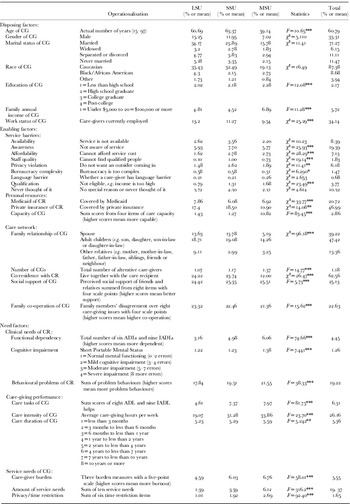
In the ICS, care-givers self-reported reasons why they did not use specific support services even though they had acknowledged needs (Table 1). Those who had no service need were considered as having no service barrier, and these independent variables are not inherently correlated with dependent variables of service utilisation in this study. While attempting to use a needed service, care-givers were asked to self-report whether they experienced any barrier in terms of availability, awareness, affordability, staff quality, privacy violation, complex bureaucracy, language barrier and programme qualifications. Care-givers were also asked whether they had never considered using services, which was considered a barrier to service in this study. In the framework of the Andersen model, these service barriers are categorised as the domain of enabling factors and are the independent variables of primary interest in this study. In descriptive analyses, this study reported frequencies of ten service use barriers for each type of service, and also indicated overall service barriers, measured by whether care-givers experienced specific service barriers for any of ten services. In inferential statistics, only overall service barriers were included.
Measurement and descriptive statistics of the study variables

Notes: CG: care-giver. CR: care recipient. MSU: multiple service user. SSU: selective in-home service users. LSU: light service user. ADL: activities of daily living. IADL: instrumental activities of daily living.
Significance levels: † p<0.1, * p<0.05, ** p<0.01, *** p<0.001.
Other predisposing, enabling and need factors
Guided by the modified Andersen model and empirical literature, other predisposing, enabling and need factors were assessed, as detailed in Table 1. Predisposing factors included care-giver socio-demographics (age, gender, marital status, race, education, family annual income, and work status).
Along with the aforementioned service barriers, enabling factors included personal resources and the care-givers' social network. Personal resources included care-givers' care capacity and care recipients' insurance status (Medicaid and private insurance). Care-givers' care capacity was computed by whether they experienced uncomfortable feelings, bad emotions, difficulty in lifting or moving, and insufficient knowledge of medical care with an acceptable reliability (Cronbach's α=0.78). Care-giving networks included family relationships with a care recipient, the number of alternative care-givers, co-residence with a care recipient, social support and family co-operation. Care-givers' perceived social support is the extent to which care-givers appraised support or confidence from their friends or relatives; its combined score was used (Cronbach's α=0.92). Family co-operation was computed with eight items on other family members' engagement in care-giving activities (Cronbach's α=0.93).
Lastly, need factors included both care recipients' and care-givers' needs. Care recipients' needs were measured by functional dependency, cognitive impairments and problem behaviours. Care-givers' needs were captured through care-giving performance (care-giving tasks, intensity and duration), care-giver burden, and restrictions in privacy/time and number of formal service needs. Care-giver burden was combined with three domains of physical, emotional and financial burden based on a reliable internal consistency (Cronbach's α=0.78). Care-giver privacy and time restrictions were computed by two items (e.g. whether they had less time with other family members than before, whether they had to give up vacations, hobbies or their own activities due to care-giving) with a Cronbach's α of 0.82. Questions for service needs of ten services were indirectly asked to care-givers whether or not they had no specific needs. To measure the amount of needs, we recoded who had service needs and then counted total number of service needs.
Statistical analysis plan
The NLTCS data combine a longitudinal sample collected since 1982 with two cross-sectional cohorts: those who became 65 years old between 1999 and 2004, and those who survived to 2004. Due to the complex sampling design, we employed the survey analysis procedure in Stata 10.0 dealing with primary sampling units, post-stratification and weighting, in addition to the Balanced Repeated Re-sampling technique (BRR), which can modify sampling errors and approximate more accurate parameters and standard errors as a robust replicate resampling technique (Lee and Forthofer Reference Lee and Forthofer2006). We conducted a multinomial logistic regression in the svymlogit procedure because the dependent variable consisted of the three service use patterns estimated by the previously reported Latent Class Analysis (Hong Reference Hong2010). This analysis examined the effect of service use barriers on service use patterns. Through correlation tests, we confirmed no multicollinearity problem among the study variables. For the final analysis, only significant independent variables based on bivariate tests (Table 1) were added in the final model (Table 3). Of the eight service barriers, two barriers having no difference among three service user classes (language barrier and no thought of services for care-givers) were excluded in the final analysis of this study.
Results
Sample characteristics
The age of care-givers ranged from 15 to 97 years old, and they were predominantly married (71%), female (65%) and Caucasian (87%), with a high school education or higher (78%). Only 34% of care-givers were employed. The care-givers provided an average of six care-giving tasks for 26 hours per week, with up to 16 per cent providing care for over ten years.
The care recipients were aged 65–107 years and also predominantly female (65%) and Caucasian (88%). Less than half of the care recipients were married (46%), and nearly half (44%) did not graduate from high school. The care recipients were almost evenly distributed in urban and rural residential areas (45% urban residents). The care recipients were dependent on 4.5 out of 15 ADL and IADL tasks and were predominantly cognitively intact (around 84% showed normal mental functioning).
Description of service use barriers
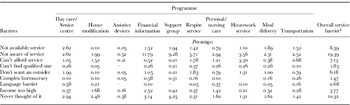
Table 2 provides the frequencies of barriers reported for each of the ten services. For each type of service barrier, frequencies of reporting service barriers were mostly less than 5 per cent for ten services with exceptions of awareness barriers for financial information (12%), support group (9%) and respite services (6%). After each type of service use barrier was reviewed for the ten services, an overall service barrier frequency was calculated to be inclusive of any report of the service barrier, regardless of service type. In most of these cases, care-givers did not use the services (19%) because they were not aware of them. More than 10 per cent answered that they had never thought of using these services. In addition, lack of service availability (8%), affordability (7%) and privacy protection (6%) were prevalent reasons why care-givers did not use these services despite their service needs.
Service use barriers by type of service

Note: 1. Those who perceived any service barrier when they used any one of the ten services.
Impact of service use barriers on service use patterns
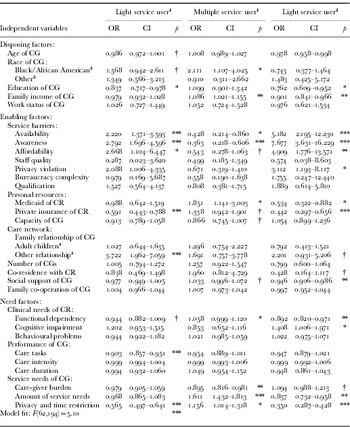
To examine the effect of service use barriers on care-giver service use patterns, we used a multinomial logistic regression incorporated with the BRR resampling survey data analysis technique (Table 3). As enabling factors, service use barriers were significant to distinguish care-givers' service use patterns. Care-givers reporting an availability barrier were more likely to be light service users compared to multiple service users and selective in-home service users. Furthermore, barriers in service availability led to lower probability of being multiple service users than selective home service users. Similarly, those who were unaware of services to support care-givers were more likely to be light service users. Lack of awareness also significantly distinguished selective in-home service users from multiple service users. Care-givers who could not afford to use services showed higher probability of being light service users than multiple and selective in-home service users. Care-givers who did not want an outsider to visit their homes were more likely to be light service users compared to multiple service users.
The results of multinomial regression of care-giver service use patterns

Notes: CG: care-giver. CR: care recipient. OR: odds ratio. CI: confidence level. 1. Selective in-home service users are the comparison group. 2. Multiple service users are the comparison group. 3. Caucasian category is a reference group. 4. Spouse is a reference group.
Significance levels: † p<0.10, * p<0.05, ** p<0.01, *** p<0.001.
With regard to personal resources, care recipients with Medicaid had an increased probability of being multiple service users compared to selective in-home service users and a decreased probability of being light service users compared to multiple service users. Care recipients with private insurance were less likely to be light service users compared to selective in-home service users and multiple service users. Care-giver network compositions also led to different service use patterns: compared to spousal care-givers, other care-givers were more likely to be light service users than selective in-home service users. Those reporting higher levels of social support were less likely to be light service users than multiple service users.
As for predisposing factors, light service users reported lower levels of education compared with selective in-home service users. Multiple service users were also more likely to be African American than Caucasian and had higher family income, compared to selective in-home service users.
Need factors contributed to the differentiation of service use patterns. Multiple service users' care recipients reported higher levels of functional dependency compared to selective in-home service users. In contrast, cognitive impairment was more likely to be higher in light service users' care recipients than multiple service users.
Care-givers' needs more significantly influenced diverse service use patterns. Light service users were likely to perform lower numbers of care tasks and report lower levels of restricted privacy and time compared to selective in-home service users. Although multiple service users reported greater service needs and more restricted privacy and time, care-giver burden was higher for selective in-home service users than for multiple service users.
Discussion
Governments in the USA and other industrialised nations are increasingly offering a wide range of supportive services for informal care-givers of frail older adults, including programmes to help care-givers directly and services to support them indirectly by helping their care recipients (Doty Reference Doty2010; Gibson, Gregory and Pandya Reference Gibson, Gregory and Pandya2003). Yet, the negative consequences of care-giving and the cost of institutional long-term care remain a pressing public health concern (Talley and Crew Reference Talley and Crews2007). With evidence of low care-giver utilisation of these supportive services (United States Department of Health and Human Services and the Administration on Aging 2004), designing and implementing these programmes must not stop at their enactment but must also extend to assessing the programmes' reach, acceptability, and ability to overcome barriers to use of a wide range of services. In light of differences in care-givers' service use patterns (Hong Reference Hong2010), this study used an innovative approach to examine the effects of service barriers on service use patterns. Our findings may help inform future policy efforts that seek to minimise the potential unmet needs of informal care-givers.
First, this study aimed to describe the presence of service barriers as a whole regardless of service type as well as for each particular service type. Surprisingly, given that care-givers' actual service utilisation is still relatively low (United States Department of Health and Human Services and the Administration on Aging 2004), the frequency of barriers reported was relatively low (less than 20 per cent), with the top two barriers being related to lack of awareness and never having considered the possibility of seeking support. We speculate that the other barriers may occur sequentially, in that first a care-giver needs to think about or be aware of the service before other barriers to services would be recognised. This preliminary finding indicates the need for prioritising efforts at dissemination and outreach about the existence of support services for care-givers with particular focus on financial information, per these data.
Depending on population characteristics, language barriers or other cultural factors may need to be reconsidered. The study sample had only a small proportion of non-Caucasian care-givers and care recipients. Thus, although other literature highlights the importance of culturally and linguistically competent health and social services (Institute of Medicine 2003) and variations of formal service use per differences in cultural norms (Haberkern and Szydlik Reference Haberkern and Szydlik2010), this study did not find such barriers. As with many other countries, the USA is facing shifts in demographics – an increasing ageing population that is increasingly ethnically and racially diverse. This increased diversity is attributable to changing patterns in fertility and mortality rates among non-white adult populations as well as an ongoing influx of older adult immigrants (Hooyman Reference Hooyman, Berkman and D'Ambruso2006; Moon and Rhee Reference Moon, Rhee, Berkman and D'Ambruso2006). Further research is needed to explore the issue of service barriers among diverse care-giver populations.
The second research aim focused on the impact of service barriers on care-givers' patterns of service use. Our findings indicate that care-givers' perceptions of service use barriers offer a meaningful clue on how to enhance the capacity and outreach of care-giver support programmes. The three service barriers of availability, awareness and affordability were consistently related to service use patterns when all comparisons were considered. These findings add to the results of the first aim, by explicating that not only outreach to increase awareness is pivotal, but so too is recognising the service accessibility of care-giver support programmes in terms of both locality and cost. In the USA, the programmes are administered under the Older Americans' Act, which encompasses specific state-level service regions geographically, with the local Area Agency on Ageing being responsible for service to all residents, with a prioritisation for those most vulnerable due to income levels. Thus, the intention is inclusion by countering these barriers of availability and affordability. Yet, different programme regions may vary in their effectiveness in achieving this mission; this points to a future line of study.
Furthermore, in a global context, some countries, such as Germany, Japan and South Korea, have developed public long-term care insurance that can offer more specific supportive services for care-givers of frail older adults and disabled adults. Institutionalisation of such services can ensure more resources are available to care-givers as compared to other countries that have no such public support systems for care-givers. The USA's current hybrid system of private and public long-term care will be evolving with the CLASS Act, thus creating new opportunities for research and international comparisons of how long-term care insurance impacts care-givers' barriers to and use of supportive services. Under the CLASS Act, this national, voluntary, opt-out, insurance programme will provide a cash benefit to fund a range of options for in-home, community and institutional long-term care to persons who have contributed for a minimum of five years and have functional or cognitive impairments, with the benefits starting in the year 2017 (The Kaiser Family Foundation, 2010; The Staff of the Washington Post 2010). This comparison can generate essential knowledge for how developed countries can best respond to a growing ageing population and the impacts of this growth on public expenditures on health care.
Also, when lighter service users are compared with multiple service users, privacy issues are a significant factor distinguishing care-givers who use services from those who do not. These results are consistent with Morgan et al. (Reference Morgan, Semchuk, Stewart and Arcy2002), showing that privacy and confidentiality are one of the reasons for not using formal services among care-givers of older adults with cognitive impairments. To ensure privacy, telephone or on-line support group strategies can be employed (Skipwith Reference Skipwith1994). In addition, the emerging practice of consumer direction – paying for services or support that informal care-givers provide – can be helpful (Dale et al. Reference Dale, Brown, Phillips, Schore and Lepidus Carlson2003).
In summary, perceptions of service barriers vary by individual care-giver and by service type, but these barriers may be influenced by care-giver support programmes. In considering the multidimensionality of service use barriers, we found that light service users have greater individual service barriers, while multiple service users exhibit fewer barriers. These findings are consistent with the findings of Toseland et al. (Reference Toseland, McCallion, Gerber and Banks2002), which emphasise that modifying or leveraging these service barriers may require alterations in how services are provided even though the service barriers may be categorised as individual enabling factors in predicting service use. Various service barriers may be addressed by modifying the structure of service programmes that incorporate outreach and educational efforts, enhancing availability of programmes, increasing financial support for service use, insuring easier access to service use and providing assistance with determining eligibility and applying for state assistance, such as through Medicaid in the USA.
Other predisposing, enabling and need factors are worth discussing. Insurance status demonstrated a consistent impact on service use patterns, with multiple service users most likely to have either Medicaid or private insurance. These results confirm previous research findings that educational attainment, annual household income and Medicaid enrolment are significant predictors of barriers to accessing homemaker services or home modification services (Li Reference Li2006). This finding on Medicaid's effect highlights the vulnerability of families with low to middle incomes that are just above the poverty line. When these families are not eligible for Medicaid and have no expendable private funds, the affordability of services can prohibit access to needed care-giver support services.
Understanding the function of family relationships and social supports highlights how multiple components of a care-giver's social network may function independently, as posited by other researchers (Carpentier and Ducharme Reference Carpentier and Ducharme2003). For example, spousal care-givers' tendency toward being multiple service users suggests that these care-givers may encounter more challenges as they navigate diverse services and that they may require more thorough needs assessments. However, perceived social support was an influential social network factor. Thus, the perception of social support may help facilitate the gathering of diverse information about service options, thus facilitating the use of multiple services for spousal care-givers and others. Extending care-givers' social network may increase service knowledge and use. More specific routes for care-givers to acquire service knowledge or awareness need to be further examined.
As expected from previous research, care-giver-related needs (i.e. multiple care-giving tasks, burden, perceived service needs and privacy/time restrictions) were found to be consistent determinants of using multiple services. In contrast, care recipients' diverse needs were connected with inconsistent relationships to service use. While care recipients' functional dependency increased the probability of using multiple services, their cognitive impairment decreased the probability of using multiple services, which may be attributed to the care-givers of cognitively impaired care recipients being reluctant to use services. The finding that older adults' cognitive impairment is related to low use of formal services due to their care-givers' lack of awareness, concerns about privacy and protection, mistrust of service quality and perceived lack of service needs was consistent with those of previous studies (Brodaty et al. Reference Brodaty, Thomson, Thompson and Fine2005; Morgan et al. Reference Morgan, Semchuk, Stewart and Arcy2002). Thus, more intensive education, enhancements to how health professionals and social workers make referrals to services, and customised programmes are needed to promote service use in light of the potentially unique challenges faced by care-givers of older adults' with cognitive impairment.
In summary, this study's findings demonstrate that some service barriers may be influential in determining the patterns of care-giver service use. These findings confirm previous research testing the Andersen model of service utilisation, in that enabling and need factors of the care-giver and care recipient are paramount in determining service utilisation (Li Reference Li2006; Noelker and Bass Reference Noelker and Bass1989; Toseland et al. Reference Toseland, McCallion, Gerber and Banks2002).
This study has several limitations, which suggest directions for future research. First, concerns are evident for the generalisability of the sample to other nations and the under-representation of minority populations. The cultural sensitivity of these programmes may be an important determinant of service use that is overlooked. Second, the data are cross-sectional, so causal inferences are not supported. In addition, the study findings are also limited in application to the time-dependent care-giving process, in which service needs may vary over the course of the care-giving experience. Understanding the trajectories of service predictors, barriers and service utilisation across the span of the care-giving experience may indicate pivotal times for the care-giver support programmes to connect with care-givers. Third, the outcome measure for service use patterns, though innovative and rigorous, would benefit from further study. Additional information regarding the volume or duration of service use (i.e. how often, for how many hours, and for how many weeks) may better illustrate service use patterns than a service contact (i.e. if a service was used or not). Outcome tests after service use should be further examined. Finally, in terms of the outcome measure, service use is not the ultimate goal. Instead, future work should try to link barriers and service use to the clinical outcomes of interest, such as minimising unmet needs, care-givers' health outcomes and satisfaction, and the impact on the quality of informal care provided to the care recipients.
Future research needs to look at the interactions of some of these service barriers and other predisposing and need factors. Here, testing which care-giver characteristics (e.g. race, cognition and gender) moderate enabling resources and service barriers is warranted. Furthermore, multi-level analysis of programme characteristics may help identify other service barriers that can be seen when comparing care-giver support programmes on an agency or programme level. Such work may be able to illuminate key programme variations that are linked to service use patterns, and thus overcome the barriers of limited awareness, affordability, and availability of support services demonstrated in this study.