Introduction
Because of the repetitive use of the same herbicide sites of action (SOAs) year after year across portions of the US rice hectares, herbicide resistance has evolved in many of the common weeds found in rice (Heap Reference Heap2014). The evolution of resistance has limited the number of herbicides that can be used today for effective weed control in US rice. Several of the most difficult-to-control, herbicide-resistant weeds in US rice include barnyardgrass and red rice. In a survey of certified crop advisors in Arkansas in 2006, barnyardgrass and red rice were the most troublesome weed species found in rice (Norsworthy et al. Reference Norsworthy, Burgos, Scott and Smith2007). Cases of barnyardgrass with resistance to seven different herbicides and four herbicide SOAs have been confirmed, among them propanil [Weed Science Society of America (WSSA) Group 7]; quinclorac (WSSA Group 4); clomazone (WSSA Group 13); and imazethapyr, imazamox, penoxsulam, and bispyribac (WSSA Group 2) (Heap Reference Heap2017). Several populations of barnyardgrass were found even to have resistance to multiple SOAs (Miller et al. Reference Miller, Norsworthy, Scott and Barber2015).
Red rice has been an extremely difficult-to-control weed species in rice for many years. The only way to chemically control red rice in cultivated rice is through use of imidazolinone-resistant rice (Clearfield™, BASF Corp., Research Triangle Park, NC). Imidazolinone-resistant rice enables the use of imazethapyr or imazamox in the crop (Croughan et al. Reference Croughan, Utomo, Sanders and Braverman1996). Imidazolinone-resistant rice was introduced in 2002 and since then has been planted extensively. In 2014, approximately 49% of Arkansas rice hectares were planted to the imidazolinone-resistant technology (Hardke Reference Hardke2015).
The poor stewardship followed by growers of imidazolinone-resistant rice such as repetitive use of the same herbicides in turn caused an increased occurrence of red rice with resistance to both imazethapyr and imazamox (Burgos et al. Reference Burgos, Norsworthy, Scott and Smith2008). Cultivated rice and red rice are sexually compatible, which allows for natural hybridization between them. The outcrossing associated with cultivated rice and red rice is the primary reason for the rapid buildup of red rice with resistance to acetolactate synthase (ALS)–inhibiting herbicides (Shivrain et al. Reference Shivrain, Burgos, Anders, Rajguru, Moore and Sales2007).
To combat herbicide resistance, multiple herbicide SOAs should be used annually, rather than relying on one particular herbicide (Norsworthy et al. Reference Norsworthy, Ward, Shaw, Llewellyn, Nichols, Webster, Bradley, Frisvold, Powles, Burgos, Witt and Barrett2012). From 2004 to 2007, a study was conducted by Beckie and Reboud (2009) to determine the impact of herbicide rotation on the evolution of resistance to ALS-inhibiting herbicides in field pennycress (Thlaspi arvense L.) in Canada. Resistance of plants in the soil seedbank increased from 29% to 85% after four applications of the ALS-inhibiting herbicide, ethametsulfuron. In contrast, the frequency of resistance to the ALS-inhibiting herbicide ethametsulfuron, when applied in rotation with a bromoxynil plus MCPA formulated product (WSSA Group 6/WSSA Group 4), was similar to the nontreated. Hence, the use of multiple herbicide SOAs can help manage or delay the onset of herbicide resistance for many of the problematic weed species found in crops.
Currently, there are no very-long-chain fatty acid (VLCFA)–inhibiting herbicides (WSSA Group 15) registered for use in US rice (Anonymous 2017). Pethoxamid (FMC Corp., Philadelphia, PA), a WSSA Group 15 herbicide, belongs to the chloroacetamide family and is currently under development in canola (Brassica napus L.), corn (Zea mays L.), cotton (Gossypium hirsutum L.), rice, soybean [Glycine max (L.) Merr.], and sunflower (Helianthus annuus L.). If the appropriate rice tolerance and weed control can be achieved, pethoxamid would represent a unique SOA to be used in US rice.
Pethoxamid is a root and shoot inhibitor; therefore, it must be applied prior to weed germination if it is to be effective (Anonymous 2015). A potential application timing for pethoxamid would be delayed PRE (DPRE) to control weeds that germinate soon after the rice is seeded. Pethoxamid has a spectrum of activity similar to acetochlor, S-metolachlor, alachlor, and dimethenamid-P, which are also chloroacetamides. These herbicides control small-seeded broadleaves and many grasses such as barnyardgrass and red rice (O’Connell et al. Reference O’Connell, Harms and Allen1998).
Chloroacetamides are used with success in Asian rice culture. Herbicides such as pretilachlor and butachlor are used to control troublesome grasses in Asian dry- and water-seeded rice. Butachlor has been used for weed control in India by applying the herbicide after broadcasting sprouted rice (Mutnal et al. Reference Mutnal, Kumar, Joshi and Honnannavar1998). A study was conducted comparing the use of pretilachlor plus pyribenzoxim followed by MCPA to several other common rice herbicide regimes applied 8 d after rice sowing in Sri Lanka. Rice plots in the program containing pretilachlor had the highest level of weed control at 99% and yield compared to other treatments (Chauhan Reference Chauhan2012). Because herbicides belonging to the chloroacetamide family have been successfully used in Asian rice culture, pethoxamid may be a viable option for use in US rice.
Current soil-applied herbicide options in US rice prior to weed germination include clomazone, quinclorac, pendimethalin, imazethapyr, and thiobencarb (Scott et al. Reference Scott, Norsworthy, Barber and Hardke2013); however, barnyardgrass resistance to clomazone, quinclorac, and imazethapyr can limit their effectiveness (Heap Reference Heap2017). Group 15 herbicides such as pethoxamid are at a relatively low risk for causing resistance, having only five resistant species worldwide.
Pethoxamid was evaluated for barnyardgrass control in sunflower under irrigated and nonirrigated conditions. Herbicide activity was evaluated at the four-leaf sunflower stage and just before canopy closure. Barnyardgrass control with pethoxamid was 90% to 97% with a pethoxamid rate of 1,200 g ai ha–1, regardless of irrigation condition (Jursik et al. Reference Jursik, Soukup, Holec, Andr and Hamouzova2015).
If appropriate rice tolerance can be established, it is believed that pethoxamid may present an alternative herbicide SOA for use in US rice. Therefore, the objective of this research was to assess weed control and rice tolerance following DPRE-applied pethoxamid alone and in combination with other rice herbicides in drill-seeded rice. It was hypothesized that rice would display adequate tolerance to pethoxamid applied alone and in combination with other soil-applied herbicides when applied DPRE while providing acceptable early-season barnyardgrass control.
Materials and Methods
Field trials were conducted in 2015 at the Rice Research and Extension Center near Stuttgart, AR (34 28'23"N, 91 25'05" W; hereafter referred to as Stuttgart), and in 2016 at the Pine Tree Research Station near Colt, AR (35 07'23" N, 90 55'46" W; hereafter referred to as Colt), and the University of Arkansas Pine Bluff Farm near Lonoke, AR (35 50'56" N, 91 52'47" W; hereafter referred to as Lonoke). The soils at Stuttgart, Colt, and Lonoke, respectively, were a Dewitt silt loam (fine, smectic, thermic Typic Albaqualf), Calloway silt loam (fine-silty, mixed, active, thermic Aquic Fraglossudalfs), and Immanuel silt loam (fine-silty, mixed, active, thermic Oxyaquic Glossudalfs). Imidazolinone-resistant (Clearfield™, BASF Corp., Research Triangle Park, NC) inbred rice cultivars CL111 (Stuttgart) and CL151 (Colt and Lonoke) were drill-seeded into 1.8- by 5.2-m plots at a seeding rate of 72 seeds m–1 of row, and row width was 18 cm. Rice was planted on May 5, 2015, at Stuttgart, May 9, 2016, at Colt, and May 18, 2016, at Lonoke. Rice fertility programs were based on University of Arkansas Division of Agriculture Research and Extension recommendations (Norman et al. Reference Norman, Slaton and Roberts2013).
The experiment was set up as a factorial arrangement of treatments in a randomized complete block design with four replications, with the rate of pethoxamid and additional herbicide as the two factors under study. The pethoxamid rates were 0, 420, and 560 g ai ha1. Each rate of pethoxamid was applied alone and in mixture with clomazone at 336 g ai ha–1 (Command 3ME, FMC Corp., Philadelphia, PA), imazethapyr at 71 g ai ha–1 (Newpath, BASF Corp., Research Triangle Park, NC), pendimethalin at 1,120 g ai ha–1 (Prowl H2O, BASF Corp., Research Triangle Park, NC), or quinclorac at 420 g ai ha–1 (Facet L, BASF Corp., Research Triangle Park, NC). All treatments were applied DPRE from 5 to 7 d after rice planting (DAP).
The DPRE applications were made May 11, 2015 (6 DAP) at Stuttgart, May 23, 2016 (5 DAP) at Lonoke, and May 16, 2016 (7 DAP) at Colt. Data collection included a visual assessment of crop injury (0 to 100%, with 100% being crop death) every 2 wk after application until physiological maturity, the average of three crop canopy heights (cm) per plot 2 wk after treatment (WAT), shoot density (number of shoots m–1 of row), rough rice yield (kg ha–1) (Stuttgart and Colt), and estimates of barnyardgrass control (0 to 100%, with 100% being complete control) (Lonoke and Colt). Rice injury was evaluated for percentage visible reduction in rice height, stand, and tillering. Data collection was intended to be identical at each location; however, due to the lack of natural weed pressure at Stuttgart, barnyardgrass control was not assessed. Also, yield was reported only for Stuttgart and Colt as a result of the inconsistent results caused by panicle blast [Magniporthe grisea (Hebert) Barr (teleom)] at Lonoke.
Parameters including shoot density and rice height were normalized for each location by converting them to a percentage relative to the average of the nontreated control plots. Data were analyzed in JMP 12 Pro (SAS Institute Inc., Cary, NC). Site-years were analyzed separately using ANOVA with block included as a random effect. All means were separated using Fisher’s protected LSD (α = 0.05).
Results and Discussion
Pethoxamid Selectivity
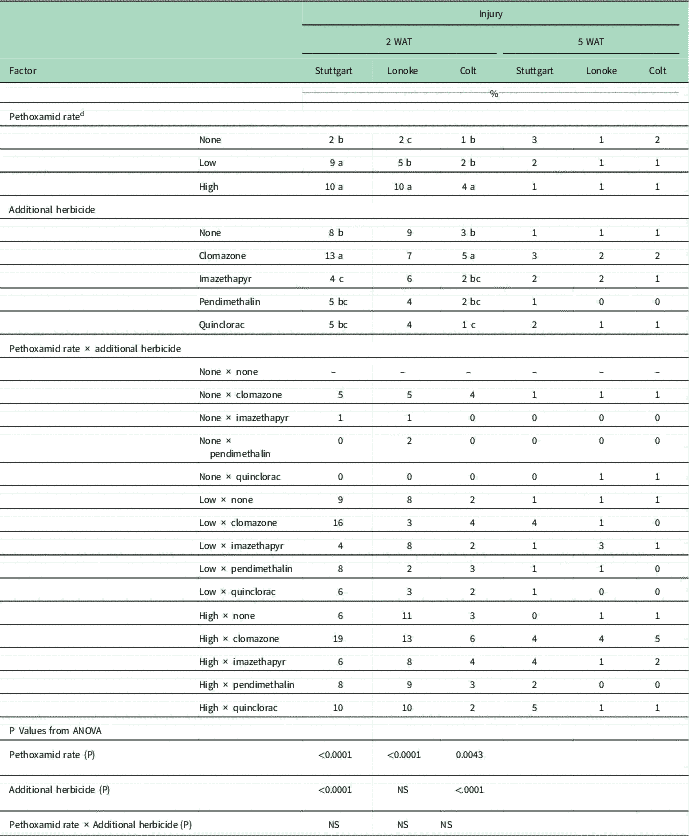
Up to 19% injury was observed at Stuttgart 2 WAT following the application of a high rate of pethoxamid plus clomazone (Table 1). The injury was due to the bleaching caused by clomazone in the mixture, considering that injury from pethoxamid alone was only 6%. Injury to grasses by VLCFA-inhibiting herbicides included leaves not properly unfurling (Gunsolus and Curran Reference Gunsolus and Curran1999). By 5 WAT, however, this injury dissipated to 4% (Table 1). By 9 WAT, injury from all treatments was ≤ 3% (data not shown).
Percent rice injury ratings 2 and 5 wk after treatment (WAT) for pethoxamid alone and mixed with other herbicides at Stuttgart, Lonoke, and Colt, AR.Footnote a – Footnote c

a Means within a column followed by the same lowercase letter are not different according to Fisher’s protected LSD at α = 0.05.
b The none × none treatment was not included in analysis and is represented by a dash.
c 5 WAT data not meet the assumption of normality and thus were not amenable to formal statistical analysis.
d Low pethoxamid = 420 g ai ha–1; high pethoxamid = 560 g ai ha–1.
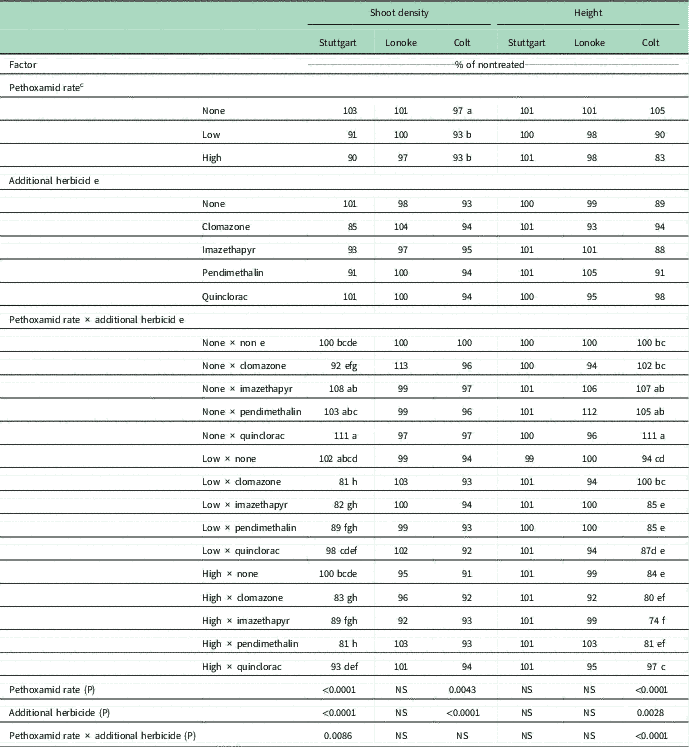
Rice shoot densities were slightly reduced when pethoxamid at either rate was mixed with clomazone, imazethapyr, or pendimethalin at Stuttgart, whereas pethoxamid alone did reduce shoot density (Table 2). Pethoxamid alone or in combination with other herbicides had no negative impact on shoot density at Lonoke. At Colt, the low and high rate of pethoxamid averaged over other herbicides decreased shoot density only 4% compared to the nontreated control.
Rice shoot density and height at Stuttgart, Lonoke, and Colt, AR.Footnote a, Footnote b

a Means within a column followed by the same lowercase letter are not different according to Fisher’s protected LSD at α = 0.05.
b Average shoot density and height for the nontreated plots was 88 shoots m–1 of row and 86 cm at Stuttgart, 52 shoots m–1 of row and 45 cm at Lonoke, and 98 shoots m–1 of row and 43 cm at Colt.
c Low pethoxamid = 420 g ai ha–1; high pethoxamid = 560 g ai ha–1
Rice plant heights were reduced by pethoxamid-containing treatments at Colt but not at Stuttgart or Lonoke (Table 2). At Colt , the only pethoxamid-containing treatments in which a reduction in plant height was not observed included the low rate of pethoxamid alone (94% of nontreated), the low rate of pethoxamid plus clomazone (100% of nontreated), and the high rate of pethoxamid plus quinclorac (97% of nontreated). Rice in all treatments from which pethoxamid was excluded had similar or greater plant heights than the nontreated. Based on data from Colt, a slight reduction in shoot density and height may be associated with the use of pethoxamid at either rate evaluated, albeit this was not observed at Stuttgart or Lonoke.
Pethoxamid Weed Control
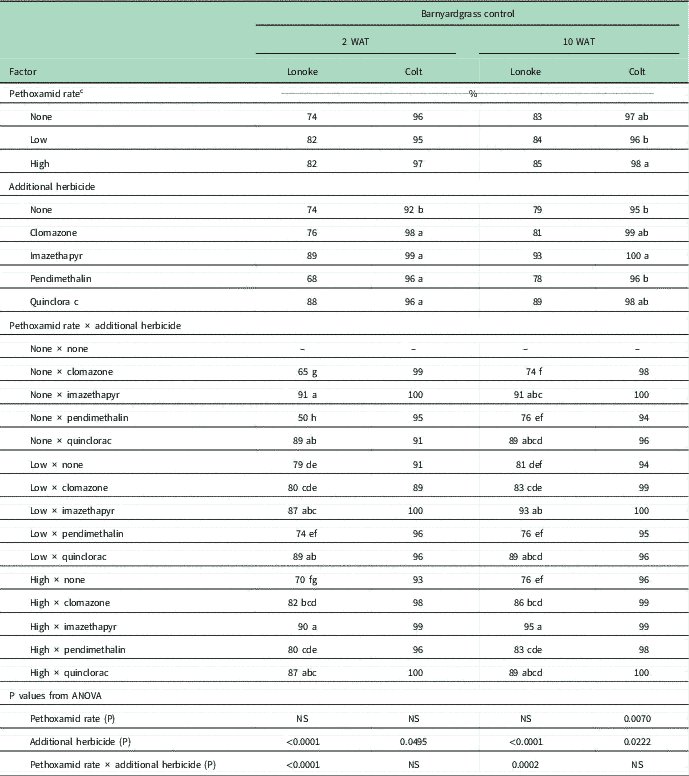
An interaction was observed between pethoxamid rate and additional herbicide for barnyardgrass control at Lonoke at 2 and 10 WAT (Table 3). At 2 WAT, use of the high rate of pethoxamid with clomazone or pendimethalin improved barnyardgrass control over both herbicides applied alone (Table 3). Barnyardgrass control at 10 WAT was 83% to 95% when the high pethoxamid rate was applied with clomazone, imazethapyr, pendimethalin, or quinclorac. In a standard production system, a subsequent POST application would be needed to control the few escaped barnyardgrass plants that exist immediately prior to establishing a permanent flood. At Colt, barnyardgrass control ranged from 89% to 100% at 2 WAT when pethoxamid was applied with clomazone, imazethapyr, pendimethalin, or quinclorac. By 10 WAT, the same treatments maintained a high level of barnyardgrass control (≥90%). When averaged over herbicides added to pethoxamid, the high level of pethoxamid resulted in a slight improvement in barnyardgrass control over the low rate at 10 WAT, reaching 98% barnyardgrass control.
Percent barnyardgrass control 2 and 10 wk after treatment (WAT) at Lonoke and Colt, AR.Footnote a, Footnote b

a Means within a column followed by the same lowercase letter are not different according to Fisher’s protected LSD at α = 0.05.
b The none × none treatment was not included in analysis and is represented by a dash.
c Low pethoxamid = 420 g ai ha–1; high pethoxamid = 560 g ai ha–1
Yield
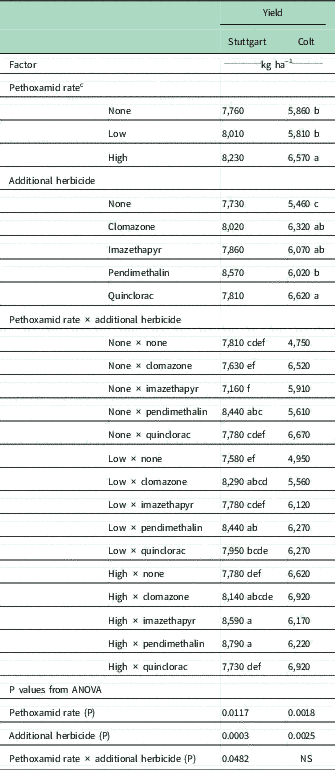
Because of panicle blast across all plots in the trial, yield data at Lonoke was inconsistent and is not reported. At Stuttgart, rough rice yield was solely a function of rice tolerance, because there was no interference from weeds to affect tolerance. All treatments with pethoxamid at Stuttgart had comparable or greater rough rice yields than the nontreated, indicating pethoxamid did not have a deleterious effect on yield (Table 4). At Colt, both pethoxamid rate and additional herbicide factors were significant (Table 4). Rice treated with the highest rate of pethoxamid had greater rough rice yield than did the lower rate or the absence of pethoxamid, averaged over herbicide additives. The improved yield is partly attributed to barnyardgrass control but may also be a result of other weeds at the experimental site that existed at lower densities. Yellow nutsedge (Cyperus esculentus L.), which can be suppressed by chloroacetamide herbicides (Zimdahl Reference Zimdahl2007), was present but not at a consistent enough density throughout the trial to assign rates; however, this weed may have reduced yield in some plots.
Rough rice yield at Stuttgart and Colt, AR.Footnote a , Footnote b

a Means within a column followed by the same lowercase letter are not different according to Fisher’s protected LSD at α = 0.05.
b Average rough rice yield for the nontreated control was 7,370 kg ha–1 at Stuttgart and 7,120 kg ha–1 at Colt.
c Low pethoxamid = 420 g ai ha–1; high pethoxamid = 560 g ai ha–1.
Based on these results, adequate rice tolerance and adequate early-season barnyardgrass control can be achieved with pethoxamid-containing weed control programs applied DPRE; however, the addition of other herbicides to pethoxamid applied DPRE are deemed necessary. These results coincide with Doherty et al. (Reference Doherty, Barber, Norsworthy and Hill2016), who saw the highest levels of barnyardgrass control with pethoxamid applied in combination with imazethapyr. Pethoxamid in combination with clomazone or pendimethalin sometimes improved barnyardgrass control compared to clomazone or pendimethalin applied alone; therefore, pethoxamid can have a positive impact on barnyardgrass control as a soil-applied herbicide in combination with other rice herbicides. The addition of pethoxamid to current weed control programs would probably increase barnyardgrass control and provide an alternative SOA to protect against further evolution of resistance in this as well as other weeds of rice.
Acknowledgments
This research was funded by the Arkansas Rice Promotion Board. No conflicts of interest have been declared.