




No CrossRef data available.
Article contents
Copula variability in Gullah
Published online by Cambridge University Press: 05 December 2003
Abstract
Many researchers have investigated the copula for possible links between African American Vernacular English (aave) and Atlantic Creoles, a connection that has served as the foundation of the Creolist Hypothesis in the on-going debate over the origins of aave. One variety that has been of particular interest in this debate is Gullah, which has been hypothetically linked to aave since some of the earliest statements of the Creolist Hypothesis. To date, however, very little research has been done on copula variability in Gullah itself. This study, therefore, provides an analysis of copula variability in present affirmative contexts in Gullah. Variation is found among full, contracted, and zero forms in 1st person singular, plural/2nd person singular, and 3rd person singular environments. The analysis also reveals some parallels between Gullah and aave that offer support for the theory of an aave/creole connection.I would like to acknowledge the Department of Linguistics and the Center for African Studies at Ohio State University for covering the cost of some of the fieldwork for this study. I would also like to acknowledge the McKissick Museum at the University of South Carolina for providing several hours of recordings used for the study. My sincerest thanks to research assistants Jason Sellers and Cherlon Ussery for help with transcriptions and data tabulation and to the following friends and colleagues for their help and support during various stages of this project: Emily Bender, Eugenia Deas, Vennie Deas-Moore, Brian Joseph, Michele Nichols, Terence Odlin, John Paolillo, Donald Winford, and Walt Wolfram. And, finally, my thanks to James Walker and an anonymous LVC reviewer for their helpful suggestions on an earlier draft of this article. I accept full responsibility for any remaining errors.
Information
- Type
- Research Article
- Information
- Copyright
- © 2003 Cambridge University Press
INTRODUCTION
For many years now, linguistic interest in Gullah has focused primarily on the question of its putative relationship to African American Vernacular English (aave). Creolists have attempted to trace the roots of aave to creole sources (e.g., Bailey, 1965; Baugh, 1980; Dillard, 1972; Holm, 1984; Rickford, 1974, 1977, 1998;1
See Rickford (1998) for a comprehensive discussion of the creole origins debate, particularly as it relates to copula variability in aave.
For purposes of convenience, the term "copula" is used in this article to refer to forms that occur in nominal, adjectival, and locative environments (i.e., "true copula" environments) as well as progressive and future environments (i.e., auxiliary environments). Later in the article, I consider whether or not the two should, in fact, be collapsed in this way.
Since this time, creolists have compared patterns of copula variability in aave to those found in a number of creole varieties, including those spoken in Guyana (e.g., Bickerton, 1971, 1972; Edwards, 1980), Barbados3
For purposes of convenience, Barbados is included in this list. However, the extent to which the variety spoken there exhibits creole features is a topic of debate (e.g., Cassidy, 1980; Hancock, 1980; Rickford, 1992; Rickford & Handler, 1994).
While creole similarities have been of primary concern for many creolists studying the history of aave, it is important to note that they represent only one type of evidence that has been brought to bear in the debate over the origins of aave. Rickford (1998) discussed seven different types of evidence that have been considered in this debate: sociohistorical conditions, historical attestations, diaspora recordings, creole similarities, African language similarities, English dialect differences, and age-group comparisons (see, e.g., Table 6.1, p. 162).
One notable exception is Holm (1984), which compared findings reported in earlier studies of the aave copula to the systems of copula variability in Jamaican Creole (based on data from LePage & DeCamp, 1960) and Gullah (based on data from Turner, 1949). Holm found that the grammatical hierarchies for copula absence in Gullah and Jamaican Creole differed from those reported in studies of the aave copula such as Labov (1969, 1972a) and Wolfram (1969). Holm's explanation for this disparity was that the speaker groups that were examined represented "different levels of the continuum" and thus were not accurate points of comparison (1984:294). However, later researchers (including Holm himself) noted that Holm's findings were skewed by the comparison of "mismatched" forms, which included both present and past copula forms as well as the progressive aspect markers

(see, e.g., Holm, 1984; Rickford & Blake, 1990; Winford, 1992a). Furthermore, Holm's categories did not correspond to those typically analyzed in studies of the aave copula, which were generally restricted to variants of is and, later, are. For these reasons, Holm's figures were not an accurate basis for comparison with the aave data, nor did they accurately reflect the system of copula variability in Gullah.
The present study, therefore, aims to fill this gap in the literature by providing a quantitative analysis of copula variability in present affirmative contexts in Gullah. Along these lines, the following questions are addressed:
- What are the variable contexts?
- What are the variants?
- What social and/or linguistic factors govern the variation?
Answering such questions should not only contribute to our understanding of the Gullah system itself, but also facilitate future comparisons between the copula systems of Gullah and aave, as well as between Gullah and other English-based creoles.5
For a full comparison of the copula systems in Gullah and aave, see Weldon (1998), from which the current study is adapted.
METHODOLOGY
The data for this study were collected in three mainland communities (McClellanville, Mt. Pleasant, and Awendaw, SC) and two Sea Island communities (Johns Island and St. Helena Island, SC). Both islands are accessible to the mainland by bridge. Through periodic visits taken between 1993 and 1995, I conducted fieldwork on Johns Island and St. Helena Island and in McClellanville. A total of ten hours of recordings from these communities was selected for examination. These data were then supplemented by an additional five hours of recordings donated by the McKissick Museum at the University of South Carolina in Columbia. These tapes were recorded in 1985 and 1989 in Mt. Pleasant and Awendaw, SC, both mainland communities.6
The fieldworkers who collected these data were Dale Rosengarten and Vennie Deas-Moore. Both researchers conducted interviews with Gullah speakers for separate projects sponsored by the McKissick Museum.
Distribution of hours collected in individual communities

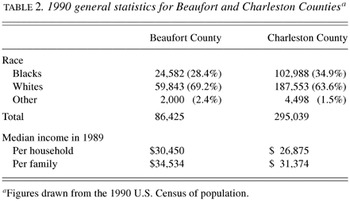
The areas in which these data were collected were primarily rural, racially segregated, working-class neighborhoods. Table 2 summarizes the socioeconomic and racial make-up of the two counties in which data were collected, based on the 1990 U.S. Census report.7
In this and subsequent tables, the terms "Black," "White," and "American Indian" are used in accordance with the labels assigned by the U.S. Census Bureau.
1990 general statistics for Beaufort and Charleston Countiesa

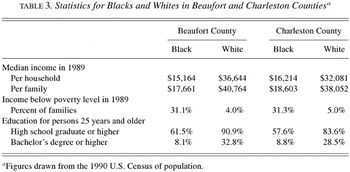
Table 3 provides a further breakdown of the socioeconomic status of Blacks and Whites in these two counties. As these figures show, the median income among Blacks was, on average, $20,000 lower than that of Whites, with approximately 30% of Blacks living below the poverty level. Although more than 50% of Blacks over the age of 25 had received a high school diploma, less than 9% had completed college with a bachelor's degree or higher. By contrast, more than 80% of Whites over the age of 25 had received a high school diploma, and roughly 30% had completed college with a bachelor's degree or higher.
Statistics for Blacks and Whites in Beaufort and Charleston Countiesa

Although significant numbers of Gullah-speaking residents were found in each of the communities where fieldwork was conducted, the repertoire of linguistic varieties spoken by African Americans in these areas was not restricted to Gullah alone. Rather, many speakers were also fluent in some variety of aave and/or se either in addition to or instead of Gullah. Age, mobility, socioeconomic status, and group identity were key factors in determining which variety or varieties were spoken. While conducting fieldwork, I found that speakers under the age of 20 commanded the widest range of varieties. However, as an outsider, I found it extremely difficult to elicit this range. In my presence, most of the young speakers used aave in unrecorded casual conversation and aave or se when the recorder was turned on. In many instances, the aave or se that they used was heavily influenced by Gullah phonology and intonation. However, there were some young speakers whose accents were not even distinctively Gullah-like. Given these tendencies, my initial impression was that Gullah was not spoken by the younger generations.8
Such observations have contributed to the theory that Gullah is dying out (see, e.g., Jones-Jackson, 1984, 1987). Opposing views are presented in Mufwene (1991a, 1991b).
Similar observations are made in Mufwene (1993).
For speakers aged 20-60, mobility and occupation were key factors in determining the varieties that were spoken. Speakers who left their communities for some time (e.g., to attend college or to work) and then returned home later were more likely to speak aave or se. Speakers in this age range who remained in the area were found to employ much more Gullah, even in the presence of outsiders. In my fieldwork experience, however, speakers fitting into this latter category were few in number. And those that I did encounter were extremely skeptical about my purpose in the community. It was, therefore, difficult to collect a significant amount of data from speakers in this age group.
The most consistent Gullah speakers were those aged 60 and older. The speakers that I met in this age group were usually permanent residents who had received a limited amount of education and who exhibited a strong sense of loyalty to and identification with the Gullah community. In most instances, Gullah was the only language variety in which these speakers were fluent. And when approached with topics such as "life in the old days," most were willing to talk to me even with the recorder turned on. Therefore, it was this age group that became the focus of my research.
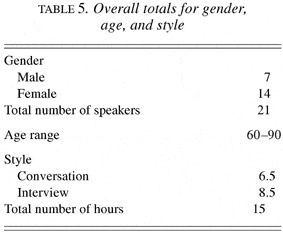
As noted earlier, 15 hours of speech were selected for examination. This total consisted of two basic speech styles: 6.5 hours of casual group conversation and 8.5 hours of interviews. The group conversations generally consisted of three to five people speaking in a casual setting with the recorder present. In some instances, I did the recordings myself. In other instances, I sought the assistance of various members of the community, who did the recordings for me. Those who assisted me were aware that my goal was to collect samples of Gullah speech. However, the speakers that I recorded were usually told that my purpose was to learn more about Sea Island culture, or to talk about the "old days," or to discuss topics such as seeking religion or the art of shrimping, fishing, farming, and so forth. The goal, of course, was to draw the focus away from the language itself and make the speakers feel as at ease as possible, thus reducing the effects of the Observer's Paradox (see Labov, 1972b, 1972c, 1984).
In addition to these casual speech samples, more formal styles were elicited by means of recorded interviews. In some cases, I conducted the interviews alone, interviewing one or two Gullah speakers at a time. Other interviews were done in conjunction with another researcher, who was collecting samples of oral history for her own research and introduced me as her assistant.10
This researcher, Vennie Deas-Moore, also conducted some of the taped interviews donated to me by the McKissick Museum.
While these assessments were based primarily on impressionistic judgments, linguistic features such as past been (vs. was), progressive (d)a + vbse/ing (vs. ving), and present ain't + vbse (vs. don't + vbse) were among the indicators used to identify Gullah speakers for this study. Most of the speakers in this study exhibited variation in their use of these creole versus noncreole features. Those who employed the creole features more frequently fell closer to the lower mesolectal end of the scale, whereas those who employed the noncreole features more frequently fell along the upper mesolectal to lower acrolectal end of the scale. Based on traditional definitions of creole continua, I would predict that basilectal and acrolectal speech samples would involve more categorical use of the creole and noncreole features, respectively.
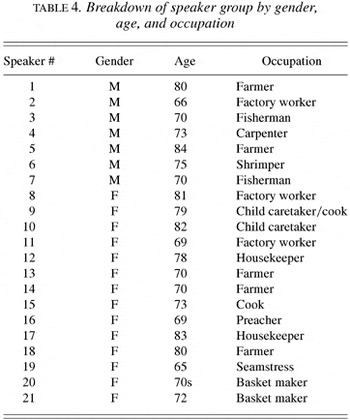
The speaker group selected for this study consisted of 21 speakers (7 males, 14 females), all over 60 years of age.12
The speakers in this study were chosen through what Milroy (1987) referred to as "judgment sampling." In other words, the speakers were judged as "Gullah speakers" by me (as the primary fieldworker) and by other reliable sources in the community. These determinations were made based on factors such as the degree of mobility, education, and access to other linguistic varieties, as well as the presence of identifiable Gullah features in an individual's speech (e.g., past been, progressive (d)a, etc.).
Breakdown of speaker group by gender, age, and occupation

Overall totals for gender, age, and style

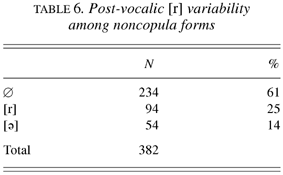
Post-vocalic [r] variability among noncopula forms

ANALYSIS
In the sections that follow, I present a quantitative analysis of copula variability in the Gullah data, based on multiple regression analyses performed by goldvarb 2.0 for the Macintosh (Rand & Sankoff, 1990). As in previous studies of copula variability, indeterminate tokens were excluded from the analysis as well as copula tokens in nonfinite, emphatic, inverted, and exposed positions, which either failed to exhibit variation at all or involved patterns of variability that differed from those that were the focus of this study (see Labov, 1969, 1972a). Decisions of which forms to exclude were also informed by Blake (1997), which provided a comprehensive overview of the various exclusions that had been made in previous studies of copula variability in aave and related varieties. Exclusions that are specific to a given variable are discussed as they become relevant.
Defining the variable context and method of tabulation
In present affirmative contexts, variation was found among full, contracted, and zero copula forms in 1st person singular, plural/2nd person singular, and 3rd person singular environments. Sentences (1) through (11) illustrate the variation found in each environment.

Previous studies have differed with regard to how variation in these environments is handled. In most studies of the aave copula, 1st person singular forms have been excluded because of the lack of zero copula tokens in this environment. Blake (1997:68) proposed that 1st person singular environments be considered "don't count" cases in studies of the aave copula because of their strong preference for contraction. Unlike aave, however, Gullah allows for variation among full, contracted, and zero copula forms in this environment, consistent with patterns found in a number of Atlantic creoles, including those spoken in Trinidad and Barbados (see, e.g., Rickford & Blake, 1990; Winford, 1992a) as well as the diaspora varieties Samana English and Liberian Settler English (see, e.g., Poplack & Sankoff, 1987; Singler, 1991). Given this variation in the Gullah data, 1st person singular forms are included in the current analysis.
There has also been debate over whether tokens of are should be analyzed as part of the overall system of copula variability. Labov, Cohen, Robins, and Lewis (1968) argued that are variability differs from that of is or am because are is deleted through a process of [r]-vocalization (or desulcalization) and subsequent loss of post-vocalic schwa. And Walker (2000:65) concluded that are should be excluded from future analyses of copula variability because of the difficulties in distinguishing instances of are-deletion from those of [r]-deletion. However, Wolfram (1974:508) cautioned against treating are absence as a simple consequence of post-vocalic [r] absence via desulcalization, noting, among other things, that post-vocalic [r] is consistently constrained by the effects of a following consonant, which favors desulcalization of [r], whereas are absence shows no consistent patterning according to following phonological environment. Thus, subsequent researchers have included are in their analyses, often collapsing are and is into a single variable to allow for a more robust data set. And Blake (1997:63) agreed that "are forms should continue to be counted in copula analysis." A small sampling of the Gullah data indicates that both [r]-vocalization and [r]-deletion are in effect in the Gullah data, as shown in Table 6. As such, these processes have at least the potential to affect the copula results, as studies such as Labov et al. (1968) and Walker (2000) suggested. Still, in consideration of the observations made in Wolfram (1974), plural/2nd person singular variation is examined here to determine how the variants are distributed in the Gullah data.
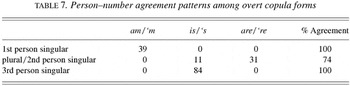
Although forms of is have been a consistent focus of copula studies, debate has ensued over the question of whether they should be analyzed in conjunction with forms of are or treated as a separate variable. Citing similarities in their respective constraint effects, a number of researchers have chosen to collapse is and are under a single variable, while capturing their differences by a person-number group. As noted by Rickford, Ball, Blake, Jackson, and Martin (1991:112), this option has the benefit of "making the data pool larger and more robust and ensuring that their similarities in constraint effects need be stated only once." For the current data set, one possible complication of merging is and are in this way involves the pattern of variable agreement in plural/2nd person singular environments, as illustrated earlier in sentences (4) through (8). In addition to copula absence, this environment allows for variation among full and contracted forms of both are and is, in contrast to 1st person singular and 3rd person singular environments, in which the overt copula forms exhibit patterns that are consistent with se rules of subject-verb concord. Table 7 shows the totals for the overt copula forms according to person-number.14
Note that, as a result of exclusions necessitated by the data, some of these totals change in the analyses to follow.
Person-number agreement patterns among overt copula forms

The variable agreement pattern exhibited here is one that has been observed in a number of nonstandard English dialects as well as several English-based creoles.15
Bickerton (1973:651) observed that in creole continua, such as the Guyanese continuum that he examined, the forms iz (in present contexts) and woz (in past contexts) are initially incorporated without any person-number inflections. He hypothesized that the "full set of English inflections is not introduced until (perhaps some time after) iz/woz has taken over all environments."
Finally, previous studies have differed in their methods of counting copula tokens in present affirmative contexts. Labov (1969, 1972a) and Baugh (1980), for example, counted zero tokens as a subset of contracted ones, arguing that "if contraction does not occur ... deletion cannot occur" (Labov, 1972a:77).16
This principle was established based on Labov's (1972a:73) observation that "wherever se can contract, [Black English Vernacular] can delete is and are, and vice versa."
In recognition of the debate over whether the variable copula is underlyingly present and phonologically deleted or underlyingly absent and morphologically inserted, the term "deletion" is written here (and elsewhere) in quotation marks.
The formulas presented here were originally adopted from Rickford et al. (1991). However, Walker (2000) offered a correction to Rickford et al.'s "insertion" formula, which has been used in place of Rickford et al.'s original formula.

In most instances, the decision of which formulas to use has been based on theoretical grounds, with consideration given to the underlying system and various rule-ordering restrictions. Walker (2000:59), however, found fault with this method of choosing a formula for a number of reasons, including the observation that "recent semantic theory ... argues that, even in English, the copula is only introduced to satisfy tense/agreement requirements of non-verbal predicates and is not underlyingly present." Given these reservations, Walker chose his method of tabulation based on statistical rather than theoretical grounds, testing each formula and settling on the "Labov contraction and deletion" formulas because they yielded the highest log likelihoods.
For the current study, the choice of formula was based on slightly different considerations. Given the decision to define the variables according to the person-number of the subject and to examine both the concord and nonconcord tokens in plural/2nd person singular environments, the "straight contraction and deletion" formulas (in which each variant is counted as a percentage of all possible forms) appear to represent the best (and, perhaps, only) option of those presented here. In all other instances, one is forced to assume se patterns of subject-verb agreement. As discussed in Rickford et al. (1991), the formula one uses has direct consequences on the results produced. In particular, it has been noted that the "straight contraction and deletion" methods result in diametrically opposed patterns for following grammatical environment, with contraction favored most in nominal environments and zero favored most in future environments (see also Labov, 1969; Wolfram, 1975). Thus, for purposes of consistency and comparison, the "straight contraction and deletion" formulas are applied to all of the variables examined here.
Linguistic, social, and stylistic constraints
To get a sense of what factors would influence the observed variables, I considered the effects of six factor groups that have been tested in previous studies of copula variability. These included four linguistic factor groups (preceding phonological environment, following phonological environment, subject type, and following grammatical environment) and two nonlinguistic groups (gender and style).
In previous studies, preceding and following phonological environments have been tested to determine how and/or whether contracted and, particularly, zero forms of the copula are phonologically conditioned. One of the issues that has sparked a significant amount of debate in the analysis of aave copula variability is the question of whether the copula is underlyingly present and phonologically deleted or underlyingly absent and morphologically inserted. Labov's methods of calculating contraction and deletion were motivated by the former assumption, while Romaine's methods were motivated by the latter. In previous studies, evidence of phonological conditioning on the zero copula has been regarded as an indication that the copula is underlyingly present and deleted. However, in Rickford et al. (1991), it was observed that the method of calculation itself actually plays a role in determining whether or not a phonological effect is realized (see also Bender, 2000).
Preceding phonological environment is significant for Labov deletion, as we would expect in Labov's formulation, where deletion involves the removal of the lone consonant remaining after contraction, a process favored by a preceding consonant. Straight deletion--which involves the removal of the copula vowel and consonant simultaneously, as a grammatical rather than phonological variable--shows no significant phonological conditioning, so each method's theoretical assumptions are supported by its respective quantitative results. (Rickford et al., 1991:118; emphasis in the original)
Although conclusions about the status of the copula (as underlyingly present or absent) may not be informed by the effects of phonological conditioning, examinations of phonological environment can inform the analysis in other ways, particularly with regard to the nature of are variability. These groups, therefore, were considered in the current analysis.
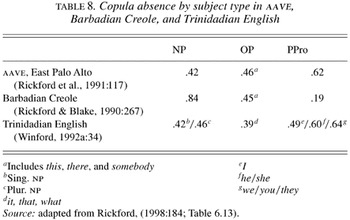
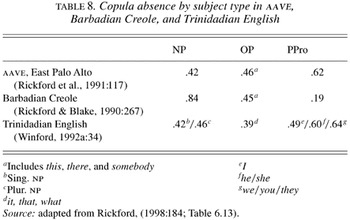
For subject type, previous studies of copula variability in aave have shown that both contraction and absence are generally favored in pronominal environments (particularly in the environment of personal pronoun subjects) and disfavored in the environment of full np subjects. Labov (1972a:85) called this factor group "the single most important constraint on deletion in bev [Black English Vernacular], and upon contraction in se and bev." However, for copula absence, many creole varieties have either exhibited the reverse of this pattern, as illustrated by the figures for Barbadian Creole in Table 8, or the same pattern as aave but with smaller margins of difference, as illustrated by the figures for Trinidadian English.19
If Winford's figures for Trinidadian English are averaged out, however, the margins of difference are much more comparable to those found in aave.
Copula absence by subject type in aave, Barbadian Creole, and Trinidadian English
As noted earlier, the effect of following grammatical environment on the copula has been a primary focus in the debate over the possible creole ancestry of aave. Specifically, creolists have argued that the distribution of copula absence along the hierarchy in aave, where copula absence is favored more in progressive and future environments and less in nominal, adjectival, and locative environments, resembles that found in a number of creole varieties. Comparisons of the aave hierarchy with those in creole varieties, however, have revealed two major inconsistencies that have led some researchers to question the extent to which aave actually exhibits the typical creole pattern. One of the inconsistencies, noted by Poplack and Sankoff (1987) as well as Mufwene (1992), involves adjectival predicates, which exhibit relatively high frequencies of copula presence in aave but strongly favor copula absence in creole varieties. But studies such as Singler (1991) and Winford (1992a) have argued that, when mesolectal creoles are examined, the patterns of copula variability by following grammatical environment are much more comparable to those found in aave. A second inconsistency, noted by Mufwene (1992), is the fact that aave allows for variable copula absence in the environment of predicative NPs, whereas creoles generally require an equative copula in this environment. According to Winford (1998:112), this inconsistency may be accounted for by the fact that "early aave [was] affected by restructured varieties containing no copula in nominal environments," whereas the substratum inputs for Caribbean English Creoles (cecs) required a copula in --NP environments. Winford suggested that the early copula system of Gullah is likely to have had a significant influence on the emerging aave system.
Another issue regarding following grammatical environment involves the specific effects of the predicates gonna and gon. Many studies of the aave copula have routinely collapsed the two into a single factor: gon(na). However, it has been observed by Rickford and Blake (1990), as well as Winford (1992a, 1998), that separating these predicates might reveal two different patterns of distribution, consistent with those observed in many cec varieties. According to Winford (1992a:55, fn. 8), "other mesolectal varieties of cec ... distinguish sharply between gon and gwain/goin tu; the former never allows be, while the latter does, at least in the "upper' mesolect." Winford described this distinction in creole varieties as one between a "pure future marker" go/gon, which requires no copula, and a "prospective" goin/gwine, which allows a copula (1998:113). An alternative theory, proposed by Poplack and Tagliamonte (2001), is that gon and gonna in African American diaspora varieties and other English dialects represent phonological variants of English going to and involve no creole remnant. They argued that,
if some of the variants of going to descend from a(n invariant) creole grammar, choice among them should not be affected by phonetic environment. But when variant distribution is examined according to place of articulation of the following segment ... a clear pattern of phonological conditioning emerges, implicating phonetic assimilation in the reduction of going to.
The effects of co-articulation are evident in all the varieties (except Ottawa): gon is preferred in alveolar stop contexts... while gonna prevails elsewhere. (Poplack & Tagliamonte, 2001:223-224)
All of these issues were taken into consideration in the testing of the following grammatical environment in the Gullah data.
Finally, two nonlinguistic factor groups, gender and style, were also considered. In an investigation of complementizer, prepositional, and pronominal constructions in Gullah, Nichols (1976:137-138) reported that young to middle-aged women were more innovative in their incorporation of "standard" (i.e., English) features than were their male counterparts, whereas a group of older women "chose to resist change toward the standard."20
As noted by Nichols, the interaction of gender and market forces was largely responsible for the patterns that she observed in her study.
Because of the presence of various knockout factors, singleton groups, and interactions, not all of these factors or factor groups were tested for all three variables.21
goldvarb 2.0 will not conduct runs if knockout factors or singleton groups are detected in the data. Knockout factors are those that exhibit categorical behavior (i.e., either 0% or 100% use of some variant). Singleton groups are groups containing only one factor. Interactions occur when two or more groups contain factors with overlapping data. Because varbrul programs assume independence among factor groups, such overlaps often cause the programs to produce unreliable results.
1st person singular variation
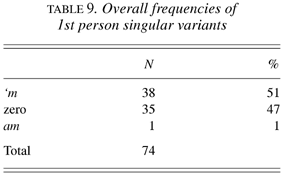
Table 9 shows the overall frequencies of the 1st person singular variants. Although the overall frequencies of zero and 'm are comparable at 47% (N = 35) and 51% (N = 38), respectively, there was only one token of am in the data, which was produced in an interview-style setting (see sentence (1)). As a result, am produced many 0% knockouts and thus did not undergo any further statistical analysis. The distributions of 'm and zero, however, were analyzed further.
Overall frequencies of 1st person singular variants

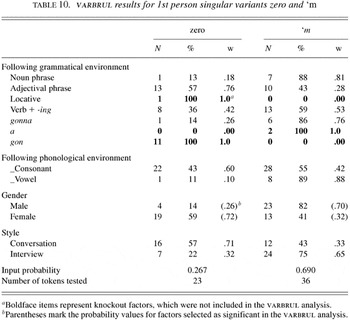
Because the 1st person singular variants only occur with the subject I, subject type and preceding phonological environment represent singleton groups for this variable, the former involving only the personal pronoun factor and the latter involving only the preceding vowel factor. As a result, these groups were not tested for this variable. However, the remaining groups--following grammatical environment, following phonological environment, gender, and style--were tested for their potential influence on the variation. Table 10 shows the results of two varbrul runs testing the effects of these groups on the distributions of zero and 'm.22
goldvarb 2.0 only tests for binomial variance such that one variant of the dependent factor group serves as the application value and the remaining variants serve as the nonapplication value. Each variant was, therefore, tested as a separate application value.
varbrul results for 1st person singular variants zero and 'm

Following grammatical environment included seven factors: noun phrase, adjectival phrase, locative, verb+-ing, gonna, a, and gon. Three of these--locative, a, and gon--were not candidates for the varbrul analysis because they exhibited categorical behavior in the data. The categorical use of the zero copula in the environment of predicate locatives is most likely a simple consequence of the fact that only one locative construction was produced for this variable. The other two environments, however, seem to represent more significant trends in the data.
In the environment of a, which appears to represent a phonologically reduced form of gonna, only the 'm variant is used.

The lack of zero copula tokens here may be motivated by an effort to avoid VV clusters (e.g., (13)): only one zero copula token occurred in the environment of a following vowel in these data. Note that although following phonological environment was not chosen as significant, it does suggest a preference for cvcv patterning, with zero favored in the environment of following consonants and 'm favored in the environment of following vowels. Similar observations have been made in previous studies with regard to aave, se, and a number of contact vernaculars (see, e.g., Baugh, 1980; Labov, 1972a).
In contrast, the predicate gon exhibits categorical copula absence, as shown in Table 10. This pattern also contrasts with gonna, which exhibits a high frequency of 'm tokens. For this variable, gon and gonna do appear to involve distinct patterns of behavior, consistent with observations made by Rickford and Blake (1990) and Winford (1992a) for other creole varieties. The hierarchy for following grammatical environment also resembles creole varieties with regard to the high probability of copula absence in adjectival environments. As shown in Table 10, the probability for copula absence in adjectival environments is even higher than that for verb+-ing predicates, whereas in aave adjectives tend to disfavor copula absence. This discrepancy is one that has proven to be problematic for the Creolist Hypothesis.
Of the four groups tested, only gender was found to have a statistically significant effect on the 1st person singular variation. Women favor the zero copula, whereas men favor the 'm variant. This finding is consistent with patterns observed by Nichols (1976): older Gullah women were actually slower than their male counterparts in adopting more standard (i.e., less creole-like) variants. These findings suggest that this pattern may still be in effect, at least among older rural speakers.
Finally, style was not chosen as significant in the varbrul analysis. But it is interesting to note that zero was favored in conversation styles, whereas 'm was favored in interview styles. These patterns are discussed further, following the examination of the other variables.
3rd person singular variation
The 3rd person singular variable included three variants: is, 's, and zero. Initially, all six independent factor groups were considered for this variable. Three of these--following phonological environment, gender, and style--consist, more or less, of the same factors that were tested on the 1st person singular variants, with one exception: following consonant. Consistent with previous studies of the copula, sibilant consonants were excluded from the following consonant count for the 3rd person singular variable because of the difficulties that this environment creates for distinguishing contraction from absence.
Following grammatical environment included seven factors: noun phrase, adjectival phrase, locative, verb+-ing, a+verb+-ing, gonna, and gon. a+verb+-ing consists of a preverbal imperfective marker a, characteristic of many creole varieties, followed by the more English-like -ing inflected verb. This construction represents a double marking of progressive aspect and appears to be indicative of a more mesolectal variety.
For subject type, four factors were initially considered: what/it/that (wit) subjects, personal pronouns, noun phrases, and other pronouns. Since the discovery of the NP--/PRO-- effect in Labov (1969, 1972a), a number of studies have separated pronominal subjects into two categories--personal pronouns (which primarily end in vowels) and other pronouns--in order to determine whether the pronominal effect is, indeed, an independent grammatical effect or whether it is related to the effects of preceding phonological environment. Rickford et al. (1991:130, fn. 7), in their analysis of contraction in aave, concluded that subject type was an independent constraint because the probabilities for personal pronouns were higher than those for preceding vowels (see also Rickford & Blake, 1990). These effects were examined in the Gullah data.
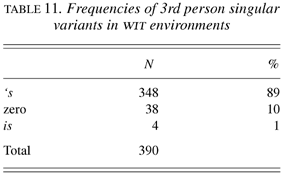
wit constructions have typically been excluded from analyses of copula variability in aave because of the categorical (or near-categorical) use of the contracted copula (i.e., 's) in these environments. However, researchers examining varieties such as Samana English (see Poplack & Sankoff, 1987) and Trinidadian Creole (see Winford, 1992a) have observed variable copula absence in these environments and have included them in their analyses.23
Winford (1992a), however, excluded wit subjects in his comparison of Trinidadian Creole and aave.
Frequencies of 3rd person singular variants in wit environments

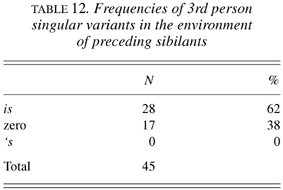
For preceding phonological environment, three factors were initially considered: vowels, nonsibilant consonants, and sibilant consonants. Although following sibilants are typically excluded from analyses of is variability, researchers have varied with regard to the inclusion or exclusion of preceding sibilants. One argument against their inclusion points to the possible effects of this environment on the contracted copula. As noted by Fasold (1990:15, fn. 14), "The inhibitory effect of preceding sibilants on contraction is intuitively easy to understand. Contraction would produce a geminate cluster which apparently cannot survive in that form." It has also been argued that this environment is likely to create difficulties in distinguishing contraction from absence while coding (see, e.g., Wolfram, 1969). By contrast, Blake (1997) argued in favor of their inclusion, noting that they caused only minimal coding difficulties in the aave data that she considered. In the Gullah data, however, the 's variant never occurred in the environment of preceding sibilants, as shown in Table 12. Given their apparent inhibitory effect on contraction, preceding sibilants were excluded from the analysis of this variable.
Frequencies of 3rd person singular variants in the environment of preceding sibilants

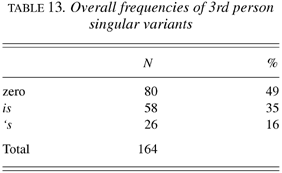
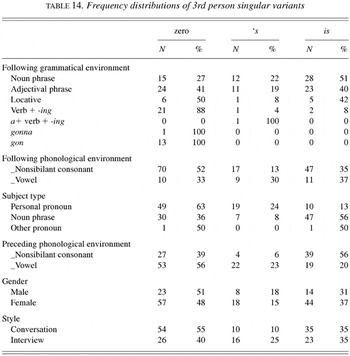
With the wit and preceding sibilant environments excluded from analysis, the overall number of tokens was reduced from 599 to 164 tokens. The overall frequency of the variants is shown in Table 13; the frequency distribution of the variants across the six factor groups is shown in Table 14. Note in Table 14 that three factors--a+verb+-ing, gonna, and gon--are knockouts in following grammatical environment. The 's variant is categorical before a+verb+-ing, which occurred only once in the data. And in the environments of gon and gonna, the zero copula is categorical. Note that this pattern differs from that found in 1st person singular environments, where the contracted copula is the most frequent variant in the environment of gonna.
Overall frequencies of 3rd person singular variants

Frequency distributions of 3rd person singular variants

The other knockout factor in Table 14 is the other pronoun factor, which has a 0% knockout for 's. In this environment, zero and is occurred once each. What these numbers do not show, however, is that the low number of tokens in the other pronoun environment actually resulted from the exclusion of preceding sibilants from preceding phonological environment. Originally, the other pronoun factor included 34 tokens, 32 of which were tokens of the pronoun this, which, of course, ends in a sibilant consonant. The exclusion of the preceding sibilant factor thus left the other pronoun factor with just two tokens: everything and everybody, as shown in sentences (14) and (15).

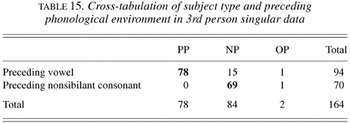
The overlap between other pronouns and preceding sibilants, however, represents just one of several overlaps in the 3rd person singular data. A cross-tabulation of subject type and preceding phonological environment revealed additional overlaps between personal pronoun subjects and preceding vowels and between noun phrase subjects and preceding nonsibilant consonants, as shown in Table 15.
Cross-tabulation of subject type and preceding phonological environment in 3rd person singular data

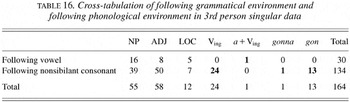
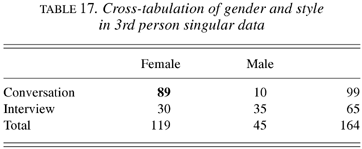
In addition, a cross-tabulation of following grammatical environment and following phonological environment revealed overlaps between gon and gonna and following consonants, between a+verb+-ing and following vowels, and, somewhat less predictably, between verb+-ing and following consonants, as shown in Table 16. And, while a cross-tabulation of gender and style revealed no empty or near-empty cells, the data distribution was significantly skewed; a majority of the tokens were produced by female speakers in conversation style, as shown in Table 17.24
See Guy (1988) for a discussion of nonorthogonal data and skewed data distributions.
As discussed in studies such as Cedergren (1973), Guy (1988), and Paolillo (2002), varbrul, unlike some other statistical packages, assumes that all factor groups being tested are independent of one another. Because the program does not automatically test for interactions itself, it is necessary to examine the data for possible interactions to avoid getting unreliable results. The studies cited here offer ways of handling such interactions when using varbrul.
Cross-tabulation of following grammatical environment and following phonological environment in 3rd person singular data

Cross-tabulation of gender and style in 3rd person singular data

Note, first of all, that the interactions between following grammatical environment and following phonological environment affect only the auxiliary environments, which overlap with following consonants, except in the case of a+verb+-ing. The potential for this type of interaction was noted by Fraser (1972:13), who observed that "gonna begins with a consonant, and the likelihood of a verb beginning with a consonant is greater than for an NP, either because of the determiner a or nouns without determiner which have initial vowels." Wolfram (1974:507) acknowledged this potential for interaction as well, noting that the "following consonant rather than the type of syntactic environment may be responsible for the increased incidence of deletion in certain types of environments." Clearly, such a finding would have serious implications for the Creolist Hypothesis, which has placed much emphasis on the grammatical effects of following environment. Given this observation and the fact that all of the auxiliary environments except verb+-ing were also knockout factors in the data, the varbrul analysis for this variable was restricted to "true copula" environments: only those tokens occurring in the environment of nominal, adjectival, or locative predicates. Separating the copula and auxiliary environments in this way allowed for the effects of following phonological environment to be examined without the interaction observed in Table 16.26
A similar strategy was used by Wolfram (1974), who excluded gonna tokens from his analysis of are variability in order to examine the independent effects of following consonants. His findings are discussed later in the article.
The overlap between subject type and preceding phonological environment is, of course, unsurprising, given the intentional separation of personal pronouns from the other subject type factors because of their final phonological segment. However, this interaction does not appear to have been problematic for other studies in terms of the varbrul results that were produced.27
Perhaps these interactions were present in other studies as well, but were avoided in ways that simply were not explicitly stated in the text.
Similar types of cross-product groups have been used in previous studies as well (see, e.g., Labov, 1972a).
Finally, in an effort to accommodate for the skewed distributions between gender and style, another cross-product group was constructed consisting of four factors: female speaker/conversation style, male speaker/conversation style, female speaker/interview style, and male speaker/ interview style. Unfortunately, this group produced new interactions with the linguistic factor groups and therefore could not be reliably tested. Attempts were also made to partition the data (e.g., by running the conversation data separately from the interview data or the male data separately from the female data). However, these attempts failed to produce reliable results as well, possibly due to the low overall number of tokens resulting from the exclusion of auxiliary environments and other pronoun subjects. For these reasons, gender and style were not tested for this variable.
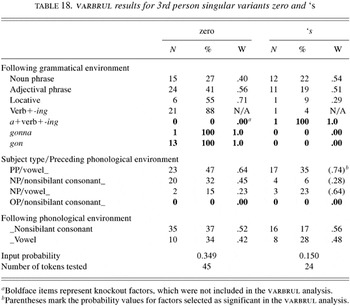
Table 18 shows the results of the varbrul runs for zero and 's with these adjustments made to the data. The only factor group chosen as significant in these runs was subject type/preceding phonological environment. For this group, 's was favored most by preceding vowels with personal pronoun subjects and then by preceding vowels with noun phrase subjects. It was disfavored by preceding nonsibilant consonants with noun phrase subjects. These results are consistent with previous findings in showing a strong favoring effect on contraction from personal pronouns and vowels. However, the fact that preceding vowels with noun phrase subjects also favor contraction in these data suggests that the effect of preceding vowels is most important. And, as in the 1st person singular data, these findings suggest the presence of a cvcv patterning preference in the data.
varbrul results for 3rd person singular variants zero and 's

Subject type was not chosen as statistically significant for the zero copula; however, the percentages and factor weights here resemble the pattern typically found in aave, in which personal pronouns favor copula absence over noun phrases, unlike the opposite pattern found in many cec varieties. In contrast to the contraction figures, the effect on copula absence appears to be more grammatically driven. This effect may be a reflection of the "straight deletion" formula that was used to calculate the percentages, as discussed in Rickford et al. (1991).
Finally, following grammatical environment also was not chosen as significant in these data; however, the distribution of the zero copula here matches that typically observed in studies of copula variability in aave, in contrast to that found in the 1st person singular data. Note also that following phonological environment appears to have little effect on the zero copula distribution, not only in terms of the probability weightings (which were not selected as significant), but also in terms of the percentages, which favor consonants over vowels by only 3%.
Plural/2nd person singular variation
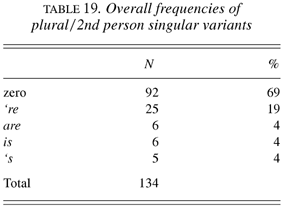
Table 19 shows the overall distribution of the variants found in plural/2nd person singular environments. To eliminate indeterminate tokens and inhibitory environments from these data, tokens occurring in the environments of preceding and following [r], as well as in the environments of preceding and following sibilants, were not included in the totals shown in Table 19 (see Blake, 1997).29
There was some concern that excluding preceding sibilants from the plural/2nd person singular data would eliminate a majority of the tokens to the extent that plural NP subjects were marked with the plural -s morpheme in the Gullah data. However, the exclusion only resulted in the elimination of ten tokens.
Overall frequencies of plural/2nd person singular variants

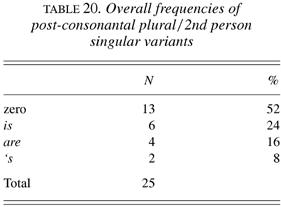
Overall frequencies of post-consonantal plural/2nd person singular variants

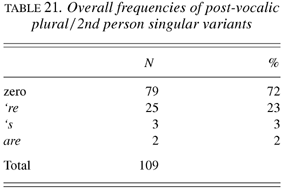
Overall frequencies of post-vocalic plural/2nd person singular variants

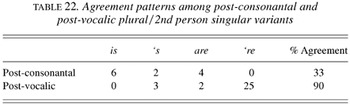
The zero copula is the most frequent variant in both post-vocalic and post-consonantal environments, but it is more frequent in the former than in the latter, suggesting at least the possibility of an effect from post-vocalic [r]-deletion. This possibility is also supported by the fact that the se concord forms, are and 're, make up the majority of overt copula forms in post-vocalic environments in contrast to post-consonantal environments, where the nonconcord forms, is and 's, constitute the majority, as shown in Table 22.
Agreement patterns among post-consonantal and post-vocalic plural/2nd person singular variants

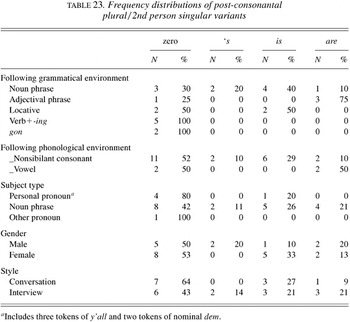
Table 23 shows the frequency distributions of the post-consonantal variants. Clearly, not much can be said about the frequencies in Table 23, given the low overall number of tokens in post-consonantal environments (N = 25). A few tentative observations may be made. Note that copula absence occurs with 52% frequency in the environment of following nonsibilant consonants and with 50% frequency in the environment of following vowels, suggesting a negligible effect from following phonological environment, as was found for the 3rd person singular variants. The frequency distributions for subject type suggest a preference for copula absence in pronominal environments, consistent with patterns typically found in aave.30
Note here, however, that the personal pronouns are consonant-final y'all and nominal dem, in contrast to the 3rd person singular data, in which the personal pronouns were all vowel-final.
Frequency distributions of post-consonantal plural/2nd person singular variants

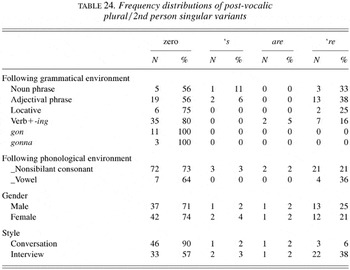
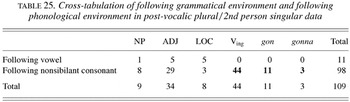
The frequency distributions of the post-vocalic variants are shown in Table 24. Subject type was not included in this table. This group was eliminated as a singleton group because all of the subjects for this variable were personal pronouns, again showing the overlap between personal pronoun subjects and preceding vowels observed in 3rd person singular environments. A series of cross-tabulations was done to check for any additional interactions in these data. Surprisingly, following grammatical environment and following phonological environment revealed the same pattern of interactions found in 3rd person singular environments, with overlaps occurring between auxiliary environments and following consonants, as shown in Table 25.
Frequency distributions of post-vocalic plural/2nd person singular variants

Cross-tabulation of following grammatical environment and following phonological environment in post-vocalic plural/2nd person singular data

The fact that this interaction occurs in more than one variable (particularly with regard to the verb+-ing predicate) suggests that this pattern may be reflective of a general tendency that has not been fully explored in the literature. As discussed earlier, one notable exception is Wolfram (1974), which excluded tokens of gonna from the analysis of are variability in order to examine the independent effects of the following phonological environment. However, given the relatively low overall number of tokens for this variable, it was not possible to partition out the auxiliary environments as was done for the 3rd person singular variable to achieve a reliable varbrul result. Some observations were made, however, with regard to the percentages in Table 24.
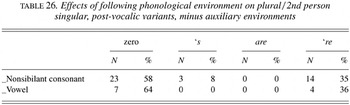
As in the post-consonantal data, the hierarchy for following grammatical environment in Table 24 resembles that typically found in aave. However, the zero copula is categorical in the environments of both gon and gonna in contrast to the 1st person singular data, which exhibited distinct patterns of contraction and absence in these environments. With regard to following phonological environment, there is a 9% difference in the frequencies of the zero copula in the post-vocalic data, with the higher percentage found in the environment of following nonsibilant consonants. Although this difference is not extremely large, it would support the theory of post-vocalic [r]-deletion, which, as observed by Wolfram, is consistently favored by following consonants. However, as with the interactions between following consonants and auxiliary environments shown in Table 24, it is impossible to tell how much of the effect is phonological and how much of it is grammatical. Table 26, therefore, shows the figures for following phonological environment with the auxiliary environments excluded.
Effects of following phonological environment on plural/2nd person singular, post-vocalic variants, minus auxiliary environments

With the exclusion of auxiliary environments, the percentage of copula absence actually shifts in favor of following vowels, thus suggesting that copula absence in post-vocalic environments is not a product of [r]-deletion but instead is grammatically constrained. Wolfram (1974:508) reported the same finding in his analysis of are variability, following the exclusion of gonna tokens. Finally, for the nonlinguistic groups, gender reveals no particularly noticeable patterns. However, style exhibits the same pattern found earlier for the 1st person singular and plural/2nd person singular post-consonantal variables. For this variable, the zero copula is near-categorical in conversation styles, occurring with 90% frequency.
SUMMARY AND CONCLUSIONS
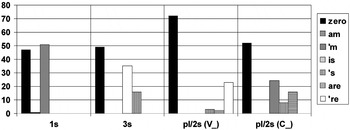
Figure 1 summarizes the overall patterns of copula variability observed in the Gullah data. Note that the zero copula is the most frequent variant in every environment except with 1st person singular subjects. Unlike aave, however, which tends to exhibit near-categorical contraction in 1st person singular environments, the Gullah data show an almost equal distribution of zero and 'm tokens--a pattern that has been more typically observed in creole and diaspora varieties. The highest percentage of copula absence is found in post-vocalic plural/2nd person singular environments, where zero varies primarily with tokens of 're. Although this pattern appears on the surface to suggest complicating effects from post-vocalic [r]-deletion, the effects of following phonological environment do not support this theory. The inclusion of are variability in the overall analysis, therefore, seems justified. Separating the plural/2nd person singular environments into two variables, as was done in this study, provides a clearer picture of the patterns of variable agreement in the data. Of course, the disadvantage of separating the variables in this way, as well as in separating the plural/2nd person singular and 3rd person singular variables, is the reduction in the pool of tokens to be tested. These separations, however, are necessitated by the distinct patterns of variation exhibited in each environment.

Summary of overall frequencies.
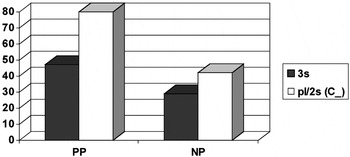
Although the interactions between phonological and grammatical constraints in the Gullah data make comparisons with aave and other varieties somewhat difficult, a few interesting patterns emerge. Recall that subject type and preceding phonological environment were not tested for the 1st person singular and post-vocalic plural/2nd person singular variables because they involved singleton groups. However, the patterns of copula absence for the other two variables warrant further discussion. In both cases, the zero copula occurs more frequently with personal pronouns than with noun phrase subjects, consistent with patterns found in aave. Figure 2 shows the frequencies of copula absence for both variables.31
To facilitate comparison in Figure 2, the noun phrase/preceding nonsibilant consonant and noun phrase/preceding vowel figures have been collapsed for the 3rd person singular variable.

Summary of copula absence frequencies by subject type.
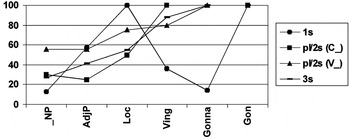
Following grammatical environment also was not chosen as significant for any of the variables in these data. However, the frequency results are more or less consistent with those typically reported for aave, with higher percentages of absence in auxiliary environments than in "true copula" environments. Figure 3 summarizes the distributions of the zero copula by following grammatical environment. Note that with the exception of the 1st person singular variable, the Gullah data resemble the hierarchy characteristic of copula absence in aave. As such, these data address some of the inconsistencies between aave and creole varieties that studies such as Mufwene (1992) and Poplack and Sankoff (1987) have observed as being problematic for the Creolist Hypothesis. Gullah, like aave, allows for variable copula absence in the environment of np predicates; most creole varieties require a copula in this environment. And with the exception of the 1st person singular data, the Gullah data also resemble aave in exhibiting a lower frequency of copula absence in adjectival environments than in locative environments; many cec varieties tend to exhibit the reverse pattern.

Summary of copula absence frequencies by following grammatical environment.
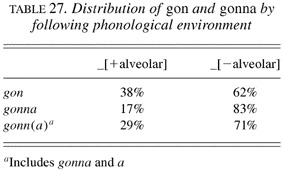
The 1st person singular variable is the only variable that exhibits the gon/gonna distinction in the Gullah data.32
With so few gon/gonna tokens in the data, however, it is difficult to determine whether or not this pattern extends to the other variables.
These percentages are based on the total number of occurrences of gon and gonn(a) in the data, not just the 1st person singular tokens.
It might also be noted that gon is variably pronounced as [go] rather than [gon] in Gullah. So the use of the variant gon in following alveolar contexts may not even represent a true coarticulation in the Gullah data in all instances, as Poplack and Tagliamonte (2001) suggested for their data.
Distribution of gon and gonna by following phonological environment

The interactions between following phonological environment and following grammatical environment point to a distinction between "true copula" and auxiliary environments, one that might be worthy of further exploration. The exclusion of auxiliary environments in the 3rd person singular data did not unmask any significant effect from following phonological environment; nevertheless, the overlap between auxiliaries and following consonants, especially with verb+-ing predicates, should be explored in future studies to determine how much it actually affects the results for following grammatical environment. Walker (2000), who observed a number of interactions in his own data, including interactions between following grammatical environment and prosodic structure, suggested that copula and auxiliary contexts should be examined separately.
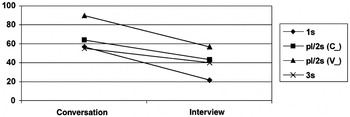
Finally, with regard to the nonlinguistic constraints, style was not chosen as significant for any of the variables examined. It is interesting to note that the zero copula consistently occurs more frequently in conversation styles than in interview styles, as illustrated by Figure 4. Of course, in the case of the 3rd person singular data, these patterns may be affected by the heavy overlap between female speakers and conversation styles. However, none of the other variables exhibited this skewed distribution pattern. Gender was only chosen as significant for the 1st person singular variants, where female speakers favored the zero copula and male speakers favored 'm. These patterns contradict the findings reported in most language and gender research that women use more standard variants than men. However, they do parallel the observations made by Nichols (1976) for older, rural Gullah speakers.

Summary of copula absence frequencies by style.
The evidence examined in this article describes a mesolectal to upper mesolectal system that, in some ways, resembles that of intermediate Caribbean English Creoles and, in other ways, shows interesting parallels with the copula system of aave. The observed parallels are likely to have significant implications for the debate over the origins of aave, given that the Gullah data exhibit parallels with aave that have not been attested in comparisons between aave and other creole varieties. Specifically, the adjective/locative distinction, the use of the zero copula in --np environments, and the np--/pro-- distinction in subject type are patterns that have proven to be problematic for creolists who have compared aave to other creoles. The Gullah patterns, however, resemble the aave patterns in ways that offer new support for the theory of an aave-creole connection.
References
REFERENCES
Bailey, Beryl L.
(1965).
Toward a new perspective in Negro English dialectology.
American Speech
40:171-177.Google Scholar
Baugh, John.
(1980).
A reexamination of the Black English copula. In
William Labov (ed.),
Locating language in time and space.
New York:
Academic.
83-106.
Bender, Emily.
(2000).
Syntactic variation and linguistic competence: The case of aave
copula absence.
Doctoral dissertation,
Stanford University.
Bickerton, Derek.
(1971).
Inherent variability and variable rules.
Foundations of Language
7:457-492.Google Scholar
Bickerton, Derek.
(1972).
The structure of polylectal grammars. In
R. Shuy (ed.),
Twenty-third annual round table: Sociolinguistics: Current trends
and prospects.
Washington, DC:
Georgetown University Press.
17-42.
Blake, Renee.
(1997).
Defining the envelope of linguistics variation: The case of
"don't count" forms in the copula analysis of African
American Vernacular English.
Language Variation and Change
9:57-79.Google Scholar
Cedergren, Henrietta.
(1973).
The interplay of social and linguistic factors in Panama.
Doctoral dissertation,
Cornell University.
D'Eloia, Sarah G.
(1973).
Issues in the analysis of Nonstandard Negro English: A review of J.
L. Dillard's Black English.
Journal of English Linguistics
7:87-106.Google Scholar
Dillard, Joe L.
(1972).
Black English: Its history and usage in the United States.
New York:
Random House.
Edwards, Walter.
(1980).
Varieties of English in Guyana: Some comparisons with bev.
Linguistics
18:289-309.Google Scholar
Ewers, Traute.
(1996).
The origin of American Black English: Be-forms in the hoodoo texts.
Berlin:
Mouton.CrossRef
Fasold, Ralph.
(1990).
Contraction and deletion in Vernacular Black English: Creole
history and relationship to Euro-American English.
Unpublished manuscript.
Fraser, Bruce.
(1972).
Optional rules in grammar.
Monograph series on languages and linguistics, Georgetown University.
25:1-16.Google Scholar
Guy, Gregory
(1988).
Advanced Varbrul analysis. In
K. Ferrara,
B. Brown,
K. Walters, &
J. Baugh (eds.),
Linguistic change and contact.
Austin:
University of Texas Department of Linguistics.
124-136.
Hancock, Ian.
(1980).
Gullah and Barbadian: Origins and relationships.
American Speech
55:17-35.Google Scholar
Hannah, Dawn.
(1997).
Copula absence in Samana English: Implications for research
on the linguistic history of African-American Vernacular English.
American Speech
72:339-372.Google Scholar
Holm, John.
(1984).
Variability of the copula in Black English and its Creole kin.
American Speech
59:291-309.Google Scholar
Howe, Darin, &
Walker, James.
(2000).
Negation in Early African American English: A creole diagnostic?
In
S. Poplack (ed.),
The English history of African American English.
Oxford:
Blackwell.
109-140.
Jones-Jackson, Patricia.
(1984).
On decreolization and language death in Gullah.
Language in Society
13:351-362.Google Scholar
Jones-Jackson, Patricia.
(1987).
When roots die: Endangered traditions on the Sea Islands.
Athens:
University of Georgia Press.
Kurath, Hans.
(1928).
The origin of dialectal differences in spoken American English.
Modern Philology
25:285-295.Google Scholar
Kurath, Hans.
(1949).
A word geography of the Eastern United States.
Ann Arbor:
University of Michigan Press.
Labov, William.
(1969).
Contraction, deletion, and inherent variability of the English
copula.
Language
45:715-762.Google Scholar
Labov, William.
(1972a).
Contraction, deletion, and inherent variability of the English
copula.
Language in the inner city: Studies in the Black English Vernacular.
Oxford:
Blackwell.
65-129.
Labov, William.
(1972b).
Some principles of linguistic methodology.
Language in Society
1:97-120.Google Scholar
Labov, William.
(1972c).
The study of language in its social context.
Sociolinguistic patterns.
Philadelphia:
Philadelphia University Press.
183-259.
Labov, William.
(1984).
Field methods of the project on linguistic change and variation.
In
J. Baugh &
J. Sherzer (eds.),
Language in use: Readings in sociolinguistics.
Englewood Cliffs, NJ:
Prentice-Hall.
Labov, William,
Cohen, Paul,
Robins, Clarence, &
Lewis, John.
(1968).
A study of the non-standard English of Negro and Puerto Rican
speakers in New York City (2 vols.).
Philadelphia:
U.S. Regional Survey.
LePage, Robert, &
DeCamp, David.
(1960).
Jamaican Creole: Creole Language Studies 1.
London:
Macmillan.
McDavid, Raven, &
McDavid, Virgina.
(1951).
The relationship of the speech of Negroes to the speech of Whites.
American Speech
26:3-17.Google Scholar
Milroy, Leslie.
(1987).
Observing and analysing natural language.
Oxford:
Blackwell.
Montgomery, Michael.
(1991).
The linguistic value of the ex-slave recordings. In
G. Bailey,
N. Maynor, &
P. Cukor-Avila (eds.),
The emergence of Black English: Text and commentary.
Amsterdam:
Benjamins.
173-189.
Mufwene, Salikoko.
(1991a).
Is Gullah decreolizing? A comparison of a speech sample of the
1930s with a sample of the 1980s. In
G. Bailey,
N. Maynor, &
P. Cukor-Avila (eds.),
The emergence of Black English.
Amsterdam:
Benjamins.
131-140.
Mufwene, Salikoko.
(1991b).
Some reasons why Gullah is not dying yet.
English World-Wide
12:215-243.Google Scholar
Mufwene, Salikoko.
(1992).
Ideology and facts on African-American English.
Pragmatics
2:141-166.Google Scholar
Mufwene, Salikoko.
(1993).
Investigating Gullah: Difficulties in ensuring
"authenticity'. In
D. Lance &
W. Glowka (eds.),
Language variation in North American English.
New York:
Modern Language Association.
178-190.
Nichols, Patricia.
(1976).
Linguistic change in Gullah: Sex, age, and mobility.
Doctoral dissertation,
Stanford University.
Paolillo, John.
(2002).
Analyzing linguistic variation: Statistical models and methods.
Stanford:
Center for the Study of Language and Information.
Poplack, Shana, &
Sankoff, David.
(1987).
The Philadelphia story in the Spanish Caribbean.
American Speech
62:291-314.Google Scholar
Poplack, Shana, &
Tagliamonte, Sali.
(1989).
There's no tense like the present: Verbal
-s inflection in early Black English.
Language Variation and Change
1:47-84.Google Scholar
Poplack, Shana, &
Tagliamonte, Sali.
(1991).
African American English in the Diaspora: The case of old-line Nova
Scotians.
Language Variation and Change
3:301-339.Google Scholar
Poplack, Shana, &
Tagliamonte, Sali.
(1994). -S or nothing: Marking
the plural in the African American Diaspora.
American Speech
69:227-259.Google Scholar
Poplack, Shana, &
Tagliamonte, Sali.
(2001).
African American English in the Diaspora.
Oxford:
Blackwell.
Rand, David, &
Sankoff, David.
(1990).
goldvarb, version 2: A variable rule application for the Macintosh.
Montreal:
Universite de Montreal, Centre de recherches
mathematiques.
Rickford, John.
(1974).
The insights of the mesolect. In
D. DeCamp &
I. Hancock (eds.),
Pidgins and creoles: Current trends and prospects.
Washington, DC:
Georgetown University Press.
92-117.
Rickford, John.
(1977).
The question of prior creolization in Black English. In
A. Valdman (ed.),
Pidgin and creole linguistics.
Bloomington:
Indiana University Press.
190-221.
Rickford, John.
(1992).
The creole residue in Barbados. In
J. Hall,
N. Doane, &
D. Ringler (eds.),
Old English and new: Studies in language and linguistics in honor
of Frederic G. Cassidy.
New York:
Garland.
183-201.
Rickford, John.
(1998).
The creole origins of African-American Vernacular English:
Evidence from copula absence. In
S. Mufwene,
J. Rickford,
G. Bailey, &
J. Baugh (eds.),
African-American English: Structure, history, and use.
New York:
Rutledge.
154-200.
Rickford, John, &
Blake, Renee.
(1990).
Copula contraction and absence in Barbadian English, Samana
English and Vernacular Black English. In
K. Hall,
J-P. Koenig,
M. Meacham,
S. Reinman, &
L. Sutton (eds.),
BLS 16: Proceedings of the Sixteenth Annual Meeting of the Berkeley
Linguistics Society.
Berkeley:
Berkeley Linguistics Society.
257-268.
Rickford, John, &
Handler, Jerome.
(1994).
Textual evidence on the nature of early Barbadian speech,
1676-1835.
Journal of Pidgin and Creole Languages
9:221-255.Google Scholar
Rickford, John,
Ball, Arnetha,
Blake, Renee,
Jackson, Raina, &
Martin, Nomi.
(1991).
Rappin on the copula coffin: Theoretical and methodological issues
in the analysis of copula variation in African American Vernacular
English.
Language Variation and Change
3:103-132.Google Scholar
Romaine, Suzanne.
(1982).
Socio-historical linguistics: Its status and methodology.
Cambridge:
Cambridge University Press.CrossRef
Schneider, Edgar.
(1982).
On the history of Black English in the U.S.A.: Some new evidence.
English World Wide
3:18-46.Google Scholar
Schneider, Edgar.
(1989).
American earlier Black English.
Tuscaloosa:
University of Alabama Press.
Schneider, Edgar.
(1993).
Africanisms in the grammar of Afro-American English: Weighing the
evidence. In
S. Mufwene (ed.),
Africanisms in Afro-American language varieties.
Athens:
University of Georgia Press.
192-208.
Singler, John.
(1991).
Copula variation in Liberian Settler English and American Black
English. In
W. Edwards &
D. Winford (eds.),
Verb phrase patterns in Black English and Creole.
Detroit:
Wayne State University Press.
129-164.
Stewart, William.
(1967).
Sociolinguistic factors in the history of American Negro Dialects.
The Florida FL Reporter
5(2):11, 22, 24, 26, 28.Google Scholar
Stewart, William.
(1968).
Continuity and change in American Negro dialects.
The Florida FL Reporter
6(1):3-4, 14-16, 18.Google Scholar
Tagliamonte, Sali, &
Poplack, Shana.
(1988).
How Black English past got to the present.
Language in Society
17:513-533.Google Scholar
Tagliamonte, Sali, &
Poplack, Shana.
(1993).
The zero-marked verb: Testing the creole hypothesis.
Journal of Pidgin and Creole Linguistics
8:171-206.Google Scholar
Turner, Lorenzo D.
(1949).
Africanisms in the Gullah Dialect.
New York:
Arno.
Walker, James.
(2000).
Rephrasing the copula: Contraction and zero in early African
American English. In
S. Poplack (ed.),
The English history of African American English.
Oxford:
Blackwell.
Weldon, Tracey.
(1998).
Exploring the aave-Gullah connection: A comparative study of copula
variability.
Doctoral dissertation,
Ohio State University.
Winford, Donald.
(1992a).
Another look at the copula in Black English and Caribbean creoles.
American Speech
67:21-60.Google Scholar
Winford, Donald.
(1992b).
Back to the past: The bev/creole connection revisited.
Language Variation and Change
4:311-357.Google Scholar
Winford, Donald.
(1997).
On the origins of African American Vernacular English--A
creolist perspective. Part I: The sociohistorical background.
Diachronica
14:305-344.Google Scholar
Winford, Donald.
(1998).
On the origins of African American Vernacular English--A
creolist perspective. Part II: Linguistic features.
Diachronica
15:99-154.Google Scholar
Wolfram, Walt.
(1969).
A sociolinguistic description of Detroit Negro speech.
Washington, DC:
Center for Applied Linguistics.
Wolfram, Walt.
(1974).
The relationship of White Southern speech to Vernacular Black
English.
Language
50:498-527.Google Scholar
Wolfram, Walt.
(1975).
Variable constraints and rule relations. In
R. Fasold &
R. Shuy (eds.),
Analyzing variation in English: Papers from the second colloquium
on New Ways of Analyzing Variation.
Washington, DC:
Georgetown University Press.
70-88.
Wolfram, Walt.
(1986).
Good data in a bad situation: Eliciting vernacular structures. In
J. Fishman,
A. Tabouret-Keller,
M. Cline,
B. Khrishnamurti, &
M. Abdulziz (eds.),
Sociolinguistics and the sociology of language. Vol. 2. The
Fergusonian Impact: In honor of Charles A. Ferguson on the occasion of
his sixty-fifth birthday.
Berlin:
Mouton de Gruyter.
1-22.

Distribution of hours collected in individual communities
1990 general statistics for Beaufort and Charleston Countiesa
Statistics for Blacks and Whites in Beaufort and Charleston Countiesa
Breakdown of speaker group by gender, age, and occupation
Overall totals for gender, age, and style
Post-vocalic [r] variability among noncopula forms
Person-number agreement patterns among overt copula forms
Copula absence by subject type in aave, Barbadian Creole, and Trinidadian English
Overall frequencies of 1st person singular variants
varbrul results for 1st person singular variants zero and 'm
Frequencies of 3rd person singular variants in wit environments
Frequencies of 3rd person singular variants in the environment of preceding sibilants
Overall frequencies of 3rd person singular variants
Frequency distributions of 3rd person singular variants
Cross-tabulation of subject type and preceding phonological environment in 3rd person singular data
Cross-tabulation of following grammatical environment and following phonological environment in 3rd person singular data
Cross-tabulation of gender and style in 3rd person singular data
varbrul results for 3rd person singular variants zero and 's
Overall frequencies of plural/2nd person singular variants
Overall frequencies of post-consonantal plural/2nd person singular variants
Overall frequencies of post-vocalic plural/2nd person singular variants
Agreement patterns among post-consonantal and post-vocalic plural/2nd person singular variants
Frequency distributions of post-consonantal plural/2nd person singular variants
Frequency distributions of post-vocalic plural/2nd person singular variants
Cross-tabulation of following grammatical environment and following phonological environment in post-vocalic plural/2nd person singular data
Effects of following phonological environment on plural/2nd person singular, post-vocalic variants, minus auxiliary environments
Summary of overall frequencies.
Summary of copula absence frequencies by subject type.
Summary of copula absence frequencies by following grammatical environment.
Distribution of gon and gonna by following phonological environment
Summary of copula absence frequencies by style.
 You have
Access
- 12
- Cited by