Morphology is the study of word formation through the combination of morphemes, the smallest linguistic units of meaning, to form more complex words. Since the objective of writing is not to faithfully encode speech as we speak it, but rather to transmit meaning as efficiently as possible, many writing systems have prioritized the transparency of word roots over the regularity of speech sound, resulting in differences in morphological complexity. An example of this can be seen in the written words “heal”–“health,” or by how the various pronunciations of English plurals (i.e., dogs /′dɒgz/ and cats /kæts/) are represented by a single “s.” The preservation of meaning over sound often produces spelling irregularities in some languages, such as English. However, an increase in morphological complexity has been shown to support reading. The increase of morphological complexity allows individuals to utilize the morphemes of a target word as units of processing through which meaning and associated phonological representations may be extracted from the mental lexicon (Landerl & Reitsma, Reference Landerl and Reitsma2005; Levin, Ravid, & Rapaport, Reference Levin, Ravid and Rapaport2001). Therefore, in cases where individuals are limited in their ability to effectively create or access quality phoneme–grapheme correspondences, such as individuals with dyslexia, an awareness of a language's morphological structure may, in part, offer a means of compensation for any observed literacy impairment (Burani, Marcolini, De Luca, & Zoccolotti, Reference Burani, Marcolini, De Luca and Zoccolotti2008; Elbro & Arnbak, Reference Elbro and Arnbak1996; Law, Wouters, & Ghesquière, Reference Law, Wouters and Ghesquière2015). To broaden our understanding of how individuals with dyslexia use morphological structure and its potential role as a compensatory factor, this study explored morphological awareness and morphological processing in typical and dyslexic Dutch readers. Indexes of morphological complexity have placed Dutch as falling between the more complex French language and English (Bane, Reference Bane, Chang and Haynie2008). Therefore, the inclusion of a Dutch-speaking population provides a unique bridge through which to discuss and compare past findings of French and English studies. This work will not only broaden the current explanatory models of dyslexia but also aid in furthering the characterization of compensatory factors in individuals with dyslexia.
MORPHOLOGICAL AWARENESS (MA) AND READING
MA is described as an individual's “conscious (or explicit) awareness of the morphemic structure of words and the ability to reflect on and manipulate that structure” (Carlisle & Feldman, Reference Carlisle and Feldman1995, p. 194). Research has shown MA begins developing prior to reading instruction, yet is often seen to be limited to an awareness of inflectional forms in prereading children (Berko, Reference Berko1958; Carlisle & Fleming, Reference Carlisle and Fleming2003; Law et al., Reference Law, Wouters and Ghesquière2015; Law & Ghesquière, Reference Law and Ghesquière2017). Through increased print exposure and instruction, a wider range of morphologically complex words are introduced to children, which in turn stimulates and expands the individual's MA (Nagy & Anderson, Reference Nagy and Anderson1984).
MA is thought to aid in the identification, comprehension, and pronunciation of words through the analyses of the morphological structure of a target word. Recent studies have demonstrated MA as a contributing factor in word recognition, independent of orthographic processing, phonological awareness (PA), rapid automatized naming, and vocabulary (Carlisle, Reference Carlisle2000; Deacon & Kirby, Reference Deacon and Kirby2004; Levesque, Kieffer, & Deacon, Reference Levesque, Kieffer and Deacon2017; Roman, Kirby, Parrila, Wade-Woolley, & Deacon, Reference Roman, Kirby, Parrila, Wade-Woolley and Deacon2009), and in reading comprehension, after controlling for word reading, vocabulary, and PA (Carlisle, Reference Carlisle2000; Deacon & Kirby, Reference Deacon and Kirby2004; Nagy, Berninger, & Abbott, Reference Nagy, Berninger and Abbott2006; Tong, Deacon, Kirby, Cain, & Parrila, Reference Tong, Deacon, Kirby, Cain and Parrila2011).
MORPHOLOGICAL PROCESSING (MP) AND READING
MP refers to the unconscious or implicit use of the morphological structure of a target word during language processing. Although often discussed as being related to MA, research demonstrating a relation between MP and MA in adult readers is lacking.
MP is thought to contribute to initial word decoding and increased reading speed of morphologically complex words through the decomposition of a target word into its constituent morphemes, thus aiding in lexical access (Elbro, Reference Elbro, Von Euler, Lundberg and Lennerstrand1989). In addition, this morphological deconstruction provides additional information to the reader beyond form, such as syntactic, semantic, and phonological information, that further aids in word reading, reading comprehension, and fluency achievement (Elbro, Reference Elbro, Von Euler, Lundberg and Lennerstrand1989, Mahony, Singson, & Mann, Reference Mahony, Singson and Mann2000; Nagy et al., Reference Nagy, Berninger and Abbott2006).
Support for morphology's role in early visual word recognition has been proved through priming studies demonstrating, across various languages, derivational morphological effects beyond the independent effects of semantics and orthography in early visual word recognition, thus supporting a morphological structure within the lexicon's mental organization (Dutch: Diependaele, Sandra, & Grainger, Reference Diependaele, Sandra and Grainger2009; English: Marslen-Wilson, Bozic, & Randall, Reference Marslen-Wilson, Bozic and Randall2008; Rastle, Davis, & New, Reference Rastle, Davis and New2004; Italian: Burani et al., Reference Burani, Marcolini, De Luca and Zoccolotti2008; and Spanish: Duñabeitia, Perea, & Carreiras, Reference Duñabeitia, Perea and Carreiras2007). Furthermore, recent studies have shown that the magnitude of morphological priming (i.e., reader–read) is greater than the magnitude of pseudoderived priming (i.e., corner–corn). These differences have been attributed to the added benefit of the processing of morphosemantic information above that offered by the morpho-orthographic information, thus demonstrating independent morphosemantic and morpho-orthographic effects during early visual word recognition (Diependaele et al., Reference Diependaele, Sandra and Grainger2005; Diependaele, Duñabeitia, Morris, & Keuleers, Reference Diependaele, Duñabeitia, Morris and Keuleers2011; Feldman, O'Connor, & del Prado Martin, 2009).
DYSLEXIA AND MA AND MP
Dyslexia is a hereditary neurological condition often characterized by accuracy and/or fluency difficulties in decoding, word reading, and spelling (Vellutino, Fletcher, Snowling, & Scanlon, Reference Vellutino, Fletcher, Snowling and Scanlon2004). Recent etiological views of dyslexia have suggested a cognitive multideficit model to explain the behavioral traits of individuals with dyslexia (Pennington, Reference Pennington2006). Pennington (Reference Pennington2006) theorized that multiple genetic or environmental factors act probabilistically as risk or protective factors. It is thought that the probability of the development of the expressed behavioral symptoms is increased or decreased through the interaction of these factors. One such risk factor that is considered to be at the core of dyslexia, and found across all languages, is a deficit in the formation of, and/or access to, phonological representations (Snowling, Reference Snowling2000, but see Ramus & Szenkovits, Reference Ramus and Szenkovits2008). Although heavily represented in the literature, phonological impairments are not universal within the dyslexic population, and in turn, not all individuals with phonological impairments develop the behavioral traits associated with dyslexia (Snowling, Reference Snowling2008). However, attention has begun to shift from a single cause model of dyslexia to one embodying multiple risk and protective factors, such as MA and MP.
Although underrepresented in the literature when compared to studies of phonological skills of individuals with dyslexia, research examining MA across various ages and languages has shown that dyslexics underperform across a variety of measures assessing MA when compared with chronologically age-matched controls (Berthiaume & Daigle, Reference Berthiaume and Daigle2014; Casalis, Colé, & Sopo, Reference Casalis, Colé and Sopo2004; Fowler, Liberman, & Feldman, Reference Fowler, Liberman and Feldman1995; Martin, Frauenfelder, & Colé, Reference Martin, Frauenfelder and Colé2014; Shankweiler et al., Reference Shankweiler, Crain, Katz, Fowler, Liberman, Brady and Fletcher1995; Tsesmeli & Seymour, Reference Tsesmeli and Seymour2006). In studies employing a reading age match design, however, dyslexics were shown to perform similarly to, or better than, younger reading skill matched controls (Casalis et al., Reference Casalis, Colé and Sopo2004; Martin et al., Reference Martin, Frauenfelder and Colé2014; Robertson, Joanisse, Desroches, & Terry, Reference Robertson, Joanisse, Desroches and Terry2013; Tsesmeli & Seymour, Reference Tsesmeli and Seymour2006), yet Casalis et al. (Reference Casalis, Colé and Sopo2004) did find that children with dyslexia were found to be poorer in morphological segmentation tasks when compared with reading-age controls.
Taken together these findings indicate that MA deficits are not causal to a dyslexic's reading struggles, thereby suggesting that MA deficits are a consequence of a poor reading experience, or more primary deficits, such as the phonological deficit often observed in individuals with dyslexia (Snowling, Reference Snowling2000; Vellutino & Fletcher, Reference Vellutino, Fletcher, Snowling and Hulme2005).
In contrast, research of MP has produced little evidence or agreement as to whether or not the ability to rapidly process a word's morphological structure is intact in individuals with dyslexia (Elbro & Arnbak, Reference Elbro and Arnbak1996, Quémart & Casalis, Reference Quémart and Casalis2015, but see Deacon, Parrila, & Kirby, Reference Deacon, Parrila and Kirby2006; Lázaro Camacho, & Burani, Reference Lázaro, Camacho and Burani2013). Theoretically, it has been suggested that a hierarchical structure of linguistic units is employed during early visual word processing, in that the processing of smaller linguistic units (i.e., graphemes) are required to process larger size units such as rhymes (Duncan, Seymour, & Hill, Reference Duncan, Seymour and Hill1997). Such a situation would ultimately limit the visual processing of morphemes in a dyslexic population, thus limiting MP. In support of this, a study by Deacon et al. (Reference Deacon, Parrila and Kirby2006) reported evidence suggesting a lack of sensitivity to the derivational structure of written words by high-functioning dyslexics. Through the use of a standard lexical decision task, Deacon et al. reported that response times of the control group varied between the derived and pseudoderived test conditions, with derived forms being more quickly responded to by controls while similar effects were not found within the high-functioning dyslexics.
However, based on the findings of Feldman et al. (Reference Feldman, O'Connor and del Prado Martín2009) the results of Deacon et al. (Reference Deacon, Parrila and Kirby2006) could be interpreted as an indication of differences in how morpho-orthographic and the morphosemantic information is utilized during visual word processing. Feldman et al. (Reference Feldman, O'Connor and del Prado Martín2009) noted that reaction time differences between derivations and pseudoderivations could be seen as a result of the difference in morphosemantic and morpho-orthographic processing during visual word recognition. Therefore, the results of Deacon et al. (Reference Deacon, Parrila and Kirby2006) could be interpreted, not as a lack of sensitivity to the derivational structure, but as an indication that individuals with dyslexia may utilize morpho-orthographic and morphosemantic information differently than controls.
Additional support of intact MP skills of individuals with dyslexia was reported by a recent masked priming study of French-speaking children, which reported significant morphological priming effects in children with dyslexia (Quémart & Casalis, Reference Quémart and Casalis2015). Findings of Quémart and Casalis (Reference Quémart and Casalis2015) demonstrated a sensitivity to morphological structure of individuals with dyslexia and some level of morphological organisation of the lexicon. Furthermore, children with dyslexia demonstrated greater prime effects for derived versus pseudoderived conditions, which was not observed in controls, suggesting an earlier reliance on the morphosemantic properties of morphemes during early visual word recognition when compared with controls. These results did differ from our interpretation of Deacon et al.’s (Reference Deacon, Parrila and Kirby2006) findings that suggested a greater reliance on morpho-orthographic skills of adults with dyslexia and not morphosemantic skills. These differences may indicate the possible influence of age and reading experience in the development of MP skill and strategy use of individuals with dyslexia.
MA AND MP IN COMPENSATION
It is theorized that when dealing with novel or less automatized words, dyslexics’ phonological impairment limits their reliance on the sublexical route that involves decoding prior to lexical access. Thus, individuals with dyslexia are bound to utilize the lexical route, which in a recent reconceptualization of the dual-route model of reading (Grainger & Ziegler, Reference Grainger and Ziegler2011) has been argued to include not only direct lexical access but also indirect access through the aid of complex graphemes and morphemes (Deacon, Tong, & Mimeau, Reference Deacon, Tong, Mimeau, Perfetti, Pugh and Verhoeven2016).
Supporting this notion, Elbro and Arnbak (Reference Elbro and Arnbak1996) found that when compared with typical reading age-matched controls, Danish-speaking dyslexic adolescents’ word reading benefitted more from semantically transparent morphological structures than from semantically opaque control-matched words; controls showed no such benefit. In addition, in an experiment where participants were presented with a text parsed into morphemes rather than into syllables, Elbro and Arnbak noted that individuals with dyslexia were found to benefit more from the morphological structure when compared to the syllables. This benefit was not observed in the controls. Furthermore, Law et al. (Reference Law, Wouters and Ghesquière2015) examined cognitive differences in compensated and noncompensated adult dyslexics based on age-appropriate word reading achievement and found that of all the cognitive measures assessed, only MA differed between the two groups. In addition, the MA ability of the compensated dyslexics was found not to differ statistically from the same-aged reading-matched controls.
A more recent French language study by Cavalli, Duncan, Elbro, El Ahmadi, and Colé (Reference Cavalli, Duncan, Elbro, El Ahmadi and Colé2016) involving university students with and without dyslexia demonstrated the presence of intact morphological skills and their dissociation from the development of phonological knowledge. Cavalli et al. (Reference Cavalli, Duncan, Elbro, El Ahmadi and Colé2016) revealed that the level of dissociation between the quality morphological skills of an individual with dyslexia and his or her poor phonological skills was highly predictive of reading skills of university students with dyslexia, supporting the notion of MA and MP as a potential avenue toward achieving compensation in reading.
THE PRESENT STUDY
This current study set out to address questions regarding the processing of derivational morphology and MA and their association with literacy outcomes in high-functioning dyslexic university students with a past diagnosis of dyslexia, who have age-appropriate reading comprehension skills. Deacon et al. (Reference Deacon, Parrila and Kirby2006) noted that although such a population can achieve age-appropriate reading comprehension scores (specifically in untimed testing conditions), high-functioning dyslexics still demonstrate serious word-level and reading-rate difficulties in addition to phonological processing difficulties.
Specifically, this paper will address the following questions:
1. Do high-functioning adults with dyslexia activate morphological information in the initial stages of visual word recognition?
2. Do high-functioning adults with dyslexia differ from controls in the use of morphological information during visual word recognition?
3. Do high-functioning adults with dyslexia differ from control in their MA?
4. Can MP and MA be said to be related?
5. Do MP and MA contribute to reading outcomes similarly across both reading groups?
Similar to the study of Quémart and Casalis (Reference Quémart and Casalis2015), these questions will be addressed through the implementation of a visual masked priming paradigm within a lexical decision task that will utilize specifically designed word lists that allow for the separation of morphosemantic, morpho-orthographic, orthographic, and semantic effects. This testing paradigm has been recognized as a powerful tool to investigate rapid and automatic word recognition, in addition to allowing for the examination of a process that is not within explicit control (Forster & Veres, Reference Forster and Veres1998; Quémart & Casalis, Reference Quémart and Casalis2015; Rastle, Davis, Marslen-Wilson, & Tyler, Reference Rastle, Davis, Marslen-Wilson and Tyler2000).
This study will not only provide a replication of Quémart and Casalis (Reference Quémart and Casalis2015) but also expand on this work through the introduction of an adult high-functioning dyslexic population. The examination of morphological skills and its association to literacy outcomes in such a population will allow for greater understanding of how morphology is used and processed by individuals with dyslexia and its population as a compensatory factor. Furthermore, in comparison to past adult dyslexia studies such as Deacon et al. (Reference Deacon, Parrila and Kirby2006), the method followed by this study will offer greater control of specific orthographic, semantic, morphosemantic, and morpho-orthographic influences during early visual word processing, ultimately providing greater insight into how specifically morphological information is used and aids in the reading process.
HYPOTHESES
We hypothesize that if the participants are able to process the morphological structure of words during early visual word recognition, it could be expected that a significant morphological priming effect in one or both of the morphological conditions (derived or pseudoderived) is observable and to differ from orthographic and semantic controls. As reasoned by Deacon et al. (Reference Deacon, Parrila and Kirby2006), if MP is to be considered as a path to compensation in reading comprehension, despite phonological difficulties, we would then expect a greater morphological priming effect within the dyslexic sample when compared to controls. If a significant morphological priming effect is observed in the controls, but not in dyslexics, then it would suggest that, similar to phonological processing, MP is an area of weakness.
If morphological facilitation is observed, then further investigation into the nature of the observed morphological priming effect can be made (see Quémart & Casalis, Reference Quémart and Casalis2015). Two assumptions could be made regarding the nature of a morphological priming effect. As suggested by a form-driven hypothesis, a morpheme's meaning is not directly involved in MP, and therefore, we would expect to observe similar priming effects in both the morphological and pseudoderivational conditions. If a group of readers were to rely upon the semantic information contained within the morphemes to process derivational morphology, then the meaning-driven hypothesis would predict significant priming effects in the morphological condition alone. As semantic priming is often observed in the later stages of visual word recognition, we do not expect to observe a significant priming effect in the semantic control condition (Bonnotte & Casalis, Reference Bonnotte and Casalis2010; Diependaele et al., Reference Diependaele, Sandra and Grainger2005; Rastle et al., Reference Rastle, Davis, Marslen-Wilson and Tyler2000). Based on the past results discussed earlier, it would be expected to observe morphological facilitation in early visual word recognition for both groups. As seen in Quémart and Casalis (Reference Quémart and Casalis2015) and Elbro and Arnbak (Reference Elbro and Arnbak1996), we expect individuals with dyslexia to differ from controls in the pattern of morpho-orthographic and morphosemantic prime effects. Based on the adult study of Deacon et al. (Reference Deacon, Parrila and Kirby2006), we would expect this difference to be reflected in the greater reliance on morpho-orthographic information of adults with dyslexia.
We expect to find a relation between aspects of morphosemantic priming effects and performance on morphological tasks used in our study. It could be argued that the MA tasks used here may rely more heavily upon the semantic and syntactic information than upon the orthographic structure of the morphemes. Therefore, it should be expected that observed morphosemantic priming effects would be more likely to relate to our measure of MA.
Finally, for MP and MA to be considered a variable related to literacy comprehension of adults with dyslexia, we expect that MA and MP do relate to reading outcomes of individuals with dyslexia, and based on the findings of Law et al. (Reference Law, Wouters and Ghesquière2015), we expect that this relationship will be greater within the dyslexic group than in controls.
METHOD
Participants
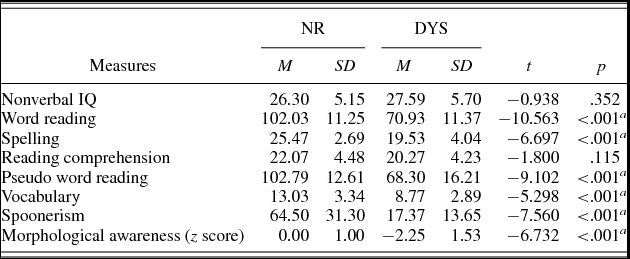
A total of 60 university students were recruited for this study, 30 (20 female, 10 male) typical reading control participants and 30 (23 female, 7 male) participants with dyslexia. All participants were native Dutch-speaking university students at least 18 years of age. All participants reported no history of brain damage, language problems, psychiatric symptoms, visual problems, or hearing loss. The participants with dyslexia were recruited through the University's Student Services’ Special Needs office and possessed an official diagnosis completed by a registered clinical psychologist in secondary school or earlier. High-functioning dyslexics were contrasted with a control group that consisted of normal adult readers with no history of reading difficulty and possessed similar levels of untimed reading comprehension as the high-functioning dyslexics, t (58) = –1.601, p = .115, as shown in Table 1. The adoption of such a control group followed the rationale of Deacon et al. (Reference Deacon, Parrila and Kirby2006) to ensure an adequate control group, where similarities in reading (in terms of text complexity) and word experience were better matched than what would have been achieved through the use of a younger word reading age-matched control group. The control population was assembled through class announcements and the placement of posters throughout each campus. Groups were found not to differ across age, t (58) = –1.298, p = .199, and intelligence, t (58) = –0.938, p = .352, as measured by Raven's Advanced Progressive Matrices (Raven & Court, Reference Raven and Court1998). As expected, the normal reading adult group was found to perform significantly better than the dyslexic group in both word reading, t (58) = –10.563, p < .001, nonword reading, t (58) = –9.102, p < .001, and spelling, t (58) = –6.697, p < .001, and PA (measured with a spoonerism task), t (58) = –7.560, p < .001. In addition, the control group outperformed the dyslexic group on the measure of vocabulary, t (58) = –5.298, p < .001.
Participant characteristics and performance on background literacy and phonological processing measures

aThe significance was maintained after adjusting for multiple comparisons.
Background measures
To assess the background measures, all participants completed a testing battery to provide a better understanding of the cognitive and literacy skills of each group. All tests were administered in a single session between the two experimental MP tasks. Table 1 reports descriptive statistics and t and p values from independent t tests for each background measure.
Intelligence (IQ)
Intelligence was measured by Raven's Advanced Progressive Matrices (Raven & Court, Reference Raven and Court1998), which has a reported substantial test–retest reliability (r = .83). This measure required the participants to make judgments related to presented problems and to indicate their choice by pointing to the correct answer. The raw score was calculated as the number correctly identified items for a maximum achievable score of 60.
Reading comprehension
Reading comprehension was assessed through the use of the Gevorderd Lezen en Schrijven (GL&SCHR) subtest, an original standardized Flemish dyslexia test battery for adults where split have reliability was reported as r = .71 (De Pessemier & Andries, Reference De Pessemier and Andries2009). This task required the subjects to read a present text silently and then answer questions about a text. For each of the 18 questions, a score of 0, 1, or 2 was awarded based on the correctness of the response as outlined in the GL&SCHR manual.
Word reading
Word reading was assessed through the use of the EMT or One Minute Test, which has been found to be a reliable measure (r = .87), as determined through the utilization of a parallel test method (Brus & Voeten, Reference Brus and Voeten1999). This timed task required students to read aloud as accurately and quickly as possible a list of 116 Dutch words of increasing difficulty, printed in four columns. The participants were given 1 min to read as many words as possible. The raw score was calculated as the number of words read correctly.
Pseudoword reading
Pseudoword reading was assessed with the Dutch test, De Klepel (reported reliability of r = .91 was determined through the use of a parallel test method; Van den Bos, Spelberg, Scheepsma, & De Vries, Reference Van den Bos, Spelberg, Scheepsma and De Vries1994). Students were instructed to read aloud as quickly and as accurately as possible a list containing 116 pseudowords following the Dutch grapheme–phoneme correspondence rules. The raw score was calculated as the number of pseudowords read correctly to a maximum of 116 in 2 min.
Word spelling
Word spelling was assessed through a subtest from the GL&SCHR (De Pessemier & Andries, Reference De Pessemier and Andries2009), which has been found to be a reliable measure for a university-level population (Cronbach α = 0.76). Thirty Dutch exception words were read out loud at a rate of one word per 2 s. Students were required to write down as many of the words as they could. If needed, the subject was allowed to skip a word and to continue to the next one. Once completed, missed words were repeated without time limits. A point per correctly spelled word was awarded to a maximum of 30.
PA
A spoonerism task, taken from the GL&SCHR (De Pessemier & Andries, Reference De Pessemier and Andries2009), was used to assess the subject's PA. Test–retest reliability was determined at r = .90. For this task two words at a time were presented orally. The subject was required to exchange the first letters of the given words (e.g., Harry Potter will become Parry Hotter). In addition, a reversal task was performed. Participants were to judge if two spoken words were reversals or not (e.g., rac–car). Both time and accuracy were taken into account. A point per correct response was awarded to a maximum of 20.
Vocabulary
Vocabulary was assessed by a subtest of the GL&SCHR (De Pessemier & Andries, Reference De Pessemier and Andries2009). Reliability was determined for a university-level population through a Cronbach α of 0.90. Participants were asked to orally give definitions of low-frequency words in the Dutch language, such as the Dutch equivalents of anonymous or simultaneous. A point per correctly defined word was awarded to a maximum of 25.
MA
MA was assessed through an adapted version of the MA task created by Wilson-Fowler (Reference Wilson-Fowler2011). Wilson-Fowler revealed a unidimensional factor structure of MA and generated a validated, exogenous measure of MA in university students based on two assessment approaches: a derivational suffixes task and a nonword sentence completion task. For the purposes of this study, this task was adapted for a Dutch-speaking population.
DERIVATIONAL SUFFIX TASK
The derivational suffix task was based on tasks created by Carlisle (Reference Carlisle2000). The task required participants to complete 25 visually presented sentence by applying a derivational suffix to a target root word (Dutch example: West. De aanwijzer stuurt ons in westelijke richting. / English equivalent: Act. The secret police arrested the ___ before he could give his speech). The frequency of the stem for each item varied from 0 to 735 words per million (M1 = 91.21, SD1 = 174.64), the frequency of the derived words ranged from 0 to 24 per million (M2 = 5.88, SD2 = 7.14). Of the 25 items, 14 were nouns, and 11 were adjectives. The task included items with various combinations of orthographic, semantic, or phonological shifts. Instructions, along with four examples, were presented verbally and in writing. The task items are thought to offer a measure of syntactic MA. Participants could achieve a maximum total score of 25.
NONWORD SENTENCE COMPLETION TASK
The nonword sentence completion task was based on Mahony (Reference Mahony1994). Participants were instructed to read and complete 27 incomplete sentences. Responses were selected from a list of four possible nonword choices that varied according to the suffix (Dutch example: Fijn dat hij kon rekenen op hun ____ [gruinlijk/gruinig/gruiner/gruinheid]. / An English equivalent: They presented the highly ____ evidence first [credenthive, credenthification, credenthicism, credenthify]). All nonwords were composed of a nonsense root or base word combined with a real Dutch suffix. The target words were equally divided between nonsense nouns, adjectives, and verb derivatives. Instructions and one example were presented verbally and in writing. Responses were scored as correct or incorrect to a maximum achievable score of 25.
Cronbach's α was calculated to assess the internal consistency of the construct of MA by first submitting all item responses of both MA measures. The analysis resulted in the removal of 10 of the 50 questions. Two questions were removed due to zero variance found, while 8 others were removed to strengthen internal consistency. The remaining 40 questions had a high level of internal consistency, as determined by a Cronbach α of 0.75, which exceeds the recommended value of 0.7 or greater (DeVillis, 2003; Kline, Reference Kline2005). The final composite score of MA was produced through the summation of the remaining 40 questions (20 from each subtest) and standardized.
MP
Stimuli and design
The design of the experiment allowed for the manipulation of orthographic, morphological, and semantic links between prime–target pairs across four experimental conditions. The conditions were the following:
1. Morphological (+M +S +O; e.g., angstig–ANGST): Prime targets are morphologically related and morphologically decomposable (+M). The target was orthographically represented within the prime (+O) as well as being semantically related to the prime (+S). An English equivalent would be jumper–JUMP.
2. Pseudoderivation (+M –S +O; e.g., heerlijk–HEER): In this condition, primes are considered as pseudoderivations, as the primes and targets are not actually morphologically related as they share no semantic overlap (–S), but they can be segmented into an apparent stem and productive derivational affix (+M), like, for instance, the English example of corner–CORN. The pseudoderivation prime corner can be segmented into a stem of corn and the derivational affix –er, yet the word pair of corner–CORN is without semantic overlap.
3. Semantic control (–M +S –O; e.g., schip–BOOT): The target and prime were only semantically related (+S) and the prime was not morphologically decomposable (–M). An English equivalent would be hound–DOG.
4. Orthographic control (–M –S +O; e.g., banket–BANK): In this condition, targets were orthographically related to the primes in that the initial part of the prime contained the target but could not be parsed into existing Dutch morphemes (i.e., –et is not a suffix in Dutch). For instance, an English example would be scandal–SCAN, where the target scan can be observed within scandal yet the final syllable dal of the prime can not be considered a possible derivational affix in Dutch, thus making it not morphologically decomposable.
Each of the four experimental conditions contained 24 prime–target pairs, creating a total of 96 experimental pairs. All targets were free morphemes. Morphological status of the primes was determined using the CELEX Dutch lexical database (Baayen, Piepenbrock, & Gulikers, Reference Baayen, Piepenbrock and Gulikers1995). As in Marslen-Wilson et al. (Reference Marslen-Wilson, Bozic and Randall2008), word pairs were considered morphologically decomposable (+M) when the derived form had a recognizable Dutch suffix that was attached to a potential stem, thus making them morpho-graphically related (or potentially related) as seen in Conditions 1 and 2. Semantic relatedness shared between prime–target word pairs, and unrelated filler pairs were evaluated by 25 native Dutch-speaking graduate students from the Linguistics and Educational Sciences departments of the Katholieke Universiteit Leuven in Belgium. Semantic relatedness was rated on a 5-point scale from 1 (definitely not related) to 5 (definitely related). Prime–target pairs for the semantically related condition (+M +S +O and –M +S +O) were selected when word pairs received an average rating of 4 or greater, while pairs for the semantically unrelated condition (+M –S +O and –M –S +O) were chosen when they received an average score of 2 or less.
Targets and primes were matched across the four conditions for lemma and word frequency, length, neighborhood size, syllable count, family size, and family frequency (ps > .100). Primes were matched across all four test conditions for word frequency, lemma frequency, and syllable length (ps > .085) but could not be perfectly matched for length, F (3, 110) = 7.020, p < .001, as the sematic control primes were shorter (mean letters = 5.8) than the morphological (mean letters = 7.2), pseudoderivation (mean letters = 6.9), and orthographic control (mean letters = 6.9) conditions. In addition, primes were unable to be matched perfectly for neighborhood size (N), F (3, 110) = 7.452, p < .001. Primes from the semantic control (mean N size = 4.55) condition had more orthographic neighbors than primes in the morphological (mean N size = 1.32), the pseudoderivation (mean N size = 2.06), and orthographic control (mean N size = 1.51) conditions. Average values for each of these attributes across all conditions are displayed in Table 2.
Mean values for item attributes across testing condition

Note: The N size corresponds to the mean number of orthographic neighbors (neighborhood size).
Similar to the procedure of Marslen-Wilson et al. (Reference Marslen-Wilson, Bozic and Randall2008), each of the 96 targets was associated with an unrelated prime by pseudorandomizing the primes around the targets. Unrelated control prime–target pairs were checked to ensure they shared no morphological, semantic, or orthographic relationship. These control prime–target pairs provided a baseline allowing for the assessment of priming effects.
To reduce the proportion of related prime–target pairs, an additional set of 24 unrelated prime–target pairs were included as fillers in the experiment, generating a total of 192 prime–target pairs.
Furthermore, 192 word/nonword pairs were created. Primes consisted of real Dutch words while the nonword targets were orthographically and phonologically plausible sequences in the Dutch language (e.g., gump, cheme). Similar to Quémart and Casalis (Reference Quémart and Casalis2015), 84 nonword targets were preceded by an orthographically related word while the remaining 108 nonwords were preceded by an orthographically unrelated word. Half of the primes of the word/nonword pairs were derived or pseudoderived words.
Following the procedure of Quémart and Casalis (Reference Quémart and Casalis2015), the 384 items or prime–target pairs were divided into two presentation lists of 192 items, each list containing 96 word targets and 96 nonword targets. All the targets appeared once in each list. In List 1, half of the 96 word targets were associated with a control prime (12 word targets from each of the four conditions) while the other half was associated with an unrelated prime (the remaining 12 word targets from each of the four conditions). Whereas in List 1 a target word was preceded by an unrelated prime, it was then preceded by a related prime in List 2.
Procedure
Both control and dyslexic subjects were randomly divided into two equal groups where one group was presented list order 1–2, while the stimuli were presented to the second group through a list order of 2–1. As each participant completed both experimental lists, an attempt to minimize repetition effect was made by completing the cognitive and literacy tasks described earlier in this paper between the presentations of the two experimental lists. Furthermore, to ensure that the repeated target presentation did not influence priming effects, presentation of the list order (1–2 or 2–1) was entered into the statistical analysis.
Stimuli presentation along with the recording of reaction times and accuracies were controlled for by the PsychoPy version 1.8 software package (Peirce, Reference Peirce2008) running on a Dell Latitude D630 laptop computer. In a random order, each item was displayed in black Times New Roman 42 type on a white background. Each trial began with a 1000-ms fixation cross (+) center on the screen, which was then proceeded by a forward mask (######) displayed for 500 ms. The prime was displayed in lowercase letters for an stimulus onset asynchrony (SOA) of 72 ms (Marslen-Wilson et al., Reference Marslen-Wilson, Bozic and Randall2008; Rastle, Davis, Marslen-Wilson, & Tyler, Reference Rastle, Davis, Marslen-Wilson and Tyler2000). Immediately following, the target word was presented in uppercase letters. The target remained on the screen for 5000 ms or until the participant responded. Participants were instructed to respond as accurately and as quickly as possible by pressing a designated button on a keyboard to indicate if a letter string was a real word or not. Reaction times were measured from the onset of target presentation until the participant's response. Participants were given 10 practice trials at the beginning of each trail.
To isolate morphosemantic effect apart from the influence of morpho-orthographic information during the processing of derived forms (as in the morphological condition), individual priming effects of the pseudoderivational condition were subtracted from the morphological prime condition (+M +S +O) isolating any prime advantage that could be attributed to the processing of morphosemantic information while controlling for the use of morpho-orthographic information. This resulted in a new variable: morphosemantic advantage (MS).
RESULTS
MP
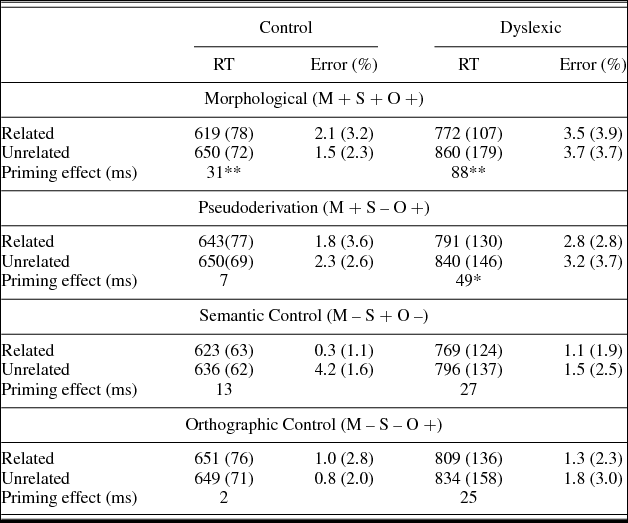
Overall mean rates of correct items for each participant within each experimental condition were calculated. Mean error and mean reaction times (RTs) to correctly responded items in each condition by participant group are presented in Table 3. Data cleaning involved the removal of response times faster than 300 ms or slower than 3000 ms, in addition to outliers that were defined as response times more than 2.5 SD from the mean response time for any given individual in each condition. Priming effects for each condition were calculated as the difference between RTs of primed and unprimed presentation within each condition (see Table 3). Analysis within each group involved a 4 (condition: morphological, pseudoderivation, semantic control, orthographic control) × 2 (priming: related vs. unrelated) × 2 (order of list presentation: 1 vs. 2) repeated-measure analysis of variance where RTs acted as the dependent variable. Similar to Deacon et al. (Reference Deacon, Parrila and Kirby2006) as well as Quémart and Casalis (Reference Quémart and Casalis2015), only significance in the analysis by subjects and not by item was relied upon to reject the null hypothesis. Raaijmakers, Schrijnemakers, and Gremmen (Reference Raaijmakers, Schrijnemakers and Gremmen1999) asserted that in experiments employing highly selected and balanced items, as was the case within this study, the null hypotheses may be rejected based solely on a found significance in the analyses by subjects.
Mean (standard deviation) RTs (ms) and error percentages for control and dyslexic groups according to the condition and priming relationship

Note: RTs, reaction times; +/–M, morphologically decomposable/not decomposable; +/–S, semantically highly related/unrelated; +/–O, orthographic overlap high/low.
*p < .05. **p < .001.
Do high-functioning adults with dyslexia activate morphological information within the initial stages of visual word recognition?
A main effect of list order was not found, F (1, 28) = 0.134, p = .717, and therefore will not be further discussed. Analysis indicated a significant main effect of condition, F (3, 84) = 6.728, p < .001. A main effect of priming was found to be significant, F (1, 28) = 6.688, p = .015, demonstrating faster RTs for related prime–target pairs than for the unrelated ones. A significant two-way interaction between priming and condition, F (3, 84) = 5.285, p = .002, indicated that the amount of priming differed across the four conditions. Post hoc analysis of the found two-way interaction revealed that the high-functioning dyslexic group showed a significant priming effect in both the morphological, F (1, 28) = 14.740, p = .001 (prime effect of 88 ms), and pseudoderivation conditions, F (1, 28) = 4.697, p = .039 (prime effect of 49 ms), while not in the orthographic and semantic control conditions, F (1, 28) = 2.259, p = .144; F (1, 28) = 1.462, p = .237. Differences between the prime effect of the morphological and pseudoderivation conditions were found to approach significance, F (1, 28) = 3.765, p = .06
Do high-functioning adults with dyslexia differ from controls in the use of morphological information during visual word recognition?
The control group contrasted with the dyslexics sample as only a significant priming effect in the morphological condition was found, F (1, 28) = 17.999, p < .001 (prime effect of 31 ms), but not in any of the other three condition, pseudoderivation: F (1, 28) = 0.567, p = .458; orthographic control: F (1, 28) = 2.049, p = .163; and semantic control: F (1, 28) = 0.015, p = .903.
Following the rationale of Deacon et al. (Reference Deacon, Parrila and Kirby2006), for MP to be considered as a potential compensational path in reading comprehension (as suggested by Elbro & Arnbak, Reference Elbro and Arnbak1996), the morphological priming effects should be expectedly greater for dyslexics than for the controls. An examination across both groups of the priming effects of both the derived (morphological condition) and pseudoderivation conditions revealed a significant difference where dyslexics were found to benefit more from the morphological structure of the prime in both conditions when compared to controls with similar reading comprehension levels: morphological condition, t (49.9) = –6.732, p < .001, and pseudo derived condition, t (49.9) = –6.732, p < .001.
Do high-functioning adults with dyslexia differ from control in their MA?
Adults with dyslexia were found to significantly underperform controls on our MA measure, as seen in Table 1. These results were found to support past research of MA of children and adults with dyslexia. As MA is often found to be closely associated with vocabulary and PA, an analysis of covariance was run to determine the effect of group differences concerning normal and dyslexic readers on MA while controlling for vocabulary and PA. After adjustment for vocabulary knowledge and PA (as measured by the spoonerism task), the initially observed poorer performance of readers with dyslexia was maintained, F (1, 56) = 12.170, p = .001, partial η2 = 0.179.
Do performances on MP and MA tasks share any commonality?
To examine the relationship between performance on MA and MP tasks, Pearson correlations were conducted between the morphological priming effect and the composite score of MA within each group. Results demonstrated that MA differed between groups in its relationships with measures of MP. MA's relationship with the new variable of MS was found to significantly differ between groups (p = .024), for MA and MP where were only found to be significantly related within the high-functioning dyslexic participants (r = .513, p = .004). MA was not related to any other measure of morphological priming effect within the control population or dyslexics (ps >.060).
Does MP and MA contribute to reading outcomes similarly across both reading groups?
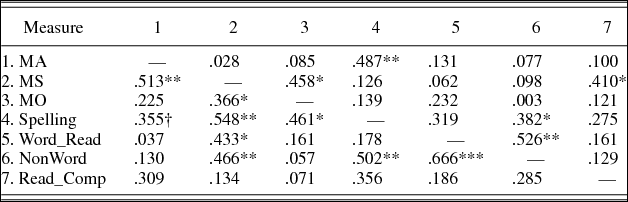
To examine the relationship between MA and MP with the performance on the assessed literacy background measures, Pearson correlations were conducted within each group (see Table 4). Different patterns of significant relations of MA and MP and literacy measures were observed across the two groups. Within the control group, the composite score of MA was found to be significantly related to spelling (r = .487, p = .006) in addition to reading comprehension significantly relating to MS (r = .410, p = .025). Yet, within the dyslexic group, spelling was found to be significantly related to both the MS (r = .548, p = .002) and morpho-orthographic priming effect (as measured through the pseudoderivation condition; r = .461, p = .010), while a trend toward a significant relationship between spelling and MA was observed (r = .355, p = .054). In addition, word reading and nonword reading were found to be significantly related to MS (r = .433, p = .017; and r = .466, p = .009). Further analysis comparing the differences of these relations between groups found MS's relation with spelling to significantly differ between dyslexics and controls (Z = 1.8, p = .036), while group differences between the relation of word reading and nonword reading with MS were found to be approaching significance (Z = 1.48, p = .069; Z = 1.49, p = .068).
Pearson correlations between measures of literacy and morphological knowledge within each group

Note: MA, morphological awareness; MS, morphosemantic advantage; MO, morpho-orthographic; Word_Read, word reading from the 1-min word reading test; NonWord, non word reading task; Read_Comp, reading comprehension. The values above the diagonal are for the control participants and below the diagonal for dyslexic.
†p < .06. *p < .05. **p < .01. ***p < .001.
Because of the found group differences on the measure of vocabulary, t (58) = –5.298, p < .001, additional analyses at all levels were conducted controlling for this difference. All patterns of significance reported above were maintained when controlled for vocabulary, with the addition of the finding of a significant correlation of spelling and MA within the high-functioning dyslexic group (r = .368, p = .049).
DISCUSSION
The current study set out to address questions regarding the processing of morphologically derived forms and its association with measures of MA and literacy outcomes in high-functioning dyslexics, defined as university students with a past diagnosis of dyslexia with age-appropriate reading comprehension skills. Similar to Deacon et al. (Reference Deacon, Parrila and Kirby2006), the high-functioning dyslexics were compared to a control group of age-matched peers with similar reading comprehension ability.
The background variables of the dyslexic group were found to be consistent with much of the literature, as they were found to perform significantly poorer on measures of phonological processing, spelling, as well as word and nonword reading when compared to a normal reading population (Deacon et al., Reference Deacon, Parrila and Kirby2006; Vellutino et al., Reference Vellutino, Fletcher, Snowling and Scanlon2004).
A masked priming experiment was conducted to examine morphological facilitation during early visual word recognition as well as the effects produced by the shared semantic (meaning) and orthographic (form) overlap between morphologically related primes (Conditions 1 and 2). Ultimately, we were aiming to determine if high-functioning adults with dyslexia implicitly use morphological information within the initial stages of visual word recognition and whether they differed from controls in how morphosemantic and morpho-orthographic information influenced this facilitation during visual word recognition.
Results demonstrate significant morphological priming effects for the dyslexic readers in both the morphological and the pseudoderived conditions. These findings differed from the controls who were only found to have a significant morphological priming effect at our prime duration of 72 ms, fitting with the results of Rastle et al. (Reference Rastle, Davis, Marslen-Wilson and Tyler2000). Significant priming effects were not found in the orthographic and semantic control conditions in either group. These patterns of priming suggest that high-functioning dyslexics benefit from morphological facilitation during early visual word recognition, and this effect can be distinguished from priming attributed to general orthographic and semantic overlap alone. These results support the hypothesis first put forth by Elbro and Arnbak (Reference Elbro and Arnbak1996) and builds on previous research (Burani et al., Reference Burani, Marcolini, De Luca and Zoccolotti2008; Quémart & Casalis, Reference Quémart and Casalis2015), which suggested that regardless of their decoding deficits, dyslexics can process morphemic units rapidly and automatically.
As reasoned earlier, for MP to be considered as a potential path to compensation (as suggested by Elbro & Arnbak, Reference Elbro and Arnbak1996), it should be expected that morphological priming effects would be greater for dyslexics than for the controls. A significant difference of priming effect of morphological facilitation between the two groups was observed. Dyslexics were shown to benefit more from the morphological structure of the prime compared to controls with similar reading comprehension levels. These results support the notion that MP is not only intact in high-functioning dyslexics but also a strength compared to age- and reading-comprehension matched controls. MP, therefore, may well be an avenue to achieve compensation within reading comprehension for individuals with dyslexia. Leikin and Zur Hagit (Reference Leikin and Zur Hagit2006) as well as Burani et al. (Reference Burani, Marcolini, De Luca and Zoccolotti2008) theorized that due to dyslexic readers’ poor decoding abilities and often slow and less automated whole word processing, individuals with dyslexia must rely on morphological decomposition to aid lexical access, as was depicted in the previously discussed reconceptualized dual route model of reading (Grainger & Ziegler, Reference Grainger and Ziegler2011). Leikin and Zur Hagit (Reference Leikin and Zur Hagit2006) went on to propose that to overcome their poor decoding skills, dyslexic readers develop an increased morphological sensitivity. The results of this study support this theory.
Second, our experimental design allows for the determination of whether or not the overlap in form and meaning between morphologically related words is required for high-functioning dyslexic readers to benefit fully from morphological facilitation during visual word recognition. To our knowledge, this is the first study to examine differential effects of morphosemantic and morpho-orthographic processing in a masked priming paradigm within a population of adults with dyslexia.
Similarly to the study of Feldman et al. (Reference Feldman, O'Connor and del Prado Martín2009), the priming effect found for the morphological condition was observed to be larger than the effect within the pseudoderivation condition (although it was only found to be approaching significance). Diependaele et al. (Reference Diependaele, Sandra and Grainger2009) discussed these differences as a feature of the hybrid model of MP. This model predicts that both morphosemantic and morpho-orthographic properties are activated in parallel when a reader is presented with a morphologically complex word. The parallel activation, in turn, generates a feedback connection through the interaction of the morphosemantic and morpho-orthographic routes, resulting in a noticeable increased priming effect. This differs from the slower pseudoderivation conditions that were reliant on a single activation at the morpho-orthographic level.
Past research in dyslexic children by Quémart and Casalis (Reference Quémart and Casalis2015), found that at 60 ms of visual prime presentation, dyslexic children differed from controls in the use of both morphosemantic (meaning) and morpho-orthographic (form) properties of morphemes to benefit from morphological facilitation during visual word recognition at this early time point. Although at a longer 72-ms prime presentation, the results of this study do support previous findings of differences between dyslexics and controls in the use of morphological information. Our results did differ from the pattern of findings reported by Quémart and Casalis (Reference Quémart and Casalis2015) as dyslexics were found to make use of both morpho-orthographic and morphosemantic information while the processing of morpho-orthographic information did not offer any measurable advantage for controls.
As our study differed from that of Quémart and Casalis (Reference Quémart and Casalis2015) in two key areas, prime duration and participant age, two possible arguments could be made to explain the differences in these patterns of results. First, it could be argued that with the increase of age, dyslexic individuals may increase their flexibility to process morpho-orthographic properties alongside morphosemantic processing. A more likely explanation could be attributed to the natural evolution of various forms of facilitation during early word visual recognition, as those noted by past time course studies, such as Rastle et al. (Reference Rastle, Davis, Marslen-Wilson and Tyler2000). Therefore, the observed difference in the influence of morphosemantic and morpho-orthographic information between our findings and those reported by Quémart and Casalis may be evidence of an alternative time course of facilitation within individuals with dyslexia when compared with controls. Future time course studies utilizing a range of SOA will need to be conducted within individuals with dyslexia to help further address these questions.
MA in high-functioning adults with dyslexia
To date, we are unaware of any study to examine the role of MA in Dutch-speaking adults with dyslexia. Our study found that adults with dyslexia performed worse on measures of MA when compared with age-matched controls. Similar results have been found across various languages in adults (Law et al., Reference Law, Wouters and Ghesquière2015; Leikin & Zur Hagit, Reference Leikin and Zur Hagit2006; Nagy et al., Reference Nagy, Berninger and Abbott2006) and children (Carlisle & Feldman, Reference Carlisle and Feldman1995; Deacon & Kirby, Reference Deacon and Kirby2004; Nagy et al., Reference Nagy, Berninger and Abbott2006). Our results are in agreement with these past findings, which conclude that individuals with dyslexia have a deficit in MA relative to typical readers of the same age. Yet, previous studies have also demonstrated that individuals with dyslexia perform as well as or better than younger, reading age-matched controls on MA tasks, which suggests that the MA deficit observed in dyslexics is not causal of their word reading deficit and is potentially a consequence of their poor reading experience or poor PA skills (Cavalli et al., Reference Cavalli, Colé, Pattamadilok, Badier, Zielinski, Chanoine and Ziegler2017; Martin et al., Reference Martin, Frauenfelder and Colé2014; Robertson et al., Reference Robertson, Joanisse, Desroches and Terry2013; Tsesmeli & Seymour, Reference Tsesmeli and Seymour2006).
Relations among MA, MP, and literacy
To examine whether the relationships between measures of morphological and literacy achievement were different in the two groups, with dyslexia versus controls, correlations were calculated separately within each group. Our results found that only MS was related to MA within the dyslexic group. That lack of a significant relationship between morpho-orthographic properties and MA may have been a function of the MA test design. The two MA tests employed in the study both relied less on form and more heavily on the semantic and syntactic information of the target morphemes. For instance, in the nonword sentence completion task, students had to judge which of the provided nonwords (all containing plausible Dutch affixes) completed the sentence. To execute this task, subjects had to rely specifically on the syntactic and semantic information conveyed by the affix only.
The MS pattern of significant relations with literacy measures also differed between groups. Morphosemantic priming effects were found to be strongly related to spelling, word reading, and nonword reading in the dyslexic group while only relating to reading comprehension in controls. Although morpho-orthographic information was found to facilitate increased morphological decomposition within the dyslexic subjects (as evidenced by the significant prime effect found for the pseudoderived condition), the results of our correlational analysis support the argument of Elbro and Arnbak (Reference Elbro and Arnbak1996), which states that individuals with dyslexia may rely more on the morphosemantic properties of morphemes to aid their performance during time-sensitive literacy measures (as in the word and nonword reading tasks administered in this study).
Spelling's relationship with MA and within both groups was expected. Similarly across various languages, Caravolas (Reference Caravolas2004) points out that spelling is based on not only phoneme–grapheme correspondence but also on morphemes and other orthographic patterns that may not be directly predicted at the phoneme level.
Although considered to be a relatively transparent language, Dutch does contain numerous cases of words that are not spelled using phonological but rather morphological principles (see Rispens, McBride-Chang, & Reitsma, Reference Rispens, McBride-Chang and Reitsma2008). Therefore, it can be expected that spelling is facilitated by morphology as morphemes are often considered to be more consistent and transparent with respect to the morphological structure of words (Caravolas, Reference Caravolas2004).
Limitations and future perspectives
The reliance of a single SOA (72 ms) during the priming task could be seen as a limitation of this study. Studies that have examined morphological facilitation over a time course of varying SOAs demonstrated that the scale of visible morphological priming effects changes as a function of SOA (Marslen-Wilson et al., Reference Marslen-Wilson, Bozic and Randall2008; Rastle, Reference Rastle, Davis, Marslen-Wilson and Tyler2000). Rastle (Reference Rastle, Davis, Marslen-Wilson and Tyler2000) found that in normal reading adults, the priming effect for pseudoderivation conditions was larger and significant at shorter SOAs of 43 ms than compared to an SOA of 72 ms where significance was not found. The examination of prime–target pairs at different SOAs may have yielded a different pattern of results. The general slow speed of information processing associated with individuals with dyslexia (Bowers & Wolf, Reference Bowers and Wolf1993; Breznitz & Misra, Reference Breznitz and Misra2003) may have skewed what would have been considered a normal pattern of results at an SOA of 43 ms to a longer SOA of 72 ms. Future research would need to conduct a time course study of varying SOAs to examine if the observed pattern of results is unique to an SOA of 72 ms or if dyslexics consistently differ over time in how morphological facilitation aids early visual word recognition.
In addition, the limitation posed by the MA tasks reliance on semantic and syntactic information also may have obscured the observation of potential relationships between morpho-orthographic priming effects and many of the literacy tasks. As this study has demonstrated that differential effects of the various levels of information contained within a morpheme are observable, future studies should take care in the selection and design of MA measures. Although Law et al. (Reference Law, Wouters and Ghesquière2015) did demonstrate intact MA skills of compensated adults with dyslexia through the use of the same MA testing design, it should be noted that the visual presentation of the MA tasks represents a limit of the study since the dyslexic group had reading difficulties. Future MA task design should focus on oral presentation and the balanced use of the syntactic, semantic, orthographic, and phonological properties and information of morphemes within the tasks.
Finally, to better understand morphology's role as an avenue to compensation, future studies should attempt to examine not only compensated or high-functioning dyslexics but also noncompensated dyslexics.
ACKNOWLEDGMENTS
We acknowledge the help and support of Christine Swennen, Dr. Ditte Kimps, and Dr. Natalia Pericchi Pagá in the design and balancing of the measures. This research was financed by the research fund of Katholieke Universiteit Leuven (Grants dBOF/12/014 and OT/12/044).