“Not all advocates of term limits are Republicans, but most are.”
—Nelson Polsby 1993, 102Introduction
In January 2021, there were four different resolutions presented to Congress to limit the number of terms that a member could serve. Each resolution was sponsored by Republican lawmakers, the most popular had more than 50 cosponsors, all of which were Republican. The push for term limits in Congress and state legislatures has been ongoing for 40 years. Although there has not been successful legislation at the federal level, there are now 16 states that limit the number of terms that a member can serve (for more information see Table A1 in the Appendix).Footnote 1 The debate around modern term limits developed from the late 1980s into the early 1990s but always had strong public support. Although term limits are supported by voters from both parties, term limits among elected officials have uniquely partisan motivations. Term limits come from a partisan place, yet, this central motivation has received little scholarly attention.
Term limit proposals have been pushed to “drain the swamp” of long-term incumbents or to “clean up Congress” by removing career politicians. Although term limits were a response to the changes in government, there is less known about why term limits were the solution and not something else. This research takes a step back to evaluate one of the lesser-observed components of legislative term limits, the partisan push. Although term limits are supported by voters of both parties, the push for term limits as a solution was largely driven by Republicans. The partisan-driven solution included the forceful removal of the Democratic majorities, which greatly benefited the Republican party.
There is a great deal of existing research on legislative term limits, their supposed outcomes, and whether they are helpful or harmful. Within this body of research there are some studies that find no significant effects of partisanship on term limits or vice versa.Footnote 2 However, since the early 2000s there is far less research focused directly on term limits and their role in state legislatures. Most early studies had incomplete or predictive data based on legislatures without term limits. Recent research has found that there are long-term partisan differences in the careers of lawmakers.Footnote 3 These results warrant a second look at the long-term effects of partisanship on term limits and how those term limits further influence members of different parties. This is the first examination of political parties engaging longitudinal data to examine the effects from 1992 to 2018.
This study is an evaluation of whether the partisan push for term limits resulted in a noticeable partisan shift within the legislature. Specifically, did the Republican strategy of pursuing term limits pay off with legislative gains? The goals of this study are twofold. First is to present a historical narrative of the relationship between the Republican Party and legislative term limits. Building from the work of Karp (1995), this section outlines the motivations of the Republican Party and how term limits became their solution to gaining legislative seats. At the time, Democrats enjoyed a strong majority in Congress and many state legislatures,Footnote 4 whereas many term limit advocates were Republican.Footnote 5 This examination includes a look at the moves made by the Republican Party and how it was uniquely poised to capitalize on a proposal such as term limits.
The second goal is to understand the effects that term limits had on partisanship in state legislatures. To assess this, there are two distinct empirical analyses. First, there is an examination of the effects of term limits on partisanship over time. This analysis of all 50 states attempts to parse the national trends from those of term limits to see just how much this change may or may not have helped the Republican party. The second explores the broader partisan effect by looking at whether term limits affected the careers of Democratic and Republican lawmakers differently. These analyses reveal that, after term limits went into effect, there was an increase in the number of Republican seats in the majority of term-limited states but this was not significant. However, this trend has become more prevalent the farther states move from the date of implementation. The partisan motivations behind the push for term limits are not without warrant–the Republican Party was underrepresented and the push to implement term limits did “drain the swamp,” only to fill it with members of the same party.
Current Understandings of Term Limits
It is no secret that the public has long disliked institutions of government, even though they may like their personal representative. However, increasing unhappiness with the government reflects poorly on incumbents.Footnote 6 So how did incumbents become a problem? The number of incumbents increased after moves to institutionalize and professionalize state legislatures.Footnote 7 These changes began in the 1930s, altering state legislative membership, and continued throughout the 1980s as turnover rates declined and membership stabilized.Footnote 8 As a result, the number of new members in state legislatures reached an all-time low.Footnote 9
The added incentives of the job (pay) and the resources (staff) that helped members to do their jobs made it more appealing for members to stay longer. Jewell and Breaux (1988) found in their examination of legislative election results from 1968 to 1986 that incumbency rates remained high and that incumbents won by increasing margins over time.Footnote 10 Numerous other studies have found that legislative professionalization decreases turnover rates, thus helping incumbents.Footnote 11 The increasing number of incumbents and their electoral security made it difficult for new candidates to pursue office.Footnote 12 The effects of these changes eventually stalled in the 1990s prior to the push for term limits.
Term limits quickly gained national momentum and were supported at the Republican national conventions in 1988 and 1992.Footnote 13 Not only was there support among Republican candidates, but members of the Republican Party, like political consultant and RNC executive Eddie Mahe, were also behind the push for term limits.Footnote 14 Term limit proposals saw high levels of support, especially in the states where term limits were intended for both state legislators and members of Congress.Footnote 15 Since this initial push, term limits have remained popular among voters from both parties.Footnote 16 Even though there are no term limits in place for members of Congress, their success at the state level was centered on the proposal to limit members of Congress.Footnote 17
The solution to force people out of office was quite popular among the public, and proponents of term limits made many promises to voters. These promises touched on policy changes and the balance of power with the executive, but the focus here is on those individual demographic changes—namely, partisanship. Term limits promised to increase the number of women and racial minorities,Footnote 18 increase electoral competition,Footnote 19 and benefit the minority party.Footnote 20 The long-standing theory behind term limits was that their implementation would create a partisan shift specifically to benefit the minority party.
The logic behind term limits was twofold; limits would not only remove entrenched incumbents but also allow for greater competition with open-seat elections.Footnote 21 However, many of these promises were left unfulfilled, as term limits played out differently than expected. Under term limits, incumbents are more secure,Footnote 22 but the incumbency advantage is helping fewer people because those individuals eventually term out of office.Footnote 23 Early examinations of Colorado found a lack of turnover and fewer incumbents termed out than expected.Footnote 24 In states with term limits, electoral challengers were rare, which supported incumbent security.Footnote 25 Furthermore, legislators were strategic in their actions; if an incumbent saw a potential loss they were more likely to voluntarily leave so that they exited on their own terms.Footnote 26
There was a lack of evidence that partisan shifts occurred in the states as a result of term limits.Footnote 27 Mooney and colleagues examined the partisan differences across three states and found no clear connection between term limits and the partisan makeup of the legislature.Footnote 28 Furthermore, explorations of party changes within a single state found no noticeable party trends. In Colorado, there was no distinct evidence of partisan change related to term limits, Republicans (the majority at the time) continued to win elections in both chambers.Footnote 29 Arkansas, a Democratic state, was the only state to see a slight increase in the number of Republicans winning post-term limits.Footnote 30 Overall, the findings in support of what term limits promised are inconsistent at best. Most, however, are simply lacking support, as the suspected changes were left largely unfulfilled except for one to two states.
Historical Narrative
The review above makes it clear that there is a lack of connection between term limits and legislative partisanship. Although these works are important and increased understandings of term limits, they focused more on immediate demographic changes. There is a lack of attention focused on the partisan motivations behind term limits and how they may change over time. Many of these explorations, however, were limited to single-state studies with fewer years of data than a single term-limited cohort.Footnote 31 A legislature cannot be overtaken in a single session, there are electoral and district-level factors that take time. Recent scholarship has demonstrated in other respects that the changes brought by term limits were not immediate, but this has been less explored with respect to political partisanship.
The trends of party in the states after the establishment of term limits are clear; there was no change. I propose revisiting the relationship between legislative term limits and how they can alter partisanship in the legislature. As various scholars have speculated, the true effects of term limits would take time. As moderates left the legislature, they would be replaced by more partisans, given the shortened time in office and lack of need to be collegial.Footnote 32 Even as term limits were still taking hold, parties were beginning to shift in Arkansas and Maine and partisanship was increasing.Footnote 33 In this section, I review the historical narrative of the relationship between the Republican party and legislative term limits to illustrate that, even though changes were not immediate, there is cause to revisit the question of term limits and parties.
A Public Problem
Incumbency alone did not drive public support for term limits, it was the numerous scandals that really fired up advocates for change and where party started to take a notable role. Perhaps the most infamous example is the House check-writing scandal from the early 1990s. In 1992, the House Ethics Committee reported that 300 members (current and former) had overdrawn their accounts.Footnote 34 Despite assurances that no laws were broken, there was public uproar. As a result of the scandal, and the public release naming those who were involved, a number of long-standing members either lost or withdrew from the election.Footnote 35
At the same time, state legislatures were witnessing scandals of their own. One such example is the AZscam where seven lawmakers from Arizona were caught by an undercover agent posing as a lobbyist; these lawmakers were indicted on various charges including bribery and money laundering.Footnote 36 In Oklahoma, senior State Senator Gene Stipe was forced to resign after being caught in a campaign contribution scandal.Footnote 37 Similarly, former Speaker of the Maine House, John Martin, was implicated in a ballot tampering scandal because of his aide’s role in the affair.Footnote 38
The strong and long-lasting Democratic majority in Congress was met with disdain by voters of the opposite party, who were eager to find a solution. There was an idea that incumbents ought to be “punished,” and this problem of incumbency was anchored by the Democratic Party.Footnote 39 This was compounded in professionalized legislatures, which tend to lean Democratic.Footnote 40 It should be no surprise then that, when Republican politicians offered up term limits as a solution, the public would support it, overwhelmingly.
To be clear, the public issue with incumbent politicians was not a rapid shift, nor was there any singular instance. Rather, the strengthening of the incumbency advantage and the scandals that occurred simply wore down the public over time. Given that incumbents continued to win reelection, despite the various scandals, many lost hope of voting people out. As Paul Jacob noted, “people realize(d) they cannot change things at the polls… that’s where term limitation comes in.”Footnote 41
A Partisan Solution
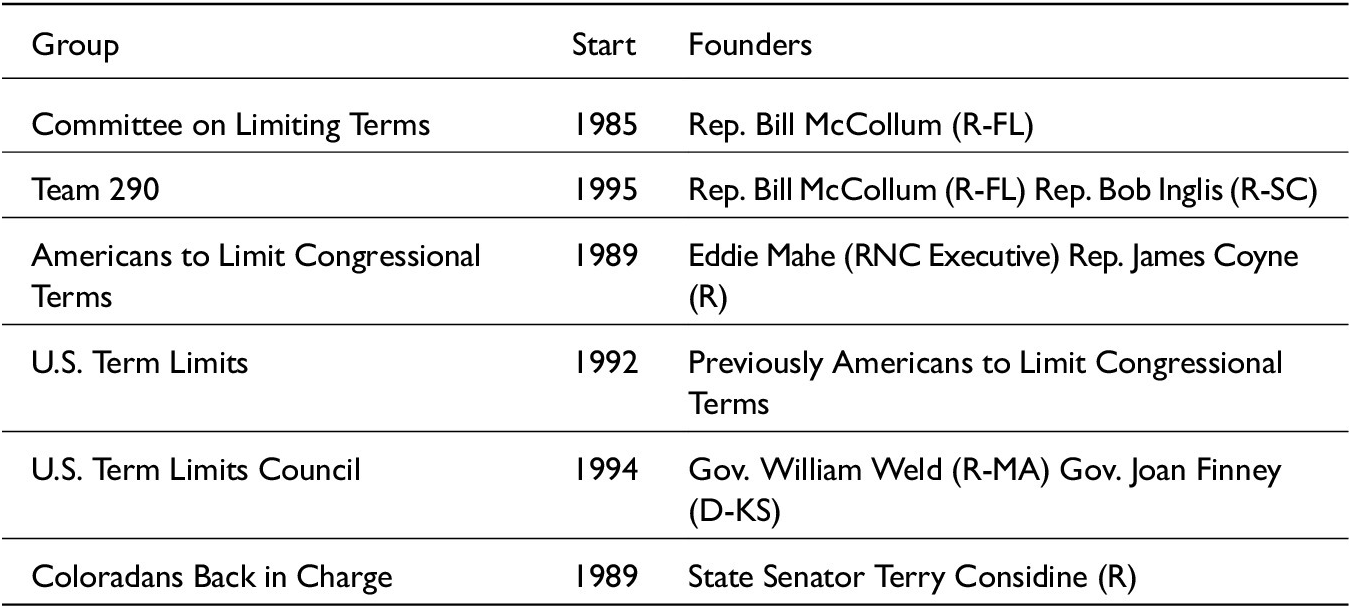
The public was disenchanted with incumbent politicians, but what could be a solution to the unhappiness, frustration, and annoyances of government? Term limits. The notion of limiting elected service was not new for the Republican Party; it is a long-held belief that there should be some sort of limitation. Term limitation, or rotation in office, has a long history in the United States, taking root during in the Articles of Confederation. Term limits were thought to be essential to good governance. In fact, term limits were directly tied to views of representation at the time.Footnote 42 At the state level, the idea of rotation in office has been a long-standing tradition, even if not always formalized in law or statute.Footnote 43 The idea of term limitation somewhat died in the early 1900s, as the trend was more toward professionalization and experience. However, post-Watergate discussions of limiting time in office began to reappear and were centered primarily on Congress.Footnote 44 In the 1980s the suggestion of term limits was ongoing, but discussions within Congress were stalled. A group of Republican representatives created a group called COLT (Committee on Limiting Terms), and the goal of this group was to make the push for term limits public.Footnote 45 Rather than pushing term limits through government, the goal became to gain public support for limiting terms. There were several other groups and organizations getting their start at this time, with the goal of pushing term limits at the state and federal levels. Table 1 outlines some of the known origins of term-limit groups. Although this does not account for all term-limit organizations, it does outline some of the groups of known origins, mostly Republicans.Footnote 46 Many of these groups morph into other iterations of term-limit organizations over time, similar to U.S. Term Limits and Americans to Limit Congressional Terms. Most founders on this list were elected officials, only one of which was a Democrat. The push for term limits was not part of the Democratic party platform or pushed by the DNC.
Origins of Select Term-Limit Groups

Note: All information from John David Rausch, Jr., A Genealogy of Term Limit Groups.
In the early 1990s, there was a great deal of public and academic attention on the topic. For example, C-SPAN captured numerous panels and symposiums directly related to term limits. At such an event, hosted by the National Civic League, there was a discussion about voters and term limits as a remedy. Elaine Kamarck of the Progressive Policy Institute said, “We have been paying Saks 5th Avenue prices for K-Mart quality government … voters are getting madder and madder and madder about it … one of those manifestations is in term limits, another is in the anger at incumbents.”Footnote 47 To Kamarck’s point, voters from both parties tend to support legislative term limits without ever understanding how term limits alter partisanship and legislative service.
Kamarck’s K-Mart analogy, although a bit unusual, does well to capture the sentiment of voters at the time—people want more from their lawmakers. In addition, many felt that they could not oust their lawmakers at the polls. Term limits forced members from office, so they would not be initiated by members of the majority party, which would be against their self-interest. As Paul Jacob (Citizens for Congressional Reform) said, “Politicians, elected officials, have been overtaken with a career mentality. They are no longer the citizen legislators that our forefathers envisioned. They care more about their career, their pension, their pay, than they do about the problems of the country… it is a systematic problem.”Footnote 48
Also occurring at the start of the 1990s, the Republican Party earned the label “permanent minority.”Footnote 49 This minority was due in part to structural shifts, scarce incumbency advantages, and gerrymandered districts.Footnote 50 Republicans, who were in the minority in Congress for several decades, had the most to gain out of pushing such proposals on a national scale.Footnote 51 It was the Republican party that placed term limit proposals on their platform in 1988 and 1992.Footnote 52 The 1992 Party platform includes some explanation for the support of term limits.Footnote 53
The Democrats have trampled the traditions of the House, rigging rules, forbidding votes on crucial amendments, denying fair apportionment of committee seats and resources. They have stacked campaign laws to benefit themselves. The Democrat Leadership of the House has been tainted with scandal and has resisted efforts to investigate scandals once disclosed. Some in their Leadership have resigned in well-earned disgrace. The Democrat Leadership of the Congress has turned the healthy competition of constitutional separation of powers into mean-spirited politics of innuendo and inquisition. Committee hearings are no longer for fact-finding; they are political sideshows. ‘Advise and consent’ has been replaced by ‘slash and burn.’ Republicans want to change all that. We reaffirm our support for a constitutional amendment to limit the number of terms House Members and Senators may serve. We want a citizens’ Congress, free of bloated pensions and perpetual perks.
Were term limits the only solution to pacify unhappy constituents? No, but term limits were the solution pushed by the Republican Party out of self-interest because they had the ability to capitalize on such a proposal.
It is worth pausing for a moment to explore the other solutions that the Republican Party could have pursued. First, Republicans could have sought avenues of proportional representation. Second, campaign finance reform would have curbed careerism and new laws could have encouraged new challengers. But these alternatives were not pursued, in part, because term limits had greater public appeal. These would have reduced Republican advantages while reducing the benefits of service; therefore, they were not a plausible solution. However, after being in the minority for so long, forcing open seats would benefit the Republican Party while disadvantaging Democrats.
Given the popular discontent with politics and the political process, Republicans were ready to capitalize on major electoral changes. Some argued that “Democrats ha[d] rigged the process to perpetuate their majority,”Footnote 54 so it was only right for Republicans to do the same. The best way for Republicans to turn the tide was to focus on recruitment to force a change.Footnote 55 The question remains, why were term limits the chosen solution for the Republican Party? The answer is simply open seats. Term limits would automatically open seats held by Democrats, and Republicans were working to develop stronger candidates. Republicans were in a position to take advantage of the open seats created by term limits. Although, Democrats had a long history of strong candidates and candidate recruitment, as seen with their success in Congress.
The strengthening of the incumbency advantage (primarily Democrats) and the difficulties for (Republican) challengers led to increased unhappiness among constituents. This is when the Republican Party began to push for term limits, meant to counter the strength brought by legislative institutionalization and professionalization and to create open seats.Footnote 56 Not only were members serving for longer, but the public was also becoming increasingly frustrated with government and legislatures, in particular. Again, term limits were not a new idea; they had existed under the Articles of Confederation, and they were brought back to life post-Watergate, but it was not until term limits became a tenant of the Republican party that the party saw success.
Republicans had a new strategy to focus broadly on recruitment across all levels of government. The tactic to secure an office from the bottom up positioned the Republican Party to take hold of newly vacated Democratic seats. For example, Newt Gingrich’s GOPAC provided training to potential Republican candidates, starting with securing elected offices at the local level and continuing up through Congress.Footnote 57 Interestingly, this recruitment strategy came in the form of tapes as well as visits and marking professionals.Footnote 58 Yes, cassette tapes and videotapes were the Republican Party’s recruitment tool from the mid-1980s through 1994. Newt Gingrich used tapes to reach potential candidates all over the United States to both encourage them to run for office and how to be a good candidate.Footnote 59
In total, Gingrich spent over eight million dollars recruiting, preparing, and selecting the best possible Republican candidates.Footnote 60 In an interview with PBS in 2001, Newt Gingrich reflected on the Republican reforms of the 80s and 90s saying, “First of all, we tried every two years from 1978, so we had lost in ’80, ’82, ’84, ’86, ’88, ’90, and ’92. It wasn’t like we woke up one morning merrily winning. We had spent an enormous amount of energy on actually building the momentum.”Footnote 61 Collectively, these efforts helped the Republican Party secure its first congressional majority in 40 years.Footnote 62
Of course, not all supporters of term limits were Republican, and not all Republicans supported term limits but there were notable partisan trends. In the 105th (1997–1998) Congress, party support for term limits was stark: 18.5% of Democrats and 79.3% of Republicans. Not all Republicans supported term limits, but most did. The party used the expansion of professionalization and its advantages to capitalize on public support for curbing careerism. However, a greater story was developing among the elected. Notably, Republican members of Congress vowed to self-induce term limits, placed limitations on chairmanships, and advocated for term limits for all elected positions under the Contract with America. Footnote 63
In an effort to reform and rebuild the presence of the Republican Party, Newt Gingrich’s Contract with America in 1994 was part of an effort to regain the support of voters who were disillusioned with politics. Much of the content within the Contract with America originated in the recruitment tapes that Gingrich had used earlier. Of particular interest was the 10th point, which was labeled “Citizen Legislature Act,” designed to limit legislative service for all members.Footnote 64 , Footnote 65 The proposal went so far as to note that this would be the first-ever congressional vote on term limits, when in fact there had been another some decades earlier.Footnote 66 Similar to other pushes for term limits, this was unsuccessful.
Added support for the Republican Party, such as increased leadership rolesFootnote 67 and higher levels of interest group funding,Footnote 68 continued to benefit the party. Such a strategy would suggest that given Republican resources and prior successes, the party would, over time, become stronger in those states with term limits. Put another way, the states with term limits created an opening for the Republican Party, which has strengthened with time. To be clear, the push for term limits at the federal level was unsuccessful. However, 15 of the 16 states with term limits were passed by the popular vote, not Republican lawmakers, demonstrating the importance of voter support. The push for term limits at the state level was successful and the implications merit further attention. In the next section, I explore the effects of this push and the lasting outcomes for partisanship in state legislatures.
Data and Research Design
Much of the research focused on term limits and their changes has been speculative, simply because time is required to realize the effects of term limits and how they shape the legislature. Now that term limits have been in place for several decades, their long-term effects can be analyzed. To test the changes to partisanship in term-limited legislatures, I use an original data set, which contains information on the number of Republican seats in each legislative chamber for all 50 states.Footnote 69 This information is available for each state from 1992 to 2018, allowing for an assessment of the long-term effects of term limits on shifting partisanship in the legislature. Given the breadth of the available data, each observation is state–year. This section is composed of a descriptive overview of changes to Republican seat share in term-limited legislatures, followed by an analysis of how the effect of term limits has changed with time.
All 50 states are included in this analysis, but only 15 with legislative term limits are accounted for. The term-limited states are Arizona, Arkansas, California, Colorado, Florida, Louisiana, Maine, Michigan, Missouri, Montana, Nebraska, Nevada, Ohio, Oklahoma, and South Dakota.Footnote 70 For analysis, there are three distinct periods that term-limited states go through. In line with Mooney (2009), the effects of term limits vary by how long the restriction has been in place.Footnote 71 First, there is the pre-term-limit period: this is the period before term limits go into effect. Second, there is an early period where states are experiencing term limits for the first time. Each state with term limits had its own start (or impact) date but the average was 2002. For this analysis, the early period is classified as the years between the impact date and the first full cohort (those elected in the same year that term limits went into effect) terming out of office.
Finally, there is the point of equilibrium, which occurs when states have largely adjusted to the restriction of term limits.Footnote 72 The distinction with equilibrium assumes that major shifts are no longer occurring and the legislature has adjusted to term limits. For the purpose of this analysis, the equilibrium period begins after the first full cohort has left office. Using this particular method, a state like Oklahoma, with a 12-year limit would not reach equilibrium until 2016, 12 years after the impact date. Although this is an imperfect method for evaluating the different periods, this allows for separate examinations for each state rather than inputting artificial cutoff points by year that are not unique to each state and their experience with term limits.
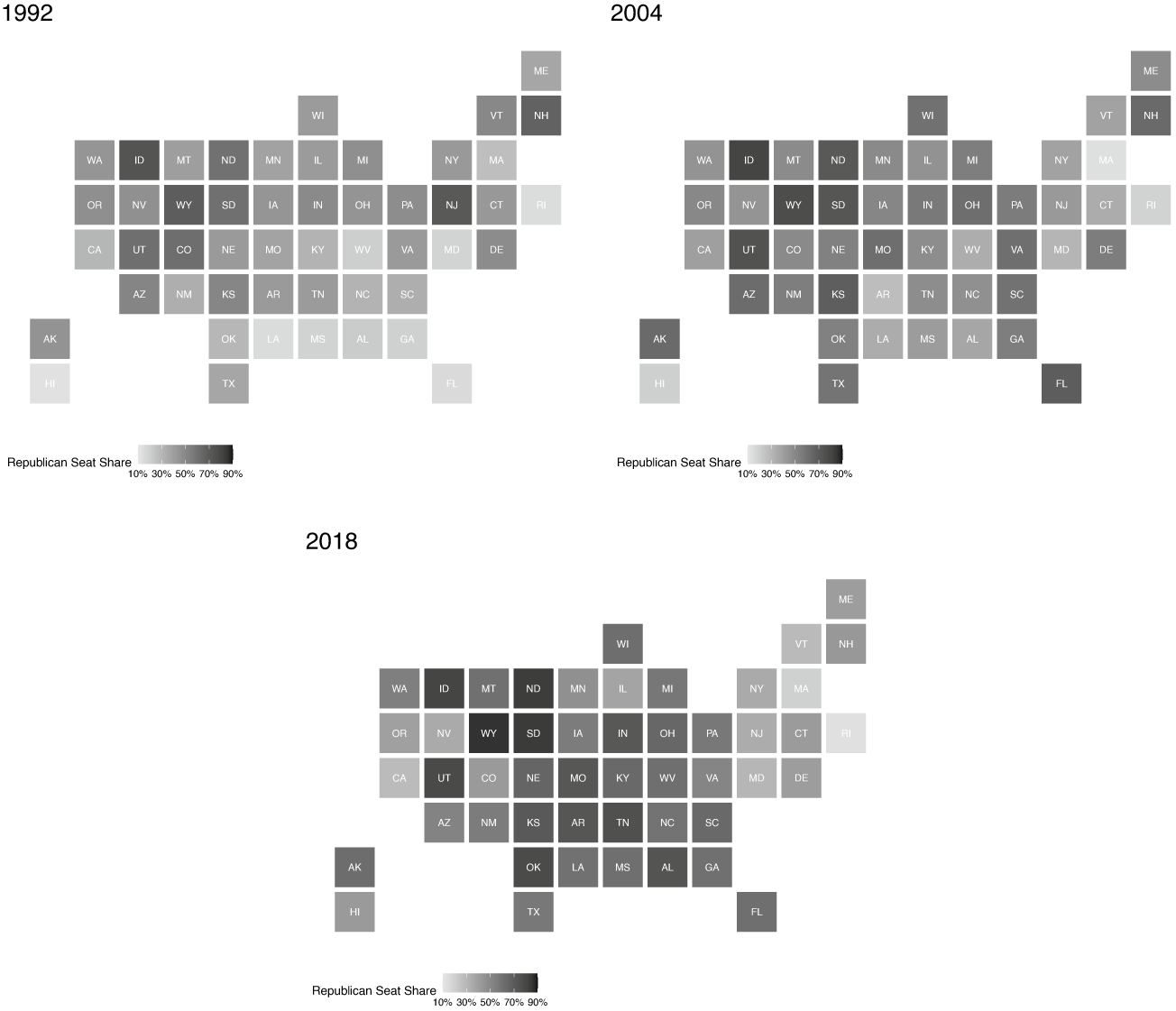
The trends across time can be seen in Figure 1. Each map illustrates the density of Republican seats in 1992, 2004, and 2018. Although these cutoff points are not representative of periods that are unique to each state, they do illustrate the aggregate variation across time. Darker shading indicates that there are more Republicans in the legislature. This distinction between periods allows for an easy comparison of legislative makeup before term limits and how they are now. The Republican seat share trends, seen in Figure 1, appear to strengthen over time. In the majority of the term-limited states, the Republican seat share was at its lowest in the early period.
Density of Republican seats in 1992, 2004, and 2018.

Looking at the illustrations in Figure 1, there are noticeable trends. As term limits were being implemented and beginning to remove legislators, there was an increase in the percentage of Republican seats. However, from these particular maps, it is unclear whether the increase in Republican seats is unique to term-limited states or whether it was part of a nationwide trend. Alternatively, it could be that the increase in Republican seats was a national trend but was amplified in states with term limits.
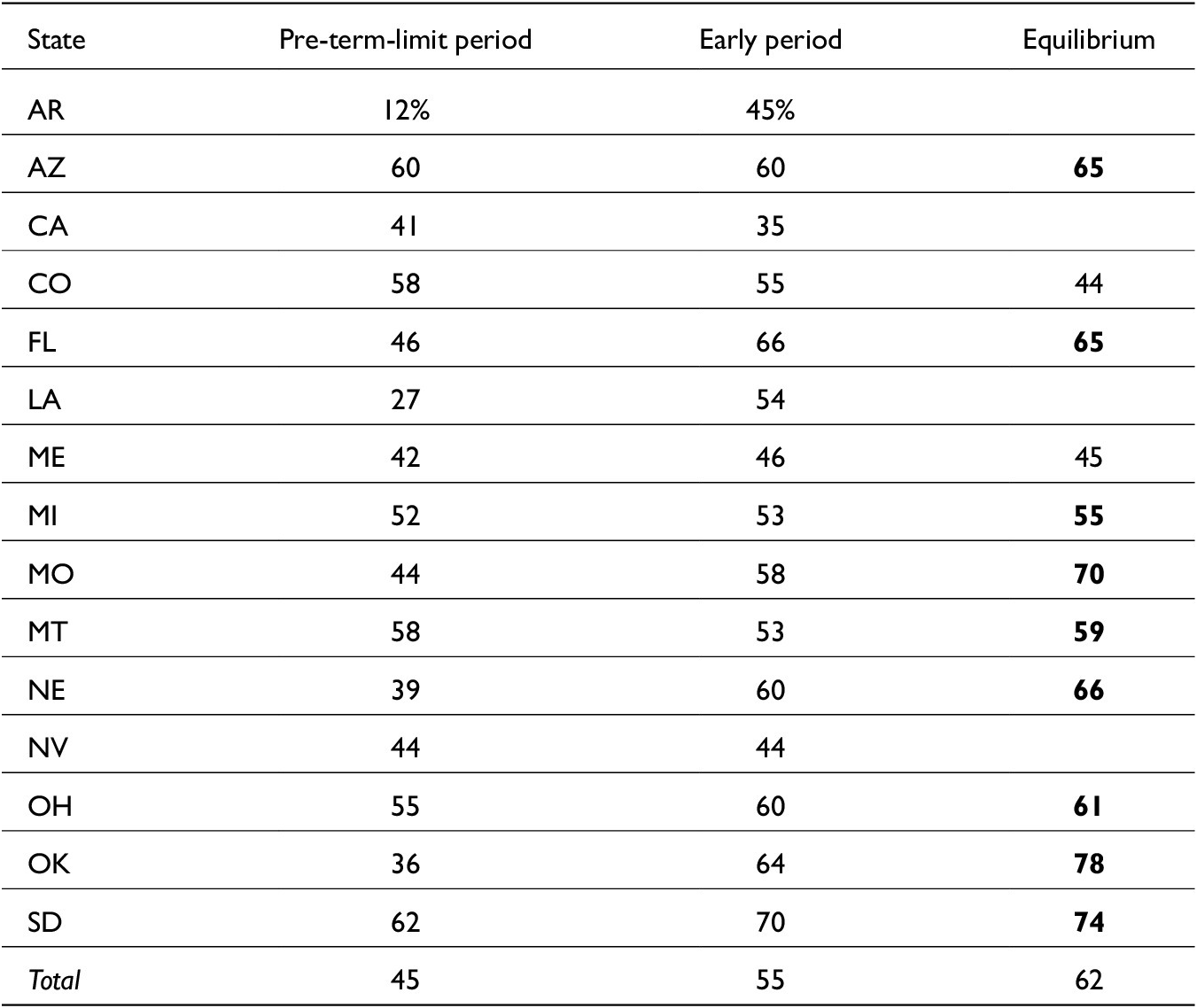
Table 2 displays the average percentage of Republican seat share over time for term-limited legislatures only.Footnote 73 Before implementing term limits, there were many states with Republican minorities. There were eight states where Republicans made up less than 45% of the legislature, two of which were superminorities. After implementing term limits, this shifted and only four states had a Democratic majority. In the final stage, equilibrium, all states with a Republican majority are noted in bold, some states saw an even stronger advantage for Republican lawmakers. The states without a strong history of Republicans, like Maine and Michigan, saw a minimal shift between the early period and equilibrium, suggesting that term limits had advantaged Republicans but did so by realigning the playing field. It is important to note that Colorado and California, which had a greater share of Republicans, saw a decline in Republican seats after they passed term limits.
Average Percentage of Republican Seat Share across Time in Term-Limited States

Arizona and California deserve a bit more attention given that they defer from the other states. Arizona had a strong Republican hold in the early 1990s and still does. However, Arizona experienced public distrust with the AZscam and needed a way to counter the long-serving incumbents. California, which experienced an initial decline in the number of Republicans, had a different experience altogether. California, a primarily Democratic state is also the most professional state legislature. Although the state did have some Republican upswings during this time, there was a need to counter the level of professionalization brought by Democrat Jesse Unruh. Voters were unhappy, the Republican party was pushing a nationalized platform for term limits and, importantly, California and Arizona have direct democracy, allowing term-limit groups ballot access.
This particular examination serves as an update to Richard Powell’s (2008) assessment of partisanship in term-limited states. Powell compared the percentage of Democratic lawmakers from 1990 to 2004 and found that Republicans had gained seats in term-limited states, but only minimally. To assess the effect of term limits on partisan shifts within the legislature, I focus on the percentage of Republican seat share for the entire legislature. Republicans have been adamant supporters of term limits and were also the most likely to benefit from the policy, making Republican seat share the main variable of interest. Republican seat share is a percentage derived from the total number of Republican members serving in the state legislature from the total number of chamber seats.
To advance current understandings of partisanship in state legislatures, this section evaluates the extent to which Republican seat share has changed across time in two different analyses. First are the changes to Republican seat share following the passage and implementation of term limits. Second, is the effect of time on term limits’ ability to influence Republican seat share. This second model, and the use of an interaction term, helps to advance current understandings of the relationship between time and term limits in ways that could not previously be examined given the severe data limitations after term limits passed. These models explore how time could influence the extent to which term limits forced change.
There are two different measures of time to help capture the long-term effects of term limits. First, there are dichotomous measures indicating the three periods outlined above: pre-term-limit, early, and equilibrium periods. This method, however, is less illustrative of the influence that term limits and time have on Republican seat share. To address this interactive relationship, there is a second method of measuring time based on the impact date of term limits. This second analysis makes use of the interaction of time and term limits to evaluate the effects as states move farther from the time term limits remove members.Footnote 74 Each state with term limits is set at its unique date, whereas states that do not have term limits are set at 2002.Footnote 75
In addition to the time component, there are several other variables included that can influence partisan seat share. First, is having a Republican governor. A successful Republican governor can help the party to secure more seats in the legislature, but a less successful governor can lead to midterm seat loss. Another factor that can influence party seat share is the level of electoral party competition, which is an updated measure using components from the Holbrook and Van Dunk Index.Footnote 76
To capture characteristics that are unique to each legislature, legislative professionalizationFootnote 77 and career opportunitiesFootnote 78 are included. Professionalization and career opportunities not only capture institutional characteristics but also serve as a measure of resources. Legislative professionalization is a measure of the time in session, salary, and staff support offered by each legislature. A more professional legislature (1) offers lawmakers more time to do the job, as well as greater resources to achieve their goals, a less professional legislature (0) can be more restrictive. Career opportunities are a measure of the advancement opportunities beyond the lower chamber of the legislature.Footnote 79 Last, there is a binary indicator for each of the states that have term limits.Footnote 80
Analysis
Column A in Table 3 contains the regression results of Republican seat share in state legislatures across different intervals of time related to term limits. The independent variables of interest, pre-term-limit, early, and equilibrium, are unique to each state with term limits.Footnote 81 A positive coefficient reveals an increase in Republican seat share, whereas a negative coefficient indicates a decline in the number of Republican seats. Although it appears that, during the equilibrium period, the Republican Party assumed greater control among state legislatures, there is a lack of evidence indicating term limits are driving this change. The model conveys the main variables that drive Republican seat share, but there is still no clear answer as to how term limits have altered this relationship over time.
Regression of Republican Seat Share for All States

* p < 0.1;
** p < 0.05;
*** p < 0.01.
To better understand the specific relationship between term limits and time, an interaction term is included in Table 3, column B, to parse these effects. The inclusion of the interaction term allows for a test of the influence of term limits over time rather than independently assessing the influence of term limits and time. The independent variable for this model is the interaction of term limits and time since the implementation of term limits or time since impact. Given that legislatures are malleable institutions, term limits may have different effects the longer that they have been in place.
A significant value for the interaction term indicates that the influence of one variable on the other changes and is significant, but these coefficient values are not directly interpretable. The presence of a significant interaction indicates that the effect of one variable, term limits, on the other, time, is different the longer term limits have been in place. In other words, the proportion of Republican seats is dependent on both having a term limit and how much time has passed. This is a relationship that is not revealed when simply controlling for each of the variables, which demonstrates that there is something unique about how these two variables work together.
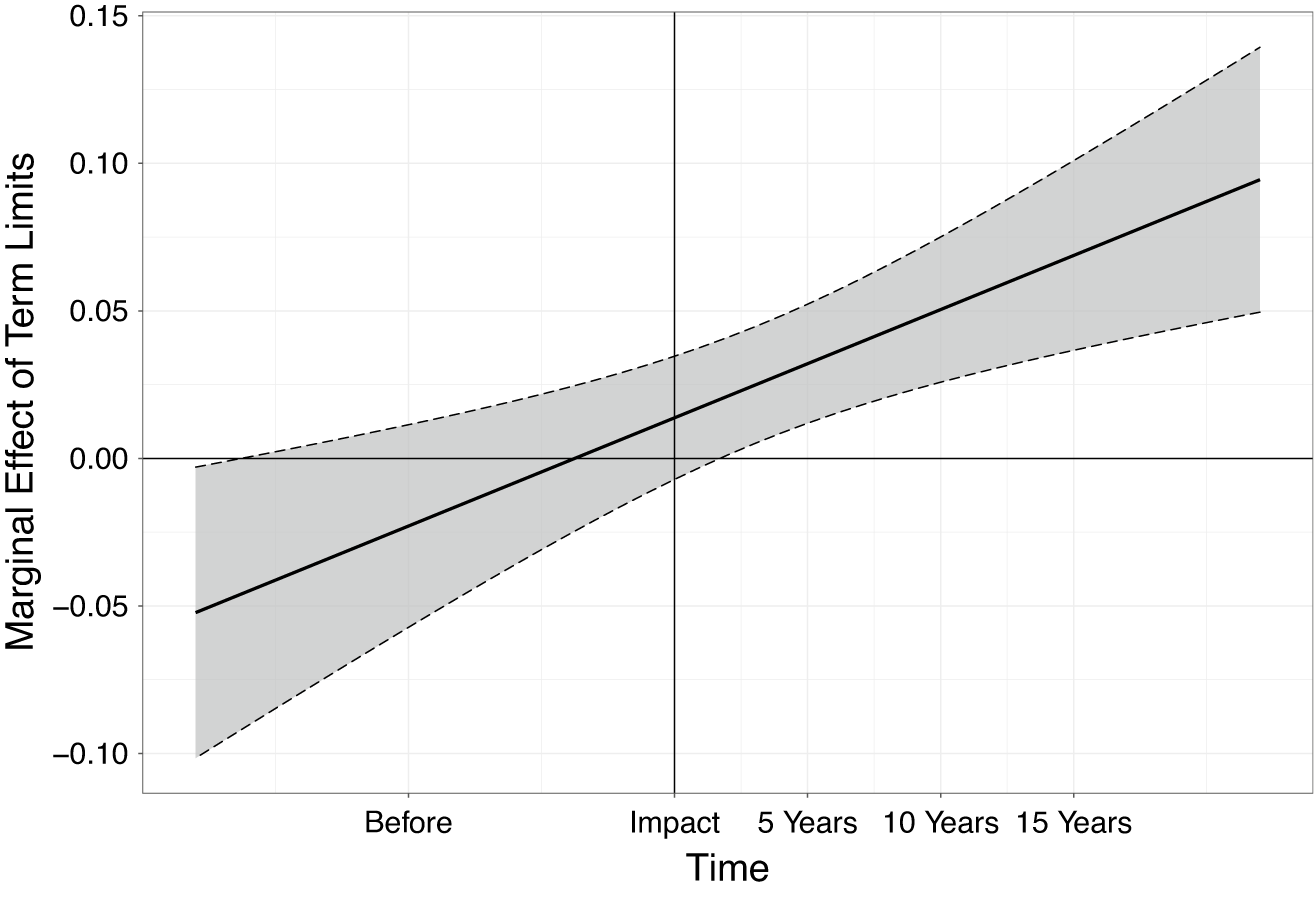
Figure 2 illustrates the marginal effect of term limits on Republican seat share across time with 95% confidence intervals. At the impact date, Republican seat share was insignificant. As time progressed and states moved away from the initial turnover, the effect of term limits became positive and significant. However, only after 15 years has the effect of having term limits become statistically distinguishable from the initial surge effects. During the transition, there was no significant difference between the start date and having term limits for five years.
Marginal effect of term limits on Republican seat share.

These analyses reveal a distinct relationship between term limits and the portion of seats occupied by Republican lawmakers.Footnote 82 The first analysis reveals a clear trend toward Republican gains, whereas the secondary analysis accounts for both time and term limits. There is support for an increase in the number of Republican lawmakers, and this appears to be prevalent in states that have legislative term limits. What is interesting about this finding is that the long-term adjusted effects of term limits present a greater share of Republican seats than the initial change post-implementation. These results may indicate that something else is at play—namely, that lasting recruitment efforts have potential effects on the careers of lawmakers.
Partisan Consequences
It is clear that partisan balance matters. But how much? A difference across parties in who retires and who terms out can influence the broader partisan dynamics of the legislature.Footnote 83 Recent research suggests that term-limited lawmakers have different careers than those who do not face term limits,Footnote 84 but less is known about the partisan differences in political careers. The career trajectory is important: if one party regularly has more senior members, then they hold the upper hand. Put simply, in a legislature with little experience, those with the most hold the power. This examination of the partisan effects on term limits is meant to be preliminary. Rather than an exhaustive list of potential partisan outcomes, as there are surely many, this assessment is designed to demonstrate some of the potential avenues for further research. There are two components to understanding the substantive partisan effects of term limits. First, what are the differences between Democratic and Republican lawmakers? Second, are these differences unique to states with term limits? This section seeks to preview an answer to such questions. Using the TLS-Careers data, which includes a sample of 12 term-limited states and 5 non-term-limited states,Footnote 85 allows for a comparison of the careers of Democratic and Republican lawmakers in term-limited states.Footnote 86 In total, these data contain yearly observations for over 6,000 lawmakers among 17 states from 1994 to 2018.
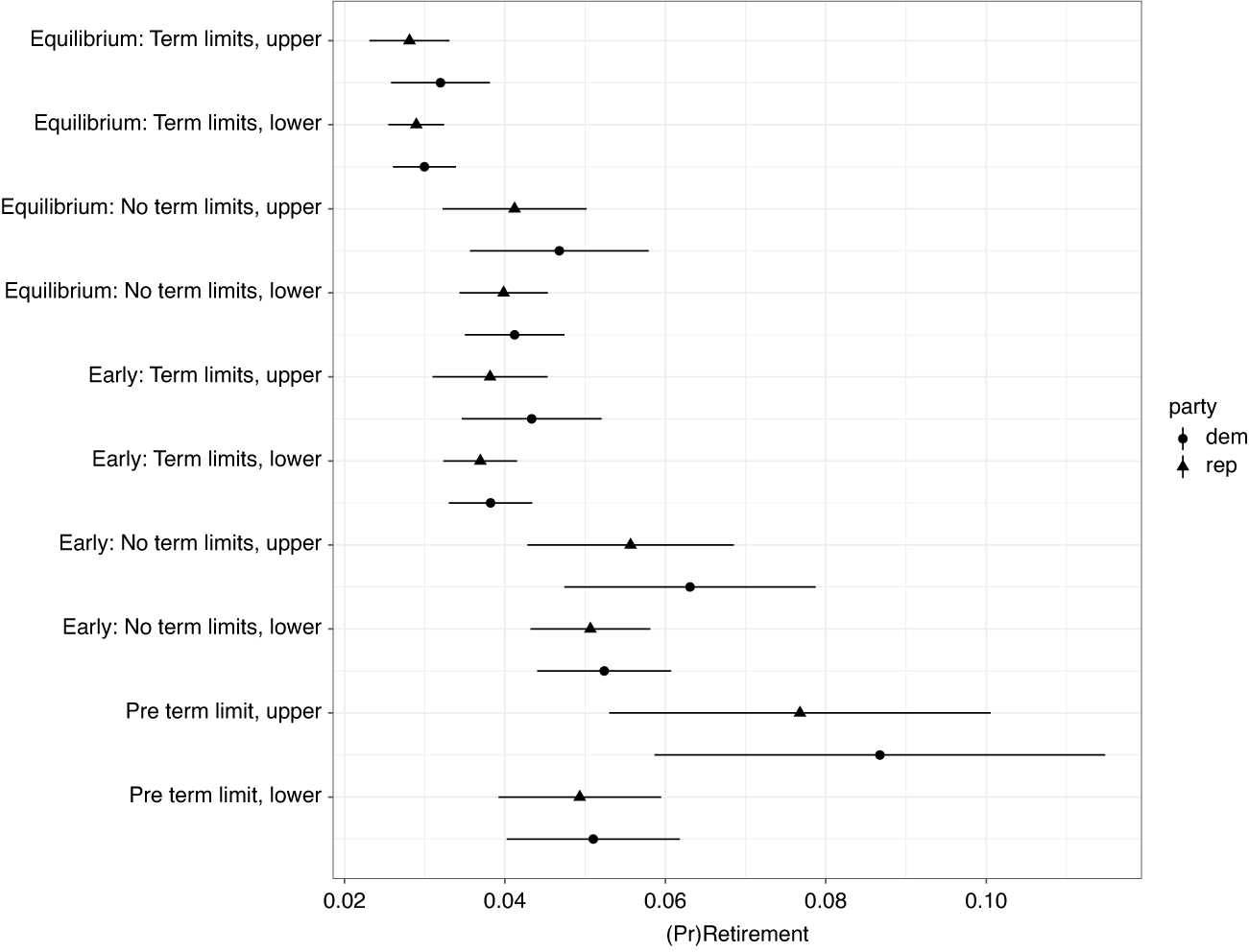
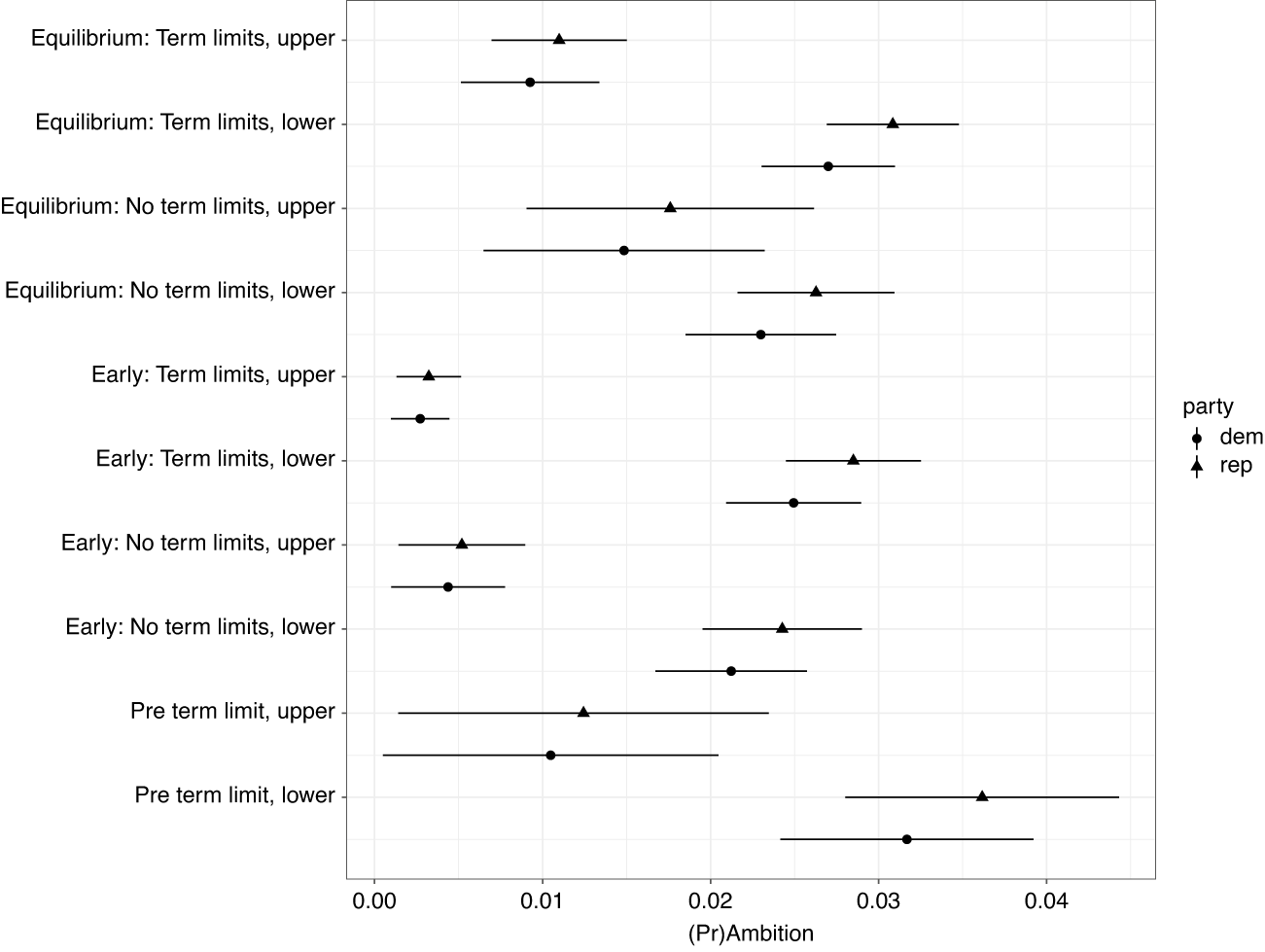
Although there are several avenues for a member to leave office, this section seeks to examine some of the partisan differences that exist for members when they can make their own career decisions. In particular, do the partisan effects of term limits influence members to retire or seek higher office?Footnote 87 For this particular evaluation, each legislative chamber is examined separately. The ability to advance or the decision to retire can be shaped by where in the legislature a member serves; notably, those serving in the upper chamber have fewer advancement opportunities.Footnote 88 To examine this very question, Figures 3 and 4 present the probability of a member choosing to retire or seek higher office, under a variety of circumstances.Footnote 89
Probability of a member choosing to retire or seek higher office.

Probability of a member choosing to retire or seek higher office. The focus is on members who leave in pursuit of higher office

The probabilities presented in Figures 3 and 4 are representative of an average-aged member (roughly 55 years old) who serves in a citizen legislature with limited career opportunities but serves in a Republican-led chamber along with a Republican governor.Footnote 90 There are many ways that a member may leave office, and this brief examination is designed to show whether there are partisan differences for members who retire or seek higher office. Each scenario is composed of three pieces: whether a state has term limits, in what period the member is serving, and if the member serves in the upper or lower chamber.
Starting with Figure 3, there are clear differences between the states with term limits and those without. There are also noticeable differences between the pre-term-limit, early, and equilibrium periods. A few brief observations worth noting are that as term limits are implemented the probability of a member retiring decreases, regardless of party. Interestingly, states without term limits in the early period closely resemble the career patterns of states before having term limits. Similarly, as time progresses states without term limits in the equilibrium phase are much like term-limited states in the early phase. Overall, there is a decline in the number of members who are retiring from office, but this trend appears to be accelerated in term-limited legislatures.
Focusing on the members who leave office in pursuit of higher office, Figure 4 presents a different story. The consistency seen in the decision to retire is not present here; rather, the decision to seek higher office appears to be highly correlated with the chamber in which a member is serving. Members who serve in the lower chamber are more likely to seek higher office, whereas those in the upper chamber are not. This is unsurprising given that there are fewer opportunities to advance for a lawmaker who is already serving in a state senate. As time goes on and states reach equilibrium, this appears to have decreased for those facing term limits, yet members from the lower chamber are still significantly more likely to seek higher office.
The percentage of Republican seat share is not wavering, as there are few differences between the parties in reasons that they leave. Rather, this increase in Republican seat share will likely be maintained due to the lack of distinction in why members choose to vacate their seats. If Republicans and Democrats are just as likely to seek higher office or just as unlikely to retire from office, the partisan dynamics are unlikely to shift.
Although the results of this particular examination do not yield any differences between the parties, there are clear substantive differences across both time and term limits. Perhaps this particular result is encouraging for those who fear long-term majorities. Even though there are strong Republican majorities in term-limited legislatures, the decisions that members make about their careers do not diverge by party. This is not to say that differences do not exist, but they do not appear to unduly affect the decision of a member to either retire or seek higher office.
Discussion and Conclusion
James Thurber argued that “The term limit solution is a solution that is biased towards one political party and not both and the consequences of these term limits have significant negative impact.”Footnote 91 Term limits were designed to generate mass turnover in state legislatures to help long-suppressed partisan minorities. In fact, when term limits passed, most states had strong Democratic majorities, as did Congress. Given that, and the Republican support for term limits, Republicans should be the primary beneficiary of legislative term limits. Although early research revealed there was not a relationship between term limits and partisan shifts, this study uncovers a significant change over time in the number of Republican seats in term-limited legislatures. Looking at the legacy of this change reveals that Democrats and Republicans have somewhat similar careers, meaning this partisan shift is unlikely to change soon.
This analysis explores the partisan dynamics of legislative term limits using original data to explore the percentage of Republican seats in all 50 states. The first part centers on the relationship between the implementation of term limits and the seats occupied by Republican lawmakers. The second part centers on assessing the relationship between term limits and the Republican Party over time. As term limits have settled in the states, so has their influence. It is necessary to account for the initial as well as the long-term effects. Some changes may have reverted to how they were before term limits, whereas others have become the new norm.
These findings present a distinct partisan reversal in the states with term limits. One explanation for the results seen here is that the district lines in term-limited states have become more partisan and the majority party continues to gain strength, which could be driving some of the significant results here. Alternatively, these results could be a microcosm of larger shifts in electoral politics. Even though there were nationalized shifts toward Republicanism in state legislatures, if anything, term limits allowed Republicans to gain seats at a faster rate than states without term limits.
Broad efforts centered on recruitment were clearly effective, and given the shift in the number of Republican-controlled seats these effects are amplified in term-limited states. Although the solution for better recruitment was a beneficial one, recruitment only works when there are more seats. The two-pronged approach of more candidates and forced open seats appears to have benefited the Republican party in the long run. To be clear, term limits alone would likely not have seen these same results, but the moves made by the Republican party prior to pursuing term limits compounded these effects.
In contrast to alternative explanations, Republicans have not only strengthened their numbers since the implementation of term limits; their careers are not entirely different from Democrats. In particular, Table 3 reveals that there has been an increase in Republican seat share over time but there has been a decline in both Republican and Democratic retirements over time. This examination of the lasting effects on legislative careers is far from exhaustive and is merely meant to represent one potential form of change. There is room to extend this by looking at where members go when they seek higher office or leave. There is also the potential for gendered differences given that more women are members of the Democratic Party than the Republican Party. There are more consequences of this partisan shift to explore, knowing that this shift is strong and prevalent.
The presence of term limits is shaping legislative partisanship in the states. Term limits have benefited the Republican Party, which supported the push to restrict careers in the early 1990s. Since this initial push, three states have shifted their term limits. This begs the question, “Is the public still discontent with their politicians? Although these lasting partisan effects do not influence the career decisions of members, they are undoubtedly shaping other areas of state politics. The partisan motivations behind the implementation of term limits have greatly benefited the Republican Party, but whether these partisan motivations exist for current term limit pushes and in those few states that have changed their limits still needs to be explored.
Acknowledgments
A previous version of this was presented at The Policy History Workshop. The author would like to thank Gregory Koger, James Endersby, Marvin Overby, Noah Haynes, Semih Demirtas, and the anonymous reviewers for their suggestions and feedback.
Appendix
An Overview of the Term-Limited States

Alternative Logit Models Focused on Redistricting and Party Strength

Note: Robust standard errors in parentheses. There are fewer observations given the limited data, so these results should be taken with caution because of the lack of data during the pre-term-limit period.
Alternative Logit Model Focused on Party Polarization, by Chamber

Note: Robust standard errors in parentheses. Party polarization is measured using Shor and McCarty’s 2020 update of the distance between party medians.
Logit Models for Predicted Values

Note: Standard errors in parentheses. Equilibrium is excluded from the second model due to collinearity.