1 Introduction
We define a Pythagorean triple to be a triple
$(a, b, c)$
 of integers such that

Pythagorean triples have been a subject of study by mathematicians for millennia.
In the 17th century, a letter from Fermat to Mersenne considered the problem of finding the Pythagorean triples in which a and
$b + c$
 are squares [Reference Sierpiński4, page 67]. We call this question the Fermat–Mersenne problem. In the letter, Fermat noted the surprising fact that of all (nontrivial) solutions, a solution with the smallest possible value of a is given by

Number-theoretic solutions of the Fermat–Mersenne problem are known (see [Reference Lagrange, Serret and Darboux2] and [Reference Sierpiński4, Section 12]); however, the arguments are complicated and the reader may be left wondering why they work.
In this paper, we solve the Fermat–Mersenne problem by using a geometric approach that provides new insight. Some of the relevant ideas appear in a textbook of Silverman on elliptic curves [Reference Silverman6, pages 327–329], but no previous applications of these ideas in the literature explicitly focus on the Fermat–Mersenne problem, to the author’s knowledge.
To motivate the strategy of this paper, let us consider the well-known simpler question of finding all Pythagorean triples. There are at least two standard approaches to the problem: a number-theoretic approach and a geometric approach. Both approaches start by dividing all entries of a general Pythagorean triple by their greatest common divisor; this converts the triple to a primitive Pythagorean triple, that is, a Pythagorean triple
$(a, b, c)$
 where
$\gcd (a, b, c) = 1$
 .
The number-theoretic approach [Reference Sierpiński4, Section 2] uses the factorisation given by
${c^{2} = (a - b)(a + b)}$
 to show that each of the numbers
$a \pm b$
 is a square (respectively, twice a square) if c is odd (respectively, even). A variation on that theme uses the factorisation
$a^{2} = (b - ci)(b + ci)$
 in
$\mathbb {Z}[i]$
 instead [Reference Marcus3, pages 1–2].
In the geometric approach [Reference Silverman6, page 13], the primitive Pythagorean triples correspond to rational points on the unit circle, which are transformed into rational points on a projective line by stereographic projection.
The Fermat–Mersenne problem asks for the Pythagorean triples
$(a, b, c)$
 such that a and
$b + c$
 are squares. The number-theoretic approaches to the problem ([Reference Lagrange, Serret and Darboux2] and [Reference Sierpiński4, Section 12]) can be viewed as adaptations of the number-theoretic approach for general Pythagorean triples. In this paper, we adapt the geometric approach instead. We divide out by positive common factors, associate the resulting primitive solutions with rational points on a curve C and apply stereographic projection.
This time, the image of the projection will be an elliptic curve E of rank 1 instead of a projective line. The point from which we project will not be defined over
$\mathbb {R}$
 ; to compensate for that, we apply a tweak that involves complex multiplication on E so that the rational points on C correspond to the rational points on E.
The Fermat–Mersenne problem has infinitely many solutions because the elliptic curve E has infinitely many rational points. Apart from providing that insight, the geometric approach has a further advantage over the number-theoretic approach. The number-theoretic arguments involve chains of solutions that can have negative values of b or c, and no way is given to determine whether all of the entries in, say, the
$10^{10}$
 th solution in a chain are positive, apart from actually calculating the infeasibly large solution or doing something tantamount to that. In the geometric approach, the question ‘Are all of the entries in the nth solution in a chain positive?’ has a beautiful and unexpected answer that emerges organically from the geometry, and we can answer the question without calculating the nth solution. To the author’s knowledge, that has not been done before.
We assume that the reader has background knowledge of abstract algebra, projective geometry and elliptic curves. Some of our notation is taken and/or adapted from Silverman’s books [Reference Silverman5, Reference Silverman6] on elliptic curves. Several routine manipulations involving points in projective space, as well as other calculations, are detailed in the supplementary material available at https://github.com/ThackerayMayaR/FermatMersenneAG. SageMath Version 10.0 (release date 20 May 2023) was used as an advanced calculator (for example, to determine multiples of points on an elliptic curve).
We use the following formal definition of stereographic projection. In a projective space
$\mathbb {P}^{n}$
 , let H be a hyperplane, let C be a smooth curve and let
$P_{0}$
 be a point that is on C but not on H. For each point P on C, we let
$L_{P}$
 be the projective line through
$P_{0}$
 and P, except that if
$P = P_{0}$
 , then we let
$L_{P}$
 be the tangent line to C at P. The stereographic projection through
$P_{0}$
 from C to H is the map from C to H that sends each point P on C to the intersection of
$L_{P}$
 and H.
2 Warmup: general Pythagorean triples
We briefly describe the standard argument [Reference Silverman6, page 13] that uses stereographic projection to find all Pythagorean triples. Although the argument is well known, we include it here because the argument for the Fermat–Mersenne problem follows the same structure, so the simpler problem is worth keeping in mind.
For any Pythagorean triple
$(a, b, c)$
 , if
$d = \gcd (a, b, c)$
 , then
$(a/d, b/d, c/d)$
 is a primitive Pythagorean triple. The Pythagorean triples are precisely the triples of the form
$(ka, kb, kc)$
 , where k is a positive integer and
$(a, b, c)$
 is a primitive Pythagorean triple.
In the projective space
$\mathbb {P}^{2}$
 of points
$(X_{0} : X_{1} : X_{2})$
 , let C be the curve defined by
$X_{0}^{2} = X_{1}^{2} + X_{2}^{2}$
 . The intersection of the affine plane
$X_{0} \neq 0$
 with C is the affine unit circle
$1 = X^{2} + Y^{2}$
 , where the point
$(X, Y)$
 in
$\mathbb {A}^{2}$
 corresponds to the projective point
$(X_{0} : X_{1} : X_{2}) = (1 : X : Y)$
 in
$\mathbb {P}^{2}$
 . It is easily checked that the map
$(a, b, c) \mapsto (a : b : c)$
 from the set of primitive Pythagorean triples to
$C(\mathbb {Q})$
 is a bijection.
The point
$(1 : 0 : 1)$
 is on C. In
$\mathbb {P}^{2}$
 , consider the stereographic projection through
$(1 : 0 : 1)$
 from C to the projective line
$X_{2} = 0$
 . For each point P on C, the projection sends P to a point
$(t_{0} : t_{1} : 0)$
 and we let
$f(P)$
 be the point
$(t_{0} : t_{1})$
 in
$\mathbb {P}^{1}$
 . Calculations show that the map f is given by

and that f is an isomorphism over
$\mathbb {Q}$
 ; its inverse is given by

(See Section 2 of the supplementary material.) It follows that f restricts to a bijection from
$C(\mathbb {Q})$
 to
$\mathbb {P}^{1}(\mathbb {Q})$
 .
Therefore, the map
$(a, b, c) \mapsto f((a : b : c))$
 from the set of primitive Pythagorean triples to
$\mathbb {P}^{1}(\mathbb {Q})$
 is a bijection. In the reverse direction, if
$t_{0}$
 and
$t_{1}$
 are coprime integers that are not both zero, then it can be checked that the point
$(t_{0} : t_{1}) \in \mathbb {P}^{1}(\mathbb {Q})$
 corresponds to the primitive Pythagorean triple
$(t_{0}^{2} + t_{1}^{2}, 2t_{0}t_{1}, t_{1}^{2} - t_{0}^{2})$
 (if
$t_{0} + t_{1}$
 is odd) or
$((t_{0}^{2} + t_{1}^{2})/2, t_{0}t_{1}, (t_{1}^{2} - t_{0}^{2})/2)$
 (if
$t_{0} + t_{1}$
 is even). For a primitive Pythagorean triple
$(a, b, c)$
 and the corresponding point
$(t_{0} : t_{1}) \in \mathbb {P}^{1}(\mathbb {Q})$
 , all entries of
$(a, b, c)$
 are positive if and only if
$t_{0} \neq 0$
 and
$t_{1}/t_{0}> 1$
 .
3 The Fermat–Mersenne problem
We now consider the Fermat–Mersenne problem. To be explicit, we define a Fermat–Mersenne tuple to be a 5-tuple
$(a, b, c, m, n) \in \mathbb {Z}^{5}$
 such that

To solve the Fermat–Mersenne problem, it is enough to find all Fermat–Mersenne tuples. To obtain the corresponding Pythagorean triples
$(a, b, c)$
 , we discard m and n. It is easily checked that each Pythagorean triple
$(a, b, c)$
 obtained in this way comes from exactly two Fermat–Mersenne tuples, which are of the form
$(a, b, c, m, n)$
 and
$(a, b, c, -m, n)$
 for some m and n.
For a Fermat–Mersenne tuple
$(a, b, c, m, n)$
 , if some positive integer p is prime and divides
$\gcd (m, n)$
 , then
$(a/p^{2}, b/p^{2}, c/p^{2}, m/p, n/p)$
 is a Fermat–Mersenne tuple. (Note that
$p^{4}$
 divides
$n^{4} - m^{4} = (b + c)^{2} - (b^{2} + c^{2}) = 2bc$
 , so
$p^{3}$
 divides
$bc$
 , so
$p^{2}$
 divides b or
$p^{2}$
 divides c, but
$p^{2}$
 divides
$n^{2} = b + c$
 , so
$p^{2}$
 divides b and
$p^{2}$
 divides c.) We define a primitive Fermat–Mersenne tuple to be a Fermat–Mersenne tuple
$(a, b, c, m, n)$
 such that
$\gcd (m, n) = 1$
 . The Fermat–Mersenne tuples are precisely the tuples of the form
$(k^{2}a, k^{2}b, k^{2}c, km, kn)$
 , where k is a positive integer and
$(a, b, c, m, n)$
 is a primitive Fermat–Mersenne tuple.
To find all primitive Fermat–Mersenne tuples, we associate them with the rational points of a certain projective curve and we show that those points correspond to the rational points of a certain elliptic curve.
4 The projective curve
In the space
$\mathbb {P}^{3}$
 of points given by
$(Y_{0} : Y_{1} : Y_{2} : Y_{3})$
 , consider the smooth curve C with the two defining equations
$Y_{0}Y_{1} = Y_{2}^{2}$
 and
$2Y_{1}^{2} = Y_{0}^{2} + Y_{3}^{2}$
 (see [Reference Silverman6, pages 22–23]). The intersection of the affine 3-space
$Y_{0} \neq 0$
 with C is given by the equations
$X = Y^{2}$
 and
$2Y^{4} = 1 + Z^{2}$
 , where the point
$(X, Y, Z)$
 in
$\mathbb {A}^{3}$
 corresponds to the projective point
$(Y_{0} : Y_{1} : Y_{2} : Y_{3}) = (1 : X : Y : Z) \in \mathbb {P}^{3}$
 . The two points of C that satisfy
$Y_{0} = 0$
 are the points
$(0 : 1 : 0 : \pm \sqrt {2})$
 , neither of which is in
$C(\mathbb {Q})$
 .
Proposition 4.1. The map
$(a, b, c, m, n) \mapsto (1 : m^{2}/n^{2} : m/n : (b - c)/n^{2})$
 from the set of primitive Fermat–Mersenne tuples to
$C(\mathbb {Q})$
 is a bijection. For each point
${(1 : y^{2} : y : z)}$
 in
$C(\mathbb {Q})$
 , the corresponding primitive Fermat–Mersenne tuple has all of its entries positive if and only if
$0 < y < 1$
 .
Proof. We show the map is well defined. If
$(a, b, c, m, n)$
 is a primitive Fermat–Mersenne tuple, then the rational numbers
$y = m/n$
 and
$z = (b - c)/n^{2}$
 satisfy

so
$(1 : y^{2} : y : z) \in C(\mathbb {Q})$
 .
We show the map is injective. Let the point
$(Y_{0} : Y_{1} : Y_{2} : Y_{3})$
 in
$C(\mathbb {Q})$
 be the image of some primitive Fermat–Mersenne tuple
$(a, b, c, m, n)$
 under the map. The integers m and n are uniquely determined by the conditions
$n> 0$
 ,
$\gcd (m, n) = 1$
 and
$Y_{2}/Y_{0} = m/n$
 . The integers a, b and c are uniquely determined since
$a = m^{2}$
 ,
$b = (n^{2}/2)(1 + (Y_{3}/Y_{0}))$
 and
$c = (n^{2}/2)(1 - (Y_{3}/Y_{0}))$
 .
We show the map is surjective. Let the point
$P = (Y_{0} : Y_{1} : Y_{2} : Y_{3})$
 be in
$C(\mathbb {Q})$
 . Now, P must be of the form
$(1 : y^{2} : y : z)$
 for some rational numbers y and z such that
$2y^{4} = 1 + z^{2}$
 . Let
$(m, n)$
 be the unique pair of integers such that
$n> 0$
 ,
$\gcd (m, n) = 1$
 and
$y = m/n$
 . Let
$d = n^{2}z$
 . The number d is in
$\mathbb {Q}$
 and

so d is an integer with the same parity as n. It is easily checked that

is a primitive Fermat–Mersenne tuple that is sent to P by the map.
For a primitive Fermat–Mersenne tuple
$(a, b, c, m, n)$
 and the corresponding point
$(1 : y^{2} : y : z)$
 in
$C(\mathbb {Q})$
 : n is always positive;
$y> 0$
 if and only if
$m> 0$
 , in which case
$a = m^{2}> 0$
 ; and we have
$b> 0$
 and
$c> 0$
 simultaneously if and only if
$|z| < 1$
 if and only if
$|y| < 1$
 .
5 The elliptic curve
In the space
$\mathbb {P}^{2}$
 of points given by
$(X_{0} : X_{1} : X_{2})$
 , consider the elliptic curve E with the defining equation
$X_{0}X_{2}^{2} = X_{1}(X_{1}^{2} + (1/2)X_{0}^{2})$
 . The intersection of the affine plane
$X_{0} \neq 0$
 with E is given by
$Y^{2} = X^{3} + (1/2)X$
 , where
$(X, Y)$
 corresponds to the point
$(X_{0} : X_{1} : X_{2}) = (1 : X : Y) \in \mathbb {P}^{2}$
 . The one point of E that satisfies
$X_{0} = 0$
 is the point
$O = (0 : 0 : 1)$
 , which we take as the identity for the group law on E as usual.
The elliptic curve E has complex multiplication by
$\mathbb {Z}[i]$
 , where the multiply-by-i map

is an isomorphism over
$\mathbb {Q}(i)$
 . For each
$z \in \mathbb {Z}[i]$
 , we write the multiply-by-z map as
$[z]: E \rightarrow E: P \mapsto [z]P$
 (see [Reference Silverman5, page 107], [Reference Silverman6, pages 69–70] and, more generally, the introductions to the theory of complex multiplication of elliptic curves in [Reference Silverman5, Ch. 2] and [Reference Silverman6, pages 425–429]).
The two points
$R = (2 : -1 - i : 1 - i)$
 and
$(1 : 0 : 0)$
 are on E, and they satisfy
$[2]R = (8 : 2 : 3)$
 and
$[2](1 : 0 : 0) = O$
 . Each of the two maps

is a group isomorphism. (A proof may be given using the techniques of [Reference Silverman6, Example 4.5 in Section III.4, Sections VII.1–3 and Proposition 4.9 in Section X.4]. This may also be checked using SageMath and a database like LMFDB; the elliptic curve E is isomorphic to the curve with Cremona label 256b2 [7]. See Section 3 of the supplementary material.)
6 Correspondences between the two curves
The point
$(1 : 0 : 0 : i)$
 is on C. Starting with a point
$P = (y_{0} : y_{1} : y_{2} : y_{3})$
 on C, apply stereographic projection in
$\mathbb {P}^{3}$
 through
$(1 : 0 : 0 : i)$
 from C to the projective plane
$Y_{3} = 0$
 . We obtain a point
$(x_{0} : x_{1} : x_{2} : 0)$
 ; let this correspond to the point
$f(P) = (x_{0} : x_{1} : x_{2})$
 in
$\mathbb {P}^{2}$
 .
Proposition 6.1. The map
$f: C \rightarrow E$
 is an isomorphism over
$\mathbb {Q}(i)$
 .
Proof. Calculations show that f sends each point in C to a point in E, that f is given by

and that the map

is the inverse of f. (See Sections 4.1–4.3 of the supplementary material.) The maps f and
$f^{-1}$
 are defined over
$\mathbb {Q}(i)$
 , and the result follows. (The map f can be obtained from the map
$\phi ^{-1}$
 in [Reference Silverman6, pages 327–329] with
$d = -1$
 ,
$a = 0$
 and
$b = 1/2$
 by rearranging and renaming co-ordinates, post-composing with
$[i]$
 and taking the projective closure where necessary.)
Table 1 lists some points on E and on C that correspond under f. It is easily checked that the maps

are isomorphisms over
$\mathbb {Q}(i)$
 , and that every point P on C satisfies

(See Section 4.4 of the supplementary material.)
Points on E and points on C that correspond under f. The point R is the point
$(2 : -1 - i : 1 - i)$
 in
$E(\mathbb {Q}(i))$
 . Each point that is defined over
$\mathbb {Q}$
 is marked with an asterisk.

Table 1 Long description
The table consists of four columns and thirteen data rows.
Column headers:
1. s
2. t
3. [s + ti]R in E
4. f super -1 ([s + ti]R) in C
Data rows:
- Row 1: s = 0, t = -3. Column 3: (4394 : 13 - 3107i : 1 - 239i). Column 4: * (1 : 169 : 13 : 239).
- Row 2: s = 0, t = -2. Column 3: (8 : -2 : -3i). Column 4: (9 : -4 : -6i : -7i).
- Row 3: s = 0, t = -1. Column 3: (2 : 1 + i : -1 - i). Column 4: * (1 : 1 : -1 : -1).
- Row 4: s = -3, t = 0. Column 3: (4394 : -13 + 3107i : -239 - i). Column 4: (1 : -169 : -13i : 239).
- Row 5: s = -2, t = 0. Column 3: * (8 : 2 : -3). Column 4: (9 : 4 : -6 : -7i).
- Row 6: s = -1, t = 0. Column 3: (2 : -1 - i : -1 + i). Column 4: (1 : -1 : i : -1).
- Row 7: s = 0, t = 0. Column 3: * (0 : 0 : 1). Column 4: (1 : 0 : 0 : i).
- Row 8: s = 1, t = 0. Column 3: (2 : -1 - i : 1 - i). Column 4: (1 : -1 : -i : -1).
- Row 9: s = 2, t = 0. Column 3: * (8 : 2 : 3). Column 4: (9 : 4 : 6 : -7i).
- Row 10: s = 3, t = 0. Column 3: (4394 : -13 + 3107i : 239 + i). Column 4: (1 : -169 : 13i : 239).
- Row 11: s = 0, t = 1. Column 3: (2 : 1 + i : 1 + i). Column 4: * (1 : 1 : 1 : -1).
- Row 12: s = 0, t = 2. Column 3: (8 : -2 : 3i). Column 4: (9 : -4 : 6i : -7i).
- Row 13: s = 0, t = 3. Column 3: (4394 : 13 - 3107i : -1 + 239i). Column 4: * (1 : 169 : -13 : 239).
Note: Asterisks indicate points defined over the field Q.
We would like to find an isomorphism from C to E over
$\mathbb {Q}$
 instead of over
$\mathbb {Q}(i)$
 so that points in
$C(\mathbb {Q})$
 correspond to points in
$E(\mathbb {Q})$
 . Table 1 suggests that we consider the map
$g: C \rightarrow E, P \mapsto [-i](f(P)) - R$
 (which sends the rational points
$(1 : 1 : 1 : -1)$
 and
$(1 : 169 : -13 : 239)$
 on C to respectively the rational points O and
$(8 : 2 : 3)$
 on E).
Proposition 6.2. The map g is an isomorphism over
$\mathbb {Q}$
 , so g restricts to a bijection from
$C(\mathbb {Q})$
 to
$E(\mathbb {Q})$
 .
Proof. By Proposition 6.1, the map g is an isomorphism over
$\mathbb {Q}(i)$
 and its inverse is
$g^{-1}: E \rightarrow C,\ P \mapsto f^{-1}([i](P + R))$
 . Calculations yield the formulae for g and
$g^{-1}$
 :


(See Sections 4.5 and 4.6–4.7 of the supplementary material, respectively.)
The maps g and
$g^{-1}$
 are defined over
$\mathbb {Q}$
 , and the result follows.
7 Results
The propositions proved so far imply the following result.
Theorem 7.1. The map
$(a, b, c, m, n) \mapsto g((1 : m^{2}/n^{2} : m/n : (b - c)/n^{2}))$
 from the set of primitive Fermat–Mersenne tuples to
$E(\mathbb {Q})$
 is a bijection.
In the reverse direction, the correspondence is as follows. For each P in
$E(\mathbb {Q})$
 , the point
$g^{-1}(P)$
 in
$C(\mathbb {Q})$
 is of the form
$(1 : y^{2} : y : z)$
 for some rational numbers y and z such that
$2y^{4} = 1 + z^{2}$
 . Defining m, n and d as in the surjectivity-related part of the proof of Proposition 4.1, we find that

is the corresponding primitive Fermat–Mersenne tuple.
For
$t \in \mathbb {Z}$
 and
$u \in \{0, 1\}$
 , let us write
$P_{t, u} = [t](8 : 2 : 3) + [u](1 : 0 : 0)$
 . If the tuple
$(a, b, c, m, n)$
 corresponds to the point
$P = P_{t, u} \in E$
 , then the following statements hold. Simultaneously negating m and swapping b with c corresponds to replacing P with
$(1 : 0 : 0) + P$
 (that is, replacing u with
$1 - u$
 ). Negating m corresponds to replacing P with
$(8 : 2 : -3) - P$
 (that is, replacing t with
$-1 - t$
 ). Therefore, since
$(1 : 0 : 0) + (8 : 2 : -3) = (1 : 2 : 3)$
 , swapping b with c corresponds to replacing P with
$(1 : 2 : 3) - P$
 (that is, simultaneously replacing t with
$-1 - t$
 and replacing u with
$1 - u$
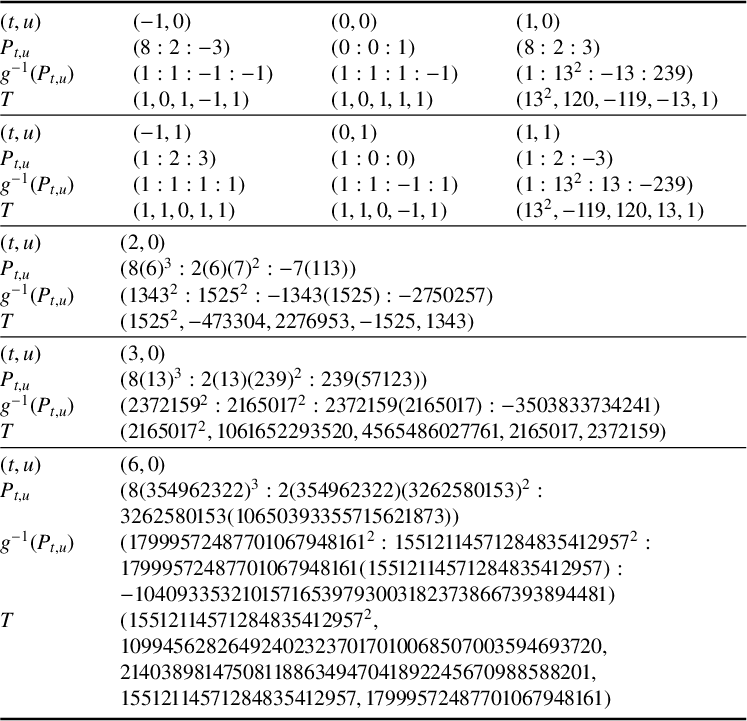
 ). Table 2 lists some rational points on E, the corresponding rational points on C and the corresponding primitive Fermat–Mersenne tuples (see Section 5.1 of the supplementary material).
Some rational points
$P = P_{t, u}$
 on E, and their associated rational points
$g^{-1}(P_{t, u})$
 on C and primitive Fermat–Mersenne tuples
$T = (a, b, c, m, n)$
 .

Table 2 Long description
The table is organized into repeating sets of four variables: (t, u), P sub {t, u}, g super -1 (P sub {t, u}), and T.
* Row 1 to 4:
- (t, u) values: (-1, 0), (0, 0), and (1, 0).
- P sub {t, u} values: (8 : 2 : -3), (0 : 0 : 1), and (8 : 2 : 3).
- g super -1 (P sub {t, u}) values: (1 : 1 : -1 : -1), (1 : 1 : 1 : -1), and (1 : 13 super 2 : -13 : 239).
- T tuples: (1, 0, 1, -1, 1), (1, 0, 1, 1, 1), and (13 super 2, 120, -119, -13, 1).
* Row 5 to 8:
- (t, u) values: (-1, 1), (0, 1), and (1, 1).
- P sub {t, u} values: (1 : 2 : 3), (1 : 0 : 0), and (1 : 2 : -3).
- g super -1 (P sub {t, u}) values: (1 : 1 : 1 : 1), (1 : 1 : -1 : 1), and (1 : 13 super 2 : 13 : -239).
- T tuples: (1, 1, 0, 1, 1), (1, 1, 0, -1, 1), and (13 super 2, -119, 120, 13, 1).
* Row 9 to 12 (t, u = 2, 0):
- P sub {t, u}: (8 times 6 super 3 : 2 times 6 times 7 super 2 : -7 times 113).
- g super -1 (P sub {t, u}): (1343 super 2 : 1525 super 2 : -1343 times 1525 : -2750257).
- T: (1525 super 2, -473304, 2276953, -1525, 1343).
* Row 13 to 16 (t, u = 3, 0):
- P sub {t, u}: (8 times 13 super 3 : 2 times 13 times 239 super 2 : 239 times 57123).
- g super -1 (P sub {t, u}): (2372159 super 2 : 2165017 super 2 : 2372159 times 2165017 : -3503833734241).
- T: (2165017 super 2, 1061652293520, 4565486027761, 2165017, 2372159).
* Row 17 to 26 (t, u = 6, 0):
- P sub {t, u}: (8 times 354962322 super 3 : 2 times 354962322 times 3262580153 super 2 : 3262580153 times 10650393355715621873).
- g super -1 (P sub {t, u}): (17999572487701067948161 super 2 : 15512114571284835412957 super 2 : 17999572487701067948161 times 15512114571284835412957 : -104093353210157165397930031823738667393894481).
- T: (15512114571284835412957 super 2, 109945628264924023237017010068507003594693720, 214038981475081188634947041892245670988588201, 15512114571284835412957, 17999572487701067948161).
We now consider the condition where all entries are positive in the primitive Fermat–Mersenne tuple corresponding to some
$P = (x_{0} : x_{1} : x_{2})$
 in
$E(\mathbb {Q})$
 . That happens if and only if the point
$g^{-1}(P) = (1 : y^{2} : y : z)$
 in
$C(\mathbb {Q})$
 satisfies
$0 < y < 1$
 . If we have
${P = O}$
 or
$P = (1 : 0 : 0)$
 , then
$y = 1$
 or
$y = -1$
 , respectively. If we have
$P \in E(\mathbb {Q}) - \{O, (1 : 0 : 0)\}$
 , then by the expression for
$g^{-1}$
 in the proof of Proposition 6.2, we have
$0 < y < 1$
 if and only if
$x_{2}^{2} + x_{1}^{2} < x_{2}^{2} + x_{1}x_{2} - x_{0}x_{1}$
 , that is, if and only if
$x_{1}(x_{0} + x_{1} - x_{2}) < 0$
 , that is, if and only if
$1 + x_{1}/x_{0} < x_{2}/x_{0}$
 (since
$x_{0}x_{1}> 0$
 ). It is easily checked that this corresponds to
$Y> 3$
 in the representation of the affine part of E as
$Y^{2} = X^{3} + (1/2)X$
 (see Section 5.2 of the supplementary material).
It is now useful to consider E as a curve over
$\mathbb {R}$
 . Define

Note that
$0 < \kappa < 1/2$
 .
Theorem 7.2. For
$t \in \mathbb {Z}$
 and
$u \in \{0, 1\}$
 , the point
$P_{t, u}$
 corresponds to a primitive Fermat–Mersenne tuple with all entries positive if and only if the fractional part of
$\kappa {}t + u/2$
 is in the interval
$(0, 1/2 - \kappa )$
 .
Proof. On E, the differential
$(1/Y) \,dX$
 is invariant under translation via elliptic-curve addition. Since
$E(\mathbb {R})$
 is connected, we deduce that the map

(where the integral is taken from P upwards along
$E(\mathbb {R})$
 to
$Y \rightarrow +\infty $
 ) is a topological group isomorphism. Going downwards along
$E(\mathbb {R})$
 corresponds to going in the increasing direction of
$\mathbb {R}$
 modulo
$\mathbb {Z}$
 .
We obtain
$h(O) = 0 + \mathbb {Z}$
 ,
$h((1 : 0 : 0)) = (1/2) + \mathbb {Z}$
 and
$h((8 : 2 : 3)) = \kappa + \mathbb {Z}$
 , so for each
$t \in \mathbb {Z}$
 and each
$u \in \{0, 1\}$
 , we find
$h(P_{t, u}) = (\kappa {}t + u/2) + \mathbb {Z}$
 . In particular, we have
$h((1 : 2 : 3)) = h(P_{-1, 1}) = (1/2 - \kappa ) + \mathbb {Z}$
 . The result follows.
We can write
$\kappa $
 in terms of a series. The binomial expansion for
$(1 + X)^{-1/2}$
 (see [Reference Hademenos, Spiegel and Liu1, (18.8), page 116]) implies that

for all z such that
$0 < z < (1/2)\sqrt {2}$
 . It is easily checked that the integrals

(taken along
$E(\mathbb {R})$
 upwards) satisfy
$\omega = 2(2\omega _{1} + \omega _{2})$
 and
$\kappa = (\omega _{1} + \omega _{2})/(4\omega _{1} + 2\omega _{2})$
 . By the equalities

we obtain

A calculation to 15 decimal places yields
$\kappa = \text {0.341556449662819}\cdots $
 (see Section 5.3 of the supplementary material).
Without calculating the Fermat–Mersenne tuple corresponding to the pair
${(t, u) = (10^{10}, 0)}$
 , we can verify that not all of the entries in the tuple are positive: the fractional part of
$10^{10}\kappa $
 is
$\text {0.62819}\cdots $
 , which is not in
$(0, 1/2 - \kappa )$
 . However, for
$(t, u) = (10^{10}, 1)$
 , all of the entries in the Fermat–Mersenne tuple are positive: the fractional part of
$10^{10}\kappa + 1/2$
 is
$\text {0.12819}\cdots $
 , which is in
$(0, 1/2 - \kappa )$
 .
We easily obtain the following result.
Theorem 7.3. The Fermat–Mersenne problem has infinitely many primitive solutions with all entries positive.
Proof. It is easily checked that for each real number x, if the fractional part of x is not among
$1/2 - \kappa $
 ,
$1 - 2\kappa $
 ,
$3/2 - 3\kappa $
 ,
$1 - \kappa $
 ,
$3/2 - 2\kappa $
 and
$2 - 3\kappa $
 , then the fractional part of at least one of the eight numbers
$x + \kappa {}T + U/2$
 with
$T \in \{0, 1, 2, 3\}$
 and
${U \in \{0, 1\}}$
 is in
$(0, 1/2 - \kappa )$
 . The number
$\kappa $
 is irrational since
$(8 : 2 : 3)$
 has infinite order in
$E(\mathbb {Q})$
 . Therefore, for each nonnegative integer
$t_{0}$
 , for at least one pair
$(t, u)$
 in the set
${\{t_{0}, t_{0} + 1, t_{0} + 2, t_{0} + 3\} \times \{0, 1\}}$
 , the corresponding primitive Fermat–Mersenne tuple has all of its entries positive.
For illustration, we list the first 25 pairs
$(t, u)$
 with
$0 \leqslant t \in \mathbb {Z}$
 and
$u \in \{0, 1\}$
 , ordered by increasing t, such that
$P_{t, u}$
 corresponds to a primitive Fermat–Mersenne tuple with all entries positive:

The pairs
$(t, u)$
 with
$t < 0$
 can be obtained from the pairs with
$t \geqslant 0$
 by simultaneously replacing t with
$-1 - t$
 and replacing u with
$1 - u$
 ; this swaps b with c in the tuples. The pair
$(t, u) = (3, 0)$
 corresponds to Fermat’s solution.
Supplementary material
Supplementary material for this paper is available from a GitHub repository at https://github.com/ThackerayMayaR/FermatMersenneAG.
Acknowledgements
I was supported by the University of Pretoria Research Development Programme during the completion of this work. Many thanks indeed to Mapundi Banda, Eder Kikianty, James Raftery and everyone else at the University of Pretoria for their generous support. Many thanks indeed to Quay van der Hoff, whose discussions with me about Pythagorean triples and geometry provided inspiration for this paper.