Inadequate eating habits during adolescence are an important risk factor for obesity and other chronic non-communicable diseases in adulthood. Therefore, early encouragement is crucial for the development of healthy habits(Reference Sommer and Twig1).
In Brazil, from 1974–1975 to 2008–2009, the prevalence of excess weight increased sixfold in boys (from 3·7 % to 21·7 %) and nearly threefold in girls (from 7·6 % to 19·4 %)(2). These changes have been accompanied by shifts in the quality of the Brazilian diet. By comparing the results of Brazil’s last three Household Budget Surveys (2002–2003/2008–2009 and 2008–2009/2017–2018), we found a decrease in the share of energy from natural or minimally processed foods and an increase in the share of energy from processed and ultra-processed foods(Reference Oliveira and Canella3).
The school environment is a prime space for developing activities to improve health conditions and nutritional status and can serve as a strategic place for implementing health promotion initiatives. It can also favour the application of large-scale health education programmes, including nutritional education programmes, which should consist of active and interactive processes that foster changes in eating practices(Reference Medeiros, Azevedo and Garcia4).
The presence of canteens in schools has thus been criticised because children and adolescents with easy access to snack bars, fast-food outlets and other establishments that sell processed foods are more exposed to obesogenic food environments. Canteens also hinder food and nutritional education, interfering with adherence to the National School Food Program, which aims to meet students’ dietary needs while they are in school, contributing to their growth, development and learning, as well as the formation of healthy eating habits(Reference Bubolz, Rombaldi and Gonzales5–7).
ERICA et al. found an association between food sales in schools and the prevalence of obesity(Reference Goncalves, Duarte and Dutra8); however, few studies have evaluated the influence of food sales on ultra-processed food consumption. In the USA, a cross-sectional school-based survey of students in grades 6 through 10 found a positive correlation between the availability of fruits and/or vegetables and chocolate and/or sweets and the intake of these food items, especially among younger students(Reference Rovner, Nansel and Wang9). Thus, we aimed to assess the association between food sales in Brazilian schools and food consumption by adolescents, according to the degree of food processing. We hypothesised that adolescents studying in schools that sell ultra-processed foods have a higher overall consumption of this food group.
Methods
Study design and sample
The Study of Cardiovascular Risks in Adolescents (ERICA) is a nationwide Brazilian multicentre cross-sectional school-based study conducted from March 2013 to November 2014 that aimed to assess the prevalence of cardiovascular risk factors and metabolic syndrome in adolescents aged 12–17 years attending public and private schools(Reference Bloch, Szklo and Kuschnir10). The study population was stratified into thirty-two geographic strata, consisting of twenty-seven state capitals and five sets of other municipalities from each of the country’s five major geographic regions. A sample of 1248 schools was selected using probability proportional to size. In each school, three classes were chosen, with different combinations of shifts (morning and afternoon) and grades (seventh, eighth and ninth grades of elementary and first, second and third grades of high school)(Reference Vasconcellos, Silva and Szklo11).
Three questionnaires were administered: one for adolescents, one for parents or guardians and one on school characteristics. Anthropometric measurements, blood pressure and food consumption data were also collected for all participants. Blood samples were collected only as subsamples. The adolescent questionnaire was completed by a Personal Digital Assistant (PDA) and consisted of 100 questions divided into eleven sections addressing sociodemographic, health and lifestyle aspects. The school questionnaire was completed by field researchers using a PDA and addressed aspects of the school environment, such as physical structure, availability of physical education teachers, presence of canteens, types of foods sold, supply of school meals, advertising for industrial foods, and food and beverage sales in the surrounding area(Reference Bloch, Szklo and Kuschnir10).
The ERICA study population consisted of adolescents aged 12–17 years with no temporary or permanent disabilities and who were not pregnant. The current study assessed data from 71 740 adolescents who provided complete information on a subset of the adolescent questionnaire, anthropometric measures and 24-h dietary recall (24HR). The response rate of this subset was 70·1 %. Sample weights were calculated by adjusting for non-responses to obtain unbiased estimates for the study population(Reference da Silva, Klein and Souza12).
All analyses were performed using the DOMAIN statement in Statistical Analysis System version 9.4 (SAS, Institute Inc.) to maintain adequate sample weights and standard error estimations; all 71 740 participants were included. However, the analytical sample was restricted to 67 797 adolescents who had complete exposure data and reported plausible energy intake (> 1st or < 99th percentile of energy intake).
This study was conducted according to the guidelines of the Declaration of Helsinki, and all procedures involving human subjects were approved by the Research Ethics Committee of the Federal University of Rio de Janeiro (Approval No. 01/2009, Process No. 45/2008). Written informed consent was obtained from all adolescent participants and, when required by the local Research Ethics Committee, additional written informed consent was obtained from their legal guardians(Reference Bloch, Szklo and Kuschnir10).
Food consumption
Dietary intake was estimated using a single 24HR. The adolescents were interviewed by trained field researchers who asked them what they had consumed on the day prior to the interview. They used specific software for food consumption data entry and recorded the information directly in netbooks. The software contains a list of foods obtained from the database of food and beverage purchases from the Household Budgets Survey 2008–2009 conducted by the Brazilian Institute of Geography and Statistics(13).
The multiple-pass method was used during the interviews to improve the accuracy of reported food consumption(Reference Conway, Ingwersen and Vinyard14). The amount of food consumed was converted into weight (g) and/or volume (ml) to relate the food intake data to a nutritional composition table and thus estimate macronutrient and micronutrient intake. The energy and nutrient intakes of the adolescents were calculated using the Brazilian Food Composition Table and the reported food measurements table(13). This study did not assess consumption of supplements or medicines(Reference Souza, Barufaldi and Abreu15).
To estimate the energy and nutrient intakes from foods, we accounted for the addition of soyabean oil in the preparation of cooked or sautéed meats and vegetables. For usual consumption of sugar or sweeteners, when adolescents reported regular sugar intake, we added 10 g of sugar per 100 ml of fruit juice, coffee, coffee with milk or tea. When both sugar and sweeteners were reported, we added 5 g of sugar per 100 ml to these beverages(Reference Souza, Barufaldi and Abreu15).
Food groups classification
The 1128 foods reported by adolescents were categorised according to the NOVA classification as natural, processed or ultra-processed, in line with the conceptual framework proposed by Monteiro et al. (2019)(Reference Monteiro, Cannon and Levy16,17) . Only ultra-processed foods were included in the analysis. Ultra-processed foods are classified as industrialised foods, mostly or entirely made from ingredients extracted from foods or synthesised in the laboratory and contain little or no whole foods. The group included cakes, cookies, sweets, low-energy sweet, distilled alcoholic beverages, reconstituted powdered juices and fruit drinks, flavoured and sweetened milk-based beverages, soya-based and other non-alcoholic beverages, pizzas, fried and baked salty pastries/snacks, industrialised snacks, sandwiches, soups, broths, sauces, spices, dairy products, low-energy dairy products, processed meats, instant noodles and French fries.
Food sales in schools
Food sales in schools were assessed through interviews with the school principal or manager, using the following yes-or-no questions: ‘In your school, are there self-service vending machines in operation selling foods and beverages such as sodas, sweets, candy, potato chips, and other similar snacks?’; ‘Is there any kind of food sales (any food or food product) in the school?’ If the answer was ‘yes’, the school principal or manager was asked another question, ‘Which foods are sold?’ Food items were then checked on a table, including sweets, candy, lollipops, chocolate, cookies, crackers, sodas, fried or baked pastries, sandwiches, and pizzas. Food categories were not arbitrary examples but rather items commonly identified in previous Brazilian school surveys as markers of ultra-processed food consumption(18). These items were strategically selected to capture the presence of foods typically associated with obesogenic environments.
For the purpose of analysis, exposure was defined as the presence of any food or beverage sales within the school environment, regardless of the number or diversity of the items reported.
Covariates
The demographic factors of interest included sex, age and type of school (public or private). The consumption of school meals was assessed using the question, ‘Do you eat meals provided by the school?’ The answer options were grouped as ‘never’, ‘sometimes’, ‘usual intake of school meals’ (combination of ‘almost always’ and ‘always’) and ‘my school does not supply school meals’. Participants’ height and weight were measured by trained researchers using portable digital scales and wall-mounted stadiometers(Reference Bloch, Szklo and Kuschnir10). The following cut-offs were applied: underweight (Z-score < –2), normal (–2 ≥ Z-score ≤ 1), overweight (1 < Z-score ≥ 2) and obese (Z-score > 2)(Reference de Onis, Onyango and Borghi19). Waist circumference was measured using inelastic fibreglass tape. It was classified as adequate when < p90 for adolescents aged 12–15 years and/or < 90 cm for boys or < 80 cm for girls between 16 and 17 years and classified as elevated when ≥ p90 for adolescents aged 12–15 years and/or ≥ 90 cm for boys or ≥ 80 cm for girls between 16 and 17 years(Reference Zimmet, Alberti and Kaufman20).
Statistical data analysis
The weighted frequencies of sex (male/female), age (12–14 years and 15–17 years), type of school (public or private), usual intake of school meals (yes/no), elevated waist circumference (yes/no) and obesity (yes/no) were estimated for the entire sample and stratified according to exposure to food sales in schools. Prevalence ratios with 95 % CI for demographic and anthropometric variables were also estimated according to exposure to food sales in schools.
The diet share of ultra-processed foods was calculated by dividing the amount of energy obtained from ultra-processed foods by the total energy intake. Weighted mean and mean differences with 95 % CI of diet share of ultra-processed foods were estimated according to demographic and anthropometric variables and exposure to food sales in schools.
Unadjusted and adjusted linear regression models were used to assess the association between exposure to school food sales and intake of ultra-processed food. In the linear regression models, exposure to food sales in schools and the diet share of ultra-processed food were considered as independent and dependent variables, respectively. As the diet share of ultra-processed food followed a non-normal distribution, a log transformation was applied. The following variables were considered potential confounders: sex, age, type of school, usual intake of school meals and total energy intake. Analyses were also stratified by sex, usual intake of school meals and type of school to assess the possible effect modification of these variables.
All analyses were performed using SAS version 9.4, accounting for sample weights and the complex design. Statistical significance was set at 5 %.
Results
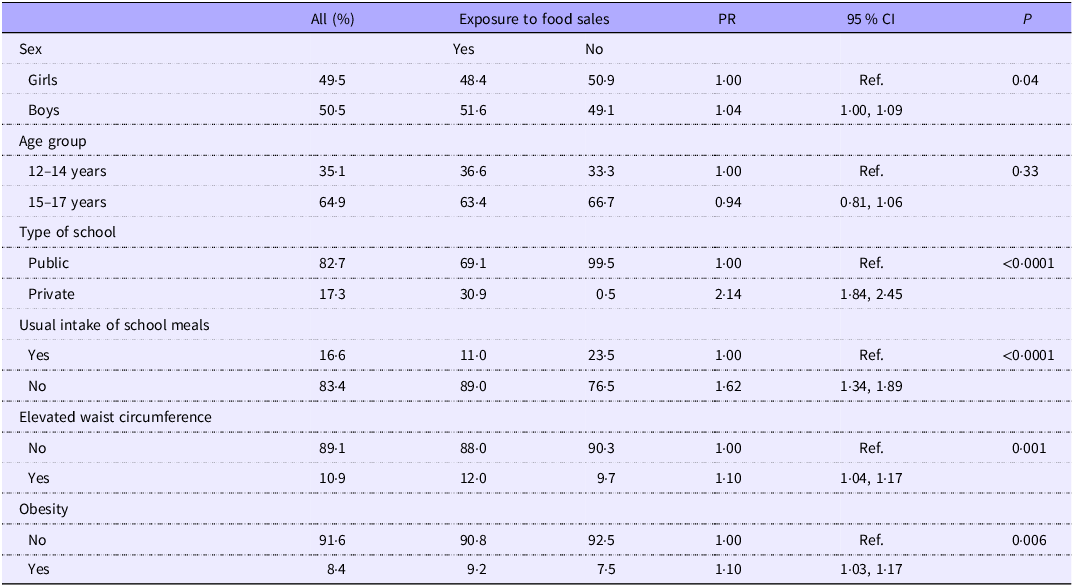
Overall, 55·2 % of adolescents were exposed to food sales. Prevalence was higher among male adolescents, those enrolled in private schools, those who reported usual intake of school meals, those who had elevated waist circumference and those who had obesity (Table 1).
Frequency (%), prevalence ratio (PR) and 95 % CI for demographic characteristics according to exposure to food sales in schools. ERICA study, Brazil, 2013–2014

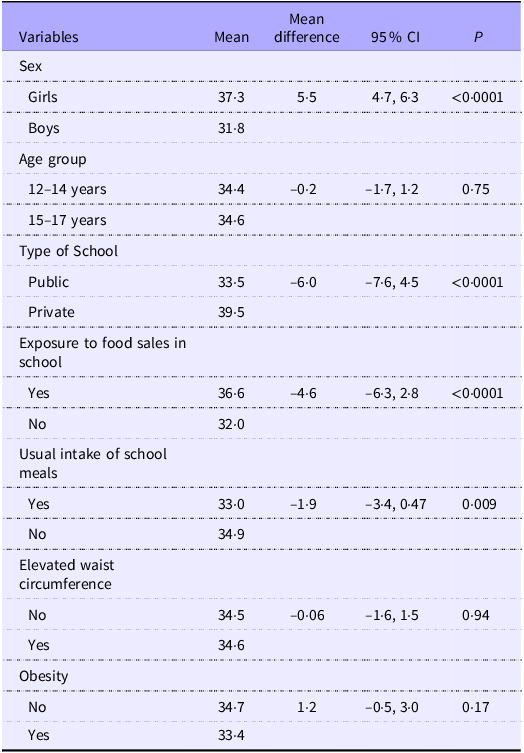
The mean dietary share of ultra-processed foods was 34·5 %. The intake of ultra-processed foods was higher among female adolescents, those enrolled in private schools and those who reported an unusual intake of school meals (Table 2).
Mean, mean difference and 95 % CI of dietary share of ultra-processed foods (% of total energy) by study sample characteristics. ERICA study, Brazil, 2013–2014

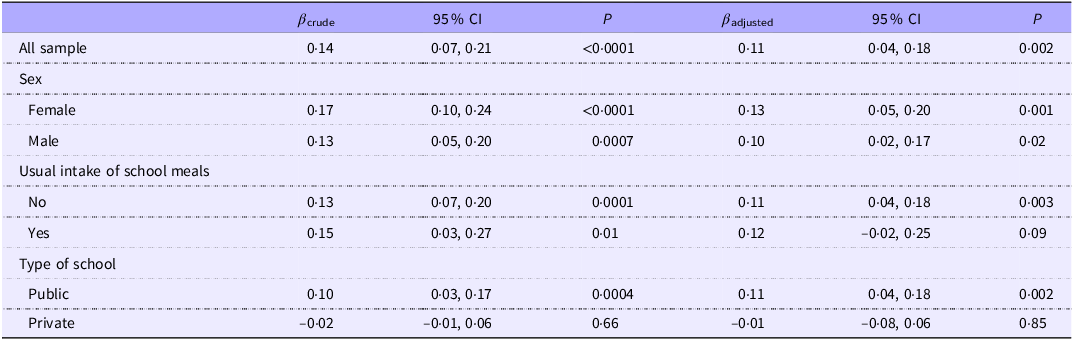
Simple and multiple linear regression models were used to assess the association between food sales in schools and dietary share of ultra-processed foods (Table 3). Exposure to food sales in schools was associated with higher consumption of ultra-processed food (β = 0·14; P < 0·0001). The association remained significant after adjusting for age, sex, school type, elevated waist circumference, presence of obesity and total energy intake (β = 0·11; P = 0·002). Similar results were obtained when the analyses were stratified according to sex and school meal intake. However, exposure to food sales in schools was associated with higher consumption of ultra-processed food only among public school students (β = 0·11; P = 0·002). A negative but non-significant association was found among private school students (β = –0·01; P = 0·85).
Crude and adjusted * regression model coefficients (β) and 95 % CI on the association of exposure to food sales in school with the dietary share of ultra-processed foods (% of total energy) among Brazilian adolescents according to sex, usual consumption of school meals and type of school. ERICA study, Brazil, 2013–2014

* Sex, age, school type, usual school meal intake and total energy intake.
Discussion
The present study demonstrated that Brazilian adolescents have a high intake of ultra-processed foods, accounting for more than one-third of their total daily energy intake. This pattern was particularly evident among female students, those attending private schools and adolescents who did not regularly consume the school meals provided by the public education system. More than half of the schools reported food sales, with private institutions showing the highest frequency of sales. Food sales within schools were associated with a higher consumption of ultra-processed foods. This association persisted after adjustment, although it was statistically significant only in public schools. These findings highlight the influence of the school environment on the dietary quality of adolescents.
The proportion of energy from ultra-processed foods observed in our sample (34·5 %) was higher than that reported in the Brazilian Household Budget Survey 2017–2018, in which these products represented 26·5 % of the total energy intake among adolescents. Data from the National School Health Survey (PeNSE-2015) also indicated a regular and elevated consumption of unhealthy foods, with 40 % of students reporting daily intake of at least one ultra-processed product. This high level of consumption directly contradicts the recommendations of the Brazilian Dietary Guidelines, which advise avoiding consumption of such products. The consistency of our results with findings from national surveys reinforces the importance of this issue and its potential public health implications(17,21,Reference Costa, Flores and Wendt22) .
A comparative analysis of the school systems revealed notable contrasts. While the provision of school meals is nearly universal in public schools supported by the Brazilian National School Feeding Program (PNAE), only a fraction of private schools offer this service. In contrast, commercial cafeterias and vending facilities are more common in private institutions, contributing to a more obesogenic food environment. Previous studies using ERICA data confirmed this trend. Carmo et al. (2018) found that in private schools, food and beverage sales were more prevalent (97·8 % v. 45·1 %, P < 0·001), as well as the presence of vending machines (14·4 % v. 5·5 %, P < 0·001). This disparity reveals a paradox: although private school students generally have higher socio-economic status, they are more exposed to school environments that promote unhealthy dietary patterns(Reference Carmo, Assis and Cunha6,7,18) .
Consistent with our findings, other studies have also shown that school environments can contribute to excess weight among children and adolescents. Villalobos et al. (2019) assessed the nutritional status and dietary habits of students from public schools in La Unión de Cartago, Costa Rica, and reported that foods sold within and around schools were energy-dense and of low nutritional value, with 35 % of students classified as overweight(Reference Villalobos Leal, Villalobos Alfaro and Martínez Izaguirre23).
With respect to the availability of ultra-processed foods in schools, our results are consistent with those of Barrios Gayoso et al., Saavedra-Garcia et al., and Foo and Tan. In schools in Tobatí, Paraguay, Barrios Gayoso et al. (2023) found that although most cafeterias (81·8 %) offered seasonal fruits, more than half did not provide healthy meals. The commercialisation of ultra-processed foods was predominant, with savoury snacks and various types of industrialised sweets available in all cafeterias assessed. Similarly, Saavedra-Garcia et al. (2020) analysed public and private institutions in Metropolitan Lima, Peru, and reported that ultra-processed foods were sold in all schools surveyed, most frequently cookies, cakes, candies, sugary drinks and other energy-dense items. Comparable results were obtained by Foo and Tan (2021), who evaluated canteens in primary and secondary schools in Kelantan, Malaysia. The authors identified similar patterns across school levels, with foods rich in fats and sugars (23·4 % and 24·1 %, respectively) and sugar-sweetened beverages (24·9 % and 21·3 %) among the most common items, while fruits and vegetables (3·2 % and 1·0 %) and legume-based products (0·8 % and 1·9 %) were the least frequently offered(Reference Barrios Gayoso, Páez Gómez and Burgos Larroza24–Reference Foo and Tan26).
The strengths of our study include the ERICA study’s national scope and representativeness, and the possibility of assessing the effect of food sales and food consumption in schools on adolescents’ overall diet.
The limitations of this study include the use of a single 24HR, which may not represent the students’ usual nutritional intake, and the fact that the 24HR depends on the individual’s memory, having to recall, define and quantify their food intake on the day before the interview. In addition, accurate intake may have been omitted due to underreporting. However, one day of consumption provides good estimates of the average population food intake, and 24HR has the advantages of low cost, rapid and user-friendly application in the field, and absence of interference in eating habits, since the individual reports after food intake itself. The multiple-pass method(Reference Conway, Ingwersen and Vinyard14) was used to reduce underreporting of food consumption due to recall errors.
Final remarks
Exposure to food sales in schools and the lack of school meals can influence adolescents’ food choices. The presence of school canteens promoting such sales, especially for ultra-processed foods, reinforces and encourages their consumption and contributes to unhealthy eating habits. This scenario highlights the importance of food and nutritional education programmes, as well as federal regulation of food sales in schools, in protecting children and adolescents from the harmful effects of excessive consumption of ultra-processed food.
Acknowledgements
This study was supported by FAPERJ – Fundação Carlos Chagas Filho de Amparo à Pesquisa do Estado do Rio de Janeiro – under the grant number E-26/211.692/2021.
The funders had no role in the study design, data collection and analysis, decision to publish or manuscript preparation.
The authors declare no conflicts of interest.
B. C. C. A.: conceptualisation, formal analysis, investigation, methodology and writing – original draft preparation. T. R. G.: project administration, validation, visualisation, writing, review and editing. A. M. S.: conceptualisation, formal analysis, data curation, methodology and supervision.