Introduction
A fundamental challenge for all organizations that engage in innovation is how to allocate resources across competitive project proposals (Boudreau, Guinan, Lakhani, & Riedl, Reference Boudreau, Guinan, Lakhani and Riedl2016). Public or private fund managers usually invite domain experts to evaluate the potential of innovation projects and allocate resources on the basis of the evaluation. Prior studies have investigated how innovation funding decisions are influenced by the quality of innovations (Chan, Li, & Zhu, Reference Chan, Li and Zhu2018), the innovators who pitch the idea (Lu, Bartol, Venkataramani, Zheng, & Liu, Reference Lu, Bartol, Venkataramani, Zheng and Liu2019), the evaluators who make the decisions (Mueller, Melwani, Loewenstein, & Deal, Reference Mueller, Melwani, Loewenstein and Deal2018; Polidoro, Reference Polidoro2020), or the similarity/distance between innovators and decision-makers (Boudreau et al., Reference Boudreau, Guinan, Lakhani and Riedl2016; Lo & Li, Reference Lo and Li2018; Shen, Kim, & Li, Reference Shen, Kim and Li2022).
A growing body of research highlights the role of narrative signals in these decisions. Since Martens, Jennings, and Jennings’s (Reference Martens, Jennings and Jennings2007) pioneering work on storytelling in resource acquisition, studies have identified how linguistic elements, such as concrete terminology (Pan, McNamara, Lee, Haleblian, & Devers, Reference Pan, McNamara, Lee, Haleblian and Devers2018) and emotional tone (Moradi, Dass, Arnett, & Badrinarayanan, Reference Moradi, Dass, Arnett and Badrinarayanan2024), influence funding outcomes. Framing strategies, including disruptive vision (van Balen, Tarakci, & Sood, Reference van Balen, Tarakci and Sood2019), novelty-familiarity balance (Pan, Li, Chen, & Chen, Reference Pan, Li, Chen and Chen2020), and pro-social emphasis (Defazio, Franzoni, & Rossi-Lamastra, Reference Defazio, Franzoni and Rossi-Lamastra2021; Nielsen & Binder, Reference Nielsen and Binder2021), further shape stakeholder perceptions.
Despite this progress, temporal focus as a costly signal of learning capacity remains underexplored. Temporal focus – the cognitive emphasis on the past, present, or future – has been recognized as a stable individual trait (Briker, Walter, & Cole, Reference Briker, Walter and Cole2020; DesJardine & Shi, Reference DesJardine and Shi2021; Zimbardo & Boyd, Reference Zimbardo and Boyd1999) that shapes strategic decisions such as mergers (DesJardine & Shi, Reference DesJardine and Shi2021) and R&D investments (Nadkarni & Chen, Reference Nadkarni and Chen2014). Past temporal focus requires innovators to invest effort in articulating lessons from prior experiences, making it a costly yet credible indicator of learning capacity (Bettinazzi & Zollo, Reference Bettinazzi and Zollo2022; Gamache & McNamara, Reference Gamache and McNamara2019). For example, proposals that emphasize past failures signal adaptability but are often overshadowed by future-oriented pitches, underscoring the tension between costly credibility and strategic visibility.
Our research framework integrates the emphasis in signaling theory on credibility and visibility (Connelly, Certo, Reutzel, DesJardine, & Zhou, Reference Connelly, Certo, Reutzel, DesJardine and Zhou2025) with gender expectations. Signals must be not only credible (i.e., costly from senders) but also visible (i.e., salient to receivers) (Bafera & Kleinert, Reference Bafera and Kleinert2023; Connelly et al., Reference Connelly, Certo, Reutzel, DesJardine and Zhou2025; Dobrev & Verhaal, Reference Dobrev and Verhaal2024; Plummer, Allison, & Connelly, Reference Plummer, Allison and Connelly2016). Research has also demonstrated that the gender of senders (Lee, Koval, & Lee, Reference Lee, Koval and Lee2023) and receivers (Inesi & Cable, Reference Inesi and Cable2015) influences signaling effectiveness differently. Although Park et al. (Reference Park, Schwartz, Sap, Kern, Weingarten, Eichstaedt, Berger, Stillwell, Kosinski, Ungar and Seligman2017) confirmed that women generally focus more on the past, the signal credibility and visibility of past temporal focus for different genders have been underexamined. This study combines the literature on signaling theory and gender expectations to explore gender differences in the perception of past temporal focus from both the sender (i.e., innovation presenter) and the receiver (i.e., evaluator) in the competition for innovation funding.
Our study utilizes a unique dataset from Inno Fund Beijing to examine the signaling role of learning capacity in relation to past temporal focus and further explores the contingent effects of signal credibility and visibility. On the basis of 5,085 evaluator‒project dyads and high-dimensional fixed-effect models, we find that innovation projects that provide detailed information about past experiences are more likely to receive favorable evaluations. Consistent with predictions of signal credibility and visibility, female-dominated presenting teams that emphasize past actions receive higher evaluations, and female evaluators tend to give higher ratings to innovations with a past-focused narrative.
This study makes three key theoretical contributions. First, we clarify the strategic value of past temporal focus in innovation contexts by demonstrating its role as a credible signal of learning capacity, countering prior associations with rigidity or negative psychological outcomes (Holman & Silver, Reference Holman and Silver1998; Shipp, Reference Shipp and Grouzet2020). Given the belief that the past is a rich source of knowledge and experience that can be appropriated and recycled (Bettinazzi & Zollo, Reference Bettinazzi and Zollo2022; Gamache & McNamara, Reference Gamache and McNamara2019), our surprising yet reasonable findings of the positive signaling effects of past temporal focus in innovation funding deepen the understanding of past focus literature. Second, we extend signaling theory by identifying gender differences in the signaling effects of temporal focus: female-led teams gain credibility when they emphasize past experiences, whereas female evaluators exhibit heightened visibility to such signals – a dual dynamic that aligns with ‘signal fit’ principles (Colombo, Reference Colombo2021; Connelly, Certo, Ireland, & Reutzel, Reference Connelly, Certo, Ireland and Reutzel2011). Our research emphasizes the importance of signal credibility and visibility as boundary conditions to enhance signal effectiveness (Bafera & Kleinert, Reference Bafera and Kleinert2023; Dobrev & Verhaal, Reference Dobrev and Verhaal2024; Plummer et al., Reference Plummer, Allison and Connelly2016). Third, our post hoc analyses reveal that past focus loses persuasiveness in long-term-oriented cultures, advancing signal necessity frameworks (Connelly et al., Reference Connelly, Certo, Reutzel, DesJardine and Zhou2025; Zhang, Shi, & Connelly, Reference Zhang, Shi and Connelly2024). Collectively, we systematize Connelly et al.’s (Reference Connelly, Certo, Reutzel, DesJardine and Zhou2025) call to explore the boundary conditions of signaling relationships through credibility, visibility, and necessity, which bridges the literature on temporal focus, gender expectations, and cultural cognition.
Literature Review
Temporal Focus
Prior research supports the idea that temporal focus is a stable cognitive trait among individuals (Briker et al., Reference Briker, Walter and Cole2020; DesJardine & Shi, Reference DesJardine and Shi2021; Zimbardo & Boyd, Reference Zimbardo and Boyd1999). Once formed, an individual’s temporal focus becomes a significant cognitive characteristic (Briker et al., Reference Briker, Walter and Cole2020), even though ‘people are rarely aware of its subtle operation, influence, or biasing powers’ (Zimbardo & Boyd, Reference Zimbardo and Boyd1999: 1272). Previous scholars have established that past, present, and future foci are theoretically distinct (DesJardine & Shi, Reference DesJardine and Shi2021; Gamache & McNamara, Reference Gamache and McNamara2019; Nadkarni & Chen, Reference Nadkarni and Chen2014). A weak focus in one temporal profile does not necessarily mean a strong focus in another. Following this trend, we view them as separate dimensions rather than points on a continuum. The literature has shown that the behavioral consequences of individuals’ present and future temporal focus differ fundamentally from the consequences of individuals’ past temporal focus (Briker et al., Reference Briker, Walter and Cole2020; Nadkarni & Chen, Reference Nadkarni and Chen2014; Shipp & Aeon, Reference Shipp and Aeon2019). For example, individuals with strong preferences for the past tend to learn and reflect from experience, whereas neither present nor future temporal focus has been empirically linked with these learning and reflecting tendencies (Bettinazzi & Zollo, Reference Bettinazzi and Zollo2022; Gamache & McNamara, Reference Gamache and McNamara2019).
The Role of Temporal-Related Signals in Funding Decisions
Time, as both an objective measure (sequencing) and a subjective experience (temporal focus or orientation), plays a critical role in shaping decision-making processes in innovation and venture funding. For example, Criscuolo, Dahlander, Grohsjean, and Salter (Reference Criscuolo, Dahlander, Grohsjean and Salter2021) highlighted the influence of temporal sequences on funding decisions and revealed that prior positive funding decisions negatively impact subsequent R&D project selection. In addition, Bian, Greenberg, Li, and Wang (Reference Bian, Greenberg, Li and Wang2022) identified a position effect in funding decisions where initial proposals are evaluated less favorably despite their superior performance metrics.
Scholars are increasingly interested in exploring the impacts of temporal focus (past, present, future) or orientation (long-term vs. short-term) on funding decisions. Gleasure (Reference Gleasure2024) claimed that future-oriented appeals are more effective than past-oriented appeals in crowdfunding as they elicit more positive emotions in donors. However, some scholars argued that an excessive focus on future plans can be perceived as ‘cheap talk’ that lacks substance and credibility (Colombo, Reference Colombo2021; Di Pietro, Grilli & Masciarelli, Reference Di Pietro, Grilli and Masciarelli2023). These scholars suggest that statements about past achievements serve as costly signals that increase crowdfunding success, whereas future plans, as costless signals, are less effective (Colombo, Reference Colombo2021; Di Pietro et al. Reference Di Pietro, Grilli and Masciarelli2023). More recent studies, such as Kleinert (Reference Kleinert2024), proposed an inverted U-shaped relationship between future-focused ambition and crowdfunding performance, indicating that moderate future orientation may be optimal. These inconsistent findings require a deeper understanding of the signaling role of temporal focus.
With respect to the signaling role of long-term orientation, scholars have focused on its positive impacts on funding decisions. Ye, O’Brien, Carnes, and Hasan (Reference Ye, O’Brien, Carnes and Hasan2021) found that bondholders prefer firms with a long-term orientation, which aligns with their interest in long-term value creation through enhanced R&D investments. Similarly, Huang, Joshi, Wakslak, and Wu (Reference Huang, Joshi, Wakslak and Wu2021) argued that a long-term orientation and a propensity for large-scale growth are less likely to be screened out during the investment process.
Theoretical Background and Hypotheses Development
Past Temporal Focus as a Costly Signal of Learning Capacity
The past serves as a repository of concrete facts and causally linked experiences (Suddaby, Foster, & Quinn Trank, Reference Suddaby, Foster, Quinn Trank, Joel and Lampel2010) that enables individuals to construct cognitive frameworks to guide future actions (Alipour, Mohammed, & Martinez, Reference Alipour, Mohammed and Martinez2017). Innovators with a strong past temporal focus act as ‘mental archivists’ who systematically analyze historical successes and failures to inform present decisions (Mohammed & Harrison, Reference Mohammed and Harrison2013; Nadkarni & Chen, Reference Nadkarni and Chen2014). Crucially, this focus functions as a costly signal in signaling theory (Connelly et al., Reference Connelly, Certo, Ireland and Reutzel2011): deep reflection on the past demands time and cognitive effort, making it a credible indicator of an individual’s learning capacity – a trait critical for innovation success. Learning capacity, in turn, drives competitive advantage by enabling the absorption of cutting-edge knowledge, identification of technological opportunities, avoidance of resource waste, and mitigation of legitimacy deficits (Cohen & Levinthal, Reference Cohen and Levinthal1990).
First, reflecting on the past can help in acquiring, assimilating, transforming, and exploiting knowledge, which can lead to organizational innovations (Chen, Lin, & Chang, Reference Chen, Lin and Chang2009). The literature shows that tacit knowledge, in particular, can be valued, acquired, assimilated, and applied by learning from past experiences (Robertson, Casali, & Jacobson, Reference Robertson, Casali and Jacobson2012). Since innovation is inherently fraught with uncertainty, leveraging knowledge and experience from the past can shape future directions and foster sustainable competitive advantages (Gamache & McNamara, Reference Gamache and McNamara2019; Karniol & Ross, Reference Karniol and Ross1996; Stein & Levine, Reference Stein, Levine, Snow and Farr1987).
Second, focusing on prior experience helps in identifying technological opportunities and enhances firms’ ability to appropriate them (Cohen & Levinthal, Reference Cohen and Levinthal1990). Individuals with a strong past temporal focus often recall past episodes and contemplate how or why the events occurred (Karniol & Ross, Reference Karniol and Ross1996). They value history and tradition and appreciate past successes. This deep thinking contributes to a deeper understanding of the technological context, better learning of cutting-edge technologies, and faster detection of innovation opportunities (Nadkarni & Chen, Reference Nadkarni and Chen2014). Therefore, a strong past temporal focus can help innovators better understand the technological landscape and enable quicker identification of innovation opportunities and areas for application (Chen & Nadkarni, Reference Chen and Nadkarni2017).
Third, highly past-focused individuals continue to employ strategies that have proven effective by spending significant time vividly remembering and analysing past experiences, emotions, and decisions (Briker et al., Reference Briker, Walter and Cole2020; Holman & Silver, Reference Holman and Silver1998). They appreciate established routines and rely heavily on traditional, well-known approaches to accomplish tasks (Cohen & Levinthal, Reference Cohen and Levinthal1990). Focusing on the past helps them avoid neglecting effective strategies and procedures or wasting resources by ‘reinventing the wheel’ (Briker et al., Reference Briker, Walter and Cole2020).
Finally, a strong past temporal focus mitigates legitimacy concerns for innovations as learning from the past indicates that the innovation trajectory is grounded (Gleasure, Reference Gleasure2024; Suddaby et al., Reference Suddaby, Foster, Quinn Trank, Joel and Lampel2010). Focusing on past actions can enhance learning by enabling an analysis of these actions for relevant lessons (Shipp, Edwards, & Lambert, Reference Shipp, Edwards and Lambert2009). This approach suggests that innovation explorations are built upon previous trials and errors, thereby weakening legitimacy concerns.
Learning capacity is recognized in strategic management as a primary source of competitive advantage and a key driver of innovation success (Chang & Cho, Reference Chang and Cho2008). Learning from past experiences enables the valuation, acquisition, assimilation, and application of tacit and explicit knowledge (Robertson et al., Reference Robertson, Casali and Jacobson2012). Numerous studies show that individual learning capacity contributes to innovation performance. For example, prior research has shown that learning from both success and failure increases the likelihood of repeat innovative efforts (Deichmann & van den Ende, Reference Deichmann and van den Ende2014). Individuals with a learning mindset perform better on similar tasks in the future than do those without such a mindset (Jordan & Audia, Reference Jordan and Audia2012). Nadkarni, Chen, and Chen (Reference Nadkarni, Chen and Chen2016) emphasized that CEOs who are devoted to past events may not have had more valuable experiences, but this cognitive orientation enables them to leverage their experiences effectively by rethinking important past situations to benefit future outcomes.
By arguing that past temporal focus is a costly signal of learning capacity, we posit that innovators who emphasize past reflection signal their ability to leverage experiences effectively (Nadkarni et al., Reference Nadkarni, Chen and Chen2016). Thus, we hypothesize the following:
Hypothesis 1 (H1): An innovator’s past temporal focus is positively related to innovation evaluation.
The Moderating Role of Signal Credibility: Gender Composition in Innovation Presenting Teams
Signaling theory emphasizes the credibility of signals by describing the concept of ‘signal fit’ and explains that signals that are incongruent with established expectations are likely to be disregarded or rejected (Colombo, Reference Colombo2021; Connelly et al., Reference Connelly, Certo, Ireland and Reutzel2011; Di Pietro et al., Reference Di Pietro, Grilli and Masciarelli2023). In the entrepreneurship context, signal credibility determines how investors process information from male and female entrepreneurs (Kanze, Huang, Conley, & Higgins, Reference Kanze, Huang, Conley and Higgins2018; Lee & Huang, Reference Lee and Huang2018). For example, due to concerns about the credibility of female entrepreneurs’ values or capabilities (Eddleston, Ladge, Mitteness, & Balachandra, Reference Eddleston, Ladge, Mitteness and Balachandra2016; Kanze et al., Reference Kanze, Huang, Conley and Higgins2018), investors tend to ask male entrepreneurs promotion-focused questions and female entrepreneurs prevention-focused questions. Recent studies, such as one by Eddleston et al. (Reference Eddleston, Ladge, Mitteness and Balachandra2016), show that signaling effectiveness is moderated by credibility due to gender. Notably, signals of venture characteristics from male entrepreneurs generally attract more funding than those from female entrepreneurs. Drawing on these insights, this article posits that the effectiveness of signaling about past temporal focus is contingent upon signal credibility, which varies due to the gender composition of the innovation presenting team.
We contend that having women on innovation presenting teams increases the team’s credibility in demonstrating learning capacity, particularly when the focus is past events. In turn, this influences investors’ funding decisions and aligns with the ‘signal fit’ perspective. Compared to men, women are often perceived as having superior self-regulation skills (Vohs & Schmeichel, Reference Vohs and Schmeichel2003), which allow them to learn and adapt from past experiences. They are more likely to be regarded as backward-looking rather than forward-looking (McClean, Kim, & Martinez, Reference McClean, Kim and Martinez2022; Park et al., Reference Park, Schwartz, Sap, Kern, Weingarten, Eichstaedt, Berger, Stillwell, Kosinski, Ungar and Seligman2017). Through reflective thinking, women are better able to absorb cutting-edge knowledge, identify new technological opportunities, avoid resource waste and compensate for a lack of legitimacy. Therefore, women’s self-regulatory and reflective abilities contribute to a credible demonstration of learning from past events (Gwyther & Holland, Reference Gwyther and Holland2012).
Investors often look for teams that demonstrate learning capacity that is not solely instrumental but is consistent and reliable (Dobrev & Verhaal, Reference Dobrev and Verhaal2024). Owing to their inclination towards a non-instrumental emphasis on a past focus, female-dominated innovation presenting teams are more likely to meet these expectations. This alignment increases the perceived credibility of past temporal focus and makes investors more likely to fund a project (Kleinert, Reference Kleinert2024). Based on arguments above, we propose the following:
Hypothesis 2 (H2): The gender composition of innovation presenting teams moderates the positive relationship between past temporal focus and innovation evaluation; specifically, this relationship is strengthened for female-dominated innovation presenting teams.
The Moderating Role of Signal Visibility: The Evaluator’s Gender
Scholars have shown that male and female decision-makers differ in their perceptions of business opportunities (Botelho & Gertsberg, Reference Botelho and Gertsberg2022; Lee & Huang, Reference Lee and Huang2018). For example, Engel, Lewis, Cardon, and Hentschel (Reference Engel, Lewis, Cardon and Hentschel2023) reported that women, but not men, are sensitive to information about organizational gender composition. The signal visibility literature argues that a signal can be effective only when it is viable for the receivers (Dobrev & Verhaal, Reference Dobrev and Verhaal2024; Eddleston et al., Reference Eddleston, Ladge, Mitteness and Balachandra2016). Additionally, extensive research has revealed persistent differences in the way people think about and value time (Karniol & Ross, Reference Karniol and Ross1996; Mohammed & Harrison, Reference Mohammed and Harrison2013; Nadkarni & Chen, Reference Nadkarni and Chen2014). Therefore, we argue that evaluators of different genders may perceive the past temporal focus differently, which further influences their decisions about funding innovation projects.
As mentioned previously, women tend to exhibit more reflective thinking than their male counterparts do (Gwyther & Holland, Reference Gwyther and Holland2012; McClean et al., Reference McClean, Kim and Martinez2022). Consequently, female evaluators are more likely to rely on past experiences than future projections to inform decision-making processes (Park et al., Reference Park, Schwartz, Sap, Kern, Weingarten, Eichstaedt, Berger, Stillwell, Kosinski, Ungar and Seligman2017). They particularly appreciate innovation projects that learn from and reflect on past routines and actions. Innovation presenters who emphasize past experiences demonstrate a strong understanding of the technological landscape (Chen & Nadkarni, Reference Chen and Nadkarni2017; Nadkarni et al., Reference Nadkarni, Chen and Chen2016). Relying on proven methods or routines from the past promotes greater reliability and reduces significant delays and setbacks in innovation implementation (Katila, Reference Katila2002; Nadkarni & Chen, Reference Nadkarni and Chen2014). Female evaluators, who are more sensitive to these past-focused signals, perceive such innovation projects as more viable, which accelerates trust formation. We propose the following:
Hypothesis 3 (H3): The gender of evaluators moderates the positive relationship between past temporal focus and innovation evaluation; specifically, this relationship is strengthened for female evaluators.
Methods
Samples
The Inno Fund Beijing, which was established to provide seed funding for innovative technology, was utilized in 2017 to test our hypotheses. The choice of this year was inevitable as it was the only year with video recordings of the presentations, which allowed us to analyze the temporal focus in the presenters’ language during the evaluation process. This fund supports startups that were founded within the past five years, making it an ideal context to study how these programs allocate resources to experimental and high-growth innovation projects. Out of 1574 applications in 2017, a total of 271 received the same amount of funding – 400 thousand RMB – indicating a success rate of approximately 17.21%. The evaluation process involved panels of five randomly selected evaluators who assessed the projects in terms of three aspects: team, technology, and business model. Each innovation team gave an 8-minute presentation followed by a Q&A session. Funding results were determined by the average score rank from the five professional evaluators. The number of presenters in our sample varied from one to four. After missing data were excluded, the final analysis included 5085 observations across 1017 projects, with each project undergoing five evaluations. These evaluations were conducted by 67 panels comprising 271 evaluators.
Dependent Variable
Innovation evaluation
Each innovation project was randomly assigned to an evaluation panel. The evaluators independently assessed the potential of these ideas from their professional perspective. Theoretically, the evaluations ranged from 0 to 100.
Independent Variable
Temporal focus
Research has suggested that executives’ language use can reflect their cognitive characteristics (DesJardine & Shi, Reference DesJardine and Shi2021; Gamache & McNamara, Reference Gamache and McNamara2019). Thus, we analyzed the language used by innovation presenters during the presentation phase to measure their temporal focus. Consistent with Nadkarni and Chen (Reference Nadkarni and Chen2014), we used the Linguistic Inquiry and Word Count (LIWC) text analysis software and employed its three dictionaries designed to analyze temporal focus. The LIWC 2022 software provides separate dictionaries to measure an individual’s past focus, present focus, and future focus. Given the strong validity and reliability of the LIWC dictionaries, they are increasingly used in strategy studies (Pan et al., Reference Pan, McNamara, Lee, Haleblian and Devers2018; Shi, Zhang, & Hoskisson, Reference Shi, Zhang and Hoskisson2019). Specifically, we measured the temporal focus by calculating the percentages of words related to the past, present, and future in the total word count of the presenter’s speech. Each temporal dimension was standardized, with higher scores indicating greater emphasis on that time frame.
Moderators
Female-dominated team
An innovation team was classified as female dominated and coded as ‘1’ if the ratio of female presenters was 0.5 or higher. Teams with a ratio less than 0.5 were considered male-dominated and coded as ‘0’.
Female evaluator
The female evaluator variable was coded as ‘1’ if the focal expert was female and ‘0’ if the focal expert was male.
Control Variables
Following prior studies (Boudreau et al., Reference Boudreau, Guinan, Lakhani and Riedl2016; Lo & Li, Reference Lo and Li2018), we controlled for the potential effects of firm-, project-, presentation-, and evaluator-level characteristics on innovation evaluation. At the applicant firm level, we controlled for the firm age (years since founding), number of employees (logged), revenue (logged, for the year before the application), number of applied patents, award (whether a focal firm had obtained award(s) from a national entrepreneurship competition), certification of high-tech enterprise (whether a focal firm was certified as a high-tech enterprise), external investment received (whether a focal firm had received investment(s) from a third party(ies) prior to the application), founder’s gender (‘1’ if female, and ‘0’ otherwise), age (years since birth), and education level (master’s degree and doctorate, using bachelor’s degree as the baseline).
At the project level, we controlled for R&D scale, which was measured by the logged total estimated R&D expenditure for each project. We also controlled for R&D progress, which was calculated as the ratio of the already spent R&D expenditure to the total estimated R&D expenditure at the time of application. The projects were divided into three categories based on the stage of development: the developing, prototyping, and manufacturing phases. Using the developing phase as the base group, we created two dichotomous variables: the prototyping phase (‘1’ if yes and ‘0’ otherwise) and the manufacturing phase (‘1’ if yes and ‘0’ otherwise). Certification of new technology/product was coded ‘1’ if a focal project had received certification for the new technology, product, or service from the Beijing City government. International standard was coded ‘1’ if a project was developed in accordance with international standards and ‘0’ otherwise. A project’s core technologies may have come from independent development or cooperative development (with other institutions). Using cooperative development as the base group, we created a dichotomous variable of independent tech development (‘1’ if yes and ‘0’ otherwise).
At the presentation level, we controlled for presenter number, which ranged from one to four. Duration of presentation was the time length (unit: minutes) for each project presentation. Duration ratio of women’s presentation was calculated as the duration of female presentation divided by the total duration of presentation. For the Q&A sessions, we controlled for the number of questions (how many questions were raised by the evaluators) and the ratio of female evaluators’ questions (the proportion of questions asked by female evaluator(s)). Communication was coded ‘1’ if the evaluators discussed the focal project after its Q&A session and 0 otherwise.
At the evaluator level, we controlled for evaluator elite identity, which was coded ‘1’ if the evaluator graduated from Tsinghua University, Peking University, or the Chinese Academy of Science and ‘0’ otherwise (Armanios, Eesley, Li, & Eisenhardt, Reference Armanios, Eesley, Li and Eisenhardt2017). To account for the possible impact of an evaluator’s background, we created a dichotomous variable, tech background, which was coded ‘1’ if an evaluator had a technology background and ‘0’ otherwise. We also controlled for an evaluator’s average evaluation excluding focal project, which was measured by the mean of the evaluations that a focal evaluator gave to other projects excluding the focal project that s/he evaluated. The inclusion of this variable allowed us to consider potential differences in evaluations among evaluators.
Analysis Strategy
We controlled for industry fixed effects and panel fixed effects to account for possible evaluation differences among industries and evaluating panels. Since the Beijing City government may allocate funding quotas across its 16 districts (e.g., Haidian, Chaoyang, Changping), district fixed effects were also included. All continuous variables were winsorized at the 1% level at both ends to avoid the influences of outliers.
Since the unit of analysis was the evaluator‒project dyad and the five rating scores for the same applicant may not be independent of each other, we opted for a robust cluster variance estimator to account for possible intracluster (within-project) correlations (Lo & Li, Reference Lo and Li2018). Specifically, we clustered observations within multiple groups (evaluator and project) in the same model using the Stata command reghdfe (Correia, Reference Correia2014). The mean VIF of the full model was 2.19, indicating that multicollinearity was not a major concern in our models.
Results
Table 1 presents the descriptive statistics and correlations for the variables. The average innovation evaluation score is 68.50 (out of 100). Innovation evaluation shows a positive correlation with past temporal focus (r = 0.09, p < 0.01) but has no significant correlation with future (r = 0.00, n.s.) or present focus (r = −0.01, n.s.), giving preliminary support for our hypotheses. Past temporal focus is found to be positively correlated with both future (r = 0.10, p < 0.001) and present focus (r = 0.30, p < 0.001), consistent with prior seminal work on temporal focus (Shipp et al., Reference Shipp, Edwards and Lambert2009). One possible explanation is that reflecting on the past can provide a foundation for setting future goals, and past experiences often shape how individuals perceive and interact with their current experiences (Blagoev, Hernes, Kunisch, & Schultz, Reference Blagoev, Hernes, Kunisch and Schultz2024; Shipp et al., Reference Shipp, Edwards and Lambert2009). Female-dominated teams constitute about 10%, and female evaluators about 25%, confirming that women are underrepresented in the technology innovation field.
Means, standard deviations, and correlations of the variablesa

a Notes: N = 5,085 evaluator‒project dyads.
† p < 0.1, * p < 0.05, ** p < 0.01, *** p < 0.001.
Table 2 reports the results of the testing of our hypotheses. Model 1, the baseline model, includes all control variables. At the applicant firm level, number of employees (β = 0.63, p < 0.1), revenue (β = 0.28, p < 0.01), number of applied patents (β = 0.43, p < 0.01), award (β = 1.73, p < 0.01), external investment received (β = 2.95, p < 0.01), master’s degree of founder (β = 0.81, p < 0.05) and doctorate degree of founder (β = 2.35, p < 0.01) are positively related to innovation evaluation, as expected. Moreover, firm age (β = −0.68, p < 0.01) is negatively related to innovation evaluation, consistent with the mandate of the Inno Fund Beijing Program in funding young innovation projects. Moreover, founder female (β = −1.34, p < 0.01) is negatively related to innovation evaluation, consistent with expectations.
The impact of past temporal focus on innovation evaluation

* Notes: p < 0.1, ** p < 0.05, *** p < 0.01. Standard errors are in parentheses, clustered at the project and evaluator level. Panel fixed effects are nested within industry fixed effects.
At the project level, R&D progress (β = 2.63, p < 0.05) is positively related to innovation evaluation, as expected. At the presentation level, both duration of presentation (β = 0.46, p < 0.01) and number of questions (β = 0.27, p < 0.01) enhance innovation evaluation. At the evaluator level, tech background (β = 0.37, p < 0.01) and evaluator’s average evaluation excluding focal project (β = 0.89, p < 0.01) positively influence innovation evaluation, whereas evaluator elite identity (β = −0.11, p < 0.05) negatively impacts the evaluation of innovation.
Model 2 adds the main effects of past temporal focus, while controlling for future and present temporal focus. The coefficient for past temporal focus (β = 0.86, p < 0.01) is positive and significant whereas the coefficients for future temporal focus (β = 0.09, n.s.) and present temporal focus (β = −0.20, n.s.) are not significant. These results indicate that innovations that emphasize past achievements generally receive higher ratings than those that focus on future plans or current activities. Therefore, H1 is supported.
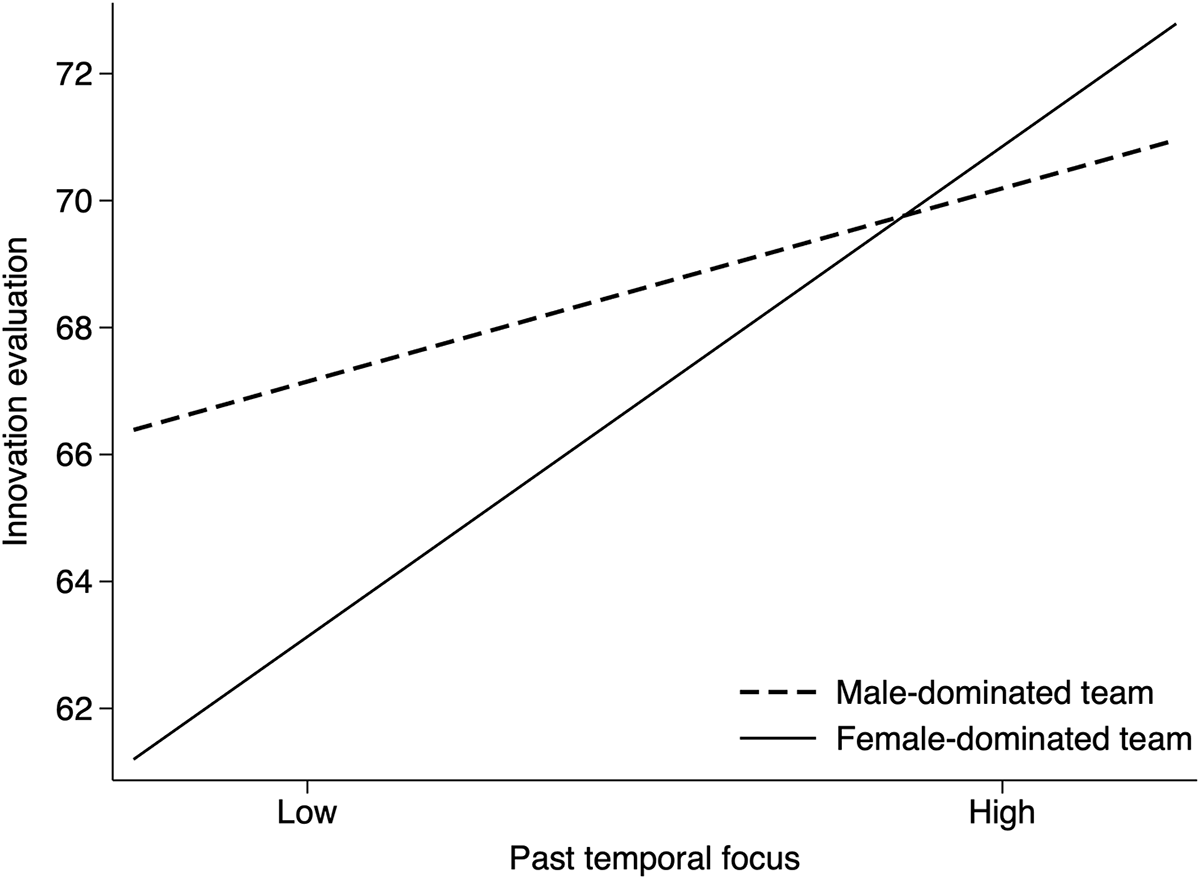
Model 3 includes the interaction term between past temporal focus and female-dominated team. The coefficient for the interaction term is positive and significant (β = 1.17, p < 0.1), consistent with H2. Figure 1 illustrates these interaction effects and shows a significantly steeper slope for innovation evaluation with a past temporal focus in female-dominated teams than in male-dominated teams. Thus, H2 is supported.
Moderating effects of gender composition on innovation teams

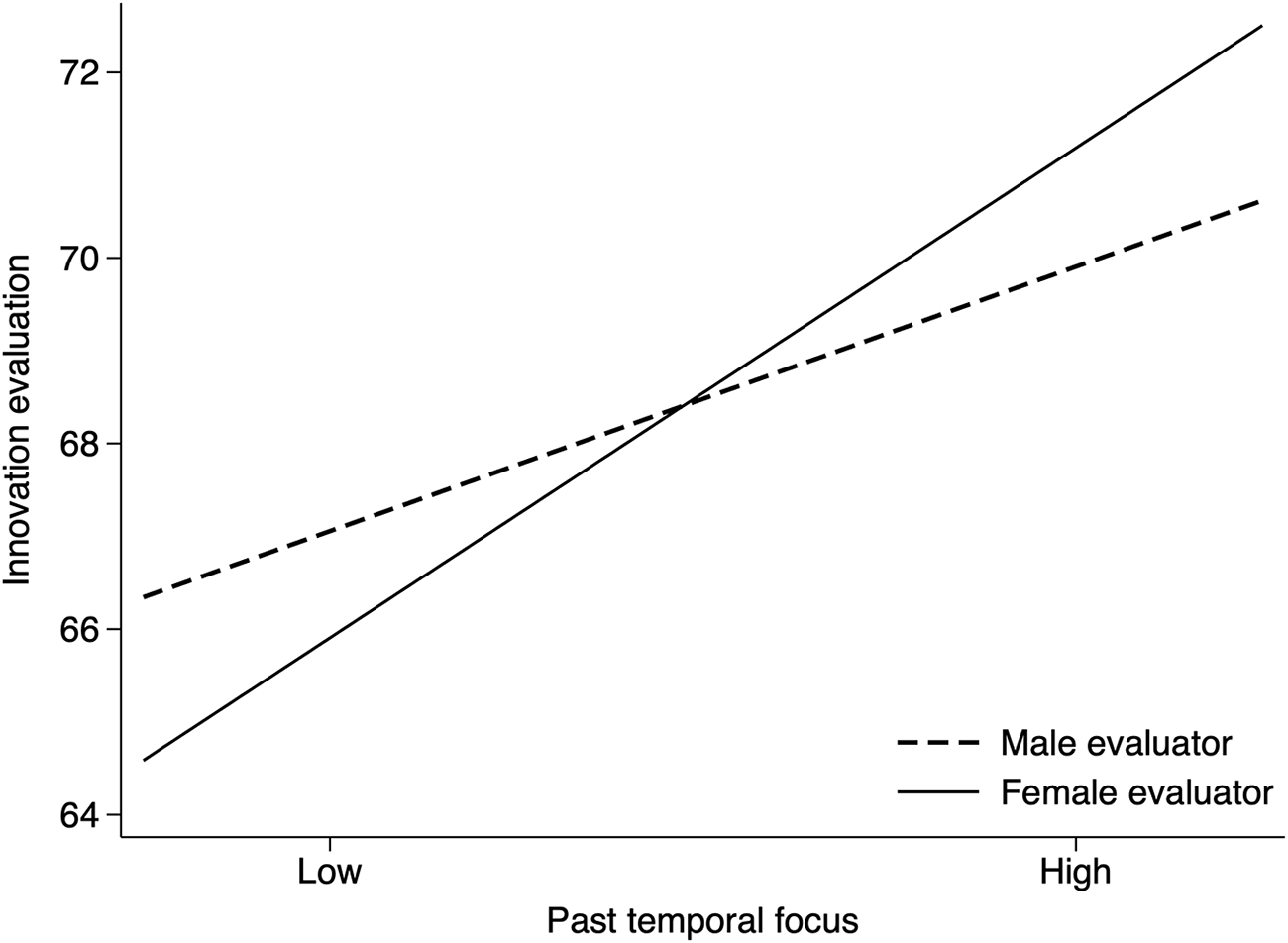
Model 4 includes the interaction term between past temporal focus and female evaluator. The coefficient for the interaction term is positive and significant (β = 0.61, p < 0.05). To illustrate the interaction effects, Figure 2 was plotted. The slope for innovation evaluation related to past temporal focus is much steeper when evaluated by women than when evaluated by men. Thus, H3 is supported.
Moderating effects of evaluator gender

Post-Hoc Analyses and Robustness Checks
Cultural Differences in Perceiving Past Temporal Focus
We conducted a post hoc analysis to investigate whether the signal effectiveness of past temporal focus varies across different cultures or institutions. Research shows that Chinese people pay more attention to past information than Westerners do (Ji, Guo, Zhang, & Messervey, Reference Ji, Guo, Zhang and Messervey2009) and are more likely to have a long-term orientation (Hofstede, Reference Hofstede2011). Prior literature on signal necessity shows that the screen of ‘quality shareholder’ industry holdings is less useful in hot markets but is particularly valuable in cold markets as market heat can substitute for the value of an informative screen. Following the logic of signal necessity (Connelly et al., Reference Connelly, Certo, Reutzel, DesJardine and Zhou2025; Zhang et al., Reference Zhang, Shi and Connelly2024), we suggest that a past temporal focus is less persuasive in cultures that encourage a long-term orientation and is more persuasive in cultures that are tolerant of a short-term orientation. This is because long-term oriented cultures see reflecting and learning from the past as necessary. To examine cultural differences in the perception of past temporal focus, we focus on the moderating role of evaluators’ long-term orientation, which was measured in three ways based on the frequency of words related to long-term and short-term horizons in the questions (Shi et al., Reference Shi, Zhang and Hoskisson2019):
 \begin{equation}Long-term{\text{ }}orientation = \left( {Long-Short} \right)\end{equation}
 \begin{equation}Long-term{\text{ }}orientation = {{\left( {Long-Short} \right)} \mathord{\left/
{\vphantom {{\left( {Long-Short} \right)} {\left( {Long + Short + 0.001} \right)}}} \right.
} {\left( {Long + Short + 0.001} \right)}}\end{equation}
 \begin{equation}Long-term{\text{ }}orientation = {{\left( {Long-Short} \right)} \mathord{\left/
{\vphantom {{\left( {Long-Short} \right)} {\left( {Long + Short} \right)}}} \right.
} {\left( {Long + Short} \right)}}\end{equation}
In Formula (1), Long is the standardized percentage of words related to the long time horizon and Short is the standardized percentage of words related to the short time horizon. In Formula (2), Long is the percentage of words related to the long time horizon and Short is the percentage of words related to the short time horizon. A value of 0.001 is added to the denominator to prevent empty sets. In Formula (3), Long is the percentage of words related to a long time horizon and Short is the percentage of words related to a short time horizon. Formula (3) can result in missing values for long-term orientation if the denominator is zero. The dictionary of keywords was adapted from DesJardine and Bansal (Reference DesJardine and Bansal2019) and translated into Chinese. The regression results are reported in Table 3.
The contingency role of long-term orientation in the relationship between past temporal focus and innovation evaluation

* Notes: p < 0.1, ** p < 0.05, *** p < 0.01. Standard errors are in parentheses, clustered at the project and evaluator level. Panel fixed effects are nested within industry fixed effects. aFive singleton observations are dropped. bBecause the denominator of the long-term orientation (measurement 3) is 0, 2020 observations are dropped.
In Model 1, the coefficient for the interaction between past temporal focus and long-term orientation ( Formula 1) is significantly negative (β = −0.21, p < 0.1), indicating that past temporal focus is less effective in convincing evaluators who are long-term oriented. In Model 2, the negative and significant coefficient for the interaction between past temporal focus and long-term orientation ( Formula 2) (β = −0.48, p < 0.1) shows that evaluators who are long-term oriented are less receptive to the past-focused language used by innovators. Model 3 reveals similar findings (β = −0.50, p < 0.1). Overall, the post hoc analyses resonate with the signal necessity perspective and suggest that a past temporal focus may be less persuasive for evaluators in cultures that emphasize long-term orientation.
Measuring Temporal Focus Using the Word2Vec Algorithm
With advances in machine learning techniques, it has become feasible to calculate innovators’ temporal focus according to the word’s semantic meaning. We employed the Word2Vec algorithm, as described by Mikolov, Chen, Corrado, and Dean (Reference Mikolov, Chen, Corrado and Dean2013), to calculate the similarity of each word to a past, future, or present temporal focus. This algorithm is distinguished by its computational efficiency and its capacity to produce high-quality word embeddings. A word is deemed similar to the pre-established temporal focus dictionary in LIWC when its cosine similarity score exceeds the threshold of 0.8 (Corsini, Pezzoni, & Visentin, Reference Corsini, Pezzoni and Visentin2022). All models were rerun using these alternative measurements of temporal focus. The results are reported in Models 1–3 in Table 4.
Robustness checks of the impact of past temporal focus on innovation evaluation

* Notes: p < 0.1, ** p < 0.05, *** p < 0.01. Standard errors are in parentheses, clustered at the project and evaluator level. Panel fixed effects are nested within industry fixed effects.
In Model 1, the coefficient for past temporal focus is positive and significant (β = 0.99, p < 0.01), suggesting that innovation projects that are described with a past-oriented narrative receive higher evaluations of their potential. In addition, the coefficients for future temporal focus (β = 0.01, n.s.) and present temporal focus (β = −0.22, n.s.) are not significant. Model 2 reveals that the interaction effect between past temporal focus and female-dominated team is also significantly positive (β = 1.00, p < 0.1), indicating that a past temporal focus is more effective for convincing evaluators in female-dominated teams than male-dominated teams. Additionally, in Model 3, the positive and significant coefficient for the interaction between past temporal focus and female evaluator (β = 0.72, p < 0.05) shows that female evaluators are more receptive to past-focused language used by innovators. Overall, our hypotheses are supported.
Including the Q&A Session
As previously mentioned, we measured temporal focus by analyzing all words spoken by innovators during their 8-minute presentations in our main analyses. To validate this, we included words from the Q&A sessions in the robustness check. According to Models 4–6 in Table 4, the results are significant: Model 4 shows a coefficient of 0.80 (p < 0.01) for past temporal focus; Model 5 reveals a coefficient of 1.15 (p < 0.1) for the interaction between past temporal focus and female-dominated team; and Model 6 displays a coefficient of 0.51 (p < 0.1) for the interaction between past temporal focus and female evaluator. These findings support H1, H2, and H3.
Endogeneity Concerns
To further mitigate potential endogeneity concerns, we used a nearest-neighbor matching technique for one-to-one propensity score matching (PSM) to balance the treatment and control samples. Using the median value of past temporal focus as a cut-off, we matched high past-focused innovations with low past-focused innovations. The covariates used for PSM analyses included firm age, number of employees, revenue, number of applied patents, award, certification of high-tech enterprise, and external investment received. The matched sample consisted of 3,835 observations. The balance test results show that the standard bias of each variable between the treatment and control groups is far less than 10%, suggesting acceptable matching results. According to Models 7 to 9 in Table 4, the results are robust: Model 7 shows a coefficient of 0.92 (p < 0.01) for past temporal focus; Model 8 reveals a coefficient of 1.73 (p < 0.05) for the interaction between past temporal focus and female-dominated team; and Model 9 displays a coefficient of 1.01 (p < 0.01) for the interaction between past temporal focus and female evaluator. These findings support H1, H2, and H3.
Discussion
Assessing the potential of innovation is highly challenging for early-stage resource providers, who are usually interacting for the first time before a trust-based relationship has developed (Kleinert, Reference Kleinert2024). Drawing on studies that show that a past focus is linked to learning and reflecting tendencies (Bettinazzi & Zollo, Reference Bettinazzi and Zollo2022; Gamache & McNamara, Reference Gamache and McNamara2019), we assert that learning capacity emerges as a potent mechanism for signaling a past focus, whereas a present or future focus does not. Specifically, our findings indicate that innovation projects that present detailed information about past experiences are more likely to receive favorable evaluations. Notably, narratives about future plans or current activities for innovation projects are generally not considered effective in contributing to funding decisions. Additionally, in accordance with the signal credibility and visibility literature (Bafera & Kleinert, Reference Bafera and Kleinert2023; Connelly et al., Reference Connelly, Certo, Reutzel, DesJardine and Zhou2025; Dobrev & Verhaal, Reference Dobrev and Verhaal2024), our research suggests that female-dominated presenting teams that emphasize past actions receive higher evaluations and that female evaluators are more reactive to past-related signals, leading to higher evaluations of innovations with a past-focused narrative.
Theoretical Contributions
Our study contributes to the literature in several ways. First, we contribute to the temporal focus literature by examining the role of past temporal focus, which is traditionally viewed negatively, in signaling unobservable learning capacity and its effectiveness in securing innovation funding. Innovation funding is crucial for the progression and success of new ventures. Securing this funding often hinges on the perceived potential and capabilities of the innovators. One interesting dimension that influences these perceptions is temporal focus, which reflects the extent to which individuals emphasize the past, present, or future (Nadkarni & Chen, Reference Nadkarni and Chen2014). The perception and salience of past, present, and future experiences have been demonstrated to affect risk taking, career adaptability, and professional achievement (Levasseur, Shipp, Fried, Rousseau, & Zimbardo, Reference Levasseur, Shipp, Fried, Rousseau and Zimbardo2020). Prior literature offers a predominantly negative view of past temporal focus and suggests that individuals who emphasize the past may become ‘psychologically locked’ or ‘stuck in the past’ (Holman & Silver, Reference Holman and Silver1998; Rabinovich & Morton, Reference Rabinovich and Morton2012). This fixation can lead to adverse outcomes such as neuroticism, anxiety, negative affect, and reduced well-being (Levasseur et al., Reference Levasseur, Shipp, Fried, Rousseau and Zimbardo2020; Shipp, Reference Shipp and Grouzet2020; Shipp & Aeon, Reference Shipp and Aeon2019). Contrary to these prevailing psychological arguments, we suggest that the past is viewed as a rich repository of knowledge and experience that innovators can appropriate and recycle (Bettinazzi & Zollo, Reference Bettinazzi and Zollo2022; Gamache & McNamara, Reference Gamache and McNamara2019). By reflecting on past experiences, individuals can derive valuable insights that contribute to obtaining cutting-edge knowledge, identifying new technological opportunities, avoiding resource waste, and compensating for a lack of legitimacy. Our evidence that a past temporal focus can serve as a signal of an innovator’s learning capacity and improve innovation funding evaluation broadens the horizons of the literature.
Second, this article contributes to the literature on signaling theory and gender expectations by systematically examining gender differences in the signaling effects of temporal focus. Our findings highlight the importance of considering gender dynamics in the study of signaling and suggest that aligning the signal with the receiver’s expectations can enhance its effectiveness. Gender expectations theory suggests that individuals are rewarded for behaviors that align with societal expectations for their gender (Eddleston et al., Reference Eddleston, Ladge, Mitteness and Balachandra2016; Kanze, Huang, Conley, & Higgins, Reference Kanze, Huang, Conley and Higgins2018). Prior literature indicates that women often exhibit superior self-regulation skills and a greater focus on past precedents (McClean et al., Reference McClean, Kim and Martinez2022; Park et al., Reference Park, Schwartz, Sap, Kern, Weingarten, Eichstaedt, Berger, Stillwell, Kosinski, Ungar and Seligman2017). Our analysis further reveals that female-dominated innovation presenting teams that emphasize past experiences tend to receive more favorable evaluations. In addition, female evaluators are more likely to be persuaded by a focus on past accomplishments. Female senders who emphasize past precedents are better received by female receivers, indicating a ‘signal fit’ that enhances the perceived credibility and visibility of the message (Bafera & Kleinert, Reference Bafera and Kleinert2023; Dobrev & Verhaal, Reference Dobrev and Verhaal2024; Plummer et al., Reference Plummer, Allison and Connelly2016). These insights contribute to a broader understanding of how gender expectations shape the dynamics of signaling in professional settings.
Third, our post hoc analyses responds to a call from Connelly et al. (Reference Connelly, Certo, Reutzel, DesJardine and Zhou2025) to explore the boundary conditions of signaling relationships by leveraging the principles of necessity, credibility and the salience framework (Connelly et al., Reference Connelly, Certo, Reutzel, DesJardine and Zhou2025; Zhang et al., Reference Zhang, Shi and Connelly2024). Research by Hofstede (Reference Hofstede2011) suggests that cultures such as China have a predominant long-term orientation that affects how individuals perceive time in communication. This study extends this understanding by integrating gender and cultural differences into the interpretation of past temporal focus. The findings reveal that a past temporal focus is more persuasive for enhancing innovation evaluation in cultures with a short-term orientation. In contrast, long-term-oriented cultures, such as China, exhibit a less favorable response to a past temporal focus since they consider it necessary to reflect on and learn from the past. This research contributes to the understanding of how cultural factors influence the persuasiveness of temporal focus in communication (Ji et al., Reference Ji, Guo, Zhang and Messervey2009). Identifying the cultural boundary conditions of signaling relationships offers insights to enhance communication strategies across different cultural contexts.
Managerial Implications
For innovators, our study provides recommendations on which narratives are more or less likely to influence the evaluation of innovation. We do not imply that the use of one type of narrative over another – such as a past temporal focus instead of a future or present temporal focus – will determine funding decisions. However, we believe that innovators should be aware of the benefits of signaling learning capacity through a past focus and the risks of overusing certain narratives (i.e., future and present focus). Our findings also provide specific guidelines tailored to the gender of both innovators and evaluators. For example, female innovators may benefit from emphasizing reflective learning during their presentations to increase their chances of securing financial support. Similarly, female evaluators tend to be more responsive to cues related to past experiences when assessing the potential of innovation projects.
The findings of our study are valuable for policymakers and government fund managers. Our analysis clearly shows that government funding is not suitable for all innovation projects. Innovators who cannot provide evidence of their learning capacity are likely not the best candidates for this type of financing even if they have radical innovations and speak of ‘a future revolution’ (Di Pietro et al., Reference Di Pietro, Grilli and Masciarelli2023). These ventures might benefit more from alternative funding sources such as venture capital or angel investing, which are typically more risk-tolerant and focused on strategic plans rather than past experiences.
Limitations and Future Research
Our research is not without limitations. First, while the real-world setting and quasi experimental design provided a valuable empirical opportunity to examine innovators’ use of and evaluators’ responses towards past temporal focus, it may involve selection bias given that the Inno Fund Beijing data were recorded and accessed only in 2017. Despite the importance of China in the area of innovation funding, focusing on a single country does not allow us to capture cultural differences related to the use of temporal focus in innovation competition. Analyzing data from different years or linguistic contexts, if available, could help to verify the applicability of our findings.
Second, it remains important to explore how different types of temporal focus can optimally influence decision-making. In our study, we examined the individual impact of a past temporal focus, specifically its signaling effects on learning capacity. Although we tested various configurations of temporal foci, we found no significant effects. Scholars who study temporality continue to emphasize that the past and future are interconnected through ongoing present activities, described as ‘a chordal triad’ of past, present, and future (Rindova & Martins, Reference Rindova and Martins2022). Therefore, it is necessary to explore how different kinds of temporal focus collectively influence decision making, including innovation funding decisions.
Third, future research can formulate an integrated temporal framework that enhances the understanding of how temporality influences funding decisions in innovation competitions. Past or future orientation is only one facet of temporal perceptions (Ancona, Goodman, Lawrence, & Tushman, Reference Ancona, Goodman, Lawrence and Tushman2001). Various temporal constructs, such as temporal depth (Nadkarni et al., Reference Nadkarni, Chen and Chen2016), temporal distance (Nadkarni, Pan, & Chen, Reference Nadkarni, Pan and Chen2019), and strategic rhythms (Zhang, Priem, Wang, & Li, Reference Zhang, Priem, Wang and Li2023), have received significant scholarly attention as management tools to sustain competitive advantages or implement strategic activities. Consequently, temporality emerges as a complex, multifaceted construct that exerts subtle yet profound impacts on funding decisions. An integrated and coherent framework that elucidates how various dimensions of temporality are signaled and interpreted is needed, particularly in the context of innovation funding.
Conclusion
This research underscores the importance of a past temporal focus to signal learning capacity in innovation funding. Our findings indicate that innovation projects that present detailed information about past experiences are more likely to receive favorable evaluations. Drawing on signaling theory and the gender expectations literature, our study further shows that female-dominated presenting teams that emphasize the past are deemed more credible. Additionally, female evaluators tend to give higher evaluations to innovations with a past-focused narrative as these signals are more visible to them. By providing empirical support for the effectiveness of past-focused signals and the contingent role of signal credibility and visibility, our research contributes to a deeper understanding of temporal focus and signal effectiveness.
Data availability statement
Data are available on request from the authors.
Acknowledgements
We want to express sincere gratitude to our editor and the three anonymous reviewers for their valuable and constructive feedback on this paper. This research was supported by the National Natural Science Foundation of China (Grant No. 72302021, 72473142).
Lun Li (lilun@bnu.edu.cn) is an assistant professor at the Business School, Beijing Normal University. His research focuses on technological innovation & entrepreneurship, and strategic management. He earned his PhD from the Department of Innovation, Entrepreneurship, and Strategy at Tsinghua University. His research has been published in journals, such as the Journal of Organization Design and Chinese Management Studies, and nine of his papers have been accepted by the Academy of Management (AOM).
Xi Xi (xix@ruc.edu.cn) is a postdoctoral researcher at the School of Information, Renmin University of China. Her research focuses on technological innovation, tech-mining, and business intelligence. Her research has been published in journals such as Journal of Product Innovation Management, Technological Forecasting & Social Change, Information & Management, among others.
Xiwei Yi (yixiwei@gsm.pku.edu.cn) is an associate professor at Guanghua School of Management, Peking University. Her research interests focus on digital transformation, health care industry and hospitals, E-government, new ventures and entrepreneurship, and the internationalization of emerging market firms. Her research has been published in top journals such as Academy of Management Journal, Strategic Management Journal, Journal of Management Studies, Management and Organization Review, Academy of Management Perspectives, among others.
Jizhen Li (lijzh@sem.tsinghua.edu.cn) is a professor at the School of Economics and Management, Tsinghua University. His research area includes digital transformation and innovation, management of technological innovation, science & technology policy, and SMEs innovation and entrepreneurship. His research has been published in top journals such as Administrative Science Quarterly, Management Science, Strategic Management Journal, Journal of Management, Research Policy, among others.
Xue Liu (liuxuejoyce@163.com) has a master’s degree from The London School of Economics and Political Science. Her research interests include technological innovation and strategic management.