The Antarctic toothfish (Dissostichus mawsoni Norman) has been considered an occasional large prey item of the Weddell seal (Leptonychotes weddellii Lesson) (Kooyman Reference Kooyman1967, Calhaem & Christoffel Reference Calhaem and Christoffel1969, Testa et al. Reference Testa, Siniff, Ross, Winter, Siegfried, Condy and Laws1985, Castellini et al. Reference Castellini, Davis and Kooyman1992, Davis et al. Reference Davis, Fuiman, Williams, Collier, Hagey, Kanatous, Kohin and Horning1999, Fuiman et al. Reference Fuiman, Davis and Williams2002). The seal's most common prey is the Antarctic silverfish (Pleuragramma antarcticum Boulenger) as well as benthic and sub-ice fish, cephalopods, and crustaceans (Dearborn Reference Dearborn1965, Green & Burton Reference Green and Burton1987, Plotz Reference Plotz1987, Plotz et al. Reference Plotz, Ekau and Reijnders1991, Castellini et al. Reference Castellini, Davis and Kooyman1992, Burns et al. Reference Burns, Trumble, Castellini and Testa1998).
Here we report observations of Weddell seals frequently feeding on Antarctic toothfish in McMurdo Sound, Antarctica. During the springs and summers of 2001, 2003, and 2004, sea ice camps with experimental dive holes were located on the sea ice of McMurdo Sound, at 77°52.680′S, 166°51.480′E (January 2001), and 77°42.858′S, 166°06.483′E (November 2003, 2004). Depths at these sites were > 300 m. The 2001 camp was located c. 15–20 km from the ice edge. In 2003, the Ross Sea ice edge was less than 10 km from the camp. In 2004, the ice edge, near Beaufort Island, was > 50 km from the camp. Sea ice thickness at each camp was c. 2 m.
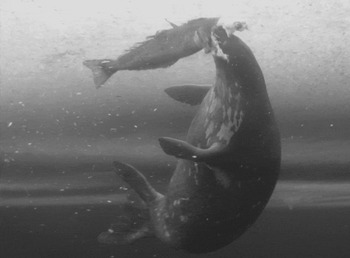
In January, 2001, at least ten toothfish were brought to the surface by Weddell seals over an 11-day period. Nine seals utilized this breathing hole, but we do not know if captures were limited to specific seals. In November 2003, one Weddell seal was observed to consume at least four toothfish over a three day period. These observations were aided by the sub-ice observation chamber as the fish were eaten underwater, and were not always brought up to the surface of the dive hole (Fig. 1). More extensive observations at the surface and from the sub-ice chamber in October–November 2004 confirmed that at least 28 fish were captured over a 37-day period by three Weddell seals visiting the dive hole. On one occasion, a seal was observed to begin eating a second toothfish within an hour after consuming another. During one evening, a seal cached up to three toothfish in the dive hole (Fig. 2).
Weddell seal feeding upon Antarctic toothfish underwater (2004).

Weddell seal and two cached Antarctic toothfish in dive hole (2004).

These observations extend prior reports of Weddell seals feeding upon the Antarctic toothfish at experimental dive holes in McMurdo Sound (Kooyman Reference Kooyman1967, Calhaem & Christoffel Reference Calhaem and Christoffel1969, Castellini et al. Reference Castellini, Davis and Kooyman1992, Davis et al. Reference Davis, Fuiman, Williams, Collier, Hagey, Kanatous, Kohin and Horning1999), and confirm a report of Weddell seals possibly caching prey beneath the ice (Kim et al. Reference Kim, Conlan, Malone and Lewis2005). The incidence of capture may be underestimated by the nature of our opportunistic observations, and by the fact that such activity often occurs below the ice with the fish not being brought to the surface. Indeed, the use of the sub-ice observation chamber in 2003 and 2004 was essential to many of our observations. In addition, time of year and the location and water depth of experimental dive holes may also contribute to differences in the feeding behaviours of seals at different sites (Testa et al. Reference Testa, Siniff, Ross, Winter, Siegfried, Condy and Laws1985). The toothfish is generally associated with depths > 300 m (Eastman Reference Eastman1993). However, encounters with toothfish on 14 dives of instrumented Weddell seals occurred at a mean depth of 132 ± 87 m (Fuiman et al. Reference Fuiman, Davis and Williams2002). In 2003–04, toothfish distribution may also have been affected by exceptionally thick (> 3 m), multiyear ice in most of McMurdo Sound.
The frequency of toothfish capture is potentially difficult to determine from scat and even stomach samples because Weddell seals are reported to rarely eat the bony parts of the toothfish, (Ainley Reference Ainley2004). Frequent captures of toothfish by Weddell seals are demonstrated by our observation of a second toothfish capture within an hour after the seal consumed the first fish, and the capture of four toothfish in five hours reported by Calhaem & Christoffel (Reference Calhaem and Christoffel1969) who estimated that one Weddell seal repeatedly captured 150–200 lb of toothfish per night over a two week period. However, the vast majority of prey items of Weddell seals instrumented with video cameras were the Antarctic silverfish (Davis et al. Reference Davis, Fuiman, Williams, Collier, Hagey, Kanatous, Kohin and Horning1999, Fuiman et al. Reference Fuiman, Davis and Williams2002). It may be that toothfish are captured by specialists, namely, older, larger and more experienced seals. Possible differences in foraging ecology between female and male adult Weddell seals, and among different age groups have been suggested by differences in stable isotope signatures (Burns et al. Reference Burns, Trumble, Castellini and Testa1998, Zhao et al. Reference Zhao, Castellini, Mau and Trumble2004).
We conclude that Antarctic toothfish may be an important component of the Weddell seal diet. Further examination of this hypothesis is warranted given the introduction and expansion of a Ross Sea fishery (CCAMLR 2005) for the slow growing Antarctic toothfish (Eastman Reference Eastman1993, Horn Reference Horn2002). In CCAMLR Subarea 88.1, which includes the Victoria Land coastal waters of the Ross Sea, more than 99% of the 2004–05 reported catch of Dissostichus spp. was the Antarctic toothfish, D. mawsoni (CCAMLR 2005). With an annual legal limit of 3250 metric tons in Sub-area 88.1 in 2005 (CCAMLR 2005) and unknown illegal takes, the impact of such fishing extends beyond that of fish stocks alone. In order to determine the effects of the toothfish fishery on the entire Ross Sea ecosystem, trophic models (Ainley Reference Ainley2004, Pinkerton et al. Reference Pinkerton, Hanchet, Bradford-Grieve and Wilson2005) should include toothfish-apex predator interactions. Two top predators that may be affected include the type C killer whale (Orcinus orca L.) (Pittman & Ensor Reference Pittman and Ensor2003), and the Weddell seal. Further investigations of these predators' diets are warranted (i.e. fatty acid signature analyses (Budge et al. Reference Budge, Iverson and Koopman2006), and in Weddell seals, remote video monitoring of feeding behaviour).
Acknowledgements
Supported by OPP grants 9814794 and 0229638. We thank E. Stockard for the photo in Fig. 2, R.P. van Dam, M. Bustamante, J. Heil, K. Sato, Y. Habara, K.V. Ponganis, E. Stockard, J.U. Meir, T. Zenteno-Savin, and J. St. Leger for assistance in the field, J.T. Eastman for confirmation of fish identification, and G.L. Kooyman for manuscript review.