Introduction
Obstructive sleep disordered breathing (SDB) includes a range of respiratory disturbances from primary snoring to frank obstructive sleep apnea (OSA), all related to increased upper airway resistance or obstruction during sleep. Accounts from the public press and expectations among parents and clinicians suggest that childhood SDB is associated with neuropsychological and behavioral deficits, especially hyperactivity, inattention, impaired memory, and learning deficits (Beebe, Reference Beebe2006; Hodges, Bloomfield, Coulas, & Giordani, Reference Hodges, Bloomfield, Coulas and Giordani2008). On the other hand, a recent, comprehensive review of research on cognitive and behavioral difficulties in children with SDB pointed out that parents most frequently associate mood disorders in their children (e.g., depression) to SDB, in contrast to the usually held expectations that hyperactivity and inattention are the most prevalent concomitants of SDB (Kohler, Lushington, & Kennedy, Reference Kohler, Lushington and Kennedy2010). This same review also noted, however, that the most common findings from direct cognitive testing of children with SDB are impairment in attention (71% of studies reviewed) and verbal intelligence (40%), with impairments in executive functioning also evident, along with less common deficits in memory, visual-spatial ability, language skills, academic achievement, and sensorimotor functions.
The most common treatment for SDB is adenotonsillectomy (AT; Marcus & Loughlin, Reference Marcus and Loughlin1996). It is now performed at academic centers more often for SDB than for recurrent pharyngitis (Weatherly, Mai, Ruzicka, & Chervin, Reference Weatherly, Mai, Ruzicka and Chervin2003). Therefore, children scheduled for AT may be ideal for study of SDB-related morbidities and their amelioration (Hodges et al., Reference Hodges, Bloomfield, Coulas and Giordani2008). Nevertheless, few studies have completed rigorous investigations of post-surgical neurocognitive outcomes (Kohler et al., Reference Kohler, Lushington and Kennedy2010). Following AT, SDB resolves in a majority of cases, and gains in some cognitive and behavior scores are consistently reported (c.f., Hodges et al., Reference Hodges, Bloomfield, Coulas and Giordani2008), including relatively robust IQ, school performance, attention, visual spatial skills, and spatial ability improvements (Ali, Pitson, & Stradling, 1996; Friedman et al., Reference Friedman, Hendeles-Amitai, Kosminsky, Lieberman, Friger and Tarasiuk2003; Galland, Dawes, Tripp, & Taylor, Reference Galland, Dawes, Tripp and Taylor2006; Gozal, Reference Gozal1998; Hansen & Vandenberg, Reference Hansen and Vandenberg2001; Hogan, Hill, Harrison, & Kirkham, Reference Hogan, Hill, Harrison and Kirkham2008; Li, Huang, Chen, Fang, & Lee, Reference Li, Huang, Chen, Fang and Lee2006; Lundeborg, McAllister, Samuelsson, Ericsson, & Hultcrantz, Reference Lundeborg, McAllister, Samuelsson, Ericsson and Hultcrantz2009; Owens, Spirito, Marcotte, McGuinn, & Berkelhammer, Reference Owens, Spirito, Marcotte, McGuinn and Berkelhammer2000). However, some investigators have seen persistent deficits or further declines across several other cognitive areas (Friedman et al., Reference Friedman, Hendeles-Amitai, Kosminsky, Lieberman, Friger and Tarasiuk2003; Hogan et al., Reference Hogan, Hill, Harrison and Kirkham2008; Kohler et al., Reference Kohler, Lushington, van den Heuvel, Martin, Pamula and Kennedy2009; Lundeborg et al., Reference Lundeborg, McAllister, Samuelsson, Ericsson and Hultcrantz2009; Montgomery-Downs, Crabtree, & Gozal, Reference Montgomery-Downs, Crabtree and Gozal2005; Richards & Ferdman, Reference Richards and Ferdman2000).
The recent review by Kohler and colleagues (2010) suggests that the above noted variability in findings relates to a series of issues, including frequent usage of small sample sizes, restricted range of cognitive domains assessed, reliance often solely on parental report, lack of pre- and post-surgery polysomnographic assessment, and failure to longitudinally test controls to account for learning and developmental changes. Of the 30 studies they reviewed that investigated changes in neurocognitive performance following treatment for SDB in children, they reported that only two sets of studies met the minimum, basic criteria they recommended: reasonable subject numbers, pre- and post-AT testing of controls, polysomnography confirmation of SDB status, and use of comprehensive cognitive testing. The first was a study of 44 healthy, snoring children scheduled for AT and 48 healthy, non-snoring controls between the ages of 3.0–12.9 years of age (Kohler et al., Reference Kohler, Lushington, van den Heuvel, Martin, Pamula and Kennedy2009). Intellectual and cognitive testing was completed approximately 1 week before and 6 months following AT, with controls tested at similar intervals. The primary finding was that although children with SDB showed significantly improved sleep and breathing 6 months after AT, there was no improvement relative to the control group in any cognitive domain.
The second set of studies that met “criteria” emerged from the Washtenaw County Adenotonsillectomy Cohort I, as originally described by Chervin and colleagues (2006): 78 children aged 5 to 12 and scheduled for AT (with and without polysomnographically confirmed OSA) were compared to 27 unrelated surgical controls before and 1 year after AT. Evaluations included comprehensive medical, psychiatric, and neuropsychological assessments. Chervin and colleagues (2006) found significant baseline differences between children undergoing AT with OSA and children undergoing AT without OSA, on the apnea/hypopnea index (AHI) and the Multiple Sleep Latency Test (MSLT) and showed that these differences resolved 1 year following surgery. All children with AT improved significantly on a cognitive attention index and on a behavioral hyperactivity index at 1 year. Comprehensive psychiatric examinations demonstrated that initially significant differences in frequencies of attention and disruptive behavior disorders between AT and control subjects resolved at 1 year (Dillon et al., Reference Dillon, Blunden, Ruzicka, Guire, Champine, Weatherly and Chervin2007).
A comprehensive review of the neuropsychological and parent behavioral report measures from Cohort I at baseline found that both groups of children with AT scored lower than controls on aspects of visual spatial problem solving and on measures of visual delayed recall and arithmetic academic achievement (Giordani et al., Reference Giordani, Hodges, Guire, Ruzicka, Dillon, Weatherly and Chervin2008). Counter intuitively, however, children without polysomnographically confirmed OSA (AT/OSA-), and not the children with confirmed OSA (AT/OSA+), also scored lower than controls on three additional subtests of academic achievement, two measures of short-term attention and working memory, and a computer-presented sustained attention task (Giordani et al., Reference Giordani, Hodges, Guire, Ruzicka, Dillon, Weatherly and Chervin2008). Parental ratings of behavior in both groups of children undergoing AT reflected increased concerns related to hyperactivity, with parents of the AT/OSA+ children reporting higher concerns as compared to controls for internalizing behaviors and the AT/OSA- group's parents reporting higher externalizing behaviors than controls. Although significant differences were noted between the AT and control groups on neuropsychological and behavioral measures, overall scores for the children with AT generally were within the average range, consistent with most previous findings (Hodges et al., Reference Hodges, Bloomfield, Coulas and Giordani2008; Kohler et al., Reference Kohler, Lushington and Kennedy2010). The relatively increased parental concern for mood disturbance among children with OSA was consistent with previous findings (Kohler et al., Reference Kohler, Lushington and Kennedy2010). However, the unexpected finding of increased cognitive problems in children without OSA could suggest that current, standard polysomnographic measures may be insensitive to some important pathophysiological features of sleep or breathing that are more prominent in the AT/OSA- participants than the AT/OSA+ (Giordani et al., Reference Giordani, Hodges, Guire, Ruzicka, Dillon, Weatherly and Chervin2008). An alternative explanation is that cognitive deficits may be more tied to general sleepiness than polysomnographic measures (Chervin et al., Reference Chervin, Ruzicka, Giordani, Weatherly, Dillon, Hodges and Guire2006; Kohler et al., Reference Kohler, Lushington and Kennedy2010; O'Brien et al., Reference O'Brien, Holbrook, Mervis, Klaus, Bruner, Raffield and Gozal2003; Rosen et al., Reference Rosen, Storfer-Isser, Taylor, Kirchner, Emancipator and Redline2004).
The current report now presents the results of the comprehensive 1-year follow-up neuropsychological examinations with the Cohort I children. Attention to possible differential patterns of improvement in children with and without OSA was expected to be possible given the extended follow-up period. The original hypotheses were that children undergoing AT in comparison to controls would show greater improvement in behavior ratings and cognitive testing and that AT/OSA+ subjects in comparison to AT/OSA- subjects would also show more improvement. Careful examination of the latter hypothesis, and the possibility that the opposite could also occur, is of particular interest in light of our initial, baseline findings that AT/OSA- subjects, in comparison to AT/OSA+ subjects, more clearly demonstrated baseline differences with controls.
Method
Participants
For the original baseline study, 78 children (age range: 5–12 years 11 months) scheduled for AT were recruited from local otolaryngology practices in both the suburbs of a Midwestern city and at a large university setting, and 27 controls were recruited primarily from a university hospital-based pediatric general surgery clinic. Of the children scheduled for AT, 91% had been thought to have nocturnal upper airway obstruction by their otolaryngologists based on history and physical exam. Full details on the demographics and medical descriptors of these children are available in the original reports (Chervin et al., Reference Chervin, Ruzicka, Giordani, Weatherly, Dillon, Hodges and Guire2006; Giordani et al., Reference Giordani, Hodges, Guire, Ruzicka, Dillon, Weatherly and Chervin2008). Exclusion criteria for the AT group included previous clinician-determined necessity for polysomnogram, past SDB treatment, and severe medical conditions precluding full participation. For the healthy controls, exclusions included the above, as well as any history of large tonsils, frequent throat infections, and habitual snoring.
Briefly, as in the study describing the baseline neuropsychological findings (Giordani et al., Reference Giordani, Hodges, Guire, Ruzicka, Dillon, Weatherly and Chervin2008), children undergoing AT were defined as having OSA or not having OSA based on an obstructive apnea index score of greater than or equal to 0.50 to conservatively demonstrate that that AT/OSA- group was free of any significant sleep apnea. This criterion is based on obstructive apneas only and follows one of the most commonly cited criteria, an obstructive apnea index ≥1 event per hour of sleep (Marcus & Loughlin, Reference Marcus and Loughlin1996). The AT/OSA+ subjects (21 boys, 19 girls; age = 7.8 ± 1.8 years, education = 2.1 ± 1.8 years) were somewhat younger (F = 4.1; p < .05) and, as would then be expected, less educated (F = 3.8; p < .05) than either the AT/OSA- (19 boys, 19 girls; age = 8.4 ± 1.8; education = 2.6 ± 1.7) or healthy control children (18 boys, 9 girls; age = 9.1 ± 2.0; education = 3.3 ± 2.0). No differences were apparent for social economic status (F = 2.35, ns; AT/OSA = 2.08 ± 1.03; AT./SA = 2.58 ± 0.99; Control = 2.50 ± 0.71). Of this original sample, only 5% of the children (1 AT/OSA+, 4 controls) did not return for their 1-year follow-up assessment (mean time between assessments = 13.0 ± 1.4 months).
Procedures
At baseline and again 1 year later, each child underwent polysomnography as close as possible to the child's usual bedtime and rise times. On the next day, MSLT, neuropsychological testing, and parental ratings of behavior were completed. Each child was given a $25 toy store gift certificate and parents were given a check for $100 to compensate them for their time. Each child provided assent and a parent provided written informed consent as approved by the Institutional Review Board of the University of Michigan (IRBMED).
Polysomnographic recording and scoring conformed to subsequently issued guidelines for children (The AASM Manual for the Scoring of Sleep and Associated Events, 2007) except for new recommendations that frontal EEG leads be used in addition to central and occipital leads; that nasal pressure be used to score hypopneas; and that respiratory-effort related arousals be scored when appropriate based on nasal pressure or esophageal pressure recordings. In part for these differences, but also because much previously published literature has based assessment of OSA and its severity in children on the obstructive apnea index alone, we follow the same approach in this report. Our group's previous analyses have suggested that addition to the obstructive apnea index of hypopneas and respiratory effort-related arousals yields no additional predictive value for neurobehavioral comorbidity (Chervin et al., Reference Chervin, Ruzicka, Giordani, Weatherly, Dillon, Hodges and Guire2006). Parental OSA symptom ratings on the Sleep-Related Breathing Disorders Scale of the Pediatric Sleep Questionnaire (PSQ) were collected for subjective assessments of change in children's nocturnal and diurnal symptoms, specifically snoring and sleepiness (Chervin, Hedger, Dillon, & Pituch, Reference Chervin, Hedger, Dillon and Pituch2000; Chervin et al., Reference Chervin, Weatherly, Garetz, Ruzicka, Giordani, Hodges and Guire2007). The MSLT was used as an objective measure of sleepiness.
For ease of presentation, neuropsychological measures (Giordani et al., Reference Giordani, Hodges, Guire, Ruzicka, Dillon, Weatherly and Chervin2008) are grouped into domains: Verbal Ability—Vocabulary and Similarities from the Wechsler Abbreviated Scale of Intelligence (WASI; The Psychological Corporation, 1999); Visual Spatial Ability—WASI Block Design and Matrix Reasoning; Academic Achievement—Reading, Reading Comprehension, Spelling Listening Comprehension, Oral Expression, Mathematics Reasoning, and Numerical Operations subtests of the Wechsler Individualized Achievement Test (WIAT; The Psychological Corporation, 1992); Short-Term Attention/Working Memory—Numbers and Sequences from the Children's Memory Test (CMS; Cohen, Reference Cohen1997); Sustained Attention—Full Scale Attention Quotient (FSAQ, measuring vigilance and sustained attention) and Full Scale Response Control Quotient (FSRCQ, measuring response inhibition and impulsivity) of the Integrated Variables of Attention (IVA; Sanford & Turner, Reference Sanford and Turner1994); Verbal Learning and Delayed Recall—CMS Stories and Word Pairs; Visual Learning and Delayed Recall—CMS Dots and Faces; Executive functioning—Children's Category Test (Boll, Reference Boll1993); and Fine Motor Coordination—bihaptic trial of the Purdue Pegboard (Tiffin, Reference Tiffin1968).
The Parent Rating Scale: Long Version (CPRS-R:L; Conners, Reference Conners1997) was used to record parental ratings of children's emotional and behavioral functioning. The same three domain scores validated with confirmatory factor analyses (SAS PRINCOMP Procedure) that were used for the baseline comparisons were used for the post-AT test session: Hyperactivity (Hyperactivity, DSM-IV Hyperactive-Impulsive, DSM-IV Inattentive, GI-Restless-Impulsive); Internalizing (Anxious/Shy, Social Problems, Perfectionism); and Externalizing (Oppositional, Emotional-Lability).
Data Analysis Plan
Comparisons of sleep measures and demographic variables before and after AT surgery are repeated here only for the key variables of interest (Chervin et al., Reference Chervin, Ruzicka, Giordani, Weatherly, Dillon, Hodges and Guire2006). The data were analyzed with repeated measures analysis of covariance (ANCOVA) to contrast the performance of the AT/OSA+ and AT/OSA- groups by using the healthy control group to establish the expected change in performance across the year for each variable and then using that expected change to adjust the pre-surgery scores of the AT groups. This approach permitted all baseline data to be included and provided a clearer comparison of differential changes over time in the two AT groups after accounting for any changes that could be attributed to development or practice effects, consistent with analysis approaches recommended to assess post-surgical changes in neuropsychological performance (Rasmussen et al., Reference Rasmussen, Larsen, Houx, Skovgaard, Hanning and Moller2001). Age also was added as a covariate. The comparisons of interest were the ANCOVA main effects of Group and Time and the interaction of Group by Time. For example, a significant Time effect would suggest that children with AT when considered together had either improved or declined relative to the control participants. We report Cohen's d statistic (Cohen, Reference Cohen1988) for all main effect comparisons that were significant as recommended (Beebe, Reference Beebe2006) as a measure of the strength of the statistical relationship. Where necessary, post hoc comparisons were completed with a least squares means procedure. Because of the high return rate of the participants in this study (95%), raw, rather than standardized, scores could be used for analyses to avoid possible issues resulting from children moving from one age-standardization table to another across the year and to more directly compare test performances for each child. Confirmation of results with standard scores resulted in consistent findings. Finally, although the primary question of interest concerned relative change in cognitive performance after adjustment for control group changes, any variables that yielded significantly improved raw scores over time were used for analyses comparing all three groups (controls, AT/OSA+ A/OSA-) using standard scores at 1-year follow-up. This evaluation serves, within the context of daily performance, to better evaluate whether improvements noted in the year following surgery had actually led to “normalization” of performance in the AT group. Histograms of residuals of all analyses suggested that assumptions of normality were valid for all variables. Because this study of retest differences was largely exploratory in nature, an alpha level of .05 was applied to all analyses.
Results
Results for polysomnography, MSLT, and Pediatric Sleep Questionnaire measurements are presented in Table 1. Significant Group, Time, and Group by Time interactions were evident for OAI, with AT groups improving, although a significantly greater improvement was evident in the AT/OSA+ group. Group differences were no longer evident at follow-up. For the MSLT, significant Time and Group by Time effects demonstrated that both groups improved, with a somewhat larger increase in the AT/OSA+ group, although both groups had similar levels post-AT. For the PSQ-snore subscale, Group, Time, and Group by Time interactions were found, such that improvements over time were strongest for the AT/OSA+ group, although overall levels remained higher for the AT/OSA+, as compared to AT/OSA- group. For PSQ-sleepiness, only a significant Time effect was found, demonstrating a decrease for both AT groups after adjusting for changes that might be evident for controls.
Means and standard deviations for sleep-related variables

*p < .05.
**p < .01.
***p < .001.
aNumbers in parentheses represent standard deviations.
bObstructive Apnea Index (OAI); OAI analyses completed on log data due to skewed distribution, but raw data presented for clarity.
cPost hoc analyses for the Group by Time effect revealed significantly higher log OAI values for the AT/OSA+ group before surgery (p < .0001) that then improved over time (p < .0001) resulting in no differences between the two AT groups post-surgery.
dMultiple Sleep Latency Test
e Post hoc analyses of the Group by Time interaction revealed a trend toward differences between the AT groups before surgery (p < .08), although both the AT/OSA+ (p < .0001) and AT/OSA- (p < .007) improved following surgery with no differences at post-AT measurement.
fPediatric Sleep Questionnaire (PSQ)
gPost hoc analyses of the Group by Time interaction revealed significantly greater complaints of snoring for the AT/OSA+ vs. AT/OSA- group before surgery (p < .0001), with both groups improving following surgery (both p < .0001), and no group differences at the post-AT assessment.
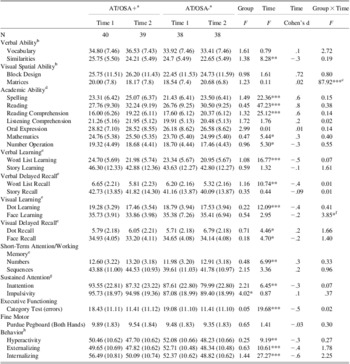
Mixed results were evident for academic and cognitive performance of children in the AT/OSA- and AT/OSA+ groups (Table 2). For verbal ability, there was a significant Time effect for Similarities, with declines rather than increases in children's performance. Cohen's effect size value (d) was small to moderate.
Means and standard deviations for behavioral and cognitive test scores

*p < .05 or better.
**p < .01.
***p < .001.
aNumbers in parentheses represent standard deviations.
bWechsler Abbreviated Scale of Intelligence (WASI).
cExamination of the significant Group by Time interaction revealed that the group differences before surgery (p < .03) were no longer evident post-surgery, and that AT/OSA- group improved significantly (p < .02) and the AT/OSA+ group declined (trend, p < .08) following surgery.
dWechsler Individualized Achievement Test (WIAT).
eChildren's Memory Test (CMS).
fExamination of the significant Group by Time interaction revealed that the AT/OSA+ group declined significantly (p < .009), although no significant differences were evident before or following surgery.
gIntegrated Visual and Auditory Continuous Performance Test (IVA), Attention Quotient; standard scores used as available scores do not lend easily to raw score comparisons.
hConnors’ Parent Rating Scale: Long Version (CPRS-R:L); raw scores summed by domains and then converted to T-Scores for comparison.
For visual spatial ability, Block Design, which had been significantly lower in both AT groups in comparison to controls at baseline, demonstrated no significant post-AT improvement. For Matrices, one in which significant baseline deficits previously were found in AT/OSA- subjects relative to controls, a Group by Time interaction was evident, with the AT/OSA- participants improving their scores significantly, while the AT/OSA+ group demonstrated a trend toward a decline.
For academic achievement, in which several AT versus control differences were found in the baseline study, Spelling, Reading, Reading Comprehension, and Mathematics demonstrated significant improvements (small to large effect sizes). For Number Operations, however, the significant Time effect reflected a decline rather than improvement in scores for both groups (small to moderate effect size).
For initial learning, significant Time effects were evident for both visual and verbal tasks (i.e., Word List Learning and Dot Learning), showing a decline in performance relative to healthy control changes (small to moderate effect sizes). For the Face Learning subtest, a significant interaction reflected a decline in ability relative to control performance for the AT/OSA+. Delayed recall measures were mixed. Word List Recall demonstrated a significant decline for both age groups, while the Dot Delayed Recall subtest revealed a significant improvement across AT groups (small to moderate effect sizes).
In baseline assessments of short-term attention, both the Numbers and Sequences had demonstrated lower scores for children with AT as compared to controls, in particular for the AT/OSA- group. One year after surgery, a significant main effect for Time only was evident for Numbers (small to moderate effect size), reflecting a general improvement across groups. In our previous baseline study, a trend toward lowered performance in comparison to control cases was reported for IVA sustained attention. Analyses now revealed an overall main effect for Time, with a decline evident for scores from both AT groups (small effect size). For the Impulsivity measure, a main effect for group indicated lower performance for the AT/OSA- group as compared to the AT/OSA+ group across both testing sessions.
Regarding executive functioning, although lower mean scores in the AT groups did not reach significance in comparison to controls at baseline, after 1 year both groups significantly increased in ability (moderate effect size). Motor proficiency findings were not significant. On the three summary Conners’ measures of behavior, a significant Time effect demonstrated reduced parental concerns, without difference between AT/OSA- and AT/OSA+ subjects (small to moderate effect sizes).
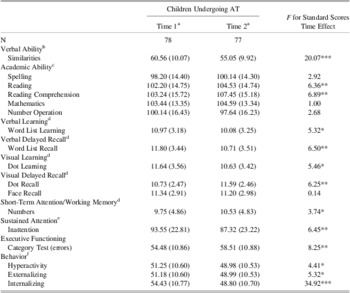
Although the raw scores were presented in the primary table of results (Table 2), Table 3 presents the results of the Time effects from analyses using the standard scores to aid in the clinical understanding of the changes that occur over time in the surgical groups. This table also demonstrates that the statistical results with the standard scores, although somewhat attenuated as would be expected due to range restrictions in the use of standard scores, are consistent with those using the raw scores.
Standard Score means and standard deviations for behavioral and cognitive test scores with significant Time effects

*p < .05 or better.
**p < .01.
***p < .001.
aNumbers in parentheses represent standard deviations.
bWechsler Abbreviated Scale of Intelligence (WASI).
cWechsler Individualized Achievement Test (WIAT).
dChildren's Memory Test (CMS).
eIntegrated Visual and Auditory Continuous Performance Test (IVA).
fConnors’ Parent Rating Scale: Long Version (CPRS-R:L).
The secondary analyses comparing standard scores at follow-up for both AT groups to those of the control children for subscales that demonstrated significantly raw score improved performance revealed that for all but one measure (WIAT Mathematics), differences were no longer evident at follow-up (Table 4).
Discussion
In this cohort of school-aged children tested before and 1 year after AT along with controls, significant improvements were noted in sleep-related measures and parental reports of behavior, whereas cognitive performance outcomes were mixed. Developmental and retest issues were addressed in the analyses by adjusting for the performance of a control group over a similar period. After adjustment, both AT groups were shown to improve across academic achievement measures, delayed visual recall, short-term attention/working memory, and executive functioning. These findings are consistent with earlier reports that SDB treatment leads to improvement in school performance (Gozal, Reference Gozal1998; Guilleminault, Winkle, Korobkin, & Simmons, Reference Guilleminault, Winkle, Korobkin and Simmons1982; Moré et al., Reference Moré, Isern, Zumel, Gonzalez, Soler and Alcover2008), attention (Chervin et al., Reference Chervin, Ruzicka, Giordani, Weatherly, Dillon, Hodges and Guire2006; Moré et al., Reference Moré, Isern, Zumel, Gonzalez, Soler and Alcover2008), and executive functioning (Owens et al., Reference Owens, Spirito, Marcotte, McGuinn and Berkelhammer2000). Short-term attention and working memory are closely tied to executive functioning. Such skills are critical for school performance and may underlie improvements noted in academic achievement. Although WIAT Mathematics achievement improved following surgery, lowered performance was still evident in comparison to controls at 1-year testing, although the above average performance of the control group also could suggest a deviation in the control children.
The hypothesis that improvements would be most evident for children with polysomnography-confirmed OSA was not consistently confirmed. Visual spatial ability that had shown significant impairment among subjects with AT in comparison to controls at baseline (Giordani et al., Reference Giordani, Hodges, Guire, Ruzicka, Dillon, Weatherly and Chervin2008) did not improve post-surgically and the IVA sustained attention score declined following surgery. Improvements in sustained attention following AT have been suggested (Avior et al., Reference Avior, Fishman, Leor, Sivan, Kaysar and Derowe2004; Galland et al., Reference Galland, Dawes, Tripp and Taylor2006; Li et al., Reference Li, Huang, Chen, Fang and Lee2006), but these studies generally did not directly account for developmental changes or differentiate attention from impulsivity. Subtests related to verbal abstraction ability, efficiency with arithmetic problems, and visual and verbal learning/memory also declined in comparison to baseline performance following surgery, and these declines may be linked closely to concomitant deficits in sustained attention, given the close association among these cognitive domains. Overall, our results suggest that children undergoing AT may not have effectively improved facets of their SDB that are critical for all aspects of cognitive enhancement, leading to continued difficulties or even declines following surgery. There also is some suggestion that these declines could be worse in children with baseline polysomnography-confirmed OSA (i.e., significant interaction effects for Matrices and Face Learning). Children who undergo AT for OSA may still have some level of residual disease thereafter, possibly contributed to by the obesity issues. Another possibility is that central nervous system damage from OSA at early ages may create cognitive impairment that does not resolve; becomes worse or more apparent with development; or appears phenotypically only years later, despite intervening alleviation of the original insult.
Kohler and colleagues (2009) who evaluated children across 6 months post-AT failed to find improvement in any cognitive measures. The present study had a full year's follow-up and did demonstrate noticeable improvements in academic achievement, consistent with earlier reports of improved classroom performance following AT (Gozal, Reference Gozal1998; Guilleminault, Eldridge, Simmons, & Dement, Reference Guilleminault, Eldridge, Simmons and Dement1976). At 1 year, several other subtests also suggested an increase in ability that had not been seen at 6 months post-op by Kohler and colleagues (2009), specifically in short-term attention and executive functioning, key behavioral features often described as being associated with SDB. On the other hand, the extended time of follow-up in this study also may be sufficient to document continued declines in some of the most vulnerable aspects of children's cognition. Continued cognitive declines were not expected following successful AT, particularly in light of developmentally based increases in cognitive performance that would be expected normally. The possibility that ongoing cognitive declines may be occurring in children with sleep disruption, even after successful surgical intervention, is a significant area of concern and strongly suggests the relevance for ongoing monitoring. The fact that most academic achievement areas demonstrated significant improvement could reflect effects of improved short-term attention and executive functioning on performance during the school day, along with possibly improved attendance due to better health. On the other hand, the possibility that declines in other important cognitive domains might augment academic difficulties in the long run remains an important area of inquiry.
Although objective neuropsychological measures of sustained attention did not demonstrate improvement following surgery, all parental behavior measures dramatically improved, suggesting that parents may be influenced to some degree by popular expectation that behavioral difficulties resolve soon after surgery. Reports in the ADHD literature, however, have not consistently shown a clear match between parental behavioral ratings and computerized sustained attention measures, leading to concern that laboratory-based tests may have only limited ecological validity and may not reflect the actual aspects of daily functioning to which parents are sensitive (Barkley, Reference Barkley1991). The established improvements in short-term attention and executive functioning also may have contributed to parents’ improved outlook. Amelioration of hyperactive and related behavior, which may result from improved frontal cortical function when normal sleep is restored, could directly tie into parental senses of improvement in sleep, activity level, mood, and externalizing behavior. Further study is warranted to more carefully and comprehensively compare parental behavioral ratings and explicit expectations with AT treatment outcomes.
Several limitations suggest caution in assumptions of cause and effect based on our findings. For one, children in the AT/OSA+ group, recruited from the same hospital setting as other study children, were slightly older than the other two groups, although the primary interest in this study was overall longitudinal change and age was entered as a covariate. Given the exploratory nature of this study, a .05 alpha level was considered reasonable, although this does increase the possibility of Type I error, finding a significant effect with this number of comparisons, so overall conclusions should be conservatively interpreted. In addition, although larger than most studies previously evaluating the neurobehavioral effects of tonsillectomy, this study was originally powered to address the question of the cognitive and behavioral effects across AT in children, regardless of OSA status. For this reason, interactions of time and OSA status may be underpowered and require caution in interpretation due to the possibility of Type II error, potentially not finding significance due to the sample size. From a review of Table 4, the control performance of children in this study may reflect higher than average or normal performance on several variables. It is possible that somewhat higher levels of performance may attenuate expected changes over time in the healthy controls and thus potentially increase the possibility of finding a spurious significant change in the surgery groups, although higher scores also are evident in some of the AT groups’ performances and these children are all drawn from the same general hospital population. Finally, this study does not represent a randomized controlled trial, as polysomnography-based diagnostic comparisons were established before surgery and all children in the AT groups received the surgical intervention. A multicenter randomized controlled clinical trial, to assess the impact of expedited AT versus watchful waiting and supportive care for pediatric OSA, is under way in the United States (Redline et al., 2011).
Our findings, like those of Kohler et al. (Reference Kohler, Lushington, van den Heuvel, Martin, Pamula and Kennedy2009), lend some pause to the prevailing view that AT “cures” most behavioral and cognitive difficulties in children with clinical, office-based diagnoses of SDB. Neurobehavioral morbidity is important, because it motivates many of the ATs performed for childhood SDB (Weatherly et al., Reference Weatherly, Mai, Ruzicka and Chervin2003). Neither the current study nor the multi-center clinical trial mentioned above directly addresses the possibility that disrupted breathing earlier in life than 5 years of age, a critical period in neurodevelopment (Anderson & Catroppa, Reference Anderson and Catroppa2005; O'Leary et al., Reference O'Leary, Lovell, Sackellares, Berent, Giordani, Seidenberg and Boll1983), may lead to the prolonged deficits and perhaps ongoing cognitive decline evident in this study. Consideration of earlier interventions, when sleep problems become apparent at very young ages must balance the immediate safety concerns of the surgery with the potential of forestalling later cognitive and behavioral sequelae. This can only be resolved with continued research and attention to the developmental trajectory and potentially comorbid factors such as obesity.
The lack of clarity on the role of polysomnography in identification of children most likely to benefit from AT, along with the inability to demonstrate a consistent, direct relationship between SDB severity and neurobehavioral disturbance (Beebe, Reference Beebe2006; Kohler et al., Reference Kohler, Lushington and Kennedy2010), supports the need for ongoing research into other indicators that might improve clinical practice and our understanding of the pathophysiology underlying OSAS-related cognitive effects. More informative measures of sleep microstructure or sleep fragmentation, along with sensitive structural and functional neuroanatomical measures, may be key in future studies. Cognitive deficits, for example, may be tied more to general sleepiness than to polysomnogram measures (Chervin et al., Reference Chervin, Ruzicka, Giordani, Weatherly, Dillon, Hodges and Guire2006; Kohler et al., Reference Kohler, Lushington and Kennedy2010; O'Brien et al., Reference O'Brien, Holbrook, Mervis, Klaus, Bruner, Raffield and Gozal2003; Rosen et al., Reference Rosen, Storfer-Isser, Taylor, Kirchner, Emancipator and Redline2004). Alternatively, current standard polysomnography measures may be insensitive to some important pathophysiological features of sleep or breathing that are more prominent in AT/OSA- subjects than the AT/OSA+ children (Giordani et al., Reference Giordani, Hodges, Guire, Ruzicka, Dillon, Weatherly and Chervin2008). Related to this, both groups of children undergoing AT demonstrated substantial improvements on both the objective and parent ratings of sleep hygiene used in this study, even after accounting for developmental changes in the control group, emphasizing pathology in both groups of children.
With respect to opportunities for future research, we speculate that specific brain regions may show selective vulnerably to childhood OSA. This idea is supported by findings in our study of improvements in cognitive domains associated with cortical frontal areas (executive and short-term attention skills ) in contrast to possibly ongoing declines in areas associated with hippocampal integrity (e.g., learning/memory). Follow-up over periods longer than 1 year would be important to assess whether cognitive declines may continue beyond the year following surgery. Limited studies to date in adults and children with OSA point to involvement of both hippocampal and frontal areas (Halbower et al., Reference Halbower, Degaonkar, Barker, Earley, Marcus, Smith and Mahone2006; Hill et al., Reference Hill, Hogan, Onugha, Harrison, Cooper, McGrigor and Kirkham2006; Macey et al., Reference Macey, Henderson, Macey, Alger, Frysinger, Woo and Harper2002), although the time frame or differential recovery rates in these areas is not established. Understanding the relationship between neuropathological and polysomnography-related changes following AT also may allow a better identification of which children will or will not benefit from AT. Group means may mask marked individual differences in response to AT, and a better characterization of these differences across patients may hold the key to better understanding the utility of possible follow-up treatment options after AT, such as continuous positive airway pressure or orthodontic intervention. Although the differential decline in some cognitive areas for AT/OSA+ children raises the possibility that further OSA treatment may be warranted, the AT/OSA- group also did not demonstrate consistent cognitive improvement following surgery and conceivably could also benefit from further intervention aimed at a sleep condition for which morbidity is not readily predicted by polysomnography.
Finally, despite clear initial deficits among children with AT in comparison to controls and some residual concerns even after AT, the AT study group means both before and after AT were generally within the average range and did not reflect marked dysfunction. Nonetheless, improvements (as well as some declines) of clinically meaningful magnitude did appear after AT. These observations raise the concern that the public health burden of childhood SDB, or adenotonsillar hypertrophy more generally, may be much larger than might be expected based on past literature that focuses only on children with Attention-Deficit/Hyperactivity Disorder or clearly abnormal baseline measures of cognition or behavior. Effective treatment of SDB could conceivably mean the difference between average and excellent school performance for one child or between excellent and exceptional performance for another. Such differences in childhood could translate into life-time impact for adults. In short, the total public health burden posed by treatable childhood SDB, from a neurobehavioral standpoint alone, may be much larger than commonly recognized in studies confined to childhood or those confined to children with clear neurobehavioral problems.
Acknowledgments
There are no financial or other relationships that could be interpreted as a conflict of interest affecting this manuscript. The work reported in this manuscript was supported by the National Institutes of Health (1R01 HD38461), “Behavioral Effect of Obstructive Sleep Apnea in Children.”