A range of tools is available for educational psychologists to use when exploring the learning abilities of children. Traditional intelligence tests have been a standard part of educational psychology for decades. They are employed by psychologists in education systems to determine eligibility for resources and special education programs. They are also used by psychologists to make sense of children's learning. In particular, the profile of a child's scores across the range of subtests may be indicative of selective learning difficulties suggesting specific intervention strategies.
Intelligence tests are the operationalisation of theoretical models of intelligence, of how psychologists see intellectual functioning. For most of the 20th century, the construct of intelligence was defined by the frameworks of Wechsler and Binet. They provided the structure and the language with which psychologists talked about intellectual functioning and reported test results to parents, teachers, and students. In the late 20th century, alternative models of intelligence were developed, and tests based on them have become available to psychologists. The practice of a psychologist in which 41 children completed both a traditional intellectual test, the Stanford-Binet Intelligence Scales Fifth Edition (SB5; Roid, Reference Roid2003a) and a contemporary test, the Das Naglieri Cognitive Assessment System (CAS; Naglieri & Das, Reference Naglieri and Das1997a) has allowed for the comparison of these tests, their results and an analysis of their relative utility in educational psychology casework.
Theoretical Models of Intelligence Underlying the SB5 and the CAS
The Binet strand of intelligence tests began in 1905 with the Binet-Simon Scale, which had a developmental basis and included items to represent the then contemporary view of multiple mental functions, such as visual discrimination, sentence construction, repetition of sentences, repetition of digits, and drawing from memory (Sattler, Reference Sattler2001). In its fifth edition, the Stanford-Binet (SB5) published in 2003 is based on five factors from the Cattell-Horn-Carroll cognitive model that was compiled in the 1990s from factors or abilities defined by Cattell in 1943 and Horn in 1965 (Roid & Barram, Reference Roid and Barram2004). The SB5 has five factors that represent key reasoning abilities: fluid reasoning involves inductive and deductive reasoning, sequential reasoning, visualisation, cognitive flexibility, attention and concentration; knowledge includes crystallised knowledge, general information, oral production and fluency, verbal comprehension, synthesis of information and cognitive flexibility, attention and concentration; quantitative reasoning involves mathematical and quantitative knowledge, logical thinking, visual discrimination, conceptual thinking, synthesis of information, cognitive flexibility, attention and concentration; visual-spatial processing involves visual processing, spatial relations, visualisation, perceptual reasoning, visual discrimination, planning, problem solving, speed of movement, scanning ability, cognitive flexibility, attention and concentration; and working memory involves short-term memory, working memory, memory span, visual memory, and serial perceptual integration, attention and concentration (Sattler, Reference Sattler2008).
Each factor is split into two domains (verbal and nonverbal) based on the ‘the degree to which a class of item requires the use of language skills, particularly in generating a response to an item’ (Roid, Reference Roid2003b, p. 23). The verbal–nonverbal dichotomy has been a key structural dimension of the Wechsler Scales and has been introduced to this most recent edition of the Binet in response to the multilingual nature of society (Roid, Reference Roid2003c). This dichotomy has been relied on in educational settings for many years to assist in the determination of language delays and disorders, as well as to support the use of nonverbal scales in assessment of children who have language other than Standard Australian English. Traditionally, the Wechsler scales had Verbal and Performance IQ scores along with a full-scale IQ; however, the verbal–nonverbal distinction is no longer as prominent in the most recent version, the WISC-IV.
Concurrently with development of the recent revisions of the Wechsler and Stanford-Binet intelligence tests, a new strand of cognitive psychology has been developing, along with new instruments for assessment of cognition. The Cognitive Assessment System (CAS) is the operationalisation of an information processing theory of intellectual functioning that is grounded in Luria's neuropsychological work of the 1960s and is described as ‘new intelligence testing technology’ (Naglieri, Reference Naglieri1999, p. 1).
In this model, four cognitive processes, linked to the functional units of the brain, define the basic components of intelligence (Naglieri, Reference Naglieri1999). These cognitive processes are Planning, Attention, Simultaneous processing, and Successive processing, known as the PASS processes. Planning is a mental process that allows determination, selection, application and evaluation of solutions to cognitive tasks. Attention is the process of attending to relevant information while filtering out irrelevant information. Simultaneous processing is the process of making sense of information holistically, while successive processing is being able to use sequential information (Sattler, Reference Sattler2008).
Both the SB5 and the CAS are marketed as measures of intelligence or cognitive ability, and are available in Australia for use by registered psychologists through the Australian Council for Education Research. The SB5 provides a full-scale score that represents general intellectual ability (Roid, Reference Roid2003c), cognitive ability (Roid, Reference Roid2003b), or intelligence as in the title (Roid, Reference Roid2003a). The CAS provides a full-scale score that represents cognitive processing (Naglieri & Das, Reference Naglieri and Das1997b), cognitive performance or intelligence (Naglieri, Reference Naglieri1999).
The SB5 is designed to assess both child and adult levels of intellectual functioning and has norms from ages 2 years to 89 years 11 months. The SB5 is used for diagnosis of developmental disabilities and exceptionalities and is designed to inform interventions, as well as being used as a basis for placement decisions for children with intellectual disability and intellectual giftedness (Roid, Reference Roid2003b). Previous versions of the Binet Scales have been used in Australian schools for decades to determine eligibility for access to special education programs. In the 1980s, both the Stanford-Binet and Wechsler scales were basic equipment distributed to NSW school counsellors for school casework. More recently, the Wechsler Scales have been the primary tool of school counsellors when a measure of intellectual ability is required. Neither the SB5 nor the CAS is currently provided to psychologists in this education system. However, consideration should be given to alternative measures of cognitive functioning that may have more relevance to recent developments in ‘cognitive education’ (Haywood, Reference Haywood2010).
Traditional Intelligence Tests Compared to the CAS
As far as the current authors can determine, there are no published direct comparisons of the Stanford-Binet scales and the CAS scales. However, there are a few studies comparing the Wechsler scales (WISC-III and WPPSI-R) with the CAS. The concordance between the Stanford-Binet measures of intelligence and the Wechsler measures has been well established (Roid, Reference Roid2003c). Hence, we will here briefly review findings comparing the WISC-III and the CAS.
The CAS manual (Naglieri & Das, Reference Naglieri and Das1997c), for example, reports on one study in which the mean WISC-III and the mean CAS full-scale IQ scores were compared in samples of regular education students (105.1 and 106.1, respectively), students with learning difficulties (89.6 and 87.5), and students with mental retardation (60.7 and 65.9). These results indicate that the CAS full-scale score can be considered comparable to the full-scale score obtained from the WISC-III. However, in Naglieri, Lauder, Goldstein, and Schwebach (Reference Naglieri, De Lauder, Goldstein and Schwebech2006), mean full-scale IQ as measured by the WISC-III across a sample of 119 children referred for psychoeducational assessment and intervention, was 104.5 compared to the CAS estimate of 97.2. Naglieri, Goldstein, Iseman, and Schwebach (Reference Naglieri, Goldstein, Iseman and Schwebach2003) also report average full-scale IQ scores obtained from the WISC-III as noticeably higher than the CAS estimates (102.3 vs. 93.0 for an ADHD group and 107.6 vs. 100.2 for an Anxiety/Depression group). Although the average scores for full-scale IQ estimates on both instruments fell within the normal range, traditional tests may return higher estimates of full-scale IQ than CAS estimates. Further research is required in this area and is part of the motivation for the present study.
The relationship between the WISC-III and the CAS has also been examined in relation to achievement. For example, Naglieri and Bornstein (Reference Naglieri and Bornstein2003) reviewed 21 studies of the relationship between intelligence test full-scale scores and various achievement indices. They found that intelligence tests based on cognitive processing models (such as the Kaufman ABC; Kaufman & Kaufman, Reference Kaufman and Kaufman1983) predicted achievement as well as the traditionally formatted tests of intelligence despite the fact that traditional tests include items that are very similar in content to what is also included in the achievement tests. The degree of item overlap and subtest similarity between tests of general intelligence and achievement artificially inflate the correlations between the two measures. In the Naglieri et al. (Reference Naglieri, Goldstein, Iseman and Schwebach2006) study referred to earlier, the WISC-III scale scores correlated with achievement (as measured by the Woodcock-Johnson Achievement Tests — III; Woodcock, McGrew, & Mather, Reference Woodcock, McGrew and Mather2001) with a median of .67 whereas the CAS scale correlated with a median value of .82.
The utility of the CAS scale scores in differentiating subgroups of children on the basis of important cognitive processing characteristics has also been demonstrated. Naglieri, Salter, and Edwards (Reference Naglieri, Salter and Edwards2004) compared samples of regular education students, students with ADHD, and students with reading disability and found that children with ADHD can be distinguished by lower mean scores on the Planning scale whereas the reading disability group could be distinguished by lower Successive processing scores. Naglieri et al. (Reference Naglieri, De Lauder, Goldstein and Schwebech2003) found that the CAS scale scores could significantly distinguish a group of ADHD children from a group of anxiety/depressed children on the basis of lower Planning scores (whereas the WISC-III could not). Kroesbergen, Van Luitt, and Naglieri (Reference Kroesbergen, Van Luitt and Naglieri2003) found that Dutch children with mathematical learning difficulties had specific deficiencies in Planning and Successive processes compared to normative scores, although an intervention to improve mathematical skills had no significant effect on the CAS scales despite a highly significant overall improvement in mathematics. The CAS has also been used to inform interventions for reading (Das, Parrila, & Papadopoulos, Reference Das, Parrila, Papadopoulos, Kozulin and Rand2000; Ooi Boon & Ismail, Reference Ooi Boon and Ismail2011).
Finally, the utility of combining the information provided by traditional intelligence tests and the more recent cognitive processing intelligence tests has been recognised in neuropsychological settings. McCrea (Reference McCrea2007) has shown that differential assessment of cognitive domains provided by the WAIS-R and the CAS during recovery from brain injury provided valuable insights into recovery processes and provided clues for intervention. By examining a patient's responses to particular items in addition to the scale scores, a deeper understanding of learning difficulties can be obtained which can inform intervention strategies.
In summary, research relating the CAS intelligence scales to the Stanford-Binet intelligence scales is very limited or nonexistent. However, research comparing the Wechsler scales for children and the CAS demonstrates at least an equivalent relationship with achievement (with less overlapping item content), and the focus on cognitive processing in the CAS allows practitioners to provide recommendations in terms of cognitive skills that may respond to intervention or teaching. The use of the CAS scales as a guide to intervention has been presented as a strength of the CAS that makes it particularly useful in practice (Sparrow & Davis, Reference Sparrow and Davis2000). Such ‘cognitive education’ or cognitive ‘modifiability’ has considerable support (Haywood, Reference Haywood2010) and is evident in many curriculum documents that now highlight the development of cognitive or thinking skills as core to the curriculum. Hence the present study attempts to evaluate this potential in an applied setting.
Structure and Administration of the SB5 and CAS
Both instruments are only to be administered by psychologists who have training in test administration, scoring and interpretation. There are strict administration frameworks and explicitly outlined procedures for the test setting, administration, scoring and interpretation. Full administration of either the SB5 or the CAS takes about 40 to 60 minutes (Australian Council for Educational Research, 2005–2011).
The SB5 has 10 subtests, 1 verbal and 1 nonverbal for each of the five factors (Fluid Reasoning, Knowledge, Quantitative Reasoning, Visual-Spatial Processing and Working Memory). The SB5 combines the point-scale format of the fourth edition with the age level format used in earlier editions. The initial two subtests (one verbal and one nonverbal) are scored and provide an indication of which level of subtests to administer for the other factors. The Nonverbal Subtests are then administered starting at the entry level and working up until a ceiling on each subtest is reached. Finally, the four Verbal subtests are administered, again until ceilings are reached. Each subtest provides a scaled score (mean 10, SD 3), and these are combined to provide eight scores (mean 100, SD 15), one for each of the five factors plus a nonverbal and verbal composite and a full-scale score. The SB5 makes a distinction between access skills (attending, listening, seeing, sitting still, reading, tracking movements and following directions) and target skills (the cognitive abilities of reasoning, knowing, quantifying, visualising and remembering) and provides guidelines for accommodating students who have identified disabilities that impact on accessing the test items (Roid & Barram, Reference Roid and Barram2004)
The CAS has 12 subtests in four processing areas that have been developed to assess four types of cognitive processing that combine to make the PASS theoretical model: Planning, Attention, Simultaneous and Successive Processing. The three subtests for each of the four types of cognitive processing are administered in a set order. Some of these have ceilings, determined by a series of failed items, while others are timed and the student completes the full task. The CAS provides several methods that aim to ensure the student understands what is required in each task and this includes demonstration and sample items as well as ‘opportunities for the examiner to clarify the requirements of the task’ (Naglieri & Das, Reference Naglieri and Das1997b, p. 8).
The CAS uses two item sets, for children aged 5 to 7 and then 8 to 17, with some common subtests and some completely different item sets. This partitioning was designed to ensure understanding by young children (Naglieri & Das, Reference Naglieri and Das1997c). Each subtest provides a scaled score (mean 10, SD 3), which are combined to provide four standard scores (mean 100, SD 15), one for each of the four cognitive processes, Planning, Attention, Successive and Simultaneous Processing. These are then combined to produce a full-scale standard score (mean 100, SD 15).
Reliability and Validity
Both manuals report excellent reliability coefficients for internal consistency and test–retest measures. The SB5 manual reports full-scale, split-half reliability coefficients of between .97 and .98 across age groups and .95 to .96 for the Verbal and Nonverbal IQ scores (Roid, Reference Roid2003a). The CAS coefficients were reported to be from .95 to .97 across age groups, and the PASS Scale coefficients were from .88 to .93 (Naglieri & Das, Reference Naglieri and Das1997b). Both manuals provide extensive information on validity, including evidence for content, construct, and criterion validity. For example, scores on both tests increase substantially with age, and factor analyses confirm theoretical item structures. The SB5 was normed on a US representative sample of 4,800 people from ages 2 to 85+. The Stanford Binet has an Australian adaptation pack that has altered the order or nature of some items; however, it is still referenced to the US norm group. The CAS was normed on a US representative sample of 2,200 children. No Australian check norming or adaptations have been undertaken.
Unfortunately, much of the research on the reliability and validity of the CAS has been conducted by the authors of the test. Very little independent research exists to counter this. One series of independent studies (Keith, Kranzler, & Flanagan, Reference Keith, Kranzler and Flanagan2001; Kranzler & Keith, Reference Kranzler and Keith1999) has criticised the factor structure of the CAS and hence the general validity of the measures available from the CAS. Obviously more research is required to resolve these issues.
In addition to quantitative measures of reliability and validity, the ease with which the CAS can be used and is interpreted are important factors for obtaining accurate assessments. Thompson (Reference Thomson, Plake and Impara2001) in a review published in the Mental Measurements Yearbook described the CAS as having ‘many strong features’ (p. 369), including clear, straightforward directions for administration and scoring and taking less time to administer than either Wechsler scales or the Stanford-Binet scales. In addition, the use of the same scaled means and standard deviations as used with the traditional tests makes it easy to explain, interpret, and compare test scores to teachers, parents, and administrators.
The Study
Selection of psychoeducational tests to assist in school and educational psychology casework is crucial in determining how school psychologists, teachers, and parents talk about and think about intellectual abilities and appropriate interventions for students who have learning difficulties. Understanding children's learning is the aim of intellectual assessment, and it is important to use appropriate tools to interpret the assessment information meaningfully. Most educational psychologists are employed by large education systems and provided with tests that are selected by the system. Professional reflection on these tools and what they can offer is vital for practising psychologists. The current study aimed to identify similarities and differences in the assessment information and utility of the SB5 and CAS, and to explore whether they could be used interchangeably or in a combined manner to further elucidate learning difficulties.
The CAS has been available in Australia for a number of years and has been acquired mainly by tertiary institutions (E. Lammi, ACER, personal communication, July 26, 2011). The psychologist making the assessments reported here acquired the CAS in 2005, and with training from one of the authors of the CAS, Professor Jack Naglieri, proceeded to use it in educational psychology casework. The study is an analysis of the information provided by these two instruments over a period of 6 years in an educational psychology practice. Both assessment instruments were used as they provided different perspectives through which to investigate the learning abilities of the referred students, particularly given the complexity of the cases.
Participants
The participants were 41 children (19 girls and 22 boys) whose families and/or schools sought psychoeducational assessment. The children attended either public schools (23) or independent schools (18) in NSW and the ACT. They ranged across all grades except Years 9 and 10, with 35 of them in K-6 and six in secondary school. Their ages were from 5 years 4 months to 17 years 4 months (mean 9 years 3 months).
Two students were identified as having ADHD, one student had Asperger Syndrome, one student received behavioural support at school, one student had an identified anxiety disorder, and three children were fostered by extended family or other foster parents and had possible effects of drugs on foetal development. The students were mainly European Australian, with one student identified as Aboriginal and two from the Pacific islands. All children were referred for assessment because of concerns about academic achievement.
Method
The SB5 and the CAS were administered to the students as part of casework. Standard manual instructions for administration, scoring, and interpretation were followed by an experienced educational psychologist. It was most usual that the CAS was administered in an initial assessment session and the SB5 in a second session. For some students both instruments were administered in 1 day (two sessions), but it was more common to have two separate sessions on different days. There was no systematic collection of data about the preferred instrument for the students. Neither the SB5 nor the CAS have tasks that resemble classroom tasks. This creates a novel experience that most students enjoy. In every case the results were considered a valid assessment that was not impeded by behavioural or emotional factors.
The SB5 has a complete scale (all 10 subtests) and an abbreviated battery of 2 subtests. The CAS has two batteries, a standard battery that includes three subtests for each of the four PASS scales, and a basic battery that is complete after two subtests in each scale (eight subtests). In the present study, the complete scale of the SB5 and the standard battery of the CAS were administered to all students. This provided a full score for each test, the nonverbal and verbal composites for the SB5, as well as the factor and scale scores. These eight SB5 scores and five CAS scores were able to be statistically compared in this study.
Results
Comparison of the SB5 and CAS Composite, Factor and Scale Scores
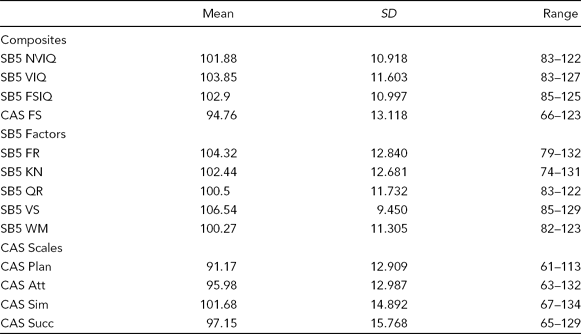
The means and standard deviations of the 13 scores achieved by the 41 students were calculated (Table 1). Independent t tests comparing males and females on mean scores revealed that the SB5 and CAS composites and all the Factor scores did not approach significance. However, there was a highly significant difference between the mean full-scale scores for the two instruments, with the SB5 mean almost 8 points higher, t(40) = 5.18, p < .001. There was a weak correlation between age and full-scale difference scores, r(39) = .31, p = .047, indicating that there were larger differences for older students compared to younger students.
Means and Standard Deviations for SB5 and CAS Composite Scores
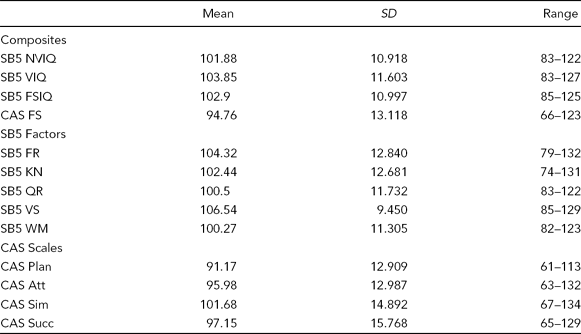
Note: NVIQ = Nonverbal IQ; VIQ = Verbal IQ; FSIQ = Full-scale IQ; FS = Full scale; FR = Fluid reasoning; KN = Knowledge; QR = Quantitative reasoning; VS = Visual-spatial reasoning; WM = Working memory; Plan = Planning; Att = Attention; Sim = Simultaneous processing; Succ = Successive processing.
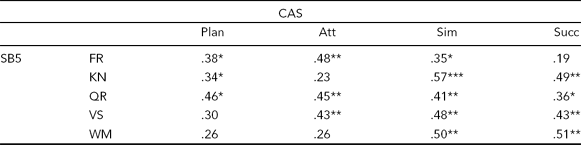
Relationships among SB5 Factor and CAS Scale scores were investigated using Pearson correlations (Table 2). The full-scale scores for the SB5 and the CAS were significantly correlated, r(39) = .66, p < .001.
Correlations Between the SB5 Factor and CAS Scale Scores
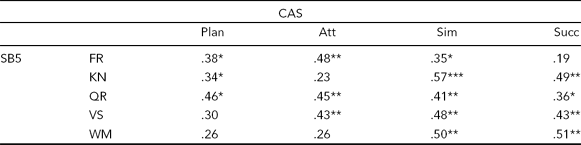
Note: *p < .05, **p < .01, ***p < .001
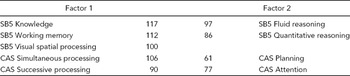
In addition, the five SB5 scales and the four CAS scales were entered into an exploratory principal components analysis with oblique rotation to find a major factor composed of Knowledge, Working Memory, Visual-Spatial processing, Simultaneous processing and Successive processing (50.5% of variance) and a minor factor of Fluid Reasoning, Quantitative Reasoning, Attention and Planning (13.2% of variance). There were, however, several high crossloadings and the two factors were correlated r = .48. This indicates that the two test batteries considered together measure two broad dimensions of cognitive abilities.
Comparison of Descriptors
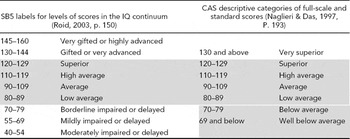
Both the SB5 and CAS provide descriptive labels for score ranges that are used in reporting, from very gifted or highly advanced and very superior, to moderately impaired or delayed and well below average (Table 3).
Descriptors for SB5 and CAS Scores

The scores on the SB5 in this study ranged from 85 to 125, from low average to superior, while the CAS scores, between 66 and 123 could be described from well below average to superior (shaded in Table 5). The range for the CAS full-scale score extended into the well below average range, while the SB5 was maintained in the low average range. However, the top of the range was only 1 point different, both in the superior range. For 24 of the 41 students there was a discrepancy in the classification and a notable discrepancy for 9 students that would create very different descriptions of a student's cognitive ability when reported.
Individual Cases
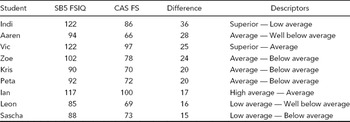
Differences in scores for individual students were analysed. Information on the nine most discrepant SB5 and CAS scores and their associated descriptors can be found in Table 4. In the total sample, the order of magnitude of difference ranged from 36 points to 1 point, with these nine students having differences of 15 or more points (i.e., 1 standard deviation or more). SB5 scores were higher for 35 of the 41 students, including all nine with significant differences.
Students With Significantly Different Descriptors of Full-Scale Scores on the Two Tests

Note: All names are pseudonyms.
The four most outstanding examples were Indi, a Year 3 girl, who scored in the superior range on the SB5 and in the low average range on the CAS; Aaren, a Kindergarten boy, scored in the average range on the SB5 and in the well below average range on the CAS; Vic, in Year 8, who would be described as superior by his SB5 score but average based on the CAS score; and Leon, in Year 3, who would be considered low average based on his SB5 score, but well below average based on the CAS score.
Discussion
The present study was designed to compare the administration and interpretation of the Stanford-Binet Scales of Intelligence Fifth Edition (SB5) and the Cognitive Assessment System (CAS) in psychoeducational casework. The results of the analyses have some important implications for the professional utility of the two tests.
Determinations of Intelligence
Tests based on cognitive processing theory have been presented as being equal to or even better correlated with achievement than traditional intelligence tests (Naglieri, Lauder, Goldstein, & Schwebach, Reference Naglieri, De Lauder, Goldstein and Schwebech2006). The results of the present study suggest that this is the case, since the students were all referred for low achievement and the CAS tended to reflect this. However the significant difference between the mean scores indicates that the SB5 provides a higher full-scale score than the CAS and that this difference can be quite large, up to 36 points. This is a similar finding to what has been reported for the WISC-III compared to the CAS (Naglieri et al., Reference Naglieri, De Lauder, Goldstein and Schwebech2003; Naglieri et al., Reference Naglieri, Goldstein, Iseman and Schwebach2006). The differences were not dependent on gender but there was a tendency for a greater difference with older students.
There were a number of students for whom the results from the two tests were widely discrepant and would have produced different interpretations of intelligence or intellectual ability. For example, Indi's full-scale IQ of 122 on the SB5 (95% confidence interval of 118–126) presents a very different picture to her CAS full-scale score of 86 (95% confidence interval of 81–92). Although IQs or full-scale scores are not presented as being as absolute as they once were, they can still have a significant effect on the perception of a student's intellectual ability and can influence expectations set by teachers and parents. This full-scale score is mediated by the psychologist, often using the general descriptor provided in the manuals. The descriptive label is often the information that is reported and it can be the strongest message a teacher or parent receives about the assessment and is often what is repeated to other teachers. In this case, Indi could be described as having superior or below average intellectual abilities; two very different descriptions that could have significant implications for how she is seen by her teacher and family, and how she sees herself. It also has implications for how teachers review their teaching for the student, and what expectations they have of the student.
Can the SB5 and CAS be Used Interchangeably?
The SB5 and the CAS are based on very different models of intelligence but are presented as alternative measures of intelligence. However, the differences between the SB5 and CAS full-scale scores have serious implications if the full-scale scores are to be used as the key interpreting factor. For example, in situations in which intellectual disability is required to be identified or when a measure of ‘at least average’ intelligence is needed for determining eligibility for special education support programs (such as Language Support or Intensive Reading), then the two tests are not interchangeable.
The differences between the two tests can be highlighted in the context of determining intellectual disability. Aaren and Leon scored 66 and 69 respectively on the CAS but 94 and 85 on the SB5. Their SB5 scores demonstrate quite strongly that neither student has intellectual disability. Three other students had borderline disability range scores of 70 and 72 on the CAS, but average SB5 scores of 90 and 92. Such discrepancies do not support the interchangeability of these instruments for determining levels of intellectual abilities. Perhaps more work needs to be done in norming CAS scores to the Australian population, especially with more typically developing children. Alternatively, the CAS may be more sensitive to these cognitive deficits than the SB5. Obviously, further research into these aspects of the CAS is required.
Two Lenses Through Which to Understand Student Learning
The administration of both the SB5 and the CAS in many cases has allowed meaningful interpretation of student learning needs that could not be achieved through one test only. It is vital to carry out meaningful contextual interpretations in order to make sense of the scores of the SB5 and the CAS and what they mean in terms of each student. Because the results were part of a wider assessment responding to specific issues about learning, the scores were interpreted in that context and in each case both tests contributed to increased understanding of the student. Behind each set of scores is a complex human being and the results need to be interpreted in the context of each case. The interpretation for Indi illustrates how this was done.
Indi, in Year 3, came for assessment at the instigation of her mother, a teacher, who was concerned about her school learning. A recent Neale Analysis of Reading Ability (Neale, Reference Neale1999) had placed her reading skills 12 months below her chronological age, yet she presented as intellectually capable in other contexts. In this assessment, the SB5 produced scores for full-scale (122), nonverbal (121), and verbal (121), indexes in the superior range. All factor scores were in the high average or superior range (FR 129, KN 114, QR 119, VS 120 and WM 112). In contrast, the CAS FS score was in the low average range, at 86. This composite score was made up of three average PASS Scale scores (Attention — 90, Simultaneous Processing — 96 and Successive Processing — 102) and a below average Planning score (73) indicating that this type of thinking skill was a significant difficulty for her.
These discrepancies support the complexity of Indi's functioning as presented by her mother and could be unpacked to help make sense of Indi's current learning needs. The CAS results provided some direction for cognitive intervention, whereas her SB5 results did not. Her CAS profile suggested an emphasis on strategies to develop planning skills which were then able to be implemented at school and home. Subsequent feedback from the mother indicated that this had resulted in more effective learning at school for Indi. Being able to present the assessment information in terms of thinking processes that can be explicitly taught is a much more constructive framework to take back to a child's teacher or family, than a profile on the SB5 that is often presented as much more stable and impervious to intervention.
In another case, the differences between the SB5 and CAS results were meaningful for understanding school achievement and learning. Zoe had chronic anxiety and her managing psychiatrist was interested in her intellectual functioning. Zoe had a CAS full-scale score of 78 that matched her low levels of academic performance at school. The profile of PASS Scale scores indicated average Simultaneous and Successive Processing, but below average Attention and well below average Planning. The process of planning represents executive functioning (Davis et al., Reference Davis, Tomporowski, McDowell, Austin, Miller, Yanasak and Naglieri2011) and this pattern suggests that Zoe's executive functioning is seriously impaired and would be contributing to her school learning difficulties.
Zoe's SB5 provided a score of 102, mid average, with no difference between Nonverbal and Verbal Indexes. Also found were: high average Working Memory and Knowledge, mid average Visual-Spatial Processing and Fluid Reasoning, and low average Quantitative Reasoning. This was a meaningful profile to discuss with Zoe herself and fitted with family and friend perceptions of her in everyday living. Combining this information with the information from the CAS allowed discussion of all nine dimensions, and exploration of strategies to support planning and attention skills development. The distinction between two major factors spread across the two instruments was only notable in a couple of cases, one being Zoe's. Her scores across these factors are shown in Table 5.
Zoe's Scores on the Two Major Factors Identified Across the SB5 and CAS

This pattern can be interpreted in Zoe's case as reinforcing the idea that reasoning and executive functioning skills are relatively depressed for her, whereas her general knowledge, memory, integrating and grouping strategies were quite competent. The two groupings of measures supported a perception that she was significantly underachieving academically, and helped make sense of the impact of her mental health condition on her school functioning, as well as on everyday functioning.
The two different perspectives on cognitive functioning provided by the SB5 and the CAS have proven useful for making sense of student cognitive functioning, and the feedback from parents has affirmed the interpretations. Review of the total caseload indicated that both tests were used in cases that were complex. The tests were able to provide two different lenses through which to make sense of this complexity. This supports the idea that the SB5 and CAS measure different and unique processes/abilities and can contribute different views in response to the referral questions.
In each case, the difference between the SB5 and the CAS was used to help make sense of student cognitive functioning and learning. This is in line with the cross-battery assessment that has been developed in order to respond to the outcome of more than 10 years of factor analysis that showed that ‘none of our intelligence batteries contains measures that sufficiently approximated the full range of broad abilities/processes that define the structure of intelligence specified in contemporary psychometric theory’ (Flanagan, Ortiz, & Alfonso, Reference Flanagan, Ortiz and Alfonso2007, p. 7). This idea is supported by the presence of the two factors across the SB5 and CAS. Perhaps this move is an acknowledgment that we are trying to measure a very complex aspect of human functioning and it is impossible to develop a definitive operationalisation.
Conclusion
The purpose of this study was to examine the relationships between a traditional test of intellectual ability (SB5) and a cognitive processing test (CAS) in a psychoeducational practice. We explored the utility of the two instruments and whether the two instruments can be used interchangeably or in combination. The referral questions for the children in this study were not simply to gain a measure of general intellectual ability, but were more complex and open ended and required subtle evaluation and understanding of weaknesses and strengths in the child's intellectual functioning. The CAS was able to provide more explanation for levels of academic achievement than the SB5 and provided a more meaningful vehicle for exploring student learning and identifying students at risk of learning difficulties. Families and teachers can respond to the identified specific learning needs and translate these into teaching and parenting interactions.
The present analysis has highlighted significant differences in composite scores that have implications for the utility of each of the instruments. Special education programs that have level of intellectual ability as part of the admission criteria, have access traditionally decided through consideration of full-scale Wechsler or Binet scores (along with other adaptive behavioural and academic performance information). The differences in SB5 and CAS scores in this set of cases cast significant doubt over the interchangeability of the tests for this purpose. A number of students in this study would have been classified as having an intellectual disability if the CAS scores were the measure. Yet their SB5 scores clearly indicated they did not have an intellectual disability.
The study has limitations due to the small clinical sample and needs to be received in this context. Future research is required with a typically developing Australian sample to examine normative standards of the CAS and shed more light on the relative contributions that the CAS can make to psychoeducational assessment in clinical samples. The analysis of the results of the SB5 and CAS within one practice is valuable for professional reflection for the practitioner and provides one situation in which both instruments are used meaningfully to make sense of learning and to shape recommendations for intervention for students who have learning difficulties. This study has implications for future research in cognitive education and intervention. The next question is whether the directions for intervention that the CAS provides, the reframing of learning needs into information processing skills, and selection of strategies to develop these skills, can be shown to have a positive impact on student learning and academic achievement.