





Introduction
In 1934, bones of at least 235 unique individuals were recovered from commingled human skeletons in a Late Neolithic “Wartberg culture” gallery grave at Altendorf, Hesse, Germany (9.203°E, 51.209°N) (Jordan Reference Jordan1954). In 2017–2019, the Kiel University Leibniz-Laboratory dated 45 of the skulls to the late 4th millennium BC calibration plateau (mean ±s.d. 4483 ± 41 BP), as expected, but 17 skulls dated to an unexpected second phase (∼4000–3000 BP, ∼2600–1500 cal BC) (Rinne et al. Reference Rinne, Drummer and Hamann2019). One medieval date came from a mandible. Superficial consolidants were observed on most skulls dated to both prehistoric phases, but all samples passed routine quality control (collagen yield, %C, %N, δ 13C, δ 15N), with no difference between phases (Figure 1), so it was believed that all 14C ages were accurate, and that the grave was regularly re-opened for later burials. Indeed, four Final Neolithic or Early Bronze Age potshards were found in the grave fill, in addition to Wartberg pottery (Rinne et al. Reference Rinne, Drummer and Hamann2019).
14C ages, collagen yields and EA-IRMS data for Altendorf samples dated in Kiel in 2017–2019, showing median (—), 68% (box) and 95% (whiskers) ranges in samples attributed to Wartberg (blue) and second (red) phases by Rinne et al. (Reference Rinne, Drummer and Hamann2019). 2017–2019 values for skulls 199 and 222, re-dated in 2025, are indicated by individual symbols.

Subsequent archaeogenetic sequencing of 28 individuals (da Silva et al. Reference da Silva, Özer, Haller-Caskie, Chen, Kolbe, Schade-Lindig, Wahl, Berszin, Francken and Görner2025, Reference da Silva, Nebel, Kolbe, Myburgh, Klimscha, Görner, Fuchs, Meyer, Schierhold and Rind2026) shows that the second phase is spurious, however:
-
• at least two “second-phase” individuals (skull 79, KIA-52619, 3618 ± 27 BP and skull 167, KIA-52635, 3969 ± 28 BP) were second-degree relatives of “Wartberg-phase” individuals (skull 52, KIA-52613, 4510 ± 29 BP and skull 119, KIA-52626, 4480 ± 30 BP respectively)
-
• aside from the medieval mandible, all sequenced individuals share a distinctive ancestry with burials at several nearby Wartberg gallery graves, none of which has a “second phase”
-
• none of the prehistoric individuals has “steppe ancestry”, which is otherwise ubiquitous in Europe after the early 3rd millennium cal BC (Lazaridis et al. Reference Lazaridis, Patterson, Anthony, Vyazov, Fournier, Ringbauer, Olalde, Khokhlov, Kitov and Shishlina2025).
This raises three questions:
-
• should we trust the Wartberg-phase dates from Altendorf?
-
• what factors could explain the 500–1500y offsets in the second-phase samples?
-
• what screening methods would let us reject spurious dates, or avoid sampling undatable bones?
Here, we use ATR-FTIR and biomolecular methods (ZooMS collagen peptide mass fingerprinting, LC-MS/MS proteomic sequencing, DNA barcoding) to identify consolidants, and date samples from various locations on two second-phase skulls to confirm that the second-phase 14C ages are misleading.
Methods and materials
Osteology
In 2024–2025, all skulls were compared with 14C/EA-IRMS and aDNA sampling documentation, to record exactly which bones were sampled, and to confirm that stable isotopic and genetic data were attributed to the right individuals; no sample swaps were detected, but two samples (KIA-52631, KIA-54262; Rinne et al. Reference Rinne, Drummer and Hamann2019) were shown not to belong to skulls 36 and 142 (Supplementary Table 2017-19 humans). All skulls were carefully examined for visible consolidants; this exercise did not suggest that Wartberg-phase and second-phase skulls had different conservation histories.
Stable isotopic analyses
In 2017-2019, technicians recorded visible consolidants on all 14C/EA-IRMS samples, and tested bone powder from each using a Nicolet 380 ATR-FTIR Spectrometer. Bone samples were crushed and ultrasonicated in acetone (35 °C, 30 min, 2×), then rinsed 5× in distilled water. Collagen was extracted by demineralizing in HCl at room temperature, dissolving secondary organic compounds with NaOH, and re-acidifying in HCl, before gelatinization (pH3, 75–85 °C, 17 hr) and filtration to remove insoluble particles >4 μm. Part of the freeze-dried collagen was combusted and graphitized for dating in Kiel (Nadeau et al. Reference Nadeau, Grootes, Schleicher, Hasselberg, Rieck and Bitterling1998), and part was sent to isolab GmbH, Schweitenkirchen, Germany, for EA-IRMS measurement of %C, %N, %S, δ 13C, δ 15N and δ 34S (Lehn et al. Reference Lehn, Rossmann and Mayr2020).
New 14C samples
Two skulls, 199 and 222, were selected for further 14C/EA-IRMS analyses in 2025, following the 2017–2019 protocols. Skull 199 was chosen because no aDNA was analyzed (as teeth and petrous bones were not preserved) and it gave an excellent collagen yield (11.3%), so its 2017 date (KIA-52647, 3830 ± 25 BP) could have been valid. Skull 222, the latest-dated skull (KIA-54261, 3195 ± 23 BP), has a Wartberg archaeogenetic profile, and gave a relatively low collagen yield (3.2%), so it was assumed to be heavily contaminated. Samples were taken at 3–4 locations on each skull. Unless collagen and consolidants were uniformly distributed, contamination should vary between samples. Any relationship between F14C and yield or EA-IRMS data (%C, %N, δ 13C, δ 15N) should reflect the proportions of carbon coming from endogenous collagen and any contaminant, and help identify the contaminant(s).
Two solid glue fragments were dated in Kiel, in 2017 and 2024, from Wartberg-phase skull 140 (collagen KIA-52629, 4524 ± 30 BP) and second-phase skull 72 (collagen KIA-52616, 3901 ± 27 BP). The glue was sampled with a scalpel and analyzed without pretreatment. The skull 72 glue sample was large enough for EA-IRMS analysis at isolab GmbH, and for solubility tests in reagents used during collagen extraction (acetone, water, HCl, NaOH).
ZooMS
The 2017-2019 EA-IRMS data suggest that second-phase samples could have been contaminated with bone/hide glue, which has the same chemistry as collagen, and is not fully removed during collagen extraction (Takahashi et al. Reference Takahashi, Nelson and Southon2002). Bovine peptides, attributed to bone/hide glue, were detected by ZooMS in whale-bone collagen dated by van der Sluis et al. (Reference van der Sluis, McGrath, Thil, Cersoy, Pétillon and Zazzo2023), even when the contamination level must have been extremely low, given the 14C results. We tested 20 Altendorf collagen extracts (10 dated to each phase) by ZooMS, expecting that only second-phase collagen would give peptide biomarkers of species commonly used in bone/hide glue (e.g., horse, cattle, rabbit, sturgeon), in addition to human biomarkers. We did not test the bones themselves, as collagen extracted for isotopic analysis is routinely analyzed by ZooMS (Barakat et al. Reference Barakat, Jimenez, Heikkilä, Royer, Hodgkins, Niven, Soulier, Lagle, Dancette and Steele2026). Following Guiry et al. (Reference Guiry, Kennedy, Malcom, Miller, Hall, Buckley and Szpak2024), ∼1 mg collagen was resuspended with 100 μL 50 mM ammonium bicarbonate and then digested with 0.4 µg sequencing-grade trypsin (Promega, UK) (37 °C, 18 hr). Samples were diluted in 0.1% trifluoroacetic acid (TFA) and 1 µL co-crystallized onto a stainless steel MALDI target plate with an equal volume of 10 mg/mL alpha-cyano-hydroxycinnamic acid in 50% acetonitrile (ACN)/0.1% TFA. Mass spectrometric analyses were carried out using a Bruker Rapiflex over the m/z range 700–3,700 and peaks compared with those of previously published mammalian biomarkers for >200 species that include human (Lawrence and Buckley Reference Lawrence and Buckley2025).
LC-MS/MS
To better understand sample complexity and potential sources, we chose two second-phase samples (skull 199-KIA-58812, skull 222-KIA-58817) for proteome characterization of collagen extracted for dating. Separation was performed on a Thermo RSLC system, method time 25 minutes (Guiry et al. Reference Guiry, Kennedy, Malcom, Miller, Hall, Buckley and Szpak2024). The analytical column was connected to a Thermo Orbitrap Fusion Lumos Tribrid mass spectrometry system. Data were acquired in a data-dependent manner using 10 scans per cycle, an expected peak width of 6 sec and a default charge state of 2. Fragmentation spectra were acquired with a resolution of 15,000 with a normalized collision energy of 30%, an automated AGC target, first mass of 110 Th and an automated max fill time based on a single microscan. Mascot generic files (.mgf) created using Mascot Daemon were searched against SwissProt with four variable modifications: deamidation (N/Q), oxidation (K), oxidation (M) and oxidation (P) to account for the main spontaneous and biological post-translational modifications likely to occur in collagenous tissues. Other search settings included precursor tolerance of 5 ppm, MS/MS tolerance 20 ppm, up to 2 missed cleavages with enzyme as trypsin/P.
DNA
We screened all Altendorf aDNA samples, which were taken from petrous bones, for DNA originating from non-human species historically used in bone/hide glues by targeting the mitochondrial cytochrome b (CYTB) gene. CYTB was selected as a species-informative marker following Wu et al. (Reference Wu, Zhang, Zhang, Ma and Hu2025), who demonstrated that CYTB barcoding can identify the animal source of bone and hide glues. Shotgun sequencing reads were competitively aligned to a concatenated reference comprising CYTB sequences from camel (NC_009628.2), cat (NC_001700.1), cattle (NC_006853.1), chicken (NC_053523.1), chimpanzee (NC_001643.1), dog (NC_002008.4), duck (NC_009684), goat (NC_005044.2), goose (NC_011196.1), horse (NC_001640.1), human (NC_012920.1), pig (NC_000845.1), rabbit (NC_001913.1), red deer (NC_007704.2), and sheep (NC_001941.1). Mapping was performed with BWA aln v0.7.15 (Li et al. Reference Li, Handsaker, Wysoker, Fennell, Ruan, Homer, Marth, Abecasis, Durbin and Subgroup2009) using reduced mapping stringency (-n 0.01). Alignments were filtered to retain reads with a mapping quality ≥30 and ≥95% sequence identity. Reads assigned to non-human references were further validated using BLASTn (Altschul et al. Reference Altschul, Gish, Miller, Myers and Lipman1990) searches against the NCBI nucleotide database to evaluate alternative high-identity matches and to assess potential cross-mapping to human nuclear mitochondrial insertions.
Results
Consolidant identification
A typewritten report by the excavator, Wilhelm Jordan, states that some Altendorf skulls were conserved soon after excavation in 1934 with Zaponlack, a nitrocellulose-based adhesive (Mollison Reference Mollison1937), and hints that some may have been treated with shellac first. The first osteological report indicates that some (perhaps all) of the skulls were “hardened” with Zaponlack, and that breaks were glued together, soon after the assemblage was delivered to the Anthropological Institute in Berlin (Perret Reference Perret1937, 6). We compared recent photographs to Perret (Reference Perret1937)’s photographs of the same skulls (in 19 cases, of which 5 gave second-phase dates), but did not observe any adhesives that were not already visible in 1937. Visual examination of the entire assemblage suggests that all the dated skulls were consolidated, that multiple adhesive formulations were applied, and that some fractures were repaired later without records.
Shellac (C30H50O11) is made from resin secreted by an insect, Kerria lacca; it would have had a modern 14C signature (F14C ∼0.98 in the 1930s). Adhesives made with nitrocellulose (C18H21N11O38) typically contain both modern and geological carbon, and can have similar F14C to mid-Holocene bone (Crann and Grant Reference Crann and Grant2019). Nitrocellulose consolidants were widely used before the development of acrylic consolidants (Johnson Reference Johnson1994), which are typically made from petrochemicals (Crann and Grant Reference Crann and Grant2019), and thus irrelevant here, because contamination would make mid-Holocene bones appear older.
ATR-FTIR spectra of glue peeled off skulls 110, 121, 140, 203 (Wartberg phase) and 72, 199, and 222 (second phase) did not distinguish more than one product. All glue spectra have peaks around 825, 1000, 1275 and 1640 cm−1, of which only the 1275 cm−1 peak, probably from nitrocellulose (France et al. Reference France, Epitropou and Kavich2019), should be clearly visible in consolidated bone spectra, as the others coincide with peaks in clean bone spectra. FTIR peaks associated with shellac, and not bone or nitrocellulose (e.g., 1710, 2850, 2920 cm−1 [Vahur et al. Reference Vahur, Teearu, Peets, Joosu and Leito2016]) were not observed.
We measured or re-examined untreated bone ATR-FTIR spectra for 30 skulls dated in 2017-2019 (22 Wartberg-phase, 8 second-phase). Twenty-one, including five second-phase samples, only contained peaks seen in clean bone powder. Two Wartberg-phase spectra had anomalies: peaks at 450, 780 and 790 cm−1 (skull 138, KIA-54265), and an absorption band at 2970 cm−1, probably an instrumental artifact (skull 36, KIA-54262). Seven spectra had small peaks at 1270–1280 cm−1, presumably from nitrocellulose (Supplementary Figure 1). None of the second-phase samples concerned (skull 79, KIA-52619; skull 105, KIA-52622; skull 222, KIA-54261) had unusual collagen FTIR spectra, however.
We re-measured collagen ATR-FTIR spectra of all 62 samples in 2024. Most were consistent with collagen from clean bone standards measured on the same instrument. Ten spectra were noisy or included absorbance lines at 2850 and/or 2920/2940 cm–1, interpreted as instrumental artifacts, not evidence of contamination; only two of these were dated to the second phase.
The skull 72 glue (and consolidant from Wartberg-phase skull 136/187, tested in 2019) dissolved rapidly in room-temperature acetone. The skull 72 glue FTIR, F14C, EA-IRMS and solubility results are comparable to those of a nitrocellulose-based adhesive used in the 1960s on bones from Mesolithic Hohen Viecheln (Meadows et al. Reference Meadows, Boudin, Groß, Jantzen, Lübke, Wild, Groß, Lübke, Meadows and Jantzen2019). The skull 72 glue has practically the same 14C content as the skull 140 glue, measured in 2017 (Supplementary Table glue), which suggests that the same formulation was applied to both.
Mixture modeling
Contamination must affect collagen %C, %N, δ 13C and δ 15N in proportion to its effect on F14C. Figure 2 shows the second-phase data, and expected F14C, C/N and δ 15N, based on simple mass-balance calculations, in mixtures of Wartberg-phase collagen (median F14C 0.5723, C/N 3.15, δ 15N 10.275‰) and up to 50% contamination from the following:
-
• Altendorf skull 72 glue (F14C 0.80, C/N 3.78, δ 15N −9.9‰)
-
• Hohen Viecheln nitrocellulose glue (F14C 0.71, C/N 4.28, δ 15N –18.4‰ [Meadows et al. Reference Meadows, Boudin, Groß, Jantzen, Lübke, Wild, Groß, Lübke, Meadows and Jantzen2019])
-
• HMG nitrocellulose glue, made in 2005 (F14C 0.63, C/N 5.68, δ 15N 3.2‰ [Crann and Grant Reference Crann and Grant2019])
-
• hypothetical 1930s shellac (F14C 0.98, C/N 50, δ 15N 6.0‰) and bone/hide glue (F14C 0.98, C/N 3.16, δ 15N 8.0‰).
Altendorf 2017–2019 second-phase data (dots) vs expected F14C, C/N and δ15N (lines) in mixtures of Wartberg-phase collagen and 0–50% consolidant.

Figure 2 shows that any shellac contamination would sharply increase collagen C/N, so it cannot explain the Altendorf second-phase 14C results. Pure nitrocellulose (C/N ∼1.64, F14C ∼1) would probably have been thinned with petrochemical solvents (Mollison Reference Mollison1937), increasing its C/N and lowering its F14C. The smaller the F14C difference between consolidant and Wartberg-phase collagen, the more contamination is required to obtain the second-phase F14C values (up to ∼40% of carbon from the skull 72 glue), which would affect stable isotope values. As nitrocellulose glues have much lower δ 15N than human collagen, they are also excluded.
Of plausible consolidants, only bone/hide glue could have had a high-enough F14C, and %C, %N and δ 15N close enough to those of human collagen, to account for the second-phase F14C values (Figure 2). Bone/hide glue also has the same FTIR spectrum as collagen (Vahur et al. Reference Vahur, Teearu, Peets, Joosu and Leito2016). Zaponlack could have been made from old films coated with gelatin, but the coating should have been washed off before use (Mollison Reference Mollison1937), and was probably insoluble in organic solvents used to dissolve the film.
Biomolecular analyses
Peptide mass fingerprinting (Supplementary Table ZooMS) gave no reason to suspect the presence of bone/hide glues, as all MALDI spectra yielded only human-derived peptides (e.g., Buckley and Kansa Reference Buckley and Kansa2011). LC-MS/MS proteome sequencing (skull 199/KIA-58812 yielding 73197 ions, skull 222/KIA-58817 yielding 73866 ions) revealed a range of proteins, with at least 25 proteins other than the two chains of type 1 collagen present, with two or more unique peptide sequences in each (Supplementary Table LC-MS/MS). Peptides unique to type 3 collagen (e.g., dermatopontin in KIA-58812), type 5 collagen (both samples) and type 7 collagen (both samples) are more specific to skin/dermis than the other collagen types mentioned. DNA analyses predominantly detected human-derived sequences (Supplementary Table DNA). A small number of reads (n=10, across 8 samples) were initially assigned to cat and chimpanzee, but subsequent BLASTn searches revealed that these reads showed 100% identity to human nuclear MT-CYB pseudogenes. These assignments are therefore interpreted as cross-mapping artifacts, rather than genuine non-human mitochondrial signal. After validation, no authentic reads attributable to the other targeted species were detected.
Intra-individual variation
The new skull 199 and 222 14C results (Table 1) span almost the entire 2017–2019 second phase (Supplementary Table 2017-19). The 500–800y variation within each skull confirms that the second-phase 14C ages are spurious. There is a weak inverse relationship between F14C and collagen yield within each skull, but no correlation between F14C and other variables; even collagen yield is not correlated with F14C in the 2017–2019 second-phase samples (Figure 3).
EA-IRMS and 14C results on Altendorf skulls 199 and 222, obtained in 2025 unless stated. One sample provided insufficient collagen for EA-IRMS.

Table 1. Long description
A table comparing carbon and nitrogen isotope data from skull samples. The table has 10 rows and 15 columns. Column headers are Sample, Location, Lab code, yield percent, percent C, percent N, percent S, C/N, C/S, N/S, delta 13C, delta 15N, delta 34S, F 14C, and 14C age BP. Row 1: Skull 199, Frontal or parietal, KIA-52647, 11.3, 40.0, 14.9, 0.205, 3.13, 521, 167, -, 20.73, 10.47. Row 2: Skull 199, L frontal, lateral to orbital ridge, KIA-58811, 11.7, 40.0, 14.9, 0.37, 3.13, 289, 92, -, 20.61, 10.71. Row 3: Skull 199.2 occipital, L occipital, near midline, KIA-58812, 9.9, 38.6, 14.4, 0.35, 3.13, 294, 94, -, 20.70, 10.77. Row 4: Skull 199.3 parietal, R parietal, near lambdoid suture, KIA-58813, 6.3, 39.3, 14.6, 0.34, 3.14, 309, 98, -, 20.69, 10.83. Row 5: Skull 222, Probably temporal, KIA-54261, 3.2, 40.0, 14.7, 0.21, 3.17, 509, 160, -, 20.79, 10.28. Row 6: Skull 222.1 petrous, R petrous, KIA-58814, 1.0, -, -, -, -, -, -, 0.6922 ± 0.0028, 2955 ± 32. Row 7: Skull 222.2 sphenoid, R sphenoid, near midline, KIA-58815, 4.9, 38.3, 14.1, 0.35, 3.16, 292, 92, -, 20.77, 10.81. Row 8: Skull 222.3 frontal, L frontal, lateral, near coronal suture, KIA-58816, 3.9, 37.8, 13.8, 0.27, 3.19, 373, 117, -, 20.85, 10.38. Row 9: Skull 222.4 occipital, L occipital, near occipitomastoid suture, KIA-58817, 4.8, 39.8, 14.7, 0.35, 3.16, 304, 96, -, 20.68, 10.47.
F14C vs collagen yield, C/N, δ13C and δ15N in Altendorf bone samples, including multiple samples of skulls 199 and 222.

Discussion
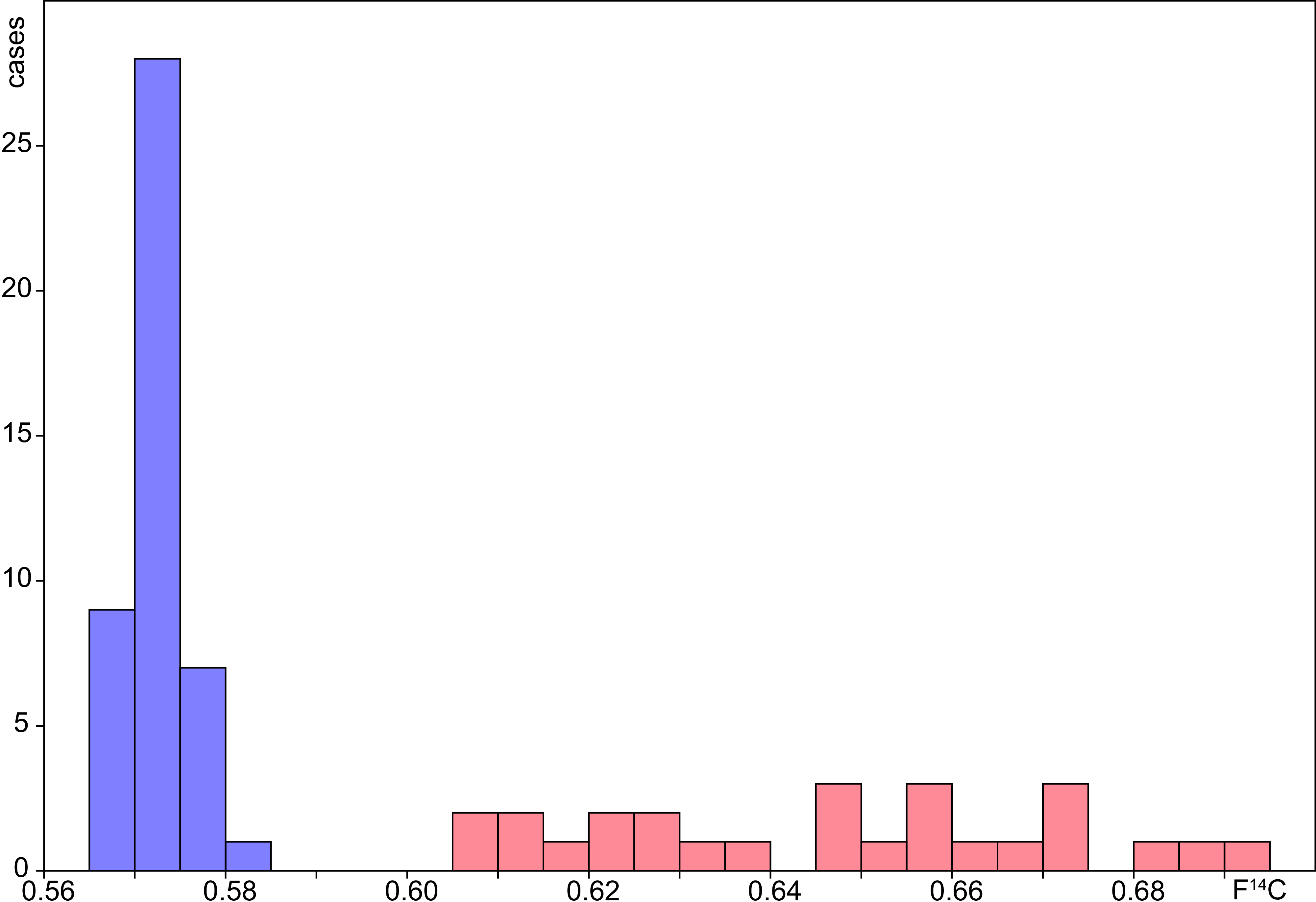
The narrow range of Wartberg-phase 14C results, relative to the gap between the “phases” (Figure 4), suggests that only the second-phase results are affected by contamination. Kiel 14C ages for other Wartberg assemblages, obtained concurrently, are all credible. More detailed sequencing (da Silva et al. Reference da Silva, Nebel, Kolbe, Myburgh, Klimscha, Görner, Fuchs, Meyer, Schierhold and Rind2026) now reveals 27 instances of first- or second-degree relatedness between 20 dated individuals at Niedertiefenbach; none of the 14C ages (Meadows et al. Reference Meadows, Rinne, Immel, Fuchs, Krause-Kyora and Drummer2020) are incompatible with these relationships. An identity-by-descent (IBD) network links many individuals buried at various Wartberg sites, including Altendorf (da Silva et al. Reference da Silva, Nebel, Kolbe, Myburgh, Klimscha, Görner, Fuchs, Meyer, Schierhold and Rind2026). 14C ages obtained in Kiel in 2017–2019 for 18 human bones from two other sites, Sorsum and Rimbeck (da Silva et al. Reference da Silva, Nebel, Kolbe, Myburgh, Klimscha, Görner, Fuchs, Meyer, Schierhold and Rind2026), support the first- and second-degree relatedness between individuals from these sites and Niedertiefenbach, and IBD links between Sorsum, Rimbeck and Altendorf. Of eight Altendorf individuals with IBD links to other Wartberg sites, six were dated to the Wartberg phase, and two to the second phase, the expected ratio if the Wartberg-phase dates are accurate, and the second-phase dates are spurious.
Frequency histogram of all Altendorf bone F14C results, contrasting the tight cluster of Wartberg-phase results (blue) with the spread of second-phase results (red).

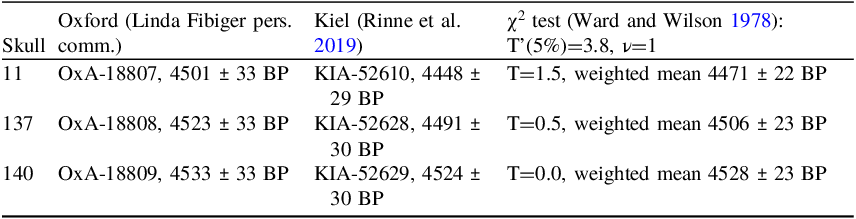
In 2008, three Altendorf skulls were dated at the Oxford Radiocarbon Accelerator Unit, using solvent washes, collagen extraction and ultra-filtration (method AF*; Brock et al. Reference Brock, Higham, Ditchfield and Bronk Ramsey2010). Kiel 14C ages for these skulls are statistically consistent (Table 2), so ultra-filtration, not used at Kiel, had no measurable effect. This supports the accuracy of the Kiel Wartberg-phase 14C ages but has no bearing on whether ultra-filtration would have affected the second-phase results.
Oxford (2008) and Kiel (2017) 14C results on the same Altendorf skulls.

Table 2. Long description
A table comparing radiocarbon dating results from Oxford and Kiel for Altendorf skulls. The table has four rows and three columns. Column headers are Skull, Oxford (Linda Fibiger pers. comm.), Kiel (Rinne et al. 2019), and χ2 test (Ward and Wilson 1978): T’(5 percent)=3.8, ν=1. Row 1: Skull 11, OxA-18807, 4501 ± 33 BP, KIA-52610, 4448 ± 29 BP, T=1.5, weighted mean 4471 ± 22 BP. Row 2: Skull 137, OxA-18808, 4523 ± 33 BP, KIA-52628, 4491 ± 30 BP, T=0.5, weighted mean 4506 ± 23 BP. Row 3: Skull 140, OxA-18809, 4533 ± 33 BP, KIA-52629, 4524 ± 30 BP, T=0.0, weighted mean 4528 ± 23 BP.
Nitrocellulose FTIR peaks in untreated bone dated to both phases, but not in any collagen spectrum, suggest that Zaponlack remained soluble in acetone. The amount of Zaponlack required to explain the 14C offsets would have affected EA-IRMS results; in particular, F14C would be negatively correlated with δ 15N, which we do not observe (Figures 2 and 3). Due to the addition of plasticizers, modern nitrocellulose glues are not fully soluble in organic solvents (Brock et al. Reference Brock, Dee, Hughes, Snoeck, Staff and Bronk Ramsey2018), but France et al. (Reference France, Epitropou and Kavich2019) found that nitrocellulose did not affect collagen stable isotope values, as any consolidant not removed by acetone remained insoluble in acid, and could be removed by filtration (cf. Meadows et al. Reference Meadows, Boudin, Groß, Jantzen, Lübke, Wild, Groß, Lübke, Meadows and Jantzen2019).
By elimination, the glue causing the Altendorf 14C offsets must be collagenous, and thus undetectable by FTIR. Any treatment that dissolves it would also remove endogenous collagen (Takahashi et al. Reference Takahashi, Nelson and Southon2002), hence the lack of a clear correlation between yield and F14C in second-phase samples (Figure 3). Contamination with recent-modern bone/hide glue could explain the 14C offsets, provided that its δ 13C, δ 15N and δ 34S values were close enough to those of Wartberg-phase collagen to mask any correlation between F14C and stable isotopes in second-phase samples.
In this case, however, we would expect non-human biomarkers in second-phase bones. DNA sampling targeted the densest bone within the pars petrosa, which was probably not consolidated, so the DNA barcoding results are inconclusive. While it is difficult to define an appropriate detection limit for collagen from non-human taxa, ZooMS results on second-phase collagen imply that any bone/hide glue was made from primate remains. LC-MS/MS detection of type 3, 5 and 7 collagen biomarkers, which are rare-absent in bone collagen, suggests that skulls 199 and 222 were treated with glue derived from soft tissues, confirming that modern hide glue is the most plausible explanation of the 14C offsets. Some of the type 3 collagen peptides are unique to primates.
When Jordan consolidated the more fragile skulls in 1934, he may have contaminated them with (unreported) hide glue, or his Zaponlack may have contained gelatin from old celluloid films. Either way, it is difficult to see how such gelatin could contain only primate biomarkers, or, if derived from other mammals, why it would not have been detected by proteomics. Perret’s consolidation of the entire assemblage is probably responsible for thin Zaponlack films on skulls dated to both phases. This work took place in 1935–1937 at the Kaiser Wilhelm Institute for Anthropology, which kept apes and monkeys for experimental use (Schmuhl Reference Schmuhl2005), potentially providing modern primate skin collagen that Perret could have applied to some skulls before the Zaponlack. Although human bones from Napoleonic battlefields were used for industrial purposes during the 19th century (Pollard Reference Pollard2021), human bone glue would not account for the skin collagen biomarkers detected by LC-MS/MS. Given that Perret’s Zaponlack remains in good condition today, we suspect that later interventions were limited to repairing breaks, with adhesives that may include the skull 72 and 140 glue samples.
Museum objects and human remains are intrinsically valuable, and it will seldom be possible to date multiple samples to test for contamination, as we did. Osseous objects consolidated with bone/hide glue could be recognized before 14C sampling, if surface glue is tested by FTIR and ZooMS. ZooMS and DNA can only detect bone/hide glue made from a different species to the object, however. Minimally invasive sampling for ZooMS is a valid strategy before 14C sampling, both to detect bone/hide glue, and to show the survival of endogenous collagen (Harvey et al. Reference Harvey, Egerton, Chamberlain, Manning and Buckley2016), preventing unnecessary damage to undatable objects. ZooMS analysis of collagen from previously dated objects, particularly stray finds, is also worthwhile (e.g., if the date is unexpected, considering the morphometric species attribution).
Conclusion
Given their internal consistency, and comparisons with dates from other Wartberg gallery graves, the Altendorf Wartberg-phase 14C ages should be accurate, despite the ubiquitous use of Zaponlack. Another, unrecorded consolidant was apparently applied only to the second-phase skulls. This appears to have been bone/hide glue, made from primate soft tissues. Bone/hide glue cannot be fully removed by bone extraction procedures, including isolating bulk or individual amino acids. At Altendorf, a large-scale dating program and good collagen and aDNA preservation clearly demarcate contaminated from uncontaminated skulls, but in other circumstances only dating multiple samples of the same specimen would show which 14C ages are reproducible, despite sample inhomogeneity. As this is rarely feasible, our case-study illustrates a problematic gap in our ability to accurately date bones in museum archives.
Supplementary material
To view supplementary material for this article, please visit https://doi.org/10.1017/RDC.2026.10287
Acknowledgments
We thank CRC1266 (DFG project no. 290391021), which funded the analyses; staff of the Leibniz Labor, Kiel; and particularly Dr Irina Görner (Hessen Kassel Heritage) for supporting our research.






 Open access

