It is difficult to exaggerate the level of critical praise that American solo performer Ruth Draper received during her long career, which stretched from 1920 until her death in 1956. As one critic notes: “Very few people have ever talked very coherently about Ruth Draper. There are no standards by which to gauge her. The magic she conveys is as inexplicable as air or light or love.”Footnote 1 Indeed, after reading the myriad panegyrics that collected during her career, words like “magic,” “genius,” “powerful,” and “consummate” begin to lose their meaning. Her critics were so adoring that by 1956, one admitted, “London has long ago worn its most extravagant adjectives, clichés, and superlatives to tatters in its attempt to cope with her achievement.”Footnote 2
What made Draper's performances, composed of a series of monologues in which she embodied several different characters, so extraordinary? Rather than resort to superlatives, George Bernard Shaw reportedly described a Draper performance by stating simply, “That's not acting. That's life.”Footnote 3 Shaw's reaction summarizes the consensus surrounding Draper's talent: that she did not merely impersonate or enact her characters but became them. Studs Terkel, in his article titled “When Ruth Draper Was Onstage, the World Was There,” expands on this idea in universalizing terms: “she became all of us. So human. So ordinary.”Footnote 4 Likewise, Jay DiPrima's 2016 article, “Remembering Ruth Draper,” one of the few recent works of scholarship on Draper, argues that “what distinguished Draper's ‘sketches’ from the other monodramatists of her time” was her “sense of humane, psychological realism,” and the “dimension of human sympathy in her writings.”Footnote 5 This idea moreover, that she coupled “sympathy” with “realism,” was present from her earliest notices. A review in the Observer from 1 February 1920 comments on both the keenness of her observations and the kindness of her portraits: “Miss Draper sees intensely, understands piercingly, and can express cleanly. . . . At the bottom of it all lies sympathy. She can jest because she understands.”Footnote 6
Critical discussions of Ruth Draper, then, overwhelmingly agree on her talents as a realist and a humanist. They praise her ability to portray a character truthfully along with her capacity to pay sympathetic attention to universal human experiences. Given that she was a woman who performed exclusively female characters, there has been surprisingly little or no scholarly consideration of her performances as feminist. This absence likely stems from the general lack of scholarship on Draper's career and writings but is also indicative of the tension between realism and feminism. Feminist critics and performance theorists of the 1980s and 1990s challenged and rejected realism as a genre, viewing it, in Sue-Ellen Case's terms, as a “prisonhouse of art” for women, with its frequent objectification of the female subject and emphasis on the domestic sphere.Footnote 7 In Unmaking Mimesis, Elin Diamond investigated how “realism operates in concert with ideology” by “mystif[ying] the process of theatrical signification.” With realism's insistence on “an objective world” that can be represented faithfully onstage, Diamond explained, it “reinforces” the dominant ideologies of that world, such as patriarchy.Footnote 8 Diamond also, however, offered the possibility of a “feminist mimesis,” which, “if there is such a thing, would take the relation to the real as productive, not referential, geared to change, not to reproducing the same.”Footnote 9
More recent scholarship has questioned the outright dismissal of realism by feminist critics and looked for more “productive” relationships to the real from within the genre as well as outside it.Footnote 10 Roberta Barker and Kim Solga's anthology New Canadian Realisms “celebrates realism's contrarian powers,” calling attention to the paradoxes of a form that “purports to be ‘real’ but of course can never be,” and the ways in which that contradiction can and has been used for “politically productive ends.”Footnote 11 In addition to reconsidering realism as a genre, feminist scholars have revisited realist acting techniques and interrogated the binary drawn between Brecht and Stanislavsky. J. Ellen Gainor's “Rethinking Feminism, Stanislavsky, and Performance,” for instance, recontextualizes the arguments made against realism by Sue-Ellen Case, explaining that they were targeted at the type of realist drama produced by the “matrix of Method director-playwright-actor” in the Group Theatre.Footnote 12 Caught within the critique of this matrix, Gainor argues, feminist scholars often neglected to consider “feminist creativity,” including the work of actors whose performance techniques might incorporate both Brecht and Stanislavsky.Footnote 13
A director-playwright-actor in one, Ruth Draper created a performance technique all her own. She never had any formal acting training, and traces of both Brecht and Stanislavsky can be found within the techniques she devised. Her monologues likewise rely on both realist and antirealist conventions. Draper, in other words, presents an optimal subject of study as a neglected “feminist creat[or].” Taking up both Diamond's suggestion of a feminist mimesis and the more recent feminist reconsiderations of realism, this article examines Draper's relationship to “the real” within her approaches to representation and its reception by critics and audiences. In particular, I query the tension between universality and specificity in Draper's writing and performance techniques and argue that the multivalence and theatricality of her monologues demonstrate a “productive” paradox within Draper's realism. By expanding the view of Draper's realism, the article ultimately finds a potential for “feminist mimesis” within Draper's solo performance techniques and connects Draper's work to the realignment of realism and feminism within current discourse.
Finding these potentials in Draper's techniques also ties them to the more overtly political and feminist work of solo performers and performance artists that followed her in the second half of the twentieth century. Draper's approach to solo performance prefigures the work of performers like Lily Tomlin and Anna Deavere Smith, who similarly use the tools of mimicry and mime to portray a series of disparate characters. By examining Draper's connection to these performers, I do not seek to ascribe a preternatural foresight to her performances. Rather, following Charlotte Canning's schema in her essay “Feminist Performance as Feminist Historiography,” I hope that strengthening the connections between Draper and later performers will help “to transform knowledge about gender and the past.”Footnote 14
Discussing Draper's appropriation of otherness in her character sketches, for example, opens many useful questions about the frequency of cross-racial, cross-ethnic, and cross-class portrayals in female solo performance. The acceptability of portraying multiple identities on a single body as well as the range of identities that a certain performer might inhabit depended on the cultural standards and contexts of their time. Given the often racist, sexist, and classist attitudes of American culture, these standards did not prevent white, female solo performers from problematic portrayals. While it might be tempting to view the successive generations of solo performers as a progression from the unenlightened racial caricature of the vaudeville era to the socially conscious and politically minded projects of performers like Anna Deavere Smith, there is also something to be gained by considering the similarities between Smith's work and the earlier performers—by reading backward to unlock the aspects of multicharacter solo performance that facilitate this kind of fluidity and interrogate the aspects that fail to hold up to the scrutiny of contemporary politics.
Born in New York in 1884, Ruth Draper was the second-to-last child in a large and well-connected family. Her father, Dr. William H. Draper, was a physician; her mother, Ruth Dana Draper, was the daughter of Charles Dana, the influential editor and co-owner of the New York Sun. Due in large part to the efforts and social graces of Mrs. Draper, the family maintained a high position in New York society. In an accomplished family, Ruth Draper's talent and fame eventually outstripped them all. Her gift for imitation presented itself at an early age. As a child, she entertained her family with impressions of household figures, such as their Jewish tailor and German governess, and her first performances occurred in the Draper's drawing room for family and friends. As she grew up, she developed these imitations into monologues and performed them at private parties and functions. Although her privileged background gave her an easy introduction into the practice of society entertainment, it also prevented her from entering the theatrical profession until much later in life. For a woman of Mrs. Draper's stature, it was simply unthinkable that her daughter would go on the stage, and while her mother lived, Ruth Draper remained an amateur.
The first steps toward Draper's professional career occurred in 1914, with her mother's death and the advent of WWI. In 1915, Draper embarked on a solo recital tour of the United States. At the conclusion of the war, she went abroad, entertaining large crowds of soldiers with the YMCA. During these years she also experimented with other, more traditional forms of theatre. She played a small part in A Lady's Name with Marie Tempest, and in February 1917, she produced, staged, and acted in a one-time-only performance of three short pieces: Strindberg's The Stronger, a pantomime of her own devising, and her monologue “The Actress.” “Only The Actress received good notices,” her biographer Dorothy Warren recounts; “the program as a whole was damned as ‘ill-advised, misguided and tedious.’”Footnote 15 After these experiments, she never again attempted to act in anything other than her own monologues. Draper's need for creating her own work was so pronounced that when her great admirer Henry James wrote a monologue for her, she refused to perform it—not only because the monologue was not up to her standards, but also because she felt uncomfortable performing any material but her own.
Draper herself explained that the impetus for her decision to pursue a solo career stemmed from three main sources. One was the encouragement of the pianist, Ignacy Paderewski, a friend of the Draper family. The other two were Beatrice Herford's monologues and the Chinese play The Yellow Jacket: “I saw Beatrice Herford perform her monologues and realized what could be done. And I saw a Chinese play, The Yellow Jacket, without scenery—small steps that one went up and down, so, when one wanted to enact climbing a mountain—and I understood the extraordinary illusion that can be created with nothing.”Footnote 16 With these references, Draper aligned her own performance style with mime and mimicry. A decade into her career in 1930, she went to see Mei Lan-fang on his American tour several times and again commented on her “understand[ing]” of the performance style.Footnote 17 In both Herford's satirical imitations of ordinary women and Mei Lan-fang's embodiment of dan roles, an added focus is given to the performance and representation of female character. In her main sources of inspiration, then, Draper responded to the possibilities of a bare stage and a central female character—both of which were generally obscured in realist dramas.
The texts of Draper's monologues lived entirely within her memory, and she constantly revised and refined them in performance, allowing them to be recorded and published only at the end of her life. Since her death, the collection of her monologues, The Art of Ruth Draper—containing thirty-five monologues and editor Morton Dauwen Zabel's lengthy essay on Draper—remains the primary text concerning her work. Dorothy Warren, an acquaintance of Draper's, edited the publication of her letters and published a biography, The World of Ruth Draper, in 1999. In 2000, Susan Mulcahy produced a CD rerelease of Draper's recordings.
Despite her relative obscurity today, Draper's success in her lifetime is undeniable. She made her professional debut as a monologist at the Æolian Hall in London on 29 January 1920, and for the next thirty-six years performed regularly, with a season each year in London or New York and several world tours. Among her papers at the New York Public Library's Billy Rose Theatre Collection is a typewritten document titled “Random Recollections of Memorable Appearances,” which lists the wide range of places where she performed, from “the tables of Balliol College” to “the counters of the general store in a small copper-mining village in New Mexico.” The list also includes Sing Sing Prison, Windsor Palace, the White House, Fiji, “the Palace in Marrakesh,” and the times she “did her characters” for “Sarah Bernhardt, Eleanora Duse, Ellen Terry, Bernard Shaw, Paderewski, Sir James Barrie, Henry James.” The length and unmitigated triumph of Draper's career as a solo performer was such that her name became synonymous with the one-woman show and solo performance in general.Footnote 18
Scholarship on Draper often cites these facts and her glowing reviews to provide evidence of her greatness, but none has mined the large body of extant reviews for any nuanced perspective on the reception of her monologues. Although most critics adored Draper, there are some notable, and blatantly misogynistic, exceptions. More crucially, the record provided by the reviews contains conflicting and complicating insights into Draper's so-called realist techniques. For instance, in a review from the beginning of her career, critic James Patterson calls into question the positive reception Draper enjoyed, arguing that her work was notable only because she was one of the only women still performing “impersonations.” Patterson further explains that ignorant women were the biggest fans of her work: “Women love Miss Draper. They laugh terribly at her impersonation of the things they do themselves and do not realize it.”Footnote 19 By connecting Draper to the realms of “impersonations” and women's humor, Patterson trivializes her talent, but he also rightly identifies the tradition to which Draper belonged. Following in the footsteps of monologists like Beatrice Herford and mimics like Cissie Loftus, Draper's career grew out of society entertainment and vaudeville traditions rather than realist drama or actor training.Footnote 20 Patterson's review is a reminder, therefore, that when other critics praise the “realism” of her portraits, they are citing the remarkable verity Draper brought to an antirealist form.
Although framed in a negative light, Patterson's comments also draw attention to Draper's connection with female audience members. As indicated by the list of her “memorable appearances,” Draper could adapt her monologues to suit a wide variety of performance venues and environments, and she could appeal to audience members across boundaries of class, nationality, and gender. At the beginnings of her professional career, Draper proved the broad appeal of her work, successfully entertaining large crowds of soldiers after WWI and large, mixed crowds on a tour of British Music Halls in 1920. Writing from her stint in Manchester, for instance, she remarks on the challenge of winning over the working-class audience members: “these factory town audiences can be pretty rough—but when you do get them it's wonderful.”Footnote 21 Draper's initial development as a performer, however, occurred within her own milieu, reciting monologues for private parties and events, many of them teas, luncheons, or benefits organized by women for women. Understandably, several of her monologues, especially her more satiric portraits, feature characters to which the women in the audience could directly relate. That Draper expanded her repertoire beyond these portraits to win more “universal” acclaim should not overshadow her ability to create material tailored to female audience members both of her own class and background and otherwise. It should not negate the fact that, as Patterson phrases it, “women love Miss Draper.”
Thirty-three years after Patterson's review, John Chapman similarly took pleasure in disagreeing with the critical consensus on Draper:
Ruth Draper, the talker, retired from talking last year and her audiences gave her such a prolonged and profitable farewell that she changed her mind and reappeared at the Bijou Theatre last evening, talking some more. She is a remarkable woman—but then, all women are remarkable in the same way. Once they get started talking they can't stop.Footnote 22
The ease with which Chapman and Patterson dismiss Draper affirms the unlikelihood of her otherwise smooth path to fame and adoration. In their disgust and disinterest, these critics fixate on aspects of her work, which most reviews tend to gloss over—that her shows consisted of a woman talking alone onstage, featured only female characters, and appealed to female audience members. The critics who praise her work often downplay this fact in favor of commenting on the universality of her characters and the remarkable manner in which she populated the stage.Footnote 23
More insidious than the facile misogyny of these negative reviews, then, is the discourse surrounding the praise for the accuracy and sympathy of Draper's character portraits. Although these traits are certainly present in (even at the heart of) her work, both the realism and the humanity of her portraits are commented upon with a vocabulary that skews toward female-gendered words like “compassion,” “generosity,” and “heart.” In their original context, the intentions behind these words are positive. Critics like Philip Hope-Wallace and Brooks Atkinson write eloquently about these characteristics:
Her success as an artist came as much from the depth and generosity of her character as from her precision in observing and skill in recapturing the essence of so many different characters. Underlying the laughter, there was always compassion. (Hope-Wallace)Footnote 24
As a writer Miss Draper has the generosity of perspective and the detached wisdom that see the spirit behind the mask of reality, and as an actress she has warmth, integrity, dignity and stature. She can entertain the customers with the best of them, but she can also look down into the ringing depths of human beings. (Atkinson)Footnote 25
Nothing in the comments above diminishes Draper's supreme skill; rather, they commend Draper's ability to find a universal humanity in her portraits. By qualifying the parts of her act that elicited “laughter” or “entertain[ed] the customers,” however, both critics seek to distance Draper from a satirical or critical intent. Even the realism of her portraits, the critics reassure the reader, is tempered by her humanism. A problem arises not necessarily with individual instances of gendered words like “heart” and “generosity,” then, but with the persistence of this single perspective on Draper's work. The repeated praise for Draper's combined observation and compassion diminishes the active, creative work she did, honing and crafting the monologues over a long career. Moreover, it implies that any greatness in her work derived from the ability to transcend the particulars of female experience to reach the “ringing depths” of all humanity.
The desire of these critics to separate Draper's work from the large number of women who performed “impersonations” on variety stages in the decades preceding her career perhaps reflects a discomfort surrounding the imitative prowess of women in this period, when modernist anxieties over authenticity and reproduction made mimicry “a provocative and historically significant mode of cultural enactment.”Footnote 26 In Female Spectacle, Susan Glenn argues that the practice of mimicry gave women onstage a new role, “that of the artist-intellectual”: “the mimics and their audiences not only asserted the right of women to look powerfully at others, but their ability to creatively elaborate what they observed.”Footnote 27 The male critics who privileged Draper's “heart” over her wit thus detracted from the critical potential of Draper's observational and creative abilities.
The most overt example of this biased perspective occurs in Morton Dauwen Zabel's prefatory memoir in the printed edition of Draper's monologues. Zabel, like many newspaper reviewers, attempts to explain the appeal of Draper's art by categorizing her talent as one of observation and empathy, rather than “invention” or “creation” as he terms it. “[H]er art,” he writes, “was essentially one of acute empathy, insight, and recognition, not (except in a few obvious tours de force) of deliberate invention or fantasy.”Footnote 28 Unable to see Draper as a generative, creative artist, Zabel continues, “She was at heart a realist, a recorder of social and moral fact, a reader of the common human destiny.”Footnote 29 The passive descriptors like “recorder,” “reader,” and “recognition” undermine any inventive elements in Draper's monologues and imply that her art was merely reproductive.
That the male critics responding to Draper's work consistently emphasized the existence of an imitative or innate understanding of humanity in her work corresponds to dichotomous thinking, which sees women as instinctual and men as intellectual. It also indicates that Draper's monologues, at least on first analysis, functioned in line with (Diamond's) mystifying theatrical signification of realism, reinforcing hegemonic ideas of gender and representation. When reading against the grain of this existing narrative about her work, however, several salient points emerge that contradict the view of Draper as purely a “realist” with humanist generosity. For instance, in several monologues Draper chose to shift identity instantaneously onstage (such as from young ingénue to disgruntled grandmother in “Three Generations in a Court of Domestic Relations”), drawing attention to the constructed nature of her characters. She also developed and performed a number of gibberish languages, seeming to mock her own abilities as an observer and chameleon. At the most basic level, she always performed alone on a bare stage, with no props, and minimal costumes, starkly eschewing the trappings of stage realism.
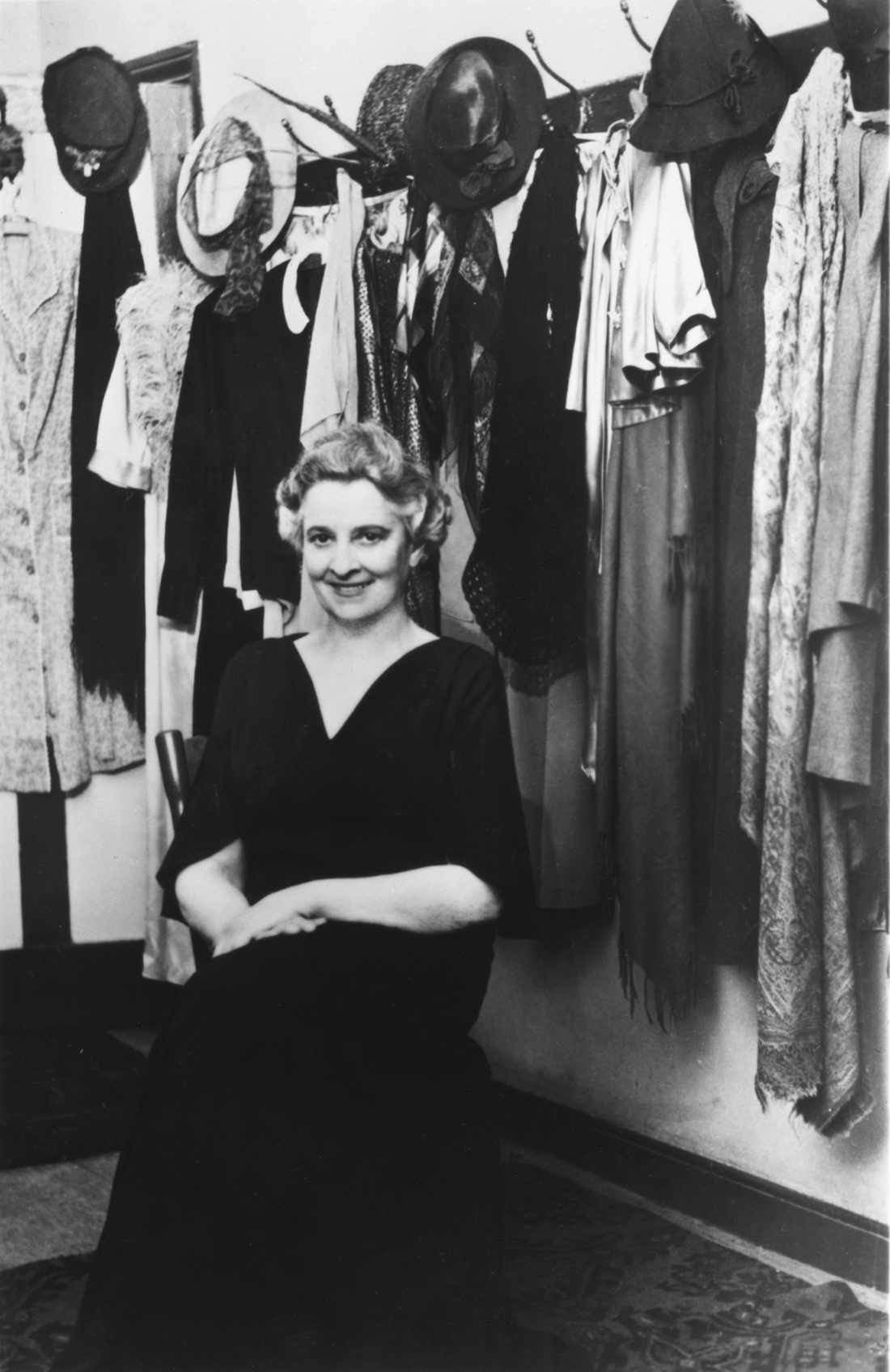
Turning to Draper's mimetic techniques, her choices as a performer reveal as much of an emphasis on difference as on universality as well as a paradoxically self-conscious style of verisimilitude in her acting. In one of Draper's publicity photos, she sits demurely in the middle of a dressing room, wearing her standard costume of a brown velvet gown. Lining the wall behind her is a row of coats, hats, and shawls (Fig. 1). These simple costume pieces became the emblems of her art, the signs of the many different characters she would inhabit through the course of an evening's performance. The shawls became so closely linked with Draper's person that, at her funeral, they decorated her coffin. Symbolizing both the minimalism of her performance style and the many characters in her “company,” the distinctive costume pieces worn for each character also marked the farthest Draper would go toward any kind of illusionism in her representation style. The design elements for her performances were characteristically stark: “No ornate scenery, no elaborate costuming, no trick lighting,” one review from the New York Herald Tribune describes; “Just a bare stage hung with soft cinnamon velvet curtains, a chair and a table, a single dignified figure in brown.”Footnote 30 The bareness of the stage coupled with the fullness of the imagined worlds she created defined the essence of Draper's performances.
Ruth Draper sits before a row of coats, hats, and shawls—the simple costume pieces that became emblems of her art. Billy Rose Theatre Division, the New York Public Library, “Ruth Draper.” Photo: New York Public Library Digital Collections, accessed 29 March 2020, http://digitalcollections.nypl.org/items/510d47de-c8aa-a3d9-e040-e00a18064a99.

By performing a series of unrelated monologues in one evening's performance, Draper followed the format of monologists like Beatrice Herford, but she also experimented with and expanded her monologues into much longer and more sophisticated pieces. Capable of comic and dramatic, satirical and melodramatic modes, she stretched the form to its fullest range. One monologue by Draper might take as long as an hour to perform and could contain anywhere from one to thirty characters. Draper also broadened the field of character types in terms of age, nationality, profession, and class, her repertoire including “A Scottish Immigrant at Ellis Island,” “A Charwoman,” “A French Dressmaker,” a “German Governess,” and “a Dalmatian Peasant.” As Michael Feingold notes, Draper pushed beyond the expected comedic portrayals of society ladies from her own class to capture the voices of those outside her personal sphere: “She set out, in effect, to study experiences as alien to her as possible, to texture her programs and ‘stretch’ her acting abilities.”Footnote 31
Draper herself described this intention in her work, explaining that as an actor “Your curiosity must take you outside of yourself so that you cease to exist and the thing you pretend you are takes your place.”Footnote 32 Contradicting Stanislavsky-based acting techniques, which look to the self for inspiration and material, Draper quite explicitly erases the self in order to capture her various, diverse characters. Her comments, in fact, prefigure the theories of another female solo performer, Anna Deavere Smith. In writing about her work, Smith situates the origins of her solo-performance style within the realm of acting teaching and theory. Dissatisfied with the “‘self-based’ method” dominating American acting technique through the influence of Stankislavsky and his progeny, Smith “began to look for ways to engage [her] students in putting themselves in other people's shoes.”Footnote 33 This approach questions the assumption within naturalistic acting techniques that the self is the site of true character. For Smith, “the search for character is constantly in motion. It is a quest that moves back and forth between the self and the other.”Footnote 34 By seeking and creating characters that reached outside of her own experience, Draper likewise practiced an “other-oriented” approach,Footnote 35 in which the measure of a successful performance was not just how near she came to each character, but how far she traveled to get there.
In one case, for example, Draper traveled to the East End of London “to try and get more of the Cockney accent.”Footnote 36 She describes the visit in a letter to her friend, Harriet Marple:
I visited with the Sanitary Inspector this morning and saw many typical homes and some sad cases [. . .] tho’ no immediate help to my monologues, I love the feeling of being immersed in all the vital force of this grim and appealing underworld: [. . .] It's terribly depressing and desperate—the impotence one feels in the face of such problems. I can only hope something of what I feel will come out in my poor old monos.Footnote 37
Draper's condescension here is clear. Unlike Smith, Draper was a privileged, white woman who avoided any overtly political messages in her art. In hindsight, many of her portrayals do not measure up to standards of socially and politically conscious performance, especially her appropriation of ethnic otherness. Also apparent in this letter, however, is the effort and thought Draper applied to her portrayals. When Draper made this trip to the East End, she had just finished her stint of performances at Music Halls in Manchester and Brighton, venues where dialect humor and racial stereotypes abounded. That Draper felt the need to “immerse” herself in the East End in order to improve her Cockney accent demonstrates a conscientious approach to the Others of her monologues. Beyond simply “stretching” her acting abilities, then, Draper's inclusion of a diverse array of characters also stemmed from altruistic motivations. Draper and her family, it might be noted, were active in several philanthropic causes of the day. Her sisters all made significant contributions to education, health care, and war relief organizations, and, most notably, her aunt, Eunice Dana, was an active and militant suffragist said to be “one of the greatest money raisers for the suffrage movement.”Footnote 38
Although this attention to authenticity might indicate a naturalistic acting approach, Draper's monologues also include several nonnaturalistic aspects. Along with the “other-oriented” approach, Draper also shares with Smith a performance style that showcases the virtuosity of her particular brand of mimicry while at the same time pointing to the incompleteness of the picture. The sheer number of characters in a Draper monologue, for example, exceed the boundaries of a naturalistic technique. In the appendix to The Art of Ruth Draper, Zabel tabulates the total number of characters present in the volume, finding that in the thirty-five published monologues, Draper portrayed a total of fifty-four characters, while evoking the presence of 330 other figures. This remarkably high number derives in part from pieces like “A Cocktail Party,” in which the single speaker addresses or makes reference to twenty-four other characters. The titular party is brimming with guests for the speaker to bump into, avoid, and gossip with, and through their conversation, the crowded scene materializes. A typical passage from this short piece, for instance, names five different people in a few short lines:
Hello, Maud! . . . My dear, I've just made the most awful break! . . .
(Sips, then bumps someone at her right)Clarence!—if this isn't the luckiest thing! . . . I've been dying to see you! . . . Do you know Miss Doolittle? . . . Of course, how stupid of me. . . . I forgot you were cousins. . . . How's Genevieve?
(To the servant)May I have one of those?
(She shifts her glass)They're the best things! . . . I know. . . . But if you can get Parmesan cheese they're even better. . . . I have the recipe. . . . Clarence, I must know if it's true about Jim and Caroline?Footnote 39
With such a high density of unseen characters, the audience member might easily become confused, but Draper excelled at making the disembodied figures, such as Maud or Clarence, as clearly delineated as the characters she embodied. Monologues like “A Cocktail Party,” therefore, provided Draper with the chance to display her virtuosity in this regard, demonstrating an intentional showmanship behind Draper's execution of her form. By choosing a ridiculously crowded scene for her character to navigate, Draper flaunts the ability to evoke invisible characters.
Pushing the boundaries of believability, the scene also illustrates the paradox of Draper's realism. In the broadest definition, her work fits many of the characteristics of literary realism. “A Cocktail Party,” for instance, provides a slice of life, focusing on the mundane frustrations and amusing faux pas that accompany conversation in a crowded room. Parts of her acting technique also fits with realism; a piece like “A Cocktail Party” required full immersion into the given circumstances of the scene, and Draper excelled at keeping an absolute attention to detail in her performances with a full awareness of where her “invisible” scene partners were at all times. Moreover, her monologues ostensibly kept the fourth wall intact, since the dialogue always addressed the implied interlocutor and never the audience directly. The result in “A Cocktail Party” was a “realistic” portrayal of a woman at a crowded party, as if the partygoer had simply been plucked from the party and dropped onto the stage alone.
Yet how can a cocktail party scene be considered realistic when there was only one person onstage, holding an invisible cocktail glass, eating nonexistent cheese, and speaking to imaginary guests? Although her attention to the details of daily life, her fixation on manner, and her use of naturalistic speech fit into a general categorization of realism, Draper's style as a performer was highly theatrical. Her ability to evoke bustling restaurants or crowded cocktail parties may have caused audiences and critics to get lost in the illusion, but the starkness of the stage and the focus on the single performer locates her work far outside an illusionistic stage realism. (Miming is still miming, no matter how convincing.) Thus, while the content of her monologues may have been realist, the staging was antirealist, or more precisely anti-illusionistic. The distinction is important because a consideration of Draper's theatricality enables a perspective on her work that goes beyond a purely character-based reading of the everyday women in her writing and allows for an investigation of the ways she constructed female identity onstage and manipulated the gaze of the audience.
Although Draper was both author and actress, her medium was the stage rather than the page, and as her letters make clear, she relied on feedback from her audiences when composing and refining new monologues. She may have kept a semblance of the fourth wall intact, but her relationship with the audience was always foremost in her mind. She counted audience members as active participants in the creation of her scenes and described their role as central to her philosophy of both acting and drama:
What is really important is not to put anything ‘over,’ but to bring the audience up onto the stage and into the scene with you. It is they who must give you even more than you give them in the way of imagination and creative power. Once this was the great fact of the drama. It needed no artificial effects; it simply brought the actor and the audience together and fused their minds and feelings in an imagined reality.Footnote 40
Draper's comments here point to the key difference between her form of theatrical signification and that of realism. Insisting that the audience cross over the fourth wall and into the scene, Draper asks her spectators to create an “imagined reality” without the assistance of “artificial effects.”
Conversely, in discussing the operations of stage realism, Diamond stresses the importance of physical objects and perspectival distance to the spectators’ participation. Realist dramas fill the stage with “objects that supplied evidence” and “characters who supplied testimony,” positing a singular, universal perspective, from which to view and judge the representations onstage.Footnote 41 Crucially, this stage–audience relationship facilitates realism's system of theatrical signification, which “naturalizes the relation between character and actor, setting and world.”Footnote 42 Inevitably, the “eye [I]” position frames the world from a masculinist perspective, creating one of the key arguments against realism made by feminist theorists of performance in the late twentieth century.Footnote 43
Although Draper's monologues sometimes center on the domestic sphere, she creates the onstage world with her female characters as the sole reference points. Whereas realism requires a certain distance between the spectators and the stage to maintain the proper measurements of the “perspectival space,”Footnote 44 she seeks to eliminate this distance and bring the audience up onstage with her. She asks that each spectator enter the scene, not as a “judge” or in relation to a present male subject but as part of the scene itself. By casting the spectators as her scene partners, Draper allows the perspectives on her monologues to be as various as the people in her audience, avoiding a “single and immobile” viewpoint.Footnote 45 The Herald Tribune, for instance, recounted an amusing instance of a group of audience members disagreeing over an interpretation of “Doctors and Diets”:
The telephone in the office of Miss Draper's manager rang. A feminine voice asked whether a bet could be settled. ‘What kind of hats do the women in Miss Draper's sketch, ‘Doctors,’ wear?’ she asked. ‘What's the bet?’ she was asked. ‘I bet that they were hats of the vintage of 1895, and my friend says modern,’ the caller explained. ‘You're both right,’ she was told. ‘Miss Draper is the only woman there, the other women do not exist, and so they do not wear hats.’Footnote 46
Draper was not wearing a hat either.Footnote 47 Instead, she prompted the audience members to fill in the details of the scene, with “hats of the vintage of 1895” or not. Not only did the audience members become so lost in the world of “Doctors and Diets” as to forget the imaginary nature of the characters, but they each contributed their own interpretation of the events—and as the manager rightly replied, each was equally correct. Draper's use of unseen characters and spare scenic elements in her monologues thus created a powerfully intimate relationship between performer and spectator: the spectator relying on Draper's mimetic ability to evoke a scene solely through her voice and body, and Draper relying on the spectator to fill in the gaps by entering the scene with her.
Although audiences, drawn in by the pull of this dynamic, often found themselves lost in the world of her monologues, Draper also incorporated moments that reminded the spectators they were watching a show. Although these moments did not alienate the audience in a strictly Brechtian sense, they did astonish them, producing a distancing effect by making the audience wonder at her seemingly superhuman mimetic skill. It was, in fact, the balance between show[wo]manship and verisimilitude in her performance to which critics like Brooks Atkinson responded so warmly. In the haste to praise the “truth” of her portrayals, of course, her theatricality was often overlooked. Draper's letters, however, reveal her to be a performer who understood this balance and intentionally crafted moments that showed the seams between her representations. A letter to Harriet Marple from 1922 details her decision to change costume onstage for her set of “Five Imaginary Folk-Songs.” She boasts of the “amusing” and “original” idea but wonders if New York audiences would be able to handle the “innovation.”Footnote 48 It might not seem like such an innovative idea today, but any kind of dressing in public was certainly a little risqué for a woman of Draper's class and time period. She clearly liked this innovation, however, and continued to perform pieces that required the changing of costume and character onstage.
One instance of this onstage quick change drew particular comment from audiences and critics. In her piece “Three Generations in a Court of Domestic Relations,” Draper used one of her famous shawls to switch among the “three generations” with a quick and determined motion. In an interview, Draper proudly remarked on the “speed” of these “transformations” to Studs Terkel, who writes:
There was one particular moment in “Three Generations in a Court of Domestic Relations” that knocked me out, as well as everyone else in the house. She was three women: an old immigrant grandmother, her harried, worn-out daughter and her vibrant 17- or 18-year-old granddaughter. How did she do it? “Instead of leaving the stage to adjust the shawl,” she said, “I just drop the shawl from my head to my shoulders, and then, for the young girl, I fling it off. I think it's the speed of the transformation that impresses them.”Footnote 49
Rather than leave the stage, Draper brought attention to the moment of transition, and the speed with which she changed character further heightened the effect. Transforming before their very eyes, Draper, like a magician, caused her audience to wonder, how does she do it?—a question that unmasks the act as an act. Mildred Adams also remarks on the marvel of these moments in the New York Times:
Of all [Draper's] moments the most unbelievable and convincing are those when, with a movement too quick for the eye to analyze, she sloughs off one personality and takes on another, leaving the discarded self there in the shadows to play its part in the drama. Say she does it with the twist of a shawl, a gesture of her arm, a contortion of her face, and you have noted only the surface things.Footnote 50
The contradiction between “unbelievable” and “convincing” in Adams's description illustrates the tension between the accuracy of her portraits and the theatricality of her performance style. Draper uses the “surface” gesture of the shawl to mark the boundaries between identities, a theatrical flourish meant to incite incredulity at her mimetic skill. At the same time, she fully inhabits each character, “convincing” the audience of the depth beneath the surface and causing the previous personality to remain present in the scene, with the “discarded self” still lingering in the “shadows.”
The conflict between the multiple identities that reside in the single body of the performer gives Draper's monologues a multivalent perspective and grants equal weight to the disparate female identities she inhabits. The three women in “Three Generations” each have an equal voice in their domestic dispute. In this “character drama” (which is how Draper regarded her pieces),Footnote 51 three generations of a Jewish immigrant family appear in court to settle an argument over the daughter's desire to marry and move west. Through the course of each woman's testimony, the audience learns that the daughter is tired of providing for her mother and grandmother and wishes to make a life with her future husband, sending her relatives to a “home for old people” in the process.Footnote 52 At the end of the daughter's monologue, the judge asks her to return with her fiancée on Wednesday to hear his final decision. By presenting the testimony of the three women, Draper invites the audience to sit in the position of “judge” as in Diamond's conception of realism, yet she leaves the decision open-ended. Although the daughter is the third one to testify and therefore has the last word, the specters of her mother and grandmother loom over the scene, tempering the cheery optimism of her language. One can easily picture the reactions of the older relatives, scoffing in the shadows at the daughter's insistence that her young man “won't drink no more when we get married” or that the retirement home she's found for them “is fixed up beautiful.”Footnote 53 The drama ultimately reserves judgment on the women, presenting the legitimate arguments of each family member but leaving the audience guessing the outcome.
The performative aspect of Draper's onstage transformations into several distinct characters, evident in “Three Generations,” corresponds to Jill Dolan's discussion of solo performance forms in Utopia in Performance. Like Diamond, Dolan finds potential for feminist representation techniques within the Brechtian aspects of multicharacter solo performance, which by virtue of its form, destabilizes the concept of identity, blurring distinctions between self and Other as the performer races through a series of personas. In a discussion of the solo shows of Lily Tomlin and Anna Deavere Smith, Dolan argues that Tomlin and Smith are able to “tak[e] on the other in a way that's not possible in the real world.” Their performances, she explains, become a site for “utopian performatives,” because they “model[ ] the fluidity of cultural identities.”Footnote 54 Draper's work bears a strong resemblance to that of her successors, and Dolan's analysis of Lily Tomlin's performance in The Search for Signs of Intelligent Life in the Universe especially highlights the similarities between Tomlin and Draper and provides a useful framework for considering Draper's art.
Dolan argues that, in addition to the blurred distinctions between self and Other, the performative aspects of Tomlin's performance maintain a Brechtian distance from the characters she presents. According to Dolan, Tomlin “creates a world with only her body as corporeal resource and as sign,” and like the descriptions of Draper's shawl twists in “Three Generations,” Dolan notes the speed of Tomlin's character transformations, writing that they “happen in split-second adjustments of posture, gesture, and voice.”Footnote 55 For Dolan, these quick gestures “materialize on Tomlin's face and body through her hard performative (and performed) labor” and facilitate her movement “between and among . . . social spheres.” The gesture becomes the gestus, defining the outward markers of identity, while the fluidity of Tomlin's chameleonic presence breaks down “presumptions” about social difference.Footnote 56
Although perhaps unintentional, Draper's shawl movements constitute her gestus, drawing attention, as they do, to the performed nature of the identities onstage. Moreover, like Tomlin, her talent for transformation demonstrates a utopian capacity for “taking on the other.” Reviews of her performances attest that she proved equally convincing as a thirty-year-old woman playing the grandmother in the early part of her career, as when she played the young daughter as a veteran performer of sixty. Thus, in “Three Generations” she circumvents the boundaries of age and culture, moving fluidly between the rigid obstinacy of the first-generation immigrant grandmother and the pliant optimism of the assimilated granddaughter. The structure of the character drama allows the perspectives of each woman to remain separate, yet also points to the connections between them through the materiality of the single performer's body. As Dolan discusses, this is possible because multiple-character solo performers are uniquely able to “stage various cultural identities on the same body in ways that highlight difference but also perhaps point toward commonalities among people.”Footnote 57 This is the universalism that makes Draper's art profound. Rather than positing any one perspective as the right one, Draper dramatizes both difference and commonality, staging multiple points of view that emanate from a single source.
It is worth noting that, in addition to Tomlin and Jane Wagner's Search for Signs, “Three Generations” resonates with the contemporary work of playwright-performer Heidi Schreck, whose play What the Constitution Means to Me had its Broadway premiere in March 2019. Schreck's play, a mostly (though not entirely) one-woman show, likewise considers how generations of women interact with and are affected by the legal system in the United States. In Schreck's case, she tells her own family's history, dating back to her immigrant great-great grandmother, who came to the United States as a mail-order bride, and focusing on the stories of herself, her mother, and her grandmother. Although telling her own story adds another dimension to “the real” of Schreck's play, her storytelling techniques include several distancing devices. In the early parts of her monologue, for example, she switches back and forth between playing her current forty-year-old self and herself as a teenager, allowing (like Draper) the multiple perspectives to exist simultaneously onstage. In Schreck and Draper's work, therefore, the combination of staging both “the real” and “the impossible” (e.g., playing multiple ages at once) creates an environment in which the individual and the collective (the personal and the political) are equally apparent and inextricably linked.
In addition to her shawl gestus, Draper's use of fake languages in her monologues also illustrate this combination. Alongside her visible costume changes, Draper's “Folk-Songs” showcased her talent for creating gibberish languages—imitations of Slavic, Scandinavian, and Balkan languages that captured their rhythms and inflections if not their sense. Within her oeuvre, the “Folk-Songs” serve as the clearest example of Draper the entertainer. That she performed silly songs in nonsense languages and changed into exaggerated national costumes onstage seems enough to undermine any uncritical categorization of Draper as realist. Moreover, her “Folk-Songs” cannot be dismissed as an aberration, since gibberish languages also made their way into her more serious monologues.
In “The Actress,” one of her better-known pieces, Draper portrayed a Slavic diva, who speaks a combination of English, French, and her native language throughout the twenty-minute monologue.Footnote 58 Draper originally titled the character drama “Mademoiselle X of the Theatre Français,” hinting at the character's multilingual background. As might be expected of an eastern European actress who performs in French, Draper speaks the English portions with a heavy accent that mixes both French and Slavic inflections. Her French is more fluent, and when she switches to her native tongue, to berate her manager, a torrent of language pours out. This language might be Polish, Russian, or even Romanian. Like the hats in “Doctors and Diets,” Draper lets the audience decide. Indeed, for nearly seven minutes in the middle of the monologue, the audience must interpret the meaning behind the fake words, following the course of the conversation through Draper's tone and expression alone. She thus plays with the audience's imaginative role in her work, asking them to find sense where there is none.
Of course, Draper's comfort with imitating and parodying the languages of minoritized cultures demonstrates the privilege of her position as a rich, white, American performer. Indeed, both Draper and Tomlin exploit the mobility of their whiteness to take on other identities. Yet Draper's imitations never intend ridicule. Instead, the linguistic liminality of “The Actress” makes the audience look and listen more closely to the character portrayed. The gibberish language forces a shift in perspective. It causes the audience to accept difference—a deluge of incomprehensible speech—while paying attention to commonalities—the clearly comprehensible emotion and intention behind the actress's gibberish.
With these performative disruptions of verisimilitude—costume changes, shawl twists, linguistic gymnastics—Draper opens the representational field of her monologues beyond the narrow scope of most realist drama. That openness creates room for multivalent perspectives on both the female performer and her characters. Although the female body onstage, as Diamond explains, cannot escape being “a sign in the system . . . usually owned and operated by men for the pleasure of [a male] viewing public,” Brechtian feminist theories of performance “imagine[ ] a polyvalence to the body's representation.”Footnote 59 Following Diamond's construction, then, Draper's performative and theatrical gestures can be read through “gestic feminist criticism,” in which “the female performer, unlike her filmic counterpart, connotes not ‘to-be-looked-at-ness’—the perfect fetish—but rather ‘looking-at-being-looked-at-ness’ or even just ‘looking-ness.’”Footnote 60 Draper's monologues, which turn her audience into scene partners while also occasionally disrupting the mimetic fabric of her world, create a double perspective. The spectator, upon entering the scene, views Draper from the perspectives of the absent characters, while Draper, as the sole signifier in the drama, guides the spectator through the scene from the perspective of her female characters, a perspective not often found in canonical dramatic works.
One of Draper's longest and most ambitious dramas, “Three Women and Mr. Clifford,” provides a fascinating case study for this double perspective. In the drama, Draper portrays Mr. Clifford's secretary, wife, and mistress, three vastly different women surrounding the unseen Mr. Clifford as he proceeds through two ordinary days. By structuring her three-act character drama around a male figure, Draper invites the possibility that her audience members will cast themselves as Mr. Clifford, and reviews of “Three Women” reveal that some male spectators did just that. As a Washington Post critic writes, “Mr. Clifford . . . is one of those phantom characters whom the audience feels it knows, likes and sympathizes with.”Footnote 61 This sympathy was so strong that, “In fact,” the critic recalls, “a gentleman in the audience was once heard to remark, when Mrs Mallory, [the mistress] impersonated by Miss Draper, kisses Mr. Clifford, ‘I could actually feel that kiss.’”Footnote 62 The experience of this gentleman spectator, who inserted himself as the male character in his bodily absence from the stage, raises the question of where the monologue's sympathy truly lies, with the “Three Women” or with “Mr. Clifford”? Although Draper's title and the critical reception of the monologue suggest the latter, the detailed characterizations of the three women—Miss Nichols, Mrs. Clifford, and Mrs. Mallory—provide ample material for an alternative interpretation.
In an article by Brooks Atkinson titled “One Exciting Hour: ‘Three Women and Mr. Clifford’ in which Draper Increases the Scope of the Monologue,” the Times critic examines the piece from an unquestionably masculine perspective. First, he praises the “scope” of “Three Women” with the same kind of undermining language discussed above, echoing Zabel's perspective (that Draper is reproductive rather than inventive) by categorizing “Three Women and Mr. Clifford” as observant rather than critical:
This sketch is the novel of an epoch—no flat statement of surface phenomena, but a rounded story with depth, detachment and a wealth of observant detail. Some day Miss Draper may go even further by adding to her clarity of observation a shaping point of view. By risking a little more she can carry her sketches beyond representation into the sphere of ideas and criticisms of life.Footnote 63
Atkinson rightly identifies an openness to the form of this monologue, which offers several points of view rather than one “shaping” perspective. He seems to have no trouble providing his own point of view, however, and his interpretation of the characters is almost comically sexist. In Miss Nichols, he finds “the super-efficient secretary of a highly influential man of finance, reveling in the subsidiary importance of her job.” The portrait, he applauds, “represents truthfully the joy of service which is a womanly trait and one of the fetishes of America.” Mrs. Clifford, on the other hand, “never draws an unselfish breath,” and it is her unsympathetic presence that drives Mr. Clifford to the arms of his mistress: “If it were not for Mrs. Clifford's forbidding character, Mrs. Mallory would never have captured Mr. Clifford's heart.” Although Atkinson concedes that Mrs. Mallory is “charming,” he also determines that “she has little strength of character.”
In each description, Atkinson finds value only in the roles each woman plays in Mr. Clifford's life. As for Mr. Clifford, Atkinson projects onto his absence a portrait of the everyman: “You perceive him as an attractive, energetic man of affairs, great-hearted, able and honest, and remotely perplexed about the elusiveness of life. For the three women make him a complete man without making him whole.”Footnote 64 This interpretation of Mr. Clifford's character is not apparent anywhere in the text of the monologue, deriving rather from Atkinson's own contribution to the imagined world. The ambiguity inherent in the form allows audience members to see what they want to see in these characters, and clearly, for Atkinson this meant projecting onto the drama an interpretation that confirms a patriarchal worldview.
On first consideration, then, Draper seemingly fails to give her female characters the autonomy that a feminist reading would demand; she defines each woman through her relationship to Mr. Clifford and invites the spectators to view them through the unseen male character's eyes. That they are (or can be) viewed from this perspective, however, does not necessarily obfuscate the vibrancy of the women in comparison with the invisible male presence. A closer look at the text of the monologue supports the possibility for another reading. In the framework of gestic criticism, Diamond looks for “moments in which the historical actor, the character, the spectator, and the author enter and disrupt the scopic regime of realist representation.”Footnote 65 Such moments in “Three Women” occur through Draper's use of dramatic irony and metatheatrical commentary, which subvert the audience's expectations surrounding these well-worn character types. Draper, as actor, character, and author, reveals surprising or endearing pieces of information about each woman to the audience while implying the inability or unwillingness of Mr. Clifford to understand these important details about the women in his life. In this reading, the emptiness surrounding Mr. Clifford, makes him a sort of cipher, keeping the lives of the three women in focus and welcoming a “viewing position for the female spectator.”Footnote 66
As in her other multiple-character dramas, Draper inserts repeated topics and themes, which are developed and reshaped as each character treats them from a new angle. One such refrain is the well-being of the Clifford children, and the women's comments on the children in all three parts of the monologue suggest Mr. Clifford's indifference and inattention as a parent. Only the three women ever bring up the topic of the children, and his secretary and mistress take more interest in them than he does. For instance, Mrs. Mallory hears an amusing story about Mr. Clifford's sons from Miss Nichols and chides Mr. Clifford for not telling her about it: “how could you forget to tell me about Peter dropping those fire-crackers down the chimney! [. . .] And about Johnny nearly winning the race!”Footnote 67 The audience knows, however, that Mr. Clifford didn't tell her about it because he wasn't aware of the incidents until his wife told him the same story a few hours before. Thus, the combination of the two conversations about the sons, one with his wife and one with his mistress, makes clear his absence from his sons’ lives. He spoils them, as Mrs. Clifford complains, but takes no active role in their upbringing.
Of course, when Draper premiered the monologue in the 1930s, a man like Mr. Clifford wouldn't be expected to fill an active parental role, but his inattention as a father matches the general detachment he seems to have from his affairs, both personal and business. The most striking injustice of the monologue, especially perhaps for the modern reader, is the wealth of female care Mr. Clifford receives without having to give much in return. The three women organize, tend to, and arrange his business, familial, and sexual needs, their dialogue indicating that Mr. Clifford needs to do very little for himself. For instance, Miss Nichols, his highly skilled secretary, oversees the details of his extramarital affair with discreet efficiency. She calmly orders flowers for both the wife and the mistress, and when his wife wants to see the same play he is seeing with his mistress, Miss Nichols craftily convinces the wife to choose a different show. The three women dictate so many of the details of his life, that the audience is left to wonder what it is he actually does. Draper leaves this to our imagination, never specifying what kind of business Clifford is in or why he has been so successful. The portrait of Mr. Clifford, which develops by the end of the three acts, betrays the entitlement of his class and gender. He does not deserve the care of the “three women” in his life, but he gets it all the same.
In common threads woven throughout the three parts, Draper plays with the expectations surrounding each woman's type, shattering assumptions about the prudish secretary, the shrewish wife, and the alluring mistress. One thread follows the secretary's romantic life. In the first act, Miss Nichols deftly finishes her morning work before unexpectedly arranging to meet a sweetheart for lunch. In the next act, however, Mrs. Clifford, imperiously assumes that she must be a spinster, saying to her husband, “I often wonder if Miss Nichols has any life of her own? . . . I bet you she'll never get married. . . .Well, I think she's absorbed in her work. . . . She's devoted to you—seems to be devoted to all the family” (366). Finally, Mrs. Mallory, the mistress, tells Mr. Clifford that she just learned of Miss Nichols's engagement and hopes to be invited to the wedding. Each small mention of Miss Nichols's romance, pointedly reminds the spectator to look past type when judging the characters, calling attention to Mrs. Clifford's mistaken assumptions about the working woman as spinster and granting the secretary a life outside of her relationship to Mr. Clifford.
The details also clarify an alliance between Miss Nichols and Mrs. Mallory against Mrs. Clifford, reflecting a seeming bias against the wife throughout the three monologues. At first glance, for instance, the portraits of Mrs. Clifford and Mrs. Mallory appear to be playing even more into type than that of Miss Nichols. Set up in contrast to each other, the wife is cold and unsympathetic, whereas the mistress is all warmth and compassion. Given the choice, any man would choose Mrs. Mallory over Mrs. Clifford (disregarding, of course, that they are both Ruth Draper). Draper engages with her wife and mistress stereotypes in a satirical and critical way, however, even including a metatheatrical reference to the tired trope of marital affairs in domestic dramas. The Cliffords attend a play titled The Question, and during their car ride home Mrs. C. expresses her disgust for the play by exclaiming:
Well, I mean, the question was answered in the first act—one saw exactly what was going to happen. . . . I mean, one saw that his wife had neglected him—and that she was going to drive him straight into the arms of that soft and sentimental creature. . . . Oh! How I loathe that type of woman! (362)
On one level, the dramatic irony in Mrs. Clifford's statement serves as a humorous device to point out her own lack of self-awareness. She can see the obvious in the play but can't see it in her own life. On another level, however, the commentary also calls attention to the “types” in Draper's drama, forcing the audience to think about how these women are portrayed and suggesting that there might be more to Mrs. Clifford and Mrs. Mallory than the stereotypical qualities of the cold wife and “soft” mistress.
Both monologues also include details that indicate how differently the women might feel and behave if their roles were reversed. Mrs. Clifford complains endlessly about how tired she is from her day, while Mrs. Mallory laughs off the idea of fatigue: “Am I tired? . . . No, why should I be tired? . . . I've had a lovely day” (368). (Calling her Mrs. Mallory, Draper never specifies if she is married, widowed, or divorced. Mr. Clifford meets her at her home, however, so the latter options seem likely.) Although their difference in attitude makes Mrs. Mallory the more appealing companion, the audience, with Mr. Clifford, hears about both their days, and comparatively speaking the mistress lives a much easier and more carefree life. Mrs. Clifford might be a spoiled society wife, but as she reminds her husband, “it's no joke—looking after four children, and three houses, and all the endless outside things that I have to consider from morning till night” (365). The end of the monologue justifies her right to complain even further. She begins reminiscing about happier times as they pass the “old Museum” in their car, and the subtext of her comments imply the loneliness and dissatisfaction she feels in her marriage:
Oh, we're nearly home, thank heaven. . . . There's the old Museum! I'm ashamed to say I've not been inside the Museum for nearly a year. . . . Huh—I'll bet you've not been there for about fifteen years! . . . I remember we used to go sometimes . . . when we were engaged. . . . Oh, I remember when you were crazy about art, and music, and poetry. . . . (Yawns) But you seem to have lost it all. . . . Well, one does, I guess . . . lose things . . . lose one's taste for things. (367)
Mrs. Clifford assumes her husband has stopped his visits to the museum, but the succeeding monologue from Mrs. Mallory reveals that he still enjoys cultural activities, just not with his wife. Mrs. Mallory mentions that she “stopped in at the Museum, and [. . .] looked at all our favourite things,” and makes plans to attend the symphony with him “next Thursday night” (368), making it clear that Mr. Clifford hasn't lost his taste for art and music, he has simply lost his taste for his wife.
The collection of details between the two monologues indicates how the wife manages the brunt of the responsibilities in the marriage while the mistress enjoys all the pleasures of companionship from the husband. Draper emphasizes this point at the end of Mrs. Mallory's monologue, when Mr. Clifford brings up an old argument between them about whether he should leave his marriage for her. Displaying a great deal of insight and clarity, Mrs. Mallory reminds him that the magic might be gone from their relationship if they were to marry: “But Tony . . . think what we have. . . . And think what we might lose. . . . Yes. . . . It is. . . . After all. . . . So different! [. . .] You and I don't have to face the challenge of everyday life” (369). Mrs. Mallory understands the distinctions between the role she plays as a mistress and the functions she would serve as a wife, her comments implying that the happiness of their romance would grow stale under the pressure of “everyday life.” The pragmatism of this perspective is subtly subversive. Not only does it provide a cynical view of fidelity in marriage—especially the weakness of the husband in that regard—it also suggests that the role of “wife” or “mistress” shapes the woman and not the other way around. Thus, Draper injects her drama with an awareness of how social “types” are a product of circumstance and expectation, highlighting the different roles each woman serves in Mr. Clifford's life and pushing beyond type to investigate the intricacies and injustices of these relationships.
Draper herself may not have intended to expose Mr. Clifford as anything but an average business man, but by framing the story through the lives of the women in his life she inherently draws attention to the worth and value of their stories over his. Miss Nichols may be a devoted secretary, but she is also leaving Mr. Clifford to get married. Mrs. Clifford may be a tired, nagging wife, but her bitterness is understandable under the pressure to keep up appearances in a loveless marriage. Mrs. Mallory may be the soft and seductive mistress, but she has an admirably practical view of her place in life. In sum, they might be framed as his secretary, his wife, and his mistress, but Draper lets their voices dictate the story and includes ample avenues for a perceptive audience member to question these categories.
A closer reading of Draper's multicharacter dramas thus exposes the possibilities for societal critique within her work. The inherent theatricality, multivalent perspective, and audience–performer dynamic of Draper's monologues all invite a more critical reading of her characters, one that destabilizes the “realism” of her portraits and points to the performed nature of their roles. Although Draper's writing fits within the literary definitions of realism, in that it makes detailed observations of human behavior and reserves judgment on her characters, critics who focus on these qualities in her work forget the antirealistic conventions of solo performance, which Draper intentionally incorporated. Moreover, in the astonishment at the “humanity” of her portraits, they neglect to acknowledge what Lily Tomlin notably praised in Draper's work, that “She did women, and she did them with humanity.”Footnote 68 What Tomlin understands and recognizes is the scarcity with which humanity is granted to female characters. Draper may have chosen only female subjects because she could more honestly portray them, but the fact remains that her depictions of ordinary, seemingly familiar women elevated her characters to a level of recognition and visibility not often found for women onstage.
Reframing the “realism” of Ruth Draper, then, connects her work to a long tradition of female solo performance. Her technique and approach to performance developed from the work of pioneering monologists like Beatrice Herford and continued after her death in the innovative one-woman shows of performers like Lily Tomlin, who acknowledges her debt to Draper.Footnote 69 Draper's legacy continues, moreover, in the innovative approaches to “the real” in contemporary one-woman shows, such as What the Constitution Means to Me. As theorists such as Diamond and Dolan discuss, the techniques of solo performance offer vital alternatives to the limitations of most standard stage representations of women. Highlighting the alternative, paradoxical nature of Draper's realism, therefore, also opens the possibility for finding the elements of her work that facilitate a form of feminist mimesis. The critical conversation surrounding women's solo performance, however, has focused almost exclusively on the generation that followed Draper, perhaps because these performers, such as Anna Deavere Smith or Holly Hughes, more explicitly rejected realism within their techniques. However, as a survey of Draper's monologues, letters, and reviews reveal, a multivalent, productive, and critical approach to solo performance existed well before these recent generations. Through her manipulation of dramatic irony, metatheatrical commentary, and performative gestures, Draper's performances drew attention to the coded signs that connote type and character onstage, while the depth of her characterizations supported the primacy of women's voices and perspectives.
Jennifer Schmidt is Assistant Professor of Theatre at Hanover College. Schmidt's research traces the history of the one-woman show in the United States. Her writing on performers such as Cissie Loftus, Lily Tomlin, and Heidi Schreck has appeared in the Journal of American Drama and Theatre, Etudes, and HowlRound Theatre Commons. She received the American Theater and Drama Society's Emerging Scholar Award in 2015, and she holds an M.F.A. and D.F.A. in Dramaturgy and Dramatic Criticism from Yale School of Drama.