INTRODUCTION
In sub-Saharan Africa the lack of appropriate methodologies to distinguish typical and atypical language development is an important issue to address (Alcock & Alibhai, Reference Alcock, Alibhai and Boivin2013). The current lack of appropriate tools is associated with a dearth of systematic studies of typical development. Locally validated measures of communicative development are not only important for both educational and clinical practice, but will also advance linguistic knowledge in an area of scientific interest.
In the East African context an alternative methodology to monitor communicative development is required that avoids the use of recorded samples or direct testing (whether through structured or unstructured formats) for assessing language development. One challenge is infants' reticence with strangers (Wenger, Reference Wenger and Belle1989), which can alter their behaviour sufficiently to lead to an underestimation of ability (Fenson, Dale, Reznick, Bates, Thal & Pethick, Reference Fenson, Dale, Reznick, Bates, Thal and Pethick1994; Labov, Reference Labov and Alatis1970). In addition, the use of recordings of spontaneous speech is both impractical for the collection of data from large numbers of children (MacWhinney, Reference MacWhinney2000), and is hampered by the shortage of suitably qualified personnel to complete transcriptions. The Communicative Development Inventory (CDI) provides a useful alternative methodology. Inventories in the CDI family consist of a checklist of words or statements about a child's communicative abilities through which parents can report on both receptive and expressive language. The question and answer format allows for the possibility of both a written and an orally presented format, to make the inventory accessible to a population with limited literacy. CDIs have a long history, but perhaps the best known standardized format is the MacArthur-Bates (M-BCDI) developed for US English (Fenson et al., Reference Fenson, Dale, Reznick, Bates, Thal and Pethick1994).
A recent publication has described full or partial adaptations of the MacArthur-Bates CDI in over sixty languages, dialects, or settings (Dale & Penfold, Reference Dale and Penfold2011), including European and Asian languages (Dutch: Bornstein, Putnick & De Houwer, Reference Bornstein, Putnick and De Houwer2006; Basque: Barreña, Ezeizabarrena, & García, Reference Barreña, Ezeizabarrena, García, Pérez-Vidal, Juan-Garau and Bel2008; Bengali: Hamilton, Plunkett & Schafer, 2010; British English: Hamilton, Plunkett & Schafer, Reference Hamilton, Plunkett and Schafer2000), New World variants of European languages (Brazilian Portuguese: Padovani & Teixeira, Reference Padovani and Teixeira2004; French Canadian: Poulin-Dubois, Graham & Sippola, Reference Poulin-Dubois, Graham and Sippola1995), and signed languages (Anderson & Reilly, Reference Anderson and Reilly2002). There are, however, no published examples in any Bantu languages, spoken by approximately 240 million people worldwide, primarily in Africa (Nurse, Reference Nurse2002).
Good concurrent and predictive validity of the CDI format has been reported for many adaptations (Dale, Reference Dale1991; Dale, Bates, Reznick & Morisset, Reference Dale, Bates, Reznick and Morisset1989; Feldman et al., Reference Feldman, Dale, Campbell, Colborn, Kurs-Lasky, Rockette and Paradise2005; Reese & Read, Reference Reese and Read2000). Multiple validation methods have been applied including comparison with pre-existing transcriptions of children's speech samples (Anderson & Reilly, Reference Anderson and Reilly2002; Berglund & Eriksson, Reference Berglund and Eriksson2000), laboratory based experimental techniques (Marchman & Martinez-Sussmann, Reference Marchman and Martinez-Sussmann2002; Szagun, Steinbrink, Franik & Stumper, Reference Szagun, Steinbrink, Franik and Stumper2006; Thordardottir & Ellis Weismer, Reference Thordardottir and Ellis Weismer1996), home observations (Prado et al., Reference Prado, Hartini, Rahmawati, Ismayani, Hidayati, Hikmah and Alcock2010), and EEG measures of vocabulary comprehension (Mills, Coffey-Corina & Neville, Reference Mills, Coffey-Corina and Neville1993, Reference Mills, Coffey-Corina and Neville1997). However, all of these methods require previous research on the target language and, where this information is not readily available, validation is either not undertaken, or has used as comparison instruments intended for other language settings (see Dale & Penfold, Reference Dale and Penfold2011, for information about Tamil; Hamadani et al., Reference Hamadani, Baker-Henningham, Tofail, Mehrin, Huda and Grantham-McGregor2010; Mastin & Vogt, Reference Mastin and Vogt2011a, Reference Mastin and Vogt2011b; Prado et al., Reference Prado, Alcock, Ullman, Phuka, Yakes, Arimond and Dewey2011). As the assumptions of standardization are only justifiable within the population for which the tests were originally developed (Kitsao-Wekulo, Holding, Taylor, Abubakar & Connolly, Reference Kitsao-Wekulo, Holding, Taylor, Abubakar and Connolly2013), validation against tests developed for other language groups cannot be considered best practice.
An additional challenge presents itself in settings with low literacy. Previous authors (Hamadani et al., Reference Hamadani, Baker-Henningham, Tofail, Mehrin, Huda and Grantham-McGregor2010; Vagh, Pan & Mancilla-Martinez, Reference Vagh, Pan and Mancilla-Martinez2009) have either constructed CDIs especially for use in an interview setting or have given caregivers the choice of whether to complete a CDI in interview or written format. However, no validation or comparison between written and interview formats has yet been reported.
We here describe the construction and validation of an interview form of a CDI for two related Bantu languages, Kiswahili and Kigiriama, for children from 0;8 to 2;4. Although previous data are available on typical language development in these languages, these were not systematically collected with a view to designing an assessment instrument (Alcock, Rimba & Newton, Reference Alcock, Rimba and Newton2011). We now report a study to develop full versions of a CDI in these languages. The original M-BCDIs include gesture items (for younger children), vocabulary items (for all ages), and grammatical complexity items (for older children); these new CDIs follow the same format.
Characteristics of the study languages
Kigiriama and Kiswahili are very closely related Eastern Bantu languages, which share a good deal of grammatical structure and have many cognate forms, though they are not mutually comprehensible. Kigiriama has an estimated 600,000 speakers, while Kiswahili has an estimated 700,000 monolingual speakers in Kenya, and about 33 million speakers across Eastern and Central Africa (Gordon, Reference Gordon2005). Bantu languages have multiple noun classes (up to 12), which are functionally equivalent to grammatical gender. Adjectives, verbs, and many function words must agree with the noun class, and verbal morphology is also rich and extensive. Verbs are marked with a prefix for noun class and tense, and with a suffix for voice and derived verbs.
Effectively, this means that children must produce and comprehend many different forms of the same adjective and verb, as well as singular and plural forms of nouns, and multiple forms of many function words. However, considering the similarities in structure and culture across many Bantu languages, developing common techniques of construction and administration of CDIs should be relevant and valid for a variety of contexts. The rich grammatical inflections found in these Bantu languages, unlike in English, mean that we must make decisions about how to measure children's development of these inflections, as has been done in other languages where the grammatical forms children must learn are different from those learned in English. In some CDIs in other languages, for example, grammatical development inventories have concentrated on contrasting utterances with different lengths in words or morphemes (Maital, Dromi, Sagi & Bornstein, Reference Maital, Dromi, Sagi and Bornstein2000); in others, only questions about the presence or absence of inflectional morphology, but no questions about utterance length, have been asked (Kristoffersen et al., Reference Kristoffersen, Simonsen, Bleses, Wehberg, Jørgensen, Eiesland and Henriksen2013), while others have used both types of question.
METHOD
Study population
The study took place in multiple communities in Coastal Kenya. Children living within our target population are generally raised in multi-generational settings, with siblings, as well as grandparents, taking part in childcare. Observations made in the recording of children's spontaneous speech samples (Alcock, et al., Reference Alcock, Rimba and Newton2011; Deen, Reference Deen2002) within this collectivist family structure, where it can be difficult to identify interlocutors, highlighted the potential threat to validity in using the CDIs with only one caregiver. Another challenge in the study area is that many parents do not have sufficient literacy to complete a written format unaided.
Participants were drawn from the catchment area of Kilifi District Hospital (KDH), a predominantly rural area, and Kisauni location, a peri-urban neighbourhood of the city of Mombasa. Kilifi is primarily agricultural and more than half (67%) the population lives below the poverty line (Kahuthu, Muchoki & Nyaga, Reference Kahuthu, Muchoki and Nyaga2005). Adult literacy levels are also low (44·9%), below the national average of 83·9%, and lower in women than men (Kenya National Bureau of Statistics, 2007). Most rural families speak Kigiriama or a related Mijikenda (the larger language group to which Kigiriama belongs) dialect. However, some (primarily Muslim) villages are monolingual Kiswahili-speaking. The peri-urban site comprises mainly squatters living in informal settlements with approximately 47% below the poverty line. As the resident population is ethnically diverse, Kiswahili has commonly supplanted regional vernaculars, even within the home.
Participants and recruitment
Parents of children aged 0;6 to 3;0 living in our designated study sites were recruited as part of a larger study developing an assessment protocol to monitor infant development in this community (Abubakar, Reference Abubakar2008). The majority of the children were identified through a census database held at the research unit at KDH. In the metropolitan area, families were identified through a snowballing method, with the aid of key neighbourhood leaders. These leaders helped identify households with children of the correct age. They then accompanied the research team for a first introductory meeting at these households, and subsequently to other households identified by the families so approached.
Prior to assessment/interview, written informed consent (in the form of a signature or thumbprint) was obtained from all parents. The consent form was read out to illiterate participants in their preferred language. Where children's participation was necessary (in validation testing), children's non-verbal assent was sought. When children became unwilling to continue, testing/recording was discontinued.
Test development underwent several stages that followed steps similar to those outlined in Holding, Abubakar, and Kitsao-Wekulo (Reference Holding, Abubakar, Kitsao-Wekulo and Landow2010) – ‘Construct definition’, ‘Item pool creation’, ‘Developing a procedure’, and ‘Evaluation of test schedule’ – each of which is described below. We developed two versions for each age group, the ‘Long form’ and the ‘Short form’. The younger long form includes gesture as well as comprehension and production vocabulary, to evaluate both communication and vocabulary growth. In the older long form scale, items covering gesture are dropped and communication growth is represented by the addition of grammar items. In the long form, all vocabulary items that are in the younger scales are also included in the older scales.
Data collection occurred primarily among families that speak almost exclusively one language – Kigiriama or Kiswahili – within the home. Different groups of caregiver–infant dyads were constituted for the various forms of reliability and validity testing. In total, 126 Kigiriama-speaking mothers were interviewed to develop and validate the questionnaire for younger children (Words and Gestures – Maneno na Ishara). The questionnaire for older children (Words and Sentences – Maneno na Sentensi) was refined and validated on 139 Kigiriama-speaking and 29 Kiswahili-speaking mothers.
Construction of the Kilifi CDIs
Permission
Permission for these adaptations was sought and obtained from the CDI Advisory Board. This Board holds the global rights to grant permission for any new CDIs and offers good research guidelines for new versions (CDI Advisory Board, 2008, online: http://mb-cdi.stanford.edu/guidelines_adaptations.htm). These adaptations are henceforth known as the Kilifi CDIs.
Construct definition and item pool creation
The Kilifi CDIs were constructed using spontaneous speech samples collected from children in their home settings (Alcock et al., Reference Alcock, Rimba and Newton2011), as well as a word list from a UK version of the MacArthur-Bates CDI (the Oxford CDI: Hamilton et al., Reference Hamilton, Plunkett and Schafer2000) and the gesture list from the original MacArthur-Bates CDI (Fenson et al., Reference Fenson, Dale, Reznick, Bates, Thal and Pethick1994). In an attempt to maintain item and hence construct equivalence (Holding & Kitsao-Wekulo, Reference Holding and Kitsao-Wekulo2009) all words from the original inventories were retained unless it was not possible to identify a corresponding item that was culturally relevant or familiar (e.g. snow, penguin). Substitute and additional items were obtained from the spontaneous speech samples previously referred to above (Alcock et al., Reference Alcock, Rimba and Newton2011), as well as through consultation with experienced researchers from the local community.
Construction of the Kigiriama and Kiswahili forms was carried out concurrently in the two languages – with the equivalent form of a word known by children acquiring one language then also included in the questionnaire in the other language. When two separate words in one language had only one form in the other, the two words were included as alternatives in the first schedule, rather than as two separate items. This was a rare occurrence. Both Kiswahili and Kigiriama have extensive noun class systems and a three-value system of demonstratives; the total number of pronouns and demonstratives equivalent to the ‘Pronouns’ and ‘Quantifiers’ sections in the original M-BCDI therefore exceeded 130. At the initial stages, these were all included in the Kilifi CDIs form.
Semantic equivalence was evaluated using back-translations into English. Instructions for both administrators and respondents were also prepared to support the administration of an interview format.
Developing a procedure
(a) Developing the content
Piloting 1st draft Words and Gestures
The two language versions of the Kilifi CDIs were then piloted on ten Kigiriama- and ten Kiswahili-speaking mothers. Each language group consisted of five mothers of younger children (aged 1;0 to 1;6) and five with older children (aged 2;1 to 3;0). Categorical prompts such as ‘words for animals’, ‘words for things around the house’, ‘words for things he/she likes’, ‘words for things adults use’, ‘words for things he/she plays with’ were developed to help mothers recall additional words that their children could say or understand but were not on the original list. From responses obtained, words that received no endorsement were removed from the word list, while new function words provided by mothers were added.
Piloting 2nd draft Words and Gestures
The resulting questionnaire was piloted on a further twenty families: ten Kigiriama- and ten Kiswahili-speaking mothers. Again, children were selected to represent younger and older children (the sample included two groups, aged 0;9 to 1;1, and 1;7 to 2;1, respectively). A similar evaluation of responses was made, culminating in the removal of a number of words and the additions of others based on the criteria outlined above.
Piloting 3rd draft Words and Gestures
This third version of the questionnaire was administered to sixty-eight more caregivers of younger children: thirty-eight Kigiriama- and thirty Kiswahili-speaking mothers. Their children were aged 0;8 to 1;8.
The total number of words trialled across all the three piloted versions was 765. There were also sixty-nine questions about gestures. The total time taken to complete each of the interview schedules ranged between 28 and 112 minutes.
(b) Creation of age-specific forms
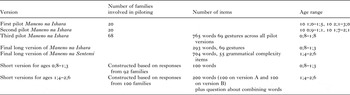
In the next phase of construction, data from the previous stages was used to select items for inclusion in the long forms of the Kilifi CDIs for younger (Maneno na Ishara – Words & Gestures) and older children (Maneno na Sentensi – Words & Sentences). The words most frequently endorsed as known by younger children, sixty-two questions about gestures, and ten function words, were included in the final questionnaire for younger children, providing a total of 355 items.
The older version included seventy pronouns and demonstratives from all of the possible noun-class based third person pronouns and demonstratives, as well as all four first and second personal pronouns, and the most frequently endorsed words for older children – 704 vocabulary items in total.
(c) Addition of grammatical complexity items for older children
Spontaneous speech samples obtained in an earlier study (Alcock et al., Reference Alcock, Rimba and Newton2011) were used to catalogue sentence complexity and common patterns of morphological errors. Examples of immature forms of frequently used words, consisting of omission errors of morphemes, were also documented. All of the morphological structures that were included exist in both Kiswahili and Kigiriama. In the English M-BCDI – Words and Sentences, some more complex grammatical structures are represented by pairs of examples that contain more clauses or additional adjectives, rather than contrasts between grammatically correct and incorrect utterances; in some other language versions, such contrasts have also been used (Maital et al., Reference Maital, Dromi, Sagi and Bornstein2000). Pairs of examples of this type were therefore also included in the Kilifi CDIs. In addition, examples of morphemes commonly used in adult language and produced correctly in our child samples, as well as commonly used immature forms of words, were included. In the final version of the long form of the Kilifi CDIs for older children – Maneno na Sentensi – the following complexity sections were represented, totalling fifty-five items:
Section A: small parts of words (‘word endings’ in English)
These included questions about the general use of noun and verb prefixes and suffixes, including those representing noun classes, plurals, and the past tense.
Section B: complexity
This included pairs of words or phrases, representing less and more complex forms that children may use. For example, parents were asked about the use of koba vs. mkoba, where the noun mkoba ‘bag’ consists of the noun class prefix m- plus the root –koba. koba is an error and is an immature form involving omission of the noun class prefix; such errors are frequently observed in spontaneous speech.
Section C: word combinations
Parents were asked if their children were combining words into sentences, with immature examples given. If parents answered in the affirmative, Section D was also administered.
Section D: sentence complexity
This section included examples where correct morpheme use is determined from sentence context. For example, Kiswahili-speaking parents were asked about the use of watu mrefu vs. watu warefu. The plural noun watu ‘people’ consists of the plural noun class prefix wa- plus the root –tu. This should be followed by the adjective warefu ‘tall’, consisting of the plural noun class prefix wa- plus the root –refu, not the form mrefu, which consists of the singular noun class prefix m- plus the same root, and would apply to one person. Such examples of morpheme substitution were observed much less frequently than morpheme omission in the spontaneous speech samples (this has also been noted in other Bantu languages; Demuth, Reference Demuth and Slobin1992). Parents were also asked about contrasts such as nataka biskuti vs. nataka biskuti na maziwa ‘I want a biscuit’ vs. ‘I want a biscuit and milk’, where both examples are grammatically correct, but one utterance is shorter and the other longer.
(d) Constructing short forms of the Kilifi CDIs
Younger version for children aged 0;8 – 1;3
Frequency tables of responses to the Kigiriama version of Maneno na Ishara (N = 92) were used to generate a short form comprising 100 words, excluding gesture items. The pilot sample was arranged into age groups by month. Words that were comprehended by at least 50% at any month of age formed the initial core of the lexicon. On review it was observed that five of these words had close, or overlapping, meaning, representing only two concepts between them. Three of these words were therefore dropped, and were replaced by the three highest-frequency function words, a category of word otherwise unrepresented (ii ‘this [class 9]’, iryahu ‘that [class 9]’, and mimi ‘me/I’). To avoid a potential ceiling effect at the older end of the age range we also replaced ten medium-frequency words with low-frequency words comprehended by only 20% of the oldest children. An additional eight words, the highest-frequency words produced by these children, were then added (recall that all of the other words were selected based on children's comprehension; these additions comprised three sound effects, as well as ‘yes’, ‘thank you’, ‘grandfather’, ‘child’, and ‘meat’). This short form has no gesture items.
Older version for children aged 1;4 – 2;6
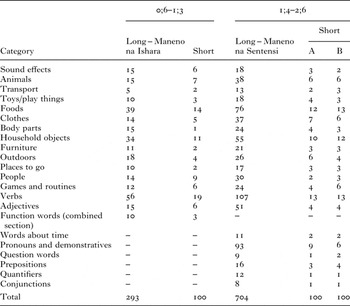
A similar procedure was followed for the construction of the short form of the Kilifi CDIs for older children using data from parents who completed the Kigiriama version of Maneno na Sentensi (N = 100). Children were again placed into month age groups. A list of 180 words was identified that comprised words endorsed by at least 50% at any age group. These words were systematically selected to represent an even distribution across the age range, as well as the different semantic categories represented in the original M-BCDI (see Table 2). To avoid a ceiling effect, the twenty least frequently produced words (that were known by at least 20% of children in at least one age band) were added to the list. These 200 words were then arranged according to the earliest age at which they were produced by at least 50% of the children, and divided evenly into two parallel short forms – form A and B – each consisting of 100 words. Creating two parallel forms is helpful for longitudinal studies where a different form can be administered at two time-points. This questionnaire ends with the single question about sentence use: “Has your child started to join words together such as ‘Want food’ or ‘dog bite’?”
A summary of the numbers of families, content and number of items, and the age ranges involved for all versions of the Kilifi CDIs is shown in Table 1. A summary of the content of the two long forms and the three short forms (Maneno na Ishara long form, younger short form, Maneno na Sentensi long form, and older short A and short B forms) is shown in Table 2. The Kiswahili versions were constructed using the translation equivalents of the words used in the Kigiriama short forms, since fewer data were available from Kiswahili-speaking parents.
Versions of the Kilifi CDIs

Numbers of words in each semantic category on each form of the Kilifi CDIs

Evaluation of the test schedules
The reliability, validity, and sensitivity of the Kilifi CDIs were evaluated through a series of sub-studies. The internal consistency of the different forms was examined using Cronbach's alpha. Other properties were examined using correlation analyses. We evaluated consistency of scores over two time-points, between parallel A and B forms and also between different modes of presentation (self-completed vs. interviews). The association between scores on different components of the Kilifi CDIs was also measured. Finally, we examined the relationship between communicative abilities as derived from parental report and other methods of eliciting communication skills, as well as the relationship of performance to age.
Reliability
Internal consistency reliability
The internal consistency reliability of the long form of Maneno na Ishara was calculated for each section (words, gestures) separately and then for the full scale (N = 103). Within-section (words and sentences) reliability was also assessed for Maneno na Sentensi (N = 96). These analyses were carried out on data from Kigiriama-speaking families.
Test–retest reliability
This was assessed by interviewing twenty Kiswahili-speaking parents using the vocabulary section of the long form of Maneno na Ishara. The approximate interval between the two visits was one week.
Parallel form reliability
This as evaluated in two ways: (a) written vs. interview presentation. Literate Kiswahili-speaking parents (N = 14) were administered Maneno na Ishara using both a written and an interview method. Although many parents in the study setting are illiterate, the majority of Kenyan adults have had some schooling, and literate parents are therefore representative of the local population. (b) short form A and B of Maneno na Sentensi were compared (N = 23). For both methods the order of presentation was reversed for 50% of respondents, and the parallel form presented after a gap of approximately one week.
Validity
Concurrent validity
For Maneno na Ishara we measured the degree of association between Kilifi CDI scores and:
-
(a) free recall score derived by summing all the words and gestures that the caregiver stated the child produced;
-
(b) observed gestures;
-
(c) performance of the child on a naming task; and
-
(d) performance of the child on an object selection comprehension task.
Procedures
-
(a) A free recall score was derived from mothers of Kigiriama-speaking children who were asked to recall all the words they had heard their child produce as well as the gestures the children use. Categorical prompts were used as explained above. The mothers were then interviewed using Maneno na Ishara (N = 19 mothers and children aged 0;9 to 1;3).
-
(b) The same dyads were used to measure the child's ability to produce gestures. For example, after the mother was asked whether or not the child could shake their head to signify ‘no’, the child was asked to “Shake your head ‘no’”. The child received a second prompt “Can you do that?” if they failed to produce the gesture the first time, but if a child still failed to produce the gesture, it was demonstrated for them and no score was awarded.
-
(c) The same children were then shown ten toys or objects whose names are listed in Maneno na Ishara and asked to provide their names.
-
(d) A separate group of Kiswahili speaking mother–child dyads were used to compare CDI scores with performance on an object selection task. The child was presented with twenty pairs of items (food items, small household items, items of clothing) that appear on the short form, and asked: “Can you show me X?” Presentation of some items was repeated, making a total of thirteen unique items (N = 20 dyads, with children aged 1;0 to 1;3).
For Maneno na Sentensi scores on the Kilifi CDIs were compared to:
-
(a) a picture vocabulary task, and
-
(b) spontaneous speech samples were used to establish concurrent validity.
Procedures
-
(c) A total of twenty-three Kigiriama-speaking children aged 2;0 to 2;6 completed a picture vocabulary test developed within the same context (Holding et al., Reference Holding, Taylor, Kazungu, Mkala, Gona, Mwamuye and Stevenson2004). The score on the Kilifi-PVT was the total number of items correct out of 24.
-
(d) Using a small recorder placed in a child-sized backpack, recordings of about 30 – 60 minutes were obtained from ten Kigiriama-speaking children aged 1;8 to 2;4 while they engaged in typical play activities in their home settings. Their spontaneous speech was transcribed by a linguistics graduate (KR) working on the project. The means (s.d.s) of the number of tokens and utterances were 204·00 (119·67) and 149·6 (51·35). Type–token ratios, mean length of utterance in words, and the proportion of utterances in which a morpheme was omitted, were calculated for all children. Mothers of children in both groups were then interviewed using Maneno na Sentensi.
RESULTS
Reliability
Internal consistency
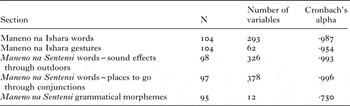
One child whose reported production vocabulary of 98/293 words at the age of 1;0, representing an outlying value, was removed from the dataset, and from subsequent analyses of the whole Maneno na Ishara dataset. Cronbach's alpha was high (over 0.9) for both sections (words and gestures) of Maneno na Ishara. As shown in Table 3, Cronbach's alpha for vocabulary and for grammatical morphemes ranged from ·75 to well over ·9 for Maneno na Sentensi. Out of 100 parents who completed Maneno na Sentensi, four parents failed to answer sufficient vocabulary questions to obtain an alpha and three failed to answer sufficient grammar questions to obtain an alpha.
Internal consistency for long forms of the Kilifi CDIs

Test–retest reliability
One outlier, a child whose production vocabulary was reported at Time 1 to be 7 words and at Time 2 to be 2 words (i.e. the child's production vocabulary was reported to have reduced by over 70% between the two time-points) was excluded. The correlation between production vocabulary at Time 1 and Time 2 was significant (r(17) = 0·54, p = ·018). For comprehension scores, test–retest reliability levels were in the moderate range (r(17) = 0·69, p = ·001).
Parallel form reliability
Moderate correlations were recorded for the comprehension score on the written and interview forms (r(12) = 0·69, p < ·001). Children were reported to have a very limited range of spoken words (0 – 6 items) and the correlation between production scores on the written and interview forms of Maneno na Ishara was not significant. Parents who completed the written version first reported that their child comprehended significantly fewer items in the interview (their second session) than those who completed the interview first (t(13) = 3·27, p = ·006). Correlations between scores on the older version, forms A and B, were significant (r(21) = 0·91, p < ·001).
Sensitivity to age
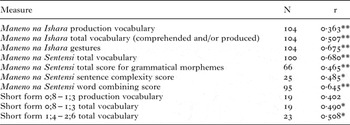
At least moderate, and significant, correlations were recorded between gesture scores, comprehension scores, production vocabulary in older children, and grammar and word combination scores on the various Kilifi CDIs (both long and short forms for both older and younger children) and age (Table 3). A weaker, but also significant, correlation was observed between production vocabulary and age on Maneno na Ishara. On the short form of the younger questionnaire alone, the correlation between production vocabulary and age did not reach significance. All of these data are shown in Table 4. On Maneno na Sentensi, there is a smaller N for this analysis because parents of children who are not yet combining words cannot answer the sentence complexity section. Two parents who answered vocabulary questions did not answer any grammar questions (even though not all grammar questions concern word combinations), and for three further parents the answer to the complexity question was unclear, meaning that for the correlations with age N = 100 for vocabulary, N = 95 for word combinations, and N = 98 for grammar.
Sensitivity to age of components of the long and short forms of the Kilifi CDIs

note: * p < ·05; ** p < ·01.
Validity
ManenonaIshara
-
(a) Correlations between maternal free recall of words and gestures known by their child, and that following prompts by the interviewers, were not significant, both for production or comprehension vocabulary.
-
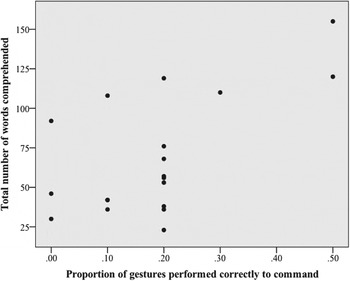
(b) Observations of children's cued gesture production were significantly correlated with children's gesture scores from the questionnaire (r(17) = 0·631, p = ·004). Since children were asked verbally to produce the gestures, there was also an element of comprehension in the gesture exercise, and observed gestures also correlated significantly with children's comprehension vocabulary (r(17) = 0·614, p = ·005). This relationship is shown in Figure 1.
-
(c) None of the children named a single object or toy.
-
(d) There was no significant correlation between scores on the object selection task and total comprehension vocabulary (r(17) = 0·119, p > ·05). The correlation between child selection and maternal report of just the thirteen items included in the selection task approached significance, however (r(17) = 0·454, p = ·051).
Scatterplot of comprehension vocabulary (Maneno na Ishara) and cued gestures.

Maneno na Sentensi
-
(e) There was a significant correlation between the PVT scores and scores on the Kilifi CDIs (r(30) = 0·525, p = ·01).
-
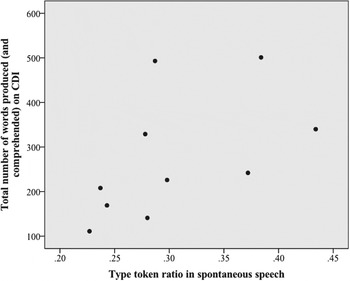
(f) Significant correlations between maternal report and recorded spontaneous speech samples (N = 10) were found for type–token ratio and total grammar scores (r(8) = 0·598, p = ·034), and type–token ratio and scores on the morpheme section of the grammar questionnaire (r(8) = 0·627, p = ·026). The correlation between type–token ratio and production vocabulary was moderate, although it did not reach significance (r(8) = 0·538, p = ·055). The relationship between total vocabulary and type–token ratio is illustrated in Figure 2.
Scatterplot of total vocabulary (Maneno na Sentensi) against type–token ratio.

Mean length of utterance did not significantly correlate with sentence complexity scores (r(8) = −0·233, p > ·05). There was a significant negative correlation (in the expected direction) between the proportion of children's utterances that contained a morphological error and the morpheme section of the CDI (r(8) = −0·559, p = ·046).
DISCUSSION
We present here the first comprehensive account of the construction and validation of a parent report checklist of children's communicative abilities within a context where few parents have sufficient literacy to complete a written format. The Kilifi CDIs include vocabulary checklists for younger and older infants (long and short forms), as well as checklists to assess gesture and grammatical development, in two very closely related languages. Examination of one short form of the Kilifi CDIs in Kiswahili and Kigiriama revealed that 92 out of the 100 words were cognate (all of which are in the same noun class in both languages), confirming our decision to adapt CDIs to both languages in parallel, and report the adaptations together.
Findings from our data
Although other researchers (Hamadani et al., Reference Hamadani, Baker-Henningham, Tofail, Mehrin, Huda and Grantham-McGregor2010; Vagh et al., Reference Vagh, Pan and Mancilla-Martinez2009) have used an interview format for a CDI before, this is the first study to carry out in-depth psychometric evaluations of tools administered in this format, assessing reliability and validity and covering key considerations in the construction of new instruments for the assessment of language development (Fenson et al., Reference Fenson, Dale, Reznick, Bates, Thal and Pethick1994). Our data indicate achievement of moderate to good indices of reliability and validity. Noteworthy is the significant correlation between the traditional written format and the more practical interview format we created; this was not assessed in previous interview versions. Although some sample sizes in validity and reliability testing were small, the majority were at least as large as in previous CDI construction studies where similar methods have been used (Thordardottir & Ellis Weismer, Reference Thordardottir and Ellis Weismer1996). Furthermore, in this study we have taken the examination of reliability or validity beyond that of internal consistency (Bleses et al., Reference Bleses, Vach, Slott, Wehberg, Thomsen, Madsen and Basboll2008; Kristoffersen et al., Reference Kristoffersen, Simonsen, Bleses, Wehberg, Jørgensen, Eiesland and Henriksen2013; Maital et al., Reference Maital, Dromi, Sagi and Bornstein2000), and gone well beyond the method used to assess content validity in some previous studies (assessing the co-occurrence of vocabulary contained in CDIs and that produced by a much smaller number of different children at a different time point; Bleses et al., Reference Bleses, Vach, Slott, Wehberg, Thomsen, Madsen and Basboll2008; Kristoffersen et al., Reference Kristoffersen, Simonsen, Bleses, Wehberg, Jørgensen, Eiesland and Henriksen2013). Our study presents advantages over all of these.
Our tools were also sensitive to maturational change, with parents reporting that children understood and produced more words as they got older. Data from our setting, reported in Abubakar, Newton, Holding, and Alcock (unpublished observations), show that the Kilifi CDIs are sensitive to the impact of biological insults, in particular HIV exposure, that are known to affect language development.
In addition, maternal reports of communicative abilities using the Kilifi CDIs corresponded closely with multiple evaluations of abilities from other sources, demonstrating an understanding of the purpose of the questionnaires by parents. Both vocabulary comprehension and gesture scores obtained on the Kilifi CDIs corresponded closely to gestures produced through verbal prompts in younger children; in addition, maternal reports of vocabulary production showed substantial correlations with comprehension of vocabulary items in a forced-choice test. These observations illustrate that mothers of infants aged below 1;4 are accurate observers of their child's gesture abilities, general language comprehension abilities, overall level of vocabulary production, and knowledge of specific vocabulary items.
Moreover, among older children, scores on the Kilifi CDIs corresponded closely with vocabulary production levels from spontaneous speech recordings, as well as with receptive vocabulary measured with a picture vocabulary test. Parents were also able to accurately report whether or not their child omitted grammatical morphemes in their everyday speech. As with other richly inflected languages, children learning Bantu languages seem to use many grammatical morphemes relatively early (Demuth, Reference Demuth, Nurse and Philippson1999). Furthermore a significant negative correlation (in the expected direction) was found between the proportion of children's utterances that contained morphological errors and the score on the morpheme section of Maneno na Sentensi.
In contrast to the structured interview approach we found that asking mothers to generate a list of words that their children could say or understand through free recall presented a challenge to them. Mothers either reported the names of objects their children recognized, words that their children heard frequently, or, for mothers of older children, only mentioned extremely high-frequency words that had been in their children's vocabulary for quite some time. Although it may sometimes be necessary to use parental recall of children's word knowledge as part of the construction of a measure, Fenson et al. (Reference Fenson, Dale, Reznick, Bates, Thal and Pethick1994) have cautioned that parent recognition of children's behaviours is much more accurate than recall. Our data support the possibility that parents pay more attention to the content of the inventories in the face-to-face interviews as they were provided with an opportunity for direct interaction with the interviewer. Although the interview format is more time-consuming, we have found that parents within this cultural context are somewhat more willing to spend longer periods of time being interviewed, especially as it is not common to have an opportunity to talk to a professional about their child's development.
Research practicalities and future directions
We have produced the first set of fully validated CDIs, for two Bantu languages. The two long versions – Maneno na Ishara for younger children aged 0;8 to 1;3 and Maneno na Sentensi for older children aged 1;4 to 2;6 – are undesirably fairly time-consuming, taking on average between one-half and one-and-a-half hours to administer. However, the length of time taken to conduct interviews about a younger child's language abilities at home is comparable to, or less than, the time it would take for travel to a central location, set up, and administer a testing session. With the constraints of time in mind, we have also created and validated three short forms of the Kilifi CDIs – one for younger children and two parallel versions for older children, enabling retesting in, for example, an intervention study.
It is essential in a setting with great linguistic diversity (over 40 languages are used in Kenya) that assessment instruments are easily adaptable. Obtaining comprehensive item sets is difficult in a situation where little previous data on child language use is available. In creating the Kilifi CDIs we therefore necessarily started with an English version because there was no closer language version available. Existing data available on the languages studied here, Kigiriama and Kiswahili, suggested that children are more advanced on some aspects of grammatical development (Alcock et al., Reference Alcock, Rimba and Newton2011; Deen, Reference Deen2002) than their counterparts learning European languages, but that early vocabulary composition is similar to that in other languages, both European and non-European (Alcock, unpublished observations). Our experience implies that there may be core universal elements to such a schedule that are shared between language groups, but that attention should be paid to specific language contexts when constructing such instruments.
We have already collaborated with other researchers on the creation of a new short form CDI for two related languages in neighbouring Malawi (Prado et al., Reference Prado, Alcock, Ullman, Phuka, Yakes, Arimond and Dewey2011). We found that basing the two Malawi versions on the Kiswahili CDI (a closely related language, with many cognates and very similar inflectional morphology) was helpful. By using an English translation of the Kiswahili inventory the linguists involved in the Malawi adaptation were able to check both the intended meaning and the phonological or grammatical form of vocabulary or sentence stimuli in the Kiswahili version, before constructing a version that closely paralleled the two Malawi languages to be studied. Although the Malawi adaptation was based on the Kiswahili CDI, parallel adaptation into both Kiswahili and Kigiriama in Kenya meant that using the same adaptation techniques in Malawi was both more flexible for the adaptation from Kiswahili to the Malawi languages, and simpler to accomplish for two languages in parallel in Malawi.
Our method is recommended for future adaptations into similar Bantu languages, even those that are not mutually comprehensible. For sub-Saharan African languages that are not very closely related to the two languages studied here, both the instructions and vocabulary items may translate more directly than those of tools developed in other cultural settings, as underlying concepts in vocabulary development are likely to be more similar.
Many families in coastal Kenya (particularly outside the main rural study area) use more than one language on a day-to-day basis. Previous research (Mancilla-Martinez, Pan & Vagh, Reference Mancilla-Martinez, Pan and Vagh2011) suggests that integrating scores from two languages is valid and useful with bilingual infants and toddlers. It would therefore be important to include translated equivalents of items in both languages to create CDIs that can be used with bilingual families.
In summary, we have created two CDIs that are valid and reliable for these languages and this setting. We have also initiated the construction of CDIs for the region and, in particular, for Bantu languages, providing a useful method for CDI construction and validation.