Introduction
Farrowing and pre-weaning mortality is one of the major problems in pig production. The rate of piglet survival till weaning is about 80% on average (Meat and Livestock Commission, 2000; Le Dividich, Reference Le Dividich2002; Knol et al., Reference Knol, Leenhouwers and Van der Lende2002b). Lower piglet survival rate was observed in the lines submitted to selection for total number of piglets born (Johnson et al., Reference Johnson, Nielsen and Casey1999; Arango et al., Reference Arango, Misztal, Tsuruta, Culbertson, Holl and Herring2006; Su et al., Reference Su, Sorensen and Lund2007). The high piglet mortality results in large economic losses in pig production, and has a detrimental impact on animal welfare. Therefore, genetic improvement in piglet survival is important in pig breeding.
Piglet survival or mortality is usually treated as a trait of the sow and analysed at the litter level (measured as survival rate or mortality percentage). However, piglet survival is the outcome of complex interactions between the sow, the piglet and the environment (Edwards, Reference Edwards2002). Some studies (e.g. Van Arendonk et al., Reference Van Arendonk, Van Rosmeulen, Janss and Knol1996; Lund et al., Reference Lund, Puonti, Rydhmer and Jensen2002; Arango et al., Reference Arango, Misztal, Tsuruta, Culbertson, Holl and Herring2006) have reported that there is a direct additive genetic effect on piglet survival. It indicates that the genotypes of both sow and piglet contribute to piglet survival. To estimate both maternal and direct additive genetic components, an appealing approach is to analyse piglet survival based on individual piglet record using a liability threshold model, which well accounts for the feature of category trait.
It is known that the causes of stillbirth and postnatal mortality are different. Previous studies (e.g. Glastonbury, Reference Glastonbury1977; Zaleski and Hacker, Reference Zaleski and Hacker1993; Herpin et al., Reference Herpin, Dividich, Hulin, Fillaut, De Marco and Bertin1996; Edwards, Reference Edwards2002; Grandinson et al., Reference Grandinson, Lund, Rydhmer and Strandberg2002) have shown that stillbirths are greatly associated with maternal environment, parturition process, and the resistance to asphyxiation of piglet; postnatal mortality is mainly due to crushing and starvation in commercial units, and most postnatal deaths occur during the first few days after birth. These lead to a hypothesis that piglet survival in different periods should be regarded as different characters.
In addition, several previous studies (e.g. Kerr and Cameron, Reference Kerr and Cameron1995; Roehe and Kalm, Reference Roehe and Kalm2000) have shown that the piglet’s individual birth weight was the most important factor determining pre-weaning mortality. It brings out a hypothesis that selection for higher individual birth weight could be a good alternative to improve survival rate.
The objective of this study is to estimate variance and covariance components of piglet survival in different periods using a threshold model that includes direct and maternal additive genetic effects, and to estimate the genetic correlation between piglet survival and piglet birth weight. A further objective is to ascertain the relative importance of direct and maternal additive genetic effects on piglet survival and the efficiency of genetic improvement in piglet survival by selection.
Material and methods
Populations and data
Data in the present study were collected from the nucleus populations of Danish Landrace and Danish Yorkshire during the period from May 2002 to December 2004. Both populations have been selected for total number of piglets born since 1992. The data included individual records from 133 004 Danish Landrace piglets and 89 928 Danish Yorkshire piglets. Pedigrees were traced six or more generations back. Number of farms, year–season classes, sows, service sires, litters, total number of piglets born per litter and sex ratio are shown in Table 1.
Number of farms, year–season classes, sows, service sires, litters, number of piglets born (NB) per litter and sex ratio

†Sex ratio = number of males/total number of piglets.
Sows were kept under commercial conditions, but there is a variation in management among the farms. All the sows were artificially inseminated. Sows were transferred to farrowing rooms, approximately 1 or 2 weeks before the predicted farrowing date, where they were housed in individual farrowing crates until the piglets were weaned. At the time that the litter was first inspected after farrowing, the total number of piglets born, the number of dead piglets (regarded as stillbirth) and the sex of the piglets were recorded. Piglets were weighed individually and identified by ear markings within 2 days after farrowing (80% within 1 day). During the pre-weaning period, when a piglet died, the body weight, the cause and the date of death were recorded. The average age of piglets at weaning was 21.27 days with a range of 19 to 23 days.
Cross-fostering was applied to homogenise litter sizes within the first 3 days after birth. Information with regard to donor and recipient litters was recorded. In total, there were 10.9% cross-fostered piglets (in relation to the number of born alive) in Landrace and 7.0% in Yorkshire. The traits analysed were birth weight (BW), survival at birth (SVB), survival during early pre-weaning, i.e. from birth to day 5 (SV5) and survival during late pre-weaning, i.e. from day 6 to weaning (SVW). Survival was scored as 0 for dead and 1 for alive. In the situation of cross-fostering, both maternal sow and nurse sow have an influence on postnatal mortality of piglets. A model including effects of both maternal sow and nurse sow is theoretically satisfied. But it could cause a problem of identifiability and give erratic results due to lack of information in data to disentangle genetic effects of maternal sow and nurse sow (Knol et al., Reference Knol, Ducro, Van Arendonk and Van der Lende2002a). In the analysis of genetic parameters, SV5 and SVW scores for the cross-fostered piglets were treated as missing. In addition, the SV5 score for the piglets that died at farrowing, and the SVW score for the piglets that died on or before day 5 were also treated as missing.
Statistical analysis
Birth weight and piglet survival were analysed using the following model:

where y is the vector of observations of birth weight or the liability of survival, b is the vector of fixed effects including farm, year–season (four seasons per year, January to March as season 1 and so on), sex, parity and linear regression on litter size (number born for BW and SVB, number born alive for SV5 and number alive at day 5 in the nurse litter for SVW), c is a vector of farm by year–season interaction effects treated as random to avoid confounding with other effects in the model due to very few litters in some combinations of farms and year–seasons, l is the vector of litter effects, a is the vector of direct additive genetic effects of piglet, m is the vector of maternal additive genetic effects of sow, e is the vector of random residuals, and X, W c, W l, Z a and Z m are incidence matrixes associating b, c, l, a and m with y. In the model, the random effects are assumed to be mutually independent except for a and m that are assumed to be correlated.
All random effects are assumed to be normally distributed. Thus,
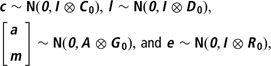
where C 0, D 0, G 0 and R 0 are the covariance matrixes for farm by year–season interaction effects, litter effects, direct and maternal additive genetic effects, and residuals, respectively, I is the identity matrix, and A is the matrix of additive genetic relationship among animals in the pedigree file. The covariance matrix G 0 include variance and covariance for direct and maternal additive genetic effects for each trait and covariance between direct additive genetic effect of trait i and maternal additive genetic effect of trait j.
According to the definition of the three survival traits, the piglets with score 0 for SVB did not have record on SV5 and SVW, similarly the piglets with score 0 for SV5 did not have record on SVW. A pilot analysis without restricting residual covariance between survival traits to zero yielded an estimate of residual covariance around zero but poor convergence and stationarity. Therefore, in the final analysis, the residual covariances between the three survival traits were restricted to be zero.
The analysis was carried out using Bayesian approach with Gibbs sampling and using the program THRGIBBSF90 (Misztal et al., 2002). The Gibbs sampler was run as a single chain with a length of 400 000 samples. Convergence was monitored by graphical inspection. The first 100 000 samples were used as burn-in and discarded. Every 10th sample of the remaining 300 000 was saved to estimate the features of the realised posterior distribution.
Following Willham (Reference Willham1972), the phenotypic variance was defined as  where σ l2 is the variance of litter effects, σ a2 is the variance of direct additive genetic effects, σ m2 is the variance of maternal additive genetic effects, σ am is the covariance between direct and maternal additive genetic effects, and σ e2 is residual variance. The total heritability is defined as
 . The phenotypic variance did not include variance of farm by year–season interaction. This is to make the heritability estimated from the current model be equivalent to those estimated from a model in which the contemporary effects are treated as fixed effects.
Results
The total mortality (Table 2) in the two populations was high. It could be partly due to selection for total number of piglets born since 1992. Most deaths occurred at farrowing and during the first 5 days after farrowing. After day 5, the mortality was very low in both populations. Moreover, there was an association between piglet BW and mortality within population. On average, piglets that died during any period had smaller BW than those alive. The association between BW and mortality did not hold across populations. As shown in Table 2, Landrace piglets were heavier than Yorkshire piglets, but have higher farrowing mortality.
Mortality in different periods, mean birth weight and the standard deviation of dead (BWd) and living (BWa) piglets

†Mortality at farrowing = number of piglets born dead/number of piglets born. Mortality from birth to day 5 = number of dead during the first 5 days after birth/ number born alive. Mortality from day 6 to weaning = number dead from day 6 to weaning/number alive at day 5.
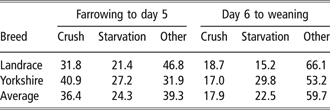
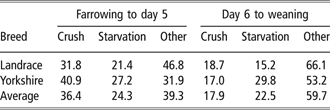
Among the piglets that died during the period from farrowing to day 5, more than half died due to crushing by the sows or due to starvation (Table 3). After 5 days, the proportion of deaths due to crushing decreased substantially. There was also a difference in death causes between the two populations. Landrace had lower proportion of deaths due to starvation during the whole sucking period and lower proportion of deaths due to crushing during the first 5 days.
Causes of death of piglets during pre-weaning (Unit: %)
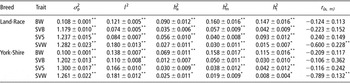
Both direct and maternal heritabilities for liability of piglet survival (at the individual piglet level) were low but significantly different from zero (Table 4). Estimates of maternal heritability (h m2) for BW were the same for the two populations, and the estimates of direct heritability (h a2) were not significantly different between breeds. For survival traits, there was a tendency for maternal heritability to decrease with increasing age of the piglet. The estimates of h m2 for SVB and SV5 were similar in the two populations. The estimate for SVW in Landrace was higher than in Yorkshire, but the difference is not significantly different from zero. The estimates of direct heritability for SVB and SV5 were higher in Landrace than in Yorkshire. SV5 had higher h a2 than other survival traits in both populations (most of the contrasts significantly differed from zero).
Posterior mean and standard deviation of phenotypic variance (σ 2p), litter component (l 2), direct heritability (h 2a), maternal heritability (h 2m), total heritability (h 2t) and correlation between direct and maternal additive genetic effects (r (a, m)) for birth weigh (BW), liability of survival at birth (SVB), from birth to day 5 (SV5) and from day 6 to weaning (SVW)

*Significant at P < 0.05; **significant at P < 0.01.
The correlations between direct and maternal effects (Table 4) did not significantly differ from zero, except for the correlation for SVW, which was strongly negative (−0.60 in Landrace and −0.79 in Yorkshire). The strong negative correlation between direct and maternal additive genetic effects led to a very low total heritability (defined by Willham, Reference Willham1972) for this trait.
The litter component of variance for SVB and SV5 (Table 4) was larger in Yorkshire than in Landrace, but the two populations did not differ for SVW. There was a tendency for the litter component of survival to increase with piglet age. The variance of farm by year–season interaction was very small for all the traits. The ratios of this component to phenotypic variance were 0.002 for BW, 0.003 for SVB, 0.008 for SV5 and 0.015 for SVW in Landrace. The respective ratios were 0.007, 0.016, 0.015 and 0.020 in Yorkshire.
Maternal genetic correlations (Table 5) between piglet survivals in different periods were low, ranging from −0.142 to 0.288, in the two populations, and the estimates were not significantly different from zero. Direct genetic correlations were all positive and ranged from 0.116 to 0.439, but only the moderate correlations between SVB and SV5, and between SV5 and SVW in Landrace were significantly differed from zero.
Posterior mean and standard deviation of direct genetic (r a) and maternal genetic (r m) correlations between liabilities of survival at birth (SVB), from birth to day 5 (SV5) and from day 6 to weaning (SVW)

**Significant at P < 0.01.
Phenotypic, direct or maternal genetic correlations between BW and the three survival traits (Table 6) were positive, except for a negative maternal genetic correlation between BW and SVB in Landrace. Direct and maternal genetic correlations between BW and SVB and between BW and SVW were low in both Landrace and Yorkshire and most of them were not significantly different from zero. However the correlations between BW and SV5 were moderately high in both populations.
Posterior mean and standard deviation of phenotypic (r p), direct genetic (r a) and maternal genetic (r m) correlations between body weight at birth (BW) and liability of survival at birth (SVB), from birth to day 5 (SV5) or from day 6 to weaning (SVW)

*Significant at P < 0.05; **significant at P < 0.01.
A further analysis was carried out using a model that excluded litter size. No detectable differences in the estimates of genetic variance/covariance components were found between the models with and without litter size as covariate. However the model that excluded litter size as covariable led to larger estimates of litter component of variance by 20% in Landrace and 10% in Yorkshire for SVB and SV5, while for SVW, results were unchanged.
Discussion
Both the genotype of sow and the genotype of piglet have an effect on piglet survival
The present study confirms that the genotypes of both sow and piglet contribute to piglet survival. Piglet survival is usually treated as a trait of the sow. Rothschild and Bidanel (Reference Rothschild and Bidanel1998) and Knol et al. (Reference Knol, Leenhouwers and Van der Lende2002b) reviewed the literature and reported that heritability estimates for piglet survival rate or mortality were 0.05 on average. However the estimates from the lines with high piglet mortality seem higher. Johnson et al. (Reference Johnson, Nielsen and Casey1999) reported a heritability of 0.17 for number of stillborn piglets in an experimental line. Damgaard et al. (Reference Damgaard, Rydhmer, Lovendahl and Grandinson2003) showed a heritability of 0.13 for proportion of stillborn piglets and 0.06 for pre-weaning mortality. Arango et al. (Reference Arango, Misztal, Tsuruta, Culbertson and Herring2005) reported estimates of heritability for number of piglets born dead of 0.09, 0.10 and 0.11 in parity 1, 2 and 3, respectively. Su et al. (Reference Su, Sorensen and Lund2007) reported estimates of heritabilities for survival rate at farrowing and during early suckling ranging from 0.042 to 0.129, and near to zero for survival rate during late suckling period, based on sow genetic component at the litter level.
Several studies have included the direct additive genetic effect of the piglet in the analysis on piglet survival. At the litter level, Lund et al. (Reference Lund, Puonti, Rydhmer and Jensen2002) reported a direct heritability of 0.01 for survival at birth and 0.04 for survival from birth to weaning in Landrace, while the respective estimates were 0.05 and 0.02 in Yorkshire. Based on litter records using a linear Gaussian model, Su et al. (Reference Su, Sorensen and Lund2007) estimated direct heritability at the litter level to be 0.108, 0.136 and 0.024 in Landrace and 0.008, 0.064 and 0.024 in Yorkshire for SVB, SV5 and SVW, respectively.
Few studies analysed piglet survival or mortality using records on individual piglets and including both maternal and direct additive genetic effects. Van Arendonk et al. (Reference Van Arendonk, Van Rosmeulen, Janss and Knol1996), using a linear model that excluded litter effects, reported estimates of maternal and direct heritabilities equal to 0.09 and 0.11, respectively. Arango et al. (Reference Arango, Misztal, Tsuruta, Culbertson, Holl and Herring2006) reported maternal heritabilities ranging from 0.08 to 0.12 and direct heritabilities ranging from 0.02 to 0.05 for piglet mortality during different periods in Large White piglets, based on a threshold model. The present study showed that the maternal heritability for SVB was higher than the direct heritability, but the direct heritabilities for SV5 and SVW were of similar magnitude as the maternal heritability. Since both sow and piglet genotypes contribute to piglet survival, a selection index for improving piglet survival should include both maternal and direct additive genetic effects. Alternatively, it could be feasible to select for maternal additive genetic effects in maternal lines and select for direct additive genetic effects in paternal lines.
Both direct and maternal heritabilities for piglet survival at the individual piglet level were low. However the amount of information in the data for piglet survival is usually very large, because each piglet has a large number of close relatives with records due to the large size of the litter in pigs. Therefore, a reasonable accuracy of predicted breeding values can be obtained despite the low heritability. Accordingly, genetic improvement of piglet survival by selection is still promising. The selection response in the observed scale will depend on the survival rate of the population. For the two populations in the present study, the response in the observed scale is expected to be relatively large for SVB and for SV5 because the survival rate at farrowing and early suckling period were far from 100%, while the response for SVW could be small due to a very high survival rate (more than 95%) during the late suckling period.
Piglet survivals during different periods are genetically different traits
It was observed in the present study that the causes of piglet mortality in different periods were different. Further, the estimates of genetic correlations for survival between different periods were low or moderate, and most were not significantly different from zero. The results agree with those of previous studies based on litter records (Lund et al., Reference Lund, Puonti, Rydhmer and Jensen2002; Su et al., Reference Su, Sorensen and Lund2007) or on piglet records (Arango et al., Reference Arango, Misztal, Tsuruta, Culbertson, Holl and Herring2006). Serenius et al. (Reference Serenius, Sevon-Aimonen, Kause, Mäntysaari and Mäki-Tanila2004) obtained an estimate of the genetic correlation between the proportion of stillbirth and piglet mortality from birth to weaning close to zero. On the other hand, Damgaard et al. (Reference Damgaard, Rydhmer, Lovendahl and Grandinson2003) reported a weakly negative genetic correlation between proportion of stillbirth and piglet mortality during suckling. In addition, in the present study, there is a trend that estimates of maternal heritabilities decrease with the age of the piglets, and the estimates of direct heritabilities for SV5 are higher than those for SVB and SVW. These results suggest that piglet survival during different periods should be treated as different traits. Selection for pig survival in a particular period would not effectively improve piglet survival in other periods.
Genetic improvement of piglet survival by selection based on birth weight does not seem to be a viable alternative
Several studies (Kerr and Cameron, Reference Kerr and Cameron1995; Roehe and Kalm, Reference Roehe and Kalm2000) reported that the piglet’s individual birth weight was the most important factor affecting pre-weaning mortality. Because of the low heritability of piglet survival and relatively high heritability for BW, the authors suggested selection for increased birth weight to improve survival, rather than direct selection for piglet survival. However, Grandinson et al. (Reference Grandinson, Lund, Rydhmer and Strandberg2002) found a positive genetic correlation between stillbirth and BW. Similarly Damgaard et al. (Reference Damgaard, Rydhmer, Lovendahl and Grandinson2003), working on the same population as Grandinson et al. (Reference Grandinson, Lund, Rydhmer and Strandberg2002), reported a positive genetic correlation between mean weight at birth and stillbirth, though they found a negative genetic correlation between mean weight at birth and piglet mortality during suckling. Knol et al. (Reference Knol, Leenhouwers and Van der Lende2002b) expressed the doubt of the feasibility of improving piglet survival via indirect selection for birth weight.
The present study shows that the genetic correlations between BW and SV5 are positive and moderate, but the correlations between BW and SVB or between BW and SVW are low. Thus, selection for birth weight should improve piglet survival during the early sucking period but neither perinatal survival nor survival during the late sucking period.
Conclusions
The genotypes of both sow and piglet contribute to piglet survival. However, direct and maternal heritabilities at the individual piglet level are low. Moreover, genetic correlations for survival between different periods were low, suggesting that survival in different periods should be regarded as different traits. Selection for birth weight should improve piglet survival during early sucking period but not perinatal survival nor survival during the late sucking period. Effective genetic improvement of piglet survival before weaning should be based on an index that includes direct and maternal effects and treat survival in different periods as different traits. In practice, it could be a feasible alternative to select for maternal additive genetic effects in maternal lines and select for direct additive genetic effects in paternal lines. Moreover, due to the low value of the direct and maternal heritabilities associated with piglet survival, breeding values for this trait, in each period, should be estimated from large, well-structured data sets, i.e. candidate animals should have a large number of close relatives.
Acknowledgements
This study was supported by The Danish National Committee for Pig Production.