Nanocomposites are multiphase compounds where one of the phases, which is usually referred to as the filler, has at least one dimension which is <100 μm. They are used in ceramics, metals and polymers where they usually form the matrix in which nanoscale fillers are added. Polymers have been used extensively in nanocomposite technology because they offer advantages in numerous application areas (Ajayan et al., Reference Ajayan, Schadler and Braun2003; Grimsdale & Müllen, Reference Grimsdale and Müllen2005; Rao et al., Reference Rao, Müller and Cheetham2006; Dzenis, Reference Dzenis2008). Polymeric nanocomposites are materials that retain uniqueness and performance combinations, unlike traditional composites. Recently, polymer nanocomposites have been used in new technologies and offered profitable scenarios in several industrial sectors (Manocha et al., Reference Manocha, Valand, Patel, Warrier and Manocha2006; Mollo & Bernal, Reference Mollo, Bernal, Mohanty, Nayak, Kaith and Kalia2015; Silvestre et al., Reference Silvestre, Silvestre and De Brito2016; Dubey et al., Reference Dubey, Hassan, Bhardwaj, Tyagi and Banerjee2017; Fu et al., Reference Fu, Sun, Huang, Li and Hu2019). Hybrid composites are made by combining two dissimilar components together. The basic aim of hybrid composites is to obtain various properties through combination of the characteristics of each additive. Hybrid polymer composite materials are designed to integrate multifunctional materials thanks to synergy between the filler phases (Sanchez et al., Reference Sanchez, Julián, Belleville and Popall2005; Gerasin et al., Reference Gerasin, Antipov, Karbushev, Kulichikhin, Karpacheva, Talroze and Kudryavtsev2013; Szeluga et al., Reference Szeluga, Kumanek and Trzebicka2015; Nguyen et al., Reference Nguyen, Zatar, Mutsuyoshi, Thakur, Thakur and Pappu2017; Ravishankar et al., Reference Ravishankar, Nayak and Kader2019; Sadjadi, Reference Sadjadi2020; Sanusi et al., Reference Sanusi, Benelfellah and Hocine2020).
Polyhedral oligomeric silsesquioxane (POSS) is a nanostructured material bridging the gap between ceramic and organic materials. The best property of POSS is its ability to enhance product competence without affecting mechanical properties, rendering it suitable for a wide variety of applications and manufacturing activities (Baney et al., Reference Baney, Itoh, Sakakibara and Suzuki1995; Lickiss & Rataboul, Reference Lickiss, Rataboul, Hill and Fink2008). The ever-growing interest in compounds is the driving force for POSS technology via composition and terminology. The POSS molecule is as small as silica nanoparticles but is different from modified nano-clays and nano-silica because it has a covalently bonded structure suitable for polymerization (Li et al., Reference Li, Wang, Ni and Pittman2001; Phillips et al., Reference Phillips, Haddad and Tomczak2004; Cordes et al., Reference Cordes, Lickiss and Rataboul2010). Furthermore, POSS is compatible with various polymer systems thanks to its inactive or non-reactive organic suitability. The ability of POSS to control chain motion usually results in its use in ‘temperature boosting’ for nearly all types of thermoplastics (Joshi & Butola, Reference Joshi and Butola2004; Kuo & Chang, Reference Kuo and Chang2011). In addition to rigidity, dyeability and weight reduction, polymers containing POSS display delayed combustion characteristics, i.e. decrease the heat-release rate thus demonstrating fire resistance (Zhao et al., Reference Zhao, Fu and Liu2008; Gnanasekaran et al., Reference Gnanasekaran, Madhavan and Reddy2009; Qian et al., Reference Qian, Wei, Zhao, Jiang and Yu2013; Zhang & Muller, Reference Zhang and Muller2013; Baykus et al., Reference Baykus, Dogan, Tayfun, Davulcu and Dogan2017; Zhang et al., Reference Zhang, Camino and Yang2017; Turgut et al., Reference Turgut, Dogan, Tayfun and Ozkoc2018).
Halloysite nanotubes are natural nanomaterials which consist of rolled alumosilicate layers containing tetrahedral SiO4 and octahedral AlO2(OH)4 sheets with intercalated water molecules between adjacent layers. The countries with the most abundant HNT reserves are USA, New Zealand, China and Turkey. Because of unique properties such as nano-sized lumens, a large length/diameter (L/D) ratio, cation exchange capacity (CEC) and low hydroxyl group density on the surface, HNT is employed in various applications as structural and multifunctional materials (Joussein et al., Reference Joussein, Petit, Churchman, Theng, Righi and Delvaux2005; Rawtani & Agrawal, Reference Rawtani and Agrawal2012; Hillier et al., Reference Hillier, Brydson, Delbos, Fraser, Gray, Pendlowski, Phillips, Robertson and Wilson2016). Despite its nano-scale dimensions, HNT is harmless even at high concentrations and cytotoxicity causes no problem in production steps (Kamble et al., Reference Kamble, Ghag, Gaikawad and Panda2012; Yuan et al., Reference Yuan, Tan and Annabi-Bergaya2015; Churchman et al., Reference Churchman, Pasbakhsh and Hillier2016). Recently emerging applications of HNT-reinforced polymer nanocomposites have been used in anti-cancer treatment (Du et al., Reference Du, Guo and Jia2010; Liu et al., Reference Liu, He, Yang, Long, Huang, Liu and Zhou2016) with sustained drug-delivery systems (Liu et al., Reference Liu, Jia, Jia and Zhou2014; Lvov et al., Reference Lvov, Wang, Zhang and Fakhrullin2016), as catalysts (Idumah et al., Reference Idumah, Hassan, Ogbu, Ndem and Nwuzor2019), as fire-resistant coatings (Huang et al., Reference Huang, Tang, Zhang, Guo, Yuan, Thill and Bergaya2016; Goda et al., Reference Goda, Yoon, El-sayed and Hong2018;) and as anti-corrosive structures (Erpek et al., Reference Erpek, Ozkoc and Yilmazer2017; Kausar, Reference Kausar2018).
The structure of thermoplastic polyurethane (TPU) involves interchanging soft and hard parts. Polyester or polyether units constitute the soft parts. The characteristic flexibility of TPU derives from this soft segment which corresponds to an elastomeric polyurethane term. The hard parts are made of groups with high polarity such as low-molecular-weight diisocyanate constituents (Hepburn, Reference Hepburn1992; Bhowmick & Stephens, Reference Bhowmick and Stephens2001; Drobny, Reference Drobny2013). TPU has many advantages, such as recyclability and practical processing by means of conventional industrial approaches. Recently, there has been interest in developing new methodologies for TPU synthesis, preparation of its blends with other polymers and production of its composites (Atiqah, Reference Atiqah, Mastura, Ahmed Ali, Jawaid and Sapuan2017; Kuang & Mather, Reference Kuang and Mather2018; Almahmoud et al., Reference Almahmoud, Choi, Kim, Seo and Yoon2020). Tuning the properties of TPU by combining several types of fillers is done because of the high cost of alternatives compared to that of fillers, modest mechanical strength, and limits in terms of chemical and abrasion resistance (Petrovic & Ferguson, Reference Petrovic and Ferguson1991; Biron, Reference Biron2018).
Polyurethane nanocomposites displayed remarkable behaviour after the inclusion of POSS nanoparticles. In previous studies, POSS was used effectively as a chain extender for the replacement of partial diol monomer at the polymerization stage of polyurethane (Liu & Zheng, Reference Liu and Zheng2005; Zhang et al., Reference Zhang, Zou and Wu2006, Zhang et al., Reference Zhang, He, Xi, Huang, Yu and Jia2011; Lopes et al., Reference Lopes, Junges, Fiorio, Zeni and Zattera2012; Markovic et al., Reference Markovic, Nguyen, Clarke, Constantopoulos, Matisons and Simon2013; Mahapatra et al., Reference Mahapatra, Yadav and Cho2012; Lewicki et al., Reference Lewicki, Pielichowski, Jancia, Hebda, Albo and Maxwell2014; Zhao et al., Reference Zhao, Xu, Adeel and Zheng2019). Moreover, POSS promotes flame retardancy (Bourbigot et al., Reference Bourbigot, Turf, Bellayer and Duquesne2009; Kim et al., Reference Kim, Kim and Kwon2014; Michalowski & Pielichowski, Reference Michalowski and Pielichowski2018; Kavuncuoglu et al., Reference Kavuncuoglu, Yalcin and Dogan2019;), self-healing (Diao et al., Reference Diao, Mao, Zhang and Wang2015; Behera et al., Reference Behera, Mondal and Singha2018), scratch protection (Lai et al., Reference Lai, Tsai, Yang, Wang and Wu2009; Ghermezcheshme et al., Reference Ghermezcheshme, Mohseni and Yahyaei2015; Hebda & Pielichowski, Reference Hebda and Pielichowski2018), thermal shielding (Kannana et al., Reference Kannana, Salacinski, Odlyha, Butler and Seifalian2006; Janowski & Pielichowski, Reference Janowski and Pielichowski2008; Spoljaric & Shanks, Reference Spoljaric and Shanks2012; Carmo et al., Reference Carmo, Oliveira and Soares2014; Liu et al., Reference Liu, Wu, Chen, Huo, Jin and Kong2015; Pagacz et al., Reference Pagacz, Hebda, Janowski, Sternik, Jancia and Pielichowski2018; Szolyga et al., Reference Szolyga, Dutkiewicz and Marciniec2018; Zaharescu et al., Reference Zaharescu, Marinescu, Hebda and Pielichowski2018), hydrogel formation (Mather et al., Reference Mather, Qin, Wu, Bobiak and Mather2006; Wu et al., Reference Wu, Ge and Mather2010), drug-releasing stent coatings (Guo et al., Reference Guo, Knight and Mather2009; Huitron-Rattinger et al., Reference Huitron-Rattinger, Ishida, Romo-Uribe and Mather2013) and thin-film applications (Oaten & Choudhury, Reference Oaten and Choudhury2005; Madbouly & Otaigbe, Reference Madbouly and Otaigbe2009; Blattmann & Mulhaupt, Reference Blattmann and Mulhaupt2016) as it was incorporated in polyurethane networks. Recent advancements in HNT-polyurethane systems have also been postulated in several studies and reviews in which the polyurethane matrix was given specific properties including: shape memory (Bouaziz et al., Reference Bouaziz, Prashantha and Roger2019), corrosion resistance in protective coatings (Zahidah et al., Reference Zahidah, Kakooei, Ismail and Raja2017; Zeng et al., Reference Zeng, Zhong, Jia, Zhang, Chen and Jia2019), drug delivery (Hanif et al., Reference Hanif, Jabbar, Sharif, Abbas, Farooq and Aziz2016; Fizir et al., Reference Fizir, Dramou, Dahiru, Ruya, Huang and He2018), removal of pollutants from water (Anastopoulos et al., Reference Anastopoulos, Mittal, Usman, Mittal, Yu, Núñez-Delgado and Kornaros2018; Papoulis, Reference Papoulis2019) and thermal stability + fire-proofing (Tang et al., Reference Tang, Liu, Guo and Su2008; Smith et al., Reference Smith, Holder, Ruiz, Hahn, Song, Lvov and Grunlan2018).
The novelty of this research study lies in addressing the effect of POSS and HNT inclusions, in hybrid form, on the basic properties of elastomeric polyurethane; no previous reports have been published about TPU/POSS-HNT composite systems. The preparation of binary (TPU/POSS and TPU/HNT) and hybrid (TPU/HNT-POSS) composites was conducted by melt-blending. Characterization of unfilled TPU and composite samples was performed mainly using mechanical, melt-flow, tribological, thermo-mechanical and morphological approaches. Dynamic mechanical analysis (DMA), scanning electron microscopy (SEM) analysis, tensile, shore hardness, abrasion and melt-flow index (MFI) tests were integrated to investigate related properties. Comparisons of test results based on individual and hybrid additions of nanostructures with two different geometries to polyurethane elastomer were reported. The results reflect the potential use of TPU-based nanocomposites in varied areas from shape-memory to abrasion-protection applications.
Materials
Commercially available TPU was supplied by Ravago Petrochemicals, Izmir, Turkey, under the trade name Ravathane 130 A85. This saturated polyester-grade TPU has a density of 1.19 g cm–3 according to the supplier. Aminopropylisobutyl-terminated POSS was purchased from Hybrid Plastics, Hattiesburg, USA, under the commercial name AM0265. Aminopropylisobutyl POSS was used due to the enhancement of compatibility and interfacial adhesion between the POSS additive and polyurethane phases. The tubular HNT clay was obtained from Esan Eczacıbaşı Industrial Raw Materials Co., Istanbul, Turkey. The trade name of this unmodified naturally occurring aluminosilicate clay is ESH HNT 5. The hollow tubes have diameters, lengths and wall thicknesses of 20–40 nm, 0.5–3.0 µm and 0.7–1.0 nm, respectively.
Experimental methods
Preparation of composites
Before compounding, TPU, aminopropylisobutyl-terminated POSS and HNT were dried at 80°C for 12 h using a vacuum oven (FN 055/120, Nuve AS, Ankara, Turkey). Typically, unfilled TPU and composite samples were prepared via melt mixing using a counter-rotating, twin screw micro-compounder (MC 15 HT, Xplore Instruments, Sittard, Holland). The screw speed, mixing time and process temperature were established as 100 rpm, 5 min and 200°C, respectively. The unfilled TPU was subjected to melt-mixing under the same processing conditions as the composite samples. Fillers in hybrid systems were mixed prior to introducing them in the extruder. POSS and HNT were incorporated separately in the TPU matrix at four different compositions: 0.5, 1.0, 1.5 and 2.0 wt.% and they were labeled accordingly as TPU/POSS 0.5, TPU/HNT 0.5, TPU/POSS 1.0, TPU/HNT 1.0, TPU/POSS 1.5, TPU/HNT 1.5, TPU/POSS 2.0 and TPU/HNT 2.0, respectively. The amounts of POSS/HNT in hybrid composites were 0.5/0.5,1.0/1.0, 0.5/1.5 and 1.5/0.5 wt.% and were labelled as TPU/POSS 0.5-HNT 0.5, TPU/POSS 1.0-HNT 1.0, TPU/POSS 0.5-HNT 1.5 and TPU/POSS 1.5-HNT 0.5, respectively. The dog-bone shaped test samples were typically prepared by an injection molding instrument (Micro-injector, Daca Instruments, California, USA). During injection molding, the injection pressure and the barrel and mold temperatures applied were 5 bar, 200°C and 30°C, respectively. Finally, test specimens with dimensions of 7.4 mm × 2.1 mm × 80 mm were obtained for each composite sample.
Characterization techniques
The tensile properties of composites were investigated using a Lloyd LR 30 K universal tensile testing machine (West Sussex, England). The cell load of 5 kN and crosshead speed of 5 cm min–1 were applied during tests. Tensile strength, percentage strain and tensile modulus values were recorded as an average of at least five samples in accordance with the ASTM D-638 standard (ASTM D-638, 2014). A-type Shore hardness parameters were estimated using a Zwick R5LB041 digital hardness tester (Zwick Roell Group, Ulm, Germany) according to the ISO 868 standard (ASTM-868, 2020).
Abrasion tests of samples were performed using a TF215 abrasion tester (Testex Instruments, Guangdong, China) according to the ISO 4649 standard (ISO 4649, 2017). Recorded results represent an average value of at least five samples with standard deviations.
The DMA study was conducted using a DMA 8000 analyzer (Perkin Elmer, Massachusetts, USA). Tests were carried out in the temperature range 70–150°C in dual cantilever bending mode at a constant frequency of 1 Hz and a heating rate of 10°C/min.
The MFI values were determined using a Meltfixer LT device (Coesfeld GmbH, Dortmund, Germany). The measurements were performed under a specified load of 2.16 kg at a process temperature of 200°C. The reported MFI parameters represent an average of 10 measurements.
A JEOL JSM-6400 field emission scanning electron microscope (JEOL Ltd, Tokyo, Japan) was used to examine the morphology of the composites. Before SEM analysis, cyro-fractured surfaces of samples were made conductive via coating with a thin layer of gold.
Results and discussion
Tensile performance of the composites
The characteristic stress–strain curves of TPU and its nanocomposites are shown in Fig. 1. The relevant tensile test data for these samples including tensile strength, elongation at break, and tensile modulus are listed in Table 1. Addition of 0.5% POSS caused a ~12% increase in tensile strength of the TPU (Fig. 1). With further increase in the amount of POSS, the tensile strength values decreased gradually. Similarly, a 2.5% increase in the elongation at break value for TPU was observed with a POSS content of 0.5%. Further addition of POSS led to a deterioration in the tensile strain values for the composites. The POSS inclusions also improved the tensile modulus of the TPU slightly. These results might be attributed to the formation of micro-phase separation into the TPU matrix after addition of POSS nanoparticles (Qi & Boyce, Reference Qi and Boyce2005; Efrat et al., Reference Efrat, Dodiuk, Kenig and McCarthy2006; Pan et al., Reference Pan, Wang, Shanks and Liu2019; Szefer et al., Reference Szefer, Stafin, Leszczyńska, Zając, Hebda, Raftopoulos and Pielichowski2019; Zhao et al., Reference Zhao, She, Shi, Wu, Zhang and Li2019).
Strain–strain curves of TPU and composites.

Tensile test data for TPU and composites.

The smallest proportion of HNT (0.5%) led to a 19% enhancement in terms of tensile strength for TPU (Table 1). Further addition of HNT resulted in a sharp decrease in the tensile strength of the composites, in accord with previous work in which the tensile strength of the polyurethane matrix shifted to higher values following the addition of HNT with 0.5 and 1.0% filling ratios (Jiang et al., Reference Jiang, Zhang, Liu, Yang, Tjiu and Liu2014; Gong et al., Reference Gong, Ouyang, Gao, Zhao and Zhao2016; Gaaz et al., Reference Gaaz and Sulong2017, Reference Gaaz, Luaibi, Al-Amiery and Kadhum2018). Composites with smaller loadings of HNT showed reduction in elongation at break of TPU, whereas, 1.5 and 2.0% concentrations of HNT led to greater elongation with respect to the unfilled TPU. The maximum tensile modulus value was obtained for the TPU/0.5% HNT sample among the binary composites.
The maximum value of tensile strength for hybrid composites was obtained for the TPU/0.5% POSS-0.5% HNT composite. Similar to binary composites, the smallest amount of both additives yielded greater strength parameters in hybrid composites. The tensile strength of hybrids was reduced with an increase in HNT concentration. In other words, further additions of HNT and POSS had a negative effect on the tensile strength. The TPU/0.5% POSS-1.5% HNT composite yielded nearly identical elongation values with the unfilled TPU, and significant reductions were recorded for other hybrid composites. Similarly, the greatest tensile modulus among all samples was recorded for TPU/0.5% POSS-1.5% HNT.
Hardness measurements
The Shore A hardness test data of TPU and its composites are listed in Table 2. The Shore hardness of unfilled TPU improved after the inclusion of additives regardless of their type. The positive effect of nanosized additives for TPU matrix at their minimum loading level was also observed in previous studies (Taheri & Sadeghi, Reference Taheri and Sadeghi2015). The enhancement of hardness values was more pronounced for smaller amounts of HNT. The hardness of the composites was affected to a lesser degree than was HNT by the inclusion of POSS at low concentrations; this may be due to the formation of POSS aggregates in the hard segment of TPU (Fu et al., Reference Fu, Hsiao, Pagola, Stephens, White, Rafailovich and Lichtenhan2001; Lach et al., Reference Lach, Michler and Grellmann2010; Bain et al., Reference Bain, Mrozek and Lenhart2017; Sui et al., Reference Sui, Salvati, Ying, Sun, Dolbnya, Dragnevski and Korsunsky2017). This observation was valid for hybrid composites where the greatest hardness was achieved by the TPU/1.5% POSS-0.5% HNT sample with a ~3% improvement compared to TPU. Large amounts of POSS enhanced the hardnesses of hybrid composites.
Shore hardness values for TPU and composites.

Abrasion resistance
The ‘abrasion resistance’ of a material is defined as its resistance to wear deformation. Smaller abrasion loss values equals better abrasion durability performance (Ozdil et al., Reference Ozdil, Kayseri, Menguc and Adamiak2012). The composites containing POSS displayed greater abrasion resistance than HNT-filled composites (Table 3), probably due to the well-known corrosion and scratch stability behaviour of POSS (Lai et al., Reference Lai, Tsai, Yang, Wang and Wu2009; Hebda & Pielichowski, Reference Hebda and Pielichowski2018). The increase in abrasion-loss values with increase in concentration of POSS indicated that the abrasion resistance of POSS was more effective at lower loading levels. HNT-filled composites displayed less favourable results compared to pristine TPU. The 2% HNT-loaded composite showed the lowest abrasion resistance behaviour in which twice the abrasion loss value was achieved compared to TPU. In the case of hybrid composites, the abrasion loss increased with an increasing amount of HNT. The greatest abrasion durability was observed for composites reinforced with 0.5% POSS and 0.5% HNT. The smaller abrasion-loss value was obtained for this sample compared to the abrasion-loss value of unfilled TPU. Similar findings were reported in recent studies where POSS nanoparticle addition promoted the abrasion resistance of the polyurethane-based composites (Mihelčič et al., Reference Mihelčič, Gaberšček, Di Carlo, Giuliani, de Luna, Lavorgna and Surca2019; Wei et al., Reference Wei, Meng, Liu, Guo and Zhang2019). In those studies, slightly greater abrasion efficiencies were reported compared to the present study, which may be attributed to a better distribution of the POSS nanoparticles using a solution-mixing rather than a melt-mixing technique.
Abrasion test data for TPU and composites.

Thermo-mechanical response
The representative storage modulus and Tan δ curves of TPU and relevant composites as a function of temperature are shown in Figs 2 and 3, respectively. The sharp decline in storage modulus curve centered at –30°C indicates that the characteristic temperature of glass transition (T g) belongs to soft segment of TPU (Savas et al., Reference Savas, Tayfun, Hancer and Dogan2019). The storage modulus of pristine TPU was improved with the inclusion of nanosized additives (Fig. 2). Similar to previous work, the presence of small amounts of HNT and POSS increased the storage modulus values. In contrast, hybrid composites displayed greater storage modulus values with greater (1.5%) concentrations for both the POSS and HNT. TPU/1.5% POSS-0.5% HNT and TPU/0.5% POSS-1.5% HNT hybrids gave higher values compared to TPU/0.5% POSS-0.5% HNT and TPU/1.0% POSS-1.0% HNT samples. The presence of POSS and HNT nanoparticles caused phase-separation in the hard portion of TPU chains which resulted in hindrance of their segmental motions (Chattopadhyay & Webster, Reference Chattopadhyay and Webster2009; Barick & Tripathy, Reference Barick and Tripathy2011; Raftopoulos & Pielichowski, Reference Raftopoulos and Pielichowski2016). For this reason, large amounts of nanoparticles added led to increases in the storage modulus of the polymer.
Storage modulus curves of TPU and composites.

Tan δ curves of TPU and composites.

All of the composites yielded greater Tan δ maxima relative to pristine TPU, regardless of their compositions (Fig. 3). On the other hand, composites containing POSS showed broadenings compared to the Tan δ curve of TPU. The broadened Tan δ curve was linked to vibration damping behavior of the polymeric material (Sung & Kim, Reference Sung and Kim2017; Kanbur & Tayfun, Reference Kanbur and Tayfun2019). The peak value of Tan δ indicates the characteristic T g value of the polymer. The T g value of unfilled TPU moved to lower temperatures following the addition of POSS and HNT (Fig. 3). The smallest value was observed for 1.0% HNT-loaded sample vs. binary composites. Similarly, the smallest value for T g among hybrid composites was obtained for the TPU/1.0% POSS-1.0% HNT sample. The reduction in T g may be related to the plasticizing effect of nanoparticles as their addition caused expansion of the free volume in the TPU matrix (Oh & Green, Reference Oh and Green2009). HNT imparted this plasticizing behaviour to TPU more than was evident with POSS.
MFI measurements
The MFI parameters of unfilled TPU and composites are shown in Fig. 4. The HNT and POSS displayed completely different melt-flow behaviour as they were compounded with TPU matrix. Incorporation of POSS gradually reduced the MFI of TPU thanks to its viscosity-promoting property in accordance with similar studies related to rheology of the polyurethane/POSS system (Nanda et al., Reference Nanda, Wicks, Madbouly and Otaigbe2006; Madbouly et al., Reference Madbouly, Otaigbe, Nanda and Wicks2007). In contrast, HNT additions improved significantly the MFI of TPU. Composites containing 2.0% HNT had MFI values which were twice as high as pristine TPU.
MFI results of TPU and composites.

Hybrid composites containing small amounts of HNT exhibited intermediate performance compared to the values for individual additions of both nanoparticles. The MFI values increased swiftly following increase in HNT concentration in hybrid composites, however. Because HNT has a fibrous structure with a large aspect ratio, a reduction in the viscosity and an increase in the shear of the polymeric phase was achieved (Arbelaiz et al., Reference Arbelaiz, Fernández, Ramos, Retegi, Llano-Ponte and Mondragon2005; Pandey et al., Reference Pandey, Jana, Aswal, Rana and Maiti2017; Tayfun et al., Reference Tayfun, Kanbur, Abacı, Güney and Bayramlı2017; Eselini et al., Reference Eselini, Tirkes, Akar and Tayfun2020). The formation of oriented HNT fibres into the flow direction of polymer chains might also have increased the MFI values.
Morphology of the composites
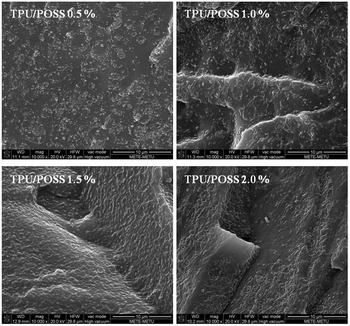
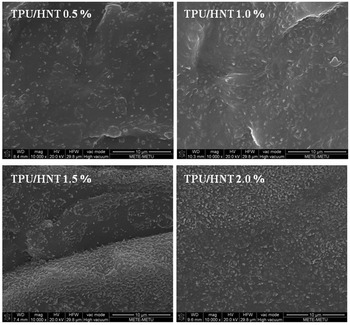
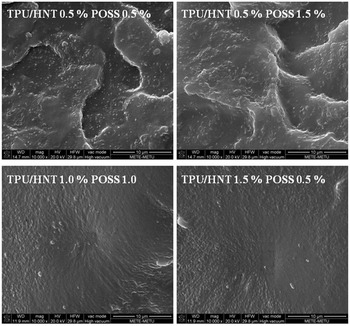
The SEM images of TPU/POSS, TPU/HNT and hybrid composites are shown in Figs 5, 6 and 7, respectively. The POSS nanoparticles were dispersed homogeneously in the TPU phase at the lowest loading ratio (0.5%) (Fig. 5) Further additions of POSS caused the formation of agglomerates. Indeed, agglomerates were identified in micrographs of TPU composites containing 1.5% and 2.0% POSS. These observations are consistent with the mechanical test data discussed above.
SEM images of TPU/POSS composites.

SEM images of TPU/HNT composites.

SEM images of hybrid composites.

The fibrous HNT showed homogeneous dispersion in the TPU matrix for a concentration of 0.5%, similar to POSS nanoparticles (Fig. 6). Nanotubes tend to interact with themselves after that loading level. The formation of bundles was observed in TPU composites containing 1.5% and 2.0% HNT (Fig. 6). The good dispersion of HNT particles for smaller amounts was in accordance with the results described above.
In the case of hybrid composites, the HNT and POSS nanoparticles which seem to be best mixed (Fig. 7) are in the TPU/0.5% POSS 0.5%HNT sample. Homogeneous mixing in the TPU phase was reduced as the concentrations of POSS and HNT increased. The POSS particles tended to form agglomerates and HNT portions remained as bundles in the matrix at high concentrations. These observations are in accordance with the results presented in earlier sections in which favorable performances were achieved at low loading levels of POSS and HNT nano-additives.
The improvement in mechanical performance of TPU following the inclusion of HNT and modified POSS in smaller amounts resulted from the enhanced compatibility between the polymer matrix and surfaces of the additives. Previous work has shown that surface free energies of TPU, aminopropylisobutyl-POSS and HNT are ~40 mJ/m2 (Pötschke et al., Reference Pötschke, Pionteck and Stutz2002; Król & Król, Reference Król and Król2012; Primel et al., Reference Primel, Férec, Ausias, Tirel, Veillé and Grohens2017; Díez-García et al., Reference Díez-García, Keddie, Eceiza and Tercjak2020), 60 mJ/m2 (Turri & Levi, Reference Turri and Levi2005; Misra et al., Reference Misra, Fu and Morgan2007; Song et al., Reference Song, Zhang, Li, Li and Chi2019; Zhang et al., Reference Zhang, Sadollahkhani, Li, Leandri, Gardner and Kloo2019), and 50 mJ/m2 (Hope & Kittrick, Reference Hope and Kittrick1964; Owoseni et al., Reference Owoseni, Zhang, Su, He, McPherson, Bose and John2015; Cheng et al., Reference Cheng, Chang, Liu and Qin2018), respectively. The narrow range of surface-energy values between phases creates strong adhesion of fillers to the TPU matrix. In addition, interfacial adhesion of POSS nanoparticles to the polyurethane chain was extended because of the presence of the aminopropylisobutyl tail. The interaction between the amino group of modified POSS and the hard isocyanate segment of TPU promotes the compatibility of these two phases. The ability to recover the mechanical deformation of the composite material is due to the establishment of the strong adhesion of the additive to the polymer phase. For this reason, the greatest mechanical response was achieved for composites filled with the smallest amount of nano-additives.
Summary and conclusions
In the present study, elastomeric polyurethane was reinforced with POSS and HNT nano-additives, as individual and hybrid forms, by extrusion followed by injection molding processes. The maximum tensile stress strength was obtained for composites containing 0.5% POSS, 0.5% HNT and their hybrid form of 0.5% POSS-0.5% HNT. Further additions of these fillers formed agglomerates of POSS particles in addition to bundle formations of HNT fibres. Tensile-strength reduction was more significant for HNT-filled composites. HNT gave better strength values at the smallest (0.5%) loading ratio. Abrasion resistance of TPU increased after the addition of POSS. A negative effect of HNT was observed for the abrasion performance of composites. Shore hardness of TPU improved with both POSS and HNT inclusions. All composites displayed greater storage modulus values than did unfilled TPU. The addition of POSS yielded remarkable enhancement in terms of the damping behaviour of TPU. Addition of POSS and HNT gave smaller values for T g than those measured for unfilled TPU because of the plasticizing effect of nanoparticles. The addition of HNT increased the MFI value due to its high aspect ratio and tubular structure. By comparison, the POSS nanoparticles contributed to a greater reinforcing effect with respect to HNT. HNT exhibited better results in some cases at lower concentrations because it has a larger aspect ratio than POSS. The adjuvant effect of POSS with HNT inclusions was achieved for hybrid composites in which intermediate values were obtained compared to composites added individually. The smallest filling ratios (0.5%) of POSS and HNT displayed optimum results for hybrid composites. Further additions of these additives resulted in the formation of bundles and agglomerates.